Staying Married Is the Hardest Part: Infidelity, Empathy, and the Glue That Holds Us Together
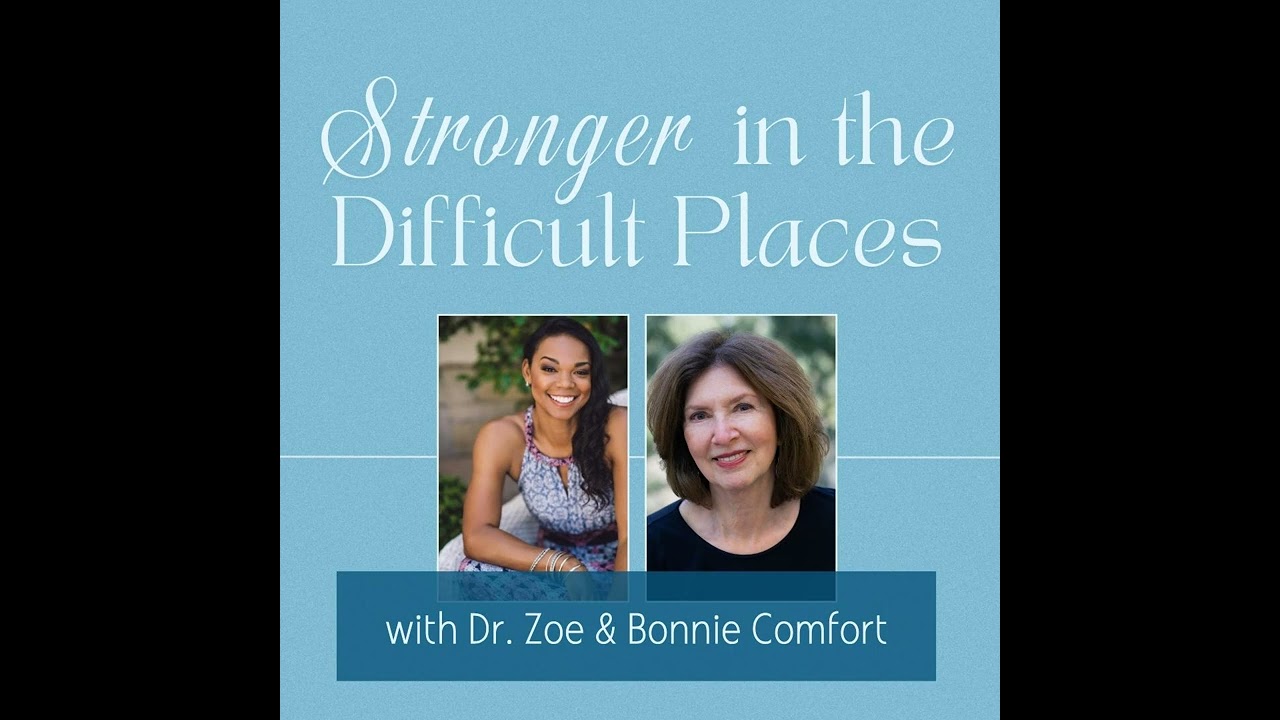
Psychotherapist Bonnie Comfort discusses her 33-year marriage, infidelity, and what actually holds couples together. She argues that disclosing an affair can sometimes cause more harm than good, and that the glue of marriage is empathy, humor, and feeling seen by your partner.
Chapters
This is not a podcast about being broken, although you may have been. This is a podcast about strength for women who find themselves in difficult relationships, including that sometimes difficult one with yourself. We'll look at your relationship through a lens of psychology, faith, and a little dash of my own kind of feminism. We're not fixing them. We're fixing you. And that changes everything. Welcome to Stronger in the Difficult Places. Save yourself, heal your relationships. Listen in. Hello, welcome to Stronger in the Difficult Places. I'm your host, Dr. Zoe, and today we are talking to Bonnie Comfort. Bonnie is the author of a new book that was named a most anticipated book of 2025. Bonnie is also a psychotherapist and she talks about relationships and in her book, Staying Married Is the Hardest Part. She talks about really the real nitty-gritty reality of staying in a long-term marriage. The conversation is really good. And if you're struggling in any way in a long-term marriage, if you're thinking about the difficulties of compatibility, of codependency— I also wanna preempt this conversation with Acknowledgement that some of the things that Bonnie and I talk about are a little bit hard to hear, and maybe they'll cause you to wrestle a little bit. I am someone who believes deeply in not just seeking conversations with people who 100% align with everything that I think. I don't wanna be an echo chamber. In this conversation, we talk about staying in a relationship, going, we talk about infidelity. And I don't bring up faith because faith is not a part of this conversation, but I hope that you listen to this conversation through the lens of whatever faith that you have and that you don't throw the baby away with the bathwater. And the psychologist that I talked about that you will hear, Dr. James Dobson, he was the, in my opinion, first prominent Christian psychologist who founded Focus on the Family. A lot of the tenets that he talked about in relationships and marriage were, in my opinion, truly valuable. So listen in. We wrestle with some really difficult concepts about marriage and relationships, and I think it's a really good conversation. So much so that I'm not even gonna do a win/fail today. I have plenty. We'll talk about 'em next week. Hello, Bonnie. Hi, Zoe. Nice to see you. Thank you. It's so wonderful to meet you. I have to say, I read your book kind of fast, so I want to go back and read it again. Oh, I love that poster you have behind you.
Thank you. That's my book cover. Yeah, I know.
So is, is this your second book?
It is. Thank you.
I am so excited to have you on. I read your book and it is gripping. It is vulnerable. It is Magnetic. And you did something that I feel like a lot of women and especially therapists aren't willing to do. And that was really give us a deep dive into your marriage, um, and everything that you experienced in your marriage, which I think a lot of women will be able to resonate with to some extent. So I'm really excited to talk to you about being in a long-term difficult relationship. And I have a lot of women in my practice. I have a lot of women who listen to the podcast who are struggling in difficult relationships. So welcome.
Thank you so much for inviting me on. I've looked at your other podcasts. I think they're terrific and I feel honored to be here.
Thank you so much. So can you tell us a little bit, how many years were you married? And can you tell us, and obviously you wrote an entire memoir, so you're not going to tell us the whole story. But just a little backdrop of how you got to the place of writing this book.
Um, well, I was married for 33 years and I was really heartbroken at the end of that time to lose my husband to death. And I started writing after it just because I was one, really heartbroken about losing him and needed to kind of process my grief, but also because These difficult issues in my marriage were never really resolved. And I had lingering anger and resentment, and I really needed to say, I had to write it down. I didn't know that I was going to turn it into such a revealing memoir about myself. Yeah. But once I did write it, I thought it was of value for other people to see it and, and to hear a psychologist who was experienced at couples therapy. struggling in her own marriage privately, because most people who go to therapy know very little about their therapist and assume therefore that they've really got it together and that everything is perfect in their life. And so I think it's really normalizing for, you know, people to know, no, your therapist doesn't have it all together. They're just focused entirely on you, giving their best work when they're in a session with you.
Right. In that moment. Yes. And that having difficulties in relationships also doesn't mean that you don't have it all. I don't know what it means to have it all together, whatever that dream or ideal is. Um, but it doesn't mean that you aren't necessarily functioning as healthily as you can as an individual. And me, I, I was in a 28-year marriage. I was together with my ex-husband for 30 years and we had Lots of difficulties, obviously, which is why I chose not to continue the marriage. So it's really intriguing for me to read your story and hear your story for, as someone who chose to stay in the marriage. And you also learned so many lessons that I know that you want to impart on women. Mm-hmm. So can we talk about some of those fundamental lessons that you learned as a result of your your marriage and, and even, you know, I mean, and then there's so much beauty in difficulty and there was a lot of grief obviously in losing him. So many things, but anyway, we'll go back to my question because I just want to talk about it. It's so good. Can you talk about the lessons that you learned?
Yes, I can. And I do want to say that there was powerful glue between me and Bob, my husband, and was that carried us through these very difficult times. But in looking back now, I can see that I contributed to the problems. And I think it's always so easy to point your finger at your partner and say, if you would just change, if you would be different, then we'll be happy together. And we have to own our 50% part of what we are doing that contributes to the problems. And I, in some ways, only learned that after Bob's death, because I realized, for example, That he, um, encouraged me because we were having a long dry spell of sex and I was very frustrated with it and I nagged him about it and carried on and he just said he can't do it. This is how it is. And you should just go out and do it with somebody else and don't tell me about it and don't do it with any of my friends.
Right.
So I did that. I did, and I did it for 5 years, which was a long stretch of time.
And.
I know, and he never knew.
Hmm.
And I, 'cause I was very good at hiding it. But when he asked me, well, so did you fool around? I said yes. And I told him about it. And it didn't occur to me at that time that in telling him, it was profoundly hurtful. Because even though he asked for it, and even though he told me to do it, and at the time I was telling him, he said to me, I won't be mad at you. I told you to do it, so it's okay. But it wasn't okay. He didn't admit it. And so if I'd have, looking back, if I'd have been smart enough to realize that as brazen as he was about sexual things, he, he couldn't really handle it. And I did a very, um, uh, it was a powerful strike against him to tell him about it. And you know, when I see couples and one has an affair, I do say, you know, because people want to tell their partner because they want to come clean and they want to be forgiven. The result is terrible damage to the relationship. And so my opinion is, if you have been unfaithful, the cost you pay for it, you should pay for yourself by keeping it to yourself. That is not going to help your relationship. To confess and ask for forgiveness from the other person.
You know, I'm so glad you said that because there's been such a push to disclose and to, and under the guise of being honest, right? Which makes complete sense in a relationship. Dr. Dobson talked about this years ago. And one of the questions he asked is, is your drive to disclose the infidelity to your partner Selfish because you want to feel better and get it off of your, your chest. Right. But are you hurting your partner in your selfishness? And I never thought about it that way.
Yes.
But it's true. And I know there's, this is controversial and so many people would say, no, you have to tell, but I am more inclined to agree with Dr. Dobson. And I am more inclined to agree with you when it comes to infidelity in certain circumstances. Obviously, if you're continuing on in the infidelity, There are plenty of, there are plenty of, you know, variables that, that could change that. But what you said makes a lot of sense. And I, you know, I remember reading that moment in your book when he kind of haphazardly, brazenly just said that to you and the pain that I read across the pages for you to have your husband say that to you.
Mm-hmm.
And so you experienced your own pain in that. And then you went and, and did the very thing that he told you to do that he didn't really mean. And obviously he was struggling with his own things, but what a beautiful lesson. I'm sorry that you had to learn that lesson. Um, but what a beautiful lesson for you to share. Thank you.
Yeah. Well, I think it is a value and I think, um, I don't know this person, Dr. Dobson, but the idea that you feel guilty about your infidelity is something to pay attention to, but to go and tell your partner because you want your partner to absolve you of the guilt. Makes your partner pay the price for it rather than you paying the price for it. So, yeah, I think, and I agree with you, there are many circumstances where this doesn't apply. I mean, I know people who've had a partner who's lived an entire other lifestyle on the side, supporting somebody else, having a father and other child.
Other children.
Yeah. Yes. Yes. So it doesn't apply, but in this, you know, if it's a You know, if it's a discrete period of time, there's really powerful reasons why at that moment you chose to have an affair and you can understand it and why you were motivated to do it and what you can do to shift the quality of your primary relationship. You don't necessarily have to confess. So, yeah.
Beautiful. Thank you. Thank you so much for sharing that. You, You talk, I think maybe even in the back of the book with regarding like questions that book clubs could ask themselves. But one of the things that I know that you've mentioned about the reason why you wanted to write this book was empowering women and their relationships. Can you talk a little bit more about that?
Well, yes, I, I, I think, um, in spite of all of these decades of the women's movement and empowering women and a lot of progress in Work situations and in having a voice, although, you know, Congress still is a small voice. Um, but we have to, women have to fight the desire to be placating, to put our needs second. And it's easy to do when you have children and, you know, your children matter the most to you. So you do, you know, you sacrifice a lot for them.
Right.
But I think it's important not to sacrifice too much in regard to your partner and to get up your courage to disappoint your partner. And that's, that was a hard lesson for me because I realized if I, if I'm not willing to tolerate his disappointment, I can't really fully do what I want to do with my life and be myself.
You can't be yourself. Yes.
And so it's so. To affirm that, that is the price to pay for really being an equal, demanding equal time, equal power, is to tolerate your partner's disappointment. Because, you know, there are various reasons why you have power imbalances in a marriage over time, and they change over time.
Right.
Be making more money. One might be more self-confident. One might be more needy. There's a lot of different reasons, but it's important Um, to try to claim your own power as a woman in the relationship. And it doesn't mean using meanness or sarcasm or, you know, lack of empathy for your partner, but it does mean in a kind way, refusing to give up too much.
I love that you just said kind because I was, I was listening to somebody and they were talking about women and, and our codependency issues and desire to please. And she said, we should always be kind, but we shouldn't strive to be nice. And I thought that that was so good because, yeah, because, you know, the nice, the definition of nice, I guess, in this context is essentially abandoning ourselves to make somebody else happy. Right. And when you talk about not being afraid to disappoint, I feel like that is probably one of the crucial issues. and codependency, because we create this story about what the disappointment means. If I disappoint him, then he is going to abandon me in some way, maybe a small emotional way, maybe a big way, right? Yeah. And so when we tend to be in these codependent relationships, we're constantly trying to appease and fix the other, but we also have to recognize that it's not from this, you know, wonderful, nice place. It's really from a desire to control. the other person's emotions so that we can feel better.
True.
And so when, when we take that big step of not trying to control their emotions, of allowing them to be disappointed, it's terrifying. But what I have found is that when we do it, number one, the thing that we fear the most often doesn't even happen. And we give ourselves freedom, both in ourselves and our relationships.
And your partners get over it.
They do.
Because you come back and you come back happy.
Yeah. Yeah.
It's interesting you're raising the term codependency. And I think in some ways when we hear that, we think, oh, that's a pejorative term. But I think that there's a healthy range of codependency, which is really to some extent a definition of marriage. You are dependent on each other. Not to define who you are, not to, you know, uh, um, be too appeasing, but recognizing that it is mutual, this, this, um, reliance on each other.
Yeah, I like to call it interdependence. Like interdependence is the healthy, is the healthy, um, spectrum, right, of dependence in a relationship. And how can we strive for interdependence instead of codependence?
Exactly.
So can you talk a little bit about that power and control dynamic in relationships and what you found over the course of your marriage with your husband? Did that change over time as you developed a better sense of self?
Exactly. It did. When I married him, I was so dazzled by him.
And I don't know if we've talked about, I don't know if we've introduced the fact that Who he was. Can you talk just a little bit about that and then we can go there?
So my husband was Bob Comfort. When I met him, I was 32 years old. I was already practicing therapy and I was in school to become a psychologist. And he was in show business. He was a producer. He was a writer at the time. He was doing television. It was comedy television and, um, special television specials. But he was charismatic. He was adorable. He was hilariously funny and he loved holding forth. When he was in the room, everybody wanted to listen to him because it was so worth it.
Yeah.
I felt therefore like I couldn't believe that he wanted me, that he was marrying me. And, and, you know, and then how can you strive and feel equal to somebody when that's what you're thinking in your head? I'm so Fortunate that he married me. So not that, not, not that he may not have felt fortunate to marry me, but there was an imbalance in my own mind about our authority. And also he was making much more money than I was. And I felt, you know, then I went to school full-time and he was supporting me.
Mm-hmm.
So I felt, you know, when somebody makes a lot more money than their partner, there is an imbalance because In our culture, making money is a form of power. And so it requires, you know, democracy in a couple for that not to be the case.
Exactly.
And so there's that, but there are also, as, as time goes by, uh, with a, in a long-term marriage, there are natural shifts in power because of shifts in respect and also life circumstances. So, um, when my husband became, um, ill the first time, I had to stop everything I was doing and I looked after him entirely for a year. And at the end of that year, he said to me, you saved my life. I can't thank you enough. And he, you know, he wanted to give me gifts, but the biggest gift was he had more respect for me. Mm-hmm. And I had more respect for myself because I saw how I had navigated the medical system for him. That was my area of expertise. It was not his.
Right.
He just, you know, became like a little child who I was looking after. And I grew my own self-respect in the process and his for me. So that was an example of how things shifted. And, um, I just, I do think over time, um, and circumstances, there can be good power shifts between people.
How, how did that change you internally when you began to see that power shift and you experienced more of a sense of autonomy and power in the relationship, but also I think in your own self?
It's an interesting question. It's a really interesting question. Um, well, the way it showed up is me being more willing to say no. And when it wasn't right for me and, um, and I became better at it and more, have more authority myself. We did have one horrible argument, um, in which I said to him, and this was about a financial thing, but I said to him, if you don't do what I want, I will never forgive you. It's not something I said lightly.
Yeah,
other time. And he, and I meant it and I was prepared for whatever the fallout was, which is a form of personal authority and, and saying, you know, what you really need and taking a stand. And he sat there in silence for a few minutes and then he said to me, okay.
Hmm.
And it was good for both of us. I think he respected it. It was an important decision and it made a big difference. So I do think I, I got better at just asserting myself more and being able to disappoint him and knowing that it wouldn't be the end of our relationship, that we would come together again, that the love was still there.
Hmm. That's so beautiful. Just hearing how you navigated You know, this 33-year marriage, and I'm thinking about a woman out there who is sitting in a relationship that's difficult and, you know, choosing to stay in the difficult relationship. And I guess I'm just thinking of the concept of compatibility and, you know, the idea that, well, 2 things. Number one, in this day and age, I don't wanna say that people end relationships easily because I don't really believe that at all. Um, but people do choose to, to leave relationships instead of staying sometimes when they get, um, difficult. And so I'm wondering what you can say to a woman out there who's sitting in a relationship that's difficult, that has some struggles, um, about that concept of compatibility and how much does it really matter? And what about the areas where you're not compatible? What could you say to her?
Um, well, first of all, I would say that if you have 70% of your marriage that's pretty good, that's pretty good. You know, the idea that there's a perfect marriage out there is a fallacy. There's just not. Every marriage has ups and downs. It has problems. But if you feel truly that you cannot live with this, then, and the, the incompatibility is too damaging to you and you cannot live with it. Then the question is, are you staying out of fear? Or is it that you really love this person in spite of the incompatibilities and you're willing to work on it? Very different. If it is fear, then it's helpful to really explore that and see what you can do to shift your fear about what the consequences would be.
That's so good. And as you say that, The question that comes up for me is, what are the reasons? What are the good, healthy reasons to stay? Is love a reason to stay?
Well, you know, everybody's definition of love is different, but I do think about glue in a relationship.
I love that word. Let's talk about that.
So I do think one of the most powerful forms of connection that keeps a relationship going in spite of ups and downs Is believing that your partner cares about your internal life, how you're feeling and what you're thinking.
Yeah.
And if both of you can get better about those kinds of conversations where you check in with each other, you read each other accurately, you don't get defensive when your partner is unhappy with something you've done, but more importantly, that you ask for what you need rather than blaming the other person for your—
That's so good.
Disappointment, you know, switching out blame for this is what I need. This is what I'd like. So one of the most powerful blues is I feel seen by this person. I feel known. I feel that in spite of our differences, there's real care there. And I also think sense of humor is so powerful in a marriage. If you can make your partner laugh, if you laugh together, it just Eases the pain. It helps so much. There's a line in my book that says, you know, an orgasm maybe lasts 20 seconds, but a funny line can entertain you all day long because you think about it and it makes you laugh a dozen more times in a day or week.
So years you can laugh about something like that years later. I love, love, love that you talk about that glue. I feel like I want to, I want to research that glue more. I have a couple in my practice. I've been seeing them for 15 years, week in, week out, they show up.
Yes.
And they have a marriage that I think if you just looked at some of the highlights, the bullet points of their marriage, you would say they are not compatible. They should not be together. And yet they are so intentional and, you know, show up every week and they do the work and they have managed to make now a 30-year, I think it's 30-year marriage, um, work and their kids are growing now. And when a lot are actually out of the house now, when a lot of people would look at each other and say, I don't even know who you are anymore. And our marriage has been crap for 30 years. Let's separate. They're in this space of having put in that 15 years of therapy and not every marriage needs to do that. Their marriage needed to do that in order to keep it. Yeah. Um, and there's that, there's that glue. I can't quantify it. I can't fully describe it. I want to one day. Um, but you've, you've put some words to it. And so thank you for that. Thank you for that.
And, and there's, I, I do think people who have been raised in families where the parents stayed together have more faith that problems can be worked out, you know, and that's a better role model for them.
Right.
And I also think that your couple is an example of commitment. They're committed to the relationship, even if it's really lousy, up and down. There is something that, that matters so much to them about staying together that they're willing to do that work. I have another, I have a couple myself who I've seen for probably 15 years, same thing. And there are many times when I thought, why do these people stay together? Me too. But they do. And I can remember a session I had with them where they were fighting in my office. And about an hour later, you know, they left about an hour later, I left and I happened to drive out of my office parking lot. They were crossing the street and they were holding hands. And I was so touched to see this after all those things said in the office, they were holding hands and there was that connection.
So. Yeah, it's beautiful. And I'm so proud of this couple because I feel like the 3 of us have worked Yeah. For the past 15 years to, to keep this marriage going. And it's, it's beautiful. It's absolutely beautiful. But I also want to speak to that woman because the reality is, is that it takes 2 people. It takes that glue cannot exist with only one person giving everything and the other person not. And I know that there are women who are out there in relationships and their partner is not willing to, you know, do those intentional things to work on the marriage for 15 years, year in and year out or weekend. week out. Um, and so I just want to honor that and speak to her that, because sometimes that can create some shame, right? That why, why can't I make this thing work? And why isn't, you know, my marriage, um, able to sustain in that way? And the reality is, is that you can only do what you can do, right?
That's, you can, yes, you can do your half. You can do your half and a half can go a long way.
Can. Yeah.
And I think that this couple you've had, you know, it, You have created an environment for them in which they can recover from maybe insults I've given or blame by showing kindness to each other, by showing empathy. And to me, empathy is the magic bullet in a marriage that can fix what's wrong. If you can really put yourself in your partner's shoes, if you can imagine your partner at the age of 7 or 8. traumatized or wounded in the ways that that person has been carrying it forward, thinking that's the way that it has to be in life. And then there's a way to ask for what you want without anger and blame that pushes the other person away. And I think men have a very hard time going to couples therapy because they're expecting that the wife has a list a mile long of things that are wrong with him.
Yeah.
And he's got to fix this. And he's bringing somebody else in to fix him too. And I think in you, you must be a talented therapist because for you to support both people and to interrupt that blame and say, let's think about what your partner really feels like is a building block of a long-term good relationship.
That's so good because I do feel like much of what I do is try to help the other develop more empathy. For the other, right. Which is hard to do when you're feeling, you know, blamed and defensive. It's really hard to develop that empathy, but yes. Wow. Oh my goodness, Bonnie, this has been a wonderful, wonderful conversation and I'm thankful for your wisdom. And I thank you for writing this book. So can you tell us how people can find your book, how they can find you?
Absolutely. It is available. online at all of the websites, Amazon, Barnes& Noble, Simon& Schuster, Target even. Um, but it is, uh, um, if you want to find me and find more out about the book itself, you can go to my website, which is easy. It's bonniecomfort.com. And I'm also available on Instagram and Facebook as Bonnie Comfort Author. So you can find me on those websites and I would love people to read it. I think, um, I would be very touched to know that they have and communicate with me about it. And thank you so much for reading it yourself. And this has been a wonderful interview and I think you're a terrific therapist.
Well, thank you. Thank you so much. I think the same of you. And yes, I do have this advanced copy, which I'm thankful for. And I suggest that people People get it and read it.
Thank you. That is the name of it. Staying Hard is— Staying Married Is the Hardest
Part. I love— that's what intrigued me the most about the title. I'm like, what an amazing title.
Thank you so much, Zoe.
Thank you, Bonnie. Thank you for listening to Stronger in the Difficult Places. New episodes go up on Tuesdays. Subscribe to my email list so that you can get some encouragement from me. And have a strong week. See you next week.
More from Dr.



The Epidemic of Not Enoughness: How It Shapes Your Relationships—and How to Break Free


You Can’t Change This (And Neither Can They): The Truth About Temperament in Relationships

What Do I Do When Overwhelming Shame Is Keeping Me From Seeking The Help I Truly Need?


