Strategies For Conquering Self Doubt with Suzy Carroll
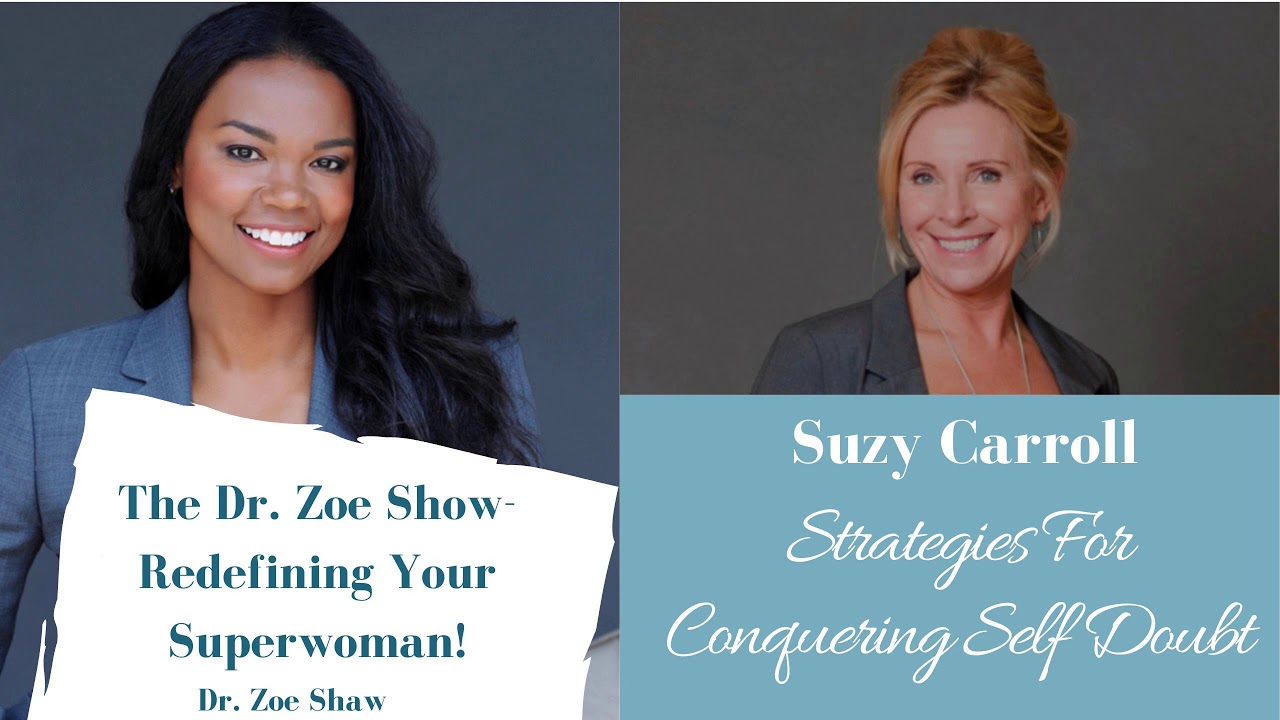
Suzy Carroll, a success mentor, talks about breaking free from busyness addiction rooted in childhood trauma and perfectionism. She shares a four-step clarity framework: Reveal hidden patterns, Release beliefs that aren't yours, Respond Differently using mantras like "How can I see this differently?", and Reorient your brain. A practical tool: name your self-doubt (like "Dory") and ask three questions to separate your feelings from others' and from exhaustion.
Chapters
Welcome. I'm your host, Dr. Zoe. Today's topic is strategies to overcome self-doubt, and my guest is Susie Carroll. She is a soul-aligned success mentor. I love that name. And she specializes in cultivating, helping women cultivate a level of well-being that fosters clarity and soul-aligned success by overcoming self-doubt, anxiousness, and overwhelm. How great is that? So I'm excited to have her here today. Before we get started, my Superwoman win and Superwoman fail. So my win, if you remember last week and if you've listened to my episode from the last episode, I shared a very personal story. And I also, I think my win from that episode was that I didn't have a vulnerability hangover. Well, I think after I did that episode, my brain was like, oh, we can take care of that for you. We will cook one up. So there was There was a little part of me that was like, ah, I knew this episode was going to go out last Tuesday, and I definitely had a feeling of, I can just not, just delete that. But I didn't, obviously. I released it, and that is definitely a win for me. And I was also tempted to go look at the stats to see how many people are listening, and— but I didn't do that either, because the last thing I'm going to do is speak my truth and then follow it around to see what happens to it. Nope. Instead, I put it out into the world and now it's God's problem to do with it as he will. So my win is that I released the episode. My fail is that— my fail actually points back to some of my traditional fails. My daughter has started back to school, so she's been in school for 2 weeks now, I think 2 weeks, 3 weeks, and we have been navigating having her in school, other ones at home, that whole deal, and the pickup drop-off time. She's at a new high school and the whole deal is a little crazy. It's like they have regular day on Monday, you know, Tuesdays, uh, early drop-off, Wednesdays pupil-free, you know, the next day it's like the times just vary. Every single day it seems like there's a different time to pick her up. So you can already guess what happened. It was Friday, she was supposed to be picked up at 1 o'clock instead of 2:40 when we usually pick her up, and I Failed to communicate that to my husband. He thought he was picking her up at 2:40, and so I get a call from the teacher. Well, I got multiple calls. I didn't recognize her number because I don't have her name in my phone, which I've since fixed, but then I got a text. We got out at 1:00. It's now, you know, 40 minutes later. Sullivan's in the office. So I called the teacher immediately and blamed it on miscommunication between my husband and I, which really it was just my fault. And I'm sure when he went and picked her up, he threw me under the bus, which is fine because he should have. It was my fault. I told him the wrong time. So there's my fail, and I was quite embarrassed because I like to be seen a certain way. And Sullivan was fine with it though. She hung out with the teacher, got to know her a little bit more. So that's my fail. It happens. I am now making sure that I have alarms on my calendar and I know which day is which. So let's get on to the topic, strategies to overcome self-doubt. Hi there, I'm Dr. Zoe. I'm glad you're here. This is the place for developing your strength as a woman and helping you navigate difficult relationships in your life, including that sometimes difficult relationship with yourself. Being a strong woman is not about what other people can see, and it's not about how loud you are about it. It's a quiet knowing. This isn't therapy, but you may feel like you've been to therapy after one of my episodes. Here, We also explore the intersection of psychology and faith, all with the purpose of creating a new kind of strong. Welcome to Redefining Your Superwoman. So welcome, Susie. I'm so glad that you are here today to speak to my listeners. We are going to be talking and hearing a little bit about your story where you've come from intense overwhelm and busyness to a place of clarity. And I'm interjecting calm. And really, we're going to talk a little bit about finding that clarity when you have self-doubt. So thank you. Oh,
you're welcome. I'm excited to have a conversation with you.
So before we get started, of course, you have to share your Superwoman win and your Superwoman fail with my audience.
Well, you know, I was thinking about this, the win and the fail, and they can be— I think women, because we always have that bar set so high, it has to be a massive win. Or maybe a massive fail. So I'll share, I guess, a little win, something I felt really good about that happened last week, and it was with a client. And I work with women who are in leadership or entrepreneurs, and this young lady was going through my program, and she got so darn clear that she did not want to own a business.
Wow.
Yeah.
So she went from, I wanna be an entrepreneur, and she worked through your program, and now she's figured out that that is actually not her path.
Absolutely.
What a gift. to figure that out at the beginning.
Right. And then she was offered her dream job. She's trained as a professional baker, and she was hired as a lead baker. And she is so extraordinarily happy. So that was a win. And my little epic fail, which was— I live in a small town, so this is kind of funny. I was so excited to vote this year that I got my ballot all done, and I drove to the courthouse, and I dropped it off. And then that afternoon, I was reading an article in The New York Times about all the different ways that ballots are rejected. And I went into self-doubt about whether or not I had signed my ballot.
Oh.
Well, it turns out I got on into the election website. Well, it turned out I had not signed my ballot. And I thought this part was hilarious. I had no less than a dozen people in the town I live in send me an email to say that my ballot had been rejected.
What?
So I went down to sign the affidavit and got it all straightened out. But I was like, oh my God, talk about a public epic fail. And I saw some people in our town in the Facebook feed saying, how did people forget to sign their ballot?
Okay, that sounds like something I would definitely do. And actually, I'm glad you said that because I haven't voted yet. And so now I know I need to sign it.
Remember to sign it. Yes.
Okay. Yay. Well, I'm actually going in, so— because I know you can print it up, right? And then sign it and turn it in?
Yes, you can. And we have an actual drop box. So instead of putting it in the mailbox like we have over the years that everyone in our town is just driving to the courthouse and sticking it in the drop box.
Oh, that's nice. We actually have an actual polling place open right near me, which is probably why I'm procrastinating, because it's right there. It's been open for days and I'm like, I can go anytime.
Well, I heard the lines can be really long, especially if you live in a bigger town. So go with patience.
Right. I will bring a book or something. Well, thank you for sharing that fail. And yeah, definitely sounds like something that I would do. And we just Give ourselves grace for that, right? And ignore the judgment. Okay, so let's dive in. Can you just give me a little bit of a reference for how you got to this place where now you are mentoring women and helping them find clarity and get over self-doubt? How did you get to this place?
Sure. Well, I was a really extreme case of self-doubt. I was raised by— my mother was a narcissist. So, you know, my—
That will definitely create that.
Yeah, exactly. So my upbringing was one of you're not enough, you can't do anything good enough. And I actually attempted suicide when I was 19 or 20. So this is ingrained pretty deep with me. But what I realized, or the belief that I developed, was if you are— excuse me, if I am Always working really hard and moving really fast and taking care of everybody and volunteering everywhere and doing everything that a good woman should, I'll be accepted and loved and appreciated. So those are what I call my unmet needs. So how I unwound from that was—
I'm going to stop you right there because I think that's so important that you just shared that. You were able to figure out where your drive came from, and I would encourage women who are in that place of distracted, constant busyness to not rationalize why you're there, but really get in a place where you're questioning and understanding for yourself, what does my business do for me? What need is it fulfilling? Or what thing is it distracting me from? Or what's the, the message or the story that I have for myself That fuels this busyness. So thank you. I'm glad that you said that. Yeah.
And thank you for pausing me because it has been essential to my healing from self-doubt and busyness is that ability to stop and ask myself the question. If I'm thinking about doing something or asked to do something, I ask, what, what is the need that this is filling?
Yes.
Yeah. Am I, am I, am I doing it because I'm going to get appreciation or am I doing it because it's filling my soul? So 2 different things.
So in your case, it was, I need to be good enough. And if I keep doing these things, somehow I'm going to make that happen.
Yeah. So I was always striving to be enough. I was very fortunate that, um, I have some extraordinary women in my life and I had a mentor come into my life. I feel like these are one of those universal synchronistic divine events. And she became a good friend of mine. She's trained as a psychotherapist and a master coach and an accomplished author. And she said to me one day, she said, Susie, you are addicted to busyness. She recognized that in me because she had been as well. And I said, what? I mean, look at me. I'm moving, I'm shaking, I'm multitasking like none other. I've increased— this is when I owned my wellness Center, nutrition store, increased sales by 200%. I'm absolutely killing it. Well, I'm killing myself.
Right.
We sat down and we called it the Susie Busyness Detox Plan. And she asked me to write down everything I felt responsible for that I needed to take care of and get done. And I filled up a legal pad, single-spaced, 2 sides.
I'm sure you did.
Yeah. And then she said, narrow it down to 6. That was really hard, but I did that. So, you know, unwinding from busyness, where I started was taking simple steps. So one of the most simple things I did, it was, this is part of retraining yourself or retraining your brain or laying down some new, more healthy neural pathways, is I embraced something called transition time. So when I was done with my workday and I came home, now I work out of my home, but then I didn't, I'd come home through the door to my house. Right. What I used to do is I come home and I just, you know, I never stopped running and I start organizing things. Instead, I took a 10-minute pause.
Mm-hmm.
Transitioning from my workday to home, doing nothing, staring out the window, maybe reading a few pages in a book. And then I built on that. So even during my workday, and to this day I still do this, when I'm done talking with you today, I'll pause for a while. I'm not going to jump right into the next thing. It's breathing room.
Our brain needs that. You know, I speak to so many women who are in that busy place. And as you were talking, I can totally relate to everything you said because I definitely have had— I struggle, I should say, with my busyness addiction. I don't know if there's an anonymous for that, a BA for that. But yeah, and so I can relate to that. And what I speak to a lot of women about is that When we don't take that time and that space, we are neglecting our mind and our brain. And often what we have is sleep issues because our brain finally gets so thankful that we have quieted for a minute that it's going to take up all of its time processing, you know, when we're sleeping or trying to sleep or, you know, sometime during our sleep pattern and it affects our sleep. Of course, it affects so many other things. But when we just give our brain the space that it needs, Like you said, 10 seconds, 5 minutes, just, you know, something very small. It gives it the space that it needs to process and breathe and think. And guess what? I'm sure what you're going to talk about is find some clarity. I'm glad that, that, uh, that you interjected that. Okay.
You know, I, it's funny how often, and I'm sure you've had this happen, where you wake up in the middle of the night with a brilliant idea or suddenly you've got to solve a problem. Well, it's because you created space. So Let's create the space during the day so we can actually sleep at night.
Yes. Have you read the book Deep Work?
No, I haven't.
Well, some of the things that you're starting to talk about, I think, relate really well to that book. And I'm not remembering the author. Maybe I'll look it up in a second and say it before. But he talks about how we spend most of our time in shallow work, just shallow, distracted busyness, right? And the importance of having that space because that's the only place that deep work is produced. And he's actually done a lot of research and also put together a lot of research that's already been done that shows that you are more productive, because we trick ourselves, right, into thinking that we're being so productive with all of our busyness, but it's actually people who are able to cultivate that quiet space that tend to be more productive in their life.
Oh, that's so true. I'm writing a note. We'll circle back to this, but I'd love to talk about unhealthy busy versus healthy busy. Ooh,
I wanna hear that, yes.
And as you well know, when you have an addiction to busyness, it is an addiction. So my addiction to busyness was how I numbed out from what I didn't wanna feel from my childhood wounds. So yeah, so when I started incorporating this transition time, I began to feel my feelings.
How was that for you?
At times, it was very difficult, and I didn't do this on my own. I got, you know, I got therapy And help. And as I mentioned, I have this extraordinary group of women in my life. So I had somebody— I had women I could process what I was learning with. So in regards to clarity, the first step of clarity is revealing what is hidden and raising awareness around what is forming the blocks to desired outcomes.
Mm-hmm.
The second step is releasing. So you're feel, and then you're releasing what isn't you or yours. And for women, so much of what drives us comes from our social conditioning, whether it's from childhood or even, you know, hundreds of years of social conditioning of how women are supposed to be. And once this has been revealed, it becomes much easier to release and take back the reins of your life. And then, and this is what happened with me, you begin to respond differently. In fact, I had I had a theme for an entire year and it was, how can I see this differently?
Oh, I like that.
Yeah, it comes from the Course in Miracles. Above all else, let me see this differently. And I embraced that phrase and I said that all day long. Every time I felt stressed, angst, frustration, I would— I was able to, over time, very quickly actually, tune in and I would just pause and say, how can I see this differently?
I like that. You know what's also helped me in that, that kind of pause, especially what you were saying, is that a lot of the things that we women do and think are because of our socialization, right? What we've been taught. I've had to ask myself that question, and I do that regularly. Why do I believe this? Because sometimes I will do things because I think we should, or why do I feel like I should? Is this something that I really, you know, have thought about? And I believe it's something that's important, or is this just a part of my conditioning?
Yes.
And all of a sudden it's like, oh, why do I believe it? And so my rule for myself is I need to have a reason, right? It's not just like, I believe this, or I think this is important, or I should be doing this. I need to also ask that— answer the question of why, because then I come to a place of really being, you know, walking out or walking my practice from a place of authenticity, not just because I learned that when I was in kindergarten that that's what a girl does, That's what I should be doing, or that's how I should be thinking.
Exactly. It's a statement I use is, what proof do I have to validate this belief I have?
Love that. Yes.
Yeah. Where's the proof? So, you know, as you begin to respond differently and your awareness expands, you, you have a heightened level of discernment, which then leads to thoughtful action instead of reaction.
Yes.
And then that sets the stage for the 4th step in calling and clarity is reorienting. So it's a, it's, and you know, this doesn't happen overnight, but it's, and this is where you're starting to rewire your brain, develop new mindsets, let go of beliefs that aren't yours, the ones that came from inherited socialization. And you start to step into living in a new and healthier way. And that's, that's pretty much how it went for me. I went through a revealing process, a releasing process, a responding differently process, and reorienting.
So that sounds so simple and tied up with a bow.
How long did that take you? Yeah, now let's talk about the layers.
Right. So how long did that process take you?
You know, I would say 6, 7 years, to be honest.
Okay.
Yeah. I had not, you know, I didn't have these written out in front of me then. I was just trying to find my own way. So there was a lot of missteps and reset. What is that? The cha-cha, 2 steps forwards, 1 step backwards. Right.
Yes.
I did the cha-cha for 7 years. So what I—
And that is exactly, Susie, why I have this podcast, because you did that for 6 years. And I'll talk to another woman who did something for 10 years. And I can tell you, I've had a 20-year journey. And my, my biggest hope for women is that they can use our stories, they can take the information we have and fast-track it, because it shouldn't take a woman 6 years or 10 years or 20 years, right, to gain some clarity or to figure out who and what she is in this world. There's that statement about wisdom that there's, there's, I guess there's 2 ways. I can't think of the statement exactly. But wisdom is gained in 2 ways, right? Learning from your own experiences, Or being able to learn from others. And I think, you know, the fastest tracker to wisdom is being able to be a good observer and learn from other people's mistakes. And so, so that's why I have this podcast. So I'm glad that you shared that this was a 6-year process. And I also want to share for the women out there, it doesn't have to be.
No, it does not have to be. So I came to this process through the School of Hard Knocks.
Mm-hmm.
And because self-doubt and not enough was so prevalent, prevalent in my life, it was very hard for me to reach out and ask for help.
Yeah.
So I began fast-tracking when I finally went into therapy in my 50s. I'm 50— how old am I? 57 now.
Mm-hmm.
I am definitely a late bloomer.
I think late bloomers are the best.
Yes. Yeah.
Well, you know, it's funny. I always wanted to be a writer, but I realized I didn't have anything to say until I was 40.
Ah, isn't that the truth? Yes.
Yeah. It's the truth. The reality is you do have to do a little living first to be able to have something to offer to somebody else. So thank you for that. So for that woman that's out there who's in this place of self-doubt, who maybe, you know, doesn't know what her next path is, what her purpose is, is really trying to figure some things out. Can we take her through that first step? Because, you know, hearing all the steps, it's like, okay, but, but how do I, how do I take that first step? How do I do that?
You know, I've always felt that questions are the pathway to our soul. So one of the first things a woman could start asking herself, and I think what is beautiful that's happening right now in our time with internet and social media is there's a lot more communication about self-doubt. We're actually speaking up and saying, yeah, this is a problem. We're used to sweep it under the rug. So if you're feeling in self-doubt— and I also want to say, it's not that I never feel self-doubt. I do. And so when I do, I'll just ask a question. What is this and where is this coming from? And then I sit with it, and it's not that I'm gonna get that answer in that moment. I call that just living in the question. Just ask the question, why, why am I feeling self-doubt? Where is this coming from? A funny thing I did kind of way back in the beginning was I named my core issues. So self-doubt was Dory.
You named them, meaning you gave them a name. Okay, awesome.
And I said, Dory, why are you here again? And it was actually really helpful because instead of embodying the feeling, I could—
You externalized it.
Yeah, I could externalize it and have a conversation back and forth and say, okay, I get it, you can go now.
Hmm, I love the you can go now part. I heard what you have to say and now you can go.
Yeah, and it, you know, part of it's protection. You know, Dory was trained to protect me and those sorts of things. So yeah, I think one of the most The most powerful places to start with is asking yourself questions without judgment. It's finding which pearls within yourself you want to polish without judging them.
So let's give a woman maybe 3 questions she needs to start by asking herself. What was the first one that you said?
What is this and where is it coming from?
Okay. What is this and where is it coming from?
Another question you could ask is, is this mine or is this from somebody else?
Excellent. Yes.
Right. What would be another good one for self-doubt? You know, let's see, I'm not quite sure how to form this into a question, but I know for me, when I'm— when I do fall into self-doubt, I stop and check in with my mental and emotional and even physical landscape in that moment. 9 times out of 10, when self-doubt really starts to dig its talons in, now it's when I'm tired.
Mm-hmm.
Or exhausted. So that's the other thing I can— I would maybe ask is, is this real or is this just creeping in because my defenses are down, I'm exhausted, and I just need to step away and rest for a while or not do this right now?
Right. Yes. Am I coming from a place of rest? I love that. You know, I think another good thing to remind yourself of, because when it comes to self-doubt, A lot of us are in this place of there's one right or wrong path, there's one right or wrong decision, and I don't want to make the wrong one. And then that's so much pressure, right? And so then we get paralyzed by that fear.
Mm-hmm.
But if we instead allow ourselves to open that idea up that there are better paths and there are not so great ones and We can and should trust ourselves that whichever path we choose, we can then figure out how to make it work for our life. And then it's not this big burden that I have to pick the right one, because reality is you're gonna pick the best one that you can, and then you can trust yourself knowing that you can make it work.
And you know, the other part is that we get to play. Who said we don't get to play? So my view of life at this point is it's all a grand experiment. My end goal is to have liberated myself from emotional encumbrances.
Hmm, okay.
That to me is real and true freedom.
To limit— to say that again? To—
Liberate myself from the emotional encumbrances that hold me back from really shining who I am.
And I think for me, I hear that and I think that's the first step. Like, when you get to that place, then you can walk out your purpose.
Yes, exactly.
Or then you can get to the place where you can fulfill your purpose because, you know, that's part of the journey is to do that. When we can let those, you know, limiting things go, then we are open to actually be and do what we are put on this earth to do.
Yeah. And then, you know, another piece I want to add to that when— because your listeners are largely women in leadership and business is you don't need to I have to have this all figured out in order to take the next step forwards. But business is like entering into psychotherapy all by itself. So that's my perception, and a lot of the women I speak with, it's the same. It brings up everything that needs to be healed.
That is so true.
Isn't that the truth? It's a bit
of— That is so true.
Yeah.
It's all very, very personal. Now, reality is that the majority of my women are not businesswomen, or I should say they are not entrepreneurs. But I'm sure there are a number of them that are, but you're right. Whenever you endeavor to do something that you create, it does really feel like a psychotherapy process because it's personal and it's not just the action or behavior or the business or, or whatever it is. It's all very much attached to you and what you find out, and this happens in relationships too, what you find out is that you kind of bring all of your stuff. Mm-hmm. You, and then you've got to figure out which stuff that you have, you know, I don't like that word baggage so much, but what is healthy, what is functional, and what do you need to let go?
Yeah, and the question I like to ask myself too is, what filter am I seeing things through right now?
So important. Yeah, so important.
I'm looking through the filter of self-doubt. I'm seeing somebody who isn't good enough. I'm seeing, I'm comparing myself to others. So Really important when you are feeling stuck or stopped or taken down by emotion is to ask you, what filter do I have up right now?
Right. So there was something in the beginning that you said you were gonna come back to. I'm trying to remember what it was.
Oh, right, yeah, unhealthy versus healthy busy.
Oh yeah, okay.
Yeah, it was something you said. So I want to say that every, you know, Everybody knows this. We're all different and we're all unique. So your level of energy is different than my level of energy. I have clients that can juggle a lot and they're fine and that actually feeds them. I'm not that way. I'm not a really high-energy person. So one of the things for coming to, in right relation with self-doubt, so to speak, is really knowing who you are. So unhealthy busy versus healthy busy is this. When you are in unhealthy busy, you are scurrying You're multitasking, you're unfocused, and you're usually exhausted. Healthy busy is intentional.
Oh, I love that. I love that. Now, I am a multitasker. I kind of feel like that's a confession, but I completely, completely get that. And I love what you just said, which I think is so very important, is that we all have different capacities. So if someone were to live my life, they might be like, that's crazy.
How
can you do that? I couldn't survive. I'd be so unhappy. Whereas I know that, I mean, part of probably, I guess, the difficulty of struggling with a busyness addiction is that there is a tendency for me to thrive on a lot, you know. Mm-hmm. And so I have to ride that line between, like you said, healthy busyness And unhealthy business, and it's going to look different for everyone. And so I really encourage you women to take that framework and look at your life, not compare yourself to another woman and how much she's doing or how little she's doing, not compare yourself to, you know, this idea, but really look at your life and how you feel and if those things are being manifested in your life. So is your business healthy or unhealthy?
Exactly. I look at life, or use this analogy of the salad bar. That you have in front of you this big, beautiful salad bar and you get to pick from it. And this is part of the grand experiment. You try this and you try that and this doesn't work and that does, does work. And over time, you fine-tune it down to the perfect ingredients for you.
Right.
Yeah,
they are unique. And that's why we've got to stay in our own lane.
That's one of my favorite phrases.
That's so true.
I'm also recovering codependent.
Oh, okay. Yes.
You know, I always say, you know, women, we are innately nourishers, givers, and pleasers. And those are all beautiful traits, but they're also the traits that trip us up.
True. Yep. It's that flip side of the coin. Yeah.
We forget to nourish and please and give to ourselves.
So thank you so much for coming on and sharing with my audience a little bit about clarity and and self-doubt. For, you know, you listening, I just encourage you, if you are feeling that, if you are feeling like you can't find clarity in your life, if you're feeling, you know, extensive or even just a little bit of self-doubt, I just want to encourage you that you can figure it out. You have all the tools actually. And, you know, sometimes it's being reminded of the tools, but they are right there. You just have to take the time And you have to be willing to get uncomfortable and sit with the uncomfortableness and take some steps that, you know, might be a little bit scary, but you do have the tools that you need to find the clarity.
Exactly. I love to say that there's no stopping a woman powered by a well-nourished soul. And what our world needs now more than ever is women with well-nourished souls.
Yes, women who are willing to care for themselves. Yes, yes, nourish themselves so that you can have that opening and that freedom. Well, thank you, Susie. Can you just share with my listeners just a little bit about what you do, some programs that you have, and how they can connect with you?
I work— I do one-on-one mentoring. That's my superpower, is working one-on-one. And I have a program called Calling in Clarity that actually touches on everything we just talked about. I also have— I just launched it— I have a Patreon, Susie Carroll Patreon, and it's called Monday Morning Messages, and they're just little messages that— they're largely questions, questions and thoughts and practices to integrate to provide a focal point in this whirlwind that we're living in right now.
Excellent. Thank you so much.
Oh, thank you.
Oh wait, I didn't hear about how we get a hold of you.
Oh yeah, susie@susiecarroll.com.
Yes, you're very easy to
find.
Okay, thanks, Susie. You have a great day.
You too. Thank you, Zoe.
Thank you for listening to the Dr. Zoe Show, Redefining Your Superwoman. New shows go up every Tuesday. Subscribe so you don't miss an episode and text the word strong to 38470 to get my weekly encouragement. I look forward to connecting with you amazing women on social media throughout the week. Have a super week! Bye!
More from Dr.



The Epidemic of Not Enoughness: How It Shapes Your Relationships—and How to Break Free


You Can’t Change This (And Neither Can They): The Truth About Temperament in Relationships

What Do I Do When Overwhelming Shame Is Keeping Me From Seeking The Help I Truly Need?


