Taking The Space to Breathe with Shonda Moralis
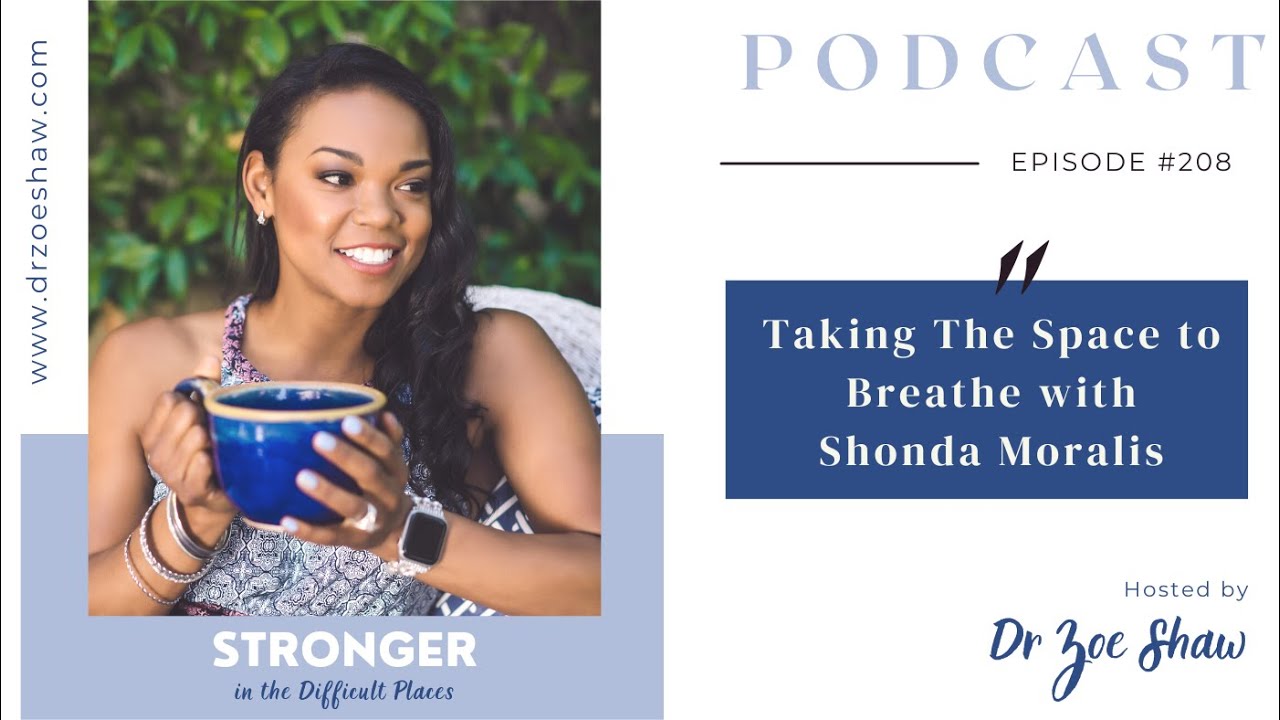
Psychotherapist Shonda Morales shares 5-minute mindfulness practices for busy women, from coffee-break awareness to the 3-breath hug. Eight weeks of daily meditation increases gray-matter volume and preserves telomere length. Her books are Breathe, Mama, Breathe and Don't Forget to Breathe.
Chapters
Shonda, welcome to Stronger in the Difficult Places. I'm so glad you're here today.
It's great to be with you, Zoe.
Thank you. So I'm excited to talk about taking a breath because I know myself included, you know, we women sometimes have a hard time doing that. We have a hard time just being still. There's so much to do. There's always so much to do. We feel selfish. We feel like there's no time for it. So I'm excited to take a minute And talk about that. Can you, can you share with my listeners a little bit about your journey and how you got to writing about this?
Sure. Yeah. So to back up, I'm a psychotherapist by training, as you are. And I've been in private practice probably for about over 25 years. And so probably I'm gonna say, well, my— I have 2 kids. My kids are 20 and 10. And so when my daughter, who's a 20-year-old, was around 3, I came across mindfulness as part of reading that I was doing for therapy. And I was intrigued by this idea. I had been doing some yoga, but I really didn't know like what exactly is mindfulness and how would I incorporate this into therapy? So in order to find out more, I enrolled in my local hospital's 8-week mindfulness-based stress reduction program. And this is a program that's been around for 35, 40 years now. It's international, well-researched. And part of the homework is to meditate for half an hour every day. So kind of like you were alluding to, I am a Type A recovering perfectionist. And so I was like, I have to do my homework. So I did. So I meditated faithfully half an hour every day. And after just a few weeks, I was like really amazed at how the idea of stopping and getting still actually made me more efficient, more productive.
Mm-hmm.
I was more patient with my daughter. I was just happier. And I, and I felt like time actually slowed down a little bit, my perception of time. And this is, you know, this all comes out in the research later. So I was hooked right away. And I continued to meditate faithfully, half an hour every day, went through teacher training and ended up teaching in that program at the hospital for a number of years and incorporated mindfulness in my practice with therapy and coaching. And fast forward to the time when I'm about to give birth to my son and my daughter's about to turn 10. And I know there's no way I'm going to be meditating for half an hour every day with a newborn. And so I was like, well, how do I keep this in my life in a way that is practical, you know, that I can do this? And so this is how 5-minute mindfulness, the mindful breaks that we'll talk more about, that's how they came to be because I was feeling like I need to keep this in my life in a way that is flexible and practical. I don't have time to go close my eyes for half an hour and meditate every day. So I started teaching it also to a lot of women and moms that I was working with and found that they too really noticed powerful benefits with just a few minutes a day. And so I continued. And so I ended up writing Breathe, Mama, Breathe: 5-Minute Mindfulness for Busy Moms. And that's my first book. And then come the time when my son is going into preschool, elementary school, I have a little bit more time on my hands. And I'm like, okay, what's next? And, and I started coming back to my roots, I would say, of where in my early 20s, I was very much into women's empowerment and feminism and how do we lift up women's voices. And I, and I started interviewing other women and started learning, reading and researching about confidence and assertiveness and, and goal setting and all of these ideas and brought them together. And that became my second book, which is now Don't Forget to Breathe: 5-Minute Mindfulness for Busy Women. So these are evidence-based backed mindful breaks. And the whole purpose behind this is, is life balance. And we'll talk, I'm sure, more about life balance. But to me, that's what I am on a mission to help women create. And it's very practical and doable. And again, I don't want to add anything else to our to-do lists because I think we have plenty. This is about how do we just kind of wake up for our lives and become more intentional and see life balance as something that we can recalibrate And it can be fun and playful and experimental.
Wow. Thank you for sharing, for sharing your journey. You know, as you talk about meditation, I meditate, but I know when I work with my clients, that word just feels kind of just maybe overwhelming, or it just feels like a lot. And a lot of women say, I don't know how to do it. I tried it, I fell asleep, it doesn't work. So I love the idea of breath. You know, take a breath. Can you, can you give just like a quick definition of what that means? Like taking a breath compared to meditation?
Right. So I love that you bring this up because they do get confused and often used interchangeably. So mindfulness, to kind of back up, very simply is paying attention to what's happening in the moment with an attitude of kindness and curiosity. And that's the part that often gets missed because we know it's sort of being in the moment. But as best we can, we're being nonjudgmental. Or we're noticing when we're judging and trying to be kind to ourselves and, and what's going on in our minds. So, and the opposite of mindfulness is auto— when we're on autopilot, we're in our minds in the future, we're worrying, what-if-ing, or we're in the past rehashing a conversation or a memory. And so mindfulness comes back into the present moment. Meditation is carving out time in our day to practice the skill of mindfulness, and it is a skill that needs to be practiced, and it can be very simple, but Really, we choose a point of focus, whether it's the breath or sounds, and we allow ourselves to notice that. And then what we notice very soon is that our attention drifts off many places, many times. It will absolutely do that always. It will not stop. I mean, it will, it will, it may slow down a little bit, but you will never sit down for 5 minutes and not have a thought. Like, good luck. I don't know, you're, you're a machine or something. So—
But I want to stop there. That's the biggest misconception. Yeah, that our listener hears that. So when your mind drifts, you're not doing it wrong.
That's right.
Right.
It's waking up when you notice, oh, look where I was. I was thinking about what I need to get at the grocery store today. That is a great moment of mindfulness. You just woke up to notice where you are. It's all about awareness. And then the other piece, like I mentioned, is this nonjudgmental approach as best we can. So it's just being curious. It's like, ah, look where I was, rather than like, what's wrong with you? You know, because what we do is we say, oh, I'm judging, but then we judge ourselves for judging. Why do you judge? yourself so much. So we're off and running. So when you have this sense of almost amusement with how incredibly busy our minds are, and like, whoa, and people will say, wow, I just— I said, I think I sat there for a few minutes and I didn't even have any thoughts. And I was like, well, you just had a thought because you were thinking, I don't— I'm not having any thoughts right now is a thought. So it, you know, it is interesting and fun. And so, but the biggest myth is, yes, I can't clear my mind of thoughts, or I'm not doing it right. So, and I like to make it very, very practical. Start with 1 minute, 5 minutes, and I think we all have that somewhere in our day that we can do that instead of scrolling social media or whatever else we're doing. So that's meditation. And then mindful breaks are these opportunities and reminders in the midst of our full day to bring our attention back into the present moment, pull ourselves out of autopilot, and we don't need to go sit down and get quiet and close our eyes to do that. When I'm walking outside to grab the mail, any time of the day is an opportunity to really check in with ourselves, notice what's going on in our body, take that breath like you said. And what's so radical is that we women, especially kind of high achievers or more ambitious women, tend to feel like I don't have time to take— I don't have time to take a breath. Are you kidding me? But that is exactly when we need it. And it is really hard and radical to do it first, to just literally stop our bodies. And take 3 deep breaths feels like, whoa. But it is, it's kind of magical because then you start to recognize, okay, I have 20 seconds to do this. And wow, how much calmer and clear-headed I am. And I just slowed down that pace ever so slightly. But think about those days when we're overwhelmed and we're kind of scattered. That's when I spill my coffee and I forget my keys. And I'm like, you know, and You're just so much more steady and efficient when you are just a little bit more calm.
Okay, so I want to get into the nitty-gritty of this. So for the woman who's driving her car and just listening to us and thinking, okay, yeah, I know that I'm stressed out, I know that I don't take time for myself, I know I need those breaks, so how can I do this in the midst of my busy life? Like, what does it actually look like? How many times a day should I take a breath? What am I doing when I'm taking a breath? Should I put it on my phone to alert me? Like, how should I incorporate this in my life so that I can experience the benefits of it?
Yeah, great question. And so, and the caveat here is that if you're listening and you're a high achiever, some women will be like, oh, well, this sounds really important. So I better schedule 45 minutes a day for myself getting started right away. Like, no, no, no, no, no, you know, and then we don't do it, right? So it's like, more is not necessarily better. It can be, but it's more important to start a daily habit. So I say start with a little bit of guided meditation. And I don't know how it was for you when you got started, but it's really helpful in the beginning to have a voice guiding you. You can go to my website and send a free 5-minute guided meditation with my voice. You can find apps, you can find all kinds of guided meditations. Just use that in the beginning. And if 5 minutes is too much for real, then 1 minute, or you sit up in your bed and you take 3 deep breaths and that's your meditation for, you know, to get started. But Make it a practice. Do it the same time every day as best you can. Anytime you're establishing a new habit, we want to bookend it between 2 already established habits. So I get up, I splash water on my face, go to the bathroom, I sit down, I meditate, I get up, I get my coffee, whatever, whatever that looks like. It just becomes part of your day, like brushing your teeth. You don't have to, to remember anymore to do it. And that's what I want. So you start there, then you pick one mindful break. And you can do this 2 different ways. You can either say, okay, I'm going to do the same mindful break every day for 2 weeks. So there's a coffee mindful break. Instead of just chugging my coffee while I'm multitasking, I'm going to actually pause and notice the fact that I'm drinking my coffee for anywhere from, again, 20 seconds to 10 minutes. You know, notice all of your senses, feel the warmth of the mug, take that first sip, feel, you know, feel the warmth in your mouth and down your throat into your stomach and taste it. That's a very different way of starting your day or, you know, having your cup of coffee. So then
you do that to kind of your routine to remind yourself to do it.
Okay, exactly. Exactly. So, so that's one way to do it. And then, you know, it— but that becomes a habit again. You know, it's how you drink your cup of coffee. That's what you notice to do. The beginning, the first 2 sips of your coffee is a mindful break. And then you can stack on another mindful break in a couple of weeks and that becomes a habit. And so before you know it, you're meditating a few minutes every morning. You're sprinkling your day with mindful breaks. And the other way you can go about doing this too is my book is designed 3 types of mindful breaks. Mm-hmm. So there are breathe breaks, help us become more calm and aware. The becoming breaks help us with assertiveness, confidence, and energy. And the balance breaks are what they sound like. They help us recalibrate a little bit more of that balance. So once you become a little more familiar with this, you can pause in your morning meditation or at the end. That's what I, guide you through it, the 5 minutes of my guided meditation. What am I craving? What am I needing in this moment, in this phase of my life today? Maybe it's a little bit, you know, maybe I do need calm, but you know, we don't always, it's not always about calm when we're looking for balance. Yeah. Sometimes we're like, you know, I'm kind of bored. I'm feeling a little lackluster in my life. I wanna like go after a goal or a project. So then you pull out a becoming break, or maybe it's just like the balance is a little bit off and you pull out a balance break. So it's all about this gentle ongoing, Curiosity, and then recalibration of what am I needing and craving, and then giving ourselves permission to do that so that we can be the best women and colleagues and partners and parents.
So when you say pull out a balance break or a becoming, that's some prescriptive kind of meditation in your book. Is that what you're talking about?
It's a mindful break, which is different than the meditation, right? A mindful break would be— right, right. So some of them are as simple as being aware of your coffee, and some of them are a little bit like a 5-minute exercise you write down. So, and different pieces, but there are 50 in the book. So different types of mindful breaks. Yeah. Yeah.
That's wonderful. So I will share a little bit of my journey with you and listeners, just so that— I hope it makes you feel better, because when I first started trying, I know meditation's good, I know I'm supposed to be doing it, I would just fall asleep. So I'd sit in my closet, I'd go in my closet, and I'd have my little routine of like pray, write, meditate, or meditate, pray, write. And I would just literally fall asleep and I'd be frustrated with myself. And it's the same thing I did in yoga. I would go to yoga and at the end of yoga meditation, I fall asleep. Probably sleep deprivation.
Yes. Thank you. Yeah. All your kids. I think maybe that's part of it.
Yeah, just a little bit. But I would be very disappointed in myself. But as I continued to practice it, I did notice the results during the day, whether I only got a minute in or whether I got 10 minutes in, I still noticed a difference. And so I continue to come back to it because even though I felt like I was doing it imperfectly, even though I felt like I could never clear my mind, I would force myself to sit and just try to let those thoughts just flow. And like you said, not judge them. Just know, okay, they're there. I see them. I can't stop them. Because when I tried to stop them, that's when I would actually bring negativity into my meditation, the judgment that you just talked about. And so instead of trying to stop and continue always to bring myself into— back to the present, which is kind of what I was always taught to do, I would just let them flow. And eventually I got to a place where I could stop and bring myself back. So that's been my journey. It has not looked beautiful, but I have noticed the results. I don't tend to take those breaks though during the day other than my Apple Watch reminds me, you need to breathe. So maybe I do. It's kind of annoying though when my Apple Watch reminds me to breathe. Yeah. Okay, let me do it. But I always feel better afterwards. But I, I don't have a regular practice. It seems like it just randomly Lets me know. So that's been my practice. And I'm glad to hear you talk about yours and hopefully help women pay attention to how important it is to bring it in. So you, in your book, talked about some research about what happens after just after 8 weeks of meditation. Can you share that?
Yeah, there's so much research out there. It's fascinating. I mean, all the way down. So from our behavior to our mood to chronic inflammation to the cellular level. So, but what research shows is just after 8 weeks of daily meditation, the gray matter in the brain actually increases. And so, and so, you know, just to come back to some really basics, and I'll come, I'll hit on some more research, but the basics of why would I want to do this? Why would I want to start doing this? You know, we tend to live in this low level of fight or flight all the time, this chronic stress, you know, and it's one of those things, think about when you go on vacation, if you're lucky enough to go for like 2 weeks, it's like, the end of the first week when you're kind of like, oh, like unwinding right at the end and you're like,
right,
oh, this is what it feels like to be relaxed. I remember kind of. So, you know, think about we're so used to feeling kind of tight and rushed and pressured and, you know, on some level that we don't notice the absence of it really. But what we're trying to do— and so what we do know about fight or flight is in our brain, that front part, the prefrontal cortex, it's in charge of planning, organizing, being able to see the big picture, that slows down or shuts down when we're in fight or flight.
Right.
And so we want that to be optimized as best we can. So when we take even just those couple of nice deep breaths, we're sending a signal to our brain that there's no danger, that fight or flight can calm down, and that, that part of our brain is working more efficiently. And that's what we feel, you know, like I'm talking about that day when I'm rushed and I'm a little stressed and overwhelmed and I'm dropping things, forgetting things. That's the difference between that and a day when you're feeling like, ah, I have all the time in the world. And I'm, you know, I mean, it's dramatic and I'm being a little bit hyperbolic, but, you know, we get that feeling.
Right.
And that, and the more awareness we have of our thoughts and what's going on in our body sensations, our emotions, that's where the power is. Because if we, you know, can just have one thought, let's say we send an email and we're like, oh my gosh, I can't believe I sent that. I made this massive mistake or error in there and I sent it to the wrong person, whatever it is, we can go into like a shame spiral and be like, oh, and I'm such a terrible— feeling like, and how could I not keep this together? And on and on and on. Or if I recognize, okay, just take a few breaths. And I have this sort of experience and practice, like we said, it's a skill.
Mm-hmm.
I can take a few breaths, recognize like, oof, I feel a little pit in my stomach and I'm feeling some pressure in my chest. Okay, can offer myself a little compassion. Can I help? It helps interrupt that automatic response of maybe I'm going to then go bark at my partner, or I'm going to, you know, whatever it is, it keeps on and on and on and affects our behavior when we're unaware. So now I have a choice to kind of be kind to myself and, you know, maybe let it go, do whatever I need to do to repair it. But I interrupt that, that automatic reaction that can often be negative.
Mm-hmm.
So it's, um, so back to the research. Another piece of research that's fascinating is after 8 weeks of meditation, the people in the control group were given a flu vaccine, and everyone was given a flu vaccine, and some— the control group was meditators and the other were not meditators. And after 8 weeks of meditation, there was a really hearty immune response to this flu vaccine. So we can help fight inflammation and, you know, any germs that are coming our way. And then telomeres at the end of the caps at the end of our chromosomes that are responsible for aging, they stay intact longer for long-term meditators. And so what that means is we are living longer, healthier lives, which is what we all want, of course, aging, you know, less rapidly with ongoing meditation. So it's You know, across the board, we know it's good for us.
So many reasons to go ahead and take that breath, even when we feel like we don't have the time. We are actually giving us— giving ourselves time back by taking us to do that. So you talked about something called a 3-breath hug. Can you share that little skill?
Sure. This is from Breathe Mama Breathe, but it's actually from Thich Nhat Hanh, who is a Buddhist meditator. teacher, Vietnamese monk. And it's basically, it's teaching this to our kids, if you or your partner or, you know, whoever's willing, and use a big bear hug, and then you coordinate 3 deep inhales and deep exhales together. And it's very calming. So it's really great with little ones. I share the story of I taught this to my daughter when she was little. And she was like 5 or 6. And I was in the bathroom having like a mommy meltdown moment. And she slid a note under the door that said, meet me in my room for a 3-breath hug. I know, so cute. So, so they love it. Yeah. And it's calming, it's connecting, you know, it's, it's just a good way to calm our nervous systems down a little bit.
Mm-hmm. So for women who have a lot going on, whether it's conflict in relationships, trauma that they're dealing with, and their lives feel very, very hectic, Or maybe they're just in a space of disappointment or depression, things in their lives, life is just, you know, it's not going well. Do you have any encouragement for them about how to maybe start up this practice when they're really not feeling motivated at all?
Yeah. Oh yeah, that's a big one. And I think, you know, I say this often when in general to women as we are, we tend to be so hard on ourselves and we know as therapists, we want to talk to ourselves the way we would talk to somebody we really love and care for. So anytime you can give yourself credit for, for even if it's feeling really hard right now, get out of bed, for getting out of bed. I mean, whatever it is that feels a little hard and you're doing it ongoing, talk to yourself and give yourself credit. Be kind to yourself. Give yourself permission to act in a loving way, a kind way toward yourself. And so, you know, I talk in this book about There are so many continuums on, on the balance scale. We want to be ideally, you know, when we're feeling— we're talking about coming more to the center for balance. Some of us are, are overdoers, you know, kind of overachievers. We fill up our plates too much with things. That's kind of our MO. My place to work is to be really careful about not overscheduling myself. I have to actually schedule open white space in my calendar.
Yeah.
Somebody else might say, okay, I tend to be, you know, I want to just lay on the couch and not move sometimes. I need to schedule time with friends. Like, I need to do this as part of what I need for my self-care to be kind and loving toward myself. What are those actions? And so, you know, really, I would say just pay attention. to how you're talking to yourself. And if you find yourself judging yourself, welcome to the club. We all do. And, you know, you don't need to judge the judging. Just, just talk kindly to yourself.
Right. It often always comes back to self-talk. It just does. Yeah.
We
influence ourselves so strongly through our own self-talk. I say it all the time because it's so important and it's real. Before we close, can you talk about a snap Break.
Sure. So this is when I think I— this is also from Breathe, Mama, Breathe, my first book. And I'm thinking when I— that I was coming back from a meeting and I walked into the house, my kids were little at this point, you know, probably like 2 and 12. And there's like homework chaos and my little one was running around and I was like frazzled and I was like, I need to go I'm going to lose it because I just can't take all the chaos at the moment. And I was already feeling totally tapped and I knew that about myself. So I went to my closet like you, that's where I, that's where I would go. Yeah. And I know they could find me, but I was a couple of doors they had to go through to get there. So it was like bought me a little bit of time. And SNAP break is very simply stop, notice. And we notice often it's helpful to notice body sensations. You know, what's going on? I felt pressure in my chest. I felt my heart was racing, tension in my jaw. Right. So noticing that, allow and accept. So because what we know about the unpleasant sensations or emotions is we want to resist, we want to push them away. But with mindfulness, we're working with sort of a different approach, that our perspective to that, our relationship is kind of allowing. And then if I can do something about it, So noticing, it's stopping, noticing, allowing, and accepting, and then proceeding. So, you know, pause, you take a few breaths, and then you proceed to the next part of your day. So if there's something to be done, sometimes just noticing and allowing and kind of lets it pass. So it's really, again, interrupting that fight or flight. Because if I would have stayed in that kitchen with all that chaos in my state of mind, It wouldn't have been pretty. I would have been yelling at my kids. I would have felt terrible. We would have had a terrible night, on and on and on. And we know this, but I came out and it was okay, you know. And I said about— I shared about like a kind of mommy dearest went into the closet with the wire hangers. And, you know, then the nice mommy came out. And so everybody wins then. And so it's— If we can't give ourselves permission for ourselves, which I would love, Do it for your kids, do it for your partner, do it for, you know, your friends, your people around you, because they will benefit. There is, you know, we know there's that trickle-down effect. I mean, mirror neurons and everything. We absolutely pick up on other people's emotions. And so, yeah.
I love that. And we can apply that in all aspects of our lives because when we are busy, when we are just moving forward, we feel like We always have to react and there's no time to take the space. But like you said, if you have a little bit of delayed gratification and understand by taking the space, whether you're at work and you need to go into your bathroom, which is what I often talk to my clients about, go to the bathroom, take a bath. Oh yeah.
Right. I have a bathroom mindful break in the second book. Definitely.
Oh, I love it. Yes. Good. Go to the bathroom, take your break in there. Give yourself 5 minutes before you react, before you respond when you're feeling so overwhelmed and you will come back a better person.
Yes, absolutely. Yeah.
Thank you so much for sharing today. So how can my listeners find you, find your books?
Absolutely. So it's Shonda Morales, S-H-O-N-D-A-M-O-R-A-L-I-S dot net. I'm on Instagram, LinkedIn, Facebook, and you can come over to my website and I'll send a free 5-minute guided meditation and a guided coffee mindful break. And there's also 3 sample mindful breaks you'll get as well if you sign up. And books are anywhere books are sold.
Great. I will put all of those links in the show notes. Thank you so much for sharing that free gift with my audience. Is there any last thing you'd want to say to a woman who's considering maybe I do need to take some space and time and breathe?
Yeah, definitely. So don't take my word for it. You know, get clear on What is your why? Like, what, what is your motivation for doing this? And just have fun and experiment with it. Try it out for 2 weeks every day for a couple minutes. 2 weeks. I believe we all have those 5 minutes we can carve out somewhere in our day and just test it out and see what you notice. You never have to do it again if you don't like it, but I think you will find you'll notice some positive benefits.
Beautiful. I love that. Thank you so much for coming on the show.
Oh, thanks, Zoe. It was great to chat with you.
Take care.
More from Dr.



The Epidemic of Not Enoughness: How It Shapes Your Relationships—and How to Break Free


You Can’t Change This (And Neither Can They): The Truth About Temperament in Relationships

What Do I Do When Overwhelming Shame Is Keeping Me From Seeking The Help I Truly Need?


