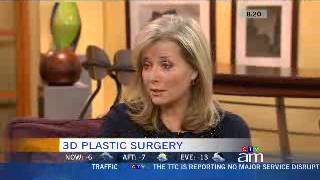
Dr. Cory Goldberg discusses Vectra 3D imaging technology that lets plastic surgery patients see their results before surgery happens. He also talks about his work with Operation Smile, which performs free surgeries in developing countries like Cambodia, transforming lives of patients who couldn't afford care.
From CTV News, this is Canada AM with Beverly Thompson and Seamus O'.
Regan.
And in 27 minutes, changing the face of plastic surgery. This is an amazing story. A Canadian doctor whose new 3D technology is giving patients a look into the future, literally. And changing the face of plastic surgeries and new technology giving patients peace of mind.
From ctp, this with Beverly Thompson and Seamus o'.
Regan.
Next, changing the face of plastic surgery. The Canadian doctor whose new 3D technology is giving patients a look at what they might look like.
Using cutting edge technology. A Canadian plastic surgeon is giving patients a preview of what they will look like. Using six cameras, the Vectra 3D Sculptor is able to show patients what new facial features might look like or maybe even a tummy tuck. Here to talk about the new technology and his work with children in developing countries is Dr. Corey Goldberg. Really great to have you in to talk about this because this is beyond cutting edge. This is a first, right? You're the first in Canada to be using this.
That is true. I'm happy to be the first in Canada to have access to this technology.
So tell us a little bit more about it. We're saying gives a better picture that you can see 3D. How much can you really tell about what you might be able to do?
Well, the technology really is able to capture high resolution three dimensional image of a patient's face, breast, body, and allows me to simulate surgery so I can show breast augmentation, facial surgery, rhinoplasty, nose surgery, and actually give the patient a very accurate portrayal of what they can look like after having an operation.
And I would think that particularly for surgery and whether that's cosmetic, you know, to look however young or whatever, but for facial imperfections or for trouble areas, as you said, rhinoplasty, that would be very significant because patients that you would deal with would be very nervous about having their faces.
Absolutely, yeah. Nose patients, rhinoplasty patients in particular, very, very anxious. It's a central feature on their face. Very small changes can make a huge difference. So this technology really lets me show patients what I'm able to do and it allows me to see what they want from me and make sure that I really know what their goals are and they're realistic and I can technically give them what they're looking for.
So this is as useful for you as a surgeon as it is for the patient who walks in and says, here's what I'm thinking of. So they get to see this new 3D imaging as well and work with you on it.
Exactly. And it allows me to really tailor a surgical plan for the patient. That way I know that I have the best chance of achieving their specific goals.
Tell me about. Because this is. It's being applied while, as you know, you said initially there was a lot of work maybe still in Calvin Hollywood and that. Not surprisingly so. But it's also in third world countries. And you've been doing some work with Operation Smile. Tell us about. I think there's. I mean, there's a number of them, but there was one case in particular, a Cambodian child.
Yeah. I was on a mission in Cambodia just over a year ago, and there was a patient in Cambodia that I worked on. The group I work with, Operation Smile, really focuses on children with cleft lips and palates and other facial deformities. But this particular patient was an older patient. He was in his mid-20s, and he had a partial or incomplete cleft of his lip. And he had lived that way his whole life. And he was really debilitated because of it. He was shut in. He lived at home, couldn't get a girlfriend, no job. And at that age, I could do the procedure under a local anesthetic. So a little bit of local anesthetic, like at the dental office, and 45 minutes of my time, and I really changed his life. It was really unbelievable.
And he gave him what you did.
Well, he was a very grateful patient. And the picture doesn't do justice. Afterwards, he was very happy. He couldn't smile because his lips were still frozen.
Sure. That's just incredible. Was he able to see what you talked about doing in advance with this technology there?
No. Having access to this kind of technology and the. A real challenge. It's pretty much here.
So if someone walks into your office and says that whatever procedure that they want, how quickly can you develop this imaging?
The image is captured and rendered in about five minutes.
That's it?
Yeah.
That's quite incredible. A real model. Dr. Goldberg, thank you so much for coming.