Bone-on-Bone Isn't the End of the Road - Part 1
Dr. Joshua John-Ram Schacter explains why pain meds and joint replacement fail: they ignore systemic health. His Pinnacle Method first restores hormones and metabolism, then uses PRP and bone-marrow injections to regenerate joints. Patients in his practice report 85% pain reduction and 72% return to activity.
Chapters
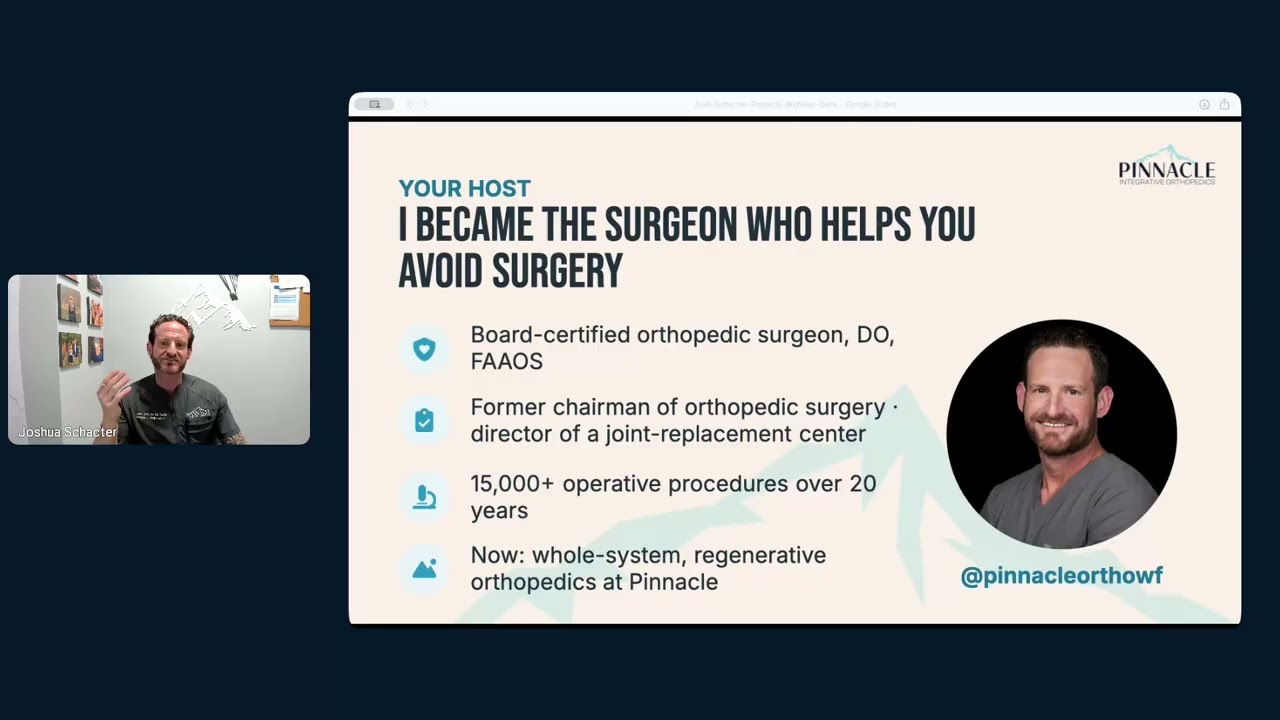
Hi, I'm Dr. Joshua Schacter, and I've spent over 20 years as an orthopedic surgeon and done over 15,000 surgeries in my career. And over time, I've started to notice something. We weren't actually fixing the problem. We were just managing it. Patients were stuck in this cycle: pain, injection, surgery, and then back to pain again. And I kept asking myself, there has to be a better way. So I stepped back. After more than a decade as the chief of orthopedic surgery at my hospital, I made the decision to rethink everything. Because the truth is, your body isn't just a joint, it's a system. And if you're not addressing inflammation, hormones, metabolism, and recovery, then you're missing the bigger picture. That's what led me to create Pinnacle Integrative Orthopedics, a completely different approach to joint care, one that combines functional medicine with advanced regenerative treatments to actually heal the source of the problem, not just cover it up. At Pinnacle, we use treatments like platelet-rich plasma and bone marrow aspirate concentrate stem cells to accelerate your body's healing. We use technologies like cold laser therapy and programs for functional strengthening to reduce inflammation and support your healing naturally. And we build personalized programs that look at everything— your hormones, your weight, your lifestyle, everything— because no 2 patients are the same. But what really ties it all together is what I call the Pinnacle Method. It's a framework that I've developed after years of seeing what works and what doesn't. Instead of jumping straight to surgery, we take a step back and look at the full picture. We identify the root cause, And we support the body's natural healing process. It's about helping you move better, feel stronger, and actually get your life back. If you've been told that surgery is your only option, or you feel stuck in that cycle, just know that there's another way, and we're here to help you find it. Just know that there's another way, guys. All right, I am going to get started. Here we go. Welcome everyone, and. Thank you so much for being here. Before we get started, everybody type in the chat where you're joining from. We treat patients from all over the country, and I love to see who's joining us. I know that I've got some friends and neighbors from here in Texoma. I see several of you that I know. Linda, great to see you. Lisa, Melissa, thank you guys so much for being here. It's amazing. So over the next 45 minutes, I'm going to change the way that you think about your joints for the rest of your life. Now, that is a big I am an orthopedic surgeon. I have spent years running a joint replacement center of excellence, and we did joint replacements day in and day out for decades. I have personally performed more than 15,000 operative procedures over 20 years of practice. And when I tell you that for a lot of people, surgery was never the only option, it's not wishful thinking. Stay with me and I'll show you exactly why. So before I dive in, do something for me in the chat. Type the single most frustrating thing about the treatments that you've already tried for your joint pain. Maybe it's a shot that wore off. Maybe it's being told just to wait until it's bad enough to replace. Maybe it's being rushed through a 7 to 10 minute consultation with that surgeon that you waited months to see after waiting months to see your primary care before that. So I read these and they tell me I'm talking to the right people. Go ahead, put it in the chat now and keep that chat open because I'll come back to what you write. So here's what we're going to cover. First, why your joints hurt far more than any x-ray can explain and why 2 people with the same x-ray can have completely different amounts of pain. Second, we're going to do the 3 reasons why nothing you've tried Thus far has actually lasted. And third, the two-part method that my team and I built that gives a joint a real chance to heal without surgery, without a lifetime of pills, and without the steroid shots that actually are making things worse. One favor, guys: close the tabs, put the phone face down. Let's just focus on being here together. What I'm about to share with you only works if you're actually here for it. So let me be clear about who this is for. So if you've been handed a surgery date and something in you is not ready to accept that that's the end of the road, you are exactly who I built this for. If you're living on ibuprofen and steroid shots and you still want to hike and golf and play pickleball and get down on the floor with your grandkids, Then stay with me. And I will be just as honest about who this is not for. If you want a magic pill that fixes everything by Friday with zero involvement from you, then this is not that. The people who do the best here are willing to look at the whole picture and change the way that they view their health. And in a minute, you'll understand why that matters so much. So here's the question I want you holding the entire time that we're here together. What if the reason that your knee or your hip or your shoulder hurts far less to do with— has far less to do with your X-ray than what you've been told? Now let's sit with that for a second. It almost sounds too simple, but everything that I'm going to show you over the next half hour to 40 minutes comes back to that. So a quick word on who I am. I'm a board-certified orthopedic surgeon. I was the chairman of orthopedic surgery and the director of a joint replacement center of excellence for over a decade. I perform— performed personally more than 15,000 surgeries in 20 years. But I'm not just an orthopedic surgeon. I'm an integrative orthopedist, and I specialize in functional medicine, hormone replacement, metabolic optimization, and regenerative therapies. I've spoken at national orthopedic conferences around the country. I've spoken at the largest functional medicine stage on the planet. And I speak all around the country educating other doctors and patients about this new standard in joint regeneration. Now, I'm not anti-surgery. I have given people their lives back with an operation. And there are absolutely times when surgery is the right call. But I walked away from running that surgical machine to build something different because I saw up close what that system was missing. I was doing thousands of surgeries and my patients were coming back, sometimes one joint after another. I realized that I wasn't the only person on that hamster wheel, that conveyor belt. I was impacting one joint and not the whole system. My patients were still sick. They were still suffering even after a successful joint replacement. So here's what nobody in a white coat will say out loud. The system that you've been trusting with your joints was never actually designed to heal them. It was designed to move you through it. A 10-minute appointment, a quick look at an X-ray, and then the conveyor belt: an anti-inflammatory, a steroid shot that fades, and eventually those words that you've been dreading: it's bone on bone and you're going to need a replacement. I know this belt intimately because for years I worked on it. I watched good people get pushed towards the operating room one joint at a time while the real reasons why their bodies were breaking down were never even discussed. So let me name that problem clearly. Insurance companies, Big Pharma, and big hospital systems are all built around one thing, and that's surgery. It's the largest source of income for most hospital systems, and it's not because everyone in them is bad, but because that is exactly what the machine is designed to produce. So you get a one-size-fits-all care. You get steroid injections that are really just a Band-Aid and that over time will actually damage your joint and the tissue around your joint. And you get joint replacements that are done far too early before anyone has asked whether that joint could have been healed. And here's the part that should make you just a little angry, because it makes me angry: the numbers back this up. So this is not just my opinion. In 2014, a study found that up to 1/3— that's roughly 34%— of knee replacements may be unnecessary. Another massive study in 2018 concluded that as many as 1 in 4 joint replacements were unneeded. And the Journal of the American Medical Association reported that unnecessary joint replacements cost Americans $8.3 billion. billion last year. Think about that. So that's billions of dollars and countless people going under the knife for surgeries that a lot of them may not need yet. So if you've been told that a joint replacement is your only option, then the odds are that that's just not true. And here's what makes unnecessary surgery so costly. There's really no going back from it. Once that joint is replaced, that decision is permanent. Recovery can take 2 to 5 years before you see maximum improvement, which may never actually get you where you want to be. So there's a real risk of chronic pain, infection, stiffness, and many other complications around joint replacement. And there's downtime for up to months, and for many people, a real risk of addiction to pain medication. So the cost of staying on that conveyor belt is not just to your knee, your hip, or your shoulder. It's years of your life and choices that you can't undo. So if part of you is suspected that that live with it until we replace it idea can't be the whole story, then you're not being difficult. You're right. So what about the steroid shot? The thing that so many of you have been offered again and again. In my old life as a traditional orthopedic surgeon, my staff and I did thousands of steroid injections. Because we had very few options that insurance would cover or our hospital would let us perform before surgery. So a steroid injection can calm things down for a while, and I understand why that's tempting. But here is what most people are never told: it masks the problem instead of healing it, and repeated steroid injections can actually damage cartilage and the tissues around the joint and worsen arthritis over time. So essentially, you're Borrowing relief from your future joint. So if the belt is pills and shots and then surgery, and each one either masks or damages the problem, then the obvious question is what actually heals? To answer that, I have to tell you why this all became personal for me. So there's an old saying, and you might have heard it. If all you have is a hammer, then everything looks like a nail. Well, that is an honest description of how most of us were trained as orthopedic surgeons. We think of that joint in a box without ever considering the system, the body that supports it. So we were handed a hammer, and every joint looks like something to operate on. And it's not out of malice or greed. It's just the only tool that our training gave us. And I believe that too. And for a long time, Until one night forced me to see how much that hammer was actually missing. So I want to take you to a cold bench outside of a hospital in downtown Dallas. It's 3 a.m., and I'm in my pajamas and a flannel shirt, and I'm staring up at the stars, and I have never felt more lost. Inside, my wife is seven. days into a nightmare. A reconstruction had gone terribly wrong. She had required 18 units of blood, more than 20 hours of surgery for a surgery that should have only taken 8, and a monitor that kept whooshing next to her bed, constantly tracking a blood supply that kept trying to fail. And her surgeons, all with good intentions, coming in over and over trying to fix the problem. While she got sicker and sicker and sicker, and I sitting there, a skilled, experienced surgeon, the chairman of orthopedic surgery at my hospital, sat on that bench and finally admitted the thing that I'd been running from. The system that I'd given my whole life to had no answer for the person that I loved the most, and I saw clearly that this conveyor belt was taking us down one path to surgery after surgery. And she nearly died because of it. And here's the part that shook me to the core. That's exactly what I'd been doing to my own patients, operating and transfusing, pushing down people, pushing people down this sort of slippery slope one joint at a time without ever asking if there was a better way. After days in the hospital and multiple more surgeries, I finally had to talk the surgeons out of doing the big complex reconstruction that they wanted to do. And we finally went home. There were months of healing, but we dug in. We found new ways to help my wife heal. We found knowledgeable functional medicine doctors to help us on this journey. She started hormone replacement therapy, and we focused on her nutrition and her healing above all else. Her surgeons And I frankly was shocked at how fast she improved. And today she is healthy and vital and lives life to the fullest. And she has the bone density of a 35-year-old woman, and she's just turned 49. Now, it was incredible to support her through that, and it changed the way that I think about what we do. But as I started to think more clearly about patients and their health before surgery, I became more and more frustrated with what what I was doing as a traditional orthopedic surgeon. I was burned out seeing 50 patients a day, performing surgery after surgery, and I realized I wasn't a healer anymore. I was that assembly line. I knew my patients deserved better than a one-way trip to surgery, and I wanted to do for them what I had seen work so well with Amber. So I did the one thing that scared everyone who knew me. I left. I left that comfortable, well-paid position. I went and learned everything that the system had never taught me— functional medicine, hormone health, nutrition, peptides, regenerative therapy— and I built a team and a method around one idea: treat the whole human being, not just the joint on the x-ray. And from our very first patients, it worked. So James came to me. He was 64 years old. He was over 120 pounds overweight, and he was in constant pain. So he'd been told that a knee replacement was his only option. But we didn't start with his knees. We started with what I call the soil— his hormones, his inflammation, his nutrition— and only then did we start to treat the joint itself. Using powerful regenerative techniques. So he healed faster than he thought possible. He lost more than 100 pounds in just a short time after his knee treatment. He was back riding his horses and down on the floor with his grandkids. 3 years later, and he is still living the life that he chooses, stronger and healthier than he's ever been, and without a joint replacement. So did Jim's story sort of resonate with you? If so, type me in the chat now. Now, individual results vary, and I am always going to be honest with you about that. But Jim's story is not a fluke. It's a pattern that we see in our patients over and over, and I'm about to show you the 3 reasons why that pattern works. Secret 1, the pain is not where you think it is. What if the reason that your knee hurts has far less to do with your X-ray than you have been told? So for years we've treated arthritis as simple wear and tear. It's like the tires on your car. The joint's a worn-out part, so just replace the part, right? Now look at these X-rays. The one on the left actually has a little bit more joint space than the one on the right. But this patient has severe pain with anything that she does, and the other is able to do almost everything that they want. We now understand it as an inflammatory and a metabolic problem as much as a mileage problem. That's why I can show you 2 people with nearly identical X-rays, and one is in agony. While the other is out hiking. The wear on the film is real, but that's not the whole story. Inflammation is the enemy here. The good news hidden inside that fact is enormous because unlike the shape of your bones, inflammation and your metabolism are changeable. That's the part that you have power over. So take LaMerle. She was 65 years old, a bowler, years of worsening knee pain and steroid shots that just did not last. So the recommendation waiting for her was a knee replacement. Instead, we lowered her inflammation, we balanced her hormones, supported her whole system, and we treated her knee regeneratively. And in no time, she was back bowling at a very high level, and her results speak for themselves. I actually saw her last week, and she had just come back from an amazing vacation with no pain. So does Lamurle's story kind of sound like you? Are you struggling to do the things that you really love? If so, type me in the chat now, and I'd love to hear from you. So if pain is not only in the cartilage, then why does the exact same regenerative treatment transform one person and do almost nothing for another? Well, that's secret 2. So secret 2, regeneration only works in the right soil. So why do the same regenerative treatments transform one patient and barely move the needle for another? Well, the answer changes everything about how you should approach this. So here's what most people never hear in regenerative therapy, whether it's your own cells or somebody else's cells that you're using. It is your own cells that are doing the healing. This is the first half of the Pinnacle Method. We call it Joint Vitality— high-dose PRP taken from your own blood to calm inflammation, heal tissue, and prepare that joint. Next, we use BMAC, bone marrow aspirate concentrate, which places your own powerful stem cells directly where they're needed. And then we perform powerful laser therapies which drive down pain and swelling and amplifies the whole treatment. Think of that laser therapy as supercharging the cells that we put in that area. These are the same regenerative tools that professional athletes use to avoid surgery and get back on the field. And here's the catch that ties back to the soil. Your own cells are only as powerful as the body that they come from. So let's think back to James. If I had just injected his knee on day 1, into a body that was inflamed and carrying over 120 pounds of extra weight with hormones and metabolism completely out of whack, I would have planted good seeds in poor soil and very little would have grown. That's exactly why the same injection fails for so many people who get it somewhere else. So we fixed the soil first and we used the most powerful regenerative options available to treat his joint, which raises the question that most doctors will never ask you. What do your waistline, your energy, and your hormones have to do with your knee? Everything. Secret 3: your joints and your metabolism are one system. What if the fatigue and the weight and the joint pain are not 3 separate problems, but one? So take Edith, 65. She spent 2 decades traveling the world, but then had to stop. She'd had a right hip replacement, was in chronic pain, 60 pounds overweight, brain fog, no energy, and then her left hip started hurting. She tried the traditional route. She did physical therapy, daily pain medications, steroid injections, and then she just hit a wall. She came to see us, and through the Pinnacle Method's whole system approach— regenerative hip therapy and hormone balancing and metabolic support— she transformed within months. Today, years later, she walks up to 4 miles every morning. She trains regularly and says she feels 20 years younger. Edith's story shows what's possible when you treat a joint and the whole body together. Isn't her story amazing? Type yes in the chat if you think that's incredible, because Edith is incredible. So this is the second half of the Pinnacle Method. It's the peak of wellness. It is a guided pathway. First, we balance your hormones and your daily habits. Then we reduce the inflammation and the excess weight that are quietly grinding your joints down. And then we restore your energy and vitality so healing actually lasts. So the same drivers— high blood sugar, chronic inflammation, and declining hormones— quietly speed up that joint breakdown and slow down healing. Now, fix them and you don't just feel better all over. This gives the joint a real chance to heal. This is individualized care. It's for you. And it's the piece that that short visit with your surgeon never had time for. So let me give you the science, because this is where most people's jaws drop. There are at least 6 major hormones that drive healing. Now, the most important of these are actually your thyroid hormone, testosterone, estrogen, progesterone, and insulin. And there are several others. When they're low or out of balance, your body simply cannot repair well. In fact, many studies have shown that low testosterone by itself makes arthritis worse in men and women. Balanced hormones support bone density. They lower inflammation and help collagen, which is the building block of your joint. And they even improve the joint's own lubrication. So think of those hormones as giving your joints the oil that they need to function well. So your joint pain may actually be worsened by a hormone imbalance that you don't even know— you didn't even know that you had. So if you fix that, then the whole system starts working with you instead of against you. Now, so let's put this side by side. The old way treats your joint as a worn-out joint, a worn-out part on a conveyor belt. A pill, a shot, a replacement, one joint at a time. The Pinnacle Method treats the joint as living tissue in a living body. We fix the terrain with the Peak of Wellness, and we regenerate the joint with Joint Vitality. As James's metabolism came back online, his inflammation fell. His pain dropped, and the joint healing and the whole body healing happened together and not separately. Now you know why nothing has fully worked for before, and you know why this does. And I want, and I don't really want you to take my word for it. So we track our results. We study this intensely, and like I said, I speak about this all around the country. Across our first 170 patients, we had 85% pain reduction even years after the treatment. And 72% of those people reached an activity level that they actually wanted within a few months. So for context there, knee replacement gets patients back to their desired activity level, what you want to do, about 50% of the time within the first year. And it can take 5 years to get the amount of improvement that we see time after time without surgery. So these are real people tracked over real time and not cherry-picked numbers to make us look good. The trend across our first nearly 200 patients in the program is exactly what you would expect once you stop treating the joint in isolation and start treating the whole system. So let me tie it together in one breath, because the pain is not only in your joint. Regeneration only works in the right soil, and your joints and metabolism are one system. So two halves: joint vitality to regenerate the joint, and the peak of wellness to fix the terrain. So what are you thinking right now? Put it in the chat, and we're going to answer your questions when we get to the back to the end. What is the whole picture? That your doctors never had time for. They never had time to consider your joint and the rest of you as one system, and that is exactly why our patients get the results that they do. So where does that leave you? Well, you really have three choices at this point. You can do nothing, and you can wait until it gets harder and more expensive to reverse. You can order the right labs. You can read your own hormones. You can choose the right regenerative therapy on your own. But that is a decade of training that I would not wish on anyone. Or you could let us do this with you. If that third path sounds right, then type 1 in the chat and let me show you the simplest ways to start. So if you already know that you want real answers, you don't have to wait and For a limited time, you can start your first visit with us for just $199, and that includes a comprehensive consultation with labs and x-rays. We also perform ultrasound of your joint here in the, in the office so that we can see the soft tissues around the joint as well. Normally, this would be about $350, but we're offering a special price since you're here. Now, you walk out with a detailed understanding of your joint health, and personalized non-surgical treatment recommendations which are built for your specific joint. And that $199 is credited towards the program of your choice. Now, this is a real workup with a board-certified orthopedic surgeon who is looking for every way to help you avoid the operating room. So here's why we start with a paid evaluation that's actually better for you. So it means that you get a real workup with a real plan. And you know, you leave knowing exactly what your options are. We keep these spaces very limited because we protect the time, and I spend about an hour to an hour and a half with you when you're here in the office. So if you want to move, claim your first visit now and let us take the first steps towards a pain-free life together. The way you do this is you can scan this QR code and it goes to a booking link. Now let me show you how this works. I will do my best here. All right, now you click that link and let me share this part of the screen for you. When you click that link on the screen, you go to this Calendly, and this is Melissa. She's a real person. She lives here in Wichita Falls, and she's going to walk you through it. So then we click on the visit, we go to a time. Click next, enter your information, make your payment, and schedule your event. It is that easy. So I would encourage everyone who's interested in learning more about their joint, go ahead and book that evaluation. So that fee, it's not a hurdle, and that's the reason why this works. It reserves your spot, it commits us both to doing this properly. And it pays for the full evaluation and the plan that you walk out with. Whether you decide that this is for you or not, you're going to get information and it's going to change the way that you think about your health. So go ahead, enter your details and complete the appointment fee, and that spot is yours. So while you're working on that, let's take your questions. And I have a lot of questions here. And I'm going to go through those, but I want to talk about the most obvious questions and the most common questions that I hear here in the office. So go back to that. Remember what's the most frustrating thing about your joint pain? And Brenda said not knowing what questions to ask at appointments. Is total joint surgery the only option for a diagnosis of bone-on-bone? Okay, not knowing what questions to ask at appointments. We're going to cover all of those. So if those things are still true for you and you want more information and to learn more about your health and the things that you can do for your joint, that consultation is where we finally get a plan together. So the question that one of you asked is, does insurance pay? Does insurance cover this? And I often get the question, is this expensive? Well, unfortunately, insurance does not cover any regenerative medicine, and it also doesn't cover you being healthier. But is it expensive? Well, compared to what? A replacement, a 2 to 5 year recovery, and the time off your feet. The lost years? Well, we invest in our businesses and our lives. We spend money on trips and full mouth reconstructions for your teeth that might cost $50,000. This is an investment in avoiding surgery and getting back to the life you love. And your first visit is only $199. And we credit that money towards the program of your choice. So of course, the purpose of that first evaluation is to get to the exact root cause of your issue. So if you want to learn why your joint hurts so bad, I encourage you, book that evaluation now. You can click the link on the screen or you can scan the QR code to get started. So another question that I get often is, I don't have time. Do I have time to do this? It sounds like a big deal. Well, the whole point is that we plan it with you. We work with patients from all around the country, so you're not spending years piecing it together. The slow, expensive path is really doing nothing. We customize programs to each patient and work with your schedule, and we have a robust system and a team of dedicated staff that are with you the entire way to make sure you stay on track. I get the question, can I bring my partner or my, my spouse, my brother, my best friend to the appointment? Yeah, absolutely. Please bring them, bring your spouse, your son or daughter, even that friend you trust. We want you to be successful, and having support at home is powerful. So that is exactly what we invite a person to do. Bring your spouse, that person that you love, into the conversation and decide together. It's always better if you have the support of the people that you love as you go through the program. Go ahead and scan that QR code. Click the link on your screen and we can get that conversation started. I get asked pretty often, is regenerative medicine proven? And honestly, for me, this is one of the most frustrating questions because it is fair. But regenerative medicine has been around for over 30 years. PRP and bone marrow aspirate concentrate stem cells have been used in millions of people worldwide to treat these problems with great success. Now, there's a recent study that was just released where they did a knee replacement on one side and did bone marrow aspirate stem cells on the other. Now, at 2 years, 85% of those people preferred the side that had the stem cell treatment, and at 10 years, about 25% of the people who'd had a knee replacement had to have it redone. Now, 85% of those people not only continued to have pain relief from the stem cell side, but also had never required a knee replacement. Now, your own cells do the healing and the same tools that pro athletes use. And we are honest about what we can and can't do. And that's why we start with a deep dive and not a promise. So of course, the purpose of the first evaluation is to get to the exact root cause of your issue. So if you're even a bit interested, I encourage you book that evaluation now. Now I'm going to go through the rest of your questions. So what about backs? Does insurance pay? I think I paid— I, I covered that. So we do backs and we take care of backs. Backs are a great regenerative option, and we're happy to talk to you more about that. It depends a lot on your medical history, whether we can optimize you, and whether you've had a bunch of back surgeries before. But we've been very successful treating backs. So Brenda said, not knowing what questions to ask at appointments. Well, Brenda, I think you might have a better idea of what questions to ask now. How long do these procedures take? Well, typically you're in the office for about an hour for each procedure, depending on what we do. Sometimes stem cells are a little bit more involved, so you might be here for about an hour and a half. Another question, are they painful? Now I numb up the area really well. In some cases, we use some sedation here in the office, and our goal is always to have you have the best experience with the least amount of pain. But anytime we're doing an intervention, there is a small amount of pain. Now that typically fades over the first couple of days. And our patients just rave about how they feel weeks to months later. So is there an age limit? There's really no age limit on who we can do stem cells and PRP on. I have done patients as old as 98, and that gentleman, by the way, still fishes in Alaska every year, and it's been a couple of years since we've seen him. The youngest person that we've ever treated in the office was 15. And she did amazingly well. We've taken care of athletes, but the most successful people are those people aged 45 to 75 who really want an option other than surgery. So the answer to that is no, there is no age limit to what we do. And if you have these problems, then we can definitely help you. If I don't think you're a good fit for our program, or if this doesn't seem like the right fit for you and you're when we're in the office. We'll decide that together. So let me leave you with this last point. Joint pain sucks. It steals the things that you love one moment at a time. And you've now seen that it does not have to be a pill, a steroid injection, or surgery. The question is not whether this works. You've seen the data and the patients today. The question is whether You are willing to keep waiting while it gets harder and harder to reverse, or you can take the first step now. So book the consult so that we can dive in deeper. Use that code on the screen, scan the QR code, and I would be honored to help you get back to living. Thank you so much for spending this time with me. I look forward to seeing you here at Pinnacle.
More from Dr.







She Traveled from Colorado for a Different Approach to Knee Pain | Lois’ Story



