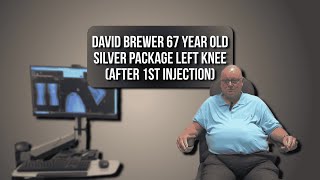
David Brewer, 63, had severe knee pain disrupting sleep and work. After one PRP injection with laser therapy, he slept through the night two days later and returned to work the next day. Dr. Joshua John-Ram Schacter explains how PRP differs from steroid injections, which can worsen arthritis.
Questions this video answers
63 ("63 as of a couple of days ago").
February 10, 2025.
A single PRP injection and some laser therapy.
The next day ("I went to work the next day").
About two weeks after the first treatment ("we're going to do his next treatment here in about two weeks").
Chapters
All right, we're here with Mr. David Brewer, and he is one of our Pinnacle Silver patients, which means that he's received his left knee. We started a PRP series with him. So he's done a single PRP and some laser, and all of our programs contain more than one injection. But Mr. Brewer has done so well after his first one that I wanted to get a chance to talk with him here today. So, David, if you don't mind, just give me your age real quick.
63 as of a couple of days ago.
And he's very active. So it's big, big part of your life is getting out and doing things, and your knee was really, really impacting that. So just let us know, what was life like before your treatment here at Pinnacle?
Well, so I'd actually retired as a school superintendent and.
Actually started sleeping really well for the first time in 20 years because, you know, just the stress relief was off of me that I didn't know I had. And then all of a sudden, my left knee was just excruciatingly painful.
And so I hadn't slept in three or four months, just hardly at all. And so just. My wife actually was thumbing through the phone book and found. Not the phone book, but, you know, the Google, and found you guys. And so here we are.
And so anyway, so my pain was just. It was just excruciating, and I had to do something, and so that's how we ended up here.
Gotcha. What else were you not able to do that kind of made you upset and irritated?
Well, just anything physical. But one of the things that I'm doing now, my folks are both in their 80s, and so I help to care for them. And so lifting, you know, my dad, who had a stroke a couple of years ago, lifting and those kind of things was. Was painful to me. So that was aggravating that I couldn't do what I. My intentions were to do for them.
Yes.
And then just things like mowing the yard and, you know, yard work and just whatever sitting in a chair, you know, was miserable.
Just everything. Everything. And sleep, folks. Sleep is important.
Absolutely.
When we. When we do our metabolic optimization programs, I mean, sleep. Sleep is so much of our health. And so if you're not able to get a restful night's sleep, it impacts more than just your knee. I mean, it impacts your mind. You're foggy. It impacts your ability to exercise. It impacts your mood. It impacts your hormone levels. It just damages your overall health. So really important.
My wife said I was grumpy I know that's hard to believe.
I can't imagine you being grumpy.
I was.
Dave, so what finally triggered you to come in and see us here at Pinnacle and meet our medical.
Well, just. It was not getting better, you know, it was just getting worse. And, you know, I tried conventional treatment, I guess, you know, pain relievers and those kind of things, and it just wasn't. Nothing was really cutting the pain, and nothing was really allowing me to sleep and, you know, continue my daily activities. And so enough was enough, you know. And so actually, honestly, I came in here for you to give me the old deadening shot, and let's go on, you know.
And then we talk about something different.
Steroids are so bad for us. Intra articular steroids damage your joint. And so what we notice with David is he's got some moderate to significant arthritis under his kneecap. So his joints are pretty well maintained on the parts he's standing on, but under his kneecap causes him a lot of pain. And that's the pain that you have when you rise from a chair or climb stairs, walk on an even ground. And. And if we were to inject that with steroids, it would worsen his arthritis over time, and that could lead to him needing a knee replacement in the near future. It can cause other complications. So PRP is a much stronger option and obviously very effective. So what kind of concerns did you have prior to the procedure? I know you talked to me earlier. He said that you signed up for the package. The package is real money.
It is real money.
It's not cheap, but it's extremely effective. And so every once in a while we have folks who have some concerns about that and just tell me about your feelings the next day.
Yeah, so it's kind of like, you know, when you. When you buy a new car or whatever, you kind of get a little buyer's remorse sometimes. So that day I was feeling really good, you know, I visited with you, and, yeah, this is what we need to do. And then as the day went on and as we do as humans, I started thinking, oh, man, that's a lot of money, you know, and this is new stuff, and is this really going to work and all those kind of things you go through. And, you know, and as I was kidding with my family, I just went in there, you know, to just give me a shot and deaden the thing so I can go on, you know, and here I am doing this. Doing this.
This crazy stuff.
This crazy stuff. Yeah, exactly. But anyway, my wife, who is Generally more conservative than I am, especially with our money. She said, look, in your career as a superintendent, you've always. You don't patch things, you fix them, you know, and so this is just your philosophy in life, and we just need to do this. And so. And so we did. And it's been fantastic, wonderful.
I love to hear it. What was the procedure like for you?
The procedure was really almost painless. You know, I felt more. The deadening was probably more painful. The weird feeling is the pressure, you know, when they. When they inject your knee. And the weird thing to me was watching my own platelets go back in my knee, you know, but the pressure was the strangest feeling, but it was not. It was, you know, a little uncomfortable, but that was it. It wasn't anything very. It wasn't invasive at all or anything like that.
And what kind of downtime did you have after the procedure? When did you return to your normal activities, your work?
Well, I went to work the next day.
Perfect.
You know, and it was a little sore, more sore and maybe more painful than normal the next day. And you guys told me it might be a couple of weeks even. But by the second, third day, I was so much better than I had been. And I, you know, actually probably the second night, I actually slept almost all night, you know, and so it was. It was amazing how quickly it worked.
And that's. And it's only getting better for you.
Absolutely fantastic.
So what's life like now? What can you do that you haven't been able to do in the past? I think sleep is.
Yeah, yeah. My number one thing has been sleep. You know, I was so looking forward to actually being able to sleep all night, and then all of a sudden I couldn't. And now I'm back to where I can sleep all night other than just normal old man problems. You know, you have to get up and go to the bathroom every once in a while.
But.
But, you know, but as far as just the pain, those are almost gone, you know, and it's very manageable now. The only thing I have left is a little bit on the inside of my knee. And I think my next treatment, I believe it'll take care of that.
And that's what, you know, that's why we do more than one treatment. We continue to have improvement when we do ortho biologics for between five and eight months, depending on what we do. So it continues to get better. We're going to do his next treatment here in about two weeks. So we're really excited to do that. And we'll come back and we'll revisit with David after his second procedure and see how his life is. What would you tell someone who's considering coming here to see us at Pinnacle Integrative Orthopedics and Sports Medicine to see us for this?
Well, I would say come in with an open mind.
And I think Dr. Schachter is going to shoot you straight.
If he can't help you with this. He'll, you know, he'll. He's one of the best, as far as I know, as far as, quote, unquote, old school guys. You know, we still do a lot of surgery, right, and do all the surgery if that's what's needed, but it's not needed in cases like mine. And I really don't want to have a knee replacement, you know, and then unless I. Unless it's what's required for me to, you know, still have the life that I have.
And in this country, you know, I mean, these things might not be covered by insurance, but they are powerful. Obviously, they work. They do prevent joint replacements for a long period of time. And that's what we're doing with Dave, and that's what we'll do with you. So come on and see us. Anything else that you'd like to say about the process? You know, our staff here at the office? Anything you'd like?
Well, I'll just say it's been a great experience for me. The staff is pleasant, they're very helpful. They, you know, I've had to, you know, reschedule a couple of points and things and have been very understanding and helpful and, you know, and creative as far as getting things accomplished that we need to get done. And it's just a great place. It's a, you know, it's a very, you know, very friendly, very open place, and I highly recommend it. It's been everything and more than I wanted it to be.
Thank you so much. That's a great one. We appreciate you very much and look forward to your journey and watching you continue to get better.