Linda's Journey to Walking 3 MILES Again!
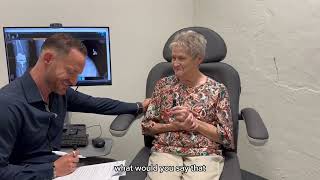
Linda McCluskey, 74, treated her knee arthritis with PRP and bone marrow injections instead of surgery. She was back to activity in three to four days and recently walked three miles without pain.
Chapters
Okay.
Good morning.
Good morning.
I've got Linda McCluskey here. She's one of our favorite patients here at Pinnacle.
Well, thank you.
She's been an amazing patient, Linda. We've been together. I've been taking care of you for a number of years.
A number of years. She did my knee replacement in 2018.
Yeah. So we did a right knee replacement on Linda McCluskey in 2018. So in case anybody wonders, we still do knee replacements when we need to. Our pregnancy preference is to try and help people not have knee replacements. And that was absolutely Ms. Linda's preference with her left knee. So we. She is a diamond patient, which means that she has been through orthobiologics treatments for her left knee. She's also in our metabolic optimization program. So you've been a patient in that program for over a year?
Almost a year, I think so, yeah.
So, and, and, and let's talk a little bit about your left knee, if you wouldn't mind. She just had a birthday.
Yes.
Happy birthday to you.
And she is 74.
74 years young. She looks amazing. And, and since we've worked with her with the program, we've seen her improve very drastically, for sure, both with respect to your knee, but also with respect to your overall, well, being.
Correct.
Would you say, you know, and what would you say.
Was your sort of baseline before we started working together in the program? I mean, you came to me because you sort of expected to have a left knee replacement, but when we talked about our other options, you sort of got excited about that. And so what was life like before we started working with you in the program with the.
As far as the knee concerned, it was getting to the point of like 24, 7 pain, especially trying to rest at night and could not do physical activity like I wanted to. And my number one goal was to hopefully not have surgery.
Right.
That was my number one goal.
And we have so many patients that come to us with that goal. I mean, that, you know what, as an orthopedic surgeon, it's been really novel to try and help people not to have these big surgeries. And with miss Linda, I think we've been wildly successful. It's been great. We can see from her X rays here that she has moderate arthritis of the left knee. Certainly some narrowing of this joint space, particularly under the kneecap. We could see some bone spurs there. We talked about that. And so what finally triggered you to come in and talk to us? It was the pain of the knee.
The pain and then just the being Not. Not being able to do my normal activity like walk the track, even to do housework. Some housework. As far as, you know, the mop and in the vacuuming and the bending and stuff.
And when we say walk the track, she doesn't just go like a half a mile. She's a. She's a walker. So. And. And we had just. We just spoke about this. Your goal when we first started working together was to walk three to four miles on the track.
Correct.
And just recently.
Correct.
When did you. When were you able to walk?
Just this past weekend. Three miles.
She did three miles. And how do you feel after that?
Awesome. No pain. No pain at all.
That's great. So with her, we did orthobiologics. So we started with PRP and prp. We used to sort of get the joint ready to receive stem cell treatment. And then we used bone marrow aspirate to treat the knee. And so we did. Your bone marrow aspirate was in May.
Okay.
And we did intraosseous bone marrow aspirate. So we actually injected it into the bone around her knee. What would you say that. Would you. Did you have any concerns before any of these procedures? What were your. What were your worries?
I think it's just the normal concern, like if you're going to be put to sleep, you know, and the. I guess it's the fear of the unknown because you're not. You just don't know. You've never had this.
Right.
But after I got there and talked to the nurse and got started and everything, I felt really comfortable. No apprehension. I just felt like I was in good hands, so. And I've always felt that way from the time I've walked into now. I've always felt like I was just part of the family. I mean, that's how I felt.
Well, you are.
I mean, it is. It's a good feeling to know that they treat you. You treat me as a person versus a number. I mean, that's. That's the best feeling.
Thank you. And that's. You know, we tell people who enter our programs, it's the Pinnacle family. We do so much work with. With the whole person. And the whole person doesn't just involve one joint or even your metabolism. It's your mind, too.
It's everything.
Right. It's. That's a relationship that we want.
Yes. And it's nice to be able to feel like you get quality time instead of just like, okay, you know, we got to be done in five minutes. If it takes 20 minutes, it takes 20. If it takes an hour, it takes an hour. And that's a great feeling.
And my favorite part about the practice, to your point, is that when we get to spend more time with our patients and get to know them better, then we get closer. And so I feel like this one size fits. Non American medicine is where we're at with most of our experiences when we're at a doctor's office or particularly a specialist clinic. And so we've specifically tried to not.
Be like that here at Pennhurst. Well, I think you've achieved it.
And what was. What would you say? Thank you. What would you say that. What would you say that the procedure was like? Now, let's talk a little bit about prp. So when you had prp, that's where we take your blood and we spin it in our centrifuge and then we inject it in and around the knee. What was that procedure like, since you've had all of these procedures?
Right. The first one, a little tender around the knee for a few days. And I did limit my activity for a few days just to be on the safe side. But then after that, it was fine. When I did the surgery with the bone aspirate, that was uncomfortable for a few days, but nothing major. I didn't have to take any pain medicine. I didn't have to. I mean, I had some that you gave, but I didn't have to have any of that.
And when were you back to doing your more normal activities after the operation?
Probably. I say within three to four days, maybe. I mean, I did go back to the gym, but I didn't do the full regimen that I used to do as far as the weights and stuff, I just kind of eased back into it.
And your full activities was a.
Was probably about three to four days.
Gotcha. So three to four days, back to full activities. We'll oftentimes ask our patients to take a couple of weeks to go gradually, depending on what we're dealing with and what's life like now.
Great.
Wonderful.
Yeah. I go the gym five, six days a week. I have no pain. A little tender around the area, but nothing that you just can't live with, you know?
Now, one of the things that I'm most proud about this program is the fact that we do our metabolic optimization. Not just working with your knee, but we work with the whole body. What. What do you feel about that program? What do you think about that?
I think that's great. Great. It's helped me to be able to.
Make better choices. As far as what I put into my body, education. Absolutely. And knowledge is power. That's what I can say. And the more knowledge I get about what I should and shouldn't do for my body, I think that that's just everything to me, 100%.
And I think that we have a whole team of people, and our whole goal is to give our patients knowledge and to give them that power to make changes in themselves. And I think that's very unique in our American medical system is we are often very reactive.
We are waiting for there to be a problem where our goal here at Pinnacle and with you is to help you to optimize your health so that those problems either don't happen or. Or happen a long time in the future.
And two, it helps you mentally, not just physically. It helps your. To me, it helps your overall being, not just being physically good. It just helps your thought process, the calmness of you. It just helps everything to me, 100%.
And what would you say to somebody who's considering to come in here to work with us at Pinnacle?
Come. I mean, everybody's great. They all treat you like your family. They all know you by name. It's. It's a great experience. I couldn't. I recommend it 100%.
100%. Thank you so much. Now, the. The elephant in the room. These treatments are not paid for by insurance.
No.
So. And when we. When we talk to our patients, one of the concerns is, well, you know, we don't want to do anything that our insurance isn't covering. But our insurance doesn't cover our overall health. It doesn't cover non surgical management. That's very effective for joints. What would you say to somebody who's considering using their hard earned money to pay for these programs rather than depending on insurance?
I guess I can look at it from an age point that if you want to have longevity, it's 100% worth it. And I know it's costly, and some people, it may be a burden, you know, and some people that may be able, they're okay, but I think it's 100% worth it. And even though insurance doesn't pay for it, I really. It was the best thing for me. It was the best thing.
Thank you so much. Well, Linda has done amazingly well. We're so proud of her, and we're happy to continue. The wonderful thing about Pinnacle is when our patients have completed their program, then they stay with us for maintenance period. And so we're looking forward to. To maintaining our connection with Linda for as long as she'll have us.
Yeah.
So as long as. As long as she wants to be healthy and well, we're going to keep working with her. Thank you so much for talking to us today.
I appreciate.
More from Dr.







She Traveled from Colorado for a Different Approach to Knee Pain | Lois’ Story



