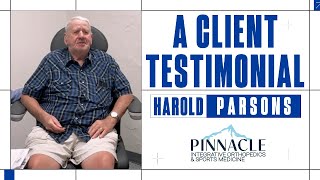
At 82, Harold Parsons received a one-hour stem cell injection into his hip to treat avascular necrosis without surgery. Two months later, his step count hit 34,000 in June, his stride lengthened, and he cut back on narcotic painkillers. His wife Judy and Dr. Joshua John-Ram Schacter discuss the outpatient procedure and how it changed his daily life.
Questions this video answers
82 years old.
Avascular necrosis of the femoral head (left hip).
Intraosseous bone marrow (stem-cell) injection into the femoral head via drilling into the femoral head.
About one hour; outpatient procedure.
About two months after the procedure.
Chapters
Welcome in, Harold. I've got Mr. Harold Parsons and his wife today.
This is my wife Judy.
Judy, and. And Harold came to us. Would you mind giving us your age?
I'm 82 years old.
Young.
82 years young. I would say so. With Harold, we. We did what's called an intraosseous bone marrow injection in his lungs. Left hip, Is that correct? Left hip. And we did that about two months ago. Does that sound familiar? Very good, Judy. Does that strike a bell with you? Very good. And Harold has been so impressive. Judy, can you tell me just a little bit? Grab that thing. Come on, girl. You got it. And would you tell me just a little bit what was Harold's life like before we started our gold program here at Pinnacle?
Well, let's put it this way. There was times he wondered if he should get out of bed or not. And now then he's up at 6 o' clock in the morning.
Is that a good thing?
Yes.
That's wonderful.
So he's up at six in the morning and what is he doing when he gets up?
Well, usually just normal things like work his way out to the kitchen to get some breakfast, coffee or something like that. And then ends up him and the dog go outside and sit for a while in the sun and just little things like that that make a big difference.
So able to enjoy his life.
Yes, really.
And so, Harold, what was life like before.
You had your procedure?
Well, it was pretty miserable and hurting all the time. Every time I took a step, it was hurting. Just couldn't hardly stand it anymore.
So they was talking about operating and I decided I don't want no operation. And then they referred me to you. And I said, this is what I want to do.
Very good.
And it's worked out good so far.
Fantastic.
And I'm a skeptic, but it's working now.
What finally triggered you to come and see us here at Pinnacle? I know you were sent to us, but we do things a lot differently than normal, I would say, than the normal American orthopedic surgery office. What would you say brought you to us?
I didn't want no operation. And they said that the only place you go is Pinnacle. So that's where I came. And it's worked out so far. That's fantastic.
So what kind of concerns did you have prior to the procedure, before we.
Started, if it would work? If it would work? Because I had this for over a year, year and a half, and it just didn't seem like it was doing any better. But it has.
That's Fantastic. And Harold, just to explain a little bit about what he had, he has a process that's called avascular necrosis, which means the top of the ball of his thigh bone in his hip has lost its blood supply or had lost its blood supply. And so what we did there was we took and we drilled a hole up into that portion of the femoral head, and we injected our stem cell bone marrow aspirin into that area. It took us about an hour to do. It was an outpatient procedure. It was really pretty easy.
What.
What was the procedure like for you?
I didn't. Good. I was out. I didn't know anything was going on.
Right. And after the procedure, did you have much discomfort?
Oh, yeah. You know, not as much, but I had some. It didn't work right away, but the vision's working.
How long would you say it was before you could get back to doing your normal activities?
It's been two months, I guess.
Okay.
And I'm getting back to where I'm walking more and doing more things.
I looked at Harold's. We just looked at his step counter for June, and He's walked almost 34,000 steps, which I think is absolutely incredible. Judy, would you say that's. Is that improved over what he had done before?
Yes, more steps, and his stride is.
More like it used to be. That's just incredible. What would you say that life is like now after our procedure?
Oh, it's. It's easier. I was struggling before, but now it's getting a lot easier, so I'm not hurting as much, so it's got to be better. To me, it is.
Judy, what would you say your life's like after?
Lots better.
Any.
Any. Anything that you notice in particular about Harold and the way. And the way that he gets. Gets around, moves, and walks?
Well, like I say, his stride is lengthened. It was. It was like baby steps, little bitty, barely putting one foot in front of the other one. And now that he's got. It's lengthened it out, he's also smiles more because he's not in pain.
I love that.
I mean, life in general is better for us.
Fantastic. That's. And that's exactly. That's what we want, right?
Oh, yeah.
What, not just going for making your joint pain better. We want to make your life better. Yes, that's the goal here at Tentacle. So what.
What.
What are you able to do, Harold, that you hadn't been able to do in the past? I know that it was affecting everything, but is there Something that's really special to you that you're able to do now, that that really brings you more joy.
Well, walking, I wouldn't be able to hardly walk at all. It just hurt all the time, and it just, you know, it dragged my leg. I didn't walk on me. And now it's completely different. I can be able to walk and enjoy myself. I love that.
That's fantastic. So what would you say to somebody who's considering Pinnacle Integrative Orthopedics and Sports medicine and our innovative new programs? The stuff that nobody knows about this. Really interesting things that we're doing?
Well, like I say, I was going to have an operation, and I said, no, don't want to. At my age, I do not want one. So I came over here, and I'll tell you what, it's been worth it. They've been fantastic people. They've taken care of me and done everything that needed to be done, and I sure appreciate it.
Well, we appreciate you guys very much. Judy, what would you say to somebody who's considering working with us?
I would say if you can get the money to pay for it, do it because it's worth it. And eventually they're going to approve this for FDA anyway. So find the money if you can.
That's right.
And get it done.
Call your congressman. We get this stuff approved, don't we?
Call your congressman.
Anything else that you guys want to say? I know that, Judy, you mentioned when we were talking earlier something about that you didn't want him to be on narcotic pain medication, that you wanted him to have some freedom.
Yes, pain medication is okay for a very short time, but when you get dependent on it, then you're just going to have to have stronger and stronger meds. And it affects your liver, it affects your kidneys, and nobody wants to go on dialysis. No, it's very painful, very degrading.
Well, thank you both. I think it's wonderful to watch your journey. I'm so excited, and I love to hear that we've been able to make a real difference in your lives. I. I think that that makes my heart full. So thank you so much for everything that you guys do to get better and to invest in yourself. Harold, do you have anything else to say?
I just want to say thanks to you and all your staff, because without y', all, I wouldn't be walking like I am, and I sure appreciate it.
All right, thank you. This is Mr. Parsons, and we appreciate you guys so very much. We're going to keep it on. That's it.