Sandy L., BMAC & PRP + Wellness
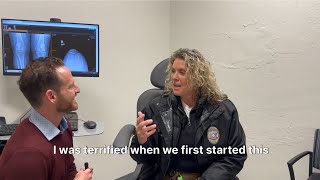
Sandy L., a 52-year-old police officer, received BMAC and PRP injections for chronic knee pain. She had severe swelling and pain before treatment, felt better climbing stairs the next day, and returned to work Monday after a Thursday procedure. She credits the biologics and wellness program with reducing swelling and restoring her range of motion.
Questions this video answers
52
29 years
Thursday (procedure), with return to work by Monday
Chapters
I was terrified when, when we first started this and they said that they were going to extract it out of my hip. That seemed a bit medieval. That was the best process because it was, it went exactly how she said it was going to. She deadened it all the way it happened, exactly the way she explained it. I never felt anything. Just I heard the knocking. That was it. And that was what I feared the most because it seemed, seemed like that was going to hurt the worst.
Yeah. Because it's the most evasive thing that.
We do right with it. Yes.
So bone marrow aspirate, a lot of people. I have a good friend who just did a video on bone marrow aspirate, which is where a tattoo or getting bone marrow aspirate done, stem cell, which. Have you got any tattoos?
I have a full sleeve.
Yeah. So way worse getting a tattoo.
Absolutely, absolutely.
All right. Well, hello, everybody. Thank you for joining us. This is Sandy Lamb. We are going to talk to her about her knees. Sandy, it's rude, but can you give me your age?
52.
So Sandy is 52 years young. She's extremely active. She's one of our local heroes. So she's a police officer. And how long have you served?
29 years.
Yeah, 29 good years. And she is extremely active. So Sandy participates both in our gold program. So she had bone marrow aspirate, our stem cells for her knees and then PRP as well as laser treatments. And she also has participated in our wellness program and has done really remarkably well. She's amazing and we love having her. So Sandy, what was life like before you came and did your treatment with us here at Pinnacle?
Well, when I came to you at Pinnacle, I was kind of at my wits end. I had gone as far as I could go. I was in a lot of pain. My knees were swollen and I could get away from it. I couldn't get away from the pain and the swelling no matter what I did. And so I, I thought that I, I was to where I needed to have knee replacement.
No, gosh, no. We don't want to do that. So when we're super active, when we're young, when we're, especially when we have a job like Sandy's, we can't just do something that's so major and invasive. It takes years to get over any replacements. We didn't have time to do that. And so what finally triggered you to come in and talk to us about, about biologics therapy? What, what got you interested?
Well, honestly, I didn't know a whole lot about it. I'd heard the commercials, but I never really put two and two together. I was in so much pain. I just, I just came to you because I felt like that's where I was at, that the only way that I was going to have any kind of quality of life was to have surgery and move on, do the therapy. When I spoke to you and I watched the videos and I couldn't really justify why I wouldn't try that. First you had said that if surgery is an option, it'll be an option if we try this and it doesn't work. And that made sense to me. And then with the fact that it was something I had to self pay, I kept thinking to myself, if I ran across a good deal on a sea doo, I'd probably take it about the same price.
People, people ask me, they say that, you know, your stuff's not covered by insurance. And my argument is, well, no, it makes it a lot easier to get it done because we don't have to worry about all of that pre certification. But we are willing to spend $10,000 on a sea doo. We're willing to spend. I have a patient who spent $15,000 on a couch, for crying out loud. And then we have, you know, we spend a hundred thousand dollars on a, on a truck. Our society has convinced us that our health is secondary.
Yeah, right.
And that's, and that, and that money that's invested in our joint is somehow not worth it. But, but that's not been your experience.
No, and I was in enough pain that it, it certainly helped me make that decision easy because I thought, you know, I'm not even going to be able to enjoy the sea do if I, if I can't fix my knees because I was in a lot of pain. So it did, it didn't take a lot of convincing. Once I sat down and listened to what you had to say, it all made a lot of sense and I couldn't justify not trying it.
So what kind of concerns did you have prior to the procedure? We just talked about the bone marrow. And you were nervous about that? We went over a little bit of that. But did you have any other concerns that were pressing for you?
Certainly if it was going to work for me for sure. I mean, the pain involved. I'd heard that the, the extraction was painful, sounded painful, and then the injections and.
No, I mean, the staff was really great. They talked you through it and.
Didn'T hurt like I thought it was going to.
We do our very best to make it as easy as possible. Did you walk out? Were you able to get out and.
Oh yeah.
Okay, so what was the procedure like for you? Just pretty straightforward. How did it.
Actually it was exactly how. How Michelle had explained it. She had told me that she was going to deaden it. I didn't feel a thing. I was, I definitely had worked myself up a lot more than I needed to because it wasn't, it wasn't painful at all. The injections were slightly painful for me, but it was very, very short lived. You know, we're talking about a few seconds, nothing that you can't endure. And then it was instant for me. From the very first injection that I had the next day I felt results. My gauge was. I have stairs at my house and it was a struggle to get up them. You know, I had to hang onto the rail and I certainly had to hang on to them going down because I didn't trust that my knees weren't going to give out. And with the next day I didn't have to hang on to the handrail. And that was kind of the gauge for me.
That's incredible. What kind of downtime did you have after your procedure?
I think I had this done on a Thursday, I think. And so I. Friday I was up and around. I just kind of, I just took it easy on Friday. I could have come back to work the next day if I didn't needed to, but it was only a couple days. I was good to go. I was back to work by Monday.
That's amazing. And so what's life like now? What have you been able to do now that you couldn't do in the past?
I definitely have range of motion at the end of the day. Before I had this done, my knees were always very, very swollen and tight, very uncomfortable. Any kind of activity that I did that was straining on my knees, I paid for it. Now I don't have any of that. I do not have any pain. My knees aren't swollen at the end of the day. I mean I still, I still have 52 year old knees. I mean I there, I didn't roll back the clock, you know, to.
But we're working on it. Yeah, we're doing a wellness program. So she's, she's also working with us in our wellness program. And, and tell me a little bit about that process. It's a very intensive process. It involves a lot of work on your part.
Yes.
And what do you feel about functional medicine? How do you feel like the direction your health is going?
Well, when I started it I, I really did not feel well at all. I had. All my hormones were completely, you know, out of. Out of kilter, and I, they just helped me line all those up. And the ones that I, I really wasn't even paying attention to and really did help. I did the testosterone, all of the things that I was, you know, they helped me get everything in a nice line. It. I felt more energy. I felt.
Just overall better. It helped me a lot.
That's what we're going for. Yeah, we're going for life changing. That's what we want to do. So what would you say to somebody who's considering working with Pinnacle Integrative Orthopedics on these programs?
Well, if they have any type of chronic pain and surgery has ever been pushed out there or mentioned, I would. I don't see how you couldn't try this first to see if it'll work for you, because it certainly worked for me. And I thought that's, you know, this was the cross in the road for me. And, yeah, I would definitely say that you can't afford not to try it.
Thank you so much. Do you have anything else that you want to say? I mean, you talked about preaching the gospel. That's what we want. We want patients who are going to go out there and tell people about what they've experienced and how amazing this is, because this is technology that, that's really emerging that we're finding is more and more effective as we go.
Yes. Yeah. No, I'm not working on commission. I mean, I'm just saying I'm preaching your gospel because if I can help somebody, you know, not have to live in that kind of pain and not go underneath the knife, I would want to do that, and I wouldn't be scared. You know, I would tell them that, you know, it's. People get stuck like what you just said, that we don't spend the money on us and our health. We spend it on toys and other things or other people. But you just have to do that.
It's the most important thing is our health, is our investment in our own future.
Right, right.
Well, thank you so much for being an amazing part of this. We're, we're, we're so lucky to have you, and we are so excited to continue with you and your journey. We're going to be right here with you.
Well, I appreciate everything.
Thank you so much.
More from Dr.







She Traveled from Colorado for a Different Approach to Knee Pain | Lois’ Story



