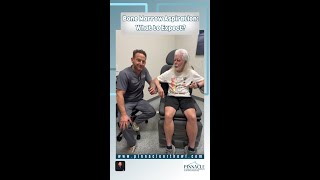
Bill, a surfer with chronic shoulder pain, describes how stem cell treatment from bone marrow aspirate helped him avoid surgery. Dr. Joshua John-Ram Schacter and Michelle at Pinnacle Integrative Orthopedics performed the procedure, and Bill reports substantial improvement in his ability to surf.
Chapters
All right. Hey, Dr. Shakhter here at Pinnacle Integrative Orthopedics. And we are doing some stem cell today on Bill. Bill, we're working on your shoulder.
Yes.
Bill's a surfer. Yes. Tell us a little bit about what's been going on with your shoulder that made you come into Pinnacle.
I couldn't battle without pain. I mean, I could not battle maybe two or three strokes without hurting, and then it's done for the day.
Yeah. So he's big time into Costa Rica. He loves to go surfing in Costa Rica. So he came and saw us here, and then we have a great support for him. So we've started our process. Bill's working on his. The stem cell portion of his process. But we've already done one treatment and you told me that it was doing much better. What did you say to me before?
I think I said it's close to a thousand percent better.
Yeah. Yeah. So we're super excited about him today. We're doing some bone marrow aspirin on him. Michelle's gonna do an amazing job with his harvest. And then we'll show a little footage of his injection as well. And. Yeah, so stay tuned for that.
What we're going to be doing today is going over the process for bone marrow aspirate harvesting and the injection process with you. Okay, so the goal for today is to do this procedure with no pain. The only thing that should cause any discomfort today is the numbing medicine. I can't help that it burns a little bit. Okay, the first thing we're going to do in a moment is take you over to the procedure room. You're going to lie down, face down with your face in a pillow like a massage table. I'm going to first do some palpating on the back of your pelvic, the top of. We call it the inner iliac crest. It's the top of the pelvic bone. I'm going to use ultrasound to find the exact spot. We're going to work on. Then I'm going to mark that area. It's usually about this big around. And I'm going to numb the skin. Then I'm going to step out, wash my hands, scrub in sterile, and the assistant's going to prep the skin with the sterile prep and drape it out in a sterile fashion. Then I'm going to do a timeout where we're going to confirm correct patient, correct side, correct procedure. And then I'm going to come back in. I'm going to take a little bit Longer needle and go to the bone and numb the area of bone as well. That should be the worst part. Skin and both. Then from there, once I know that you're good and numb, I take a little bit bigger needle, go back to that same spot, and I'm going to tap it like that to make sure you feel the vibration but don't have pain. Okay. I can't anesthetize vibration or pressure, but if you feel pain, you tell me. I stop. I put in more numbing medicine. Okay. Then I have to take a small little mallet, and I have to tap it in with a little more oomph. And I'm gonna count. One, two, three, tap. Might make you jump a little bit. 100% of my patients have told me no pain whatsoever. Okay. But you feel the vibration. It's a weird sensation. There's no getting around it. But again, no pain. Then once I've confirmed no pain, a couple more smaller taps to get it into the bone marrow itself. And we're talking about tiny distances, very small, but it takes a little effort, especially if you have good bone. Once I get in there, then I'm going to draw the bone marrow, which kind of looks like dark blood, out of the bone itself. I do six small tubes, and I count down. First one's done, second one's done. So that you know where we are in the process. Everything goes right. It takes about a minute and a half to two minutes. So it's very quick. Okay. That, though, is the point where communication is key. Some patients feel vibration differently than others. Some feel pressure differently than others. If the pressure is uncomfortable, you tell me I slow down or I even stop, let the pressure equalize, and then I can usually continue without discomfort for you. But no tough guys. No trying to hold back. This is where you tell me if you feel discomfort. Okay. And then once I get all of the tubes, I pull the needle out, I clean the skin, I put a little glue on there. Waterproof dressing that stays on for about two to three days. Okay. Sometimes once as I'm aspirating, if I kind of drain that area, I may have to move my needle, which is just. It's still in the numb area. It's just a repeat of the same process. A little tap, couple small taps, and then we aspirate the rest out. Even if we have to do that, it's still usually under two minutes. Okay. The procedure, once we're done with that, we bring you back in here. We're going to put an ice pack on that backside where we were just working. And for the next couple of days, you're going to want to do an ice pack as well. The heat will be for the shoulder, ice pack on the backside, and also for the next two to three days. You might have a slight bruising sensation, but it should not be painful. Risks of the procedure. Anytime we poke your skin, whether we're drawing blood, injecting, numbing the skin, there's always risk of infection. So big beefy red swelling around the procedure sites or the injection sites, we need to know about it. And then the other risk with this particular procedure is what's called a hematoma. If the bleeding in the bone doesn't stop quickly enough, you develop a little pooling of blood around the spot. It'll feel kind of mushy. I've never seen one after this procedure, but we know it can happen, so we just have to let you know the cure for that ice pack. And again, I've not seen one, but it can happen. If you suspect anything, you let us know right away. Okay? And today is Tuesday. The girls will call you on Thursday to check on you and see how you're doing. But if you need us sooner than that, you let us know. Questions for me at all? No. Wonderful. After we bring you back in here, it takes about 10 to 15 minutes to process, and then we'll come back in, and either Dr. Shack or I will do the injection in your shoulder, all right?