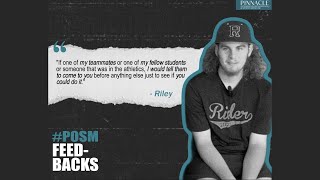
Riley Scott Thomas, 17, injured his shoulder playing baseball and faced surgery recommendations from multiple doctors. After choosing Pinnacle's non-surgical treatment instead, he returned to baseball in four weeks with no symptoms.
Questions this video answers
Riley Scott Thomas, 17.
Braden Thomas (listed as Braden Psalmist), 38.
Shoulder labrum injury causing pain with swinging/contact; disagreement over posterior vs anterior labrum location.
He returned to play about four weeks after the procedure (family reports return-to-play two weeks prior to the interview).
About one year.
Chapters
So stop being so serious.
No mean mugging. All right, so you could barely hear me. This is Dr. Chapter in the background. Riley, would you please give me your full name and age?
My name is Riley Scott Thomas. I'm 17.
Okay. And this is your dad. Braden. Braden.
Braden Thomas.
Your full name. You don't have to give me your age.
Braden Psalmist, 38.
Thank you for bringing him in here. All right, so, Riley, first of all, what was life like before your treatment? What did you come and see us at Pinnacle for?
I came to Pinnacle for my shoulder. I was having problems with swinging and contact of, like, the ball. Plenty of doctors told me that I needed to have surgery on my labrum, but it wasn't the back, it was the front. And they were trying to have me have surgery on the back. So we came to Dr. Shackner to figure everything out.
Great. And Brad, what was your experience with his problem and his issue?
His issue? Like they said, the doctors were telling him that he needed surgery on his post labrum, and me and his mother disagreed with that and decided to research other options. We came across this option and.
Just went with it. We believe in it, and it worked really well.
Awesome. So what finally. So you're a baseball player, right? And so how long were you playing with pain? How is what happened to your shoulder?
So I heard it in the fall. We were hitting up the machine. Baseball. We practice all year. We don't stop and then pick it back up. We practiced all year. So we were in the fall hitting off the machine. The ball was inside, buckled my knee, and I came over and I rotated my shoulder this way, and it didn't pop, but it, like, felt very uncomfortable after. And yeah, that's how it started. And I felt pain from days after we had. We lifted right after my horn went numb after benching. And then we had practice the next day. We did bp and everything was roll over because I was trying to put pressure on my arm and roll it over and brain.
What was it like watching him be injured? I mean, like, as a parent, it's just.
Well, baseball's our life. Like, this is what we do. We travel all around the United States playing baseball. And we, me and his mother, we both spend quite a bit of effort, time, money, all into this. And to see him hurt, it's not a. Not a good thing on the whole family.
Yeah, we. We really enjoy watching him play. I mean, he's been playing travel tournament baseball since he was 8 years old. And it's kind of the way that it keeps Our family together, so.
Absolutely. Absolutely. What finally Trigger. I know. I know that we. We've known your family for a bit. What finally triggered you to come in and talk to. And talk to us here at Pinnacle about integrated with the pH.
Well, even before we went. So we went to my health provider first, and, you know, they're not. They're just my help provider. They don't really know about shoulders and stuff like that. So then they sent us to.
What's his name? I can't say names.
Yeah.
Saw another specialist, and.
My mom was. My mom talked about you, and she was like, well, he's been doing this PBR stuff, and it might actually work. And for.
Just.
If y' all need surgery, you know, I don't want you to have surgery. Cause you're so young. You're only 17. So she was talking about it before, like, even the whole surgery thing came up. So it was already in my mind before, you know, the surgery even talk came up.
Gotcha.
And with surgery, he would have been out for a year. And we're back to full motion.
Yeah. How long's it been?
Five weeks.
Yeah. Just amazing results. So what kind of concerns did you guys have before the procedure? Riley, let's start with you. What kind of concerns?
Honestly didn't have any concerns. I was. I trusted you 100%. I mean, you found out what was wrong in, like, what few minutes? I mean, nobody was really telling me what was wrong with me. They were just throwing assumptions out there. But you found out what was wrong with me in, like, five minutes. So I had my full trust in you.
My remembrance is it was more like 45 hours. Our appointments are really quite a lot longer.
People come in and feel like it's, like, this short process. It's a little longer than that, but. And. And, Braden, what concerns did you have?
Mainly is just that it would. It would work. You know, I mean, this was going to be our first option. Surgery was our last option. And luckily, this panned out, and it worked really well, and we believe in it now, and.
Wonderful. Wonderful. Okay, here's the tough question. What was the procedure like now? It was not super comfortable for Riley. Thinking back on it, I think it was a. Was it great?
No, it wasn't bad. Yeah, it wasn't. But it was you. Y' all did a great job because, like, I don't think y' all injected in the front yet or near my bicep and stuff, so y' all did really good, especially for, like, it's a newer subject, you know, So I feel like y' all did fine. I mean, it hurt, but it's gonna hurt.
What was your. What was your opinion? That was a little bit more stressful for the rest of us.
It didn't hurt me at all.
So what kind of downtime did you have after the procedure?
The first three days, I didn't feel like doing anything. I just wanted to lay in bed, which is, I assume, normal. After that, I was like, I need to go do something. I can't just sit inside every day, you know? So I think.
We kind of. I kind of just threw where. Like, I did my band or something, you know, just, like, kind of working out this shoulder more than this. Just trying to, like, run or, you know, walk. That was the fourth day. We were just trying to find something that we could do, just other than, you know, working the shoulder.
Exactly. And when did you go back? So we just recently let you go back to Ken to just play. When did you go back to play?
Two weeks ago.
Two. No, no, no. Yeah, two weeks ago. Yeah. Yeah, maybe two. Or last week. I can't remember. Yeah, two weeks ago. My return to play was two weeks ago.
Okay, so about four weeks after procedure. About four weeks. And remember, they can't hear me very well, so you're telling them everything that they need to hear. And so what's life like now, like, Braden? What do you. What do you see in your son that's different?
I see. And it seems to come after every laser treatment, too. Just more and more progress. I mean, the laser. I guess the laser's hitting what you. What was injected, you know, speeding the process up. And he's done really well with recovery, and he's. Like I said, we're going back to hitting probably this week.
Great. Riley, what do you. What do you. What's life like now for you?
Life's great. I mean, I'm going to school. I'm playing baseball, like. Like, I would when I wasn't hurt. So it's actually. It's actually like, all the stress of me not being able to play is kind of coming out because, I mean, I'm back to my normal life. I can go to school, play baseball. I don't have to worry about movements that, like, worrying about my shoulder and doing movements, because, like, it wasn't just hurting me in baseball. It would hurt me in random situations. You know, reaching back for something in the car, it would hur. And then I'd have to yank my shoulder forward. So I just feel like I'm back to normal. You know, it just feels like a normal day.
Awesome, brother. What would you guys tell br? Let's start with you. What would you tell somebody who is interested in Pinnacle integrative Nerf beats and sports medicine? He's interested in coming to talk to us about our programs.
I would definitely give them a 100% guarantee. We really enjoy it. Our family enjoys it. We've been treated super great here and we're really proud of what y' all did for Raleigh, so. Absolutely. Thank you.
My brother and Riley, what about you, man?
I would tell them to come 100%. I would give him your number.
If one of my teammates or one of my fellow students or someone that was in athletics, I would. I would tell them to come to you before, you know, anything else just to see if you could, you know, do it.
Guys can make me cry. Thank you. That's so very kind.