Jonathan Martz, a 47-year-old retired aircraft mechanic, got PRP injections and laser therapy for chronic knee pain at Pinnacle Integrative Orthopedics. Six weeks later he could squat and run with his 5-year-old again, returning to work the next day. He says the injections hurt briefly but the downtime was minimal.
Questions this video answers
Jonathan Martz, 47 years old.
PRP injections and laser therapy.
About six weeks prior to the interview.
Both knees.
Shepherd Air Force Base.
Chapters
All right, so we are here standing up with Mr. Jonathan Martz. B. And why are we standing up? Because it's important. Because we. We've been working on his knees. So Mr. Martz, if you wouldn't mind.
Absolutely.
Give us your full name and age.
Yes, Sir. Jonathan Martz, 47 years old. I'm a retired aircraft mechanic, so that says a lot about how far I've come.
That's right.
In just a few sessions with our chapter.
And I just want to add that Mr. Mart's beard game is like next level. Totally.
This is, I feel, can't get it here, but I can get it here.
Oh, it's amazing, dude. I can't believe it. And what was life? So we've been working with him. We're actually doing what would be equivalent of our silver package. So that's PRP and laser therapy treatments. And we did his first PRP treatments about six weeks ago, somewhere around six weeks. So we're working with both of his knees.
Correct.
And then we've been doing laser therapy since that time. And so what was life like before your treatment, John?
So there was a lot of struggles to move around, a lot of grinding, a lot of pain associated with pretty much anything I did. Using the restroom, walking. I have a five year old, so doing anything with my son and he's very active, of course. But since it's just been like regreasing of the wheels, they felt all rusty and corroded for lack of a better term. But then since I've had the shots and doing laser therapy, it feels like the grease is finally back in there and the pain is less. Of course there are still some depending upon what I do and how much I do, but it's phenomenal.
So amazing. Yes, your progress has been super impressive and it's actually what we're getting used to. We're getting used to seeing this from people. And what finally triggered you to come in, meet us, talk to our medical staff, start to work with us here at Pinnacle?
Absolutely. So being active duty and retired, I have to go through the medical processes there on base. I just moved to the local area, so I went to on base, got referred to you. So this is the first place being seen from Shepherd Air Force Base.
So that's one of the things that we, we love our veterans. I've done a lot of posts about our veterans and I think that's super important. And so we've always really tried to support, nourish our relationship with our local veterans and with our local air base. And that Shepherd Air Force Base shout out, we've taken care of generals out there all the way down to service people, to retirees. And that's super important for us.
Absolutely.
What kind of concerns did you have prior to our procedure?
Mobility was my biggest concern. Just being able to keep up with my 5 year old is very important to me, especially being 47 years old. He's very active and. Daddy, hey, can you run with me? Can you play with me? Can you do this? There were days that I couldn't do that and I wanted to. And it hurts your heart and it hurts your soul.
That's right.
So coming in here and actually seeing results has been phenomenal.
I gotta get him on a TV commercial, too. This is like a natural. So what was the procedure like for you?
So the procedure, the shots did hurt a little bit, but I knew that coming in. I asked a lot of questions, did a lot of research online because this is all new to me and I'm a review kind of guy anyway, so I want to make sure when I'm into my mentally prepared. But the shots, the numbing helps, of course, but the shots themselves do hurt, like I stated. But afterwards, 30, 45 minutes later, I was good to go.
Yeah. And how much downtime did you have? Did you have to limit anything?
No. Yeah, not afterwards. I went to physical therapy the following day.
And so every once in a while we'll have patients sort of limit their activities. For instance, I really don't want you running a marathon after you have a PRP injection for sure. But you can get back to your activities very quickly, particularly in the knee. When did you return back to work?
The very next day.
Fantastic. And so what's life like now? We're six weeks in. We've been doing some lasers. What can you do now that you haven't been able to do in the past?
The squats like we were just doing.
Yeah, let's get that knocked out of the way. Absolutely. All the way down. I don't know if you could see us. We got out of the picture.
We probably did get out of the picture.
I angled down a little. There we go.
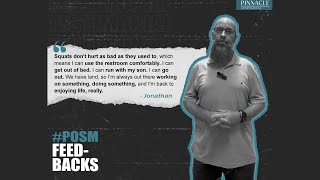
But squats don't hurt as bad as they used to, which means I can use the restroom comfortably. I can get out of bed, I can run with my son, I can go out. We have land. So I'm always out there working on something, doing something, and I'm back to enjoying life.
So that's where it's at. Love that for you. What would you say to somebody who's considering Pinnacle, Integrative Orthopedics and sports medicine and our programs here with the stem cell prp. Any of our biologics.
Don't think about it, do it.
Thank you, my friend.
Yes, 100%. This has been a blessing.
Oh, thank you.
The first person that's actually done something for me, too, and I've seen four or five other specialists that said, no, we're not going to touch you.