60 Minute COVID-19 Functional Medicine Q&A
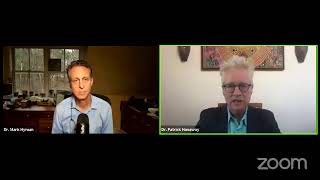
Dr. Mark Hyman and Patrick Hanaway discuss COVID-19 through a functional medicine lens, covering immune support strategies, supplements like vitamin D and quercetin, and lifestyle changes to build resilience. They address chronic disease risks and emerging therapies in a live Q&A format.
I believe so. I'm there. You should be. Setting everything up, hang in, hang tight Drew just said. But I'm right here and I'm ready to roll. Okay, are you gonna jump into the whole macrophage synthesis NAD thing? The NAD thing you sent me today? I'm not hearing you. Let's see, I am not hearing you.
Oh, there we go.
Now I'm hearing.
We're going to be starting in a few minutes. We're letting everybody join and soon people will be coming on the webinar. We have about 10,000 people, so I don't know if we can get to 10,000 questions, but We'll do our best between Patrick and I. Patrick, thank you for joining us today. This is really great. We have a chance to talk to people about what's going on with COVID-19 and how we need to think differently about it and help each other get through this. So, yes, thank you. Hey, I'll just give a few more minutes for everybody to join on. And we've got people from all over the country, all over the world, Newport on the island, Christine from Washington, lots of people. Holy cow. Livermore, California, Washington, Venice, California, Maryland. Wow. So many people.
Sacramento, Michigan, Colorado, Austin, Cape Cod.
Carolina. Okay. Wow.
Sacramento.
Hey, Mark, can you go to gallery view?
Please?
Yes, I need a gallery review. Thank you. All right, so wow, everybody's joining. We're just gonna let everybody join for a minute. Hundreds of people, thousands of people. Denmark, we have Denmark, Oregon, Tampa Bay, Katy from Houston, Bonjour from Montreal. North Carolina, South Florida, LA in the house. Okay. Holy cow. Cleveland, Ohio. We have Giselle, Ireland. Hi, Jake Kelly from Ireland. London, Nancy from London. Wow, this is quite amazing. Patrick's in North Carolina, right, Patrick?
Yep.
I'm in Massachusetts. And for those of you who don't know who Patrick Hanaway is, I will tell you in a minute. Let me see. Okay, we're getting up there.
I hope you don't have to read who I am.
No, no, no. I don't have to read who you are. I'm just looking at all the people joining from Sydney, Australia, and Caribbean, Duluth, Minnesota, Central Massachusetts, Ohio. Okay, that's probably nice there in Ohio. Carson City, Nevada, San Antonio, Texas, Rosemary, Brenda from Scotland. Welcome, Brenda from Scotland. And somebody from Hawaii and Judy from Ohio, Aloha from, I'm assuming that's, we've got Queens. All right, Queens. I grew up in Queens, so that's good.
Victoria, Australia and Jamaica.
Goodness gracious. Wow.
Cairo and Toronto.
Okay, well, we're going to start it and this is all be recorded so you can go back and listen to it. And for those who catch the beginning, you can go back and listen. So, I'm Dr. Mark Hyman. I'm a functional medicine physician. I'm the head of strategy and innovation at Cleveland Clinic Center for Functional Medicine. And Patrick Hanaway is a close friend and colleague. We've been both in the functional medicine realm for over a couple of decades now. And Patrick and I started the Center for Functional Medicine in Cleveland six years ago. And now Patrick is the advisor, senior advisor to the CEO of the Institute for Functional Medicine and he's the coordinator of the Bid-19 Task Force for the Institute for Functional Medicine. And we thought we'd have a Q&A on COVID because people are so confused about what's going on. They're so distraught about different things they're hearing in the news and trying to make sense of all the confusion. And I think, you know, as providers, as healthcare workers, we are also trying to sift through the data and separate the wheat from the chaff and make sense of what's happening, which is not easy, as you can imagine, because there's a lot of noise, there's a lot of hype, and we want to try to find out what is true, what is not true, and how to actually sort through the levels of evidence about what is out there for us to do to protect ourselves from getting COVID-19, to protect our families. And also, if we get sick, what we can do. if we are not in the hospital and if we go to the hospital, what are the kinds of things that actually are important for us to do? You might see a cat coming along. This is my cat. Don't worry about Yoda. He's a helper cat and he likes to sit and join me when I do webinars. So just a background a little bit for where things are at today is April 8th. There are one and a half million cases to date, according to John Hopkins. And I think I have to take them down. Very distracting. There are a million and a half cases. There are about 419,000 of those cases in the United States. And unfortunately, we are the number one location by far, more than double any other nation or state. I don't understand. I think Patrick, he's looking for you. He's very excited about this webinar. Yoda. And there are about 87,000 deaths globally, 317,000 people have recovered. You know, what's interesting is that South Korea and United States both had their first COVID-19 case on the same day. They now have 10,000 cases, we have 419,000 cases. And that's because they were very, very aggressive and early testing in tracing of contacts, identifying contacts and cases, and socially isolating them aggressively. And we really did not do that in America. We failed miserably on the testing front, on developing the testing, on scaling the testing, and on the social distancing and contact tracing. So that's really why we're in the situation we're in, and we're trying to play catch up. There is sort of a On the high level, there's some good news and bad news. The good news is that most people who get COVID-19 will be fine. 80% are asymptomatic or mildly symptomatic. About 20% may need to go to the hospitals. And of those, up to a third may need to be in the ICU and up to 5% on ventilators and about a 1% death rate is what we're looking at, although it varies depending on the population. elderly, if you have a chronic condition, which by the way affects six out of 10 Americans, if you have diabetes or obesity, even younger, that also increases your risk significantly. There's basically a three-fold increase in the risk of death if you're obese, and that is 42% of Americans. And that's why we're seeing in Louisiana seven times the death rate that we see in New York City, for example, which have more cases, but just the per capita death rate for people who get sick is much, much higher. I think I'm gonna just let my cat out because he is making so much noise. Hang on, Patrick, you say something.
Sure, in addition to all the things that you're talking about, we also see that it's affecting people of color to an increased degree as well. Men more than women and people of color, and whether that's simply due to lower socioeconomic status or whether there are other genetic and racial factors, We don't clearly know the data. We'll learn more over time. But Mark, as you said, it's the role of obesity and of complex chronic disease that is going to affect the immune system and the ability of the body to fight back of where that innate immune system is in its capacity to be able to be ready when transmission occurs and you have a viral infection. And a lot of people, they're doing okay, but there's a subset who are not. And so we're gonna be talking about the things that you can do to help prevent it in the first place. The simple kinds of decreasing viral transmission in the first place, the public health measures that are being talked about, they're important and they're continuing to evolve with the use of masks. But then how do we help support the immune system of each individual so that they, if they get it or when they get it, they don't have a severe illness. It was a great conversation last week with the team that you had from Ultra Wellness Center to be able to talk about the modifiable lifestyle factors which are key, as well as some simple agents that could be used in working with the IFM Task Force and putting this together, looking at the data in humans beings, not experimental data, but in human beings, what's going to help to be able to decrease viral replication, what's going to help to amplify or support, strengthen the immune system, and what's going to help to reduce symptoms. And those are great things that we'll be talking about today, as well as some things that are on the cutting edge. And I think the last thing I want to say is that, You know, we now are having our practices that are primarily or exclusively virtual, like you do at the Ultra Wellness Center, like I do at Family to Family in Asheville, and there are functional medicine practitioners around the country who are doing the same thing, offering these same kinds of things. And, you know, you can find out more about that@IFM.org, find a practitioner. Yeah, thank you, Patrick.
So, you know, functional medicine, for those of you who don't know, is really a system of thinking that addresses the root cause of disease, but also it's a system of creating health. and it really focuses on underlying mechanisms of disease. And in COVID-19, the mechanisms that kill is overwhelming inflammation and oxidative stress and also an energy deficit of mitochondria. And these are things that we know a lot about from the functional medicine perspective. And there are a lot of tools that are really available to us to actually address this proactively with ourselves to get us more resilient and prevent us from getting sick. But also once we get sick, what to do to actually help to enhance our recovery and reduce our chance of ending up in the emergency or in the hospital or the ICU or worse. So I think this is really what we want to focus on. And I think what's really exciting about the Institute for Functional Medicine's COVID task force that Patrick is heading up and coordinating is that it's trying to look carefully at all the literature about what we know works and what we could try and what are the risk benefit ratios on various kinds of interventions and things that we know. I think both of us have worked extensively at Cleveland Clinic and I'm keeping up to date with the kind of trials they're doing there. And it's very fascinating. So even in a place like Cleveland Clinic, they're looking at giving lots of vitamin C, zinc, melatonin, and acetyl cysteine, the kinds of things that we're exploring at the Institute for Functional Medicine's task force. So I think it's really an interesting moment right now because I think we have to We have to take the long view of this, which is how do we deal with this long term? What are the kinds of things that are going to protect us and keep our society safe, keep us safe? And some of the things we're going to talk about today are pretty far out of the box. But I also think they have the potential for being extremely effective in slowing this down. So Patrick, are there any words before we get into some of the questions that people have shared?
Well, I think, as you said, first talking about what's in the box and the box is changing. Because we see that there are hospitals now that are saying, well, how do we begin to introduce the role of zinc, the role of N-acetyl cysteine, the role of quercetin and curcumin? These things are known to be able to reduce or decrease the activation of that inflammasome, the NLRP3 inflammasome that gets activated and causes the cytokine storm. And there's good data on that in human trials, and there's low risk to those kinds of interventions. So, when we're talking about using turmeric at 500 or curcumin at 500 or 1,000 milligrams twice a day, things like quercetin, 1,000 milligrams twice a day, quercetin decreases viral replication and it acts to help to be able to decrease the NLRP3 inflammasome, both of those things. So, we take natural agents that we're looking at what's the mechanism of action of viral spread, of viral replication and of immune system suppression. what are things that we can do that would help to intervene in there using the mechanisms that we know to be the mechanisms of action that are happening in the disease? And so these things like these NLRP3, big term, inflammasome inhibitors, you know, basic things that we, you and I have used for a long time, whether it's curcumin or quercetin, N-acetyl cysteine, EGCG, epigallocatechin gallate, green tea, drinking green tea.
Supplements, essentially. They're not medication.
Yeah, exactly. So, this is how we work with it and this is all in addition to those things that your team, Liz and I'm forgetting your newer doctor. George and George. I know, Todd, but Liz and George talked about specifically and you last week of what can you do to be able to decrease your stress? What can you do to be able to decrease that dysbiosis in your gut? How do you avoid those factors that are going to stimulate the immune system, like as you say, the high sugar diet, the high processed foods. These are things that you have to do now. These are the greatest opportunities. And everything that we talk about after that is on top of those things. I remember you saying one time in a talk, it's like you can't exercise your way out of a bad diet. And you can't take supplements and have a bad diet and a bad lifestyle and not sleep and think that you're going to be okay. It's a both-and proposition.
Patrick, that's really important. And I think just for those who didn't catch the webinar last week, I'd encourage you to go back and watch it at drhyman.com/c19. There's a blog that we put together that goes through what are the fundamental principles of self-care food, what are the food is medicine principles, lifestyle principles, what are the supplements and so forth. And I think that's really foundational, but we'd like to get a little deeper into the weeds today about some of this stuff and some things we're learning about and how these things work. So, Patrick, why don't I sort of start by asking you as heading up this task force, you know, IFM has put out a number of documents. They're on the IFM website. What are the kinds of things that you're discovering with the analysis of the science and the data that are the most important things that people can learn about that that are available to us today from the point of view of supplements or even medications that people are looking at?
Well, I began to talk about some of them already and really kind of in a ranking almost on a priority basis, you know, looking at the role of curcumin because it will enhance the immune system, it will improve NK cell function and the natural killer cells, those are the things that go around. They eat the viruses, they feed on the viruses and we want that to happen. And so curcumin is going to be very helpful in that regard. It's also going to to decrease viral replication, decrease viral growth, and as an anti-inflammatory, it helps to reduce symptoms overall. Now, some people get confused and they say, oh, well, I don't want to take something that's going to suppress the immune system too far, and I don't want something that's going to stimulate the immune system too far. That's the beauty of these natural agents because we see that they're going to be more adaptogenic or immunomodulatory, and so they're going to help to find a point of balance. For instance, we'll talk about vitamin D. Vitamin D is well known to be an important source of being able to decrease viral replication because it's the antimicrobial peptides that are produced that actually help to bind viruses specifically. And vitamin D has a number of different factors. So someone wrote that, oh, vitamin D can increase a certain inflammatory cytokine called interleukin-1 beta, and therefore you shouldn't take it. no, that's from a cell culture from a study 20 years ago. But, Patrick, let me stop you there.
For a second because there's a lot of noise out there and some of the questions that were posed around vitamin D. So there's people saying, you know, vitamin D is critical for immune function. We know that if your vitamin D is low, you're more likely to die of respiratory infection called ARDS. You're more likely to get the flu influenza virus. You're more likely to be susceptible to various kinds of infections. and yet there's a lot of noise out there saying that vitamin D shouldn't be taken in the face of COVID-19, that it may actually make things worse and that we shouldn't be using it.
What do you say to that? Well, I say, well, let's look at the data. And the data tells us about its role in the immune system. It's not an immune booster, it's an immune modulator. And so how it's working, you know, let's look at the data on what we need to do to help support the immune system. And, and when we're looking at studies in the way in which we've set up our task forces, like we're looking at human trials, we don't care about what happens in mice, we don't care about what happens in cell cultures, we care about what happens in human trials, and that's how we evaluate the strength of evidence and the risk of harm. And so we see the risk of harm of these natural agents is relatively low, but the strength of evidence for something like vitamin D is excellent in terms of both its safety profile and its efficacy, the job that it does in being able to add helped the immune system overall. So, we can look at multiple different pathways that it's touching, one of which I mentioned called stimulating the production of antimicrobial peptides, but taking a dose or having something on the order of 5,000 IUs a day, especially if you're in latitudes that are, say, in the U.S. north of Atlanta and especially in the wintertime, where you can measure your vitamin D levels and have them be in that 50, that optimal 50 to 80 range that we know to be of great benefit. You know, and we do hear noise that says, oh, and if you get sick, you should stop taking vitamin D and go in a dark room. And it just, it doesn't really make sense physiologically, nor, as you said, you know, low vitamin D levels are associated with increased risk of acute respiratory distress syndrome.
So, you know, that's what should be one. Dr. What should be taking in vitamin D in terms of this should be taking a thousand, five thousand, what's safe? in the face of this?
Generally 5,000 every day is gonna be safe. It's not gonna put levels up over 100. That is a dose that I use personally, have used with patients for a long period of time. We get into toxicity when people start taking 50,000 units a day in higher doses like that. And generally things like 1,000 or 400 IUs are not sufficient to be able to get the vitamin D levels up and to really have the immune boost, immune supporting activity.
Which is usually what's in a multivitamin, right? So you wanna get more than a multivitamin.
Yeah, it's a 400 or 800 IU's. Remember, we're talking about we're using things like quercetin. I mean, you can get quercetin in apples and things like that, but you're not getting enough to have the therapeutic benefit that we're looking for in this case, to be able to prevent infection or to be able to decrease the severity of illness.
So what about like elderberry? Because there's a lot of debate about elderberry. There's been a lot of questions about elderberry typically used as something you get when you have a cold or flu. And people are saying that it may be causing this cytokine storm. It shouldn't be used.
Yeah, again, this is another one that similarly that questions were raised early on that says, well, we look at some older data that elderberry can increase in fact that same interleukin-1 beta that has been associated with cytokine storm. Recall that the immune system is happening in a bell-shaped curve. What we want is the Goldilocks, just the right amount, not too much and not too little. And if we have too much of it, we can create there can be problems that can emerge. But when we look at elderberry overall in terms of its its effects. We've studied it in flu for a long period of time and been able to demonstrate that the benefit of elderberry, it decreases symptoms, it improves return to work, it strengthens the immune system, it increases NK cell function, all of these activities with elderberry. So why would we want to stop using it at this particular point in time? Now, I've heard that it can have an effect in autoimmune patients, but I've used elderberry with autoimmune patients for a long period of time and never seen any kind of clinical deterioration. And in fact, I've never seen a case study in any of the peer-reviewed literature that says autoimmune diseases get worse if you put someone on elderberry. So these are theoretical considerations that have not actually ever happened in practice. So taking elderberry, you know, Sambucus nigra, you know, a relatively well used herb for a long period of time across many different cultures is great to be able to use at a dose 500 milligrams a day, taking that in a tincture form and a capsule form.
Yeah, and I think that's fair, Patrick. I think it's important to say that a lot of people are saying a lot of different things. We have a lot of basic science, we have a lot of clinical data, but there's very little specifically on COVID-19. So people are making assumptions, extrapolations, guesses. There are a few things that I have seen, and in fact, one was a combination of of vitamin D, about 10,000 units plus intravenous vitamin C in China with good outcomes. And I think what's interesting is, I just listened to a brief report by five intensive care doctors who were actively using vitamin C intravenously, heparin, and steroids, basically methylprednisolone, which is a steroid. early on. So as soon as people are admitted to the hospital, not waiting until they get to the ICU, waiting until they're on a ventilator, but early on seeing dramatic improvements in these patients to prevent them from progressing. So I think, you know, there's a lot of interesting things that people are trying out there, whether it's vitamin D and IV vitamin C or whether it's just these combinations of things. But this is a very strange disease. It's unlike, I think, anything we've seen before. It has unusual features. where people can literally go from being fine and just a little, you know, sick and short of breath to literally needing a ventilator within 12 hours. The, the people who get on the ventilators, they can stay on for a very long time. And I think that we, we're assuming it's acting as a certain type of disease called ARDS, but it may be more like the high altitude edema, which is a very different actor. Like, you're climbing Mount Everest, and it's a very strange disease. and we're still learning about it and how to treat it best. And I think some of these other therapies that we're talking about are also being used, whether it's vitamin C in the hospital, whether it's some of these other treatments like N-acetylcysteine and vitamin D and melatonin, they can be very effective. So what else sort of come up in the discovery of the task force that has sort of caught your attention, Patrick? it is worth mentioning and helping people understand.
Well, where we're at is that we've gone through sort of the 12 most common highest rated components, and I've talked about some of them, curcumin, quercetin, zinc, clearly a role for zinc that we know has been antiviral in nature and helps to support the immune system. You've talked about N-acetyl cysteine, which is the precursor to glutathione. That's the most potent antioxidant that the body produces itself and the oxidative stress that's going on there. We've talked about vitamin D, vitamin A, and vitamin C also. Vitamin C, it seems particularly in the inpatient side and the hospitalization, using it in an IV format, but before that, being able to use it as a liposomal vitamin C in an oral form and doing that three, four, five times a day, the turnover of it is very high. You want to be taking it on a regular basis, at least if you're sick or prevention. For prevention, for prevention as well as if you've gotten exposure. So, you know, let's think about, you know, some of us have been looking at Dr. Seholt's Med Cram, you know, and relearning some of these pathways and how it works. But, you know, the idea is that if we have a strong enough immune.
System.
That as the infection, as get exposed to it and the infection is occurring and the immune system is working, we just need it to be strong enough to be able to help maintain our overall health and well-being and keep the symptoms low enough so that we don't have to go to the hospital. That's really where the greatest opportunity is. And that's where so both on the prevention side of all the things I'm talking about as well as the treatment side to be able to do it. Now, you mentioned melatonin that acts as an anti-inflammatory and that's been used used, you know, some really interesting literature on that from the, from, from cancer patients in terms of being able to use that. Not, it's not just for sleep anymore, melatonin, but, you know, taking a good sized dose of that elderberry, a new one. Well, there's two things. One, on a personal basis, looking at the role of green tea extract. And, and what it really came to be aware of is that the data on green tea extract is that when you take it in a pill form, you got to be careful because there's a small subset of people who can develop liver problems from that. It can be hepatotoxic. But if you take it as green tea and drink your green tea and having like four cups of it a day, you don't have the hepatotoxic side effects. You got the good taste and you get all of the benefits of the, of the green tea extract. So in, in addition to reducing inflammation, it's also going to help to enhance the overall immune system and it targets one of the processes involved in COVID replication. So green tea, I've been drinking four to six cups of it every day.
I hope you're not too caffeinated. That's why you're talking so fast. Okay. That explains it. You're over too much green tea.
I'm excited. I'm excited. But no coffee. And then one other interesting new agent that I've learned about from our friend and colleague, Dr. Kara Fitzgerald, is something called palmitoylethanolamide. Now, this is a natural agent, PEA, that has been used and been able to be extremely helpful as an anti-inflammatory and also helps to improve outcomes in respiratory disease that's related to influenza.
And where do you get it?
And so, there are specific formulations called PEA. There's some companies, I can't remember.
Where does it come from? Is it from a plant? Is it a fat?
You know, it's a plant-based compound. It's a naturally occurring compound. I mean, I gotta get my notes.
I can't remember. Okay, no worries. We're all learning as fast as we can. We're all learning as fast as we can. I think there are some other questions I want to get to that people have shared, and we got a lot of questions last time. I think one of the things that Christopher Alfaro asked from last time was, I'd love to hear your thoughts on the use of ozone as a treatment for COVID-19 infection and other uses. I'm just going to spend a little time, Patrick, just while you're looking that up to share about this, because in Italy, there is now an initiative using intravenous ozone for COVID-19. For those of you who don't know what ozone is, it's a gas O3. It's highly volatile. It's this set of fresh smell when the lightning strikes and you get that ozone smell, that's what it is. It's definitely dangerous to inhale and it has been used in medical therapy for a long time, for decades. It was developed in the 1800s, the first ozone generator. And essentially the method is using oxygen and ozone infused either into blood or directly into the vein. And it creates a whole set of responses that actually may be very effective. It's one of the most powerful disinfectants and germicidal agents on the planet. So it literally has a direct killing effect on viruses. But it also activates your immune system in the sense that it increases the anti-inflammatory cytokines and it decreases the inflammatory cytokines. These are the things that kill you with the cytokine storm. that happens with COVID-19. It also activates all your antioxidant enzymes and helps deal with the overwhelming oxidative stress that causes organ damage. It also may increase stem cells. So it also increases blood flow and the beneficial effects around the coagulation. So there's a lot of benefits to this. And, you know, I just read a report, peripherally, that the equivalent of the National Institute of Health has approved its use. It's used in 17 hospitals there. They had the first initial report of 36 patients, 35 who were admitted to the hospital, recovered and didn't need ICU care and were discharged, one needed ICU care. That's in contrast to about a third of patients admitted needing ICU care in the United States. So I think there's a lot of potential for this. It really needs to be studied in a rigorous way, but as a potential therapy for COVID-19 and for viruses and infections in general, I think it's extremely effective and really worth looking at. and I'll share some extra data and resources on this afterwards, linked to the post. But I think it's such an important moment in history where we can all therapies, we need to try things in a rigorous way that are safe. And again, we're talking about a lot of different therapies here, whether it's quercetin or N-acetyl cysteine or green tea or curcumin or vitamin D or zinc, vitamin C. These are things which are safe and have potential benefit. I think ozone potentially a little more riskier, but has been used as a safe, effective medical therapy for decades and is used around the world. So, in theory, it's really hard to find a beachhead and I'm working hard to try to find a place where we can get this studied, but I think it's going to be in a very important therapy. And I believe that if we find it as effective as we're seeing in Italy, that this literally could be a key part of the strategy to eradicate this virus, to let us get back to work, let us get back to our lives, because it will become instead of a deadly life-threatening disease, something that's treatable and fixable with a very simple and inexpensive treatment that's scalable. So I think, you know, again, we have to be very cautious about what we're recommending, but I think this is.
Definitely something to think about. And so on the therapeutic side, and Mark, I've watched you. I've watched you go through your own healing, which was deeply helped by Biozone and helped you to kind of spring back to life, which was beautiful to see. And, you know, it may have effects that not only in terms of its antioxidant effect, but some of the newer data that we're seeing just over the past couple days, as you talked about, that this may have something to do with the way in which oxygen binds to heme and the role to the hemoglobin molecule and the role in which that is occurring, as you said, more like a high altitude pulmonary area edema, because we see this picture where we see a white out of both lungs and that doesn't happen with pneumonia in general.
No.
Something else is going on and the rapid deterioration that we're seeing is not consistent with a typical, acute respiratory distress or ARDS type of syndrome. So ozone as a therapeutic benefit, particularly in the hospital, is a fascinating opportunity. And as you said, the Italian studies are really provocative. And this can be done, you know, it'd be interesting to see that done of ozone or ozone and vitamin C together versus neither and see how we see a benefit from it. I think it's a great opportunity. yeah.
And again, you know, there's, there's, there's so many different things that people are trying. There's drugs like remdesivir, there's convalescent plasma, which is basically the antibodies that are from someone who's been sick and giving them to someone who's well. I mean, someone who's, who's already sick and trying to treat them that way. There's, there's a lot of work going on on different antivirals or immune modulating drugs. and nothing sort of to date has really jumped out. There's the chloroquine and the Zithromax combo, which people are using in desperation. And it's not clear how far it's really working because people are dying every day and if it was working, they wouldn't be dying. So I think we're still in the stages of discovery, but it's interesting to see across the world how scientists are working so hard to innovate and try different approaches to really help patients in this really tough condition. So I think that the the goal really is to stay safe yourself. And I think the diet part is really important. I want to emphasize that because I read an article in the New York Times last night about how people are going to comfort foods and going back to eating macaroni and cheese and Cheetos. And I think this is the worst time to do that. I mean, we're all able to be at home now. We all can cook. We all can actually start to make real whole food. And that is more essential than ever because a lot of things we're talking about about quercetin and curcumin and Zinc. These are things you can actually include in your food. You can have pumpkin seeds, you can have Curry. I made a curry the other night, which is really good with a lot of turmeric in it. So we can start to use medicinal foods in our cooking to help us and strengthen our bodies and immune systems. Really, really important. Yeah.
I don't think you can underestimate the, the role of, of nutrition, of food as medicine. And I also think that there's a, there's a place. where people are super stressed. They're stressed financially. They're stressed by not being able to get out. And yet now we have a chance to be able to get out in nature and be able to just connect to the world. The cherry blossoms are blooming right outside my window here and being able to use that. These are important times to connect to the natural world. Go out and walk with a loved one who's part of your family pod. If you see other people, you just stay six feet away from them and say hello. That's an important thing to be able to do as well. and we wanna come back to also saying, well, those are the essentials, and then what are additional things? And you were asking me about PEA, it comes from soy lecithin, it comes from egg yolks, it comes from peanut fats, it's derived from that, that's the source of where it comes from. But we found it to be a useful agent for not only preventing viral illness, but also for in treatment of viral illness. And if you go to ifm.org, you can look at the document that our team has produced. You can see what the references are. You can see what the specific dosage recommendations are as a means of being able to deepen your understanding of this. And then we'll be continuing to do deep dives where we're looking at colloidal silver, andrographis, astragalus, Chinese medicines, skull cap, the beta glucans from mushrooms, which are our immune immune modulating, immune supportive, the shiitake, maitake, lion's mane, as well as, as I said, the beta glucans. And we'll be getting into those as we go along. But you've highlighted something, Mark, where it's like the way in which we work in functional medicine is we want to understand what the mechanism of action is of what's going on and then work to support that. So we're looking at the immune system and the inflammatory process. We're looking at viral replication and how that's done, and we're making specific recommendations in those regards. We're not sort of just willy-nilly just throw a bunch of stuff at it rather. Let's really target what we're doing and we don't yet know the full pathophysiologic mechanism of action of what's going on with this particular virus. You know, we've talked about some things in terms of oxygen binding, we've talked about some questions around microthrombosis that are coming in, you know, why they're using heparin, you know, should we use nattokinase, a great agent to help with kind of the clotting micro thrombosis. But these are ideas, they're new, you know, so those would sit on the experimental realm of things. We don't want people going out and saying, oh, do this experiment and this experiment, you know, but we also see that, you know, when, you know, some of our colleagues, patients and their loved ones are getting sick and they're just not getting better, better. We're going to start saying, okay, well, I've tried the first 10 things on the list. What else you got? How do we do this? And I also think that it's going to be important not only in the decrease in the severity of symptoms to prevent hospitalization, but also on the recovery side. We know from data from SARS and MERS that there's long-term consequences and insults to the lungs, to the heart, to the cardiovascular system, and to the kidneys. And so what do we need to do to continue to move forward to be able to support our patients to support each other in this process? And that's going to use the lifestyle factors and some of these specific agents to be able to help and support, you know, vitamin A's role in helping the respiratory epithelium and the mucosal epithelium. It's a great tool to be able to use. And people are afraid of it because, you know, if you if you take 50,000 IUs of vitamin A every day for three months or a year, that's too much and you're going to have a problem. But if you take 10,000 to 25,000 units a day, you're not going to have a problem with it. And the data shows that you're going to do better than those who are not using that vitamin A. And these are in long-term population studies that have demonstrated an overall benefit to the immune and a decrease. Now, one, for instance, nursing home study that my friend Bob Roundtree talked about just last night we were talking. He said, you know, they went in and they gave vitamin A at 10,000 IUs in the nursing home to decrease influenza. Now, this is influenza. It's not COVID, but it's another viral factor. And he said, and at the end of the year, they went in and they found that the people who were on vitamin A they didn't have the same number of sick days and they didn't need the additional support. But in fact, when they measured their blood, their titers, they'd all been exposed to influenza to the same degree as the others. So it helps to support the immune system, you know, so we may get exposed and we may be carriers, but, you know, we want to be in that asymptomatic carrier state and then be sure we don't give it to, you know, to grandma or Uncle Joe who's got type 1 diabetes or Aunt Jean who weighs 300 pounds who's going to be at risk.
I mean, this is one of the problems is we're dealing with a rapidly evolving knowledge base and understanding. So at first we're like, well, we don't need to wear masks unless you're a healthcare professional. And now we're being told to wear masks. And I think part of it has to do with the fact that According to Anthony Fauci, 20 to 50% of people can actually transmit the condition without actually knowing they have the virus. And the wearing of masks or wearing a cloth mask or something to cover your face when you go out is not so that you don't get the virus. It's so you don't give the virus to somebody else unwittingly not knowing you're sick. And so there are social and public health things that we need to do that aren't necessarily going to protect us, but that are going to keep the spread low. Because if we keep the spread low, our healthcare systems won't be overwhelmed and we'll be able to deal with it. But I think we do need to really make sure that we are practicing proper hand washing and sanitation, and that we are limiting our excursions to those only essential things we need to do at this point. The problem is that there's a hardship to everybody in terms of the unemployment, in terms of lack of access to a normal life, and people are getting tired of it even after just a few weeks. But I think unless we come up with some effective treatment, whether it's this combo of IVC methylprednisolone and heparin, or whether it's IV ozone, or whether it's something else to really treat this, we're going to have to be in and out of this isolation. I think the more we relax the guidelines and let people not do social distancing, I think there'll be a resurgence. And I hate to say this, but unless there really is an effective treatment, and ozone, I believe ozone may be that treatment, we're going to be in this situation for 18 months to two years until there's a vaccine. And then the question is, you know, is it going to work and how long is it going to take to get onto the market. And there's a lot of unanswered questions. So the more we can bolster our own health, the more we can take care of our families and those we love, the more we will be doing to protect the greater population who's really struggling to actually stay alive. And I think that what really terrifies me is this burden of chronic disease. And one of the questions was asked was about intermittent fasting by Paula. You know, is it a good way to boost immunity? And I think, you know, it speaks to something more important, which is that only 12% of our population is metabolically healthy. That means 88% are not. And those are the ones that are at risk. And, and so anything you can do to optimize your metabolism, whether it's getting off of starch and sugar or whether it's doing time restricted eating, which is eating within an so these things help to reduce inflammation, to increase your antioxidant systems, to build your stem cells, to reduce the inflammation in your body and help you to reverse the diabetes and pre-diabetes and insulin resistance that affects so many people. So, as an act of self-preservation and as an act of public service, taking care of your health now is more important than ever. And I encourage people to do it on their own, to work with a doctor, to do whatever they again, there's telemedicine going on at the Ultra Wellness Center. You can certainly access any bars, family to family as Patrick Center down in South Carolina and North Carolina. There's other functional medicine practice out there to help you with this, but it's really important now more than ever to get, to get a handle on what's going on with your own health and to take care of these things. And, and intermittent fasting or time restricted eating is a great way to start.
To optimize your metabolism. I think that's, that's very well said. You know, I'm, I'm a fan of the intermittent fasting and being able to do those things, you know, people people say, well, what about a ketogenic diet? And is that going to be helpful? You know, and to me, I am a fan of the ketogenic diet in certain circumstances or the ketogenic diet, which is really focused on being sure that you have enough vegetables in your diet. I mean, the food pieces come down to like eat your vegetables, lots of them, lots of different colors, a whole rainbow spectrum of being able to do that. kind of highlighted again the importance of the nutritional factors. Other kinds of questions that people ask are things like, well, what about sauna? And early on, I remember seeing a podcast with Joe Rogan, where it's like, no, it's probably not going to help because it's a cold virus and if we give it heat. But there is some interesting data out of Finland. Finland is a country that has one of the lowest rates of this occurring at this point in time, and that that heat followed by cold both stimulates the immune system and decreases viral replication. So there may be some opportunities there in terms of the hot cold interaction that are going on. All of these things have been done in different cultures over time to help improve their overall wellness. When you talk, Mark, about the role of functional medicine of being a system that's taking a big picture view of how do we support the whole being? And so it is those modifiable lifestyle factors and then saying, what are the things that we're learning in the literature about the way in which, in this case, COVID is working that we can do and let's pay attention to them? And so when we look at the role of obesity, well, now is a great time to be able to, you know, focus on that, you know, 10-day detox or that elimination diet that's going to help you to break the habit of being fixed and caught on and we know that we're going to tend to go towards those comfort foods when we're stressed and when we're, you know, I'm at home more than I ever have been, you know, doing work from home. It's like, so I go to the refrigerator, you know, in the middle of the day, I go to the refrigerator. When I'm at work, I don't go to the refrigerator. You know, it's fortunate that there's good foods in the refrigerator, and it's fortunate that I have a, you know, a time restricted eating pattern. So, you know, I'm able to maintain my health and well-being. and what we find one of the fascinating things, I don't know if you've seen this, but I've seen this in self and family and friends and patients that I've talked to is that, you know, sort of the Achilles heel that we have seems to show up greater in times of our own personal stressors, you know, and so like look at what that is, the importance of sleep, the importance of exercise, of getting out in nature, you know, what are each of those things that we can do? And we saw, you know, lots of other kinds of questions that people had along the way in terms of, you know, what are the things that we should do? You know, let's look at questions about contagion and how long are we contagious after the virus? Let's talk about, you know, kind of testing and where things are at. And, you know, this is really going to be a big unfolding over the next two to four weeks as our understanding grows. And so we get exposed to the antiviral and the antigen, you know, we're going to find it, especially in our nasal pharynx, in that deep tissue swap, kind of swiping the mouth or spitting, we're not necessarily going to find it.
Stick the thing way up in your nose.
You got to go there in order to be able to find it. So, you know, data is saying the testing is maybe 60, 70, or 70% right. It's probably mostly a sampling error because the testing for or a very simple, you know, four-stranded RNA, not that difficult to figure out if it's there. But if you didn't sample right, you're going to have a problem. Now, that's, that's, do you have the antigen? Are you carrying it? Now, that doesn't tell us anything about what's happening with your immune system. And as you said, Mark, there's a lot of people who may be asymptomatic carriers, so we don't even know, and they're out in the environment. So that's where in the future we're seeing the first OKs of finger stick testing for antibodies. Antibodies that look at IgM and IgG. IgM is the first one to come along and then IgG is sort of your memory cells. So IgM is telling us you have an acute infection that's going on. Now, if you do the test, but you got to wait seven days to get the result, not very helpful, right? You want to be able to have the answer right away. And we know that IgM is not going to come on until three to seven days after you've been exposed. so the antigen is there at the beginning, three to seven days later, you're gonna have the IgM. So you may, you can do the test, you can get exposed, you can go do the finger prick test and it says you don't have it, but then three days later you get sick. That's how that happens. So in Telluride, in San Miguel County in Colorado, they've just done a testing of looking at all 8,000 people in the county. and doing IgM and IgG testing on everybody.
So they have- For COVID-19.
For COVID-19.
Because this test, by the way, just these are just recently developed and FDA approved, so they're very new. And the more we're gonna have these tests available, the more we'll see who has had the infection. The question is, if you've had it and you have the antibodies, does that mean you're immune and you can't get it again? We don't know. We think it's gonna protect you, but we're not sure. So unfortunately, it's really tough. to get the answers because this is such a new disease and it's such a new problem that we're sort of having to figure this out as we go along. But the idea is if you've been exposed and you have the antibodies, it's likely that you're somewhat immune and it does not care how long that immunity is going to last. And they are taking the antibodies out of people who've been infected and giving them to people who are sick and it is helping them. So the assumption is that it is protective. but again, we don't know for sure.
And they're also taking the antibodies out of people who haven't received it and giving it to them a much lower dose, 1/10 the dose, and being able to demonstrate that those people have much fewer symptoms and much less likelihood of having to go to the hospital. So it can help in both areas and in both domains. And we'll be learning more about testing and Mark, I'm sure you'll be on and bringing other experts on to talk about testing.
Yeah, we had a whole webinar on testing actually from one of the labs we did it. So we did a whole hour long, a whole hour long conversation about testing. So we got deep into it.
I think.
The important thing to remember, people, is that this is an evolving story we're still learning, but that it's important that you take control over your life, over your lifestyle and habits. And I think one of the things that is happening, and it's happening for me as well, is a level of stress. and there's a question from Dr. Diane Johnson who's a friend of mine. I haven't seen her in years. Hi Diane. And she asked about, you know, how do you maintain practices that are going to help ground you in these crazy times? And you know, I had a very, today I'll just share what happened for me today. I had a very stressful day, you know, I had lots of calls working on and starting to get studies going and just really really trying to struggle with, with the kinds of, of day-to-day management of what's going on and making a difference. And so I essentially I decided, I, you know, I do my routine. I, I exercise in the morning. I, I exercise and worked out. But then I was feeling kind of droopy this afternoon. So I meditated for 20 minutes. I have a steam shower, and I did the finished treatment. I, I went in a really hot steam shower. It was, but I was, it was terrible. I actually printed out some medical articles. I probably shouldn't do this because it's not like exactly relaxing. But for me, I print out some medical articles and took them in the steam. They got soggy, but I read the articles and then through it after. And then I jumped in an ice bath, and it really just helped reset my nervous system. So there are a lot of ways to reset your nervous system. It could be just laying on your bed and taking 10 deep breaths. It could be doing meditation. If meditation or listening to an app, a meditation app like Headspace or calm, it could be going for a walk in the woods. It could be just laying down like last time my wife and I just sort of, we were just feeling the intensity of all this. We just hugged each other for like 10 minutes and just stayed in a hug for 10 minutes. It could be doing the hot and cold treatments like I did. So it doesn't matter what it is, but you can change your. I learned this from Tony Robbins that each of us have a physiologic state and there's things you can do to change change it, whether it's doing, you know, 10 burpees or putting on some music and just dancing. And the other night, my wife and I had a concert. I have these nice speakers in the house and we just put on music and she would play a song. I would play a song. We had a little concert and just closed her eyes and just let go of everything. So whatever is going on in your life, you've got to just take a minute and take care of yourselves because this is one of those times that is testing humanity. and by the way, humans, this is not new. Humanity has been doing this for millennia. And there have been plagues throughout history that have actually been much worse. And this is new for us in this time and place, but it is something that has happened throughout history. In fact, I just ordered a book I read in medical school, in college, by Albert Camus called the Plague, which talks about a virus that ravages society and how people deal with it emotionally. So, you know, I'm kind of looking to that to get some sort of emotional insight and support. And I also wonder, you know, what's going to happen after this? How is society going to be different? What are we going to decide we can do differently? I mean, telemedicine is an amazing thing that's now opened up. It was so hard just going and now Medicare is paying for telemedicine visits. We tried to do this at Cleveland Clinic. It was super hard. Now it's just happening and everybody's just switched over. so I think there's going to be some good things that come out of this. We will get over it, and I think we're going to learn a lot more. And I just really, you know, I think I want to really have everybody stay tuned to the Institute for Functional Medicine research that's going on there. It's a really credible source. There's a lot of doctors and scientists who are scanning the literature, scanning the treatments out there, trying to make sense of it, trying to put some science behind it and give people credible information about what to do. And Patrick's heading that up. And, you know, Patrick, tell us more about this task force. tell us sort of what the goals are and what the things you're working on are so that people can understand what those are and where to look for them.
Thanks, yeah. So, you know, what we've done is, is first, the first thing we wanted to come out of the gate with is talking about, you know, how to be able to work with specific therapeutics that would work, that would be antiviral in nature. And so we did that. We, and we did that using a set of standards that I've talked about already. so that it's credible information, it's safe, effective, and valid, and we know that we can stand behind that. Then the next thing that's coming out this evening is that will be available, or actually, I guess it's on Friday, that will be on the website live for everyone, is about the Modifiable Lifestyle Factors. The things you talked about last week, but they're going to be specifically what's Antiviral? It's a great paper that we've put together. So we have different experts in the field who are putting the information together and then reviewing by our internal team, reviewed by a scientific advisory board that includes Joe Pisano and Jeff Bland, Bob Roundtree, Nan Suddak, a great group of.
People to say, these are the functional medicine all-stars for those who don't know who they are.
There you go. And so we want credible information to be able to get out to everybody. So we're also acting, so there's in-depth, we're going into these areas. We'll focus on testing, we'll focus on recovery. We haven't really spent time here talking about recovery. You've alluded to to it, but it's going to be a big deal for helping people, even seeing the patients and people that I've been in contact with, recovery, it's not a slam dunk for those people, even for some who haven't been hospitalized, but they've been in bed for 10 days, friends in New York City and in Hastings on Hudson, and they're wiped out by it. And so, what do they need to do to get back into their life? we'll be focusing on what that package is and how to be able to do that. So we're continuing to develop this and then we're going into other areas of depth as I talked about where we've got specific researchers and clinicians using the standards that we have to say, what about this? What about that? Going into each of the different kinds of agents, some of them I mentioned, you know, Colloidal Silver, Andrew Grafus, you know, we'll be looking at the data on on IV ozone and on IV vitamin C in the hospitalized situations and being able to make commentaries on that from a credible source. And we're also acting as a resource base or as a resource site so that people can go there and they can get pointed to credible resources like the American Nutrition Association that's got great data on food.
What's the website, Patrick?
Is it ifm.org? org. There's an orange banner right at the top that says COVID-19. There's also a light blue dot that says find a practitioner. So if you want to find someone who is in your community who or that you want to relate to, you know, because Mark, you know, our two practices are, you know, we can't handle everybody who's out there. But there's a lot of other practitioners who are out there who can help to serve those of you who are listening in your loved ones. Yeah.
Thank you, Patrick. I mean, this is Heroes work that you're doing. Everybody's working around the clock. You know, I think we're trying to put together credible information. So, check out ifm.org, somebody I think there was a all caps question from my Sandra about what doses of vitamins and this and that. I said, well, you know, a lot of that's on the IFM website. Also, if you look at my blog, Dr. Hyman.com/c19. I list the dosages, the supplements, the recommendations, and even the products that might be useful. So I think you can look there for those doses. There's a lot of questions about that. And I think, you know, there's still a lot we're learning, but I think it's really so important for us to take control of our health, to not feel defeated, to not start binging on things, although True confession, my wife had a breakdown moment and she decided she needed cupcakes and she loves cupcakes. So she went to the store and she got all the ingredients for cupcakes. So the truth is I might actually have a cupcake tonight. So, you know, whatever. Sometimes you just gotta go with it. But I think for the most part, I think all of us are in this together. We're all struggling to find solutions for ourselves and our families. and there's a lot of great scientists and a lot of great doctors out there who are working really hard to help you figure out what to do and we're going to keep you up to date and informed. I encourage you to keep following IFM's website, ifm.org, check out again, drhyman.com/c19, the Ultra Wellness Center, family to family, IFM practitioner database, all these people can help you navigate this crisis.
And I just also want to give a big shout out to the nurses, the respiratory therapists, the doctors, you know, who are in the ERs and in the ICUs who are putting themselves, you know, in the front line of this. The healthcare workers who are doing that have, there may be an inoculum effect of a bigger dosage of a virus, but they're dying at higher rates than anybody. in this and some of it may be the stress and we'll find out more, but I just want to give a big shout out to those people who are really putting everything on the line to try to help all of us. It's a big deal.
Somebody said, Nobody's answering our questions. We're doing our best. We literally have 10,000 people asking questions. So there are a lot of questions and I think you'll find a lot of the answers on the IFM website and on my website. and I, Patrick, I just really want to thank you for joining us in this webinar. I know you're very busy working on solutions for all of us and doing God's work. And I just really cherish you as a friend and as a colleague. And I think we're going to work hard to get the information out to people to protect themselves or families. And I think the work IFM has been doing this is really unparalleled out there. There's so much noise and this is really, where you're going to find the credible information that's been vetted and it's going to help a lot of people prevent it, to treat it at home, to recover from it, and also discuss some of the innovative therapies that are happening in hospitals to prevent the progression to severe disease progression to pneumonia and ICU care and ventilator and death. So, I think it's a very hard moment for all of us, but we're all in together. We're all working hard and I'm really grateful for all of you joining our webinar tonight and we'll see you next time.
Thank you, Mark. Thank you, everybody, for listening.
Thank you, guys.
More from AI




This Is Why 99% of Skin Conditions Don't Heal — And What Dermatologists Won't Tell You






Why you need to start strength training today #strengthtraining #healthyaging #fitness
