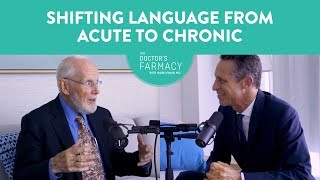
This is a YouTube video titled "Dr. Sidney Baker, MD Asks 'Are Diseases Just Ideas'?" containing a recorded conversation from August 2018 between Ask AI Mark and Dr. Sidney Baker. The discussion explores the conceptual understanding of diseases, emphasizing the individuality of patients and challenging traditional medical diagnoses, particularly in the context of chronic illness and functional medicine.
I wanted to start by asking you, how do you come up with these beautiful, simple, elegant ways of thinking that change everything about what we believed about disease and health?
It's hard to say how I come up with it. I must say it's just simple mindedness, really. I think that I started with a very simple principle. At an early stage in my education, I found myself on the fork in the road that says that the patient is the target of treatment. And then it turns out that patients are all individual. And whereas diseases are kind of groups and really not things anyway, they're just ideas.
Let me just stop you there for a minute. That is a very big statement that diseases aren't things. they're just ideas we have about things.
Exactly.
And this is what's gotten us into trouble in medicine. We say someone has autism or rheumatoid arthritis or diabetes, but the truth is that those aren't all uniform and there are many different causes for those same diseases in different people. In fact, if we don't have the right map, we can't figure out how to fix it. And you have been the map maker in functional medicine helping us navigate.
Well, the point is that the giving of a diagnosis makes the doctors look good. Like, I know what you've got.
Well, that's what we're trained to do. We're trained to basically make a diagnosis and not think about the why, but just what disease people have.
And if it's sprained ankle or a strep throat, I've got no argument about that.
That's fine.
That's acute disease. But we have not in a generation when chronic illness has become the made burden of people, these days.
One out of every two Americans.
We haven't shifted our language out of the acute illness model. Like, I know what you've got, it's a sprained ankle, I know how to fix that, or nature will fix it for you if we put a bandage on it. To one in which, I know what you've got, it's autism. And then the parents who are already in a pretty anxious state, about what's wrong with our child who can't talk and can't behave. And I think, oh, God, I'm so glad you know what it is. And then I think, well, but what do we do about it? Well, and it depends on the doctor, but in the way I was educated, the doctor basically says, We don't know. For a generation, the doctor would say, well, it's his mother's fault. But fortunately, I wasn't caught in that generation, although I was educated that way.