Food is Medicine Seminar
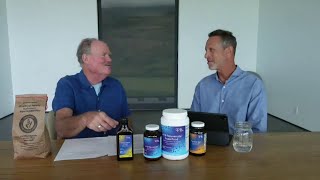
Dr. Jeffrey Bland and Ask AI Mark discuss functional medicine and how food shapes health. They cover the immune system, food quality, and regenerative agriculture, including projects like Big Bold Health and Himalayan Targhee Buckwheat.
Seriously run into Dr. Mark Kennedy. That's a joke. That's a joke. But we're so excited to have the chance to share some ideas with you.
So, Mark, thanks so much. Jeff, thank you. I'm so excited to be sharing with all of you a little time with one of my heroes, IELTS mentors. The reason that I do what I do, Dr. Jeffrey Bland, who, if you've never heard of him, it's too bad because he's one of the geniuses of modern medicine. who I think should win a Nobel Prize and basically be having an entire medical school named after him. And more and more and more, because he's really the guy who's inspired a whole generation of functional medicine doctors to do what they do. And we're just so thrilled to be able to have this time to chat about some really cool stuff we're doing together.
We are, we are. And you know, it's, for me, what is life? It's life of a collection of experiences. And hopefully those experiences are on the main good and they build who you are. you know, our genes are the template upon which we grow. We lay our experiences. And the day that I met Mark Hyman, who was at that point just starting it or applying functional medicine and clinical practice training program, and was immediately within the first 10 minutes, my star student, I could tell that Mark Hyman had this extraordinary vertical opportunity.
I was all with all the questions.
Yes, you were. They were big questions. And I, we've been affiliated for the last 25 plus years ever since. So. I've had a number of questions asked of me recently as to what are you and Dr. Hyman doing, Jeff Plan? And so I thought maybe Mark and I could tell you a little bit about what it is because it's pretty exciting for me personally. I think Mark will share his own thoughts, but it brings together and closes the loop for me ever since my starting as an assistant professor of chemistry and environmental science on Earth Day here in 1970. And you'll see how that kind of weaves its way together into this relationship today. So Mark?
Yeah, you know, it's true. We've come a long way together over the last 25 years and developing functional medicine.
And, you know, a couple of really.
Important themes have developed in that work. One is the idea of food is medicine. And if that's true, then it actually sort of invokes the question, how do you get the best medicine in food? Which takes us on the other part of the conversation, which is regenerative agriculture. So the two things that I'm really most passionate about now are how do we get people to understand that food is medicine, not just calories, it's information, and how do we help them understand that it's not like what you eat, but how it's grown or raised that matters to determine the quality of the food. And that's what my vegan diet book is about, really about the the fact that we should be focusing on quality, that we should be focused on food as medicine, that we should focus on how we change our food system and agricultural system to actually grow the food in a different way. So I'm super excited about this conversation because we're bearing together with this new project we're working on together, these old ideas about how do we rejuvenate our health? How do we rejuvenate our immune system? How do we use food as medicine? How do we take advantage of the magic in nature to regulate our own biology? as well as to help the earth itself heal and repair all the damage we've done from the destructive extractive agriculture practices we have and create a regenerative system for regenerative health and regenerative medicine and regenerative agriculture.
So in 1977, I was teaching at the Omega Institute. Dr. Stefan Rechsteiner had just started this institute in Rhinebeck, New York, and I did a course on food is medicine. Believe it or not, 1977. So at the first break, a attendee came up to me and he said, well, Dr. Bynum, I'm pretty discouraged about this program. You know, he's going to spend the whole weekend with me in this course. And I would only been like two.
Hours into the course.
And I said, so why are you discouraged? What did I do wrong? He said, no, it's not what you did wrong. He said, I thought this was going to be about the vitality of food. I thought this was going to be all about the liveness of food. I thought this was going to be about how food brings energy from the planet to the individual. And all you're talking about is chemicals. And that's not really what I was interested in. So I'm a learner like everyone else, maybe sometimes not the fastest learner, but I'm a learner. And I think over the years, where Mark and I have more and more upon our convergence is the recognition of the system. everything is interconnected to everything. And it's understanding the system that gives health at every level, health to the planet, to the plants, to the animals, and ultimately to the people. So that is part of this transition that we're engaging in now in this collaborative effort. And I, as I told Mark when I wrote a review of his book, the Pegan Diet, his most recent book that I published in the Integrative Clinician's Journal, I feel that the Pegan Diet book is, although I've loved every one of Dr. Hyman's books, I thought it brought together so many different features. I really thought it was chalk filled with news to use. And when I evaluated the Pegan Diet, this combination of the Paleo Diet with the vegetarian diet, this concept that Mark came up with, I thought it was brilliantly able to demythologize so much about food and health. And then it connected into this project that we're collaborating on that we're going to talk about.
Yeah, that's so true. And you know, you just sort of mentioned everything connected. It just reminded me of your quote, which is when we try to pick out anything by itself, we find a hitch to everything else in the universe.
Yeah.
And that's what we found as we sort of go down the rabbit hole of food and food system and agriculture and our biology. Everything is connected. And so, you know, I think the world is sort of ready for a new way of thinking about health. beyond just the old disease model. It's about how do we create health? How do we create health within ourselves? How do we create health within our communities and our planet? And it really is about rethinking the production of food and the consumption of food, the focus on quality and particularly some of the things that, you know, this new project you've got going on called Big Bold Health does, which is, it just really nails the idea that we can use food to reset our biology. and we can use food to rejuvenate our immune system. This whole concept of immunity rejuvenation is so amazing because especially under the time of COVID our immune systems are under assault. A lot of people are getting sick because their immune systems aren't working well. They're out of balance. And you're seeing cytokine storms and deaths and all this.
It's really because we're so messed up in terms of our lifestyle and our diet. Yeah. And I think that what you have done is laid an incredible track. I think that Dr. Pharmacy is a podcast really is pioneering this concept of interconnecting these variables together. And for me, I'm going to say something controversial now, so I'd like you to attack it if you feel it is not on spot. But I believe that every person needs an entry point into their own health. They need a door into the room of health, not a door into the room of disease prevention, but the door into health. which is slightly different than disease prevention. And so when I think of health for me, and here's where the area probably of controversy might reside, I think of health in the individual not being defined as the absence of disease only, but being defined as what I would call high level function. And function to me resides in four different subcategories. Physical function, to do the things you want with your body, moving in the planet around. Second is your metabolic function, those things that we spend, I spend a lot of time talking about. Third is your cognitive function, which you've done a brilliant job with your various series on brain health. And then fourth is your behavioral function. And when those are combined together at high level, then a person really feels what I would call super health. So rather than focus on we're going to reduce risk factors to disease, we are going to impart in a person a program for aspiring and achieving functional health at the physical, metabolic, cognitive and behavioral level. That's the objective. And so how do you do that? You do that through a system that connects a person, not just into themselves, but the broader picture of health in the community, in the planet. And that's a teaching that you helped me and I think all the people that followed your work to really understand.
Well, that's the thing. You're just going on a rabbit hole. It's a connection to somebody who Food Fix was about. seeing these connections between all the pieces that are our food system and how it relates to our health, to the economy, to the health of our communities, to the climate environment. And the beautiful thing about what you're talking about, Jeff, is that we now have the ability to understand how to create health. When we went to medical school, you were in medical school, you dropped out, which is a good thing. I finished it, but I've had to relearn everything. what we learned was just this reductionist model of disease where nothing really was connected. You've got all the specialists with all their body parts. Except that's not how things work. And what's fascinating about functional medicine is that it really is a science of creating an elephant human. And I always say, I don't treat disease. I never treat disease. I treat the person to create health and optimal function. And the disease goes away as a side effect.
Okay, so now I'm going to take a leap of abstraction here. What is this dig deep health and what are Mark Hyman and Dr. Jaminet doing? So, saying it really quickly from a Jet Plan perspective, I am 75 years of age. Some individuals might say this should be the glide path then, where I can take all the years of opportunity I've had and just kind of glide forward in the years remaining. But for me, there's so much happening in the world today and so many important things and there's such an equity of understanding that people have after 75 years of living that it would almost be kind of very selfish if you didn't give back for all those extraordinary opportunities that certainly I've had over my 75 years. And so how do you do that? How do you hand the baton off? And for me, it was really trying to understand much more about the immune system because I felt that that was an entre point for many people into health was through understanding their immune system and being able to personalize it and that led into this concept of big bold health. And as you were going to see in a couple of moments, we are now pulling this up. This is something I'm quite proud of because it took us two years to get this. This is the first organically produced regenerative agriculture supported Himalayan Tartere buckwheat flour with the highest phyto-nutrient immune stimulating or immune active nutrients of any product that I know of. and it became kind of my cause celebre because of meeting a farmer in upstate New York, an expert in all university professor, and also meeting some people at Vanderbilt University who are doing work on the pharmacology of some of its ingredients. And then meeting in China when I was at Harbin and taking the bullet train from Harbin to Shanghai, which is a 2400 mile bullet train ride at 240 miles an hour. and I had a conversation with my host, who was Chinese American, and he asked me a question, and I said, you know anything about Himalayan and Tarde Buckwheat? And boom, that led to the triangulation of Vanderbilt University, Coriolano University, Professor Jeff Blan, and now Mark Hyman. So that's our Himalayan and Tarde Buckwheat story that we're going to tell you a little bit about. And I was able to get Mark excited about it because it brought so much back into our focus of this, this web, this network. So. So, Mark, your perspective.
You know, Jeff has always been a Pioneer and has really been way ahead, decades ahead of everybody else. And key Concepts that we now all are talking about, like the microbiome or inflammation and the idea of food is medicine, which I remember being at Canyon Ranch, God, 20 years ago, and I said, no, we really need to change the menu and really think about how do we bring food as medicine into the menu to heal people here at a health resort. And the chefs looked at me and says, we're not an F-Fin hospital and yelled at me and totally didn't get it. Now you've got maybe universities like Tufts University, really advocating for food as medicine. You've got academic centers all over the country bringing in food as medicine programs. You've got government policy now for 15 points food as medicine. So it's now a thing which I never heard about it before I met Jeff and it's really become the key to understanding how we need to change our food and our food system. And one of the things I'm so excited about is this idea of this Himalayan herb bucket. Because one, it's really an unusual food product. It's one of the most powerful superfoods on the planet. They've got the most powerful with over 130 phytochemicals. It has the ability to help your immune system repair, rejuvenate and get younger and deal with a lot of the challenges that we're seeing around inflammatory diseases. And three, it's grown in a way that regenerates the soil and regenerates ecosystems. and it's good for the planet, it's good for you. And it's a way sort of a teachable moment for people to understand why we need to rethink our food. And I love this, the story of Emmanuel Dary about food as well as what it does because it takes us back to the most essential concepts of functional medicine, which is restoring healthy ecosystems, the healthy ecosystem in your body and your food system and the healthy ecosystem of the planet that we live in. And so by growing the food in a regenerative way, it regenerates the earth, soil, climate, environment, and it regenerates our own health, which is just so amazing. So it's kind of a combination of everything we've been talking about working on for decades. And I, 40 years ago, I took a class in biological agriculture, really studied the concepts that are now emerging as regenerative agriculture, but they're not new, they've been around for a long time, although they're sort of put together in some new ways. And now we have the opportunity to really change people's thinking and approach to what they're eating and where they're getting their food from through the power of self-interest like, I want to fix my immune system, but you also are getting your own benefit and you're also helping to change our concept of food as medicine and change our whole food production system.
So with that, you might ask the question which I ask is how is something like this, this Emile Haddad Buckley sitting after 3500 years of experience as a food with humans that no one knows about. No, well, technically, it's really kind of fascinating that, you know, in this age where superfoods are so much in the communication network that this was just laying kind of for someone to re-find it and to bring it back into kind of a... You did! Well, no, no, we did, guys. And I think that What has been so fun for me is to, I was just saying to Mark last year when we did our harvest, you have to recall that we had to grow the seeds first because you can't go to the seed store and buy these unique germ seeds. And so we did the first year of this of the seeds, the second year then we actually will get a commercial crop in September of 2020. And when I was out in the fields, and the flowers were out. These are very pretty flowers on this plant. And I watched all these bees on the plants. And I was thinking, think of these bees. They're picking up this pollen, this super pollen. They're going back to their hive. They're imparting immunity to the bees. And we're going to eat this, the seed later as flour and other products. And we're going to get the immune function. And the plant itself has had the function. And now the soil itself which is a regenerative kind of COVID crop type of product is also being rejuvenated. In fact, we're very proud to say that we are growing this on certified farms that have the biggest history of regenerative practices of any farm in the upstate New York area, actually doing carbon sequestration studies and looking at sequestering of carbon. And so we really feel like we kind of brought all sorts of things together into into a system that was sitting there just waiting to make the connections.
Yeah, it's just so such a, you know, magical time because I think the world is waking up to regenerative agriculture. The world is waking up to food's medicine and to have a product that you can use and access and get. I mean, you can buy some ghee beef and some ghee products with Dr. Bronner's ghee coconut oil, but it's really not that much out there.
Yeah, I think it's the frontier and I think we're seeing it because it's kind of the capstone, isn't it, to making the immune system of the plant connect to the immune system of plants, of the immune system of micro, to the immune system of animals, and ultimately to humans. In fact, one of the interesting things that Mark and I were talking about, this takes me in all sorts of ways that I'm learning new skills, old dog learning new skills, but one of them is about soil regeneration. And it turns out that we have run into some people working in turnip rutabaga agriculture in which they have been looking at the actual soil composition of the kinds of community that gives rise to the best healthy roots that speak then to the plant would speak to the growing seed. So the construct, and this is to me, this blows my mind when I think about it, that you have certain micro rising species that are in the soil whose genes of those mycorrhizae, that's the fungi that are living in the soil, are speaking to the genes of the root nodules of the Himalayan Targhee buckwheat plant as it's growing, which then tells those genes how to communicate to the growing plant to produce its leaves and its stems and stalks and ultimately its fruit, which are the seeds. And the right mycorrhizal species can induce a higher phytochemical content in the plant. So it's not just a plant by itself, it's the full environment that the plant is living in.
That's so important because most of the soil practices that we have today, the fertilizers, the tillage, the lack of COVID crops, crop rotations, the lack of using animals to integrate and grow the soil, all that's led to the death of a lot of these microorganisms. fungi, which are so critical to actually extracting the nutrients from the soil to get in the plant so that they can, we can eat them. So it's really a whole network of organisms that are, that are working together to create this incredible superfood.
So let's talk for a minute about something that you have been so good in communicating. And it was kind of an idea that was just an idea, a stream of consciousness for me. I'm a number of years ago, this probably 30 years ago, know, in which I said, food is not just calories, it is information for our genes. And when I said it, I thought it was kind of just like a concept, but it's kind of caught hold since then, and you've been a master of really elaborating what that means. So maybe you could talk about your view of food speaking to our genes.
Yeah, well, it speaks to everything, right, Jeff, as such as our genes. And, you know, When you think of food as calories, that's great, it's energy, but there's all this other stuff in there, the macronutrient composition like protein, fat, and fiber, carbohydrates. The quality of each of those regulates your biology in real time. So if you're eating, for example, a regeneratively raised grass finished beef steak, or even, let's say, even more, let's say you're eating a wild animal like a kangaroo or a Feedlot steak, ounce for ounce, it could be the same amount of protein, but equality is profoundly different and can have different impacts on your biology. For example, if you eat the feedlot beef, the inflammation marker goes up. If you eat the regeneratively raised beef or the grass finished beef or the wild meat, it goes down. The same thing with flour. Here's a bag of flour. Now, I always say don't eat flour. Stay away from all flour. But this is a bit different, right? Because Traditional white flour, here's an example of how food is information. If you have a cup of white flour, which is dwarf wheat grown with traditional methods in America versus Himalayan, Tarbary buckwheat, the white flour is bred to have a super starch, so it's way more impactful on your blood sugar than regular flour, than even regular wheat or even sugar. It's actually worse for your blood sugar than table sugar. It's bred away that produces way more gliadin proteins that makes it way more inflammatory. That's why we sell this gluten sensitivity. It's often sprayed to dry it out and harvest with glyphosate in some areas of the country. And it's preserved with a preservative called calcium propionate, which we know causes behavioral and attention and even autistic behaviors in kids and animal studies. That's the modern wheat, okay? That's very different than Himalayan buckwheat, which is, much higher in protein, very low glycemic load, very little impact on your blood sugar, has much higher levels of nutrients like magnesium, zinc, and all these phytonutrients which are powerful chemicals that regulate your immune system and your biology in real time. So while one is going to cause you to get sick and die in flame, the other is going to cause you to rejuvenate your immune system and live a longer healthier life. Same thing, flower, different information. So that's the idea of food as information. that is not really understood by most people. That's why quality matters more than anything. The quality of the information, the food, depends on the quality of that plant's life experience. If it's grown in a regenerative way, where a wild plant in the right soils in the right environment, it'll have much different flavor and chemistry and medicinal properties than if it's, for example, grown a different way. We now understand how to do that, which is what what's so exciting about this Himalayan buckwheat. So food as information is such a central concept to everything I do because if it is a drug, if it's medicine, if it's instruction, it's like any drug, then you can literally prescribe different ways of eating or different foods or different plants or medicines in the food for different conditions. And it's not the same for everybody, which is what's so great about it. That's why I wrote the Pegan Diet, which is a pretty inclusive approach that talked about food as medicine. and about the idea of personalization and about the idea of regeneration. And these are really central concepts to our livelihood as a species. I mean, the fact that we're gonna either do or doing it in a continuous way, we're gonna go extinct, or we're gonna figure it out and make it work.
Yeah, thank you. And one of the things that I want to clarify, 'cause sometimes words can be misinterpreted. So in the title, Himalayan Targhee Buckwheat, suggested it's a wheat. And that was, I think, the worst possible name that could have been stuck on.
Buck wheat?
It's not a wheat. It has no relationship to the wheat family at all. It's an entirely different genus and species and doesn't relate to the grasses of which the grains, it's not a grain, it's a fruit seed. So I just want to dispel any myth that because it has the word wheat in it, it's a wheat. It's not. It's not even a grain. No, it's not a grain. It's a fruit seed. But let me, if I can, come back and I want to have a discussion. this would be fun because we've never done this question before. I've had some people criticize me when I talk about food is medicine saying, well, we don't like medicine. Medicine just takes over the body and it doesn't allow the body to work right. That's just really a bad thing to say, food is medicine. Let me, if I can, quickly, hopefully qualify between a pharmaceutical medicine and a food is medicine, just so we can get kind of an understanding. If we were to eat in our diets, drugs that have the same bioactivity as a pharmaceutical drug. Think of what would happen every time we ate. Our metabolism would just go all over the place because those molecules that are in these pharmaceutical drugs are designed to be extraordinarily active and to go into binding to a specific receptor site and a specific cell and a specific tissue in our body and to hold on tightly and and make sure that it doesn't get away from that drug. It's designed to have very high affinity, very high activity so that it doesn't care what your genes are, it doesn't care, it just goes through all of that and it sticks on there and it takes over your physiology in that particular step. Now if you ate things in your food that were that active, you'd be in real trouble. So the food active materials have a much lower binding activity to how are they're going to modulate your expression of your yourself. And if so, you might say, well, that means they're not very potent. Well, sometimes small is beautiful or less is more. Because if you're trying to modulate or mediate your activity over time, you want to be able to at sometimes activate and other times you want to reduce. What's that called? That's called an adaptogen. You want your body to adapt like a thermos. That's exactly right. And so this thermostatic control is what food nutrients do. They're not like a drug that so tightly binds it. It's a one-way street. It finds the ability of the body to adapt to its environment. And in the case of these immune modulating nutrients, and Helycine, they modulate the way the immune system can adapt either up regulating or down regulating its function, depending upon need. So that is how I distinguish between food as medicine versus drugs as medicine.
But I would sort of challenge that a little bit, Jeff, because as a doctor, I get to use whatever drugs I want. And I would use drugs if I found them the most effective treatment. But they're really not. No, even though they have powerful actions for one pathway for a specific issue, when you use the right approach of using food as a medicine, it's unbelievable what happens. And you see stuff that you just don't see with traditional medicine. You see autoimmune diseases go away. You see people reversing all sorts of cognitive issues and memory and mood and depression issues. You see their reversal of diabetes. You see the reversal of kidney failure, of heart failure, liver failure. I mean, stuff you just don't see that I never saw in medical school because I didn't learn what to do. And as I began to use food, and it works fast. It's not like it takes a long time. It literally works in days to weeks. And that's what's so striking to me. There's no drug that I can give you that will reverse diabetes. It just doesn't exist.
Right.
But food will do it. And I see it every single day.
Well, and I think what you said is very profound. And I take, you know, good account of what you said, because if you think about, I'm going to go back and get a him like, turner Buck, but it's an example, but we could use many of the foods for the same point. And that is there are over a hundred different bioactive substances in Himalayan turmeric. It's not just one molecule. And they're in there after centuries of developing the structure of that plant food to do certain things. They're not just there because the plant doesn't have anything better to do with its time. So it just makes a bunch of other stuff.
It makes sense.
Specifically to be an orchestra to then speak to the audience in a different way than just having a great first violinist or a great first trumpet. You have to have the conductor orchestrating the whole orchestra for the symphony and the suite of immune effects to be seen. And I think that what you're saying is so powerful because it's not only the phytochemicals that we've discussed, but then you also have D-carvone in here as a prebiotic, which has a healthy bite microbiome. So now the microbiome speaks better to your body.
That can help with diabetes.
That's right. Exactly. So it's a symphonic suite. In fact, let me give you one other interesting fact. What I just learned about him, laying, turning Buckley, you know, when you look at the sea, it is the reason it survived, I think, all these many years is it's tough. You could probably run a tank over it. and it wouldn't burst the seed because it has an armor-like husk. And that husk is hard to mill, so it takes some kind of technology to get the hull off the in the sperm, which is the flower, without damaging anything. We developed the thanks for Miller. But one of the interesting things is when you take the holes off, people have thought of this as just kind of a throwaway. In fact, it's often been used to fill pillows or to put for the mattresses or they had to make a bean bag chair. So people didn't think of it value. But what we have learned is if we do an expression in the chemical analysis of the phytochemicals in the hulls, they are actually different than the phytochemicals that are in the embryo. And there's two principle phytochemicals in the hulls. One is called isoorientin and the other is called isocorystatin. It turns out these have a lot of literature showing that they are prebiotic phytOchemicals that prevent endotoxin. They help to heal the gut lining.
In English, what does that mean?
They actually help make the microbiome healthier. So there's actually a product that we're developing, we're going to call it microbiome magic, of the holes that will complement the phytochemicals that are in the thyme.
So basically the throwaway stuff, which is the, like the covering on the seed, is actually full of molecules that feed the good bugs in the gut and reduce inflammation.
That's exactly right. Yeah, exactly. So the concept is waste not, want not. So we've gone to regenerative organic agriculture. We are doing cover crops in the off season. We're using all the fetch for specific animal feed. We're using the seeds by milling both the in the sperm and the hulls. So everything is used, no waste. And by the way, that concept for me was born out of an experience that I had a few years earlier in Dutch Harbor, Alaska, where I got associated with an Alaskan fisherman who told me that we could reclaim all the waste of the fish that he was catching if we could find a way to use the fish debris. And I said, well, what were the fish debris? And he I said, well, I don't know. I'm not a chemist. I just things that we pulverize, we throw back into water. And I said, well, why don't you send some of that to me frozen and I'll see what's in them because I am a chemist. And when he sent that to me and we had our lab analyzing, I found all sorts of interesting bioactive molecules in what had been thrown away in pulverized for years. So we formed another company in Dutch Harbor, Alaska, where the deadliest catch folks go out on. in the Aleutian Islands. And that then started to form a new fish oil product that captures the pre-resolving meteors, it captures the vitamin A and D, DHA, EPA, and DPA. And that then became another of our sustainable products. So here it is. Here's the throwaway stuff re-repackaged after cleaned up, minimally processed as our DHO fish oil. So now what we've found is this philosophy of let's make sure we use nature's goodness, the symphony of things that have been done in their purest form possible, to use this food medicine concept to help mediate these metabolic problems that we're seeing in the world.
The property was talking about this years ago, nature is the medicine. That's right. Doctor just kind of stands watch. And I think it's so true. We such as so understand how to create health. then we don't have to worry so much about disease as we begin incorporating some of these compounds and foods and ways of being in our lifestyle and our diet. We could actually start to shift the whole trajectory of disease and rejuvenate our biology.
So if we were to leave our listeners, colleagues, friends, supporters, a few words of wisdom here. Hopefully we have just a couple of words of wisdom. But for me, if I could give a kind of a postdoc soundbite, we can take charge of our health. We have the ability within our bodies for healing, for regeneration, for rejuvenation. And if we exercise some fairly simple principles of how we manage our lives, like we would manage our checkbook or manage our schedule, manage our spreadsheets, if we manage our lives with those things in mind, staying close to nature, staying close to those things that have been proven over the the most lengthy study that's ever been done about health is called Natural Selection. And we apply those in our bodies in ways that are going to be sustainable. What we will do is not only enrich ourselves, but in the presence of that program will enrich the planet, the plants, and the animals simultaneously. It's a system of approach. So Mark, I'll turn it to you for some.
Yeah, I'll just leave you with a quote, one of my favorite quotes from the book called Soil on Health that I read 40 years ago by Sir Albert Howard, who was a father of organic gardening, said the whole problem of health is soil, plant, animal, and we said men, but humans is one great subject. It's similar to the John Muir quote, when you pull anything in the universe, it's connected to everything else. If we think like that, and if we understand our relationships to everything around us, to our own ecosystem, we really can make a huge impact on our and the health of the planet and our community, it's all connected. So that's really what I'm so passionate about. That's why Jeff and I partnered up to work on Big Bold Health and to get the word out about food is medicine, the word out about regenerative agriculture to give people practical tools to help upgrade your health. And, you know, we're going to be coming on a whole bunch of food products, pancake mix, soap noodles, dumpling skins.
All kinds of stuff. So just stay tuned. It's gonna be yummy. Thanks a million, Mark.
I can't tell how much I'm enjoying.
This and and come visit us at bigworldhealth.com. thanks so much.
All right, Jeff. Thanks.
Love you. All right. Sorry.
More from AI




This Is Why 99% of Skin Conditions Don't Heal — And What Dermatologists Won't Tell You






Why you need to start strength training today #strengthtraining #healthyaging #fitness
