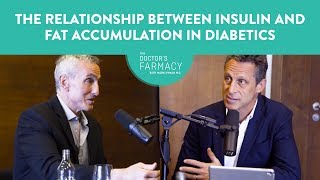
This is a YouTube video titled "Gary Taubes Answers the Question 'Is There Such a Thing as Good and Bad Calories?'" recorded in August 2018. It features a conversation between Ask AI Mark and Gary Taubes discussing the carbohydrate-insulin hypothesis of obesity, challenging the traditional calories-in-calories-out model, and exploring hormonal regulation of fat storage and diabetes.
So you're on a pan, an interview video with a, a panel with a trainer from the biggest loser, who was saying that waking is all about calories in, calories out. It's such a pervasive myth. And it is just a math problem. It's energy balance, calories in, calories out. And you're proposing a different idea, which is often called the carbohydrate insulin hypothesis or the hormonal hypothesis. which suggests that it's not about the calories, it's about what calories you eat. So can you take us down into how that works? If someone's listening, they want to know, well, what should I eat? What should I not eat? What's going to actually liberate fat from my fat cells and what's going to store fat? And how do I understand this new.
Science of why we get fat?
Well, this old science. It's old science, which is actually, by the way, gaining traction again. In fact, much of this conference is about examining some of this new science. There's a whole section on diabetes revisionism, which is the idea that our view that diabetes, type 2 diabetes is a one-way street, it's an irreversible chronic progressive condition is being turned on its head and saying, no, no, we can cure this disease.
So this is, again, the idea that obesity is just a hormonal regulatory disorder. And this was another German idea, it was gaining traction. It actually sort of won over the German research community and by the late 1930s, The Germans and Austrians were doing the best medical research in the world. And then the war comes and it just evaporates. But the idea is it's got to be a hormonal regulatory disorder and there are all kinds of ways that that's clear. You just look at how people fatten differently. Men and women fatten differently. So men get fat above the waist, women below the waist. It tells you that sex hormones are playing a role. You could have isolated areas of fat accumulation.
We all know where they are on our body. Although now women drinking soda and sugar.
Have fat above the waist too.
It is above the waist too.
No, it's funny, I was at a family member had surgery at Stanford.
About.
Four years ago and I was sitting in the waiting room waiting for her and it was fascinating to see that, yeah, all the women, all of them had upper body obesity and it used to be, you know, that men had upper body obesity. So the question is in effect, what regulates fat storage? in different fat depots in the human body. And clearly hormones are playing a role. And everyone always knew insulin played some role because type 1 diabetics who lack insulin can't store body fat. Yeah, and they can't metabolize the fat. They can't burn the fat that they eat. They can't store it.
Like as a doctor treating type 1 diabetic, when they come in, they're producing zero insulin. They're eating 10,000 calories a day. They're starving. They're hungry and they're losing weight. even though they're eating 10,000 calories a day. So how could that be?
Yeah, and that also tells you that there's a disassociation between caloric intake and fat accumulation and that insulin is in that pathway. And so the 1960s, I said you get this science of endocrinology suddenly and by 1965 or so it's been pretty well worked out how insulin regulates fat accumulation. It does it through a the whole, you know, sort of sea of enzymes and receptors and that it up regulates the lipoprotein lipase on the fat cell, which pulls fat into fat cells, it down regulates hormone sensitive lipase, which should liberate fat from fat cells.
It sort of locks it in the fat cells and they can't get it out.
Exactly. So, and this is textbook medicine. It's in the endocrinology textbooks. It's in the Biochemistry textbooks. If you look up what makes a fat cell fat, it's insulin. High insulin, low glucagon. You could include glucagon.
And it's so startling Gary to me that the science is so clear and yet the practice of medicine is so far from the science.