Hawk Newsome on Black Health Matters l Doctor's Farmacy with Dr. Mark Hyman EP3
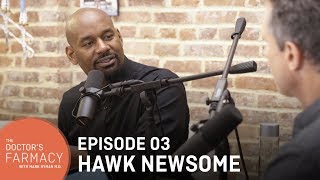
This is a YouTube video titled "Hawk Newsome on Black Health Matters l Doctor's Farmacy with Dr. Mark Hyman EP3" published in May 2018. It features a conversational interview between Dr. Mark Hyman (Ask AI Mark) and Hawk Newsome, a Black Lives Matter activist. The discussion covers topics including food injustice, systemic racism, health disparities in African American communities, personal experiences growing up in the Bronx, and efforts to improve community health through education and activism. The conversation also touches on broader social justice issues and initiatives like the Bronx Rejuvenation project aimed at transforming food systems and empowering marginalized communities.
So, Hawk, you know, we had a chance to meet first when you came to a lecture I gave about food. And the first part of my talk was about food injustice and some of the things that I think you heard were kind of surprising to you. And as a result of that talk, you invited me to speak at the Riverside Church in Harlem, where Martin Luther King gave his famous Vietnam speech protesting the Vietnam War. It was one of the most tumbling things I've ever done. I was so honored to be asked to give a talk. And I talked about food injustice, and I talked about the ways in which our food system is driving obesity, economic strife, poverty, violence, social justice issues, educational challenges, so much more climate change. And it was kind of surprising for many people to hear the message that I had. There were a lot of gasps. For example, when I said the King Center wouldn't let me show the movie Fed Up because they were funded by Coca-Cola, and this is Martin Luther King. And Martin Luther King said that our lives begin to end the day we become silent about things that matter. And you have a lot of courage because you're willing to say things that matter, even if they're not too popular. So you have this extraordinary kind of history of dropping out of high school and getting in trouble and finding yourself back to a path that has allowed you to really improve the lives of your community and and the world in a large way by having a message that is pretty resonant now, which is how do we stand up for what's right in America? How do we stand up for what's right in the world? You really came to national attention when you got up on stage at the Mother of All Rallies in Washington, D.C., which was basically an alt-right white supremacist rally masquerading as patriotism. And they asked you to come up on stage to share your thoughts, which I think you were surprised at. And I think your video had over 50 million views, which is That's pretty amazing. What was that like and what went through your mind when you got up on stage and how did you shift into a message instead of opposition and violence to love?
Thanks for having me first.
Yeah, welcome.
You know, you're my buddy. It's good. It's like we're sitting here talking. The mother of all rallies was different. It was a different, animal for me, because usually when we go to protest, we raise our voices, we put our fists in the air, we scream our points at people. Here we were at the mother of all rallies, and we're doing this, and they invite us to go up on stage. Usually it's, you know, it's like them screaming back at us, Charlottesville.
You got invited to a party you didn't want to go to?
Yeah, exactly. Exactly. The cost of admission was really high, but the experience was well worth it. between the time that they asked me to go up on stage and I arrived on stage, it was really interesting because it's hard for me to explain this, because if people aren't spiritual, if they don't believe in God, then they might not believe in these types of moments. But it was like the sky opened up and God spoke to me and said, make them understand who you are. So instead of going and screaming my point of view at them, I wanted to understand. I wanted them to understand who we and why we felt like this. And the only way to do that was out of love, but not a soft hug everybody saying Kumbaya love. But a real tough love, kind of like a motherly love, the love that allows a mother-- Mother of all love. Yes, the mother of all love, right? So you hear those stories about a mother lifting up a car to save her baby, that type of love, a strong love. So, When I said, I started out by saying, I'm an American. They went bananas. Like they couldn't believe it. Oh my God, Black Lives Matter. They're happy to be American. Yeah, I was born here. You know, my ancestors built it for free. You know what I mean? I'm vested. Like, I'm vested. This is home. And I explained that as Americans, we have the build, we see problems, we mobilize and fix them. So when we see a man like Eric Garner who screams for air, who says, I can't breathe 11 times and is choked to death, then we have to do something about that, right? I said, I'm a Christian, and I don't know if your Bible is any different than mine, but it says, Love your neighbor. And that Bible doesn't say that your neighbor has to be from the constitutional United States of America. So here you have Black Lives Matter, you have immigration issues, you have their core, which is the Constitution in America, their core, which is the Bible. And I'm telling you, like we follow the same guiding principles and the way you're approaching life in politics isn't necessarily correct. It's actually borderline evil. Some people weren't ready to hear it. I had some hecklers, but others had like this light bulb moment. Yeah. You know, and it went from these two groups that were fighting, A lot of those people, we were like throwing rocks at each other in Charlottesville. You know what I mean? Yeah, yeah. And what was really interesting about Charlottesville was, there's a picture of me in the Daily News, and I have a sign and a bullhorn. There's a little bit of blood trickling down my face.
Yeah.
I was giving a speech and kind of ducking- the rocks. The rocks and water bottles filled with cement, and I got tired of it, right? And I said, that's it. That's it. It's on, right? So I go to grab rocks to throw back, right? I devolved.
Yeah.
Yeah, so to speak. And I ran over to the side and I was looking for something to grab and a young woman from our group, Nepal, who's 17 years old, she's like, Hawk, you're gonna get yourself killed. I'm like, whatever, just hold my pole. You stay over here with. So safe. And this little white lady came out of nowhere. She had to be like 70 years old. A little mother Teresa. Yeah, right. And she'll be. Yeah, I'm serious. And she appeared and she said, Son, you could do so much more with your voice than anything you pick out, pick up out of these streets to throw. And she was in the back of my mind when I took that stage as the mother of all rallies. But since then, I've made friends across the, you know, I guess across the political gap, and they're listening now. Some are mobilizing. I have a friend named Scott Adams. You ever heard of Dilbert, the comic?
Yeah, sure.
He writes Dilbert. Wow. And he's the coolest guy in the world. We've spoken on the phone a couple of times. He's good. So we're just trying to figure out how to unite people on common ground.
How to put down their differences and.
Unite for a cause.
Yeah, we're all human first, you know? Amen. Yeah, it reminds me, I heard this guy speak who was One of the leaders of the white supremacist movement was mobilizing people. He was on the media all the time. And he told an extraordinary story where he really believed everything that he said, that he had sort of a factual basis for why whites were superior and blacks and other minorities were not. And he was sort of ostracized. He went to a normal college and was a little bit ostracized. And he met this guy, it was this Jewish guy. And this Jewish guy invited him to a Shabbat dinner, like a Friday night celebration, Jewish dinner, and he sort of befriended him and they would meet on a regular basis. And so this white supremacist was trying to convince him of his point regularly, and yet the Jewish guy just patiently was presenting him with alternative view of reality, which was based on a different set of facts. And over the course of a year, he completely transformed, and almost like he was deprogrammed because he lived in this bubble of a world where he didn't know what the other was. And so the other was foreign and bad and dangerous. And yet somebody even like that was able to shift by just communication and by sharing and by human to human contact. Absolutely.
Yeah, I think that's beautiful. There are a lot of stories that are out there like this. I'm working with a group, I'm actually on the board of a group called One America. It's rabbis, imams, Christian preachers. There's heads of nonprofits and we're all working together. And I get it. And the reason why I get it is because I've developed this philosophy, like meet people where they are. Okay? Don't expect them to be at your level, but go where they are, look at them in the eye and really try and understand their viewpoint before you assert your views onto them. Now, question, which person is more dangerous. The white supremacist who's spewing hate, or the person who has love in their heart that are good people, either self-proclaimed or not, that aren't doing anything to change that.
They're silent, right?
They're just silent. Yeah. So I always, I'm always trying to, you know, analyze which one is worse. Yeah.
I mean, you know, I'm Jewish, and I remember, you know, and heard stories of growing up and the Holocaust and. you know, there were people living all around there, and they sort of ignored it. They smelled the burning bodies, they saw what was going on, they saw the trains, and they just remained silent. So how complicit are they?
Exactly.
Yeah.
Right?
Yeah. So you come by your activism sort of honestly. Your mom and dad met at a civil rights rally in the 60s, right? Absolutely.
Yes, indeed.
And that inspired you?
Yes. I was born, right? You spent my birthday with me at Riverside Church, and I gotta say, you gave the most powerful speech on that day. You know, here you are, tall, handsome Jewish man, who's standing up there talking about food injustice. And I'd liken your statements to those that Black Panthers made in the past.
Yeah. Okay.
Like the gasps were honest.
Like, I'm an albino Panther.
Yeah.
You see those, right? But no, it's true. And it was so righteous and it was so necessary. it was just needed. But my parents met in the Bronx. They had rallied for African American studies class. And when they implemented the course, they gave the job to a white teacher. And they were like, no, we want someone who's familiar with our experience to come in. So my dad let her walk out. He was outside protesting. My mother looks out the window and he says, What are you doing in class, girl? Like, you know, come down here. My aunt introduced him and a few years later, they were married. That's true.
And amazing.
So you grew up in the Bronx? Yes.
Yes, South Bronx, about five blocks from Yankee Stadium.
And how was it back then?
It was in the 70s? Nah, in the 80s.
80S, oh yeah. I'm old, you know? Yeah. It was the height of the crack epidemic, right? So when you see, you remember those commercials about drugs and kids are like running and their foot would splash in a puddle with like crack vials in it. that was my existence, right? There was a man shot with a shotgun five times in front of my door, right? I remember I was in the room playing Barbie dolls with my cousin. I'm safe in my masculinity. I can say that. You know, I was playing, I had a Ken doll, she had a Barbie.
We were like, yeah, you had the Ken.
It was fine. I had the Ken with the Ferrari or the Corvette. All right, well that sounds so bad. So, We went to run to the door and my aunt came swinging around the hallway out of the kitchen and kind of threw us down on the floor in the living room. So there was always violence. Like the first time I saw a pistol in school was the fifth grade. You know, my friends had and we were coming back from lunch and I'm like, what's going on? Y'all look, you know, tense or tough or whatever you want to call it. And he showed me like a nickel plated 25. So life was different. and the problem for me was I was like a little black Cosby kid, right? Who was poor. I had both of my parents. They were both working at the time. They used to dress me like a preppy.
Yeah.
So Penny loafers.
Oh my God.
I put polo shirts in them. Yeah. Thigh-high pants. With sweaters tied around.
Ooh, the sweater thing. Yeah, totally, totally. And then for those of you, you know, can't see Hawk, he's six foot five and about 200. change. So he's a big dude.
Yeah.
And so it was, it was different because I knew right from wrong. And I knew what it was.
You had a Christian upbringing.
Christian, strong Christian upbringing, very pro-black and when you say pro-black people mean, people say, well, are you anti-white I always ask if you see a person with a kiss me Irish shirt, do you ask them if they hate Italians? Like, no. So, you know, every time you assert your rights as a black person, you have to apologize in a way. And we're a long way past apologizing. This is what it is. We're fighting for our rights. That doesn't mean we hate you, but this is 500 years of oppression we're dealing with. So high school, I wanted to be cool. I wanted to hang out. I wanted to be part of everything that was happening. So I veered away from my parents' teachings and I dropped out of high school. My saving grace, God, of course, but I played basketball. So instead of just hanging out all the time, I would just find a gym that was open in the daytime. and go there and play basketball. I play with guys like Ron Artest, Metta World Peace, Elton Brand. I used to travel.
They would come, those are top NBA players. For those who don't know about the NBA.
Yeah, like all stars. And they would come to games with like junior Olympic sweatsuits. They were traveling the world. I was there with like pants hanging off my behind, Timberland, smelling like all kinds of herbs. I just wouldn't get it right. So eventually, after I got into some trouble, I got back on track.
So in the environment you lived in, it was violent, it was rough, it was poor. I wanna talk a little bit about the whole food injustice issue for a minute, and what it was like growing up in that community, what kind of food there was or wasn't, what your family ate, how your dad, you mentioned he has diabetes, and he died from that, and had his legs amputated, No.
He actually, my dad had, he died on his seventh heart attack.
Seventh heart attack, okay.
Yeah, he had quadruple bypass, diabeteticulitis, you name it. He had it. And he was a smoker. He ate pretty much what he wanted to eat. But you have to look at it from the perspective of people who are living in these conditions. You have $20. It's one or two days before payday. It's a family of four. McDonald's has this dollar menu. That means you could get about eight burgers, four orders of fries for $12. It makes sense economically. We didn't know what clean eating was. After his first heart attack, then we made a shift. It was a lot of chicken baked. It was vegetables. But after a second heart attack, we kind of gave up.
He's like, oh, this doesn't work.
I'm not gonna eat this stuff. Exactly. Right. There was, he gave up, but then he couldn't work anymore. So we were like super poor and my parents would buy me whatever I wanted. I was kind of like spoiled because they didn't want me to feel like I had to sell drugs. So they would miss rent sometimes to pay for it. My mother carried the high school, carried the family. She was extraordinary in her strength. But we always ate bad food. It was to the point, like before my dad died, I would bring them healthy food and they would look at it like, eating that. Why would I eat that? So not only is healthy food not available, but the majority of us look at it like it's disgusting. Right. I work with young adults now who won't drink water.
Yeah.
Soda. It's just soda all the way. And this one person she works with, she's actually a victim. She has a family of about six and she doesn't drink water. So her kids aren't drinking water.
Well, you can get, you know, in food stamps, you can get two, bottles for of two liters of soda for $3.
Yeah.
Right?
Yeah. And it's good, right? It's sweet. Everybody's happy. It just is.
It's a different form of crack.
It is.
It's like a new crack epidemic, really.
It is. And then Chinese food that's helpful to us.
Yeah.
We don't know any better.
So with mostly like packaged or processed or starchy foods, soda, sugar, yeah, all the time. Like, you think about vegetables not happening.
Vegetables rarely.
Right.
Rarely. But if. If they are cooked, there's a lot of butter, there's a lot of salt, you know, it might lose its value. The fish is usually fried. Most of our foods are fried.
Deep fried.
Yeah. Yeah. Deep fried. And we just don't know.
Yeah.
Like, we just don't know how to eat healthy. And. And if we choose to. there aren't that many options.
And you struggle with this too. I mean, you recently dropped like 30, 40 pounds, right?
With the help of your son.
All right, Misha. The Health Warrior project. Yeah, he teaches people about food, how to cook, and what was that like switching over for you? Because this has been, you've been fighting for justice and human rights and civil rights, and yet, you were in some way, I met with Bernice King years ago, and she said, nonviolence also means nonviolence to yourself.
Amen.
And I think a lot of people who are poor or minorities, It's sort of like an internalized sense of sort of racism because they don't realize what's happening. They don't realize the way the food system is driving their behavior, is targeting them deliberately in ways that are getting them to try to use more of their products. And so how is that for you to switch over and change your diet?
It's hard because everything that you grew up eating, even the things that you believe were good are now bad. So it's like, I don't know, fried fish.
Yeah.
It's like, oh, fish. Fish. What are you talking about? Right. And a macaroni and cheese. Somehow I had it in my mind that was actually healthy.
It wasn't deep fried.
Yeah, but it was just like all this cheese. And I had actually, I have cheat days. I had some yesterday. But like oxtails, right. And like these meats and really salty meats like bacon and just The way we consume and digest food, it's just wrong. So for me, at first I just stopped eating, okay? Until I figured out what I could eat, I would just not really eat. And I'm so busy, so when I did eat, it would be later in the day. Luckily, I married a vegetarian. So my favorite meal now is like roast vegetables with seasoning.
They're kind of sweet when you roast them.
Oh my God, yeah.
But it took a while for your taste buds to switch over, right?
It did. It did. And it's coffee, you know, coffee, caramel lattes, caramel macchiatos.
Yeah, well, those have about 5, 700 calories in them.
Yeah, and I was doing three a day.
And there's sugar, basically.
Yeah. Yeah.
And I think coffee was the hardest thing, but just really realizing, okay, here's what I can eat, here's what I can't eat. That's something I still struggle with. Look at me. You know, my parents were very educated, even though they just graduated from high school, they were self-educated for the most part. I went to law school. my sister went to the best universities in the country, and we are uneducated as to what we should eat. So what does that say for the people who really don't know? It's just why I'm happy that we're working together now to hopefully bring that message.
Yeah, we're gonna talk about that in a minute. This new project in the Bronx Rejuvenation to sort of transform the food system. It's so key, you know, but I think that people don't realize that there are massive health disparities. It's like the third world in America. I mean, infant mortality in African American communities is twice that. of white communities. If you look at diabetes, we're 80% more likely to be diagnosed with diabetes if you're African-American. You are four times likely to have kidney failure, three and a half times more likely to get your legs amputated because of diabetes.
My dad had kidney failure. He was on dialysis for seven years.
Right, and so this is massive. And in some ways, there's a sense in the general culture of blaming the victim. but the whole system of food is set up in a way that actually is driving these behaviors. And what I've been sort of struck by is a lack of understanding that this is just another form of oppression that, you know, big food and the targeted food marketing and the lack of access to food and the way in which even food stamps, you know, are used primarily for junk food and soda. So how does this black community think about this issue. Is there any awareness? Is there any Consciousness that the man is really targeting you?
Yeah.
Like cigarettes, like targeting kids, like, you know, Joe Camel targeting kids for smoking. It's the same thing that's happening.
And people think, oh, this is their personal choice. Yeah, it's, it's, it's, it's unbelievable because I still live in the Bronx, and I'll go into the store, and all you hear is chopped cheese. Right? Chopped cheese is like all this fried, greasy meat with a bunch of grease.
And food and, and, and it's like a. Bronx version of a Philly cheesesteak.
Yeah, exactly. You know, you know these things. And that's what people are spending money on, and it's soda.
But.
I would call it a silent killer, right? This would be, in my opinion, this is more targeted than keeping people out of jobs, keeping people out of schools, because no one really knows about it. Because we've been trained to believe that it is our choice. So when you told me, like, these food companies are intentionally getting people addicted to these foods, it kind of changed my life's path. I never realized it. I'm fighting against police brutality every day, against racisms in different forms every day. that was a light bulb.
It was like an invisible form of racism.
Exactly. And it's so easy because people one, aren't talking about it. The institutions that we would expect to protect us from this injustice already bought and paid for. So who do we turn to?
It's true. Like I said, I was in Atlanta with Bernice King and we were gonna show the movie Fed Up about sugar and the food industry. at the King Center and I got a call that we couldn't show the movie because Coca-Cola funds the King Center. I met with the dean of Spelman College, which is an all women's African-American college in Atlanta. It's one of the top colleges in the country. And she said half, half of the 18 year old freshman class of women had a chronic disease, diabetes, obesity, hypertension, and yet all over campus was Coke machines. And I said, why is that? She says, well, because Coca-Cola is the big huge sponsor and donor to Spelman College and all the other African American colleges. NAACP and the Hispanic Federation are donated money by Coca-Cola so they will oppose the soda tax. So it's a very insidious process. In fact, I met with a guy who was a New York Times reporter who was an investigative journalist and got through FOIA, which is the Freedom of Information Act, emails that Coca-Cola executives were sending to professors at a university, because of a public university, that's how they could get them, that they had a very targeted strategy that was very deliberate bullet points of how to target minorities in the poor and how to increase their utilization of their products. And it's, you know, we think it's always an accident, oh, they made these things, we really know. They know and they're doing it on purpose. And it's, you know, that kind of makes me mad. I think, how do we get people mad about it?
Like Black health matters, you know?
Yeah.
And you know what's interesting, right? I gotta let you know, I am constantly walking around with a target on my back. Not one that would put me in fear of violence, even though there are threats. But you are walking into the Pterodactyl. You are Mad Max right now. You have to understand, when we embark on this journey, they are gonna come at you with everything. 'Cause we're talking about hundreds of millions, maybe even billions of dollars.
In America alone, the food industry is a trillion dollar industry. Jesus Christ.
And we are going to disrupt this industry. I enjoy being a disruptor. That's my thing. But you know, it's fascinating.
I think there's a consciousness that the gig is up and they're trying to shift. I had dinner with the president of Nestle's this week and he was explaining to me the kinds of things they're trying to do to shift their products. And they are the biggest food company in the world. Now they have a bad reputation. They basically got babies hooked on formula. formulas watered down, all these babies were malnourished and die, they're selling all kinds of junk and crap, but they divested of all their candy business, so no more Nestle's Crunch. And they basically are looking at buying up all these health food companies and they're working in Congress to change the farm bill to create more regenerative agriculture. Fascinating what's happening behind the scenes. And so, you know, we are in an interesting moment where everybody's sort of waking up to this idea. But to me, it seems like, you know, the Hispanic and African-American communities are the ones that are suffering most from diabetes and obesity and chronic disease. they have poor, I mean, if you're African-American, you have five years less life expectancy than someone who's white in the same country. And so people are starting to sort of think about this differently. And I wonder, how do we bring this to your communities in the Bronx and these poor communities around the country in a way to get them to be aware of what's happening and to be sort of rising up against the injustice of what's happening? How do we do that?
I believe that the program we spoke about was, is the way to do it. It's the vehicle, right?
So you're talking about something called rejuvenation.
Rejuvenation.
So tell us about that.
It's rejuve-hyphen-nation. And the concept is we are breathing life back into a deflated people. You think about when, you know, they zap people and say, Clear. And then, you know, they try to pump life. This is what we're doing. So, we're actually giving life back to people. At the end result, at the outcome, we are looking at changing history. You and I, you and I.
Down with that.
Right, we are changing history. We're working with Health Warrior Project so they can understand how to prepare this food.
How to cook.
How to cook, how to cook clean, and also how to, we're gonna give them food while they're there. They'll cook their own food and then they'll leave with the bag of groceries. So to bring you back to when I said there's $20 left two days before the paycheck. Yeah. They won't have any other choice but to eat that food.
Right, right.
And then hopefully it'll become part of their diet. So along with Rejuvenation, we're teaching people personal organizational skills. Okay. And meditation, mindfulness practice. It's all about Wellness. It's holistic. And for me, I don't have to tell you the message of black lives matter. If I teach you how to love yourself.
Yeah.
Because if you love yourself, you won't be a doormat for anyone. and you'll stand up for yourself consistently. So the bottom line is we're gonna go in, teach people how to eat. We're starting out in the Bronx and hopefully it'll grow and change, you know, Tupac. Tupac, people undervalue Tupac.
Tupac, he wrote about, he's sung about this, about the food system and what it's doing to the communities and yeah.
He was ahead of his time. He was raised by Panthers. See, I'm telling you, it all comes full circle. And he talked about this and this is, what we have to do. So yes, I'll be pushing for legislature, but food injustice, like you changed my life. You really changed my life. This is the way it was.
I mean, even though you're leading the activist movement, even though you went to law school, you're educated, this was like a big realization for you.
Yeah, it was a light bulb moment. It was the invisible bully, right? Silent killer.
Because I- I say this, you know, 1.3 million people deaths or percent are caused by gun violence, including suicide. But there's literally millions of people that are dying from bad food.
That's it.
Kills more people than anybody else, anything else.
And this is the message that we have to get out, right? So we're talking about a social media campaign and just really educating people. There's, there's, there's going to be the shift, this heart centered shift. I always talk about it, and people are just going to become really conscious.
And you think people want to change their diet? People kind of attach to this is my food, this is my culture. I remember being on this rafting trip with this Hopi chief and it was to sort of deal with some of the water issues and the tar sands mining which was going to destroy the Green River, goes into Colorado River. And he was very overweight. He had diabetes. And I said, Howard, you don't have to suffer like this. He said, you, can fix this. So what do I have to do? I said, well, you have to give up starch and sugar. soda. And he was like, well, wow, I'm gonna not, what are we gonna do? Because we have our Hopi ceremonies and we need to eat our ceremonial foods. And I said, well, what is that? He said, well, it's cookies and cakes and pies. I said, your Hopi ancestors are not having cookies and cakes. This is not your traditional ceremonial foods, right? Absolutely. And yet it's, it's so internalized, he doesn't realize that it's not his culture, right? Absolutely. It's sort of it's been imposed on them. And it, same thing has happened in African-American communities.
We hear about it. There are efforts out there to educate us, but we don't really see it as a realistic part of our day. If you're worried about keeping your lights.
On.
Paying your rent, you don't have time to worry about injustice, which is something I have to overcome. And at that point, you're just trying to buy whatever you can buy to feed your family. We would also need to look at making good food available to people. Yeah. Like, I'm not sure. I'm still learning how to shop. Yeah. You know, we have to. It has to be an intensive campaign. I love the thought of starting out in the Bronx because the Bronx is consistently the unhealthiest county in New York State. Yeah. So that's, like, ground zero for this.
It's like the third world right here in Manhattan. Absolutely, right?
Absolutely. You can go to Park Avenue in the middle of the city and be in, you know, one of the most affluent countries in the world and affluent districts, neighborhoods, districts in the world. And you could travel on that same street about three miles north and you will encounter a hell. And, you know, it's still a community where people love each other, but there's garbage out front. Rats are playing in the garbage. There's kids walking in hallways. There's urination defecation in the staircase. Kids are walking past this urination in the elevator. And people are saying, well, how can they live like that? Because there's this prevailing culture where people just don't have time to care or give up. So part of rejuvenation is organizing tenants to clean up the buildings. We'll put on suits and go and clean up these sit their cases. I have no problem doing that. If we could just help people to improve their lives, their neighborhoods, then we're doing God's work.
So you're also, we didn't talk about it much, but you're also the head of the New York chapter for Black Lives Matter.
Right on.
And a lot of people have issues with that movement because they feel like it's, you know, all lives matter. And you know, you said something the other day that was really beautiful. All lives matter, well all lives will matter when Black lives also matter.
Right on.
You know, it's not that not everybody matters. Yes, blue lives matter, white lives matter, Black lives matter, yellow lives matter, like right. But at the end of the day, there's real issues here and injustice, and we have to call them out, we have to address them.
With Rejuvenation and this project that I'm calling Common Ground, I think we'll be able to bring more people together because Black Lives Matter is very polarizing and some people won't get involved just because of the name. So you create this program called Common Ground where we are just taking the high ground. And I always, like Michelle Obama says.
When they go low, we go high.
Yeah, right on. And he won the presidency with that, right? Like people were, that first election was tough.
Obama.
Obama, yeah. It was tough, but he just took the high ground. He wouldn't engage in the politics, which was beautiful. So common ground is us staying out of the weeds. It's us talking to Republicans, right? People who may not see things eye to eye and kind of saying, okay, we don't agree on everything. Here's what we agree on across the country. Let's fight for legislature to change this. Yeah. So.
Last question. If you were king for a day, what would be the kind of policy or law or thing that you would do to change what's happening in your communities? I would imagine that having all that power. It is humbling.
It is humbling. I would give people land. Land. Land. The homes that they live in. Okay. If this is your neighborhood, your people.
Have ownership of where they are.
Have ownership of where you are.
Right.
And with that land, you control the business. So you decide who you want to rent to and things like that. I respect the Jewish Community so much. And people don't like Jewish folks, right? And I think of that as not liking the Bulls when they had Michael Jordan.
Right.
You know, 'cause they're the winning team, right?
Yeah.
They figured out how to establish their own neighborhoods, right, where they school their children, police their communities. It's safe. They have their own businesses, and it's a thriving community. However, perfect example of this is us. They do business with everyone else.
Yeah.
It's a self-sustaining community. So if I could do anything for black people, I would put them in a position where they could be self-sustaining if you look back through history, right? Even though it didn't do much, the Jewish folks received reparations, right? Hiroshima, Japanese received a lot of aid. Indigenous people, Native Americans, they're given land, they have their casinos. So it wasn't much, but it was something that was helpful to provide a foundation. Black people never received their fair share.
There were no reparations after slavery.
Yeah. So we were repeatedly victimized. You know, it was this economic oppression and now food oppression. So what would I do? I give folks land.
Yeah, because people having a sense of ownership over their life is really what allows them to stand up and to work and do the things that make their lives better. And I think when you look at disease, the biggest cause of chronic disease and death is not smoking, not even diet. It's the social determinants of health and particularly the sense of a loss of locus of control. where you feel like you're out of control in your life, whether it's your job or your community or whatever is going on. That sense of loss of control and empowerment is what actually makes people sick and die. And I think people don't realize that. And I think this is, this is a, you know, undoing, you know, centuries of, of beliefs, policies, behaviors. And there are people who break out like you, but it's tough. And when the whole system is sort of set up in a way that doesn't support you, doesn't provide the ability to actually learn and to grow and to be empowered and to have access to the skills and tools and, you know, knowledge that allows them to lift themselves up. It's powerful.
It's almost an impossibility. Yeah. This is why I love hanging out with you. You always give me these, these jewels. Like, oh, man, you're awesome. Thanks, man.
Well, this has been an amazing conversation, Hawk, and I can't wait to work in the Bronx with you. change the food system there. And we have so many ways of actually using that to help illustrate how it can be done. And then imagine tracking the levels of, of educational success or even the, the social issues around poverty and violence. How, what happens when you start to change the communities and build that? Because that's what you're talking about, is these communities start to break down and they don't have the fabric that pulls everything together. And by having ownership and and even starting with your own body having ownership of your health. Because when you are sick, when you're eating badly, when you're, you know, have a chronic disease, you can't work as well. You are not as productive. You can't think straight. You can't lift yourself up if you're oppressed by the food system. So I think for me, it's important to call it out. And there's many, many issues, obviously, racial injustice, criminal justice system that's broken. I mean, there's all those issues that have to be dealt with. But in a way, I see this as one of those things that people can change and will change. And so I'm excited to work on that with you.
Me too, brother.
All right. I'm really, well, thanks for being on the Doctor's Pharmacy. We'll stay tuned, maybe have you back another time when we can talk about the whole program.
Right on.
Okay.
Right on. We get some footage of us doing it in the streets.
There you go.
Right on.
Thank you, Ark.
Thank you, brother.
More from AI


Why Younger Women Are Getting Breast Cancer at Record Rates (And How to Reduce Your Risk)




This Is Why 99% of Skin Conditions Don't Heal — And What Dermatologists Won't Tell You




