How Addictive Foods Are Driving Fatty Liver Disease
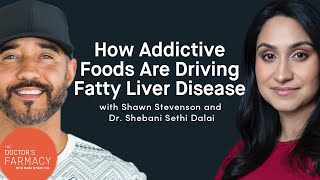
This is a YouTube video titled "How Addictive Foods Are Driving Fatty Liver Disease" created in May 2021. The content is a multi-speaker podcast-style discussion featuring Dr. Mariana Figueiro, Shawn Stevenson, Ask AI Mark, and others, focusing on the impact of sugar and ultra-processed foods on brain chemistry, addiction, inflammation, and the development of non-alcoholic fatty liver disease. The conversation explores the biological addiction to sugar, metabolic health, and practical dietary advice to improve health outcomes.
Sugar is an addictive substance. It's not just something we say. It has a straightforward neurochemical basis in the brain, just like any other drug. And I think of sugar as a, it's a recreational food.
Hi, I'm Kasia, one of the producers of the Doctors Pharmacy podcast. Non-alcoholic fatty liver disease, or fatty liver for short, affects close to 90 million Americans and is a major risk factor for type 2 diabetes, heart attacks, and even cancer. Dr. Hyman recently discussed what's driving this with bestselling author and creator of the model health show, Shawn Stevenson. He also sat down with founding director of Stanford University's Metabolic Psychiatry Program, Dr. Shabnam Sethi Dallal.
The thing that I really wanted to usher in and bring to the forefront because it sounds the most like ghostly, it sounds like cast with the ghost, like it's not even a real thing is inflammation and how inflammation has an impact on your body composition. and the data exists, it's just that a lot of folks don't know about it. And the way that it really manifests when we're talking about inflammation is that it has this very detrimental impact on our organs that are related to our body's production and utilization of our fat loss related hormones. So namely, let's take our liver for example. Your liver is incredibly important in regulating your metabolism. you know, we're talking about a relationship with how it manages insulin, even the production of fat takes place in your liver too. The storing of glycogen can take place in your liver. You know, if your liver is, if your body's overburdened by glucose, your liver can literally convert that into fat right there on the spot. And so if something is damaging your liver, it's going to inherently damage your, your endocrine system and your process of metabolism. So inflammation and I've just kind of shared some of the data in the book, damaging your liver and what this is one of the most fast growing issues in our country is non alcoholic fatty liver disease. Yeah, this is really a kind of chronically inflame in inflamed situation taking place in our liver and also how do.
We how do we get fatty livers because I think people should know we go to fancy restaurants and they give you foie gras which is French for fatty liver and and how do they get the ducks to be like that and how do they get us humans to have 90 million Americans with fatty liver.
Everybody should know by now, very simple, the fastest way to damage your liver and to create that fatty liver, by the way, it's called non-alcoholic fatty liver disease, because we associate it with alcohol. But sugar.
Sugar, absolutely. Sugar, starch, flour, it's so bad. It's so bad, particularly high fructose corn syrup.
Your liver has to take on the brunt of it because your liver is really, even the name, liver, it's responsible for so much, like every minute it's filtering your entire blood supply. You know, it's so important.
That's right.
But to take this one step further and I'll just drop this little nugget so we can move on to the other topics, but also the master regulator often referred to, of course, you know, I've even taught this in my conventional university setting, But your hypothalamus, all right? Your hypothalamus is one of the major regulators and communicators with your thyroid, with your liver, with your adrenals, all the organs related to fat loss and fat storage. The governing kind of master gland, it's called the master gland is your hypothalamus.
That's in your brain.
You hate it. Right. And now we've got data that this new term, neuroinflammation, inflammation specifically regarding the function of your hypothalamus can damage what's happening with your metabolism. But nobody's talking about that in these cookie cutter diets that you need to address the inflammation in your brain in order for you to lose weight.
Right.
So these are all. And the beautiful part is it's possible. It's not just possible. It's probable when you have the right information, and we avoid the things that create the inflammation. And namely, you just mentioned, sugar, but we go through a whole subset of the different things. Yeah, in functional medicine, we also look.
At, you know, food sensitivities and environmental toxins and the microbiome and all. There's so many things that drive inflammation. And if you're overweight, you're inflamed. And for those listening, you know, think, oh, you know, I'm a few pounds overweight, a little extra belly fat, you know, maybe I need to lose 10, 20 pounds, or maybe you're over more overweight or obese. You should really pay attention to what Sean's saying, because right now, during this COVID pandemic, what we're finding is those people who are overweight or obese or have even a little bit of extra fat are much more likely to get sick, much more likely to end up in the hospital, the ICU, and to die from COVID-19 because of poor metabolic health. And what's so beautiful about the body is that you think, oh my God, I've taken years and years to get here. Within a couple of weeks, you can change all of that. You might not lose all the weight in a couple of weeks, but you can change your inflammation markers, your hormones, your brain chemistry, literally in a couple of weeks of changing your diet and.
Following the principles that are in Eat Smarter, which is Shawn's new book, When we talk about how nutrition affects the brain and specifically focusing on reducing that sugar and processed foods and refined carbohydrates to improve mental and physical health, we know that consuming excessive amounts of sugar, processed foods, and refined carbohydrates lead to obesity, metabolic problems, fatty liver, heart disease, even cancer. There is Evidence for this, and the body is really one whole system, and what happens in the body also affects the brain. The brain has a delicate balance of neurotransmitters or chemical messengers with more sugar and processed foods, these levels really become unbalanced and they're significantly off. So I'm talking about- so wait, so.
Your brain chemistry gets screwed up when you eat processed food and sugar, is what you're saying?
Yeah. Yeah, and I'm talking about ultra processed food also in particular because I do think that there's a difference between processed food and ultra processed food. Ultra processed food is like the real sugar, the cookies, the cakes, the chips, the potato chips, it's kind of highly processed things versus minimally processed foods, maybe some oils, vegetables that are frozen, that's a little bit different than ultra processed food. And so the research is showing differences between those things in the brain.
Yeah.
And you need the right raw ingredients for chemical reactions to occur in the brain and elsewhere, like vitamins and minerals and nutrients. You need proper functioning of the brain, you need proper speed of transmitting signals. Your brain is composed of electrical cells and it's a complicated web of signaling molecules. those cells need fat to develop and to function properly. So you need those Omega-3s in your diet. And if you eat sugar and ultra processed foods, the chances are that you're likely not getting those important nutrients, those vitamins and minerals, for those important reactions that you need, nor are you absorbing them. The most people with metabolic dysfunction actually have nutritional deficiencies and are malnourished.
They're looking at all the wrong places for the nutrients. They eat more and more food. I think a study from Kevin Hall and others showed that if you let people eat as much as they want and you give them ultra-processed food versus whole foods, they'll eat about 500 calories more a day of ultra-processed food because they'll keep eating and they're hungry and they keep driving. And you talk a lot about that in your work about the biology of what these do to your brain in terms of dopamine and the addiction reward pathways in the brain that make you literally become addicted to these compounds and how that affects you.
Right. So the rates of obesity and binge eating and addictive like eating are rising alongside the increasing dominance of ultra processed foods in the modern food environment. And there are several mechanisms as to how this works. Some which act directly on the brain and some that indirectly act through hormonal signaling. So our body is very complicated and the brain is connected to the body and we used to learn in medical school that you have this blood-brain barrier that nothing can get across it. But that's not, it's like the Berlin Wall, but in reality it does leak, right? And there are things that do cross.
And-- It's more like a coffee filter, you know, it's a sip. Right.
Yeah, so ultra-processive food and sugar decrease our dopamine receptors and make us eat more compulsively, much like addictive drugs. The highly processed foods, they trigger dopamine reward pathways and they invoke addictive-like behaviors which have been well documented and include intense cravings, includes feelings of withdrawal when cutting down on ultra-processed food. continuing to eat these things despite knowing the adverse consequences to it and repeated attempts to try to quit. I'm describing addiction here basically and the consumption of larger quantities over time than intended.
People go, oh, it's emotional eating, it's not really biological true addiction. What you're saying is this is really a true biological addiction just like heroin or cocaine or alcohol that you get withdrawal. you get cravings, you get increased need for more and more of the substance to receive the same pleasure, you downregulate the receptors for pleasure, so you have to take more of the stuff to actually stimulate that reward pathway. And it's really this vicious cycle that people get into and then they blame themselves and they feel guilty for doing it and they think they just have no willpower, but you're saying it's much bigger than that.
Yeah, that's exactly right. So sugar, is an addictive substance. It's not just something we say. It has a straightforward neurochemical basis in the brain, just like any other drug. And I think of sugar as a, it's a recreational food. It's not a food that's essential for survival. We make sugar, you know, through the process of gluconeogenesis, through other foods that we consume. And so, It's really about excess carbohydrates.
It's not- I call sugar a recreational drug. I've never heard anybody say it, but I always write down in my book, Sugar is a recreational drug. It's like, if you like tequila, it's.
Fine, but not breakfast, lunch, and dinner.
In the quantities we're having in America. Exactly. Highly refined carbohydrates and ultra-processed foods can alter our brain signaling, as well as our appetite, satiety, mechanisms, and reward signaling. This leads to a cascade of physical issues including fatty liver disease in addition to higher risk for mental health issues. One of the fastest ways you can take back control of your health is to make your own kitchen a safe zone and focus on eating real whole foods. Get in the practice of reading food labels. Always avoid foods with high fructose corn syrup and other ingredients you can't pronounce and would never have in your own kitchen cabinet. Dr. Hyman says before you eat something ask yourself Who made this? Man or nature? If nature made it, eat it. If man made it, leave it. Finally, focus on feeding yourself lots of colorful plant foods and high quality fats and protein at every meal. If you'd like to learn more about anything you heard today, I encourage you to check out Dr. Hyman's full length conversations with Shawn Stevenson and Dr. Shabnam Sethi Dyal. If you enjoyed this episode, please consider sharing it with a friend and leaving.
Us a review below. Thanks for tuning in.
More from AI


Why Younger Women Are Getting Breast Cancer at Record Rates (And How to Reduce Your Risk)




This Is Why 99% of Skin Conditions Don't Heal — And What Dermatologists Won't Tell You




