How Chefs Can Be Doctors, and Doctors Can Be Chefs
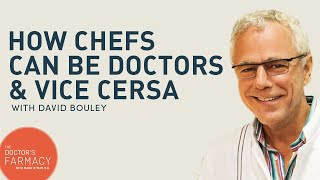
Dr. Mark Hyman and Chef David Boulet discuss how food works as medicine. They explore healing menus, the science behind ingredients, and how chefs and doctors can work together to treat illness through what people eat.
The whole idea of chef and doctor, really, they are the same. Welcome to the Doctor's Pharmacy. I'm Dr. Mark Hyman, and that's Pharmacy with an F, F-A-R-M-A-C-Y, a place for conversations that matter. And today's guest is Chef David Boulet, who I've known for a long time. He's one of the top chefs in the world, has taught me so much about food as medicine. As a doctor, I spent my life studying food as medicine, and the things I learned from David, I never learned anywhere else. He's an extraordinary guy. His restaurant, Bouley in Tribeca, was really the number one restaurant in New York for a long, long time. It was, I think, the best restaurant in the United States. It was 14 in the world. It is really an extraordinary place. I've eaten there many times. He's been named the Best Chef in America by the Herald Tribune. He's one of the few chefs in the world who understands the role of food as medicine in a way that even I learned from, using innovative, novel and creative ingredients from all over the world that create transformations in the body and healing in ways that are not typical and that combine incredible flavor and deliciousness with incredible healing that makes people feel good after you leave a restaurant instead of feeling like a food coma problem. His approach won him a lifetime achievement award from Dr. Peter Green, who is the director of Celiac Disease at Columbia, a lifetime achievement award from Dr. Barry Smith at the Rogosin Institute, and he's a professor of clinical surgery at Weill Cornell Medical College. had the most extraordinary career. His latest project is a new event venue where I do events with him called the Chef and the Doctor Series. We'll talk about that, the Boulet Test Kitchen. And he's got Boulet at Home, which is this new restaurant concept. There's three 14-foot kitchen counters where guests dine with chefs preparing their meals on domestic appliances right in front of them. He's creating a new project called the Living Pantry, a new book, and he's building A new restaurant down in Harrison Street. So it's really an extraordinary pleasure to have you, David, on the Doctor's Pharmacy. Your work has been an inspiration to me and I love eating your food. I can eat all night long, eat all, what seems like a lot of food, never feel stuffed, full, sick or anything and actually feel better than when I walked in, which is pretty awesome. That's good.
So welcome, David.
Thank you. Take us back to the start of your journey. You grew up on your parents farm in Storrs, Connecticut. you studied in France, Nouvelle Cuisine in the 70s and 80s. You brought all that inspiration, wisdom to hear. And how did that experience sort of make an impact on you and inspire your appreciation for cooking and the whole world of healing foods?
Well, thank you for having me on, Mark. There's been a lot of time that we have spent to talk about. We could talk for hours.
We have talked for hours.
Initially, when my family came from France, my grandparents brought land in a house in Woonsocket and also in Jamestown, Rhode Island, but right on the water and had a big farm. So I grew up in an area that, you know, was normal to raise rabbits and pheasants and many acres of fruit trees and raise chickens and all that was what I grew up since a small child. Of course, in the house in Jamestown, we ate really fresh fish, particularly in those days, you know, this is late 50s and 60s. So, this was something that set standards for me. And I never wanted to be a chef then. I actually never went to cooking school. And I studied business in school. And then I decided I need to travel. You know, we had a little bit of carowac. Oh yeah, get on the road. And so moved around in some different areas, New Mexico, California, Colorado. Ended up in France, studying there. And then started to work in bistros again. And then from there, to make pocket money, still not thinking I would be a chef, I went to work for Gaston Note, the great pastry chef, and then from there, they sent me to Roger Verger at the Moulin de Mougins. This is 77, 76-77. So when I saw what they were doing, I realized, well, this is unbelievable. They have every part of culture involved in this. They have all the communities involved in this. Art, there's history, there's beauty of, design, you know, this relationship with this community. And I thought, well, I got to do this in the States. So over the years, we developed, we started Boulangerie in 87 after a huge success in 85 when we opened Mont-Royal. But at that time, we took the butter and cream off and the menu because people couldn't digest it. There was just an overuse of that kind of those products that are not easily digestible for a lot of folks. And to accelerate quickly, we started the tasting menu. Through the tasting menu, we learned a lot about people's idiosyncrasies and other things that helped us to know how we should cook for folks. So we were already in this mood of cultivating knowledge from our consumer in the late 80s. Also, we spent a lot of money with farmers and seed catalogs and put a lot of stuff on the market, including the fingerling potato, Rick Bishop hadn't been on the states All these Peruvian.
Potatoes, these heirloom potatoes, weren't in the market here. You went down to Peru and you found them.
Well, he did. They brought him to Canada, quarantined them, and he had his master degree from Cornell Agricultural School. So we were developing things that were shocking. People, when they would get the menu for dessert, they would say, no, no, no, no. Just bring another bowl of that potato puree. So we realized that the ingredients we would have the attention as well, not just what we did with them. And growing up as a kid with ingredients, I have always thought I was a chef of ingredients. And then quickly to get ahead, when that was working well, so you can imagine that was a relationship where a lot of people weren't in a restaurant business developing. They didn't have so much experience with Tasty Menu. So we would know how to cook for you, but then you come in with a bunch of friends and they're all different. Now we have to make them just as happy as you. So we had to learn how to pull things out of the air and have building blocks that we could execute for your friends who might have different tastes than you. But through that whole process, we developed an incredible list of repertoire of things that we could execute very quickly that were pure, that weren't combined using more than one ingredient. And because of that palette, we could execute meals on a moment and have highlights of either complex foods or very simple foods, but still giving people the joy and pleasure by using the knowledge like your family would. So next, what evolved was quickly this autoimmune disease started to happen. And instead of a few requests of low sodium, we had a novel coming to the kitchen. And at that point, I was trying to get the chef and doctor series started, but I couldn't find doctors. And they would say to me, David, I had 23 hours of nutritional classes. I'm not sure I attended all of them. I don't know what to talk to you about or talk to them about in terms of food. But then people like you were pioneers in terms of treating systems, not symptoms. And quickly enough, there was a explosion, a combustion. There was a combustion with integrated preventive alternative, or today I think we're calling it individualized medicine, the whole new movement. of which is no different than what my uncles in France who are holistic doctors well into the 80s and 90s now always tried to teach me. They used to teach me in the 70s saying that those American doctors, they say if it ain't broke, don't fix it. And my uncle would say, but if you're already having an increase in certain areas, you've got to get back to a balanced body. And this is how we should be thinking about that. So I would hear things like food is great joy. productive calories and food is a cure. Yeah, but I would hear that in the 70s. Now, I couldn't really say that until 2000 and something. And to talk to people like you who understood not only what that meant. Yeah, but had the evidence in their practice and the experience of sharing that knowledge and employing it. And so that's why we started the chef and doctor series. And by the way, your event which is happening is going to, it has been sold out and there's an incredible amount of people who want to come in. So, you are in demand.
So, yeah, I mean the whole idea of chef and doctor, really they are the same. In order for a doctor to be a healer, he needs to learn how to use food as medicine. In order for chefs to create amazing delicious food that heals, you need to understand food as medicine. I remember when I was at Canyon Ranch, It was a health spa, health resort in the late 90s and I got everybody together, the nutritionists, the owners, the chefs and we all sat around this big meeting and I got up and said, you, know, we have an extraordinary opportunity here at this place. It's a healing health spa to make food as medicine and incorporate that in the menu. And the head chef got up and he was indignant. He says, this is not a effing hospital. This is a, you know, and he was just going crazy about this simple idea that we could have healing foods and yet, you've been thinking about this for so long.
Yeah.
In fact, when you were up in that would be up in Lenox.
Yeah.
So I was in Canyon Ranch in Tucson and I was spending hours sitting with Dr. Gerhauser. Remember him?
Yeah.
All right. So in those days, I felt that I was, you know, just what an opportunity for somebody to talk to me and for me to ask him so many questions. So it was. We had an incredible amount of time in the 90s and later. And I was curious about every kind of test that we could take, because I can't remember the owner of the Kenilworth. Mel, but Mel flew me out there in the 80s and asked me if I could help him. And unlike the chef that you just mentioned, which sometimes it's, we have it on both sides. Sometimes doctors believe that only science, certain doctors will believe that only science can really cure people. And then we have the arrogance of chefs who think that, you know, this is the only way I'm going to cook. What I saw there was at that time was a lot of food that was, even though it was clean, it wasn't what we call living food. A lot of things that were in bottles and different kinds of things like this that I said, I don't know.
And often it wasn't that tasty.
Right, often it's not. In fact, I'm always amazed that not this place, but other places could do a much better job. And I had been to Michel Guerard in the south of France, I don't know if you know that family, but they have that huge spot in Eugenie Les Bains, which family goes back, I think, eight or nine generations. And Michel was one of the pioneers of Nouveau Cuisine, one of the first chefs who had the whole world draw into his restaurant in Paris. When I went there, I saw, wow, this is amazing what he's doing. And I did that in 1989, I think, with his big herb gardens, integrating people understand about plants. And to go back a little bit earlier, there was a farm called Caprlands in Coventry, Connecticut. And this lady wrote over 50 books on gardening and plants and herbs. She had a hundred acres. And we used to go with our whole team there.
Wow.
And two rented buses. on a Sunday and we would cook with her chef and she, I insisted, well, she made the demands, but everybody had to take a three hour lecture by her before we go into her 1760 saltbox houses and we were just cook together and spend the whole day. Right, not even a quarter mile from Nathan Hale Homestead. So she had a homestead like Nathan Hale Homestead. And we'd all walk to plants and she had at that time probably 40 red basils and 70 green basils. This is going back in the 80s. So before all the, all the microgreens and herb blossoms and all this, she was one of Adele Simmons was.
Yeah.
So, you know, there was a foundation of things that I hadn't really employed as much as I could until I realized the strength of health and how do we share and get people to execute and feel more comfortable with areas have great flavor, but a great service of health too.
Amazing.
And that's where we are today.
Amazing.
And as you know, we just finished a two-year documentary with NHK, the Japanese Natural Broadcasting, and the producer told me two weeks ago that usually their ratings is five out of ten, and this one has a nine rating right now.
Amazing. It's the magic of a dish, great journey of training in Japan.
Right, right? So it was supposed to be for outside of Japan. But I asked so many questions that every night I heard the whole production team saying, we didn't know this, we didn't know that, through the translators. And we realized that they also, who are a society that's obsessed with health, sometimes have a crowded life or take things for granted. And this was a sort of resurging of all the health benefits in the Japanese culture to the Japanese. It will come here to at some point, it's a three-hour documentary. There's three more 30 minutes coming. But through that, we worked with biochemists, biologists, neurologists, gastrologists, cardiologists, all kinds of practitioners, deans of agriculture. We were in a half a dozen labs, and we took a biochemist to Holly lab up in Cornell last November and did a collaboration with lactic acid bacteria from fermented vegetable tops. back 500 years.
Incredible.
And he studied it for two and a half years. All the benefits from, like we mentioned, NAD and mycokonder support. So where this was shocking for those food physiologists up there. So in a way, our mission was to break down the barriers.
Yeah.
You're a scientist.
The chef is bringing the science to the scientists, which is fascinating.
Well, you know, it's sometimes it works that way. I remember this woman used to run the marathon every year. year, and when I had a little restaurant caught upstairs, which you ate one time. Yeah, yeah, I did. And I ate there actually a couple of times. There was a woman that came every year for the marathon. She had 2,000 or 20,000 babies on a database or whatever. And I remember three weeks before we were in Kyoto studying about the bacteria of a woman, particularly for childbirth, versus C. Caesarean. And I was telling her what I learned. And she made me feel like I didn't understand anything that they taught me. And I remember going home, telling my wife, just really misunderstood everything that they were talking about. And then next year she came back again. I wasn't in that building. I was in one of the other restaurants. She came looking for me and she was telling me that I was right.
Ah.
And that she saw the direct correlation of immune system with natural birth and cesarean. So that night I went home and told my wife, I don't know if I should feel good or bad. Or if I should bad. Why is a chef telling a woman who's focused on this, what I learned in Kielo? So that was a 12 or 14 years ago.
Amazing.
That was compelling to me and getting results already from other folks like this girl who had Crohn's disease that was in tears in the dining room and my staff thought that she was having an argument with her husband but she was frightened because she always would get sick and 14 courses later we were getting hugs and kisses from her in the kitchen and she said, that's never happened.
So maybe sick people should go to your restaurant instead of the hospital, the doctor's office.
Well, it's, you know, I'm mentioning these things because Food can function.
Yeah, it's huge.
Food is extremely powerful. And the first, and what I'm displaying is why am I so interested in this? Well, when you have these kind of testimonials and you have this kind of behavior from your customers going all the way back to Mr. Smeal, you wanna know how to do more. You wanna do better. And we needed you folks to join. us. And that's one of the things that we're lucky to have with the Chef and Doctors series now, which is like, I used to have to pour a lot of red wine to get the doctors to have the courage and come and talk about food. But now we have a waiting list.
That's so great. So, David, you have arguably one of the top restaurants in New York. It was the top restaurant. You've been doing this for 40 years or more.
52 years. 52 years.
Okay, 52 years. You could just be riding into the sunset, enjoying your life and sort of doing the same thing you've done and people will come to the restaurant and it's full every night, but you're like, wait a minute, I still need to learn things. And you, a few years ago, closed your flagship restaurant, Bouley, which I had the pleasure of eating in many times, and you went on a sabbatical and you went on to study the relationship of food and health. You took nutrition classes at NYU. You met with renowned doctors. like me and others, to learn about food. You studied at Harvard Business School. You went to Japan, Peru, Cuba, Switzerland. You consult with experts, learn about the science of the nature of healing foods and the science of whole foods. What all of a sudden took you after 52 years in the kitchen doing this sabbatical and changing everything about what you're doing?
Well, some of it's still in front of me, like the MBA program up in Carthage Hall is still, I gotta get there and get through that one.
We're doing- I'm coming to your graduation.
There is actually a graduation. I'm sure you're familiar with the program. 20% of Americans, 80% are outside the country. So you're learning a lot about the same values, concerns, isolated issues that we're all sharing, particularly in business. So I know I'm gonna learn a lot there and make some new friends, even in one class alone. built two relationships from Brazil that have been really helping me. And they were trying to do the same thing I'm trying to do. So why I took time off was what I was mentioning, you know, a few moments ago, when you're having results from customers and even the doctors, you know, they, when I started to ask doctors to do the Chef and Doctor series, I don't know if you're one of them, but many doctors were drawing blood the next day. And so they were like, how is he doing this? You know, triglycerides in the low 60s and HDL high, even the lipids were very shocking. Blood sugar balance in the morning after 12 courses. The first one that read his blood market test on a radio with millions of people living in California was Nick Gonzalez. Yeah. Right. And the other doctors challenged him. Like how could that be? And you had all that food. So food is still in this country a identity crisis. You know, I think that there's too many people talking. That's what we need. It's people like you and your success, your contribution is outstanding. And I've been watching people like you get the results from your patients without having the side effects of, you know, being treated.
You only get side effects when you eat the right food.
Well, most of the time, And now that I opened this Doctor and Chef series, I realized there couldn't be a better time to do it because at least one reservation night is in the health practitioner practice. They're somehow connected to what we're all trying to do, which is turn this epidemic around and take some responsibility for how we got here and where we have to go. And if I spent those 30 months in Japan with a country that's number one, we're number 42 in longevity, and we're spending a fortune more than so many of these primitive areas, I guess it's not working so well. So what I'm trying to do, Marcus, to answer your question here is to, there's no fuel that's greater than having a passion that you're seeing, having an action in people's lives. I'm sure you know what that's all about. You've been doing this for a long time yourself and you see them every time you see you like a young person in their 20s. You know, you just, you're gonna be 60 this year. Yeah, well, join Club. It's the 40, right? You know, the Japanese say it's beginning of your second life. So it's.
I did my telomeres, which measures your biological age, and I'm 39. I'm hoping that.
Oh, really? Oh, you're lucky. We actually did some studies in some of the prefectures, and certain people had biological age of 30% younger than the chronological. So it was interesting to see how these Lifestyles can slow down Aging. But I think to answer the question, it's not as complicated. Bullying at home is to clear up the myths that are so out there, everywhere. Americans have a crowded lifestyle. They don't know who to listen to, who to trust. There seems to be even some exposure they feel in terms of even their health practitioners. Who should they listen to? And I think that when, for instance, when I was at the University of Connecticut, when they had given me an honorary PhD over there, I was basically, I realized I have 22 minutes. Don't do this if it's a Saturday night graduation at 6:00 PM. It's not the right time. So you could feel the energy. And I walked out there, I felt like I was in a Roman gladiator, you know, and no, I'm not gonna have anyone's intention until things are flying. So I said to them, Congratulations on a foundation of education. We have 22 minutes to talk about a foundation of health. But at some point, I was giving them a toolbox, buy a glycemic index at Kmart for 20 something dollars. And if your sugar is high after a meal, your food didn't service you. And you could do the same with a heart rate monitor. And after a few hours, you may have a digestive issue if you're having a heart rate fluctuation. So use this toolbox until you listen to your body. and you won't need the toolbox. But I want to make sure they're listening. So I read a line from Mark Twain, 1857, Beware of health books, you may die from a misprint. And of course they all went crazy. And then I had their attention. But it was fascinating to walk out because I'm still answering your question, I'm taking a long walk.
Yeah, yeah.
Is that I heard some people say, because the campus was empty. And when I walked out, I heard people say, Great speech! And I didn't see anybody around. except for three policemen. And I walked over and they said, Excuse me. And the one on the left said to me, We hear a lot of speeches, but we never heard one like that before. And the one in the middle said, Can I really do that with my sugar? And the one on the right, the lieutenant, he said, you, made me curious. And then I walked two blocks to get back to the hotel on campus to find my family. My sister, who got a PhD, was driving around a young man and he can't find his parking lot. where he put his car and he's got to get back to base camp. And all he talked about was in military, they're not trained to think about health. So, and then finally I get into the elevator, push the button, go in the hotel, and there's a family in there. And I hear the young woman still in robe say, see, Grandpa, I told you, Pa has way too much Omega-6 and we have to help him with that. So I realized this is why I'm doing what I'm doing. If we can get people to understand They can cook meals that are going to give them a lot more energy, a lot more clarity, a better night's sleep, stronger during the day, and have fun and really enjoy the taste. This is a quite exciting mission.
So, you've gone all over the world. You've explored cuisines from everywhere. You've looked at ingredients that nobody's using and you brought them into your restaurants. I've eaten the food. It's unbelievable. And, for example, you have crackers. that are made from Kuzu, which is a root, a Japanese root. It's like a starchy thing.
More of a vine, it's more fiber than starch.
And tell us about Kuzu. It's delicious. And what does it do?
Well, Kuzu goes back 1000 years in Japan. In fact, I went to a 14th century, 14 generation family in the mountains in the south of Japan. And they have a An early black and white photograph of one of the emperors where they were picking up blocks of kuzu and this saved this man's life. He had a problem, digestive problem. The samurai would suck on the branches when they had digestive problems or colds or other issues and they were constantly healed from the kuzu. It's only been used for 30 years, 35 years in cuisine even in Japan. or longer in monasteries. Because when you go through a monastery or you have a cleanse of your soul and your spirit, the first thing you eat is kuizu noodles. So that's where I was introduced to them by Mr. Tsuji from Tsuji Cooking School, who has the biggest school in the world. He's in Osaka and Tokyo, a dear friend, and he exposed me to that. And then I brought it back and I was making desserts for different people using no sugar and I was using no gelatin because kuizu was set up. If you can make noodles, you can make cornstarchy things. So like cornstarchy thing. Yeah, it's way better. It's not something that has a effect of glycemic. It's not those level of carbohydrates. So again, it's higher fiber. The mystery is that it stabilizes blood sugar. Doesn't reduce blood sugar, it will stabilize it. And we've wired people up and I've cooked for them with those, I don't know if we have them yet, those- Continuous glucose monitors. Yeah, yeah, right.
Are they here yet?
Yeah, yeah, yeah. So we didn't see any movement.
Yeah, doesn't change your blood sugar. No, so eating crackers.
And the story, well, we make bread out of it, crackers, make noodles, you're gonna have it tonight, three or four courses. The evidence was particularly with Lou Reed one night, where he was eating in the private room and his friends had a tasty menu, but he didn't want to eat.
He took a walk on the wild side.
Yeah, he took a walk on the wild side. He wanted to be empty because he was doing a, an album next morning in Brooklyn, probably really early in the morning. And he, you know, like an athlete, they don't want to go with food. So I made this orange where I cooked the oranges down, thickened with the kuzu, put the wedges in, put in the martini glass, put in the refrigerator, let it set up, put a lychee sorbet and granulated honey. So there's three forms of sugar there. Yeah, yeah. And I didn't add anything outside of those three elements except for kuzu. Yeah. Right. Now he had one because they made it for him one time before. And then he ordered another one. Then he went home and checked blood sugar because he was diabetic. Yeah. And he couldn't believe that his blood sugar was stable. He hadn't eaten anything else. I remember he said eight hours at least. And I think he was going to do the album only three or four hours after this. This could have been even the people that he was going to work with. But they had the long tasting menu. So we're closed on Sunday. We're open on Monday. He's looking for me. And I didn't realize how important it was for me to answer this question when he grabbed my arm and said, I want to know what you did to me. I want to know what you did to me. My blood sugar. So at that point, that was like 15 years ago.
Yeah.
We started to study. And even going back to Japan, we had to work with folks. Some of them had some knowledge on it, some of them hadn't. Yeah. So that would be, you know, an example of a culture of food or cuisine that can translate into another culture. without having side effects, like all these people drinking raw soy milk. But Asians don't really enjoy raw soy milk. It's always fermented or in a fermented drink. So as you know, estrogen, hormone, all problems are occurring or other kinds of things that the business machine gets all excited about. Soy products. Yeah, there's a hint of evidence of health benefits, but they don't have the time or they don't have the full.
Knowledge in terms of how this culture uses it. And sometimes the ancient preparations actually modify the food in such a way to make the ingredients more available, more healing.
More good for you. In fact, there was an older PhD, Dean, eating about two months ago and I was explained, I knew him but I didn't know him and he was barking at me and I love to be lectured to and he challenged me about food and all these different things and he's talking, he's looking at the videos and he said, well, very soon their videos are going to be synchronized to what you're eating. And now we're building that little apple square box there where you can scan the menu and you can see the difference between Ceylon cinnamon and the other 119 cinnamon. You might learn a little bit about golden seal or maybe you are going to explore berberine or maybe you're going to learn more about black seed oil. And these powerful supporting health that have no side effects. And then we talked and he said to me, David, I know what you're doing. you're extracting from science, you're extracting from gastronomy, but you're also extracting from communities of health where it's not quantified by science. It's a mystery. And some of these things is true. So when I'm bringing things over, like lactic acid bacteria from fermented foods, that could be a huge benefit in Americans because they don't eat enough fermented foods.
That's right. that's right. So you, you also served me once in your restaurant, something called cognac. And it wasn't the drink.
Right. Yeah.
You have it in the 10 day details. I do.
I do.
But I, I have used that many times. I have said it's a root. It's a Japanese. It's a, yeah. It's, that's more of a, like a mountain potato. Yeah. You know, and is that Mountain Yam? Is that what you're talking about? Yeah, it's more in that category. It can go up to 92 fiber. Yeah.
Right.
So, you make noodles out of it.
And there's zero calories.
Zero calories. Right.
And it doesn't have an effect on your blood sugar. It actually lowers your blood pressure.
It lowers your blood pressure, lowers cholesterol. Yeah, it's insoluble fiber. So we know a lot about that and we know that we need to know more about fibers. And it seems as though since all this explosion of microbiome that we're learning about insoluble and soluble fibers and we realize each one of them have a huge benefit. We have to learn how to balance.
Them, where they come from, the foods.
And then that gets into the science of food, which the French know a lot about.
How do you make this cognac stuff in your restaurant?
Well, we used it like the Japanese when I discovered. I brought a chef over to help me. We were bringing up to Wegmans food stores. You know, Daniel Hageman is very interested in. And helping people with health, and he's selling good food. So we brought a chef over who was really well known, written like 10 books. and he had a bag. And I asked my friend who is a journalist who lived here for many years, he's an intellectual, perfect language of both, demand, command. And I said, what's this here? It says 37%. What is that? 37%. And he said, well, that's 37% fiber. I said, what is that? And he told me it was Kunyaku, but it's graded to look like rice. and then I learned later, this is like 12 years ago, that many Japanese people mix that into their rice. Oh, they eat rice morning, lunch and dinner. They don't have an effect of sugar. Yeah. Because they add rice.
Yeah. Right.
So I forgot who was on 60 Minutes.
Wasn't it somebody in six minutes? Puts fiber in a Coke and said, now you can drink that. Yeah. You're still going to need 20 glasses of water to adjust your pH, but at least you're not going to get a sugar climb. I mean, that's where we are with this. Confusion. So, yeah, what the konyaku is used, grated, it's pickled. When you buy it, you just have to blanch it for a minute and then you can grill it. It's made in noodles.
They call them shirataki noodles.
Right.
And they're like pasta, essentially, which. Which is zero calories, tons of fiber.
Lowers your blood sugar and tastes great. This last time we went to Japan, we were in an area outside of Kyoto. And I'm going to go back to work with a monastery. It's being organized. It's going to be a rare event. A Westerner can get into a monastery. And this very old family that has been watching me for a while, I think I've finally won the merits. I'm wondering if I have to shave my head or not. But I told them I would if I could spend a few weeks in the monastery. They don't eat the protein, they don't eat the animals. The konyaku can be grilled and has the texture like a worked gluten. When you work with gluten, that's the way they do it. It juice, you know, it almost has the fat coming out like when you're eating animals. So the monks like to have those two textures. Konyaku is usually in a block in a store. You don't have to have it in just noodles, but All you do is blanch it and then you can cook it, bake it, saute it, grill it. You can do anything with it. It tastes great. Yeah, it's amazing. Once you use it in a recipe, it'll have a lot of flavor by itself.
Yeah.
But you do have to blanch it, it will boil it to take out the bitterness. Powerful medicinal food. Yeah, I recommend it as part of my treatment for diabetics.
I use it as a medicine actually. And it's better to eat it. Well, when you do that, I'm glad because I have used your success on the book in my, sometimes in presentations, I have to speak to corporations, I'll say, You know, the food industry is finally learning a lot of things that they can make an income, which they're entitled to make and have to make without having a exposure of health. And I'll say, why is this konnyaku vegetable going from a Japanese culture where it's used in homes and restaurants and everywhere into A successful preventive doctor's book on reducing sugar and sugar addiction.
Yeah, I guess people off their sugar addiction.
Yeah.
Why isn't it being used in cookbooks? It goes from a food culture of health into a professional's book of recipes and people respond. At the same time, I'm talking with my left hand, my right hand, I'll talk about the almond milk craze.
Yeah.
And then I'll read all the college and all the different things and I'll.
Say, all the junk in it.
Yeah, we learned a lot of people, some of our customers have talked to me about that and they say develop problems, you know, with sinus and throat and issues. And I'll learn from them, well, what are you doing? Well, I'm eating really healthy. I'm not eating dairy anymore. I'm doing all this almond milk. And I was like, okay, tell me about the almond milk. And then, well, which one? And then I read this 12, 14 things in there. And by the way, you've noticed it's going down very quickly. So when I talk to the businessman, I'll say, well, here's an alternative to dairy. for certain people. The business machine is trying to, you know, expand and come to the plate. Oh, but they're not doing it. Say it's a great job. One burrito. And then I'll pick up Malk M-A-L-K. First ingredient, sprouted organic almonds. Next, a purified well water. Third, Himalayan salt.
That's it.
That's it. That's it. That's the recipe that we follow our own milk with. So the business machine is evolving, and I'll pick up the beet drink. 'Cause you know, you could talk about beets and all the magnesium, all the benefits, polyphenols and all that, but high sugar. But if we ferment it, we can lose 90% of the sugar. So I'll pick that up with the left hand and say, well, here we are, it's evolving, business machines doing a good job. Oh, but read this, 30% of your daily sodium, not so good. Let me read this one, 3% sugar, 5% sodium.
So the business machine is on the team. You've also gone to other places and picked up foods that people don't really think of eating. that you've learned have powerful medicinal effects like sea urchin. And, I try to, I mean, people go, Ooh, sea urchin. I remember the first time I ate it, my sister brought me this Japanese restaurant and was like a little piece of probably stale sea urchin on top of some rice. I'm like, Ooh, this is terrible. But, the stuff you make is extraordinary and this is a sort of an underappreciated and underutilized seafood that is incredibly powerful and it's healing property.
So, share a little bit about what you've learned. On the NHK documentary, the last prefecture was Hokkaido, and that's all the way in the north, the island in the north, where most of their kombu comes from.
Kombu is seaweed.
Seaweed, right. In particular, seaweed, there's four grades. The northern part is the highest quality for the top chefs, and as we continue to be used more for cooking or powders or different things. And up there we work with a professor from Sapporo University, Those papers are not published yet, but they have 18 years of research. They have studied sea urchins all over the world, particularly in Chile, which is a real big source of sea urchin.
Chile.
Yeah, Chile. And right now we're using California, Chile and whole kaiDo. But there is, I forget what it's, because again, my vocabulary is, you know, not, it's going to be in third grade language in terms of yours, in terms of compounds. That's good. But there is a keratinoid, in sea urchin, focal something. A lot of doctors don't know it, about 80% don't. This binds with lipids.
That's what makes it orange. It's this carotenoid.
Yeah, it's carotenoid, carotenoid. Right, that's the color.
Right.
So that this and other compounds will bind with certain lipids and they feel.
They have two- It affects your cholesterol, you mean?
Reduces Cholesterol reduces sugar level. Helps with people with diabetes and pre-diabetes. And they have two international patents. They have a huge amount of capital and soon they're going to send those papers to global health practitioners, universities, and those papers on NHK, you could see that it was written, it was highly confidential in English and Japanese and Chinese. We think we are studying more about this, but I have a lot of papers. I could share them with you. Yeah, when I was at your restaurant.
In the other night, you showed me a whole bunch of scientific papers.
Yeah, I have about 12 feet of it.
It's like, and I'm swallowing. When he comes to the doctor with a list of scientific papers, he's having.
Dinner at the restaurant. I get, you kind of love that. Well, I went to, well, anyways, that they think those folks that they have, they're gonna build this, it's not a capsule, it's more like a compressed supplement. They think that this is going to have an effect on a global issue of sugar and pre-diabetes.
Amazing. Just using sea urchin.
Yeah.
Is there enough to go around?
Well, they have a huge amount of capital to build aqua farming up in Hokkaido.
So, in other words, aqua culture for sea urchin.
Yeah, exactly. Yeah, because up there you have a lot of water movements, you have the cleanest water, the best seaweed. particularly up in the north. I don't know all the details we're going to do, but they did tell us that they are putting all this together and they've already accomplished two international patents on a product of which they have huge capital and they have the science and they're just going to finish their papers and then distribute them in the world of science. And then they're on their way. Yeah, it is on the way. So you're basically taking these ingredients that.
Have been using food, but you're sort of being sophisticated about it and actually incorporating them into the menus in a way that creates a whole healing menu. Like you were talking about salmon and the heads of salmon have this unusual cartilage that is used for healing.
Tokyo University is working, and you'll see it on when the documentary comes, that when you open a salmon, it's the only fish that has a huge amount of cartilage. Cartilage. And the Asians always make a soup from the head.
Fish head soup.
Right. Particularly the salmon and Norwegians as well. and that Russians as well, Chinese. So that fat, well, that breaks down and they know there's a certain bioavailability from that, but not enough. So we brought a PhD who lectured in as a chef and doctor series about where he is on his thesis and how they're, in fact, when I was in Tokyo last week, I went to a special health food store and some of the products based on other fish like fin of fish and other things, not shark fin, other fin. They have already succeeded to have a greater bioavailability of absorption into our body and becomes functional. So they are now addressing this. They have already seven years of work and I think they're getting close to it. In fact, they gave me their first sample. It's all in Japanese, but I'm willing to give you food. And I've been taking it for a few weeks to see, you know, because I started to feel my knees. I used to run a lot. and my knees are, I don't feel anything anymore. I don't know if it's that or the pilates I'm doing. But no, this is example of transferring a culture that has great health from food into our culture, where it's not esoteric or like, oh, I'm not going to eat that, that's seaweed.
Right.
Or other areas that they feel uncomfortable.
Right.
And that's why I'm wearing this jacket. because as much as there's silos of success and there are a lot today and everyone's thinking about health, at the end of the day it has to taste good. It has to be something they're comfortable with from a texture point. And if we can accomplish this, we know the business machine is right there to drive this hopefully. And if they can, they'll turn this issue of health around, trashing the government or anyone else, because They'll be making income out of it. I'm an optimist.
I think that we can get-- It's exciting. It's starting to happen. I mean, even just in the last few years, there have been some really big shifts. Like, Talane has a whole Institute of Culinary Medicine where the doctors in medical school learn how to become chefs and cook with foods that are healing. You've got guys like David Eisenberg putting on courses on creating healing foods and actually having doctors cook. You have a Food is Medicine program. Doctors who are, for example, cardiologists leading the world in nutrition research and science like Dr. Mazafran at Tufts, who's created a whole food is medicine program. You've got shifts happening where people are.
Beginning to think about- yeah, laboratories are being changed.
So, I think they're in the process of building correctly. You've got guys like William Lee we had on the podcast How to Eat to Beat Disease who has done very sophisticated chemical analysis of ingredients in food and match them against drugs and find that for the same conditions, the foods actually are more powerful.
Berberine would be one of those. I have given berberine, I've told people to take it, I always tell them, make sure you talk to the doctor, because some of the foods that we'll talk about, we know that they do function, and if you're on a medication already, it could have a greater effect to the combination, so make sure you talk to your doctor. But berberine, I have given it to so many business executives, and they'll come back and have another function with us, they'll say to me at the front door, David, I've lost 14 pounds. I lost 16 pounds. I haven't changed anything in my lifestyle, in my diet in the last four.
Or five months, but I am taking berberine for sugar.
Right. It helps with sugar and inflammation. Yeah. And, and I'm not a doctor, but I can kind of see those folks who are having issues with sugar or having issues with pre and probiotics.
Yeah.
They don't have a functioning digestive system, and we're, we're learning a lot about that.
You talk about that a lot in your restaurant where you have people come in with digestive problems with Crohn's disease or just irritable bowel and they leave and their digestion feels okay. A lot of times you go to a restaurant and go, oh, the food was good, but I feel like crap.
And my stomach isn't feeling great and yours is the opposite. Yeah, this restaurant that we have now has got me even more excited. I can't even sleep. I'm reading so many books right now because I'm there with the people. I'm talking to, like Lady Knight said, I just told my husband we're going to walk to 82nd Street and West End because I eat twice as much food or more here and I have more energy. Usually I'm falling asleep with half the amount of food. I'm sleeping on his shoulder in a taxi on the way home. I hear those stories. Oh, the man that was sitting on the last counter and I went around the counter and I said, How are you tonight? For a minute I went to the other table and he told me, I don't know what you're doing to me but I never get this much energy. When I came back, He said to me, this is my doctor. We don't understand why my blood sugar is not moving. I have one kidney and I'm feeling great. I never eat this much food. Or those two Ivy League professors on day two who came in and I gave them a bunch of books. I actually gave them one of your books. And they were saying, well, we're economists. They said, okay. And we all laughed. And they said, I said, why don't we have a verbal contract? And they said, why? I said, we're gonna have a verbal contract. You two and your wives, we're gonna develop a team on health. Great, what do you want us to do? I said, Tomorrow you got to get your blood tested. And they said, oh, we know where to do that. And I went to talk to some people, they were going. Day four, they were back. And I said, hello, thanks for coming back. And the first thing they said to me was, he honored the contract and I didn't know what they were talking about. But then they looked at me in all serious faces and said, Our doctor says that it appears that you know what you're talking about. And their blood marker tests shocked the doctors particularly when they saw the menu. They had 14 small plates, courses. So food here is still something that too many people have a fear of or they just don't understand this potential of flavor and health.
Yeah.
Because every night I hear people say, that's true. Well, if this is good for me, what you just served me, wow. You know, they just can't believe it.
I've literally eaten for four hours in your restaurant and leave feeling amazing, not full, not stuffed, full of energy. and you'd think, you know, well, when.
I was starting to learn about the Kyoto style cuisine, I was with Mr. Suji and I asked one of the masters, when only eight seats, you know, the ones that you wait a year to get into unless you're in their sort of society.
Yeah.
And I asked the master, I said, please, Miss Suji, what comes first here? Is it flavor or is it health benefits? Because we had just finished 16, 18 courses. I felt so much energy. I felt so great and we hadn't been drinking because it was a lunch and he asked the chef and I'll never forget the chef's face. I wish I could frame that face. It was like one of such curiosity. What does that mean? Flavor and health are on the same parallel.
That's right. In fact, the flavors in the food, it actually is where the health benefits are.
Right.
Right.
Which is people realize and it's not the crappy flavors we use in America. the true flavor of real food. I mean, you also talk about interesting things like black seed oil, which is human, black human so many doctors.
Yeah. And so many people don't know about this.
But tell us about that. Well, if you look at your cooking.
Yeah, I use it a lot. My mother turned me on to that. I found it in my fridge about 14 years ago and I realized that, wow, they're all talking about this now. It tastes horrible, but if you mix it with manuka honey and you get the benefits of those antibiotics and hydrogen peroxide and other things. It blends again, tastes great, but also they have a better function when they're together. So if you Google, you know, the black cumin black seed oil, you'll see that even in Switzerland, they took 120, it's a case study floating. You'll find it in a second. 120 or 130 bacteria, even pathogens. they'll no longer control, but antibiotics. Black seed oil inhibited 92 of them. Wow.
It's like a natural antimicrobial.
King took it to the grave because he said it was a cure for everything but death. So it's been around. It's been in Roman, Ayurvedic, Persian, Chinese, Japanese, American, Indian. And it's just not mainstream. So all these components that you can't Copyright, you can make billions of dollars on, you can't synthesize. They're there waiting for you if you have a health challenge, or possibly a lot of folks who are on the aware side, particularly Europeans, they'll have this digestive benefits regularly because they know this is part of their preventive measures. For instance, my uncle is this way. And the other thing which is interesting is when I started the Schiff Doctor series, one of the deans in New York, he was the second. You were right up in the first group, but he was, he started, you know, it's now a PowerPoint, as you know, a 45 minute lecture or so, and then we have questions and I isolate the foods of which the doctor has, has dedicated to talk to in terms of how they perform. And I prepare dishes with this so that people can understand, do you? Autochokes are for prebiotics and, and asparagus and all these things.
Yeah.
People don't even know what prebiotics are sometimes. Well, anyways, he started with his PowerPoint, two rainbows. The first one was a good doctor tells you what medication to take over it in very large letters, a great doctor takes it away. And I said, can you talk like that? I mean, aren't you part of a, a, and he said to me, science is important.
Yeah.
Well, we need science. But he said, we believe Americans are more than 85 over medicated, and we have to all take some responsibility for that. So this was an alliance that we started 12 years ago, and what is my function is what you describe right now. Find those foods that perform, like saffron. Saffron is extremely healthy for you, particularly for your eyes. Or a vanilla bean. A vanilla bean is a pre and a probiotic. It's a fermented bean. And if everybody wants to know more about fermented foods, well take the vanilla bean out of the sugar and maybe use it in cuisine. So that would be an example. So how do we get these things to become building blocks which people can execute under their own design?
Yeah.
Not following the rules.
Is that your living pantry idea?
That's living pantry.
Tell us about living pantry. A new book is coming out. When is it coming out?
It will be out at the end of this year, I hope.
2019.
It keeps expanding because I keep learning more. And I want to share it all out.
It seems like a medical book disguised as a food book.
It's just gonna be 33 years of working in New York as a restaurant owner doing tasting menus, where as I mentioned, we have to sometimes be so spontaneous with either idiosyncrasies of taste or textures or now with health challenges. And these building blocks are just waiting to be executed. So why can't they be at home waiting for you to execute them? For instance, turmeric oil, curcumin, all the benefits, right?
Yeah.
Yeah. When Dr. Steg, neurosurgeon, he was the president of Cornell Medicals, I believe. I think he just changed. He did a Chef and Doctor series and I had just presented a, I've done over 800 oils. In fact, the Crohn's people, when I have a problem with somebody who has Crohn's, I'll use a lot of peppermint oil and oregano oil. Now, peppermint oil is very good for digestive system. It helps mucus lining, but it's very bad if you have acid reflux. So, it's the bottom half, not the upper half. So, that would be an example of clarity that we need to have in the building blocks.
But when I did the turmeric oil.
Which I've been doing since 87. Infuse oil with turmeric, which is actually.
Needed to absorb the turmeric.
Right.
It's a fat soluble vegetable that has to be in a fat medium to have your absorption. To get into bioavailability stage, you have to have it in fat medium. So here's, we didn't really talk, Dr. Steg and I, but I started to show that 10 minutes and I talk about what I'm doing here with the chef and doctor series and nine minutes into his lecture, He's describing India having one of the lowest Alzheimer's disease in the world, because he ate a lot of curry, and curry is turmeric, and turmeric is curcumin, and that goes into ghee, which is a butter and oil, a fat. So if I can make turmeric oil for you, and you can come on from a crowd of life, boil some pasta, put a tablespoon of that on, mix it around a little bit, starts to smell great, put some toasted pine nuts for some protein, some good fats, a little parsley, and maybe a little grated cheese, you're going to sit down and talk to yourself, but you're going to have a meal that's engineered for health. Yeah. And you do it yourself in less than 8 minutes. So that's how the building blocks will be used. Ceylon cinnamon is another one.
We make oil out of that. Ceylon will help people with a fatty liver. Oh, my God. I can't wait for this book because this is going to be really building blocks to create food as medicine and infuse all these different ingredients that we.
Know are healing into recipes that people.
Can make at home. Right.
They'll be living either in the refrigerator, in the freezer, and less certain things will be in jars. Like we make about 19 kinds of citrus powders and the vegetables. When I first sent them up to Holly lab with Ray Glahn. Holly was the only USDA scientist to win a Nobel Prize. And there's a laboratory there by USDA, and they kind of work with different things. They're fortified American food systems. So I. I started working at Ray Glahn 13 years ago, and when I sent them all the powders, they were shocked. with not only the high level of fiber, but all the benefits of the oils, the fats, all the minerals in there. And they were shocked that so much was in the skin and we throw that away. So we create, we just peel that, take the white off, put it in a $50 dehydrator from Amazon. And in two days, those are all twisted into branches, put in a coffee grinder, and your whole house smells like orange. So every time you're cooking something, even roasting a chicken, or anything, you put any dressing, anything, you're getting all those benefits. So that would be another building block. Now that would live in one of those rubber gasket jars, so you could put that up. But basically it's there, you come home from a crowded lifestyle, you don't want to be listening to a recipe, or you don't want to be thinking so much about following the instructions. You grab the vanilla oil, you take some raspberry vinegar, you put it on a sliced tomato, and you sit down, and you think you're a genius.
So it's like Legos for food, in a sense.
Exactly.
You can build anything with it.
Right, you can. I mean, that's what food is, right? You just need a little bit of skill and technique, and you're on your way. And all this intimidation of recipes and people's idea of trying to get someone to get to the finish line is too often too much for most folks. They won't expose themselves. They don't have the time for that. But you can imagine how quickly if you can slice tomato, put raspberry vinegar and vanilla oil, and maybe some orange powder on the outside, and sit down eat that, you will be so excited about the flavor and you're having only health benefits. You're not having a thousand additives.
I basically have a pharmacy in your fridge.
In the fridge, yeah, in the freezer. You know, a lot of the purees we make, like garlic puree, we teach people how to make it. on a lower heat so we don't lose it 'cause the more we cook garlic, the more we diminish the benefits. And an old lady who took one of my cooking classes, she said, Dave, I live by myself. I'm 84 years old. I don't have anybody to cook for and I eat small portions. I can't put it in those big ice cube trays that you told me about. I put it in a Ziploc baggie. I lay it very flat and I break off what I want. But she's getting all the benefits, antibacterial, anticancer, anti-inflammation, anti everything. and now we do that, we teach people how to use fermented foods into these purees, like if you're familiar with black garlic, of course, right? So that would be another confusion on the market. A lot of the black garlic on the market is aged to turn black, but it's not fermented. Without the fermentation, you don't have all the benefits. The Allison is transformed into other health benefits that some people, some scientists say it can be 100, times stronger beneficial than regular garlic.
And, a lot of these foods that you're talking about, the fermented foods, things like kudzu, konjacu, the artichoke, miso, all these benefits. Yeah, they have benefits that are prebiotic and then the polyphenols that are all these colorful things. And, that's what the bacteria love to eat, the good guys. So, you feed the good guys and you can cure all kinds of diseases just by what's at the end of your fork.
Well, that's the bottom line. And we learned that from Elad, who's one of the scientists from Israel up at Holly Lab. He came down was part of our symposium on fermented fruits. We had a Japanese biologist doctor talk about the benefits of the natto bacteria.
Yeah.
And if you look at the- although that doesn't taste so good to the average American. It's kind of weird.
You gotta study- I love all kinds of weird stuff. That's kind of the edge drink. Well, it's only this drink, but you know, the African African's been eating natto for a thousand years. The Chinese have been eating natto for longer. Those two don't have that texture of the Japanese. A stringy, weird stringy. Yeah, so the African natto is different. It's almost dried and it's delicious. But once you mix into many things.
You have the benefits.
Like if you planted soybeans. Look at the prefectures in Japan, they eat a lot of natto. They don't have osteoporosis. Women don't have bone issues. Zero. It doesn't exist. and then start reading about the natto bacteria. So, that would be an example. We can integrate that into other foods. But when Elad described his work on microbiome for 12 years now, and how initially he didn't even have the laboratory instruments to help him quantify curiosities as he has today, but he talks about kefirman supporting the good bacteria. and the growth level was shocking even him. So if we are able to build, like you just said, a greater community of good bacteria, we know what it does. It builds a strong immune system. Strong immune system, we take care of our health issues. We address cancer cells, we address toxicities, we address all these things that we're challenged by today by building stronger and more of the good guys.
This is amazing. So I felt like I knew a lot about food as medicine, but I just feel like I'm in kindergarten compared to you because you've explored the world and found all these ingredients that are incredible and have healing properties that if we include in our diet could really almost obviate the need for medication for a lot of people.
A lot of people, certainly. I mean, you would know that better than anyone. There are a lot of people in Europe who don't run to the pharmacy. They'll run to food first. Like people that travel a lot, they should eat coriander. You know what coriander does for you? It kills parasites on contact. It kills a lot of bad bugs.
Coriander gets a bit of metals and detoxifies your liver.
Exactly, particularly in the brain. But it was used for centuries for people that were exposed to different kinds of parasites. They didn't know how to, if you look at these cuisines who have embraced these health benefits, they're like the most relevant component of their cuisines. It's fascinating, particularly if you go to Thailand and you study certain things, the benefits of kefir, lemongrass, coconut, all these different things. And realize at one point before the European sailors, Portuguese and Spanish brought the chili pepper, they didn't have the controls. They were using controls for other things. But chili pepper became so much more popular and so much more functioning for killing bacteria when we didn't have refrigerators and hydrogen and things. You know, the royal family doesn't eat a lot of spicy food.
They don't know?
I've cooked for the king and the queen and many of the royal family. They never had the exposure. They've always had the freshest, most abundant from nature delivered right to them. And the spicy cuisine was there to help folks stay healthy when the food wasn't.
Wasn't so great, yeah.
Well, it was the procurement and transportation, the management, you know, was not in refrigerators and it's very hot climate. So if you look back at those areas and see, well, what were they doing then? What were they even doing 200 years ago? Forget about it. Let's go to Woodstock. I tell many of my customers, if you find one photograph of someone that's obese at Woodstock, I will bring you my oldest Bordeaux and I will cook 12 courses for you. It's five years I've been saying that and no one has ever brought me a photograph of an obese person at Woodstock.
That's true. It's true. And now you can't go anywhere without seeing people who are obese.
No, I think we're 42%, right? Obese, not heavy, overweight.
Yeah, I know there's, it's true. It's just frightening and it's getting worse. But this is the answer. I mean, I think this is really how we think about this.
We need to shift our view to. Yeah, one of the things we learned in Japan and from my uncle was if this was unbreakable health, a circle. And we had a paradox, a triangle in the middle. And this was fats, protein and carbohydrates. Any one of those that is not properly designed from a quality point, processed, any one of those that's an inferior quality or is out of balance in your dish or your meal will penetrate the circle. And now we start to have unbalanced. We fall into the exposure of having all kinds of issues that can eventually develop into chronic disease. And the Japanese maintain this. Their government has watched when their community was in perfect balance, like the French paradox. And one thing we learned from the Japanese, which is similar to French, is many times when all the, I met lots of centennials, and we always learned that they eat at least 30 different ingredients when they sit at a meal. That's unbelievable. Not all in one, because then we call that little confusion cooking, but they have 30 different elements, very similar to a French family. You start with crudité. Why do you have crudité? Raw vegetables develop enzyme activity that's ready to manufacture your food, digest the food in the stomach before it goes to the digestive system. Because I think what, 90% of our foods are in the stomach and small intestine absorbed, right? this coup d'etat goes back hundreds of years. It goes to Persia before them, it was Russian. So who understands all the successful ceremony of food and how does it have a deal with us from the physiology point? We're still the only country that reads calories.
That's so great, David.
I mean, who eats calories? It's called energy. But how can 500 calories of maharajas be the same as 500 calories of really good functional foods? So we got to clear up a lot of things.
So true, David, you know, I wish that you could start a school for all the the best chefs in America and the world because what you're saying is so different and it's so radical and you're doing such an extraordinary job of getting this science and food and medicine all linked together. How do we get the chefs in the world to start to think like this?
We have one experience. Three years ago, we went to Washington and I think we're at Georgetown. I can't remember where we did two days. We cooked for 32 executive chefs around colleges. I remember one college. One chef said he runs 24 colleges alone. And he wanted us to demonstrate what's called the three plate food from Japan. So, he had three different plates that pretty much are the paradox of what we just talked about. And I remember it went on TV, and I remember there was a follow-up at University of the Cafeterias where it had become so successful that they started to employ certain things like Adashi, they started to employ bacteria, was available, not just yogurt full of sugar. They were actually serving different pickled vegetables like sauerkraut and different things, and it becomes so successful. So we know by these reactions that people want it, the consumer wants it, the students want it, everybody wants it. But again, it's got to fit some criteria. I mean, lifestyle is very crowded in the States. How no one's going to say, okay, I'm just going to push out two hours of my lifestyle and I'm going to focus. It has to be something that they can do easily, that they understand. And I'm sure people like you are very aware of the prospects of artificial intelligence or where we're going now with individualized medicine.
That's true. I'm so inspired talking to you. You inspire me every time I talk to you. I learn something every time I talk to you. I didn't know about the salmon heads and the cartilage. And I encourage everybody to check out David's documentary, the Magic of a Dish, which is, I think they can get online, and the chef in the doctor series, if you're in New York, we're doing one tonight. I'm doing, I'm the doctor, he's the chef, and you can learn all about what he's doing at bouleevents.com and soon.
It will become available because people like you will be working more and more with people that wear in this jacket. Our goal is Living Panache will expand into your computer into website and hopefully, like we mentioned, the vanilla oil or Well, they're very successful things that can help you strengthen your health, that you execute quickly with ownership, you know, following a recipe, you'll have your own design on it. You're gonna do it with confidence and you're gonna go on your way and you're gonna celebrate and you're gonna share and you're gonna get healthy. Everybody's gotta get the Living Pantry Book.
When it comes out. You could probably search for it on Amazon now, maybe you can pre-order it, I don't know, but it's gonna be-.
We wanna have people like you in this book. Amazing. We're finally putting it all together and we're gonna come and sit with David.
Thank you so much for your wisdom and your 52 years of service to learning how to make food amazing and healing and good. This has been Doctors Pharmacy. You've been listening to David Boulais talk about the magic of food and the medicine of food. And, if you love this podcast, please share with your friends and family on Facebook and Twitter, wherever you can, and leave a comment. We'd love to hear from you. And we'll see you next time on the Doctor's Pharmacy.
More from AI




This Is Why 99% of Skin Conditions Don't Heal — And What Dermatologists Won't Tell You






Why you need to start strength training today #strengthtraining #healthyaging #fitness
