How Feeding Hungry People Is An Act Of Love
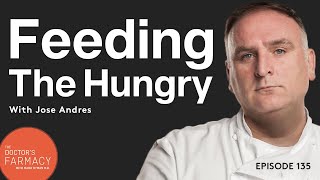
Chef Jose Andres talks about World Central Kitchen's work feeding people during crises like natural disasters and COVID-19. He and Dr. Mark Hyman discuss why food insecurity persists, how the food system fails hungry people, and what community-based solutions actually work.
We need to start seeing others that don't look like us, that they don't speak like us, that they maybe they have other gods like the ones we like as not people that they are our enemy, but as people that they are there to enrich our lives, to enrich our vision of the world.
Welcome to the Doctor's Pharmacy. I'm Dr. Mark Hyman and that's Pharmacy with an F-A-R-M-A-C-Y, a place for conversations that And if you care about food and hunger and how to deal with the crisis in our food system today, then you are in for a great conversation with none other than Jose Andres, who's the most incredible chef, incredible human I've ever met, who I think is, he should be called the food Buddha. He's like the Buddha for food. He goes around with compassion, feeding everybody who's hungry without question at incredible speed all across the world in a way I just don't even understand. He's been named times 100 Most Influential People and won the 2015 National Humanities Medal. He was also nominated for the Nobel Peace Prize for his work in the World Central Kitchen, which is no small feat in 2018. He's a culinary innovator, he's a chef. I've known him because of his incredible restaurants and his food. He's the founder and chef and co-founder of Think Food Group, which has 30 restaurants throughout the country. And I just admire him so much. He's an author and educator, humanitarian. and he doesn't just want to feed the few he talks about, he wants to feed the many. He trained in Ibili, which is arguably the number one restaurant in the world in Spain. It took a year to get a reservation in there. And treating food is this incredible experience that was almost religious for very few people that got to experience it. But he really now has shifted his work to feeding literally millions and millions of people around the world. through the World Central Kitchen, which is a nonprofit that's specialized in delivering food relief in all sorts of natural humanitarian disasters. In fact, he served 3.7 million meals to the people of Puerto Rico after Hurricane Maria and has since served more than 20 million meals around the world in every country imaginable, from Mozambique to Uganda to the California wildfires, dealing with fires to every kind of disaster. Anywhere there's a disaster, Jose just runs at it. Most of us run away. He leans in. Even with COVID-19, he's been at the forefront of trying to deal with the changes in our food system, the lack of access to food, and it's just partnering with all sorts of groups and government, small farms, partners to really deal with this issue of hunger and food insecurity. He's from Spain where I was born, and Jose has become a good friend and I'm just so honored to have him here on the podcast, the Doctors Pharmacy. So welcome.
Thank you, Mark, an honor to be here with you. Well.
You said something once which really struck me when I was sort of reading about what you do. He said, what we've been able to do is weaponize empathy. Without empathy, nothing works. And as a chef, we think of chefs as about pleasure and deliciousness and sensation and enjoyment and hedonism. But you talk about things like we need to make sure we're building walls that are shorter and tables that are longer, right? So these are very different ideas that come from a chef. How did you come to get your moral compass? How were you raised in a way that led you to be this incredible human being that got nominated for a Nobel Peace Prize?
Well, I don't know if I was nominated, use the press said it, I think some congressman and a congressman, a good friend actually over the years, nominated me, but I don't know. You don't know. I can tell you one thing that you've traveled the world like I've done and to every country I go, to every mission I go, from Haiti to Guatemala, it's always people that blows your mind away about the amazing commitment they have to improve the lives of others without any recognition, without a lot of resources sometimes. And those to me are the real people that run this world. The hidden heroes that every day they wake up no matter what and they deliver on behalf of all of us. So those are really the people that inspire me. So my life was like any other Boy growing up in Spain, middle class, my mom, my dad, they were nurses. My aunt was a pharmacist, my uncle, a doctor. My father and my uncle, they worked in an American base for a few years. I always watched my mom and my dad when I went to visit them at the hospital because they worked in different shifts. And so the hospital was the dropping zone for my brothers and I. And I got to feel very comfortable in a hospital, in the emergency room. Don't tell me why, but I was. And for me, always seen that those men and women will go the extra mile, even beyond their shifts after they ended, that they will be there reading a little book to a kid that their family didn't arrive yet. or that they will walk to an elderly person because they didn't have any family member to do it with them. That was those little gestures that show me that some of the big problems we face in humanity, actually they have very simple solutions. Is you just stop talking and they start doing. They stop clapping in a room full of people and start putting your boots and go on the ground where the problems are and they start solving one problem at a time. So I guess that's how everything began.
Yeah, I mean, it's really an unusual quality when you think about it because you think of most NGOs or various groups, there's a lot of planning and conversation and discussions and you're like, there's hungry people, they need to eat right now, they need water right now, they don't need in a week, we're going to go down there, we don't know what's going on, there's no resources. I mean, you went to Puerto Rico after the earthquake and figured out within a few days how to feel hundreds of thousands of people make food from scratch. You weren't giving processed meals ready to eat, packaged food from the world food program. It's just usually garbage that I saw in Haiti. You're giving them real food and you're doing it in a situation which is almost impossible. I mean, there's an old Chinese proverb that says, people who say it cannot be done should not interrupt those who are actually doing it.
And.
I went to Haiti after the earthquake. I think like you, we were both called to go there. Me as a doctor, you as a chef to feed the hungry. And it really changed me because I think it made me realize that it's those small acts that make the difference in the world. You can do something, you can always do something. Being of service is such, I mean, it's such a selfish thing in a way because altruism and acts of service are ways in which we actually get meaning and purpose in our life and make us feel alive and good. And I see that in you is when you are out there helping people and doing things and, you know, we're watching you on 60 Minutes recently on your profile. You're just animated and alive and excited to be actually helping others. You're not doing this to make money. You're not doing this to build another restaurant. You're like, I just see there's a hunger and a need and I want to help it.
Yeah, for me it's hard sometimes. In the old days, used to be home and watch and see the suffering of others that sometimes the only thing, in my case, the mission is very simple, right? feed the hungry and bring water to the thirsty. And it's a simple mission. The only difference between what I do, what Walden Ragas does and others, is that we take the word emergency by its real value. Emergency means now. If you're talking emergency about food means you need to be feeding people soon within 48 hours. You are talking about water means now. You need to be eating people, feeding people within 48 hours. And anything else is not good enough. I try to treat people in emergencies. World Central Kitchen, men and women, they know that they need to be providing service in the same way we will provide service. in a for-profit restaurant. If you don't deliver food within 10-20 minutes, probably you're gonna be on Yelp and it's not gonna be nice. And you don't do service because you don't want to be in Yelp. You must do good service because that's the excellence you provide, you want to dream, you want to achieve. Okay, in emergencies we treat every single one. of our people like our guests. And they're our guests in time of need, which even brings a higher level of necessity of not failing, of being successful. And more important is a moment that people want to see faces of somebody that arrive, that brings the light of hope, that somebody cares. that they are not alone, that aid is coming, that things will be better. This is vital. That's why it's so important in emergencies to be there in the face of people as soon as you can, because that way you bring anxieties down. You make people relax, children to feel better when they see a foreign face that comes from the outside. That sends a message to the communities. that things will be better tomorrow. And this gives hope and hope sometimes is the only thing that people have.
Yeah, and you see that. I mean, you know, you saw when you went and brought food to the homeless in the parks and bags of food and you just, you know, saw how much you just wanted to hug them. And then they were just so grateful and you can see the relief in their faces, you know?
Well, but I'm grateful too, you know, in this pandemic, I've been visiting because we have so many places that we are feeding. But in Washington, D.C. I always in every emergency I try to get into a circuit. So I spend part of my time what I call visiting new sites or opening new feeding places. But then I always try to have something like allows me to have certain kind of continuity. And so part of my continuity was helping organizations like DC Central Kitchen and Martha's Table in Washington, DC to feed in DC, which is where I live. And I will go to the headquarters of World Central Kitchen every day, where we were doing from one kitchen 12,000 meals a day from that one kitchen. And I will try to do the tour of the different homeless sites that nobody was feeding. for different reasons, because the shelters were overloaded or because they didn't want to go to the shelter or whatever. And when you get to know the people, like I tried to do, and you listen to their stories and their reasons of why they are on the streets, you see that sometimes I wish I had the power to find quick solutions to those people. and give them a home and a stable job that will bring them out of the streets and all of a sudden become a net contributor to our communities. So it's many interesting people with very thoughtful, very smart, they have an opinion about the country we should have, the city we should have, and this gives me joy because those are people we need to listen more to, not because they are homeless, they should not be listened to. They can be part of the solution, only we give them the opportunity to speak up.
It's true. I mean, most of us never take the moment to sit down with someone who's homeless and listen to their story and really understand what happened to them, how they got there, what their struggles are, and what their challenges are. And, you know, we sort of have this incredibly disparate society. And I think, you know, you're focused on hunger. And, you know, it's in America where we produce probably close to 500 to 1,000 calories more per person per day than people actually need to eat. We still have rampant hunger where 46 million people are on food stamps, where one in four kids is hungry. It's almost unfathomable that we have the wealthiest nation in the world and yet we are still struggling with these disparities because we don't really have a model for a food system that is equitable and fair and that produces good food, that creates good health, that helps people build back their lives. It's really tragic. I mean, as a chef, how do you see the way the food system is structured now? And how does it perpetuate this cycle of disease and obesity and health disparities that we see so much now?
I think the bounty we enjoy now in America and Europe the big production that humanity is able to achieve right now. Everybody will agree that the amount of calories we produce on planet Earth are, you know, exponentially more than the food really we need as humans. We see this amazing we don't need to compare countries around the world in our own cities. We have people that they have more than they need and we have people that they don't even have enough to feed themselves one meal a day and their children. And at the same time, in this moment we are living this crazy time that in those days if you were hungry and you were poor you will be skinny. Remember that one of the reasons the School Lunch Act passed in 1946 was thanks to the Pentagon and the requirement of the military to the US government to create a system so they could feed children in America so they will be healthier so they could join the ranks of the military. Astonishing to think that the military was the one that really created directly and indirectly the School Lunch program. But today we have this moment that we may have people that they are somehow obese, but still in many ways they are hungry and they are unhealthy. And this is something like people take it as almost like a joke, like they laugh at you, but the truth is that we forgot the meaning of nutrients versus the meaning of calories. Humans, we can produce calories like nobody right now, and we can store them in any way we want, and we can produce calories and they can be 50 years from now in a warehouse and still they're not going to go back. That's good humanity has become producing calories. But even if, so for us, it's not nutrients. But no nutrients and the delivery of those nutrients. So the bodies are enriched and we don't, so many of the problems we face, I mean, we could be talking obviously, you know, for hours and hours and hours. But The truth is that number one doesn't make sense that we have waste, a lot of food waste, and at the same time we have hungry people.
Yeah, it's more food than we need and we waste 40% of our food. So we have food for 10 billion people if we want it.
And this is, I will argue that even more. And I will say that if we could have a mechanism to test how many calories in takes we produce. Because remember now the people that produce a lot of calories have fancy gyms and we have fancy machines and we are burning all day. So probably we are burning so much that because we are putting so many more calories, right? Think about it for a second. In the old days, by me going to school, nobody drove me. I will be healthy because I will have to be walking like one hour to go to school and one hour back. That alone, as a young children, came in very good shape. This is not happening anymore in some parts. In other parts is the contrary. People have nothing, no buses to take them home and heavy, they don't even have a school. But then they're hungry because they don't have an economy. So the issue we're facing, obviously it's very different to be talking about hunger in Haiti, Hunger in Africa, hunger in Venezuela, that's hunger in America. The reasons are different in every, sometimes it's pure politics. But then when you think about it, it's always politics. United States of America right now, and for the last, I would say, 30-40 years, is not being in the business of having a healthy population. I'm a guy that I want to have big food companies. I would love to own them and I don't mind to invest. But now I realize that I don't want investing in a company that is making their living out of the spend of not creating a healthier America. And this is a reality in a very pragmatic way. So what's going on right now is very simple. When we have one of the richest country in the history of mankind, the most powerful country, produces food like nobody, wheat, corn, meat, export everybody. America feeds America and helps feed other parts of the world. We are a food producing machine, but there are subsidies within the farm bill within the USDA that provide subsidies to big companies to produce corn and other grains. cheaper than the real market establish. And because they are able to produce food cheaper than the real price value of the market, companies benefit from those subsidies and are all created around fast food, sodas, any company. And all of the sudden you have those fast food companies that they are able to produce very cheap hamburgers. very cheap sodas, a dispense of subsidies that the government gives that then people eat. It's okay because people need to have affordable food to eat. But it's kind of very, very nonsense because we need to be finding ways to provide food of good price, at good pricing, of good quality to the people that need it. and make sure that those burgers are so, so, so cheap that they produce calories in a way I cannot produce. And that millions of America eats every day in every corner, in every hot dog, in every burger, that I wanna be celebrating that, but in the process, we are making America unhealthier. So the American government, in this case, should be putting their power on a firm bill to bring more fruits, more vegetables, more beans, more grains to Americans and make sure that they don't subsidize the foods that are making America unhealthy versus the ones that are making America healthy. This way we invest into the solution. We invest in having a population that is really healthy instead of now that we have to be fixing that same population once we reach 50, 60, 70 years old, and the government has to be there for us with our hard work paying to fix ourselves from the sickness we get out of eating the wrong types of food. So the government should be in the business of investing in the solution when people are young with good food habits, with good sports habits, with good quality of life in that sense. and stop making people sick, that then we have to be paying the bill. And the health cost keeps growing, growing and growing versus bringing the health costs down and investing the money we save from the health costs into the betterment of the lives of Americans in need.
It seems almost like World Central Kitchen is a model for producing real whole food for large amounts of people at scale and in an affordable way. which seems really incredible. And with rapid speed, how do you accomplish that? Because if this is true, I mean, think about school lunches, for example, or think about institutional food that's garbage. I mean, I recently had back surgery and I was in the hospital and the breakfast was terrifying. I mean, I woke up after my surgery and I didn't really order the breakfast. They just brought me a plate and it was French toast with maple syrup with high fructose corn syrup. Cheerios, which is basically starch and sugar, a big muffin, which is starch and sugar, orange juice, which is sugar, and also I think I got a banana, which is the only real thing on the plate, and coffee rich creamer, which is basically hydrogenated fats and all kinds of caramel color and maple syrup. It wasn't even maple syrup. It was just garbage. And it was all high sugar, inflammatory.
Toxic stuff that was an institution.
Hi everyone.
Hope you're enjoying the episode. Before we continue, we have a quick message from Dr. Mark Hyman about his new company, Farmacy, and their first product, the 10-Day Reset. Hey, it's Dr. Hyman. Do you have FLC? What's FLC? It's when you feel like crap. It's a problem that so many people suffer from and often have no idea that it's not normal or that you can fix it. I mean, you know the feeling. It's when you're super sluggish, your digestion's off, You can't think clearly or you have brain fog or you just feel run down. Can you relate? I know most people can. But the real question is, what the heck do we do about it? Well, I hate to break the news, but there's no magic bullet. FLC isn't caused by one single thing, so there's not one single solution. However, there is a systems-based approach, a way to tackle the multiple root factors that contribute to FLC. And I call that system the 10-day reset. The 10-day reset combines food, Key lifestyle habits and targeted supplements to address FLC straight on. It's a protocol that I've used with thousands of my community members to help them get their health back on track. It's not a magic bullet. It's not a quick fix. It's a system that works. If you want to learn more and get your health back on track, click on the button below or visit getpharmacy.com that's getpharmacy with an F, F-A-R-M-A-C-Y.com Now.
Back to this week's episode. If what you're doing with World Central Kitchen could be replicated at scale across our food system, do you think it could provide a model for how we actually start to deal with providing real food that's delicious and affordable for large populations?
Yeah, what is very amazing is that we do it in the middle of an emergency. And if you look at the photos that people post all over America, all over, right now we have people in Indonesia, we have people in Venezuela, in Colombia, We have people in Puerto Rico and in Virgin Islands. And all across America, the quality of the meals, yes, is astonishing. This is a different type of emergency because here is no destruction. And happens we have the best chefs cooking for the people. And we have people, chefs that give their best and volunteers that give their best. And obviously we have a bounty of vegetables and fruits and fish that we can get. But yeah, we can do better. If all Central Asian is able to do this in an emergency, imagine what we cannot do in normal times. So the question here is why? And I will keep going back to political will. I believe that the political will is not there because usually what happens is that those 30-40 million people that they are under the hunger line. Right now, I think the number has increased probably 10, 15, 20 million more, and that's a real problem. They usually are people that they are disenfranchised to vote, that they feel like nothing is going to work for them, so why bother? And because they don't vote, politicians don't act. I think it's almost mandatory that we try to engage more everybody, especially people in need. and I think that will make Republicans and Democrats alike come to the table to bring a smart food solution. For example, we keep talking about food deserts. I know it's a lot of Americans don't believe that, but all these people listening to you and me now, and they're saying, Jose and Mark, they're full of baloney. Okay, we may be full of baloney, but the truth is that we cannot escape the reality. We have Americans today that don't have money to get on a taxi on a Ruber. They have to get public transportation if public transportation is available. The closest supermarket, maybe three, four, five, ten miles away. When I was young, I will go walking for the bread every day. I will go walking for the fruit every day. I will go for the fish every day. I will go for the meat every day that my mom will will buy was a walk away. We have millions of Americans that they don't have the luxury of walking to the place where they can buy affordable food. Those are food deserts that happens in America. When you have food deserts, we need to understand that a wealthy family in Chevy Chase or Potomac, Maryland may end paying less for rice and milk than a poor family in Anacostia. And that's the reality. This doubles everywhere around the world. Rich families in Porto Princes will pay less for some produce than a very poor family in the middle of the mountains of Fomberet, in the middle of nowhere in Haiti. So these food deserts makes food more expensive for the people that actually should be getting it cheaper. So the system is already faulty because that alone. So why we don't end as a federal mandate by the president and by the governors and by the mayors food deserts in America in the next five years is doable. We can make it happen. this is only one corner of many other things.
How do you see that happening? I mean, it seems like a problem that has been talked about a lot, but no one really seems to be.
Providing good Solutions because everybody talks a lot and nobody really does. And this is like a business, and the business has to be successful. And you have to think it like for profit, not for. Not for charity.
Yeah.
Charity. Remember Robert Eger, my Mentor, my Iran, one of the big fight hunger, fighters of hunger in America, very smart ideas, created this central kitchen. He told me charity seems is about the redemption of the giver versus charity should be the liberation of the receiver. When we talk about doing something, we are redeeming ourselves. If we have boots on the ground and we partner with the local community, that know best. And we really adapt to every situation because we cannot create one answer to every neighborhood. Because it's different neighborhoods with different people. Black people, Latinos, Asians, whites, it's different. It's different ways, it's different answers. Alaska cannot be the same answer than Florida. But nonetheless, the spirit should be the same. and in food deserts in the poor neighborhoods of America, the cost of land is very affordable. And usually the city, the mayor, owns land in those places. A piece of land should be put every X blocks of buildings and people where you try to establish systems to make sure that you have regular farmers markets of some farmers that come, that bring produce that they cannot sell anywhere else, but there they can sell it. The same place that maybe the food banks will be, where you will have a place where certain things will be donated, but other things you will give the people the opportunity to buy on their own what they want to add to the things that we may be giving them. through the Farm Bill other ways to let people use SNAPs to buy on those farmers' markets. We can call them community farmers' markets. All of a sudden we have thousands of community farmers' markets across America, one place at a time. Already we are closer to make sure that one neighborhood at a time, families are fed better, families have access to fresh food, families have access to quality foods, that they can afford, that we can actually channel there when we have extra production of vegetables, that the farm bill allows the government to buy that extra production of vegetables and channel them and funnel them through all those food banks, community farmers markets across America. All of a sudden, the community farmers market should be gone as a problem. should be, the food desert is gone as a problem. Community farmers markets are here as one more solution. That's one thing should be happening in the next eight years if Vice President Biden wins. Because I don't think this administration is going to make it happen because it doesn't show any interest whatsoever in making this happen. So I do believe we need to be thinking bold, but the bold ideas are not crazy ideas. are doable ideas that has been already some tests, but we need to go all the way in and make it happen. Private sector, government, local NGOs, social commitment from the local communities, we can make it happen together.
It's true, but you grew up in Spain where, like you said, there was a market really down the road for everything. It was a vegetable grocer and a meat grocer, and you saw your family making food from real ingredients and you saw where it came from and you connected to the source of it and you were cooking it and tasting it.
It was all real.
In this country, we really created generations of Americans that are so disconnected from the source of their food. They don't know where it comes from. They don't know how it's grown. They're not involved in the production of it. They don't know how to cook it. All they knew how to do is get it out of a package and stick it in a microwave or get it at a fast food restaurant. And that's really, I think, been a great decline in America where we've sort of had our kitchens hijacked by the food industry. and they sort of disintermediate us from our own food. And that act of cooking, which is so central to what everything you're doing is about, seems to be something we have to bring back into American culture. We have to get back in the kitchen. I think, you know, it's interesting with COVID-19 and the pandemic, people are forced to eat at home. The restaurants are closed. People are cooking, and it's sort of starting to shift people. And I just wonder as a chef, how do you think we can start a cooking revolution because you can bring all those things into those communities. You can bring the farmers markets, but if they don't know how to make, you know, kale or they don't know how to cook a vegetable, they've never seen a vegetable, you know, what is the step that breaks to the next level of getting people really empowered to take back ownership of their food and their food system?
Yeah, I think that is true that we've lost not only in America but in Spain and maybe the connection maybe we had. I'm not so, I don't romanticize so much about knowing where your food comes from. And I think we can have a good food system even if people they've never been to a farm. And I think people can be as committed. Holden, that doesn't mean that we should not work to make sure that every children has been to a farm, that every children understands how the food systems work in America. I think that's very important. But again, without a true political will, change just will happen with very romantic people going to conference to conference, listening to the same people giving the same speeches that sometimes I maybe even every day I decided to do less and less. Even these things I'm very hesitant to do and where everybody claps like seals in the zoo after they've been given a sardine and they all clap and they all agree and then everybody goes home. Next year, the year after, the next decade, the same problem continues and sometimes even grows. We have schools in America. We have thousands of schools. always can be better, but a very well integrated school system across America. Schools are a very important part of the DNA of our communities, of our societies. Every school should be having a full functioning kitchen, a full functioning kitchen with men and women working in this kitchen that they are proud of feeding the future of America. that we are able to employ people that maybe are homeless and we teach them a new, through training, a new profession of veterans that want to keep giving back to their country and some of them enjoy cooking and they are part of that solution. And what you see, I was in Baltimore and the people working in Baltimore in the school system, they are amazing people, amazing individuals. They give their best. but in the last few years, many of the new schools, they've been created and they are open almost without a kitchen. Only with a room that is to reheat things that come from the outside.
Deep fryers and microwaves, yeah.
You can do that because it's affordable, it's cheap, but it's one moment the level out the quality starts going down and down and down. And then what happens? What's the place in America? when it's a hurricane, or when something happens that very often ends becoming the shelter in place for people that their homes or their properties were damaged. Schools. And all of a sudden you have a school that is hosting on their gym 1000 people with no kitchen to feed those people. When you think 360 degrees, and the school systems become part of an emergency answer. Yeah. Moments of need. And you have them there because that kitchen will serve not only to feed the shelter, but maybe first responders and other communities around nearby. And I've been there and I know it for a fact. And all of a sudden, also when things are well, we have people that we employ, we are able to create jobs, we're able to make sure that that school is connected with the local farming a network. And we are able to be bringing foods and vegetables, and we are able to bring the farmer that can be talking to the children. We bring awareness to the children of their surrounding habitat, the resounding city. The farmers in the rural areas are making a good living because they're feeding our children with money that actually is better and smartly spent by the federal government through the states, through the cities. And all of a sudden you have An amazing emergency plan in case something happens one day. An amazing school kitchen, school system that feeds children. Children that are better fed, that are smarter because they are readier to get everything they get in education. They grow as healthy individuals means that the chances to be fatter or obese, in my case like I am, are lessened. All of a sudden, you are investing again in the solution versus in the, so we spoke about the food deserts. Now we're speaking about the school system. School systems, they must be totally protected by the federal government, the states and the cities. And they must be places that, yes, we provide education, but part of that education needs to be good eating, food education.
Yeah, and you recently introduced with Congress something called the Feed Act to really address this problem and to activate emergency food solutions in times of crisis like COVID-19 and people who have food insecurity and have food shortages. And tell us a little bit about the Feed Act and other kinds of legislation around food nutrition that really could make a big difference.
Before answering this, finishing with the schools, because I believe that curriculum is important to unite it with the good quality food we will give children through the food we will produce in the kitchens in the schools. I helped create with George Washington University a food curriculum for high schoolers. And was great because it was a way to be teaching history through food, to be teaching science and physics through food, to be teaching here pop culture, through food, to be teaching at the end the amazing power of what we need to learn, sometimes through food. The program went very well and it's still active. We did it in a school without walls. It's used that test that one day we hope we're going to be bringing nationally, but didn't land in there. Farmers markets of Washington, DC, they created a program called Man, I forgot front lines or food farm, but within the Farmers Market Association of Washington, D.C., the farmers donate money to create this NGO that allows to teach children how a garden works, to teach children about fresh vegetables, about seasons, about flowering, about seeds, and it's fascinating to see. So I think food curriculum is gonna have to be also very important. not taking away from anything. It's just part of the feeding, makes children interested, makes children engaged, and I think this is going to be quite frankly the future. And so I've been very proud to be helping that organization from the outside because who is leading it is amazing and they are doing an amazing job with that. And I'm very proud of being able to be part of it, like Alice Waters that did the same and she's been very successful in every school yard. In every school yard. So it's things like that but we need to come with one plan that is going to help all America and that one that all the school districts of America endorse and so they are able to do. So your second question, the real question that I forgot was...
The question really is about the Feed Act which was a way of mobilizing So this is the course of the country and the chefs in times of crisis, but also other kinds of solutions around legislation and food nutrition that have to be done to make a difference.
The feedback is amazing because many chefs, many people in the restaurant industry, we've been through this pandemic highly active into knocking on the doors of the Hill, of Congress, of the House, of the Senate, asking for the right solutions from our leaders. We had chefs speaking to President Trump. We had chefs calling every single senator and congressman. Myself, I think I spoke without overdoing the number, more than 50 senators and congressmen, way more than 50, I think. Why? Because we were asking for the right help. So it's been one that is a business one, which is to make sure that PPP worked for restaurants. Me, my restaurants, they got PPP, so I'm very, very thrilled, but many restaurants were not able to do it. And PPP, you know, is the payroll protection system that has been created. And the idea was good, but the execution is not being so great, and more is going to be needed. So we had a lot of chefs working on that. Through our organization we created Independent Restaurant Coalition, IRC. And they've been doing an amazing job. All of us have done amazing job. But on my other side, from the very early days, I wrote an op-ed to New York Times and another op-ed to Washington Post, both in the same direction. That we are talking about the health crisis. We're talking about the economic crisis, especially because President Trump is the only thing he's been talking about, not understanding that the economic crisis will go away in the moment the health crisis is beaten. But nobody was really talking about what those two were creating, which was a humanitarian food crisis. And me, I began being very obviously involved in that one. And with World Central Kitchen, we've achieved at one moment 350,000 meals a day. I think right now a day. Right now we are around quarter million. We are again emergency. We cover the black spots, the areas that the dark spots of the system that when the system shut down. So we've been feeding many hospitals. All the hospitals in New York are thanks to Mayor Bloomberg. at one moment, 17th, 18th hospitals we were doing three meals a day. Javits Center, we had a big place in front of 6,000 meals a day. This Central Park hospital with Mount Sinai, we were feeding there. We've been in many others in DC and my daughters will feed everyday children's hospital inside NIH.
Wow.
Multiply that all across America. Nobody realized, but people that build hospitals, they never thought about the pandemic. Amazing, right? That we have, we put a lot of thinking in kitchens where the fire exits are, but I would think like a hospital, we think about pandemics. Why it is that in some hospitals, I would say many areas that were shut down as a hot zone were areas where the cafeteria where you had to feed people was located. I hope that from now on people will think when they build hospitals in case a pandemic comes, how the building should be created so food would not be an issue. So that's what we had to be bringing in some places. A lot of food. How we did that? Usually we send our kitchen, we cook. But when we can't, you just create.
A kitchen out of nothing like you.
Just... Yeah, we do. But this time is not destruction. And we have millions of people in restaurants without jobs and hundreds of thousands of restaurants shut down. The idea was simple. Why we don't put them up and running? why we don't, they partner with us because they don't do it for the money quite frankly. But if we're able to pay per meal, we can put the restaurants working, the restaurants can hire some of the people, the restaurants can be buying from the local farmers that nobody, they cannot sell to anybody. And it's a way to somehow, without being amazing, but you reengage the economy. And in the process, until we are okay to be open again as normal, as a normal society, you are using the restaurants to be emergency. And we did that. We have today 2,400 restaurants in our network feeding across 35 states and we keep moving.
And they're feeding who? They're feeding the elderly or people who can't get out of their homes.
Nurses, doctors, National Guard, homeless, elderly. We have a system to feed the elderly with Uber. When the elderly cannot leave their home and they don't have anybody, we send one Uber home by home. The same traditional Uber Foods, but in disguise by emergency. Uber partner with us and others, Grab and Lyft and others. In Spain, I had the Spanish postal service delivering food home by home was beautiful to see. Hundreds of people delivering one meal at a time to elderly that they had problems with movement or problems with their immune system. Amazing system. Why I have to reinvent a delivery system when the delivery system is already invented and in place. So this is how World Central Kitchen thinks. So what we were able to do is proof concept. So I've been able to go to Congress and we got Congressman Thompson of California and Congressman McGovern of Massachusetts introduced this bill supported by Congressman Davis of Illinois and Congressman Hurt of Texas. Listen to me, Democrats and Republicans.
Yeah.
Boom. It passed Congress already. Now it's on the Senate. In the Senate we got Senator Kamala Harris from California and Senator Tim Scott of South Carolina. All of the sudden, we have a Republican and a Democrat, all their senators on both sides are joining. So the FITAG is that to make sure that the government passes this bill that will allow FEMA, once the emergency is declared, to provide funds to the governors and the cities, because the mayors are in the front lines, to activate local restaurants, to pay them to cover the needs in an emergency like the one we're living. This is a smart solution. You don't throw money at the problem. You keep the economy running. You keep America working. You keep people providing for their families without being unemployed. And how do we do that? Because everybody at the beginning, I had some Some people that were a little bit critical with me that they say why I'm putting people at risk cooking. I think people thought that I'm cooking because I have nothing else to do. I'm very proud, I'm very happy cooking for my daughters and not moving from home for 90 days. Unfortunately many people cannot afford me. Unfortunately I could. do that. But why when it's need, people were hungry, we were feeding people in real need. So we created one in February, I began following COVID in January. One of my best friends, Ambassador Jorge Guajardo, was the ambassador of Mexico in China.
Oh.
And he knew China very well for six years. and he kept me informed of what was going on in Bucharest and other places. Especially in what I like, how people were feeling in a pandemic like this. Learning, learning. We went to Japan in February to feed princes 18,000 meals a day to the 6,000, many of them American. Why us? Because we've been feeding people in Haiti through cholera, we've been feeding people in Muso through cholera, And in our camps, never call her. Why? Because we create the healthy protocols. Why I'm telling you all of these is that the first thing we created was a mascot. The mascot name is Masky. M-A-S-K-Y. Masky. Masky, red hat with a big mask and a big hand. And Masky was guiding all of us what to do. So we created the health code. in how to behave inside the restaurant, how to behave in takeout, how to behave in deliveries, how to behave in food deliveries, in how to maintain the teams producing the food healthy. So I'm very proud that we've been very lucky, but I think we were hard at it in feeding people, having very, almost no cases. Yeah. All across. Why? Because we were conscious since February that mask was mandatory, that we had to produce more with less people, that we had to keep separation even inside the kitchens and in the restaurants. And more important, I created these circles that we began putting the 15th of March on the floor. And now thousands of places in America has them to show people that they had to keep six feet distance. And where the masky was telling you that you had to wash your hands. that you had to wear your mask, that you had to make sure that you keep the distance from each other, that you couldn't shake hands, etc. etc. That's why I'm very proud of the work of World Central Kitchen. If you go to worldcentral.org, you'll find it there and you'll see that they have protocols, probably they've been the backbone of the success of World Central Kitchen through this pandemic. We were ready to adapt to this emergency. Adaptation meant be ahead of COVID being fighting COVID, by keeping everybody alert, by keeping everybody covered, by making sure that we protect each other even when we were working together.
It just shows you what great leadership can do in solving problems and how inept we've been as a country to do this. And your examples are so powerful. And I think there's so much more work to do. not just with dealing with the food crisis and COVID, but with really creating an equitable food system overall and dealing with some of these problems so that, I mean, there will always be disasters, but what's going on right now is sort of this slow motion disaster in America around food with the incredible amounts of chronic disease and obesity and health disparities and the burden on the economy and the consequences of how we produce the food and grow the food in our agricultural system and climate. It's all one big problem. And I think that you're so good at getting into the practical solutions, getting on the ground and figuring out what to do and not waiting around, philosophizing about it or talking about it, but actually doing it. And I think it's just an example for all of us. And I think it's really about just being connected to others, asking and learning what they need, and just solving one problem after the other. And that's what I found when I was in Haiti. the hospital was shut down. I was the first doctor on the ground with a crew. It was just a disaster and you just had to start solving problems and figuring things out and creating an OR and creating getting supplies and getting this and getting that. It's like you just deal, you just do it and I think most people are afraid of that and it's just so powerful to see your example. I think your Twitter profile is really beautiful. I want to sort of close that and ask you about it. You say, We are all citizens of the world. What's good for you must be good for all. if you are lost, share a plate of food with a stranger, you will find who you are. So talk about what that's about and the meaning of bringing people together over food and why that's so, so important for all of us.
I think the meaning of breaking bread is important. Breaking bread in a table, breaking bread between two people and maybe they don't get along or maybe people don't know each other. I think humanity, this comes from centuries and thousands of years that we created these tribes, right? We all belong to a tribe. And somehow, since we are children, I sense that even when nobody does it in a wrong way, even when it's wrong, everybody keeps the tribes. And it's difficult to let other people from an outside tribe to join your tribe. And we need to fight that because I believe that life starts at the end of your comfort zone. And really, your comfort zone is really challenging when you move away from the people you are comfortable with. And we need to start seeing others that don't look like us, that they speak like us, that they maybe they have other gods like the ones we like, as not people that they are our enemy, but as people that they are there to enrich our lives, to enrich our vision of the world. And for me, I think that idea and that phrase happening, hey, that I would like, obviously, I will go to the fancy restaurants because I would like to tweet about it to bring tourism to Haiti. Remember I did a documentary about travel in tourism, travel and food in Haiti, which was with National Geographic on PBS. But me, on that documentary, on that show, I didn't took people precisely to the fancy places. I took them to the places where normal Haitians eat. And sometimes poor Haitians. Why? Because that's the way. And then you realize that they are not strange people or dangerous people or people that I don't want to go there.
The other, right.
I go there because I need to feel like I'm respecting them. They don't want our pity, they want our respect. showing up is respecting them, but more important, them allowing you to be there too, and treating you with respect and giving you a smile and actually making you feel comfortable because they know you are in a place you don't belong. Shouldn't we do the same? And we shouldn't be trying to make sure we put those walls down and we bring longer tables, bringing cities together. bringing communities together. That's why for me, obviously, this is important and I believe food is important for that. It's part of the DNA of who we are. Food has many of the answers. I can give you answers of history, on science, I can give you on health, on poverty, food is there on economic growth, on unemployment, on on greenhouse gases, on CO2. Food is there. Let's make sure that food is not a problem, but the solution. That's why a few weeks ago, I was so proud that Vice President Biden, the town hall, where he invited me to join him, where the entire town hall was about food, first time in the history of a presidential candidate.
I didn't know that. That's incredible.
Four months before election. that we have a town hall about food as a national security. So I am very happy that somebody like may become a president of the United States is giving importance to food in such a way. Totally. I'm gonna be there making sure that I keep pushing him and his teams to make sure that food is an important cornerstone on his possible presidency. Totally. Why? Because at the end, if we create a better food system, where it's part of the solution, Republicans and Democrats will benefit identically. And that's why food is so important. Brings all America together in a moment that America needs to be together more than ever. Almost like Thanksgiving should be every single day. that's what we need to be aiming for.
That's such a beautiful vision, Jose. It's an incredible vision. And you're absolutely right. Food connects to everything that matters to us as the problem, but also the solution. And it's actually why I wrote my book, Food Fix, which is really about solving those issues, connecting the dots, and pushing our policymakers to actually create the change. And it's sort of I launched something called the Food Fix Campaign, which is a non-profit to really educate and raise awareness and policymakers and drive policy change to deal with these issues. Because it's not just one thing. It's a multifaceted problem, but it requires thoughtfulness and sort of like you wrote about a food czar that really brings all this together. Pretty, pretty amazing. Well, we're in this amazing moment in history and I think it feels like the worst of times, but I believe we'll come out of it and I think we'll learn a lot and I think your vision is certainly a guiding one for all of us. So Thank you so much for being on the Doctor's Pharmacy, Jose. I love you. You're an amazing man. If people want to learn more about his work, I encourage you to go to check out the World Central Kitchen at wck.org, you can learn more about what they're doing, you can get involved, you can donate. You can also learn more about what he's doing on his website at Jose Andres a J-O-S-J-O-S-E-A-N-D-R-E-S.com, he's just an incredible leader. in the space of humanity. And I think you will get the Nobel Peace Prize. I certainly will vote for you. And I just love having you on the podcast. So thanks for sharing your wisdom with all of us. And if you love this podcast, please share with your friends and family on social media. Leave a comment. We'd love to hear from you. Subscribe wherever you get podcasts, and we'll see you next time on the doctors Pharmacy.
More from AI




This Is Why 99% of Skin Conditions Don't Heal — And What Dermatologists Won't Tell You






Why you need to start strength training today #strengthtraining #healthyaging #fitness
