How to Find Your Purpose l Doctor's Farmacy with Mark Hyman, M.D. EP9
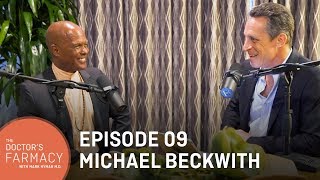
Dr. Mark Hyman talks with Michael Beckwith, founder of Agape International Spiritual Center, about spiritual awakening and finding your purpose. They discuss life visioning, intention, surrender, and how to overcome fear and trauma through meditation and practical spirituality.
Welcome to the Doctor's Pharmacy. F-A-R-M-A-C-Y, I'm Dr. Mark Hyman. This is a place for conversations that matter. And today I have an extraordinary conversation that really matters with Michael Beckwith, who's an extraordinary teacher, educator, inspirer, spiritual leader. He's the founder and director of Agape International Spiritual Center. It's his 32nd anniversary, this November, which is pretty amazing. He embraces a practical approach to spirituality, including meditation, affirmative prayer, and this amazing process called life visioning, which is something he originated. He, in 2012, addressed the UN General Assembly during its annual World Interfaith Harmony Week, and as co-founder of the Association for Global New Thought, he hosts conferences featuring harbingers of world peace, including his Holiness the Dalai Lama, and had the distinguished honor of presenting to Nelson Mandela The Gandhi-King Award, that's amazing. Gandhi-King, that's like Mahatma Gandhi and Martin Luther King, that's like a double whammy. Dr. Beckwith is a sought-after meditation teacher, conference speaker, seminar leader on the life visioning process. Three of his most recent books, Life Visioning, Spiritual Liberation, and Transcendence Expanded are recipients of the prestigious Nautilus Award. He's been on Oprah, he's been on Super Soul Sunday, in the Help Desk, on Dr. Oz, CNN, Larry King Live, Tavis Smiley, his own PBS special answer is you, and is a member of Oprah's prestigious inaugural Super Soul 100. Wow, that's a very rarefied group. He practices to teach us and take the experience of inner peace and awakened awareness into our everyday lives. Now, welcome, Michael.
Thank you, Dr. Mark.
Now, I just had this extraordinary, immersive, transformational experience of listening to you, I wouldn't say talk, I would say dance, sing, play, inspire, uplift for an hour. And I hear a lot of people, and I hear a lot of bologna, and there was no bologna in there.
It was all- I'm a vegan, so-.
It was all vegetables. It was all vegetable, hardcore. And I was just so inspired by how you see the world and how you think, and how you approach the very difficult question of how do we create joy and happiness and fulfillment? How do we become awake? How do we get connected to what matters? And how did you kind of come to be Michael Beckwith?
I go back a number of years, I had a spiritual awakening. That's the only thing I can call it. I was attending USC at the time. I transferred from Morehouse College and I was now attending USC as a psychobiology major. I began to have a series of inner experiences that at the time I labeled pathology. Seeing things, hearing things.
Mental illness.
Yeah, it was like, what's going on with me? And culminated with this dream I would have almost every night. And in the dream there was these three men that were chasing me. and I would wake up before they would catch me. But one day they were very close. I could see their face. And I turned around and I saw this long line of people going into this small tent. And I said, They can't do anything to me. All of my friends are with me. And one by one, all of my friends turned their backs on me. Two of the men held me down and one plunged a knife into my heart. The pain was excruciating physically. and emotionally, and I died. And when I woke up, I could see it was surrounded by this presence. At the time, I named it love beauty, because the love was beyond anything that I'd ever experienced, and the beauty was indescribable. And it took me a number of years to discover what had happened. I had to go on research to discover what had happened to me. And in so doing, I bumped into--.
You- didn't have the language or the thinking to kind of put in context or make meaning out of it.
No, I had no preparation. I didn't have a spiritual practice. academic. And so I bumped into the mysticism of Jesus. I bumped into the mysticism of Buddha. I bumped into the mysticism of Zoroaster and Kwan Yin and, you know, the ancient text and began to see what was going on with me. Walter Russell, one of the greatest mystics that's come out of America, studied his works and he'd had a similar experience. And so after a couple of years, there was an integrative process that took place. I didn't, I realized I wasn't crazy, even though I lost all my friends at the time. They all thought I had freaked out.
And- There were too many drugs.
There were too many.
It wasn't a drug though.
No, it was not. It was an opening.
It was an inner pharmacy.
There you go. Everything changed for me. And, I mean, agape didn't happen right away. It was a number of years later. I never at that time thought I'd be a public person. I had a private love affair with the presence. And so most of my relationships were like one-on-one with people. I would work with them and I could get them to see another reality. I could help them heal. And it wasn't until a number of years later that my mother actually took me to a metaphysical church. And I said, Mom, I'm not going to any church. They don't do truth there. They just do dogma and religion. And she took me and there was a man by the name of Dr. Morgan who was speaking and he said, Heaven and hell aren't necessarily places, they're states of consciousness. And I said, He's right! Everybody turned around, looked at me.
We create our own heaven and we create our own hell, right?
And so that began me taking classes to actually give me language to what was happening inside of me. And then time went on, I became a spiritual therapist, ended up going through the school of ministry, and then I was pulled to actually start a community.
And you created a trans-denominational center. What is that?
Trans, of course, means to go beyond or to cut through. So we wanted to go beyond denominations.
And get to- Not interfaith, but trans faith almost.
Trans, you know, because you have a lot of like Christian churches, they have different denominations. You have in every Buddhism, you have different way you approach the teachings. Different sects and Judaism. Different sects, Judaism. Conservative reform, Orthodox, Hasidic, right. So we wanted to cut through all of that, go beyond it, and get to what is known as truth. whether that truth is- With a capital T. Capital T truth. Whether it's from science or whether it's from mysticism, whatever is true, that's what we honor. And so today we have thousands of people that come, rabbis come, we have individuals that survived Catholicism, individuals that- Are they still guilty? Well, they've learned their guilt. But no, they become the Jewish, my Jewish brothers and sisters become joyous and the Catholics release their guilt and shame. And so everybody's in the room. We have people from all over the world.
Color, size, shapes, sexual orientations.
Everybody's in the room, everybody feels wanted and needed and loved. I love the experiment, it's working so far.
That's extraordinary. And you know, when I just heard you speak, because we're here at the Feel Good Summit, in Southern California, you said a few things that were pretty striking to me, and you sort of mapped out in a way I'd never heard before the questions that we ask determine our way of being and our thinking and our emotional and spiritual state. And you took us through four sort of stages of how we move from questions that actually keep us down to questions that uplift us, awaken us, and make us richer. So can you kind of walk us through what those questions are?
Right. The question, the four stages you're talking about is something that emerged a number of years ago in response to a student who was asking me about what she thought was the contradictions in the teachings. She was asking me on one level, you say, you can have it all. On another level, you say we should surrender. So she thought there was a contradiction. So I walked up to the blackboard at that time. I didn't know what I was gonna say, but what emerged was there are different stages of spiritual growth. The first stage is the victim stage. And here we think something is doing something to us.
The next stage is the effect of our life, right? As opposed to the cause of our life.
Absolutely. I said, then we grow and we realize that there are laws in the universe. Just as there's buoyancy, you know, if you surrender to buoyancy, you'll float. If you flail against it, you'll sink. So in the second stage, that's where visualization is. You learn to apply these laws of mind to make a difference in your life. The third stage is the stage that something operates through you. Something bigger is actually coming through you. The zone. The individual's zone. Peak experience. There's something, it's beyond your thinking. Flow state. Flow state, I call it flow motion.
Flow motion.
And then there's the being state, where you're at one with. So in the first stage, we ask disempowering questions. What's wrong? Who's to blame? We want to know the scapegoat. Who's to blame for this? Why me? And these questions, if we live in them chronically, the law will answer them for you.
The world's happening to you, as opposed to, yeah.
Somebody's doing something to me. It's somebody's fault. you don't grow at that level. You just kind of find excuses and reasons. You can say, well, this is happening to you because you weren't trained properly at home. Your parents didn't do this, or whatever it is. But if you look for a reason, you'll ultimately find an excuse. If you hang on to the excuse, you won't change. So you have to have a much more dynamically, aerodynamically asked question. And so those are empowering questions. what's real, you know, what good is here that I presently cannot see? What's trying to emerge in my life? What gift do I have to give? What's my destiny? What's the vision locked within me that's trying to escape? So if individuals begin to ask an empowering question and become alert, become available, they'll start to hear different answers. It's broadcast is happening all the time. But are we attuned? We're not attuned if we're asking disempowering questions.
It's true. You know, something I've noticed in my own life is that if I am just aware of possibility and I see the doors that open when they open, then I kind of walk through and magic happens. I can't really plan and I can't figure it out, but I have to be attentive to just what you're saying. And it sort of reminds me of that story of the guy who's, you know, drowning in the ocean. He calls for God to help him, you know? Right, right. And this boat comes by. He says, no, no, I'm waiting for God. And the helicopter comes by. Waiting for God, you know, the submarine comes by. No, no, I'm waiting for God. And then he dies.
And he goes to heaven. He goes, God, why didn't you save me? What do you mean? I sent a boat and a helicopter and a submarine. Absolutely. You know, it's always happening, but are we available? Are we asking the right question? Are we open? and many people are stuck in that victim stage, so they're asking the wrong questions. And the power within them doesn't have a chance to emerge.
Yeah, and it's easy to be in that state, 'cause it's sort of how we are trained and how we think, and it's everybody else's fault. It's sort of we're at the effect of our life, but not at the cause. And so your map, your life visioning map, Does that help people get to be at the cause of their life and be able to manifest? You were part of that movie, the Secret, which is all about- Right, that's stage two.
The secret is from the stage two of the four stages. It's the stage in which you learn that there are laws in the universe, mental laws, spiritual laws, and you begin to apply them. You begin to practice. And so, absolutely, people get clarity. Once they see the map, if they take a class, they suddenly know when they're operating in victim, and they begin to like become aware of the questions they're asking, the complaints, and they begin to have a practice where they lift their conversation to a much higher order and begin to ask an empowering question. So it becomes a place where people can really practice, because the whole thing is about practice.
And it's less about the little self and what it needs when you ask those questions, more about the big self.
Right? Right. Capital S self, when we're in tune with that, it will provide everything necessary, legitimate needs for the little self. When the little self is running the show, it has mature- It's annoying. Immature wants. It wants stuff that's not even good for you, you know, and thinks that it's gonna make them happy. I mean, we're looking at today, you know, the rash of suicides. And many individuals who have committed suicide recently had all the stuff from the American dream. They had money, they had family, they had fame.
It was frightening, yeah.
With the other gentleman that just-- Anthony Bourdain. They had all the stuff, but perhaps there was a fake hole there that wasn't filled. So the little self can get the stuff sometimes and still not be fulfilled. So we have to have a larger context.
I just want to come back to something you said, which is I've never really heard stay that way before, which is that when you focus on the big self, everything gets taken care of for the little self. Yes. So you don't have to worry about that.
No. And matter of fact, if you worry, it. It repels it.
Yeah.
Worry repels.
Worry is like if you're grabbing and craving and hungering instead of asking what you can give and what you can be. That contributes to a better world.
Yeah. It.
Well, I found that it's. I, you know, you. You sort of connected this to another. interesting conversation, which is something you call intention deficit disorder, which is lack of clear intention. But it can't be an intention like, you know, I want a Bentley, or, you know, I want a jet, right? Because that doesn't work out. I've had that intention. I want a private jet. It's not working out so well.
Saving you from something.
But when I have an intention that's not for me, small self, but is for the bigger World, like I really am working at Cleveland Clinic and had this, you know, have a desire to really change the world through bringing the gift of functional medicine to more and more people, which is, I believe, the way we're gonna create a solution for chronic disease. And without even trying, we raised over $15 million.
Wow, congratulations.
And I decided, you know, I really wanna help solve the brain problem, this epidemic of dementia. And I said, we need a lot of money. And I set the intention It's not for me. It doesn't have to my name on it. It doesn't go to me, it goes to this mission. And someone reached out to me the other day and says, well, I have a donor who has $50 million who wants to donate. And I'm like, well, wow, you know, like, and it was, it's all coming from that space of manifestation. And it sounds weird and corny and strange, but it actually works if it's.
Not for your own personal self-centered needs. If you didn't have an intention, it wouldn't have happened. It's not just gonna happen by accident. Things don't just happen, they happen just. And that intentionality that you're living with brought in something beyond what you could plan for. And so many people do not have intention. They have a reaction to circumstances and they live by the fight-flight reactionary mode and they don't stop and establish an intention for their life. you just grab a higher quality. It can be love, it can be beauty, it can be intelligence, it can be generosity, compassion, kindness. You know, I have an intention today to grow in this area or to share in this area, doors open that you didn't even know were there. And you have to walk through them.
And you have to walk through. Unlike that guy who was drowning. Right, right.
You have to, oh, there's a door. Why is it open? No, you gotta walk through the door.
So let's unpack this. concept of intention and surrender.
Yes.
Because they seem contradictory, right?
Yes.
How do you have an intention and manifest and have a desire to make something happen and also completely let go and surrender?
But the intention is like a rudder that your life is going in a direction. I want my life to go in a direction of service, of love, of generosity, of prosperity, of health, of wellness. Now, surrender is not giving up, acquiescing to a circumstance. Surrender is allowing that which is within you already to emerge. So the acorn is surrendering to the oak tree. The apple seed is surrendering to an orchard of apples. It's not giving up. It's actually dying to its littleness so that that which is loaded and coated within it can come forward. So when you're living a surrendered life, you're always on the verge of the more of you coming forward.
Yeah.
And what appears to be through in.
Your life or what you're actually dealing with or the stresses in your family or whatever it was, because you always seem like awesome. I'm like, well, I just have this belief that it is what it is. And I, and I'm here to just understand and learn from it. And it sounds kind of weird, but it's really worked for me. And I, I almost died last year. I was in this state of complete claps. I had complicated illness of mold poisoning. I had intestinal infection from an antibiotic. I lost 30 pounds. I was in bed for five months, and I had no physical self. I had no emotional self. I had no mental self. None of that was working. All I had was my spiritual core. And in the middle of it, I had this great sense of peace. And I was even surrendered to dying. And I didn't know why this was happening. I didn't know if I was going to come out of it. I didn't know what would happen to me. But I just sort of surrendered into it. And as it sort of turned out, it allowed me to discover a whole new way of healing to kind of resurrect myself. And now I'm stronger and better than ever, and I'm using what I learned to heal my patients. So I would have chosen that.
But you got the gift from it. You got the great gift. I often define fear as misdirected interest. that we become more interested in the worst case scenarios that could possibly happen, rather than the love and the faith of what the best case scenarios could possibly be. What we can learn from this, what we can give from this. So yeah, fear, worry, worry is like paying interest on money you haven't borrowed. There's no dividend out of that.
I thought worry works, 99% of the time what you worry about never happens.
It never happens, you know. But the body temple doesn't know, the body temple is like producing those toxic chemicals around things that never happened. Prematurely, you know this better than me. Prematurely age yourself, shrink your immune system, shrink your brain. Everything. So yeah, so worry and fear, you know, are the real demons.
So, you know, it's easy to say just don't be afraid and let go of your sense of fear about life. And for many, it's kind of hardwired in them. When you look at the epigenetic tags that we know about science now, there's tags that happen in your genes that affect your stress response. There are traumas that get literally encoded in your DNA that are hard to erase or that in your brain and whether people have PTSD or and how do so do you work with that? You know, there are people talking about using psychedelics. Michael Pollan just wrote a book about this where they're using it for PTSD, for depression, for trauma, all sorts of things.
Well, when you deal with this kind of fear or trauma, the first thing is, I always encourage a spiritual practice, something that you're doing deliberately, intentionally on a daily basis, even if it's for a few minutes a day. So you develop a different behavior, you develop a different pattern in life. Many people are doing hit and miss in reacting to circumstances, but if you can devote to whatever the practice that feels good to you, and you do it a little bit every day, then you start to change the trajectory of your life. the chemicals change in your body, the thoughts change. You start to see life differently. You have a different perception, even if it's for a small period of time every day. And then as that perception slowly changes, then your life experience changes. So I do know of people who do the psychedelics, ayahuasca, and things of this particular nature. And I always say, if that becomes your path, for a while, then make sure that the individuals that you're walking with actually know what they're doing. They actually come from a lineage. This is a thousand year old lineage of ayahuasca or whatever. You don't want to go do a fly-by night, somebody went to Peru for two weeks and came back and says, I did it. Got their certificate. Yeah, got their certificate. And my shaman. I was a shaman in the mountains for a month. No, you want to do it with somebody who actually comes from that lineage. To the best that you can, somebody that's really trained to understand all the nuances of what's happening. So just because now, you know, in America, Americans love excitement and sensations and the quick fix. But I think what we're talking about is a way of life, not just a temporary lifestyle, but a way of life that becomes-- You're beginning to be.
Able to rewire some of these-- Absolutely. Actually, I just read a study I get a little feed every morning on my computer of scientific research, and this study just came out that men who used psychedelics in the past were less likely to be violent to their spouses, which I thought was fascinating.
They've seen something. I went to college.
The doors of perception.
I went to college. I mean, I had acid. I did that back in the day.
And those were traditions that go back thousands of years, whether it's ayahuasca or peyote from Native Americans, whether it's mushrooms.
And this, Ram Dass helped make a lot of that very, very popular. I've had opportunity to do co-workshops with him. But yeah, I can remember meeting Dr. Howard Thurman, a great theologian, great mystic, on acid. One night he, and I can remember being in his field, and I was so present. And then when he left, I got disoriented. Got disoriented, but in his presence it.
Was like a guide, right?
It was totally, totally, coherent.
Yeah.
Yeah. So I've walked that path when I was in college.
So you talk about daily practice. So could you share with us what, what you do to help you?
When I, when I first start to become conscious when I'm waking up in the morning, I just, I'm aware that, oh, I'm awake in this dimension. I always say thank you. I'm grateful. And then when I get out of bed, I stand and I open myself up and I say, I'm grateful for my life. And then I say, I surrender to life. And then I say, what's my assignment for today? That's how I wake up. And then I go to the restroom and do all that.
You get a text from God, he says, Here's your job for the day.
I used to get a fax, now I get a text. And then, because I want to be prepared for whatever comes in my direction, whatever comes in my direction is my assignment for the day. Then I go, I have a place where I meditate. And I do a short meditation. And then I get ready, I go to the gym. I work out, physically work out, four days a week, Tuesday through Friday.
That's why I saw you, when you.
Did your lecture, you could do a mean kick and dance. Yeah, I do all of that. I do yoga three days a week, I do the gym four days. And then when I come back home from the gym, I shower, I get ready to go into the office, but then I have a more extended meditation. I'll actually sit in 22 minutes will be my minimal time. if I can, depending on when my first appointment is, I can go longer. And so then I go into the office. There's generally a, when the staff comes together, we have a moment of coherence together where we align ourselves with the intention for the day to be servants to life and of life. And that may happen throughout the course of the day, depending on who I'm meeting with. And then at the end of the day, I go back to the same place that I began. and turn it over, and I've tried to go to bed with not a to-do list. But I tried to go to sleep.
A to-be list.
Yeah, there you go. It's like, thank you. And then I asked to be taught even as I sleep.
So it's powerful, these simple daily rituals.
Very simple.
Seem like kind of insignificant, but they are profound and they have resonance throughout your life. and they build over time.
They build, you know, as the example, if you pour a little bit of water in muddy water every single day, eventually there's clarity with the water. So if you do something every day, just a little bit, then you become more and more clear.
That's true. I remember, you know, when I went to college, I didn't major in biology. I majored in Buddhism.
Did you?
I did.
I just, I had a Buddha call, huh?
I did. I got a call from the Buddha. He says, check out this class. and I just followed the doorway open. Actually, I remember sitting in Cornell in the dining room, and it was the first week of class, I was a freshman, and they're sitting at this guy, and he's like, oh my God, you should take this class by this Professor Gribard. He's from Paris, he's crazy, he's a Buddhist, he's like, it's amazing. I'm like, all right, so I canceled one of my classes and I switched over, and I literally just took every class he taught, and I took all the Buddhist classes, and I didn't intend to be a Buddhist major, but that's what all my classes were. And I also started meditating, and it was a yoga teacher before I was a doctor and was profoundly interested in this space. And of course then I ended up going to medical school and getting kind of sidetracked, working 100 hours a week and all that kind of fell away and got married and had kids. And, you know, I remember having really profound experience back then, but I almost like I was young and I didn't have a way to contextualize them. And in the last few years, I've sort of reconnected with meditation and 20 minutes twice a day, It's sort of like religious for me. And it's simple, it's easy. I can do it on a plane, I can do it in the back of a car, I can do it not while I'm driving.
Right, right.
And it's profound.
You can drive while meditating. You can meditate while driving. No.
And I can tell you that the amount, I didn't think I was anxious, I didn't think I was stressed, I thought I was happy. And the truth is that all those things became amplified.
Yes.
Nothing bothers me anymore. I don't react emotionally. I feel much happier and joyful. And it's just a simple, simple practice. Absolutely. Every day. And it's profound. And unless I think you have something to anchor you in the world, the spirit, it's very hard to sort of make progress in your life.
It is that the turbulence in the world, the thought forms, the opinions, the news, the all the things that we're bombarded with. I mean, we have more stimulation in one day as you know, than previous generations had in a year or five years. All one day we get all of this information. We have to have some kind of grounding into the spirit to stay sane, or you just pull the most-- Digital detox. Every single day you have to, you know. Like you said at the beginning of the conference, you have a box. You put your phone in a box so you can just be with yourself and your wife.
Well, my wife, you know, the best gift you can give anybody is your presence. And now, you're with your friends, they're on their phone, they're texting, it's like we're all disconnected, and all we want is to connect. So they're on their phones to connect.
But they don't connect with the person right in front of them. It's like, these young people are in a much harder situation, because sometimes I look at them, they're talking to each other, and they're sitting right next to each other. Why don't you just talk to him? There he is.
Just say hello. You don't have to text. It's true, it's true. And so, the gift of presence is powerful. And I literally bought my wife this box for our anniversary. and I gave her the box. She's like, that's a nice little box. And I'm like, no, that's not the present. The present is I put my phone in the box for the weekend. And she just started crying because all she wanted was my presence.
Yes.
And then I thought it was for her, but I actually had this extraordinary experience over that weekend where I just was able to be. I wasn't constantly looking for my phone, seeing what messages were there, checking the news.
Amazing. Look at my Facebook, Instagram. It's amazing. Recently, I left my phone at home as I went off to the store. to the office and had a bunch of things to do. And I was on my way. I said, I'm not gonna go back and get it. Yeah, yeah. And it was such freedom.
Yeah.
I still got all the information I needed to get. Yeah, right. It just came through different sources. Anything happens in the world you need.
To know about, somebody will find you.
It's somebody with the staff member. Did you know so and so's coming?
You need to, I said, oh, thank you. So you mentioned something I think is something that affects all of us. We live and are bombarded by hostile, messages all the time, school shootings, North Korea is going to kill us, Iran is ready to blow up the world. There's violence everywhere, there's murder everywhere. We don't hear the hopeful, joyful stories, although there are many of those.
They're in the majority, actually.
And how do we navigate that onslaught? How do we sort of build a way of dealing with that for us?
What I've done over the years and what I've trained my practitioners to do and bring this to the the congregation is that when the news, when you're watching the news, you frame it that this is actually a prayer request from our society. So instead of like, oh, this happened, this happened. What if somebody came to you and said, I have a diagnosis. How would you respond? There'd be compassion, there'd be kindness. If you were a praying person, you might pray for them. So I teach that when all that's coming at you, that's actually a prayer request from our society, in that you breathe, become still, and kind of look and see what's missing there, and you add that. You add that in your prayer, so that you're not at the effect of it. That news that's coming at you is actually making you go deeper in your spiritual practice. So with every bad news you get, it's taking you deeper into a contact with the presence. rather than being overwhelmed by it. And that's kind of how we approach it. So we say we move from the headlines to heartlines. Hear the headlines, it takes us to our heart. What is the world asking for? The world's asking for peace. The world's asking for clarity. The world's asking for connection. The world's asking for a global community rather than ego-centric nations warring against each other. what's really being called for is a sense of global community. So that's kind of how I approach it.
And you know, some people may hear that and go, well, you know, that's nice. It seems like it's great to pray and be positive and try to bring goodness into the world, and that's great, but is it going to really change anything? And I just recall this research that was done a number of years ago where, and it was really well done scientifically controlled study, where they had groups of people praying for other people at a distance. Someone's in a hospital or someone's sick. And they were able to measure the response of the people who are sick, even though they didn't know anybody was praying for them. Right, right. And it had profound effects on their outcomes and the results in terms of their hospital stay and their medication use, all these really hard measures. It was true. And it's like, wow, that's like interesting. What does that mean? If you can pray for someone somewhere in China and they don't even know.
You'Re praying for them and it has an impact? Right, it's a non-local event. Let me explain that. It's a non-local event. you know, that's what prayer is, is it's a, you know, we're tapping into the quantum reality.
I remember- It's like Einstein's world, right? Time and space are not what we think they are.
They can be transcended. I remember another study by the Spindrift Foundation, and they took three, was it three? Yeah, three groups of seeds. The first group of seeds, nothing. Second group of seeds, they had people actually visualize every day, that the seeds would grow into strong plants. So this second group- Pray for vegetables, I love that. Yeah, yeah, pray for vegetables and fruits. And so this second group grew twice as fast and was stronger than the first group. But then there was a third group that grew twice as fast as the second group. And that prayer was the people, it didn't matter what religion they were, they sat and they prayed, Thy will be done. And that grew faster than the visualization group.
Really?
Yeah. So the surrender, the surrender went beyond the imagination. Here I'm imagining the seeds growing strong, but beyond my imagination when I surrender, and it's called the Spindrift Foundation, and they do experiments like that every year.
That's incredible.
That's when they repeat. And they always get the same results, regardless of a person's religion, their background, their age, whatever the case may be. Visualization twice as, that's the intention. And the visualization, seeds grow twice as fast as nothing. And then the surrender group goes twice as fast as the visualization group.
That's pretty stunning.
Right.
So what does that mean about the nature of reality?
You know, one of my favorite affirmations is, I'm available to more good or whatever quality you want to put in there than I can even imagine. So I'm not, limiting myself by my own imagination, even though the imagination is great. And I call it an angel of God that takes us beyond where we are now. But there's always something beyond what we can imagine, the unknown. I want something that I don't even know about yet. That's great. That's wonderful to take over. You know, that's amazing.
So, you know, many people listening struggle with life. You know, they struggle with their health, they struggle with their relationships, they struggle with work, they struggle with getting the life they want. And you're the head of this great, extraordinary church, and there's people from all walks of life who've struggled with all sorts of things, probably more than most churches, because it's so cross-sectional. How do you guide people to sort of break from that cycle and become empowered and be in their lives in a different way?
Well, one of the things I do is bring them into, bringing their attention to anything in their life that's working. Because most of the time, our attention is on the areas that are, what we believe aren't working. So I have them describe to me, what's working in your life? Is your heart beating?
Focus on what's right.
Yeah. And then take that as a feeling. Okay, this is working in your life. How does that make you feel? So now, We're coming into the feeling. And so then I say, okay, take that and then move it over to this area that's not working. Take this feeling with your mind and move it to this area that's incoherent and begin to allow that feeling to be in that area even before you see inner results. And do that a little bit every day. And since everything is energy back to Einstein, everything is energy. It's not like hard, cold facts. Eventually, the energy in this area that doesn't appear to be working will speed up and begin to match the feeling that you're bringing to it. So I have people do that on a regular basis. Sometimes they have to search because they've taken for granted certain things in their life that are working and have to coax it out. You know, you love your grandchild? Wow, how does that feel when they come over and play with you, you know, whatever the case may be. until that feeling is able to be in another area. So that's how we begin. And it bears really rich fruit.
So can you share a story or two of someone in your church you work with that helped them kind of break through and get from being at the effect of their life to being at the cause of your life and the results of what happened? Sure.
First thing that popped in my mind was this man named Stuart who came up to me after a service He was mad and he was crying at the same time. And he said, Michael, Michael, I just came back from the doctor last week. I got stage four colon cancer. They said, I'm gonna be dead in six months. I said, Stuart, a doctor can give you a diagnosis. The prognosis is between you and God. I love that.
And he was shocked.
I didn't give him, he thought I didn't give him any compassion. I just had to break it, had to shock him. I said, Diagnosis from the doctor, prognosis you and God. And he stopped. He went on an exploration of diet. He was overweight, diet, exercise, changing his mind about some things. So every year for 17 years, he would stand up at the Thanksgiving service and tell that story.
Amazing.
You know, so he did eventually pass, but he passed like 80-something years old, you know? But he was, so he went from six months to a number of years later by helping to reframe another woman, I'm trying to think of her name, it'll come, Debbie. Debbie had just graduated from a class with me. At the end of the class, I had the class ask anybody, do you have any intention you want us to hold any prayer? So Debbie raises her hand, she says, Reverend Michael, Kidneys aren't working. I need a kidney transplant. I want you to pray that my name goes to the top of the list.
I don't think it works like that.
I said, I said, first of all- I'll buy you one in China, but.
I can't- I can't do it.
I said, so why don't we work with the kidneys that you have? And she said, no, no, no, no. The doctor says, very rare disease. They've never seen any kind of remission in this. I need you to help me move up the list. I said, Debbie, let's work with the kidneys that you have. She said, no. So all of a sudden this Alan Watts story came into my mind.
He's a Buddhist teacher.
Yeah. So Alan Watts told this story about how his wife was always late. And his surface mind would say, She doesn't respect my time and blah, blah, blah.
All the meanings.
All the meaning. So he's in New York. He's to ask his wife to meet him for lunch, but he tells her, Listen, I have a meeting, so you gotta be on time so we can have some time to eat together before I go to this meeting. Inevitably she's late again. So he's sitting there, he's stewing.
Oh, she doesn't.
She doesn't love me, she doesn't care. So all of a sudden he becomes aware of the mind that's complaining. And he says, My wife respects me. She loves me. She just has a casual relationship with time. And then he said, She's giving me more time to meditate. He says, so he framed it to, While I wait, I can meditate. So she gave him a lot of opportunities to meditate.
I bet.
So he reframed it. So that story came into my mind. So I said, debbie, while we're waiting for your kidney, why don't we try something? She said, okay. So I said, this is what I want you to do. So I said to the class, how many of you today woke up and gave thanks that your kidneys were working and you could pee? Nobody raised their hand. I said, this is what I want you to do. Every time you go to the restroom, you give thanks and you pray for Debbie. We call it the PP prayer, the praying while peeing. And I said, Debbie, this is what I want you to do. I gave her a book and in there it had accounts of healings and there were some accounts of healing of kidneys. So I want you to read this every single day. I want your mind to be prepared for the possibility while we're waiting for the kidney transplant. So anyway, three months later we come back, they're taking the oral exams, and she shares her kidneys spontaneously started working. Oh. And this was years, this was at least 10 years ago. She's still Agape, kidneys still working.
Still got the same old kidneys.
Still got the same old kidneys. The doctors wanted to operate on her to see why they were working and she refused. You know, but here were two cases in which there were clear diagnosis, clear prognosis, and some kind of way these beings came into a condition that changed their body, temple. Yeah.
All the most powerful pharmacy in the world is between your ears.
Right. They believed. I mean, I didn't do it for them. They did it for themselves.
I've heard so many stories like that and they're surprising.
Yeah.
It's powerful. So what's a typical day look like for Michael Beckwith?
Intense. Besides the practice that I gave to you earlier, you know, during the course of the day, I have a series of meetings with obviously individuals who run different parts of the community, individual meetings that I need to have with certain people that need to, you know, I need to be in their presence because they're going through something. And then there's different collaborations that I have with other communities to do things together. So it was a constant movement. It was quite interesting when I came here.
Mm.
And I went to the room. It was like, wow.
Nobody's bothering you.
Nobody's here. I haven't been alone in a long time. I didn't come outside until it was time for me to speak. You know, I said, oh, I'm just gonna sit here and rest. That's a good four letter word.
R-E-S-T. That's it.
It's a good word. I'm gonna rest, I'm gonna meditate, I'm just gonna be with myself. So it's an intense with the community. And then we're in a level of intensity right now, 'cause we're looking for a new place. to move and there's fundraising and there's all kinds of stuff. So besides the three services I do on Sunday, the one service I do on Wednesday, the classes I teach either Tuesday or Thursday, the events that happen on Saturday, you know, my life is a life of service.
And do you feel drained or uplifted by it?
I feel uplifted by the service aspect. I can feel like I need a little time right now only because, like for instance, this time last year, I took a month off. Except for the Sundays, I went up to Big Bear, meditated, wrote my book. This year, I only got two days off.
So, writing your book is taking time off?
Yeah.
You sound like me.
I framed the chapters.
Yeah.
And then the rest of the stuff came later. But once I got that together, it was like, okay, then I just walked through nature and had a great time. So, Right now, there's so much stuff going on that when I have a couple of hours off, it feels like a vacation. So it means it's time. It's time.
It's time to stop.
It's time to stop.
It's time. It's so great. So, Michael, if you were in charge for it, if you were king or president or who knows what, hope for the day, and you could change anything in the world that would make it a better place, what would you do?
I'd probably change the paradigm of where people live.
How people live or where?
Where they live in their thinking process.
Where they live in their head.
In their head, in their awareness. Right now, most people live in a paradigm of lack and separation and scarcity, which doesn't exist in the universe. That's a lie. There's more than enough of everything for everybody. However, the average person actually thinks that we're living in lack. They actually think that there's not enough electricity, even though it's everywhere, it's infinite. they just meter it out to you and actually think, oh, running on electricity, you know? Not enough water. We live in three, or earth, three-fourths water purified, there's enough. There's enough of everything. So I think if people came from an awareness that there is enough and we have enough, and that everything that we need for the healing of our past ills as human beings already exist, then the golden age emerges. There's enough energy. We don't have to do fossil fuel. We don't have to live the way we've been living. There's enough of everything. I think if people saw that innovativeness, creativity, resourcefulness would emerge rather than fight or flight, fear, doubt, and worry.
So moving from scarcity to abundance. Yes. That's beautiful. Well, thank you for this amazing conversation, Michael. I want to come to your church now and dance and sing and- you- gotta come! Pray.
I have- you- can live stream if you don't come in person.
All right, all right. And where can people find more about your work?
They can go to agapelive.com, A-G-A-P-E, L-I-V-E, agape means unconditional love. Dr. Martin Luther King Jr. described agape as the love of God operating in the human heart. If they forget that, they can go to michaelbeckwith.com and --and they can go.
To church with you on Sunday just by tuning into the live stream of the sermon.
--Most of the members are now online.
--And you want to get good speakers so you can hear all the great music, right?
--You want to hear the message, the music, the message in the music. You know, last month, 200 countries tuned in.
Unbelievable.
--So the world is tuning in at that level.
--Thank you for this amazing conversation that matters. It matters in a deep way. You're on the Doctor's Pharmacy. I'm Dr. Mark Hyman. And if you like this podcast, please leave a comment review. It matters to us. Share with your friends and family and subscribe on iTunes wherever you get your podcasts. And we'll see you next time on the Doctor's Pharmacy.
Thank you for having me. It's been my joy and thank you for the great work you're doing.
Thank you, Michael.
More from AI




This Is Why 99% of Skin Conditions Don't Heal — And What Dermatologists Won't Tell You






Why you need to start strength training today #strengthtraining #healthyaging #fitness
