How To Fix Nutrition In Schools with Kimbal Musk
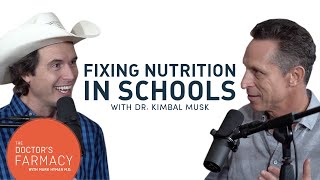
Chef and entrepreneur Kimbal Musk talks with Dr. Mark Hyman about fixing school nutrition through food literacy and sustainable farming. They discuss how the ethanol mandate damaged farmland, why indoor farming could help new farmers, and what it takes to rebuild food systems from the ground up.
You get a school garden into a school, food literacy goes up, access to food increases, the choice of fruits and vegetables goes up, test scores go up.
Welcome to the Doctor's Pharmacy. I'm Dr. Mark Hyman, and this is Pharmacy with an F, F-A-R-M-A-C-Y, a place for conversations that matter. And if you care about food, which if you're listening to this podcast, you probably do, this conversation's gonna matter 'cause it's with one of the leading thinkers, innovators, and really mavericks in the field of food, Kimbal Musk. And we're gonna talk all about his background, what he's doing, but he's an extraordinary man who's taken his success in the tech world and turned it into impetus for creating a food revolution. He's a chef, he's a restaurateur, he's a philanthropist. His personal mission is to pursue an America where everyone has access to real food. He's been named a global social entrepreneur by the World Economic Forum. He's co-founder and chairman of three real food companies that are rapidly scaling across the United States. First is the Kitchen Restaurant Group, including Next Door, Hedro and the Kitchen, which are amazing restaurants at every price point, really whole food, real food, farm to table. The restaurant source food from farmers directly, stimulating the local farm economy to $2 millions a year. It's nonprofit, big green, builds permanent outdoor learning garden classrooms, not just school gardens, but learning gardens. And we're going to talk about what that means. And they're serving hundreds of schools in multiple cities across America and underserved communities reaching over 350,000 students a day, maybe now it's 420,000, maybe it's gonna be a million, I don't know, it's scaling pretty big. We've been even talking about doing this in Cleveland. His tech-enabled Irving Farming Company called Square Roots, and we've had Tobias Peggs on the podcast talking about this, grows hyperlocal, we'll talk about what hyperlocal is real food year round, while empowering the next generation of farmers, training farmers of the future because guess what, the current farmers are aging out fast, we're gonna talk about that. He's also on the board of his brother's company, you might have heard of it called Tesla and SpaceX. So welcome, Kimbal.
Thank you for having me on the show.
Okay, so here's a really important factoid about you. You grew up in South Africa. Yep. And your mother was a dietician. Yes. How does that have any connection to.
What you're doing now or does it? No, it has a huge connection. My mother's an amazing inspiration for me. There's kind of two ways she's an inspiration. One is She gave us a wonderful understanding of nutrition and how important real food is. And then the other one is she's a really bad cook. So, I took- the dietitian is a bad cook.
That's right.
And so, I either had to cook or I would have to eat my mother's food. And I give my mother a hard time, but the truth is I love food and I love to cook. And she found food to be, as a dietitian, somewhat the enemy. And so it was, you know, for me to, when I was 12 years old, I asked my mother if I could start cooking. So, you were a child laborer. Child laborer, exactly. And I just wanted the food to taste good, but I have a joy around food. It has a therapeutic feeling for me to cook. I can come home from a super hard day of work and cook for two hours. And that sounds like, you know, maybe you want to take a break after a day like that. actually, no, the way I take a break is to cook. And it's, and it's, I was 12 years old. What I found was, well, it's a funny story. So I, I told my mother I wanted to, I wanted to roast a chicken and, and get some veggies and the whole thing. And she, she was like, she always, I think she thought I was joking, but she took me to the grocery store and, and I remember picking up these bell peppers and smelling them and She was like looking at me going, who are you? What is this? And then we went to the Butcher and we don't have, we ended up doing bell peppers because I was 12, I wanted to do french fries. So I was like, I'm gonna figure out how to do chicken and french fries, that's gonna be great. And we went to the Butcher and they gave me this chicken and I still use this lesson to this day, which is put it in an oven as hot as it will go. for one hour and you've roasted your chicken. There's really nothing else to do. So complicated. You put salt and pepper on it or something like that. You put a little olive oil on it. You could put some rosemary or something in it. But really, all you need to do is put it in the oven for one hour at as hot as the oven will go, which back in those.
Days was probably 450 degrees.
Depends on the size of the chicken, though, right? I mean, not really, actually. I mean, since I've cooked, I've just.
Kind of stuck with that philosophy and it generally works.
And it's like a magic trick. You put it in the oven. You put it in the oven and it comes out. And it's super tasty and it's super easy to share for a family. and I cooked it and the chicken came out super well and I was so proud of myself. And then I did the French fries and they were kind of gray and they didn't kind of work. We ate them because they were still French fries. And I was really proud of myself but then about 30 minutes later we all started throwing up because I had cooked the French fries in cold oil. You know when you put French fries in oil you're supposed to have hot oil. Hot oil, right. So that it seals the oil out of the French fries. Right, and you've got- But I was 12, I didn't know what I was doing. and I put it into a cold oil and I did eventually heat the oil up. So it looked like the french fries were cooking, but what they really were were these oil-soaked french fries. And so I had this kind of positive experience and then, okay, wait, I really need to learn what I'm doing. But it was a wonderful first cooking experience and I'll never forget it.
That's so great. It seems like it was sort of inspired really by adversity, which was your mom's bad cooking.
Exactly. And then I started cooking and I started getting better and it was really fun. Cooking is fun. What I loved about it, and I learned this over time, was when I cooked, my family would sit down and eat, and we would sit for an hour. And I have a very busy, intense family, and if I did not- Underachievers. Yeah, exactly. Exactly. And if I did not cook, we just sort of pick at something. And it was actually a wonderful learning experience. The fact that if I put love into the food, then everyone would sit down and we'd actually learn about each other's day and connect with each other. and I really kept that with me with my kids and I just do that. I plan to do that for the rest of my life.
I think what you're saying is one of the most important things that could be said in America today because we're talking about chronic disease, we're talking about obesity, we're talking about regenerative ag, we're talking about climate change. But at the end of the day, the solution is really in our kitchen. If everybody got enamored with cooking, which we've been, basically disrupted from the food industry. It's literally disintermediated us from our own kitchens.
Yeah, and it's taken a lot of joy out of our life.
Right, and so the amount of joy and the amount of connection and the amount of love, and we all often don't do real things anymore. Everything is sort of digital tech, but cooking is a real thing. You're dealing with like real things that- Tangibles. Use your hands and your smell and your taste. It's essential experience. And at the end of it, you get this amazing food. and you get to share it and celebrate with your family and community. I mean, that really is a huge part of the solution.
I think it's the greatest gift anyone can give themselves to learn how to cook and cook simple things. You don't need to cook fancy stuff, but realize that once you get past a few basic technique hurdles, it's totally joyful. It's wonderful and fun. And it's a lot easier to learn.
How to drive a car. Yeah, totally, exactly.
Unless it's a Tesla, then it's-- yeah, that one destroys itself.
I was in a Tesla the other day. And I'm with this guy in LA and he's like, you know, this car drives itself. I'm like, what do you mean? He says, Watch. And he's like, put it on auto and he like, it just changed lanes, it stopped in front of car. I'm like, whoa, this is terrifying. And it's amazing. It was a strange experience. Well, I think one of the things that really struck me in your story is You made a lot of success early on. You sold a company that became PayPal, and then I went to eBay, and everybody knows that story. But you decided after that you weren't going to go chase money anymore. You wanted to learn how to really cook. So you went to New York, and you went to cooking school.
Yeah, it was an interesting choice at the time. Everything was still pretty gangbusters in Silicon Valley. It just didn't fill me with joy to work on software. Even though you could reach a lot of people, of course you could reach the whole world as we've seen today, but back then it was a much smaller part of the world. There was nothing tangible about it. And so I always loved food and I didn't expect for food to be my career, but I told myself that I deserved to go to cooking school to Some people buy a yacht, you went to cooking school. Some people do other crazy stuff and mine probably is equally crazy but in my case it was really meaningful.
That's so great and during that time it was right after you graduated that 9/11 happened.
Yeah, so I live right downtown at Chambers and Broadway, so just about 10 blocks from the World Trade Centers and I woke up at 7:55 a.m. from the, from the sound of the plant, the first plane hitting the building. And I got this, the buzzing sound from the doorman saying, you know, I'll get to the phone. He's like, plane is the building. Plane is the building. You don't really know what's going on. You're a New Yorker, so you're just kind of think some idiot has flown a plane into some building.
Right.
And, like, I'm just, I'm gonna go back to sleep. So I go and get, I get in the shower. I'm like, ignoring any of this stuff. And I go down to, I go down to, I go down to go across the street to the deli to get a cup of coffee. Yeah. And, and I, by the time I get down to the, to the ground floor, the doorman says, another plane is at the building. Another plane is at the building. I still can't get my head around what's going on. Go across to the deli. And the deli is a, is a, it was a popular deli, but this time there were, there must have been 30 people in line for a coffee, which is just not normal. so I think New Yorkers, when they panic, they just line up for coffee.
Get cracked out.
But then, then what happened was, as I was getting the coffee, the, on the radio, it said the Pentagon got hit.
Yeah.
And that is when people really started to freak out and everyone just started running. And I went and got my, my wife at the time, Jen, and we, we just ran and we got to Cornell Street by the time the first one fell. And you saw this huge wall of of white powder.
So you were close to that powder.
Yeah, we were, I mean, and then policemen and firemen driving out of it at high speeds, you know, the policemen holding on to the outsides of cars because you couldn't fit in the car. You just had to get out of the out of that, and they were covered in white dust. It was just extraordinary, you know. And then the second one we kept going, second one fell when we got to Union Square. and you're seeing it from a distance, you know, when you're in the, when you're like right there and running, it's like it's a little bit of panic. But when you're at Union Square and you see it fall, it was more like reality breaking. Yeah. Like this is not possible.
Yeah.
And it fundamentally shifted something inside me, you know, so I'll never forget that.
And then you decided you weren't gonna take off and leave and go to San Francisco. You were gonna stay there and cook and help.
You know, it was a, it's a traumatic experience. But what happened with my mother, who's very well, unknown dietitian was asked to cook for the firefighters and kind of laughing about our earlier conversation. She said, you know, I can't really cook what my son can. And then they said, well, does he have the credentials? Because you got to appreciate millions of people are trying to volunteer right now. And- By the way, he just graduated from cooking school. Yeah, he just graduated from cooking school. So I got a security pass and I worked for six weeks cooking for the firefighters. I would drive ATVs with the coolers of some of the best food you've ever had. I remember taking salmon, a salmon dish with dill sauce cooked by some of the finest chefs. And I was more the, you know, peel, I'm a peeling the potato chef.
Yeah, yeah.
In the sous chef. Barely even the sous chef, you know? And because the people that would come in one day at a time, they wouldn't be able to come for the whole time, would be these famous chefs from around the world that wanted to get, give their time. And so it was beautiful experience. So I remember driving this ATV down and you get right down to ground zero. and there was this giant pile of melting metal. And this is a week after 9/11 and it was still melting. And you could smell it. It was really intense. And I went into this gymnasium that had been converted to a cafeteria and we were just empty room and these firefighters came in covered in this weird dust. And we would feed them delicious food and they would connect with each other and they would respond. For about 30 minutes, they would just kind of energy would kind of come back into their faces and they'd be re-energized and then they would go right back out into that giant pile of melting metal to save American lives. It was then I was like, you know, I really have to work in food. I have to do a restaurant. I have to, I just have to, even though it didn't match what I'd come from in terms of scale or things like that. So I went to Colorado. I was blocked out of New York and my head could not stay in New York. It was too intense to imagine staying. But I found Boulder, Colorado and we opened the kitchen and we worked with local farmers. Very simple approach to food. And really our goal was to create a community restaurant and it was wonderful. We opened the doors and kind of hit a nerve. People wanted community through food.
So what is a community restaurant?
Well, for us it was this is before the term farm to table came about. For us it was working with food grown in the community, doing as little as possible to it and serving it to the guest in a way that the guest knew which ingredient came from which farmer. And so you'd get carrots from Cura Farm or you might get parsnips from Monroe Farms or you'd get a because we are not a vegetarian restaurant. We work with local ranchers. you get a pork chop from from farmer John and that would be clear on the menu. And it's it's now done across the country. But at the time it was a very unique idea. Yeah. And it was absolutely amazing to see how much people resonated with it. They wanted to trust their food again. They wanted to know where their food came from.
Transparency.
Transparency became, you know, just naturally how we did it. without any technology. The idea was just to highlight the farmers and then the farmers would come in, we'd bring in a farmer on Monday evening and at the time we worked with 43 different farmers. So you gotta imagine how a normal restaurant, a large truck pulls up and their deliveries arrive. We had 43 different farmers coming into the back door at any time of the day and we would take their food and as long as we got the food by four o'clock, we'd tell the farmers, we would get it on the menu. And so we would creatively come up with the dishes by 5:30 when we would open the restaurant. And sort of like improv.
It was an improv restaurant.
Totally. And my co-founder, Hugo Matheson, is just an extraordinary chef. He could just do magic that way. And, but all of us participated in being creative about the menu. And it was just wonderful to see how much people resonated with knowing where their food came from.
So, you know, one of the challenges that, you know, we all would love to eat like that. And I think that, that these local farms are often not organized. Everybody's doing their own thing. They don't have a distribution system that easily gets things to all those to restaurants. I mean, you partner with them directly. But it seems like there's an interest in, you know, using Tech to actually aggregate these small farmers and create distribution systems that bypass the traditional so in.
Colorado, which I think is leading the way, is there are groups that do the actual organization of it. So if you're a farmer that wants to work with the kitchen now, you would work with Growers Organic in Colorado, and they manage the pickup from the farm and they drop it off at a convenient time to us, which is really, really important when you're running a restaurant. Back in the early days, we just figure it out, but after time, you're like, okay, this is exhausting. to have a little system here. Colorado has got a good system in place, but we do always need more innovation in the space.
Yeah, there's a guy I met in Cleveland who actually created a company to work with hospitals and schools and big institutional food providers to actually aggregate small farmers in the community to bring them all together so they don't have to do it. The farmers don't do the work.
Farmers can focus on what they're good at.
Institutions don't have to do the work and it all is seamless. And I think that that will help. But do you think this is scalable? I mean, in terms of the industrial food system, it's so big and it's so massive.
Well, we've seen Gordon Food Service is a partner of mine or ours at Square Roots, where Gordon Food Service is one of the largest distributors of food in the country, and they have a passion for real food. And the challenge that they have found is if they want to bring basil, for example, to Michigan in January, they've got to get it shipped in from around the world. It's simply not grown there. And it's not a choice of theirs. They have to ship it. And they tell us it takes 11 days to get from a farm to their distribution center where they can then they have to get it to a restaurant or a grocery store. And this is a company of massive scale that wants to be part of the solution. They came to us at Square Roots, which is our urban farming company, and asked if we would build our campuses of young farmers, we train young farmers indoors to grow indoors if we'd build our campuses on their distribution centers. So we can now harvest basil in the morning and their trucks are right there and it goes to get to their customer within two hours, which of course means the food tastes better, of course means they trust the food, there's total transparency.
And it's more nutritious.
It also lasts two weeks. 'cause it doesn't have to sit in transit for 11 days and you don't design the food for shipping, you design it for taste and flavor. Right.
Amazing. So, one of the things about Square Roots, which is the indoor farming company that can be urban and shipping containers is so great is it uses tech and it can grow certain types of crops and not others, more leafy greens and herbs and spices. But it was in part response to the farming crisis in this country where the farmers are aging out. So can you talk about what's happening in the farm landscape in America and why we need to bring new farmers into the landscape?
Yeah, sure. No, I spent years working on this problem. What I would do is there's a farmers conference in Iowa where you can actually go and meet with farmers who own most of the Iowa is mostly small hold farmers. So average farm size is 160 acres. So you can kind of imagine, it's all sort of, but you could imagine kind of going in and talking to farmers directly and maybe there's a way to get into the business.
The average farm size in Iowa is 160 acres.
I believe so, yeah.
That's the homestead size.
Well, there is a rule in Iowa, you're not allowed to own, no corporations are allowed to own farms in Iowa. So, even if you wanted to create a conglomerate of farms, you'd have to do it by yourself, not as part of a company. Wow. Yeah, so it's a couple of rules like that they keep the farms, on average, well, there are plenty of big farms in Iowa, but they are owned by one, personal one family. And I think it's that you're allowed to have only up to 40 family members or even allowed to own it. So if you have a big family, eventually you've got to figure out what to do with your farmland. Wow. Yeah. So a lot of rules in place that actually make it possible for people to get into farming. And also to protect it to be a small family business idea. It all sounds good, but the problem what I found was You go to the conference and the average age was not 58 or 59, which is what people say is the average. The average age was more like 82.
Really? You're not just being facetious.
I'm not being facetious. The actual, in Iowa, 60% of the, sorry, let me... Yes, 60% of the farmland is owned by people over the age of 79. What? So, if you go to Iowa to actually purchase land or get into the business, you're negotiating with an octogenarian and what I discovered was, I'm a immigrant, South African, Maverick, whatever you want to call it, with a cowboy hat coming in to chat with these farmers and I'm negotiating with an 85-year-old grandma. and it just didn't go well. Let's put it that way. And what I found was that they have this enormous emotional attachment to their land. What they want is their kids to farm it and they want is their grandkids to farm it.
But they're not doing it.
And they're not doing it because the business sucks.
Well, the average income of a farmer is?
Well, if you have a 100-acre farm in Iowa in a good year, which we haven't had a good year for a few years, you'd make $22,000. so if you imagine you're a young, young farmer.
And the average income of most Farmers is negative 1500.
This past two years in two years in a row, it's been negative 1800 for 100 acre farm. Yeah. So it's just been a disaster. In fact, we have the worst year for bankruptcies in a generation this year in amongst Farmers, almost 600 Farmers have gone bankrupt. And it's just awful. And so the reason is because they're so emotionally attached to the land. They want their kids to farm it. And as a result, the kids don't take it over. And most farms are bought through estate sales. So someone passes away and then the family doesn't want it. That's how you can acquire land and go into farming. And man, that's just too depressing for me to think about.
Yeah, well you said you wanted to go outside of Chicago and buy 10,000 acres.
Yeah, the idea was I'd get 10,000 acres. The problem is, you have to buy 160 acre piece of land from a farmer when they pass away. And then you have to wait for all of your neighbors to pass away to get- you-'ll be 82 years old. Exactly. And so that you just look at you running like this is not gonna work. Yeah. And of course that's why there's no innovation in the space, 'cause the farmers are aging quite and bless their heart, I mean, they're not doing anything wrong, they're doing what the government's telling them to do. It's just that what the government's telling them to do is kind of stuck in the past.
Well, the whole financial system of the farming supports all go to producing these monocrops. You were saying that ethanol.
Yeah, I mean, ethanol is one of those unique things. I think it might be one of the only things that is equally hated by environmentalists and oil companies. It is an absolute waste of land because you're taking 25 million acres of land, which is American farmland. People say we we need to feed the world. We have run out of things to do with our farmland to such a degree that we've given away 40% of our farmland to growing ethanol. It takes a gallon of oil to make a gallon of ethanol. So, how does that make sense? There's no environmental, there's no positive impact on the environment from use of fossil fuels.
Because of all the inputs, the fertilizer.
The tractors and all that. But then also you have the pesticides and the Roundup and the GMO, it's all GMO. And so it's disaster for the environment. Nitrogen is killing our rivers. So it's a total disaster for the environment. On the other side, the oil producers are saying, why are you making us do this? This is not really helping the cars. This is not really making a difference environmentally. But the reason we're stuck in it is because what else do you do with these farmers? You can't say to them, Sorry guys, the government cannot say to them, We're just gonna stop buying ethanol from you or stop making people buy ethanol from you because those politicians we voted out of office very quickly. So what do you do? And I think it is a real problem, but as a result, young farmers do not have access to land. And that's a reality. And then you can't get around that. And that's when I started working on indoor farming to create a company, Square Roots is a company we based in Brooklyn. We have another campus in Michigan where we bring young farmers in for one year. They run a climate farm. So it's a shipping container converted to an indoor farm. It's- and you can regulate and change.
The climate depending on- It's amazing how.
Wonderful the food we can create. One of our farmers did their research and found out that Genoa, Italy has best basil, which actually is where basil comes from, so that makes sense. But there was a particular summer in 1997 where the basil is known to have been the best.
Like a year of wine.
It is like a year of wine, exactly. And in that area, of course, they keep track of this stuff because it is how important it is to them. And so, this young farmer mapped out what time does the sun come up, what time does the sun set, what days does it rain, the humidity, the carbon dioxide, the oxygen levels, and the nutrients, and recreated Genovese basil from 1997 in their climate farm. And it's just extraordinary. The basil, it's more aromatic, it's got more oils to it, it's got a softer texture, it's absolutely delicious. But there are a few other things as well. We don't have the same length of stalk. So, if you have a Genovese basil from 1997. -It's all leaf and very little stalk. -It's a long stalk. Just because of the nature of the season. In America, if you buy basil, you open the basil container, it's just a whole bunch of- It's a whole bunch of stalks, right? With some leaves in it. Our basil is this wonderfully unique basil that has, it's really mostly leaves, and it's beautiful, delicious, aromatic basil.
I'm dying for my basil tomato.
Yes.
That's my favorite.
And you can pick it up in New York and Michigan.
I'm going to Brooklyn.
Yeah, Brooklyn, exactly. And we sell out and we have requests from all of our grocery stores to continue to expand. So we're working hard to do that.
That's what you call hyperlocal. The furthest distribution point, as you said, two subway stops away.
Two subway stops, exactly. And it's actually quite fun because we keep, the demand keeps growing and we keep adding production and we still sell out before the second subway stops. We're wondering when the day is going to come. Oh, we have to go three subway stops because we have a little more than we expected this week.
Yeah. And economically, does it work? In other words, could you put this in the Bronx and in underserved neighborhoods? Could you produce greens and things that actually could serve that local community and provide jobs and help everybody?
Yeah, I mean, for sure. We love working in underserved communities. Square Roots is in Bed-Stuy. And it's just part of my personal mission to bring real food to everyone is to get these farms into communities that would normally have not ever seen a basil plant. I mean, folks would grow up in that area and have never been out to a farm. So I love that. The economics work pretty well. We think that over time it'll work very well. But the goal is to empower young farmers. And so we just need to make sure we have a living wage for those farmers. It's a one-year program and we are able to do that very well. And then as the technology improves and our production improves, the economics become more and more sustainable and we can expand to the Bronx and we can expand to other parts of the country and eventually the world. I mean, this will be how if we want to empower young farmers, this is how we will empower young farmers to get into the food business.
And how does what they learn at Square Roots translate to traditional farming? Does it translate? If they want to work on a regenerative farm or go upstate or go out west?
Totally. In fact, we have a graduate from our program last year that works up at Stone Barns, which is a phenomenal farm in upstate New York run by Dan Barber. It's probably the premier farm in the country. And he got recruited by that farm to, in fact, he had to come to us and say he needs to leave the program a couple months early because our program ends in October and they needed him in July. And we said, that's the whole point. Go, go and be a farmer. That's the whole point. But we have about 80% of our graduates. We've now got 42 farmers either in training or graduated. 80% of our graduates stay in the food business. Many of them stay in indoor farming. Some go to outdoor farming. We have one farmer that is up in Bronx working with the organization Teens for Food Justice. And helping kids and teenagers get access to real food, which I love. If I can create more people like that, that's just if we played even a tiny role in that person, him making that decision to help kids in the Bronx, I love it.
I mean, it seems like a key part of the solution to some of what's happening. But there are criticisms that people talk about. I've heard Dan Barber sort of questioning from a purist as a chef, what is the quality of it? What are the nutrients in it? And think about human health because I'm a doctor. Okay, well we can learn about vitamins and minerals and how important they were and how critical they were to life. So we took food, we processed it intensely and we threw some vitamins in there. So we threw fortified flour. But it turned out that that's not that great. And yes, you get the vitamins, you don't see rickets, you don't see horrible berry-berry and pellagra and all these horrible diseases. you know, you're not actually getting the richness of what's in the soil that brings the phytonutrients, for example, into the plant that all help you. And so when I think about, you know, the soil, soil is so complex, it's so rich, especially when you have real organic matter, not the stuff we grow food in, which is mostly dirt that's using heavy intensive pesticides and fertilizers and herbicides and so on. But how do you how do you sort of answer that question of the complexity of the soil, all the microbes extracting various compounds from the soil that go into the plants that actually make it nutrient dense? How do you sort of answer that question?
Well, on the nutrient side, that's an easy part, but I think there's a more complex answer. Nutrient part, when we run our climate farms, we can actually adjust the lighting and nutrients to increase vitamin C or increase vitamin D in the actual basil. We can actually do that. It's pretty amazing. What about the phytochemicals?
For example, basil is full of all these things that aren't vitamins or minerals that are phytochemicals that give it its potent medical.
Well, I will say that the oils in the basil are much higher than you'd get in a soil-based farm. So, the aromatic oils that really make basil what basil is. So, I'm not an expert on those phytonutrients, but I would have guessed that it actually does a good job. But there is a month in the year when a soil farm is absolutely better. Right. You know, in June, you grow basil in Upstate New York. I mean, I agree, it's much better. The complex answer though is, and let me finish that, for the other 11 months, if you try to grow basil in Upstate New York, it's kind of okay. It's just not that great.
Right.
So for us, we really produce the same basil all year long. we get 12 to 13 seasons a year.
Oh, yeah, that's pretty good.
So a farmer is busy all year long. It's not a feast and famine kind of experience. It's a real occupation. So our basil is the best basil in New York, but there are times.
In the year- Except in June.
In June, exactly. But also you have to get it from a really good farm in June. And of course, that's all sold out and it's very hard to get. So what's nice about square roots is we can get it to you all year long and We also sell out, but we are able to expand, which is great. But the more complex answer is that it doesn't really matter because we don't have access to soil. But if you want to grow basil in upstate New York, you better be a multimillionaire to start. And have about 10 years to find a farm.
And then build up the soil.
And then build up the soil. And then do it. And so in order for me in my lifetime to have an impact impact on the food we eat, the real bringing real food to everyone. I looked at those working with those farmers in Iowa and I just saw 50 years of trying and maybe scratching the surface, but not really making a difference. With square roots, what I love about it is we are currently training 20 next generation farmers right now. And next year, we think we could get it to 50. And the year after that, we could get it to 250. And the year after that, we could get it to a thousand farmers being trained in one single year.
That's incredible.
And that, then I look at it and go, that gets me going. That I love.
Let's talk about the farmers then, because you mentioned this ethanol mandate, which requires 25 million acres, which is what?
That's like the size of the Central Valley in California. What percentage of our of all of all our corn being farmed?
40% of our corn. So we think we grow corn for food, but it's actually for the feed.
The world mantra was all done by Monsanto. And basically Monsanto said that was a marketing genius, said that we all have to feed the world. This is our mission. And so the American legis they had a lot of lobbyists. You tell a senator that we need to feed America. They're like, of course we do. and they were almost too successful.
Yeah.
Because in the end, this was in the mid 2000s, the government said, Hey, wait a minute, we don't actually know what to do with this food. What are we going to do with it? There was not enough people in the.
World to produce about 300 more calories per person on the planet today. And we need to eat.
Produce enough calories for everyone in the sixties. Yeah. So we don't need more calories. But what happened is in the mid 2000s, the Bush administration was basically not going to get reelected because people who are farmers are older and they vote. And so we ran out of use of the corn. So he created the ethanol mandate so that any extra corn being grown would be forced to be used as ethanol. And it sounded good from an environmental perspective. It's been a disaster. But at the time it sounded good and what it really was was a giant subsidy for those farmers and it quickly grew to be 40% of our production.
Stunning for you.
Right now, you know, grown in ways.
That are destructive to the earth, that totally destructive.
Destroy our waterways.
Creating climate change, soil erosion.
And this greatest sadness for me is preventing that land from being used by young farmers.
So it seems to me that, I mean, this is the first time I really put the whole ethanol mandate together and I've been studying this for a while, so I don't know how I missed it, but just the idea came to me, well, if we have 25 million acres, 40% of our land that's used to grow ethanol that neither environmentalists or the energy industry think is a good idea, why not turn all that into regenerative farms and bring new farmers in and create a whole program of regenerative ag on these.
That is the right thing to do.
25 million acres.
Absolutely the right thing to do.
It's like what?
Yeah. And by the way, all the land. And everybody wins. All you have to do is remove the ethanol mandate and it would happen automatically because people would be forced to sell that land to regenerative farmers. So it's, but of course, whoever does it is going to get elected out of office. So you have to have someone. Why?
Because those people vote and they're valued.
But you help the farmers transition, right? So that you, a smart politician would would create a transitional plan. Absolutely.
It's- Because that's what we need. We need investment in regenerative farmers.
We need- I mean- Because regenerative farming, if you can actually get access to the soil, is a carbon sink. You have food that is real food grown for their community. You have millions of acres outside cities like Chicago or St. Paul, Minnesota, or Indianapolis or Detroit in Cleveland. Millions and millions and millions and millions of acres that would get freed up for regenerative farming.
Yeah, it's true. We actually in some countries, they pay the farmers to restore the environment. They call it paying for ecosystem services.
Exactly. Farmers can play this amazing role, but we are stuck in a system that does not allow them to do it. In fact, the government will punish you if you change from corn and soybeans to growing real food.
Yeah, it's true. I mean, in Costa Rica, they pay the farmers for putting carbon in the soil for farming in a way that holds water in the soil, for farming in a way that restores biodiversity and brings back pollinator species. They actually pay the farmers for that. And it's happening in various areas around the world because we have to actually look at the true cost of what's going on. And the ecosystem services that we use up around the world is like $124 trillion. That's more than the global economy. And what if we just sort of flipped it on its head and said, hey, why don't we start paying for restoring the environment instead of extracting all these resources from the environment? We can actually make food that's better for us, make food that's better for the animals, I mean, treat the animals better and actually restore the ecosystem and be more profitable.
Yes. I mean, what's so sad about Iowa is all of the farmers are losing money, but they cannot change from pumping the soil with nitrogen fertilizer and growing corn and soybeans, because otherwise the government will truly punish them. The Des Moines Water Works, the utility in Des Moines, is suing all the farmers in Iowa for putting so much nitrogen in the water that it's killing people.
Yes, yeah, and Lake Erie became a person in a sense by the legislature because it has rights now. So they can't poison it.
And the problem is the farmers, so can you imagine Des Moines, which is the capital of Iowa, suing the rest of Iowa and the rest of Iowa saying, well, we don't have a choice because you guys in Des Moines have told us we can't farm anything else. Yeah. It's just an awful trap that we were stuck in.
Well, it seems like an elegant solution to just end the ethanol mandate, change the regender farms, bring in new farming young people who care about this.
I would sell them to give credit to Donald Trump, but he actually has been trying to do that.
He has?
Yes, yes.
Ending the ethanol mandate?
Maybe not ending it entirely, but reducing it. And I don't... I can't even put a rational thought on that administration. I can't rationalize it.
It's even hard to talk about it.
It's hard to explain what's going on. But the point is that even he is backing off because this is a very powerful group of voters that are old and they need a proper plan to position.
Exactly. I think that's right.
Just removing the ethanol mandate.
You can't do that.
You just can't do that. You have to have a plan. that really does support the farmers. I mean, as I said this past year to have 600 farmers go bankrupt, and these are really, these are big farmers that normally would thrive. That's not okay.
You know, what's interesting, I just talked to a farmer, Gabe Brown, you might have heard about him.
Yeah.
Who told me the story of how, you know, he went from traditional big 5,000 acre industrial farm with tons of chemical inputs, which was basically decimated during hail storms and multiple years of drought and hail storms. And, he converted her to a gender farm and he says now he doesn't use any inputs. He uses rainwater. He uses the fertilizer that comes from the cows and the beans that he plants. He uses cover crops, no tilling, crop rotations, integrating animals and plants into the farm, cows, pigs, chickens, sheep. That's absolutely the answer. And, he said, He does far better, his farm's more resilient to weather.
He's actually a prophet.
Yeah, he said he's making, I asked him, How much more are you making than your neighbors? He says, 20 times more. And I was like, well, if this is more profitable than a farmer, it's better for the environment, it creates better food for humans, it treats the animals.
Better, it seems like a no-brainer. Yes, I mean, the challenge is that the farmers are so old, Gabe isn't as old, but if you're 85, it's kind of hard to innovate.
Yeah. How can they even be farming?
Well, what happens is they assign it to a management company that does a good job of doing whatever they say, but the most profitable, just not very profitable, is just do exactly the same thing, corn and soybeans. And there's no risk in it either because if things fail, the government steps in with crop insurance and subsidies. So it's really think of it more like a pension.
Yeah.
They don't actually do any farming. So in order for it to be innovative, is we need that land to be unlocked. We need a transitional plan that encourages young farmers to take on that land and farm regeneratively. And I think it's not that complicated to do that, but it's going to require understanding that the folks who own these farms, they also need to be treated with respect as well. It's not their fault that they're doing this. This is what the government told them to do.
They'Re being squeezed by our government policies and by big ag and it's like they're the ones who are suffering the most.
Yeah, and another thing the government could do is just not punish you if you do change. Like if you change from growing corn and soybeans to tomatoes, for example, the government will not insure, the government will not back up that insurance.
Right, so if you have a big soy farm and you want to have 10 acres of tomatoes, you lose your ability to get crop insurance for your soybeans. The government will not back you up. Yeah. It's pretty crazy.
It's not okay either. So there's things that were created 50 years ago by the lobbyists of Monsanto that if it wasn't a crop that they supported, there was just simply no legislation to support it. And Monsanto is getting its comeuppance right now. And unfortunately, the getting out of that system is going to take a lot of effort politically as well as culturally. Yeah.
I mean, you're, you're focusing on the ground with real solutions for how people find and eat real food in your restaurants. You're doing it through disrupting farming by bringing in urban farming and training the future generation of farmers. And you're also doing it in schools. And, and because, you know, schools where kids start to learn about food, it's where they get hooked on bad things. And our curriculums have been disrupted so that there is no longer home ec. It was an intentional initiative by the food industry to remove home ec from schools and it was successful.
That is so sad.
And we have changed, now raised generations of Americans who don't know how to cook. So you're trying to change all that. And what's interesting is that a lot of people are talking about school gardens and helping with school lunches and all that's great. But at the end of the day, you have to retrain kids to learn about food, nutrition, and you've done it not just with the gardens, but integrating the gardens into the curriculum. So can you talk about how that works? and why it's why big green is such an important.
Big green has become my proudest achievement and I am so happy in the team that we have a big green, what we've done.
So PayPal was kind of a footnote.
Yeah, that was the old days. And you know, I think the what I found when we opened the kitchen in 2004, we took some of the profits and we supported school gardens in the community, one of our first employees. wanted to do that and we thought that would be a nice way to give back. And every year with a lot of financial support from us and others, this person was able to open two new school gardens a year. And I had a very serious accident in 2010. And so between 2004 and 2010, I was getting really frustrated that we couldn't reach that many more kids. It was very effective. You get a school garden into a school, food literacy goes up, Access to food increases, the choice of fruits and vegetables goes up. Test scores go up. I mean, if you do the same science lesson in fifth grade in a school garden versus in the class, test scores go up by 15 points on a 100-point scale. Is it because they're eating that food.
Or because they're having fun?
Exactly. I mean, imagine learning out of a textbook versus being in a garden. I mean, you're just gonna remember and learn that better. So it did work, but it just didn't scale. And I got really frustrated. And I had a, in 2010, I had a very serious accident. I went down a ski hill on an inner tube, one of those sanctioned children's runs. It wasn't, wasn't an illegal thing.
You never saw the age limit. You're not speaking.
No, exactly. I mean, I'm not over 60. They should have been a height limit. I'm six, I was, I'm 6'4, weirdly.
I'm 6'5 now because of the surgery. But, no, that's an, I know exactly.
People are gonna be writing it, how.
Do I get the height extension surgery? Well, you break your neck. You break your neck.
And so, I went down the ski hill, the tube flipped. It was meant for a kid, so I'm 6'5 and it just really wasn't meant for someone of my size. It threw me, landed on my head going 35 miles an hour, broke my spine at C6 and C7, ruptured the spinal column, paralyzed For three days and if it means it's just impossible to describe the lack of feeling with paralysis, there's no pain. There's just nothing.
Like the void.
It's just you watch your body and you just can't move it. You send the signal to your left hand to go move and it just doesn't move. You just can't believe it. You just cannot you cannot process it. And the doctors actually were telling me that the way I broke my spine, my neck, was they could fix it. There was bleeding in the spinal column, so that was causing the paralysis. But if they can get in and fix it fast enough, I'd get feeling back and hopefully motion and so forth. But I remember them telling me this and I paralyzed and I'm thinking to myself, oh no, okay, this is gonna be fine, it's gonna be fine. And there were just tears streaming down the side of my face. I just had no ability to process what was going on. It was just absolutely awful.
And.
Three days later, the surgery was successful, but I also had to be horizontal for two months as part of the therapy. And I think, while I was in hospital, while I was paralyzed, and they were telling me they could fix me, I said, to myself that if they did fix me, I would figure out food and how to scale real food, bring real food to everyone.
Why, because the hospital food was so bad?
Well, partly because I had been working in food, but I couldn't scale. I had this block in my head that you can't scale school gardens, you can't scale restaurants. That's more precious. You never heard of McDonald's? Yeah, you know, that's the weird thing. It's obviously scalable, but I had this block in my head. And when I I had this accident and I was sitting in hospital, I said to myself, you know, I am going to give this a try. I am going to focus entirely on food. It was a restart in my life. When you break your neck, you get permission from everyone to do anything at all. My joke about it is, if not for the physical trauma, I highly recommend the psychological awakening. Yeah. Because what I got out of that was permission to be myself. And myself was worth it.
You came right up against your mortality.
Exactly. And you look back on your life and you say to yourself that I told myself that, you know, I have this capacity to do good things and I am good at building businesses, I am good at leading people. And I had done my restaurant and I had done a little bit of work in school gardens. but most of my effort was in the technology space, which really just did not get me going.
-Didn'T hit your soul.
-Yeah, and many other people are even better at it than me, you know, and good for them and they should do it. But for me, what I'm uniquely gifted at is I love food, I love cooking for people, and I'm good at building businesses. And so I just gave myself permission to combine my purpose and my passion, and it's just been amazing.
Yeah, that's such an incredible story. I went through a similar crisis that changed the course of my life, which was I got very ill like 25 years ago and having to figure out how to get better led me to want to tell the world about a new way of thinking about medicine in the body. It's really about systems thinking and it's about ecosystems and that's what's led me to think about farming and all the things that we're talking about today because they're all connected. If we don't fix these problems, we're.
Not going to fix our health, we're not going to fix our economy. Well, I've got to give you a shout out. One of my team members, his name's Kevin. His daughter struggled with asthma for years. Yeah. Chronic asthma. And we'd try. We'd go to the doctor. They'd give her medications and never worked. And he read your book, eating to eat disease. That was William Lee. Sorry. That's William Lee's book. Yours is what the heck should I eat?
Yes, food. What the heck should I eat?
Sorry about that. William Lee is good. Well, I love William Lee. Sorry. But have you read your book? And changed the way his daughter ate? And not only did she improve, she is a healthier kid right now. But he actually went to her doctor and took your book in. And the doctor said that your book was the best approach to eating that she, as a doctor, had seen and is now prescribing that book to her patients. -Amazing.
-Well, it is not based on ideology. It is really honest. It is like, here is what we know. Here's what we don't know. Here's what we're sort of learning. And like, here's how to eat that's better for you and the planet. And it's sort of pretty simple and brings comments from people.
I mean, I'm too shy to say that.
Thank you. I really appreciate that.
I know, like, I interact with every day.
That's amazing. So you're going to get this school curriculum out there to not just thousands, but millions.
We're at 350,000 kids every school day. We're 650 schools. We combine the curriculum of science, what kids learn in science in the classroom, we bring it into the garden and they actually learn their science lessons in the garden so that the teachers don't have to do extra work, they just go outside to teach the same lesson. It's one of the maybe right or wrong thing to do, but we actually know what paragraph of what textbook is being taught at what hour of the day in every district. So we can, I mean, it's just because that's how teachers are trained to focus on, it's amazing how structured it is. Unfortunately, I wish teachers had a bit more freedom. But as a result, we can say, oh, we know that you're going to teach, but we do plant a seed down the first day of spring. So March 19th, this coming year, we get teachers across the country to pledge to plant a seed with their kids. But what we do is we know the paragraph in the science textbook they have to teach on that day. And so we can say, Here is the lesson. So, let us all go teach together. In the classroom, if you are in the northern climates and outdoors, if you are in the southern climates, and you will plant a seed with your kids. And our goal of this coming Plant a Seed Day is to get every teacher in America to pledge to plant a seed with their kids.
-So, you are teaching also the cooking, you are teaching about food, you are teaching about nutrition.
-Well, anytime the garden comes out of the garden, You deal with kitchens in schools which are not very sophisticated. So they're really- Deep fryers and microwaves mostly. Yeah, basically warming ovens. And so there are things that you can do really well. So if you give kale from the garden to a kitchen worker, they can put the kale in an oven, warming oven, and bake it. Make kale chips. And they'll make kale chips. And it's absolutely delicious. A little bit of drizzle of olive oil, a little touch of salt, and you put it in these warming ovens. And so that's a very popular ingredient that's cooked from our learning gardens that is absolutely delicious. And anyone at home, go get some kale, make sure there's no water on it, put it in the oven 350 degrees for about 30 minutes, little salt and olive oil, and you'll have kale chips, which is like french fries. It's sort of like your chicken.
With all the nutrition you can imagine.
It's sort of like your magic one hour chicken.
Yes, exactly, exactly. Cooking is not that hard. It's really true. So you've been thinking long and hard about the food space and you've been acting in these sectors, farming, school gardens and learning and restaurants. You know, as someone who's really deep in this, looking at our global food system, looking at our food policies, what really needs to change and how are you sort of working in the advocacy space or are you?
You know, I did work. I toured the Congress, Congressional Halls with Tom Colicchio, who's so passionate around policy, and he, he does great things in that area, and I respect it. It's just not good. It's not like I don't, I didn't find it good for me. You know, like, I, I doesn't ring your bell. Yeah. For me, I'd rather.
You don't like hanging out with politicians.
So don't get anything. No, exactly. Oh, my God. It's so against my DNA. It's just crazy. I support Tom and I do everything I can to help him succeed. And there's another group called the National Young Farmers Coalition, which is a lobbyist for young farmers, which of course, the young farmers don't pay them anything. So it's a nonprofit that people who care about farming support, like myself and a few other folks. But those folks understand Capitol Hill, they understand the patience that's required, and I trust them to move help move legislation forward, but they need more help. They need as much of us as possible to help them either with political support where we actually go to the congressional hill and support folks like Tom and National Young Farmers, but also financial support. If there's a nonprofit out there you guys want to support, it's called the National Young Farmers Coalition. And that's how those guys are really working hard to figure out how to get young people into farming gives them access to land. If they don't know about square roots, they'll let young farmers know about square roots if they happen to live in one of the cities we're working in. But it's about getting those young farmers engaged, which is going to be both political support, which I support others to do because I don't have that DNA, and then actual entrepreneurial support or figuring out how to create businesses that work for young farmers. Well, it's true. There's so much innovation in this space.
You know, in food and ag.
It's a very exciting time, actually.
It's really one of the fastest growing sectors of innovation and funding from venture capitalists. And I mean, it's just striking and, you know, it's sort of bypassing the government in a way, which is actually what's needed, I think.
I mean, I grew up in South Africa where I grew up during the apartheid era. I was in protests, anti-apartheid protests, you know, my teen years. I grew up with such a skepticism of what of government's role, you know, just how bad it could be, frankly. And in America, I'm not suggesting government shouldn't play a part, they should do their part, but I don't come at it from a perspective of the government's going to solve our problems. I come at it from the perspective that we're going to probably solve it despite the government. And unfortunately, I think in the food world, that is becoming the case.
It was interesting, we were at this conference where we met called Food Tank, and Sam Kass, who worked for the Obamas on their food policy, nutrition standards, he said, we don't have a food movement. Now, many people sort of disputed that who were in the audience, but I think what he meant was we don't really have an organized force that's lobbying and creating coordinated policy and strategy.
There is that group, the National Young Farmers Coalition. That's one sec- I think he's right though. I think for the most part, the only lobbyists out there are the ones protecting the entrenched corn and soybean industry, the ethanol industry. and those are the wrong people to succeed. And unfortunately, because there's no one to be a counterbalance, we do struggle on Capitol Hill. That being said, Tom Kalikow got up right after that and said, Hey, wait a minute, let's give ourselves some credit. Wonderful programs that have been successful because of the food movement in Washington, DC. So I think it's good for the provocatives talk. But I actually do think that there is some success happening and we should be proud of our achievements. It's just the beginning though, and we have a lot of work to do.
So if you were in charge, you were a king, you had autocratic power, which would be awesome for a minute. That's right. Sometimes autocracies are great. I mean, Saudi Arabia, they'll put in a 50% soda tax and 100% energy drink tax. Nobody's gonna bother them. What would you think are the biggest things and levers we need to pull to change the food system?
I think the answer is really simple. It would be a government program that empowers young farmers to buy land from older farmers in Iowa. And you'd start there, but that doesn't mean you only do it in Iowa. But just to keep it simple, if someone wants to buy 100 acres or 1,000 acres, there needs to be government support for that, because that is expensive. and then there needs to be transitional support so you can, because the young farmers are not going to come in and farm corn and soybeans. That's not interesting to them. They don't make any money anyway. It's not aspirational. So it would be a program that would subsidize young farmers to get into the business, not a giveaway, but maybe a loan or some structure like that, that would only qualify if you grow real food. And that I think would actually be very, very cheap for the government to do. It would be received with joy from the farmers in Iowa today because young people would come back into their community and young farmers would get access to land in a way that they could build a profitable business like Gay Brown.
And.
Everyone, I think, would be really happy.
That's true. I think you're right. I mean, the UN came out with a report that said that for $300 billion, which is the amount the world spends on military spending in just 60 days.
Yeah, right.
Which is about 1/10 of what we spend on obesity and diabetes alone in this country, which is an annual economy of Chile, which I don't think is that big. We could literally massively scale regenerative farming, and that would delay climate change by 20 years, giving us more time to figure things out.
But it's also a carbon sink, so it continues to get better in 20 years.
Exactly. So it's not just ending emissions, we have to reverse it.
Yeah, exactly.
And I was sort of surprised. The head of the Google Food Program and I were sitting having dinner last night and he said, if you could do one thing to transform everything that you're talking about around food and health and disease, economy, I'm like, what would it be? And I don't really think I thought about what's the one thing, but I was forced to think about it. and I said, really scaling regenerative agriculture, because I realized that all the problems connect. If we create better land stewardship, we solve all our environmental and climate problems. We revitalize the economy by creating more jobs. We decrease our federal debt by ending a lot of the chronic disease that's caused by the food. We make people healthier.
We're less reliant on selling food to China, which is truly a trade enemy.
So it's like you create an environment where you restore the land, you restore the economy, restore human health, you restore communities, you sort of end injustice. It sounds kind of simple, but I'm thinking about it more and more. I think it is a critical, if not the most critical solution, because it's sort of this downstream wave of effects that helps everything.
Yeah, and it really is not expensive. And what we learned at Square Roots is we have 10 climate farms in Brooklyn. and when we did a call for applications, I just did a blog post and I was curious, you know, how many applications would we get? We got 1100 applications for those 10 climate farms.
Really?
1100.
Wow, so you're getting like PhDs from Harvard.
We have some of the most amazing, our young farmers are the best and the brightest of people who want to be young farmers. It's really a wonderful group of of farmers, but the demand for being a young farmer is extraordinary. You just, you need to make it possible. So what we do at Square Roots is we give them a one-year training program. They come in, they grow basil or mint or chives or other products that we're working on, we'll announce soon, and it's fun for them. And they're, you know, with a, it's a campus, so they're with other farmers, and there's a community element to it. We do community events. and they do it for one year, they get paid a living wage, they love what they do, and then they go off into the food world and they become a soil farmer or an indoor farmer or a one of them is doing a PA, very cool, one of our graduates got into the hardest ag school in the world to get into, it's in the Netherlands. And I believe she got in as a PhD candidate even though she only had an undergraduate. So she jumped to PhD, which is, if anyone knows, that's really, really hard to do. And it's the hardest university in the world to get into because of her experience at Square Roots. So it's this extraordinary training platform that lets young farmers get access to farming so they can find their love. And it's wonderful to see someone combining their purpose and their passion, which I found and myself, but now we can give it to these young farmers. And my goal is to do this with thousands of young farmers every year. Yeah, some people will say your brother.
Is disrupting the car industry. You are clearly disrupting the food industry. It's such an amazing thing you're doing. And I think if people are listening and want to know how to get more involved, they can go to kimbellmusk.com, they can learn about Big Green Square Roots, they can learn about the kitchen, all the things you're doing. And I was going to say apply for Square Roots, but I don't know.
If that's a good thing. You should apply. We're always looking for great young Farmers, don't be discouraged by the number of applicants, but we're also growing. Yeah, there's always opportunity and we're always.
Looking for good people. And if you're in communities where there's schools are challenged and they need help, I mean, Big Green is just a great resource and they can help implement these programs. If you have money and you want.
To donate, please do. I mean, this is really- Yeah, large foundations that we work at 100 schools at a time at Big Green. So we do a city by city. Maybe we can do Cleveland together.
Yes, man, I called one of your people to talk about this and they're like, I said, there's this great important school district, we've got like, you know, whatever, 12 schools, you're like, oh no.
We want to do 100 schools. I'm like, all right, now you're talking. That's right, exactly. And it is great. So if there are foundations in Cleveland or any city that want to bring us at that scale, then please do reach out. I'm @Kimball on Twitter or reach out through my website. But the goal here is to do it at scale. And if it's one or two schools at a time, they're wonderful nonprofits that already work locally and you guys should support those nonprofits. If a foundation or a family office wants to do a large-scale project in their city, that's where Big Green is really effective.
Well, thank you so much, Kimble, for being on the Doctor's Pharmacy. This conversation clearly matters to so many of us, and I really appreciate the work you're doing, your heart, your passion, and I'm glad you woke up. I'm sorry you had the accident, but it's like a...
I'm glad to be here, too.
You'Re filled with joy and light and passion, and I can see it in the way you are.
It's just beautiful. So thank you.
Absolutely. Thank you for having me. And if you've been listening to this Doctor's Pharmacy and you love the conversation, please share it with your friends and family on social media. Leave a comment. We'd love to hear from you and subscribe wherever you get your podcasts. And we'll see you next time on the Doctor's Pharmacy. Hi everyone, it's Dr. Mark Hyman. So two quick things. Number one, thanks so much for listening to this week's podcast. It really means a lot to me. If you love the podcast, I'd really appreciate you sharing with your friends and family. Second, I want to tell you about a brand new newsletter I started called Mark's Picks. Every week, I'm going to send out a list of a few things that I've been using to take my own health to the next level. This could be books, podcasts, research that I found, supplement recommendations, recipes, or even gadgets. I use a few of those. And if you'd like to get access to this free weekly list, all you have to do is visit DrHyman.com/picks. That's DrHyman.com/picks. I'll only email you once a week, I promise, and I'll never send you anything else besides my own recommendations. So just go to DrHyman.com/picks. That's P-I-C-K-S to sign up free today.
More from AI




This Is Why 99% of Skin Conditions Don't Heal — And What Dermatologists Won't Tell You






Why you need to start strength training today #strengthtraining #healthyaging #fitness
