How To Reduce Stress And Improve Wellbeing
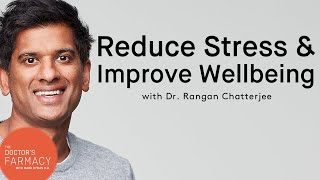
This is a YouTube video titled "How To Reduce Stress And Improve Wellbeing" containing a recorded discussion from December 2020. The content features multiple speakers including Dr. Rangan Chatterjee, Kaya Perowich, and Ask AI Mark. The conversation focuses on stress management, the importance of passion and meaning in life, practical lifestyle advice such as the LIV framework and morning routines, and how these can improve resilience and overall wellbeing. The format is a podcast-style dialogue with health and wellness themes.
I want to expand the conversation about stress to go, yeah, sure, breathing, nature, meditation, exercise, these things are fantastic. And of course I talk about them and I go into the science and the practical implications of people. But what about something about passion, doing things that you love?
Hi, I'm Kaya Perowich, one of the producers of the Doctor's Pharmacy podcast. Chronic stress has become a major issue in our society. Before the coronavirus pandemic, it was estimated that 80% or more of doctor's visits are due to illnesses related to stress. Late last year, Dr. Hyman sat down with his friend and colleague, Dr. Rangan Chatterjee, to discuss the many sides of stress and how taking time for things that bring us joy can be a very powerful method for counteracting the effects of stress.
I created a new framework that I use for my patients. I call it the LIV framework. It's a much more achievable way, I think, for a lot of people to find their meaning and purpose. The L is for love, I is for intention, V is for vision, E is for engage. We probably can't go through all of that, but, you know, I sort of I use it with my patients to help them start to find meaning and purpose. And the first one I think is really important, love. Yeah. Right, so the research on this is super clear. Regularly doing things that you love makes you more resilient to stress. Right, so you mentioned a lot of Americans are struggling that they don't have control over their life. And this is the interesting thing about stress, Mark, is that sometimes we can't as physicians change the stressors in our patients' lives.
Right, no, no, you can't change what's happening out there, you just change- But.
We can make them more resilient to it.
Yes.
And regularly doing things that you love makes you more resilient to stress. At the same time, being chronically stressed makes it harder for us to experience pleasure in day-to-day things. So one of my recommendations to my patients is have a daily dose of pleasure, even if it's just for five minutes. You know, can you each day give pleasure the same priorities you might give to the amount of vegetables you have on your plate or whether you go to the gym. This could be Going for a walk, it could be reading a book, listening to a podcast, it could even be coming home from work, putting on YouTube, watching your favorite comedian for five minutes and laughing.
Yeah.
That is very important and very valuable. Let me tell you about a patient I saw recently. I think you'll find this interesting. 54 year old chap, I think he was, certainly mid 50s. He was the local, he was the CFO of a local plastics company. and he was in a good job, earning good money, married with two kids. He came in to see me and he said, Dr. Chassy, look, I'm sort of struggling a bit. I find it hard to get out of bed sometimes in the morning. I find it hard to concentrate at work. I just feel a bit indifferent to things. Is this what depression is? Now I started to chat to him. We did some tests. I was looking into all aspects of his lifestyle. But ultimately one thing was quite clear to me is that he never did anything that he loved. So I asked him, you know, how's your job? He said, yeah, it's fine, you know, I don't really enjoy it, but it pays the mortgage, pays the bills, feeds the family. I said, okay, how's your relationship with your wife? Yeah, so-so, you know, I don't really see her much, but it's, you know, it's fine, I guess. It was very, very indifferent. I said the same about his kids, and I said, Do you do, you know, have you got any hobbies? I said, I don't have time. My work's busy. At the weekends, I've got to do all the chores. I want to take the kids to their classes and their sports games. I don't have any time. I said, did you ever have any hobbies? And he said, yeah, sure. When I was a teenager, I used to love playing with train sets. I said, okay, fine. Do you have a train set at home? He said, well, yeah, I've got one in my attic, but I haven't played with it for years. And I said, what I'd love you to do when you get home this evening is get your train set out. Now, look, Mark, I appreciate this may.
Not be the advice you'd like to give.
You write that on your prescription pad, then.
Yeah, well, kind of. I'm all for lifestyle prescriptions, right?
And he-- Play with train set three times a week. I'll tell you what happened. What was fascinating is that-- Refills unlimited. Exactly. But, you know, it may not be the advice that he was expecting from his daughter, but he said, yeah, okay, sure, I'll do that. Then this was in a conventional medical practice. These were 10 minutes. consultations. This is in the National Health Service in the UK. We don't get the chance to follow up all our patients. We see maybe 40 to 50 patients a day. We simply can't follow them all up. I didn't know what was going on with him. Three months later, I'd finished my morning surgery and I was in the car park about to go and do my home visits. And I bumped into his wife and I said, Hey, how's your husband getting on? She said, Tostojcshi, I cannot believe the difference. I feel like I've got the guy I married back again. My husband comes home from work, he's pottering around on his train set, he's always on eBay looking for collector's items, and he's now subscribed to this, you know, this magazine. I thought, okay, that's incredible. I still hadn't seen him. Three months after that, he comes in for a well-man check to my office, and he comes in with his blood tests. I'm about to go through them with him. and I said, Hey, how are you doing? Dr. Ashley, I feel incredible. I've got energy, my mood is good, and I feel motivated. I said, How's your marriage? Marriage is great. I'm getting on really, really well with my wife. How is your job? Love it. Really, really enjoy the job. So why is that so powerful, Mark, is this? Did he have a mental health problem?
Or train said deficiency?
Or did he have a deficiency of passion in his life? And when he corrected that passion deficiency, it's true, everything else starts to come back online. So I want to expand the conversation about stress to go, yeah, sure, breathing, nature, meditation, exercise, these things are fantastic. And of course, I talk about them and I go into the science and the practical implications of people. But what about something about passion, doing things that you love that's just as important? That's true.
You know, I often talk about what are the ingredients for health and one of them is meaning and purpose. And I was just shocked a number of months ago to see an article in the Journal of the American Medical Association that people who lacked meaning and purpose had a higher risk of death and disease. I mean, it's just striking. It turns out in the research that it's not just smoking or bad diet or lack of exercise, but lack of meaning and purpose that increases your risk of death. I mean, that's a very striking finding.
Even if you're living in a lifestyle that you don't enjoy, that there are lots of stresses in your life, you can help process that stress. You really can, and it can make a huge difference. I think when it comes to stresses, I think we need to think about what we can control and what we can't control. Many of us, I have for years spent time and energy worrying about things I have no control over. And that's something that I've changed a lot in my life. I've really had to work hard on that. And once you get into that mindset, it's amazing how your stress levels just come down because so many of those things, like traffic, I can't do anything about traffic. I just don't let it worry me anymore. I'm just- you- don't get road rage, Dr. Chatterjee. Hey. You know, if I'm honest, seven, eight years ago, you know, when I was a carer for my dad, when I was working a busy job, when my kids were very young and wasn't sleeping very much, you know what? If I was driving to work and someone would come in front of me or cut me up, I'd probably get quite agitated, if I'm honest. But now I just don't. I'm like, ah, they're probably having a.
Bad day if they're sort of screaming.
At me from the window, and I'm just a lot more chilled and relaxed. I mean, you give your power over to other people if you let them affect you that way. Yeah, for sure. something we have to work on. And I think the reason why many of us struggle with this is because of time. Now, let's mean what I mean by that. I think one of the biggest stressors in the modern world today, in the 21st century, is our lack of downtime. So the modern world has stolen downtime from us. It's. It's gradually been eroded out of our.
Lives, and we haven't any structures in our society for really managing that. and most cultures have had ritual, have had prayer, have had ceremony, have had meditation, have had various kinds of rituals that take a pause in life to stop and to reset and to reconnect with what matters. And we just don't do that. So let's talk about some of the strategies that you put in the book. You talk about the importance of a morning routine. Because yes, we know the harm of stress, and we can go into that more, but I think people get it. What are the three M's you talk about? that you can practice every morning to start your day and actually kind of get ahead of the stress.
Yeah, so I call these the three M's of a morning routine. The first M is mindfulness, the second M is movement, and the third M is mindset. So I say, look, I'm a huge fan of morning routines because they give you a period of calm in the morning that's just going to make you a bit more resilient to cope with those stresses that will come up in your day. It's not if they're going to come up, they will come up. So one of my patients simply does this. She does her morninG routine with those 3Ms in just five minutes. She gets up and for one minute she will do deep breathing. She does a breath that I taught her called the 3-4-5 breath. When you breathe in for three, hold for four and breathe out for five. Okay, she does that for one minute. Then she does two minutes of some yoga moves that she learned on YouTube, right? So this is super accessible. She didn't have to go to a class, even though I recommend yoga classes. She learned some moves on YouTube, which she likes. And then for the final two minutes, she's got about three or four books that make her feel good. And she literally for two for 15 minutes, she reads three or four pages from that book, and she has reported back that actually that has really, really helped her. In fact, she thinks it's helped her eczema get better, which is remarkable because there are many things that can cause eczema. Eczema we know ultimately is a slight dysfunction of the immune system. Stress impacts the immune system.
Of course.
So for her doing that morning routine, she feels is helping her with her skin. For somebody else, it may not do that, right? But I just want to really get across how powerful these small intentional moments of calm are. So again, I hope people listening think, you know, maybe I'll try that 3M morning routine for about seven days or so and see how you feel.
We know that health is not focused solely around one specific thing like diet or exercise. Our mindset and daily practices can be among the strongest guiding forces to carry us on the journey to better health. and making healthy, pleasurable habits part of your everyday life is an essential part of any wellness routine. Beneficial practices can come in many forms. Explore finding something that feels good to you and make it a non-negotiable part of your daily routine. Thanks for tuning in to this episode of the Doctor's Pharmacy. If you'd like to hear more about this topic, I encourage you to check out Dr. Hyman's full length conversation with Dr. Rangan Chatterjee. If you enjoyed this episode, please consider.
Sharing it with a friend and leaving.
Us a comment below.
Until next time.
More from AI


Why Younger Women Are Getting Breast Cancer at Record Rates (And How to Reduce Your Risk)




This Is Why 99% of Skin Conditions Don't Heal — And What Dermatologists Won't Tell You




