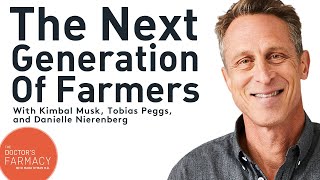
This is a YouTube video titled "How To Support The Next Generation Of Farmers" published in August 2020. It features a podcast-style discussion hosted by Dr. Hyman with multiple guests including Ask AI Mark, Kimbal Musk, Tobias Peggs, and Danielle Nierenberg. The conversation focuses on the challenges facing the aging farmer population in the United States, barriers for young farmers entering agriculture, innovative urban farming initiatives, and policy proposals to support new generations of farmers through education, financial aid, and sustainable farming practices.
Coming up on this episode of the Doctor's Pharmacy.
This is not just about creating more farmers. This is about creating businesses and programs that will support young people and make them feel really excited about agriculture.
Hi, I'm Kaya Perowich, one of the producers of the Doctor's Pharmacy podcast. The United States has an aging farmer population, and it's been projected that about 40% of the continental United States farm and ranch acreage will have changed hands between 2015 and 2035. So who will be the farmers of the future and what policies are needed to encourage a new generation to get into farming? Dr. Hyman explored these questions with several guests on the podcast last year. Here he is with chef, restaurateur and philanthropist, Kimbal Musk.
Can you talk about what's happening in the farm landscape in America and why we need to bring new farmers into the landscape?
Yeah, sure. No, I spent years working on this problem. What I would do is there's a farmers conference in Iowa where you can actually go and meet with farmers who own most of the Iowa is mostly small hold farmers. So average farm size is 160 acres. So you can kind of imagine, it's all sort of, but you could imagine kind of going in and talking to farmers directly and maybe there's a way to get into the business.
The average farm size in Iowa is 160 acres.
I believe so, yeah.
That's the homestead size.
Well, there is a rule in Iowa, you're not allowed to own, no corporations are allowed to own farms in Iowa. So, even if you wanted to create a conglomerate of farms, you'd have to do it by yourself, not as part of a company.
Wow.
Yeah, so it's a couple of rules like that, they keep the farms, on average, well, there are plenty of big farms in Iowa, but they are owned by one person or one family. And I think it's that you're allowed to have only up to 40 family members or even allowed to own it. So, if you have a big family, Eventually, you've got to figure out what to do with your farmland. Wow. Yeah, so a lot of rules in place that actually make it possible for people to get into farming, and also to protect it to be a small family business idea. It all sounds good, but the problem what I found was you go to the conference and the average age was not 58 or 59, which is what people say is the average. I think it was more like 82.
Really? You're not just being facetious.
I'm not being facetious. In Iowa, 60% of the, sorry, let me, yeah, 60% of the farmland is owned by people over the age of 79. What? So if you go to Iowa to actually purchase land or get into the business, you're negotiating with an octogenarian. and you, what I, what I discovered was, you know, I'm a, you know, immigrant South African Maverick, whatever you want to call it with a cowboy hat coming in to, you know, chat with these Farmers. And I'm negotiating with an 85 year old lady Grandma. And, and she, she, it was, it just didn't go well. Let's put it that way. And, and what I found was that they have this enormous emotional attachment to their. Yeah. what they want is their kids to farm it and they want is their grandkids to farm it. But they're not doing it. And they're not doing it because the business sucks.
Well, the average income of a farmer is.
Well, if you have a 100 acre farm in Iowa in a good year, which we haven't had a good year for a few years, you'd make $22,000. So if you imagine you're a young, young farmer.
And the average income of most farmers is negative 15.
This past two years, two years in a row has been negative $1,800 for 100 acre farm.
Farm.
So it's just been a disaster. In fact, we have the worst year for bankruptcies in a generation this year amongst farmers. Almost 600 farmers have gone bankrupt and it's just awful. And so the reason is because they're so emotionally attached to the land. They want their kids to farm it and as a result, the kids don't take it over and most farms are bought through estate sales. So someone passes away and then the family doesn't want it, that's how you can acquire land and go into farming. And man, that's just too depressing for me to- yeah, well you said you.
Wanted to go outside of Chicago and buy 10,000 acres.
Yeah, the idea was I'd get 10,000 acres. The problem is you have to buy 160 acre piece of land from a farmer when they pass away, and then you have to wait for all of your neighbors to pass away to get-.
You-'Ll be 82 years old.
Exactly. And so that you just look at, you run and you're like, this is not gonna work. And of course, that's why there's no innovation in this space, because the farm owners are aging quite and bless their heart, I mean, they're not doing anything wrong. They're doing what the government's telling them to do. It's just that what the government's telling them to do is kind of stuck in the past.
Young people who do wanna become farmers are typically faced with a number of barriers to entry. However, there is innovation happening in this space. Dr. Hyman also spoke with Tobias Peggs, who co-founded a Brooklyn-based urban farming company with Kimbal Musk called Square Roots. Square Roots is known for changing the way people think about growing local food and training the country's future generations of farmers.
You're raising up a new generation of farmers that is absolutely essential because in this country, the average age of farmers is 58 to 60. People are aging out of farming. There are really very few supports for or young farmers to enter the marketplace. The land acquisition costs are so high, the land has become financialized because corporations have bought it off because it's actually got more land value than agricultural value. So we're really in a situation where young farmers have a real barrier to entry in the market, but you've created a whole program. It's called Next Gen Farmer Training Program that allows you to bring in people who want to be part of the solution and create a career out of it.
You're right. You know, at the beginning of the pod, you were articulating the issues with the industrial food system, right? Chronic waste. terrible for the planet, all of these things, pollution, diabetes, 70% of our food has got pesticides in it. This is all horrific. And then this extra topic that doesn't get as much air time as it should is this demographic time bomb that's about to go off. If the average age of a farmer today is 58, who's going to grow the food in five or six years time when they retire? It's frightening.
Mm.
And, but, you know, to your point, very, very hard then for young people to start a career in farming. Our fundamental thought, though, belief really was that it's the farmer that's at the center of the system, right? The person that's willing this plant to come to life that just makes it taste better, right? It's like when you, when you're cooking, right? You put Vitamin L. Vitamin L. Exactly, exactly. So, we had to figure out how do we provide a pathway for young people to come in and learn how to be farmers, provide that love in the system. But we also wanted to do that in a way that was creating a positive social impact on the world. How can we empower and educate and inspire and get more young people into this local food movement? They can spend 12 months with us, 24 months with us, and then when they graduate and they leave Square Roots, are they now inspired and do they have the tools and are they ready to set up their own local food companies, right? Because the more of us working on this local food revolution, the better, right? So that was kind of the genesis of, okay, what can we do here to bring more young people into the industry?
So great. It's so important because we do have a crisis in farming and agriculture, and we're trying to shift, and there's so many movements. There's regenerative agriculture that is really defining a whole new way of thinking about growing food that restores the soil, that reduces carbon in the environment that preserves water, that reduce chemical inputs and fertilizers. These are all really essential activities.
In addition to business innovation, policy supports are also needed to bring in the next generation of farmers and beyond. Danielle Nierenberg, co-founder of the nonprofit Food.
Tank, spoke about this in her conversation with Dr. Hyman. One of the things I'm so excited about is, you know, since I was in graduate school, there's this whole generation of young people who wanna be in farming and the food system in some way. so you mentioned the challenges they face. It's really hard for new farmers or young farmers to get into farming. They lack access to land. They're coming burdened with a lot of student loan debt. They don't have things like insurance. If we can create policies and programs that help mentor those young farmers, give them business skills, forgive some of their debt, help provide them with insurance, and give them the resources they can to succeed, I think that would be really exciting. There have been some wins by the National Young Farmers Coalition in states like Minnesota, where land is being transferred from farmers who want to retire to younger farmers so that they can start on the right foot and get the mentoring and business skills and education that they need to do better. And I think this is not just about creating more farmers. This is about creating businesses and programs that will support young people and make them feel really excited about agriculture.
In his most recent book, Food Fix, Dr. Hyman proposes creating a federal farmer corp to enlist a new generation of regenerative farmers. This program would help them overcome financial and education barriers and provide training and funding to access land. If you'd like to learn more about these topics, I'd encourage you to check out Dr. Hyman's full-length conversations with Kimbal Musk, Tobias Peggs, and Daniel Nierenberg. If you enjoyed this episode, please consider sharing it on social media or sending.