Live Fireside Chat: Dr. Mark Hyman & Chip Conley
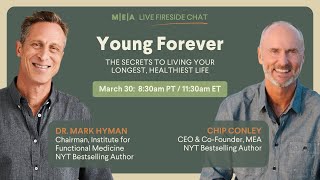
Dr. Mark Hyman and Chip Conley discuss functional medicine, longevity, and healthspan. They cover how nutrition and lifestyle changes can transform health and slow aging, with audience questions about practical steps for healthy aging.
Welcome, everyone. Welcome. Come on in. Great to see everybody. Come on in. Hello, everyone. Welcome. We've got a view here of the Baja campus. We do a little spotlighting for everyone. We've got some throwback music for you.
For every.
It's a pleasure to have everyone here. Come on in, get settled.
Beautiful.
All right. Welcome, everybody.
Forever young. Forever young.
And on that note, let's all be forever young. Welcome, everybody. My name is Carrie Cardinelli. I am the Senior Vice President for Digital at MAA: the Modern Elder Academy. And it is my distinct pleasure to welcome Chip Conley and Dr. Mark Hyman to the stage. Let me just quickly introduce the two of them and then we're going to kick this off. This will be a fun interactive conversation. Feel free to pop in the chat. Where are you from in the world? We have such a huge global audience that come to enjoy these conversations. Tell us, where are you in the world today? We'll be taking questions a little bit later on in the hour. So let's begin. Chip Conley, who is sitting at the M.E.A. Baja Campus right now, hospitality engine entrepreneur and New York Times bestselling author and founder of M.E.A. Modern Elder Academy, where a new roadmap for midlife is offered at the beautiful oceanfront campus in Baja, New Mexico. Gosh, I can't speak today.
And-- Bahusur Cali at Met Mexico and soon to be the Santa Fe, New Mexico campus.
Exactly, it's a mouthful. Chip's five books have made him a leading authority at the intersection of psychology and business. Chip was awarded the most innovative CEO by the San Francisco Business Times and is a recipient of Hospitality's highest honor, the Pioneer Award. And he holds a BA and MBA from Stanford University. And Dr. Mark Hyman, MD, practicing family physician and internationally recognized leader, speaker, educator, and advocate in the field of functional medicine. Happens to be in DC right now. He's the founder and director of the Ultra Wellness Center, founder and senior advisor for the Cleveland Clinic Center for Functional Medicine, a 15-time New York Times bestselling author and board president for clinical affairs for the Institute of Functional Medicine. He's the founder and chairman of the Food Fix campaign dedicated to transforming our food and agricultural system through policy. He's co-founder and chief medical officer of Functional Health and the host of one of our leading health podcasts, the Doctor's Pharmacy with 150 million plus downloads. He's a regular medical contributor to TV shows and networks, including CBS this Morning. Today, Good Morning America, the View, Fox, and CNN. And with that, Chip, I will let you take it away. And thank you so much for being here, both of you.
Mark, number one best-selling book, New York Times, all of the lists. Tell us, first of all, I am such an admirer of your work because as a fellow author, I'm impressed by how you get the word out on your books so well.
It's a secret.
You and I have had fun in Miami and in Pescadero and other places. So you've been here to Pescadero, where our M.E.A. campus is. Let's just start with that. Like, why do you love this area?
Oh, it's just one of those places where, you know, the world feels like it stops and you get to just be. It's got a beautiful sort of intersection of mountains and desert and ocean and incredible people. It's like a little oasis in the world from all the shit that's going on. So I kind of just love the vibe.
Beautiful. Well, we want to see you here more often. And maybe someday we'll do a workshop with you.
I love that.
So tell us a little bit about your journey to becoming maybe the most famous functional medicine doctor in the world. and how that's led to this particular book, Young Forever.
Thank you. Well, I appreciate that, Jim. It's great to be with you all. I love AEA and what you're doing. And, you know, like many of us who, you know, find ourselves in sort of places that we didn't design, I just didn't really choose this. It chose me. And I think most of us look back at our lives, we see the things that are really important. we really have had to show up in our lives and point us in the right direction. And I was 36 and I got very sick with chronic pain syndrome. After living in China, I got mercury poisoning. My whole system collapsed and I really understood that the medical system had no answers. And that my training was pretty much useless in trying to figure out what was wrong with me. And I knew it wasn't psychological and I was told to take antidepressants or sleep medication or this medication or that medication. I'm like, I know this is not in my head and I know something's wrong. And through that process, I discovered functional medicine, which is a whole paradigm shift in an understanding of human biology and disease that is more focused on the science of creating health than on diagnosing and treating diseases. And the basic philosophy is if you create health, disease goes away as a side effect. The body has certain requirements like any biological system to thrive. And if you don't provide those ingredients for thriving or you remove those ingredients that are causing impediments to health, that actually your body starts to create massive dysfunction. So functional medicine is about how do you create optimal functioning in the body? And I, you know, basically just dove in so deep that it kind of opened a world for me where I was able to heal myself, heal my patients, and I began to realize the importance of, you know, food and food is medicine and understanding how to really activate the body's own innate intelligence for healing. And so this book, Really Young Forever, is the culmination of my life's work in all the things I've learned over the last 30 years. Thank you. And how do we take that science and apply it so that we can activate these miraculous healing systems that are embedded within us that often we mostly interfere with by our lifestyle and various habits we have, environmental toxins, and all the things that we're exposed to, that.
We actually can change.
It's an exciting moment where the field of longevity research is actually highlighting a lot of the ancient principles that we've talked about and discovered about the body with functional medicine, but they haven't gone far enough to really look at what are the causes of these dysfunctions. We talked about in the book, the Hallmarks of Aging, which are these processes that seem to go wrong as we age and underlie all disease. Instead of treating heart disease and diabetes and cancer and Alzheimer's all separately, They really all have the same common roots, which are these dysfunctions called the hallmarks of aging. But as a functional medicine doctor, my approach is why? And it's really, I always say functional medicine is the medicine of why, not what, not what disease do you have, but why do you have it? And so why do we have these problems with the hallmarks? And that's where I bring in the functional medicine lens to look at the scale of longevity and guide people through a very practical approach to understanding the science of what goes wrong, how to fix it and exactly what to do. And that's really what I try to achieve in the book.
So let me ask you a why question. Why did it take medicine, modern Western medicine, so long to figure this out?
Great question. I think we, you know, fields evolve just through historical processes that don't necessarily reflect the truth, right? So Newton sort of observed phenomena and came up with his Newtonian laws, and they were a pretty good description of reality, but they weren't the complete description. And so he basically was superseded by Einstein and the theory of relativity and quantum physics. And all of a sudden we know the world is very different than it appears, even though the chair I'm sitting on seems solid, it's mostly empty space, even though time seems to go in one direction, it's not exactly true. When you kind of look at the universe, it's not exactly the same. So how do we begin to reimagine the science of biology based on understanding the natural laws? So historically, you had a headache, you go to the head doctor, you have a stomach ache, you go to the stomach doctor, you have a joint pain, you go to the joint doctor. But your joint pain might be coming from your microbiome and your headache might be coming from some environmental toxin or something else that really we have no map for in traditional medicine. So it's not that we knew it and didn't apply it. We just didn't understand how the body worked until recently. We're starting to see the whole body as an ecosystem and restoring the health of that ecosystem is what is required to create health and get rid of disease.
Beautiful, thank you. You know, Dan Buettner, who you know, who's actually on page four in your.
Book and has a-- I love him, yeah.
--Book.
Dan is here this week. He's teaching, A workshop on optimizing longevity based upon his research and his many best-selling books on the Blue Zones. We have lots of people here. There we go.
Hi everybody.
28 of us total from age 35 to age 87. Quite a range of ages. So what's the intersection or the Venn diagram between Dan's work on Blue Zones and your work Throughout your whole career, but also with this book young forever.
Well, you know, Dan did such an incredible job of going to places in the world where people had very long lives and said, what are the common aspects of these cultures that produce more centenarians 20 times as centenarians as the west and it turned out it wasn't, you know, some fancy supplement or iv nad or some fancy new drug or anything it was just sort of the default systems that were built into that culture. They ate whole, real food that was unprocessed, that was very close to Nature. In other words, they ate a lot of wild food. They ate heirloom species. They had really none of the industrial food system within their culture. Two, they moved naturally as part of their life. They didn't go to the gym. They didn't lift weights, but they, you know, they heard of their sheep up and down Rocky Mounds in Sardinia. They also had a really deep sense of connection and community and meaning. purpose. So that is probably one of the most important factors. If you are, you know, lonely and socially isolated, your risk of death is more than if you're obese. It's been said that being lonely and isolated is like smoking two packs of cigarettes a day. So it is. So that, that aspect of social connection.
Mark, if you, if you were, if you were smoking two packs today, I wouldn't want to be near you either, but you'd start to smell a little bit, but.
It's true. But the community piece is so huge. So I think these elements that he identified that are common to these cultures are really universal principles. And they're really foundational in my book, Young Forever. But then there's like more science and granularity behind it, because these cultures are not going, so what is the science of longevity and how do we apply it and what do we know? And they're like just doing their thing. and I think there's on top of that, there's this exciting revolution in our understanding of the underlying mechanisms of aging, the things that go wrong, how to address them. And if we understand those things that go wrong and use various practices like hormesis, for example, which we can talk about, which is stresses that don't kill you but make you stronger, or time-restricted eating, or various kinds of nutritional compounds, phytochemicals, or even supplements, or even medication. that can activate these longevity pathways that are built into our system, we can kind of create the 2.0 of the blue zones in a sense. We lay all those foundational concepts, but we layer on also things that we know, given our modern lives, we may need to use to support ourselves.
So thank you. In the book and in public discussions, you've said that you're 63 in terms of your chronological age, But you're 43 in terms of your biological age. Explain a little bit more about that. And are we moving into an era where over the next five or 10 years, there's going to be a bunch of companies that are going to become sort of famous or well known for the fact that they help us to understand our biological age.
Yes, yes.
When we show up in a job interview, you know, Jim's right here. Jim's 87, you know, and-- Hey, Jim. and he is, Jim is 87.
And he looks good back there.
He's very good. And, you know, when it comes to his biological age, he's probably 72. When it comes to his sense of humor, he's 16.
But.
So let's talk about that. Like, tell us about your 63, but it's chronological, 43 biologically. How does this relate to health span, lifespan, Etc.
Yeah. Yeah. So there's, there's a lot in there. I'm gonna unpack a little bit, so. you just ended with lifespan health span. I think it's an important frame. Basically, our lifespan is how long we're alive, our health span is how long we're healthy. And usually the last 20% of our lives, we're not healthy, which means we're at the doctor's office, we're on medications, we're in the hospital, we have surgeries, we're not well. And so we want to get our health span to equal our lifespan. The question is what causes us to have a degraded health span? It's the problem with these fundamental things that go wrong called the hallmarks of aging. And a lot of them are influencing our epigenetic programming. Our epigenome is basically the controller of our genes. Genes are fixed. You may be like a piano keys, there's 88 keys on a piano. But a piano player can play ragtime, jazz, classical rock, reggae, whatever you want on a piano. So we have infinite ability to regulate what genes get expressed, turned on or off, and how that affects our aging. And so everything that we do in our lives, what we eat, how we move, how we think, our relationships, environmental toxins, our microbiome, our beliefs, all these things are washing over our DNA, influencing our epigenome, and regulating our genes to actually turn on aging genes, things that accelerate aging, or to reverse aging. And so we can influence our epigenome, it's called epigenetic reprogramming. Now there's very simple ways to do it through lifestyle. There's also now discussions about using all kinds of fancy technology like the Amanaka factors and other interventions which we can get into. that are kind of sci-fi but actually can reprogram your biology to a younger you. So I'm 63, but biologically I'm 43 because most of my life I've been practicing habits of exercise and eating healthy and meditation and yoga and, you know, taking my supplements and doing my things based on functional medicine. So I've been able to actually have a 20-year gap between my actual chronological age and my biological age. And that can even go backwards. I want to try to get to 25 maybe. We'll see. But But we know that using different scientific interventions, we can start to measure the, we'll call these epigenetic programming patterns. It's called DNA methylation. And it's a test you can do with a blood test that looks at your own epigenome and looks at the rate of aging. So are you aging faster or slower than your chronological age? Now, if you get a number, let's say you're 62, but you're actually, turn out you're gonna be 70 on your biological age, that can be reversed. And there are a number of studies that show with different interventions from lifestyle, diet, even certain supplements, medications, that you can turn back the clock anywhere from two to five to 10 years. And I think that tells us that we can reprogram our biology to a younger self. And that's what really my book is about. It's how do you do that? What are the practical aspects of applying the science of longevity to your own body and your own life? so you can start to aggregate these changes that will reverse your biological age. And then you can check the test and recheck it a year later and see what happens. So the point isn't to just live longer and be hedonistic. It really speaks to a lot of the work you're doing with MEA, which is to how do you reinvent the second half of your life and be in contribution in the world, be vibrant and active and connected and actually bring wisdom and meaning and insight into the world that we've all accumulated as we get older that often gets sort of wasted because we feel like crap for the last part of our lives when we could be giving back. We're actually just sitting at home watching TV because we feel like shit. I think that's really the promise here is that, as you're exhibiting with MEA, we can actually revitalize our life even when we think we're supposed to be winding down and retiring. and that that's kind of an old idea. But in order to do that, you can't just do it on a intellectual level or spiritual level. Your biology has to keep up, right? You have to feel good enough to do the work you want to do in the world, to give back in the way you want, to be able to show up in your relationships, to actually have value for yourself and your community. So that that's really the hope here. It's not kind of some hedonistic pursuit to live forever. It's about How do, right, right, how do, I mean that's fine too if you want to do that. But listen, if I can be 150 and still go hiking, skiing, make love and ride my bike, I'm in, you know, like if I'm sitting in a wheelchair, forget it, I'm out, you know, so.
So let's, so actually, you went there, so let's talk about that for a second. So there, most of the, most of your, you're less about sort of biohacking, there's that whole movement around biohacking and then there's billionaires who are, you know, creating labs and programs to actually make maybe help us live forever or at least way beyond the 122 years that the longest person on Earth ever has lived. They're usually men, they're usually white, they're usually sort of like privileged in some way. And there's an element to this that's sort of a why is it that most of the people who are so interested in biohacking fit that demographic profile?
Well, I mean, because they're not probably dealing with the lower rung of Maslow's hierarchy of needs. So they have time to think about things that most people don't have time to think about, which is how do I optimize everything in my life? And I think if you're just trying to scrape by and make a living and paycheck to paycheck, it's, it's a hard thing to think about, you know, what is biohacking? But in a sense, functional medicine is the original biohacking. It's actually how do we hack our biology so that we can turn on this ancient, brilliant, embedded longevity healing repair and renewal system. That's what's so exciting about this discoveries now in science is that we never understood what health was. We were good at labeling and naming diseases and looking at a microscope, the pathology and looking at x-rays and blood tests and seeing what's wrong. but we never understood how to see what's right. And so for the first time, we're understanding that we have these amazing systems in our body that we just have to turn on in order to be healthy. And so for example, when you cut your skin, Kim, you don't go, okay, please recruit some stem cells, and I would like you to go to this finger and then activate these growth factors and turn on this pathway so you can close your skin and heal it. your body just knows what to do, right? We all have a healing. We understand that we have a cut and it heals, but that's happening on the inside too. The problem is, you know, as we get older, your cuts don't heal as well. But that's not a natural phenomenon. Those are the things that have to do with entropy and we can find entropy. Like if you have an old house, it requires a little more upkeep, right? If you have a, you know, 2023 Toyota Camry, you drive it off a lot. You probably don't have to do anything into it for 100,000 miles. But if you have like a 1936 Mercedes, you know, Roadster or something, It's gonna require a little more tune up and help, but it'll still run. So I think we have the ability to understand how to work on these longevity pathways and longevity switches and turn them on so we can actually activate our body's own healing system.
Beautiful. So I want to understand a little bit further, what are some of the routines? Like, what are your morning routines? The kinds of things that you do that are life sustaining. You sort of hinted at some of them before, but maybe let's just say three. If there were three things that our Community, we have 1,500 people who actually signed up for this, lots of them will watch it later, we've got 550 on the call right now, what are three things they could do? And by the way, those of you who are asking questions in the chat, we will open it up for live questions in about 10 minutes. So if you want to go ahead and raise your hand now, you're welcome to. It gets you at the front of the line. Mark, what are the three things that people could do?
Well, I do actually in my book, I have, you know, what my daily or weekly kind of monthly routines are. And a lot of it's sort of something I do regularly and some of it's like wishlist stuff that I would love to do if I could do it. But it's really, it's not that hard and it doesn't have to take that much time. And it really is just about structuring your day and your life to build those habits. So I try to get eight hours sleep at night. I wake up, meditate for 20 minutes. then I like to journal and if I, you know, get 10, 15 minutes, half an hour, depending on what's going on, just to kind of really clear my head, to really take a look inside and see what's up and, you know, just sort of sort through the things that on deeper level that are going on in my life. And then I'll do my band workout. I use the Tom Brady's program because it's bands and I can travel with them. It, it, there's less injury and using and the weights, all the weights are fine. and I'll do a routine for 30 minutes, high intensity. I'll then have my sauna turned on. I have a sauna and I have a steam. So I'll usually go in that for 10-15 minutes and then I go on an ice bath, which is like basically a chromatic process. And then I'll make a protein shake and it's my, I call my healthy aging shake, the recipes in the book. But I add in the regeneratively raised goat whey and the reason I use goat whey is it's less inflammatory than regular cow. and in whey protein is the most important protein you need as you get older to build muscle. Because we have something called anabolic resistance. As we get older, it's harder to build muscle. So the key is to use a concentrated load of muscle after a 14 to 16 hour fast overnight. So when you're in a fasted state, instead of having sugar for breakfast, which is what most people do, bagel, cereal, muffin, sweetened coffee, you know, Ben and Jerry's, I mean, the list goes on. It's the worst thing you can do. So protein in the morning and on an empty stomach will actually turn on the protein synthesis. We need to build muscle. And muscle is the currency of longevity, which is why I strength train, why I take this protein load. And I add to my shake a couple things. I had creatine, which helps build muscle, and I had something called Mitopure, which is urolithin A. It's a product that's a, we call it postbiotic. It's a compound that's from pomegranate berries. It gets converted by certain gut bacteria into this postbiotic which you absorb, which then cleans up your mitochondria and activates your muscle synthesis and actually helps to improve strength and fitness. And, you know, I put in my gut food product, which is sort of a multivitamin for the gut. And then I take my supplements, my little packet of supplements, and I have some ones that are just a basic stack of multifunctional vitamin D. And then I add on my longevity stack, which is NMN and also a few other things. But yeah.
Is this too much work?
That's like, wait, it's not.
It honestly gave me 33.
Honestly, in an hour, an hour and a half, the whole thing is done.
So, like, okay, like, get it down. Like, wisdom is about distilling things. So if I were to take it down to 20 things, what would be the 20 things?
Don't eat important things. Okay, I would say cut out starch and sugar. Don't eat three hours before bed and take a 14 to 16 hour fast between dinner and breakfast. Do strength training in the morning and have a protein load of 30 to 40 grams right after. That's going to get you so far into this and you will be doing so good if you just do that.
Beautiful, beautiful. So the name of your book is Young Forever. Have you gotten some pushback from people saying this is an anti-ageist book because you're making it sound like being old is a bad thing? And you say that aging is a disease. Tell us about that.
I do, yes. I don't think being older is bad. I think being frail and decrepit is unnecessary. And so how can you be older and younger at the same time? I think I joke and I say I want to die young as late as possible. So I think that's the goal. So I don't think it's agents in the sense that it's not saying that there's anything wrong with getting older or chronologically getting older. It's about how do we reclaim our health as we get older? How do we add more life to our years? How do we add more vibrancy and how do we protect our brains and our biology so we can show up and be in contribution in the world? I hate the word anti-aging. I hate that whole approach. I think I'm not anti-aging. I'm pro-healthy aging. That's really the message of the book.
Yeah, beautiful. Thank you. All right, let's go to some questions because there's a lot of questions out there already. I just love the fact it's all women so far. Carrie Norton, let's go to you.
Hi there. Thank you both so much. It's a great conversation. Dr. Hyman, I've heard you talk a lot about transforming the health system and on your podcast and, you know, Food is Medicine. And I'm wondering how we can all band together to build a movement to do that.
Oh, wow. Great question. Well, thank you. Right now, I'm in Washington, DC. I had dinner last night with the entire sub, most of the subcommittee, Health Subcommittee of the Ways and Means Committee, which is charge of all Medicare and Food is Medicine policies. I met this morning with the folks in charge of transforming our food system at the Health and Human Services Department, which are putting together a national strategy for how do we create a food is medicine governmental set of policies. And that came about because of a report I got commissioned through my friend Tim Ryan, Congressman, who sort of showed that we have all these food policies that are often working across purposes. and are screwed up. And we got in the bill, the appropriations bill, a mandate for the government to create a national strategy for addressing chronic disease and nutrition. And so I met with the team this morning. And so it's actually happening. I think, you know, in terms of what needs to happen, we're having hearings next, and we're meeting, you know, we've met with, you know, probably 100 different congressmen senators. I think there's a growing interest in movement in this. For sure, there's ways to help by advocating with your local member of Congress or Senate. They'd love to hear from you about this. There's also the Food Fix Action Guide, which I created. If you go to foodfixbook.com, I think you can download the Action Guide, which has a whole set of things that people can do individually that we can do as philanthropists or as business innovators or policy changes that are going to happen. If people have means, I think donating to the Food Fix campaign is helpful because it drives our ability to make change in Washington. I learned today, for example, that the Office of Disease Prevention and Health Promotion gets about zero funding. And it's kind of a joke. So they're trying to do all this great work and they have to go around with a tin can to all the departments in HHS and beg for money to get a little piece to do a little bit of work. We're now working with them to try to get $26 million through Congress, which I have a meeting with Corey Booker this afternoon about it, to get that to fund, help them develop a bigger strategy to address these problems. And it's everything from paying for medically tailored meals, it's changing front-of-label packaging and sending food marketing to kids, it's changing the SNAP benefit program, SNAP education, revising the dietary guidelines. I mean, the dietary guidelines are a joke, right? The dietary guidelines are, dietary guidelines for healthy Americans. Well, only 6.8% of Americans are healthy. 93.2% have poor metabolic health, meaning high blood pressure, high blood sugar, high cholesterol, are overweight or have had a heart attack or stroke. So basically the guidelines are for 6% of Americans. I said, we need to revise these and talk about how do we deal with this crisis, this national emergency of poor metabolic health through food as medicine. And so they're really engaged. I was, I, you know, usually I feel like I have to go in and sell, sell, sell, you know, and convince people. These people were, like, basically selling me and going further than I even thought, you know, was possible. So I feel like there's this inertia that has been overcome, that there's, there's a zeitgeist around this now in the culture of food is medicine. It's sort of a thing in people's minds. And I, I'm really, really excited about, about what we're seeing here. So it's, you know, it's a slog, right? You know, abolitionists were working in the 1700s, and of course, Here we are, you know, 200 plus years later and still barely, you know, out of the woods on that slavery thing. So, I think, you know, it takes time and it takes work, but it's going to happen.
Beautiful. Thank you. Laurie Lewis, give us a brief question.
Good morning. Mark, if 90% of Americans are unhealthy and we live in a culture where people want very quick results, and even as Chip said, ah, it's too much work, could you help me? I'm a certified health coach. I'm 60. My biological age is 40.
Amazing. Yeah.
And I'm helping people who are busy, rushed, exhausted, want immediate results. And with this latest semaglutide craze where people want to take a diet medication to turn their weight around and turn their health around. What are you saying to patients of yours who would come to you like a hypothetical patient who says, Could I take this diet? What do you say? Because my job is to have people implement fasting and nutrition and movement and sleep. And could you help me with an answer to why you can't take it?
Yeah, I mean, this is a Well, first of all, I mean, there's high level Ozempic and Wegovy and Mounjaro are these newer drugs that are used for diabetes that have been approved now for obesity and are being promoted heavily on social media by celebrities and are being over prescribed and they're not without risk. And I think, you know, just for those who don't know what they're talking about, these drugs are basically diabetes drugs that make your appetite go down and help you lose weight and they can be very effective. The problem is when you take them, you lose 40% of the weight as muscle. So you end up with poor metabolic health when you end up with the weight loss because you've lost so much muscle. That is where your metabolism is. And then you end up gaining 65% of the weight back or more on average if you stop the drug. So one, it's a lifelong treatment. Two, it has significant adverse effects if you look at the GI effects over long term, after a couple of years, there's a four and a half increase fold risk of getting a bowel obstruction, which is a very serious problem. It affects the thickness of the bowel. Also, it seems to increase risk of certain cancers. So there's a lot of problems with it. It's not a, it's not a, you know, no risk solution. Plus, it's insanely expensive. Right. So if just, if just the people who are overweight in America took it, it would be 5.1 trillion dollars a year. that is more than the entire health care expend period in this country, which is 4.1 trillion. So it's an untenable idea. Now, that does not to say that for certain select patients who have diabetes or who are massively overweight, it can't be an interim solution. It has to be paired with aggressive lifestyle change, with aggressive resistance training, strength training, because you lose the muscle. But it can be an effective treatment. I, I think it's not a, it's not really a quick fix solution for most people. I think, you know, the, the truth is that, you know, diet and lifestyle work faster, better and are cheaper, and the side effects are good ones. So, you know, I've seen people, you know, in, pretty much a patient who was in clinic who was type 2 diabetic, severely obese with them and BMI of 43, which is, you know, like, best big and heart failure, kidneys failing, fatty liver, blood pressure issues, 20,000 copay medications, three days of changing her diet. She was off insulin three months, she lost 43 pounds. Her A1C went from 11 to 5.5, which is basically a hospitalized diabetic to normal. She reversed her heart failure, which doesn't happen. She reversed her kidney failure, her liver failure, blood pressure, got off on medications and lost 116 pounds in a year. I just had another woman, she's on the COVID of Women's World. today, this week, she actually was my patient. All right, she was just someone I met recently. She's the dean of osteopathic medical college in West Virginia. She lost 134 pounds by following the 10-day detox diet, which is essentially a diet that works better than Ozempic and faster and cuts your appetite and helps reduce inflammation and helps your metabolic health by cutting out starch and sugar, refined grains, grains, beans, actually it's a very different approach a little bit than Dan, but it's a very low glycemic, a higher protein, higher fat diet, and it works so fast. Thank you.
Thank you, Mark. Thank you, Lori. Let's go to Mackie and let's just for the sake of getting everybody in here, let's keep it brief with your question and Mark even will brief us with the answer if you don't mind.
Okay, okay, sorry, no problem.
I can kind of get it. No, you're a geek. I mean, let's just be honest. You're just like, you're like a geek. I mean, you're a good looking geek and that, you know, good for you. But for a lot of us here.
We'Re actually just a nerd. I'm actually just a really bad nerd. I'm going to say you're a nerd.
All right. Oh, well, thank you, Mark. I love your work and I've followed you for a long time. So I want to follow up your last comment. So I'm a whole food person. We grow much of our own food here and we, rose from my, including meat and so forth.
In Kentucky.
In Kentucky. Totally love it.
Amazing.
But I, when, so what I heard you just say was a little bit toward leaning toward keto, but then there's like, so talk to me about the starches. Like, so in the winter, I'm eating sweet potatoes and root vegetables and things like that.
So there's a whole concept of metabolic resilience. Metabolic resilience is this idea. that you're fit and resilient. If you, for example, are fit, you can really run 10 miles, but if you're 300 pounds, you can't walk 10 feet. And human biology has a capacity to be resilient. So the goal is to create metabolic resilience and flexibility so you can tolerate a wider range of diet and be fine. For people who are poor and poor metabolic health, which is most of us in this country, We need to kind of be a little more careful about the starch or sugar stuff. So what I'm recommending is not keto, although that's a viable option for many people, especially pureed advanced type 2 diabetic. You know, Benjamin Franklin said, you know, an ounce of prevention is worth a pound of cure. A lot of people need a pound of cure. So for people who are really need a pound of cure, they need to be off grains, off beans, off sugar, off all kinds of sweeteners. And then maybe even sweet potatoes, maybe even starch vegetables, maybe even fruit. Eventually, when they become medically biologically flexible, they can add back that stuff and you can tolerate it better. So it's really about figuring out what is going on with your biology and matching the treatment to that.
Thank you.
Great. Thank you. Let's go to Tracy Strauss.
Hi, thank you so much. Very, very quickly, can you recommend some wonderful functional medicine doctors either in New York, or in Colorado or anywhere, specifically for women in their psychology in their 20s, but in their reality in their 50s perhaps.
Got it. Asking for a friend.
For me, for sure.
Yes, so I mean, I have a practice in Lenox, Massachusetts. so we've been dealing with these issues for decades. Our team is probably the most experienced in the world. We've been doing this collectively for 25 years together. And I think now, actually, telehealth is actually, I think, gonna pass. I was with the congressman last night working on a telehealth bill. There's a great website called ifm.org, which you can go to and put in your ZIP code, and it'll give you a list of certified doctors.
What was that again? Say that again?
IFM, ifm.org, Institute for Functional Medicine.org, and you can see a list of who's in your neighborhood. And that's a good place to start.
Beautiful. Thank you. Let's go to Mimi. Mimi was here last week for the Reframing Retirement Workshop. Mimi, how's your re-entry been back in the default world?
Yeah, it's always just a bit hard, but yeah, especially California weather's not helping. Yeah. So, Mark, I appreciate your work. I've been using functional medicine on myself. I've got an autoimmune disease for the past 10 years off all prescription It's working great and it's become my lifestyle. One question I have for you is as I dive deep into this, it's so hard to make sense of various people who I consider experts. Chris Kresser says nutrient-dense foods and it's liver is the most nutrient-dense. Plants are good, but should you use plants that have lectins? Because lectins aren't good. I keep researching. Exactly. How does somebody and there's a lot of people I respect. I respect you, I respect Chris Kresser, I respect Peter Attia, I expect all these people, but everybody's saying different things. Meat is good, meat is bad. How do you make sense of it?
Well, I've been studying this for 40 years, so that helps me make sense of it. I think, you know, it is over complicated, honestly. And I think if you look at the margins, there's, you know, sort of extreme differences, like a carnivore versus a vegan. But if you just, you know, look at the science, it's really clear. No processed, especially ultra processed food, sugar and starch are bad. Everybody agrees on that. Most agree we need good fats in our diet. Most agree we need lots of fruits and vegetables. Now you can say what with lectins? No lectins. I mean, I think there's a whole crew of anti-nutrient people out there. I don't really buy into that. I think protein is the big sort of question mark. Should you be vegan? Should you eat meat? I think the meat has really gotten a bad rap. And I've written many books about this, Food, What the Heck Should I Eat, Vegan Diet, Food Fix, and also this last book, Young Forever, I do talk about this issue of meat. And I think the bottom line is if you're eating, especially regeneratively raised meat, then you're doing a lot of good for yourself. And if I had to choose between the bagel and the steak, I would pick a steak every day. And I think the evidence is... About.
A steak in a bagel.
Definitely not. Definitely not. So, yeah, actually saturated fat is not that bad for you unless you eat it with starch and sugar. Then it's bad. So cookie bad, ice cream bad, butter on your broccoli, okay.
How about most importantly dark chocolate? Dark chocolate's great.
Dark chocolate's got good fats, lots of polyphenols. I think it's actually an amazing food. I think if you overdose on it and you have a lot of sugar, It's a problem, but I think if you can get, you know, lots of dark chocolate, it's okay.
Great. Thank you. All right, Tracy, was that you who asked that question or was that someone else?
It was me, Mimi.
It was Mimi.
That's right, Mimi. So Tracy, let's go to you.
Thank you. I'm recovering from jaw surgery and it's been a real interesting experience in terms of the limitations of my diet. I'm currently in week four of a liquid diet with two more to go. Can you talk about the benefits of fasting and cleanses and things? Because I feel very different in a good way.
In a good way? Okay, good.
Yes.
Okay.
Yeah. Well, one of the things we've learned is we have over 3,000 genes that are involved in adapting to starvation. and so historically, we, we were really not exposed to a lot of abundance in food. And so our bodies are very good at actually activating all sorts of repair, healing and renewal pathways when we don't eat. And that's what we call autophagy. And, and I, I mean, I explain a lot of this in the book, but, you know, that's why we say, you know, maybe a 16-hour overnight fast or, you know, don't eat for hours before bed. All these sort of pieces of advice have to do with giving your body a break from food. if you are metabolically unhealthy, if you're overweight, if you have diabetes, you know, shorter and longer fasts can be very effective. I mean, you can do up to 21 day fasts and people can have remarkable changes in their health. And you can basically start to activate all these nature repair systems. Eventually, you'll, you know, you'll waste away and die, but you have to, you have to find that Goldilocks version. But I think if you're, if you're fasting or you're eating sort of, for example, liquid diets where you can actually have, you know, adequate nutrients and adequate protein, we put them in a Vitamix, that's okay. And that actually helps the body to reset. So I think there's a lot of science on the benefits of fasting, on intermittent fasting, time-restricted eating, even ketogenic diets can be very, very effective in mimicking starvation. And they can do a lot of these things that are actually going to help activate these ancient longevity systems in your body.
Thank you. Thank you. Michael Martin, you were here Earlier this month, welcome back to the call. And you're calling in from Dallas, I believe. I am, yeah. Hey, talk to Chef Tony about that bagel steak chip, okay? Next time on that, I'll be looking for it. So, and in the spirit of- that's called a hamburger. Oh, I don't eat those often. So, Mark, thanks for being here. This is great stuff. So, in the spirit of wisdom sharing with my four young adult daughters, Could you give me a couple of quickies that I can share with them that they can stick with that will help them because they're early and they're healthy? So, the earlier they start and develop these good habits and strategies, then the better the longevity in terms of being healthy. So, I'd love your quickies on that.
I mean, essentially teenagers are humans who are in this process of temporary psychosis. So, I would say good luck trying to convince them to do anything. But if you, they're in their 20s.
They'Re older, they're a little bit further along, thank you. They're young women on their own.
Okay, I thought you were like kids, like they're teenagers. No, no, no. So the key strategy there, what I really said is to eat real food, get rid of ultra processed food especially, making sure you really limit and reduce starch and sugar in your diet, have good fats, lots of fruits and vegetables, adequate protein, and move your body and get community and learn how to de-stress. Those are just simple behaviors and sleep, by the way, super critical. Sleep is underrated, but if you don't sleep, we tend to do bad things. We don't eat well, we're tired, we eat sugar for energy and our metabolism changes. It's just a bad news thing.
And they say, here, learn how to cook. Learn how to cook.
Yes, I would say, that's a good one. I made sure my kids were in the kitchen with me from literally a year old. I had pictures of my, you know, son, you know, trying to make pancakes with powder and flour everywhere. But, you know, and they. We grew a garden together. We cooked together. They were in the kitchen making food with me all the time. I got a great book called pretend soup, which is a kids cooking cookbook, which is really fun, where you can make all kinds of fun, healthy kids food.
Great, thank you. Mel, you're up. Hello, hi Chip and Mark, thank you for the opportunity and Mark, great work.
That you've been doing. We're really happy with everything you've been doing.
So my question is, how do you see hormone replacement for men after a certain age?
Yeah. So that's a great question. Hormone optimization therapy is a key part of longevity. And the question is how do you optimize your hormones? The truth is our lifestyle, our diet, exercise, stress, sleep, all influence our hormones. And we can modify those actually to affect our homeostasis. So for example, if you're a guy and you're eating a lot of sugar and starch and you've got a big belly and man boobs, you're producing lots of estrogen, your testosterone is dropping down, you're losing muscle, you're increasing cortisol, you're increasing inflammation, your lipids are getting worse, your blood sugar is getting worse. It's a metabolic disaster. So cutting out those things which are driving your hormones to be screwed up is so key. So cutting out starch and sugar, alcohol, those are the worst for male hormones. Protein is really important, but also fats because your cholesterol is made, your testosterone is made from cholesterol. So you need good fats, even saturated fat. and resistance training. Lower body, particularly big muscle resistance training is really good at boosting growth hormone, boosting testosterone and can really help. Now for those people who need it, I don't oppose this at all, but using bioidentical hormone replacement therapy for men and women can be a really great strategy as they age for helping them retain their vitality, energy and muscle mass. Thank you. But I just, I have a guy who's 79, who's in my practice. I checked his male hormone levels. He works out every day. He eats really great. And they're like a, you know, like the 35 year old. So he doesn't take hormone replacement therapy.
So my hormone levels aren't so well right now because I'm on Lupron. Mark, you know, my. My prostate cancer moved to my. Yeah.
Yeah. I know. Yeah.
So I'm. I'm. I'm. I'm draining my body of testosterone, so I'll be glad when it. Then I can rejigger my testosterone back. So let's go to Tricia Herck.
Hi, thanks for having me. Great timing because I was going to ask specifically about women and perimenopausal because I've been following all this research for so long, but it doesn't necessarily seem always specifically tailored to women, you know?
Yeah.
Not. I don't care that the books are written by men, but, you know, there's just. I've noticed in my own body how different life is through all those changes. And I've had lots of issues, which.
Yeah.
I eat. I. I eat the way you say I should eat. I sleep eight hours. I do resistance training.
All those things. Yeah.
And yet.
And yet.
All right, Tricia, perfect. Thank you.
So the question is, what should you do?
Well, sure, not me specifically, but I.
Guess for women, yeah. I mean, I do address that in the book. I address the sort of epidemic of hormonal dysfunction that's caused by our lifestyle and society and also environmental toxins, which often we have little control over other than reducing our exposure to diet and common products and skincare products. so I think, you know, women's hormonal systems are much more sensitive to men's. They're much more responsive to fluctuations in our lifestyle and diet and environment and toxins. And so there, you know, there are ways to actually fix that. You're fixing your microbiome, reducing your exposures to environmental toxins, learning how to de-stress making sure you have those basic lifestyle things. If those are still not doing the trick, there's a lot of ways you can support women. And I think, you know, there was an era where every woman was getting hormone replacement therapy with menopause, and that turned out to be a bad idea because they were using Premarin and Provera, called all kinds of problems. They had a billion dollar study of over 160, 000 women. They had to stop the study because women were dying, were taking the hormones and getting heart attacks. So it kind of led to this period of like, no hormones. And that was a bad idea, too. So women were left kind of in a lurch. And now I think there's a Resurgence of understanding that we can personalize the approach. If we use bioidental hormones, we can low doses, that we can use them topically, that we can use them where we need them. For example, if her sexual dysfunction often give women intravaginal estrogen and also clitoral testosterone, which is topical and it's not, you know, driving all these changes systemically, but has really powerful local effects and can solve, for example, problems. So it's depending on what the symptoms are, what's going on, what you're doing, we would customize the approach. But I agree, it's a big issue and It's something I've dealt a lot with.
Great. Thank you.
Bonnie, not personally, obviously, as a doctor.
Understood. Bonnie.
You're on mute. I was going to say that or I'm deaf. No, I'm deaf.
I was coming into this question.
With.
A bent toward the microbiome definition and how everything starts in the gut. And I have celiac. So it frightens me that my gut is not working the way it's supposed to work. and how does that play into all of this?
Yeah. Well, you know, I think, I just.
Want to add so that it's, and.
How does alcohol fit?
Oh, and how does alcohol fit? Good, good question. Thank you, Bonnie.
Yeah, so the microbiome has recently been added to one of the hallmarks of aging. I included in my book because I thought it was such a powerful driver and it wasn't included in the original hallmark. So I added it and then they recently, that. And, and I think it plays a huge role in our overall health. And, and just because you have celiac disease doesn't mean that your microbiome has to be bad. If you're golf gluten and you've done the work to repair your gut from the damage it caused when you ate it, you should be fine. But as we age, our microbiome degrades, and we often need to, to take care of it. And I think most of us don't know how to tend to our inner garden. We don't know how to actually optimize our microbiome through our diet, through lifestyle, through pre and probiotics and through polyphenols, which are super important plant phytochemicals that fertilize the good bugs. So learning how to take care of your gut and your inner garden is really important. I include a lot of that in my book, so it's really described how to do that. I think we may need extra help depending on what's going on with us, with the functional medicine doctor, but we actually are now able to sort of help people reset and restore their microbiomes.
Great. Thank you. Rob Hannah from Austin. Thank you, Bonnie.
What up, Chip? Hi, Mark. I'd want to double down on your earlier statements about therapeutic fasting. It works wonders and I've been doing it for 30 years, so anybody should really dig into looking that as a cultivated skill. My question to you is about metabolic flexibility.
Where you see a lot of people.
And this is for the 6%, not the 93, where you see a lot of people sort of get banked down into keto diets and end up sort of hanging out there. I'm very intrigued by a more healthier approach in terms of like not always being banked in keto or running away from glucose. And what's your experience with sort of investigating that and especially for our age demographic of 50, 50 plus? Well, you know, the thing is as we get older, we just become more insulin resistant. There's a sort of an entropy where we lose muscle and we get it replaced with fat in our muscle. And that is what we call sarcopenia. And that's a inevitable problem if we don't do aggressive steps to prevent and reverse it, which includes resistance training and actually the right amount of protein and getting off the starch and sugar. With that said, I think being keto all the time is not actually probably a good idea. I think that if you look at historically, and this is where this studies on fasting are really interesting. Fasting is really effective, but refeeding is actually when a lot of the benefit comes. So when you refeed and what you refeed with allows your body to enter into a state of repair and growth to build the stuff that you need to be healthy. So that's a really important kind of thing to understand. If you just fast all the time, you're going to die. And if you, if you eat all the time, you're going to die. So you have this, you know, have to have this proper balance. And I think, you know, if you are metabolically fit and flexible, you can tolerate a wide range of foods and you can do a continuous glucose monitor and you can see, gee, you know, how do I, how do I respond to X, Y or Z food? Now, the beautiful thing of it is that, you know, even the exact same food will have profoundly different effects depending on who you are and your metabolism, your microbiome and everything else. So, so you can track actually, oh, I can eat a peach, but no, Johnny over here, he can't eat a peach, you know, like, and because his.
Metabolism is screwed up, well, how do we get him to eat a peach? Well, we have to kind of correct metabolism.
So that's really the key here.
Great. Our last question is going to, unfortunately, we don't have time for more from Wendy who's coming, calling us from, if I'm not mistaken, from the Bay Area.
Yes.
Yeah. So Wendy, brief question, if you don't mind. Thank you.
Yes. Hi, Chip. Hi, Mark. Hi, MEAT people. Okay, two questions. How do I find a Functional Medicine Doctor trained by you. Second question, more about your prison study.
And the results of that.
Well, trained by me would be, you.
Know, our practice in Lenox, Ultra Wellness Center is pretty good. And also the Center for Functional Medicine, Cleveland Clinic. But the truth is, you know, I've been involved in functional medicine education for 30 years, and I'm on the faculty. I was the chairman of the board, the Institute for Functional Medicine. So, if you look at the people who've been trained through there at the ifn.org and go find a practitioner, you'll hopefully find someone. And, it was a second part of your question about... But what food was involved in your.
Prison study and the outcome? Oh, the prison study, yeah, for the study.
So, I think, you know, it wasn't my study, but there's a lot of evidence on violence in prisons and juvenile detention centers. And what they found a number of different studies was by swapping out junk food for real food, they were able to reduce dramatically violence. So for example, 56% reduction in violence in prisons who ate a healthy diet compared to those who didn't. And if you added a multivitamin, it was an 80% reduction. In juvenile detention centers, it was a 95% reduction in violence in the juvenile detention centers, a 75% reduction in restraint use, and a 100% reduction in suicides, which is the third leading cause of death in that age group. So we know now that food plays a huge, huge role in behavior, mood, depression, anxiety, and obviously cognitive function. So, you know, that data is just so compelling. And I think it speaks to our need to really understand that a lot of the crisis in our country on mental health is also related to food, not just obesity.
We're gonna have a last question here from Beth, who's here in Baja with us. By the way, lots of good information in the book about alcohol.
Oh, yeah, I didn't answer that question. Yeah.
Yeah, and all of the, all of the, you know, detrimental effects of alcohol. But quick question.
Tequila shot. Once a week. How about that? Once a tequila shot a week. Be fun. No margaritas though.
Yes, something that's trending right now in.
A very significant way is genetic testing. And there's all these kits where you send in a sample and you get a report back of all these things. And I'm just curious about your thoughts about that. And, and do you recommend that? And I have my reservations, but how are you feeling about that?
I mean, I'm worried about giving your data to the big brother and getting it taken advantage of.
I don't care. I'm more about, like, the, how accurate.
It is and what people get that information.
Are they are changing in ways that they really shouldn't.
Yeah, so first of all is accuracy. Your genes are your genes and the tests actually measure what genes you have. The question is what does that mean? And you know most disorders that we have are not single gene disorders like you know Down syndrome or Huntington's chorea or some fixed genetic disorder like celiac or even celiac is not so much even because it can be variable, not everybody who has the gene will get it. So So there are about 20,000 genes. There's about two to five million variations in those genes. And what the genetic tests do is they measure what the variations are. And there are a number of them that are well understood, that are common in the population, that are amenable to intervention, and they can have profound incomes on the outcome. And I'll just tell you a quick story. MTHFR is a gene that is involved in metabolizing folate from your diet into something your body can use. If you have a certain pattern, it prevents this proper methylation, this proper DNA sort of, I mean, folate metabolism. So I had a patient who actually, the patient was a director of a movie fed up. I was in who had recurrent miscarriages. She ended up giving birth to an encephalic baby with no brain. It was horrible. And so she read my article about methylation. and said, Doctor, I want my test done for this gene. He did the test. She had the problem. He said, we'll just take folic acid. And she said, no, Dr. Hyman says, I take this particular kind of folic acid to bypass this gene. And she did. And she had a perfectly normal baby. And when we were moving, going around publicizing the movie, she was breastfeeding the baby in the back seat of that car. So actually, it can be very useful and it can customize your to your lifestyle and diet and supplements. And we'll give you a head start to see where you might be predisposed to things and how you can avert those problems.
Dr. Mark, you are amazing. That was a very dense hour, I will say that. Yeah, you know, I don't know about everybody else, but my brain is, I think it's time for us to go to Margarita's here. But, Not a good idea of margaritas just have the tequila without the rest of all the sugar.
Exactly.
But not at 9:30 in the morning here in Baja.
Thank you.
I really appreciate your leadership on this topic, your support of MEA and our growing movement globally. And I look forward to seeing you in Pescadero one of these days.
Absolutely. I definitely going to come down.
All right. Dan sends his best as well.
Okay, give my love. Yeah. All right.
Bye-bye, everybody. Thank you, everyone. The recording will be on our YouTube channel shortly, and all of you who registered will get an email with the link.
And here's everyone from MEA saying goodbye.
Everybody go ahead and wave.
Thank you.
Thank you so much. Thank you so much, Dr. Hyman. Thank you, Chip. Thank you, everybody. Have a good rest of your day.
More from AI




This Is Why 99% of Skin Conditions Don't Heal — And What Dermatologists Won't Tell You






Why you need to start strength training today #strengthtraining #healthyaging #fitness
