Longevity Scientist: Can This Supplement Really Reverse Aging?
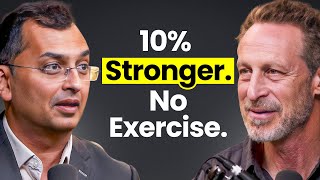
Dr. Anurag Singh explains how mitochondrial dysfunction drives aging and discusses ways to restore mitochondrial health through exercise, diet, and sleep. Urolithin A, a gut-derived compound, showed 10-12% strength gains and 10% VO2 increases in older adults in clinical trials, though not everyone produces it naturally.
Questions this video answers
About 10–12% (placebo-controlled randomized trials, older/sedentary adults).
About 10% (placebo-controlled randomized trials).
Approximately 500 mg to 1,000 mg per day (sweet spot noted around 500 mg–1 g).
Europe ~40% producers; US/Canada ~10%; India ~5%.
~17,000 mitochondria per brain cell; ~100,000–150,000 (noted as '10,15,000' in transcript) per skeletal muscle cell (transcript phrasing inconsistent).
Chapters
Saying that you could take this compound made by bacteria as a supplement. You're going to see about a 10% improvement in strength and cardiovascular fitness and a reduction in inflammation.
Mostly the trials we have run in placebo controlled, randomized trials, we see in the absence of exercise, in the absence of changing their diets, you get about a 10, 12% improvement in strength. You get about a 10% improvement in VO2 levels. Leading immunologist Dr. Anurag Singh explores how mitochondria and inflammation shape our health, aging and energy. Exercise Best mitochondrial drug. So just getting people moving in their 70s and 80s three times a week for 30 minutes, that's the basic, you know, having a rejuvenation effect on the mitochondria.
You got three ways to sort of soup up your mitochondria and make more energy. One is exercise. Two is.
Heinrag. Welcome to the Dr. Hyman Show. It's great to have you. So we're going to talk about one of the most important things that almost nobody really understands today in terms of your health. Longevity, well, being energy, brain function, immune health, pretty much everything. It comes down to something that actually is a topic that I love, which is how our bodies make energy. The problems that happen with energy and the little tiny organelles, like mini organs, systems in our cells that make energy called mitochondria. Now, people hear that word, they probably think of high school biology. They're like, what is he talking about? Maybe they remember something called the Krebs cycle or the citric acid cycle, which is basically how your body turns food and oxygen into energy in these little tiny factories, energy powerhouses in your cell. And we kind of learned about it in medical school, and then we promptly forgot about them, because unless you were some specialist dealing with some rare inherited genetic mitochondrial disease, you never thought about it, you never treated it, you never diagnosed it, and you never paid much attention. And yet it seems that mitochondria, as it turns out, are probably one of the most important things you do need to pay attention to if you want to live a healthy and long life. We're going to kind of dive deep into the mitochondria today. What it means, what it is, what we can do to optimize it, what new innovations are in the marketplace that help us to actually work with our mitochondria better and, and soup them up a little bit and clean them up, which is important, and how they play a role in so many diseases, including aging. So kind of let's start with the work that you're doing around mitochondrial research and why it's so central to aging and why, why don't we talk about it more?
Well, I'm also a trained physician and so for many years, MD, PhD.
So you're like a double doctor.
So. Well, as you said, medical schools briefly educate the students, the future doctors about. Yeah, this is the, you know, in the biochemistry class and they learn about mitochondria. But I actually think the, you know, and we talk about these biological hallmarks of aging, these 12 biological hallmarks of aging. A lot of, I actually think mitochondrial dysfunction and the lack of energy and fatigue as sort of we age is the root cause of the central hallmark of aging. And the studies I have done, whether it's with old people looking at their muscles or their brains, every time you look at a 70 year old who's exercising versus a 70 year old who's sedentary, frail, the answer is always mitochondria.
That's right. Or even you look at like a, you know, why is a 2 year old running around bouncing off the walls and a 92 year old just sitting motionless in a chair? The answer in a sense is mitochondria. The number, function and activity of the mitochondria.
And so these are, as you said, these are powerhouses of the cell and they are really the energy provider. These are the batteries. Right. So think of your cell phone battery, right? When it's all green, you can make a number of calls. You feel confident about, you know, your phone on a daily level, but the moment it gets red, that's when you, you worry that's exactly what aging and mitochondria is happening, that the, the green is becoming red.
So your, your body battery kind of.
Fatigues out and you have to recharge it.
And doctors for sure don't really know how to diagnose problems with the mitochondria or even symptoms that relate to mitochondria. But one of the most common presenting symptoms, the doctor is fatigue. So just to summarize, you got three ways to sort of soup up your mitochondria and make more energy. One is exercise.
Yeah.
Two is inducing mitophagy.
And three would be, I think, other supplementation strategies.
Supplementation strategies like creatine, carnitine, CoQ10. So can you talk about the kind of symptoms that people might have if their mitochondria aren't up to snuff, fatigue.
And lack of energy, as they say, you go through the emotions of the day and at the end of the day you feel like there's not much fuel left in the tank. That feeling, that's mitochondria, the energy deficit you have created during the day. The second is if you were to. If you're one of those who exercises a lot, as you age, you start realizing that it takes longer to recover from an exercise. That's because your mitochondria are not in that perfect sort of balance between the bad and the good mitochondria. And now you have accumulated the bad mitochondria and so you're taking longer to recover from exercise. The other things are the whole body level, just brain fog. For example, the muscle and the neuron cells have the highest density of mitochondria. Thousands and thousands of mitochondria in a single neuron or single muscle cell.
Like, what is it, 17,000 of these in every brain cell.
In every. And close to 10,15,000 in a skeletal muscle cell. So imagine that much energy that just goes away and so that contributes, I actually think brain muscle and more data. Now we are seeing in the immune. These are the three key elements that will dictate our health span and how the mitochondria are functioning in all these three.
In terms of what you described as the hallmarks of aging, the things that go wrong as we get older, that can explain most of the diseases of aging. So we tend to think about things downstream. Okay, you've got heart disease, you've got Alzheimer's, you've got Parkinson's disease, you got cancer, you got diabetes, you got all these horrible things that happen as we get older. But we don't think upstream. What do these things have in common? There may be just different manifestations of the same problem depending on the person. And it turns out that most of these conditions at the end of the day come down to problems with mitochondria and inflammation, which are linked. We're going to talk about how they're linked.
Sure.
You know, when you really look at all the hallmarks of aging, there's sort of meta ones and there's secondary ones. This is how I think of them. I don't really see them described that way, but everybody's trying to like see them all as separate or different. Their stem cell exhaustion and tell them you're shortening and epigenetic changes and there's microbiome changes and there's mitochondrial changes and protein changes and inflammation. And this is a whole list of these that I've written about in my book Young Forever. And it's really useful to understand them. But one of the meta Meta frameworks that can explain even mitochondria. Inflammation is nutrition. They call these deregulated nutrient sensing, which is a fancy bunch of jargon for meaning that your body and your food aren't working well together and that the food you're eating is messing up your body, particularly causing inflammation and causing mitochondrial dysfunction. So you know, when you look at diseases like Alzheimer's or diabetes or even cancer, these are fundamentally ultimately mitochondrial problems. And the, and the treatments can be mitochondrial treatments. But again, as I said, no, we don't learn as doctors how to treat our mitochondria or even to diagnose them. What is the way that people can think about even diagnosing mitochondrial problems other than your history and your medical symptoms or your diseases.
So mitochondrial functional testing is still in its early days. We are still learning how to high throughput it. Right. Like if you were to go and get your lab work done, you'll do a standard lipid profile, kidney profile, cardiac profile. Mitochondria is today not part of it. Inflammation is. So you do look at C reactive proteins and inflammatory cytokines. So there are new tests coming out. There are folks working on buccal swabs, for example, looking at the mitochondrial DNA content in your, in your buccal cells. There's a group called I believe MI screen that is using blood cells to look at how the mitochondria are behaving in the blood cells. To give you sort of an idea of how your mitochondria at a whole body level are. The way I do it in randomized placebo controlled trials is a few ways. So I would put for example older adults in an MRI scanner kind of setup and they'll exercise there. And I can actually at using something called resonance spectroscopy, I can actually go into the muscle and look at the depletion of ATP, which is this molecule of energy and how fast after they stop exercising it comes back into the muscle is an indicator for me how good the mitochondria are. Because if your mitochondria are not good, it just takes longer. And that's how in a lot of clinical studies today, let's say investigators or translational investigators are studying mitochondrial health. This, you know, looking at the ATP.
Recovery rate and ATP is the energy.
It'S the, basically it's the molecule of energy. Yeah. Now the other way is you take chunks of tissue. So that's what I do. I go in and take a muscle body that's fun, which is not fun, which is not easy to convince people. But believe it or not, in clinical trials, older adults who have problems with fatigue, they're very motivated and they volunteer. And what you see blows your mind away because you look at 30,000 genes in the skeletal muscle and you ask in an unbiased way, what are the top 30 pathways that are downregulated? They are all mitochondrial linked. And that just not us. Who has shown that. It's multiple groups that have shown that. As you were pointing out. I mean, these hallmarks of aging are like a subway system and they all intersect in the middle with mitochondria and inflammation.
Yeah, I think it's so important because, you know, as a doctor, I've been trying to look at mitochondria for many years in functional medicine. And we'll do, for example, VO2 max testing. You can do that maximal exercise testing where they measure oxygen consumption and carbonized carbon dioxide production as an indirect way of looking at your mitochondrial function. What we do know is that VO2 max, which is basically how much oxygen you consume per minute per body, per kg of body weight, is one of the best predictors of longevity. Sure. It's in a linear way. The higher the number, I mean, the more fit you are, the more your mitochondria can, you know, consume oxygen and produce energy, the longer you're going to live. That's pretty cool. And yet, you know, that's. That's a little bit of a more difficult test to get. But you can get it at gyms.
Yeah, we do that as well, and.
I think that's helpful. Also, we used to look at organic acid testing, which looks at sort of mitochondrial function by looking at a urine test. There's also labs in Germany that do extensive mitochondrial testing, looking at, you know, the mitochondria inside the white blood cells in your blood and looking at how they're functioning. And you can see that it's a lot of mitochondrial diseases. I mean, we didn't talk about it, we talked about some of the diseases of aging. But mental health is now an area of deep research around mitochondria and cognitive function. Not just things like dementia, but autism, you know, is found to have been really in part driven by mitochondrial dysfunction in these kids. They have a brain damage deficit. And Suzanne Go showed this, who's a Harvard, Oxford trained pediatric neurologist. She's been on the podcast and, you know, Chris Palmer, Ian Campbell, you know, been on the podcast, talked about metabolic psychiatry, where depression, bipolar, schizophrenia, these are mitochondrial diseases. And by treating the mitochondria with diet and other approaches, they can they can actually improve their function and help mitigate or relieve or put these diseases in remission, which is pretty remarkable. It is the mitochondrial medicine is just is this area that sort of so promising and yet so neglected in traditional health care. And that's what's so great about the work that you've done and that you're doing around the research. And you know, one of the things I think you sort of mentioned that in passing, I think it's important to double click on is sort of new, new discoveries around the immune system's function and mitochondrial function and how, how we've been surprised by some of the things you found around this. Because when you look at aging, these are two things that really happen. We lose energy and we become more inflamed.
We started off thinking these were two different pat because every randomized study we were doing. Now as you mentioned, diet and exercise are the two biggest mitochondrial rejuvenation drugs, if I can call them that exist.
Out my favorite drugs, diet and exercise.
The problem is it's very hard as a doctor to convince everybody to stick to it. And you see very poor compliance in the long term. And so you have to improve your cellular health and your mitochondrial health with other strategies, nutrition being one of them. So we started looking at it and what we saw is that every time we improve mitochondrial health, the inflammation levels were lower in these folks. Now, whether they were 80 year olds, whether they were overweight, obese individuals or even athletes, believe it or not, even athletes, where you think they would have the peak of mitochondrial and even over training is having an impact and they are all inflamed. And so by just tuning the knob of inflammation or vice versa, improving mitochondrial health, we are still studying which are they closely interlinked or are they, you know, one precedes the other. But there is clearly a very close interaction between these two pathways.
Yeah, you know, one of the, one of the fundamental hallmarks of aging is this phenomenon of cellular senescence, otherwise known as zombie cells. These are cells that should have died and been recycled, that seem to live forever and turn into zombies and then go around creating more zombie cells. And what these cells do is they spew out buckets of inflammatory molecules around the body. They're like basically pouring gasoline everywhere. And that's a disaster because it's sort of a feed forward cycle. And somehow what you're saying is that mitochondria play a role in this either as a cause or a consequence. And so, you know, in medicine we like to be very reductionist but the truth is that anything that causes inflammation will cause mitochondrial dysfunction. And mitochondrial dysfunction itself, if I'm hearing you correctly, also drives inflammation.
Yes. Really, These damaged mitochondria that become leaky and the damaged mitochondrial DNA, I mean, mitochondria have their own DNA that leaks out into the circulation and causes, you know, inflammation and vice versa. Inflammation can also be seen as a stressor for mitochondria that damages these mitochondria. So I think it's like a circuit loop between these two pathways.
Let's back up at a meta level and look at, you know, if these mitochondria are so important to our overall well being, to our energy, to our brain function, to our mood, to our metabolic health, to, you know, pretty much everything you can think of. And yet they're so fragile. Right. What are the things that drive mitochondrial dysfunction? Like what causes mitochondrial aging and breakdown and damage?
So there's this sort of, this may be a bit nerdy, but this is what is called as the oxidative stress pathway. So as in the life cycle of a mitochondria, you have the yin and the yang always, you have the healthy mitochondria. They're a young new, producing a lot of energy, poor diet. You know, if you're eating a lot of processed food, et cetera, or your sedentary habit, they accumulate what we call as ros, or reactive oxygen species, and they start becoming, as you were saying, zombie mitochondria. And over time, the body has an evolutionary pathway called mitophagy that should clean these damaged mitochondria out in the favor of, you know, more near healthy mitochondria. But with aging, this balance shifts to having more damaged mitochondria. And, and they occupy the real estate in the cell. And what happens is now suddenly you have all these dysfunctional mitochondria which are not producing energy. And that's why, you know, the whole sequel for energy, low fatigue, et cetera, sets in.
So basically, you know, the problem is that as we age, we accumulate more damaged mitochondria. And people have heard of, you know, time restricted eating or intermittent fasting, or maybe they've heard me talk about mtor, things like rapamycin and other compounds for longevity. What they do is they, they inhibit mtor, which is a pat, a longevity pathway. And that what that does is that induces what we call autophagy, which means cellular cleanup. So it's like recycling of your, of your damaged cells. But what you're also saying here is there's also A mitochondrial recovery process where we're supposed to be chewing up and eating up and like Pac man, recycling our old and damaged mitochondria. But often that doesn't really work that way. And we, damn, we accumulate more damaged mitochondria. And that in of itself causes us to be more tired, fatigued and have mitochondrial symptoms. And also accelerates in a few forward cycle more mitochondrial damage. Right.
Inflammation. And the others in essence is all interlinked.
But, but there's other, there's other causes for mitochondrial dysfunction besides just lack of recycling of the old mitochondria. So what, what other.
Yeah, so you know, there are three ways today you can improve mitochondrial health. And this is really, you know, one, one is you can improve what we call biogenesis. So you can kind of see neuro healthy mitochondria. And so there are strategies, exercise being a very powerful. This is the whole PGC1 Alpha pathway where you know, where you stimulate this mitochondrial biogenesis, you can improve the growth of your mitochondria. Then there is sort of the fission.
And in English that means that if you exercise, you stimulate a pathway that makes new mitochondria that helps you create.
Your mitochondria and more energy. So that's, that's kind of where the field is split into three ways. One where you have these NAD boosters, compounds like respiratory, at least from a nutrition perspective, or metformin, they're all hitting this sort of AMPK mitochondrial biogenesis pathway. Then you have this mitochondrial efficiency. So you take the pool of your mitochondria that are already functioning well and you get them to produce more energy. So there's this idea that you can supplement with creatine or nutrients like L Carnitine CoQ10 that are integrated into the different mitochondrial cycle. There are five units of mitochondria and they all come together and so you can make them more efficient. And then there's the mitophagy part. Now there are many ways you can, you know, you can combine these together as well.
Before we get too much more into how to fix your mitochondria, I want to sort of kind of just kind of double down on what are the other things like our diet, toxins, stress, sleep issues, what, what are the ways that our mitochondria become more damaged in our current environment and lifestyle.
Yeah, I think you highlighted diet is the number one ex and lack of physical activity.
So when you say diet, what do you mean?
Diet means not eating a good fresh from the farm kind of, you know, rich in fiber. Fiber nourishes our microbiome. And that's how we, you know, a lot of the mitochondria are ancient bacteria that had this great relationship in, you know, with the host, which is us. So the way they process the nutrients, you know, when they get stressed and damaged, that impacts. That's how diet is playing now, physical diet.
I would just say it's the sugar and starch, excess calories that overwhelm the mitochondria and also the oxidized foods we eat, like oxidized oil and processed foods. You know, people talk a lot about seed oils in and of themselves. They may not be the issue. It's, it's how oxidized they are. In other words, they go rancid. Are you eating rancid oils? And that a lot of the ones we eat are. And that causes more inflammation, damage to the mitochondria. So the fats you eat play a big role in which your mitochondria are made of and how resilient they are. If you're eating, you know, crappy fats versus good fats like omega 3s or even some saturated fats. So eating a highly processed high sugar and starch diet and a lot extra calories that will overload your mitochondria.
Of course, yeah. I mean we see that in the whole diabetic pandemic, sugar is the biggest stressor.
It's important you mentioned that because when you look at mitochondrial function in diabetics, it's like half of the normal population, half.
And today the technologies are advancing, so we do something called metabolomics. And we can actually find these mitochondrial metabolites in circulation, things like fatty acid oxidation derivatives that show up in our bloodstream. So we can use. And we see that the impact of diet. The other one where we see is physical activity big time. The impact of inactivity on mitochondrial health is not talked about a lot, but I think it's immense. In addition to diet, I think that's the number two thing that contributes to how good or bad your mitochondria are.
And that's why exercise is such a longevity drug. You know, it's not just good for your cardiovascular health and metabolism, but it actually is, is incredibly important for keeping your mitochondria functional and healthy and operating at the right level.
Yeah, and you mentioned sleep. I think sleep is, is a very under studied area of mitochondria in the mitochondrial space. That how your Sarcaddin rhythm, how your sleep patterns affect mitochondrial health and, and how some of these pathways point to, you know, people. So we are actually now thinking of studying a group of individuals who have sleep disorders. And the professor who came to us actually found that these folks actually all 20 years after sleep issues, they turn into neurodegenerative disorder. So they either get Alzheimer's or Parkinson's. And the fundamental root causes mitochondrial imbalance in their brain that triggers these sleep imbalances. So I think that's another key area.
So what you're saying is mitochondrial dysfunction can cause sleep issues or vice versa.
Or both, or both. I think it's, it's kind of interlinked. I think lack of or poor sleep contributes to worsening mitochondrial health. And that's kind of triggers this whole journey and acceleration to neurodegeneration down the road 20 years after, you know. So, yeah, I think sleep is a key area. What else? I think toxins. Toxins, of course, a lot of damage from the. You know, we have all these fluoride discussions today and all that. We see that actually if you put some sodium fluoride in the, on muscle cells or any kind of cells, the mitochondria get stress. So there's all these things in the.
Yeah, pesticides, heavy metals. These mitochondria are very sensitive. They're very delicate and they're very sensitive. And they get screwed up pretty easily by any kind of insult, including the load of environmental toxins we're all exposed to, whether it's the, the pfas, forever chemicals, whether it's, you know, heavy metals, whether it's, you know, synthetic toxins, flame retardants, pesticides, herbicides, these are things that are ubiquitous we're all exposed to and they are hard to get rid of. But you, you can reduce your exposures and then, and then there's the microbiome, which is something that people haven't really talked about much. But when I did some homework and looked at the literature on this, because I would see this clinically, that people had microbiome issues, it did affect their mitochondria.
Well, that's how we got into the space of discovering compounds that were made by the gut micro. So you're right, and I started to talk about it. So most mitochondria are ancient bacteria that kind of integrated with the host. Right. So they have this, what I call. And I started studying what I call the 3M axis, which is muscle mitochondria and the microbiome. So I actually see the microbiome as a polypharmacy. Okay. So a lot of, let's say Focus has been on prebiotics and probiotics and how you should modulate to have a healthy gut microbiome. I actually think it's what the gut microbiome is producing.
Has immense effects on mitochondrial health and beyond.
Yeah, it's interesting to say that. I mean, I want to double click on that, too, because I was on a panel once at Cleveland Clinic with Stan Hazen, who's a preeminent cardiologist there, who's studying the microbiome and cardiovascular health. And it's connected to cancer, to diabetes, to Alzheimer's, you name it. Right. And maybe part of its way it's affecting it is through the mitochondria. Who knows? But Stanhazen said that a third to half of all the metabolites in your blood come from your microbiome. And you're probably wondering, what is he talking about? What are you talking about, Dr. Hyman? Basically, when you're, when you, when you have bacteria in your gut, they have DNA, and the DNA's job is to make proteins. And you have probably a hundred times as much bacterial DNA as your own DNA, because you've got a thousand species. They're all different, you know, different DNA. You know, we might have 20,000 genes. There might be 2 million bacterial genes, and each one of those genes is making proteins. What happens to those proteins? Well, there's something that's active in your gut, but they also get absorbed by your body. They get absorbed and they're in your blood. And then what are they doing there? Well, they're influencing everything. We're going to talk about what some of these things are. They're called postbiotics. Postbiotics are essentially different than pre or probiotics. They're things that are made by bacteria that then are used by the body for different functions. So we're going to get into why we're here to talk about this, because I think the question is if our mitochondria are so important, if they're so damaged by our current lifestyle of poor diet, lack of exercise, stress, lack of good sleep, environmental toxins, an overload of calories and sugar, changes in our microbiome that actually are not good, you know, what can we do about it? And we hinted at a little bit about exercise, diet, supplements, and people should understand that, you know, the supplements around mitochondria are pretty well studied. And there, there's basically this chain called the respiratory chain. Basically, when you, when you pour in food and, and oxygen to ones, let's just say one side of the Factory assembly line. Out the other side comes energy. And that to get through, to get the energy, there's a lot of steps. And all those steps require enzymes, and all those enzymes require helpers. And all the helpers are vitamins and minerals or other compounds that are used by the body, like creatine or carnitine and so forth. There's ways of actually supplementing to optimize mitochondrial function and health. I use this in autism. I use this in cardiomyopathy, patients with heart failure, very effectively. Metabolic cardiology. Now we have metabolic psychiatry. So in a way, when we say metabolic, what we're talking about actually is mitochondria, because that's where a lot of the metabolic function happens.
Yeah, 200%. I think today we are in the midst of a metabolic crisis. And I think the answer to a lot of that reversal and prevention lies in mitochondrial health and reversing the mitochondrial health of the population. Right. And so whether it's neurodegeneration or whether it's, as you said, cardiovascular incidents, I actually think, you know, and I started studying a lot of sarcopenia and frailty, older adults who can move well. And the fundamental thing that I always found was the poor mitochondrial health was uniform in somebody who can't get up properly from a chair, somebody who's super inflamed when they're in their 80s and 90s. And I think that sets in very early on. I believe that sets in even when these folks were 40 and 50. So that's the cumulative of the ignoring the diet and the physical activity and the stress and this poor sleep or toxins. It's really, you know, 30, 40, or throughout our adult years, what we are seeing. So I actually think health span or mitochondrial health is something people need to think as a marathon, a longevity marathon that they think in their 30s and 40s, you know, what can I do already? So when I'm in my 70s and 80s, you know, I can. My mitochondria are enabling me to get up from a chair and cross the zebra line in 15 seconds, you know.
Yeah.
So that's where I come from. That's how I started into mitochondrial health.
Yeah. I mean, I think it's so important. People have to kind of really get that, you know, if you want to really be upstream of all these diseases, you have to start thinking about mitochondrial health and what causes mitochondrial harm and how to optimize mitochondrial function. And so, you know, what. What is sort of a big myth or misconception. You hear about things like energy fatigue.
Yeah, I think a lot of misconception I hear is that this is pretty much set in stone. It's irreversible. Oh, I, I hear now a lot of people who got post Covid fatigue who have this sort of what we are still, we are still struggling to define as what is that long Covid syndrome, they all are super fatigued and they think it's set in stone and they're struggling to find something. And I think there's a lack of research now, but I think all roads need to look into this whole sequel of poor mitochondrial health because I think that's also a key element there. So I think general education about mitochondria, as you said, I mean, everybody just has this high school textbook knowledge, I.
Think, I think you said it's important. And we didn't talk about it earlier when we talked about the cause of mitochondrial dysfunction, but infections, Yeah. I mean, when you have a virus and you have the flu and you feel exhausted and tired and achy, why is that? Because it's basically poisoning your mitochondria. And so that passes usually and you recover. But, but it's, it's an interesting phenomena. So we sort of get a short term acute mitochondrial dysfunction. Let's talk about solutions because, you know, we now have understood that these are critically important health and aging, that there's a lot of things that damage them. And we sort of hinted at some things, you know, like diet and exercise and supplementation that can help. Let's first talk about, like what, what are the natural ways that you can actually trigger mitochondrial renewal? The making of new mitochondria mentioned by biogenesis, which means just making new life, new mitochondria and also mitophagy, which is cellular cleanup. So what are the, what are the natural triggers for these things?
I think there are enough studies on exercise interventions. That's the one I'm most familiar with. You know, any kind of exercise, just moving 8,000, 10,000 steps a day, just doing a resistance or endurance or a mix of both. Training has profound. These areas we talked about, these are mitochondrial drug exercise, the best mitochondrial drug. So just getting people moving in their 70s and 80s, three times a week for 30 minutes, that's, that's the basic, you know, of having a rejuvenation effect on the mitochondria. The fact that we are unable to get people at that age to do that is, is a problem. I see. You know, and that's why, and then diet, I mean, before you jump there.
In terms of exercise, what are the Differential effect of strength training, resistance training and cardiovascular training, like walking or biking or running or whatever, they all have.
Been studied and they all have different impacts on, on mitochondrial improvements. Resistant training as something like high intensity training or aerobic training in terms of the impact on mitochondrial health. But any kind of movement, I believe is good for mitochondria. So we just need to get people moving, whether it's walking or just spinning in a yoga class for 30 minutes. I think that's very essential.
Yeah, I mean, the way I think about it is that Cardiovascular fitness, particularly VO2 max training, helps increase the efficiency and function of your mitochondria and may help you recruit new mitochondria. But also strength training increases the number, the mass. Right. You get more muscle mass, you get more mitochondria. So building muscle is really important.
Muscle quality. I think this is another, you know, if you look at the entire sarcopenia field, whether it's.
And what's sarcopenia.
So sarcopenia is this age related muscle disorder. And so when we are in our 30s, we peak in our muscle performance around a third decade of life. And following that, every 10 years, we are losing 10% of muscle strength and muscle mass. Okay. And that accelerates even bigger than 10% in our 60s. So by the time we are hitting our 60s and 70s, we have lost enough muscle mass and strength that a lot of individuals are classified if they can't get up from a chair or walk a certain distance in six minutes, and they're classified as sarcopenia. So it's really loss of muscle and strength and the quality of the muscle, those aren't inevitable.
I mean, I just had a major health crisis where I had a back surgery from a back infection. I lost 20 pounds, 15 pounds actually. And in the last four months I've gained back 20 pounds of muscle even at 65 years old.
Yeah.
So. And I actually am more quote ripped now than I was at 40 because I didn't really do any strength training. And I think it's interesting to see how even as we get older, no matter how old we are, the body will respond to.
The muscle is a sponge, you know, it just needs a little stimulus to, to get it going.
Then you talk when you're talking about diet.
Well, of course there's a lot of nutrients. Right. So all the high protein. We talked about high protein supplementation. As you age, there is this concept of anabolic resistance that after 60s, 70s, if you keep doubling your protein. And what people forget is that mitochondria is where a lot of protein synthesis is actually happening. So we are just doing a trial actually in Canada where we are combining high protein supplementation with a mitochondrial intervention to see if we can rev up just that, the muscle quality through that. So I think diet itself, and you talked about less sugar eating. Calorie restriction is intermittent fasting has these immense mitochondrial effects. So eating 15% less, as we have seen in multiple randomized trials, that has a big impact on boosting mitochondrial health.
When you say protein, how much are we talking about here? Because the RDA is 0.8 grams per kilo, which is the minimum you need to prevent a deficiency of protein, but not maximal amount you need for optimal health.
Yeah, I think with aging it's should be up so about 1 1.2 even per grams of per kilogram. So the whole, most older adults are eating 40 grams less. So they, that's why, you know, there's the idea, oh, you give them protein shakes with 10, 20 grams twice a day, so you're countering that deficiency. But they don't digest all these, it's not that you can give them a bolus of protein and they'll, they'll digest it because the body and the cells won't metabolize it. But I, I do and I look at my parents who are in their 80s. They have, they don't get enough protein from the diet. So that's a big problem today for most of us.
So as you're older, you need more. And, and I think there's been work by the Protege group, Don Layman, we've had on the podcast talking about how as you get older you might need them. Even a gram per pound of ideal body weight.
Yep.
So if you're 70 kilos, you know, or let's say 100, you know, 50 pounds, you need up to 130 to 150 pounds of grams of protein per day, which is more than most people eat. Especially as you get older, it's really important. So I think it's important. Protein and protein quality, it matters too, because if it's plant proteins 1, it's hard to get that much because you're also carrying with a lot of starch, rice or beans. But if you, but if you use animal protein, you're going to get much more concentrated protein at a lower calorie count and also with higher levels of leucine, which is the amino acid you need to actually make muscle.
And then there are nutrients like, you know, the good fats like mcts. I mean, just Having your body in sort of a ketosis state, having more ketones, ketones. Perspalmer has done a lot of work in there and a lot of other groups. Eric Verde I collaborate is looking at them and just getting your body to more. Using fat as a source instead of a carbohydrate. You know, glucose has this profound effects on getting mitochondria revved up. They like processing towards might in a few. Their preference for fuel utilization is more fat than. Than glucose.
Yeah. So the mitochondria love to eat fat. And that's why you see, for example, certain diseases, like whether it's autism or Alzheimer's or schizophrenia or bipolar disease or depression, diabetes. These are all mitochondrial problems. And they all respond extremely well to ketogenic diets. They respond better than any other current therapy.
Yeah, absolutely.
And I've seen kids with autism just sort of wake up getting on a keto diet or people with Alzheimer's or obviously with diabetics. We see with the data really strong on that reversing type 2 diabetes. So. So having you mentioned MCT oil, that's a particular kind of fat that's absorbed differently than other fats. It is a great fuel source for mitochondria. I'll use it actually before I work out or exercise, go for a long ride, bike ride or something. I'll often have some of that beforehand and it'll really keep my endurance up and keep my metabolic function high.
And the last class of nutrients that I have, I'm very familiar with is these sort of antioxidants, polyphenol. So all the berries, the pomegranates, the nuts, kind of, you know, kind of the Mediterranean diet. And that if you look at. And again, studies have been done with folks who have been on Mediterranean diet versus other diets and showing how big an impact that has on mitochondrial health. So that's how, you know, I think that's where people need to think about from a diet, what to integrate into.
So, yeah, so from the diet perspective, you know, more colorful plants. And I think I want to get into one particular one which is derived from a compound of these compounds called logic acid that's found in berries and nuts and pomegranate, which. Which is a really important advance, I think, in terms of mitochondrial therapeutics which I use regularly in my practice, something called mito pure, which is basically a compound called urolithin A, which you're involved with in studying and Eric, one of the key researchers in this whole field. So before we get into that you know, we touched a little bit about supplements besides, besides something like urolithinate, like CoQ10, of course, carnitine, creatine, and there are lipoic acid and acetylcysteine. There's a whole bunch of things that you can use to manage the energy production cycle, the B vitamins. So you need, you need all these things. NAD is something we talk a lot about in terms of longevity and aging, which is a derivative of vitamin B3 or niacin. But it's used by the body to make energy. So there's a lot of ways to actually soup up your mitochondria. What I want to sort of get into is this discovery of this compound called urolithin A, which is one of those things we call the postbiotic. It's something that's made by gut bacteria that then is absorbed and then it has biological function. Now, most of us who've taken antibiotics, which is pretty much everybody, I mean, I gave a talk to about a thousand people the other day and I said, who here has not taken antibiotics ever in their life? I think there was like one person that raised their hand that kind of wipes out some of the key species that make this postbiotic. And you've actually concentrated it, purified it from plants, from pomegranate and I don't know if other sources. What is this compound? What does it do? How does it work? What does the data show about its effectiveness?
Yeah, sure.
So start out with what it is and how it works and let's talk about then what does it do to the body?
So this is a 15 years journey of research trying to discover why are pomegranates superfoods. Right. So what we discovered was that we initially thought it was these polyphenols, these ellagitannins that are in the pomegranates that were responsible for all the health benefits. And so we started studying them. We started looking at the gut microbiome derivatives, which we thought were just byproducts and waste products of this metabolism. And we chanced upon this family of urolithins. Now the body can either make, in majority cases, if you can produce urolithins ural today, but there are other urolithins you can make. So what we discovered was that this molecule, urolithin A is actually not a waste product. It's actually a very potent gut metabolite produced by the gut microbiome that has these immense rejuvenation effects in mitochondria. And not everybody has the Right, gut microbiome again, bringing the story that we were talking about in the gut microbiome before now. I've done studies where I've gone in different parts of the world. So the, the Europeans have the highest number of producers. So if you go to the French and the Italians, you find out of 100 people you sample, 40% will make from the diet naturally, real world level. They will have some levels of URL tonight in their bloodstream. You go to the US and Canada, that number drops to 10%.
Wow.
You go to my origin country, which is India, where every kid growing up in their first year is given antibiotics for everything. The insulin drops to 5%, 5% in India, 5%. And I'm one of those that I can drink six glasses of pomegranate juice or eat six bowls of walnuts and pecans. My body just refuses to make this molecule. So that's how we discovered this molecule and then we started discovering its benefits. So the fact that majority of the adult, healthy adult population doesn't make it means now you have a case to supplement most of the population with it. And then what is it actually doing? What is actually doing is what we started talking about is it revs up this cleaning up process. So it's really like a super pac man molecule which takes the debris out from the damaged mitochondria and puts them into sort of more healthy status. And the data is showing that if you give it to different species, you get these immense improvements in muscle strength and endurance. Mostly the trials we have run in placebo controlled randomized trials, we see in the absence of exercise, in the absence of changing their diets, you get about a 10 12% improvement in strength. You get about a 10% improvement in VO2 levels. So this aerobic endurance we talked about, and you also get lower inflammation. So that's the data that's.
Well, that, that's just so mind blowing because what you just said, I'm just gonna again double click on this. You're saying that you could take this compound that's made by bacteria as a supplement and without ever getting up off the couch, just by taking this, you're gonna see about a 10% improvement in strength, in cardiovascular fitness and a reduction in.
Inflammation.
It's not a magic pill, Mark. So what we do see is that it hits the same biology as what regular exercise would do. So the same PGC1 Alpha, so a month in into taking orally the molecule and we have done studies where we have figured out the right doses that trigger this Therapeutic sort of effects as well. So the first studies I did was I started giving, you know, increasing doses of this molecule to older adults who are sedentary. And I found a sweet spot around the 500 milligram to a gram dosing of this molecule where a month in no big physiological effects. But if I went in and took blood in biopsies, I could see the damaged mitochondria turn and become into healthier mitochondria. There was more PGC1 alpha, there was less damaged mitochondrial DNA. Two months in into supplementation is where I pick up things like physiological changes. So peak VO2 is improved because now it's like mimicking the effects of intermittent fasting or regular exercise, hitting the same pathways and then longer term, four months up, we start seeing these real long term benefits that I mentioned about, which is improvement in strength. So it's not like you just pop a few days and you.
No, no. But over time, over a few months, it's basically like exercising a pillow.
It is hitting the same pathways. And so that's the case. I always say it cannot replace exercise, it cannot replace good diet, but it can be this third pillar of, of this foundation of cellular health.
And so that's really fascinating. And you publish a lot on this. I mean there's many studies in major medical journals including, you know, JAMA and other other journals, Cell Reports Medicine. And I've read these studies and they've been really compelling to me and that's really why I take it every day. I mean as an older guy. Yeah, I want to get all the benefits I can. So I take a thousand milligrams a day of mitopure urolithinic. And I've noticed it definitely does help my energy, it helps my exercise. Really interesting. And I want to keep my muscle healthy as I get older. And there's not a lot of ways to sort of overcome this sort of accumulation of damaged mitochondria. So mitophagy is not an easy thing to induce. Right. And so this, this is kind of a unique, a unique therapy in terms of that.
Yeah.
So with very little side effects because.
It'S a, it's a natural molecule, evolutionary, it's been present. We've all our ancestors probably all made it because they were, you know, hunting and eating from the farm and etc. What I do think this molecule is different from all the NAD boosters or Coq 10 or we talked about L, carnitine, creatine like molecules is those can only work if you take the bad damaged zombie mitochondria out from the real estate. Right. So if your cell, think of its cell as a, as a, as a town hall, and it's all clogged up by bad damaged mitochondria, unless you clean the waste out, unless the waste removal truck shows up, which in this case is mitopure, that's where I think the future research will go is how do you combine some of these nutrients together? You know, first you clean out the waste, and then you can even potentiate the effects of things like NAD or creatine. And so that's area of research we are now also building on.
So essentially what you're saying is that, you know, some of these mitochondrial boosters like NAD or CoQ10 or Carnitine or lipoic acid or other things that we'll use work better. If you clean up the old mitochondria, they work best on pretty good functioning mitochondria. But if you have damaged mitochondria, they just are sort of like dead weight.
And that's what makes mitopure or urolithin A so unique, is because it's one of the only molecules that is really clinically shown to activate mitophagy, clean out the debris, and then potentiate the other, probably the effects even of exercise. And these are studies, at least we need to think about. Can you combine intermittent fasting with certain things like NAD or mitopure together and augment the effects? I think this is where I think research is going.
Terms of inflammation. We chatted a little bit about before the podcast about this, this new kind of insight you've had around the relationship between inflammation, which is one of the hallmarks of aging, and mitochondrial dysfunction. Can you kind of talk about the sort of bi directional effects of inflammation and mitochondrial dysfunction?
The early trials we did, as I mentioned, whether it was the older adults, you know, sitting on their couch potato, not getting to move, or the overweight folks, or even the elite athletes. The hallmarks, wherever we would see improved mitochondrial health in the background, we will always see lowering of C reactive protein. We would always see lowering of Interleukin 1 beta or TNF alpha.
Those are cytokines.
These are cytokines, yeah. As you said, the zombie cells are spewing these, these cytokines out. And we started wondering, and I'm a trained immunologist, so I wondered, and then we partnered with Professor Eric Verdin, who's, who's a leading aging researcher and immunologist as well, and he said, well, let's do a trial where we give this molecule for a month to healthy 40, 50 year olds and we look at every single immune cell in the body at the impact it's causing and the mitochondria in it. Now this has not really been done with any other nutrients or even exercise for that matter. So we started doing, we did this trial and then Eric Scripp ran a whole scan of 80 plus immune populations. These are two, you know, these are. As an immunologist, you talk about different kind of T cells. The T cells are these cells in your body that fight infections. And then you can also profile things like NK cells which are called natural killer cells. As we age, the number of these immune cells declines in our bodies. And that's why you get sick more, you don't respond very well to vaccines, et cetera. What we actually now find with supplementation is that a lot of these immune cells that are declining with aging, they come back with mitopure supplementation. And when they come back, they have more mitochondria, just like what we were seeing with the, with the skeletal muscle or what other groups have shown with the neuron cells. And these immune cells are more wired to fight infections. So if you throw an infection on them, they engulf it and kill it much faster. To me this is probably, and hopefully it gets published very soon. But I think it's one of the breakthrough findings connecting our immune health and the declining immune health. I think now I'm changing my mindset that that's actually the first hallmark that sets in in our bodies is the declining of immune aging and the immune fitness. And then all these other hallmarks start to percolate around it and gradually. So this is the latest research we have that's interesting.
So essentially what you're saying is that with this compound which affects mitochondrial health, that by improving mitochondrial health you improve.
Your immune health, which is a fascinating concept that you can take. And so now what we are looking at is the trials, the randomized studies. We are even thinking is can we actually give it to even people who have beaten cancer, for example, who have taken a lot of chemo, their immune cells are damaged because chemo radio damages every, even the good cells. And can we bring the immune system back? Because a lot of these cancer patients who recover from cancer, they, you know, they have one low fatigue and low their muscle wasting. But the number two reason is they, they have a lot of infections because the immune system goes for a toss. So can we bring their immune system back and rejuvenate it much faster? So the number of ideas we have is how to use mitochondrial medicine to rejuvenate the immune health.
Oh, it's really mitochondrial rejuvenation and also immune rejuvenation.
Yes.
Which is something we don't really think about in medicine. And it's sort of the opposite of how we practice medicine. We use compounds or drugs that inhibit or block or interfere with some biological process like an anti hypertensive or an antibiotic or a calcium channel blocker or an ACE inhibitor. So we're inhibiting, blocking and anting everything. These are doing the opposite. They're actually enhancing health, they're optimizing function, they're rejuvenating different biological systems that are critical for health and longevity. And when you look at chronic disease as a whole, and then we talked about everything from schizophrenia to autism to Alzheimer's to diabetes, cancer, these are all mitochondrial immune issues. They're all kind of the same at the root.
Alzheimer's, I mean, it's a classic example. For many years it was proteostasic disease with all these accumulation of myelite plaques and a lack of proteostasis. Now it's turned around. It's really an inflammatory disease of the glial microglial cells. And that's where I think a lot of aging diseases need to be reversed or early on by tackling inflammation and.
Mitochondrial health in sort of the whole space of longevity. There's a lot of compounds that people are talking about, looking at, and some of them are. Some of them, you know, have good data, some of them are questionable. You mentioned metformin. This is something that works on a similar pathway. But one of the consequences of metformin is that it inhibits mitochondrial complex 1, which while, while it seems like it helps with blood sugar and many things you'd want to have it help with, it also interferes with mitochondrial function, which worries me particularly. Right.
No. So there's near. Near Bullseye has been studying metformin for a long time and now he has this big trial, I believe the TAME trial, looking at the long term effects.
I think that got canceled.
Yeah. Okay.
They couldn't get the funding for it because it wasn't a patentable drug.
So that's the challenge. Right. Or you look at rapamycin, which has, as you were talking about, inhibition effects. But rapamycin was basically sirolimus, an immune suppressive drug. So again, what has the impacts on immune health is unknown. So that's where I feel the longevity field today needs to have a more 360 approach. Where they sort of look at compounds that affect the key organs. And so the three and I talked about it. So there is this, I don't know if you know about the XPRIZE initiative. So XPRIZE has this health span prize, longevity prize and they're looking for compounds or intervention strategies that hit or can improve 10 years lower 10 years health span increase on muscle, immune and brain. Because those three organs I think together, if you can hit on all three of them with one intervention or multiple, I mean there's no magic bullet in this case. But I do think erolatin a midopur comes closer. And so now we are now looking at the third one which we don't have much data, which is brain health. So that's where we are going into.
Looking at the next frontier in research for Vitapure is, is looking at brain health. Yeah, that's a good idea because I think it's, you know, it could really enhance a lot of mitochondrial brain disorders. Everything from Parkinson's to Alzheimer's to autism to depression to bipolar disease to schizophrenia. That the brain is, you know, again has the most density of mitochondria of any organ in the body condition. You mentioned a few things like you know, the skin health and you mentioned the immune health. What else are you thinking about?
Higher level mitochondrial science is going to different ways where as I mentioned now they're trying to integrate all these other hallmarks of aging and how they link to mitochondrial health. But more important, the holy grail is to find a constellation of biomarkers clinicians can measure in clinic which is not yet available. Clinicians are not saying, oh, let me tell you how good your mitochondrial score is or mitochondrial health. So I think that's coming.
What are those biomarkers?
These are biomarkers where you're looking at the performance of a mitochondria, whether you're getting through a buccal swab. So again you talked about it, the different complex activities, mitochondria like a factory, as you mentioned, a complex 1, 2, 3, 4, 5. You can profile them and their performance and the activity. And you can also look at mitochondrial DNA and the damage in the mitochondrial DNA. So this requires complex genetic technology sometimes. So, you know, I think it's still a further away. But I believe companies like Miscreen have some good technologies where they can take blood draws and tell you how good your mitochondria and your blood cells are and integration in terms of urolithin A. The real cool research I think will come out is this immune story. We talked about, but the frontier of how it can impact cognition and cognitive health and health span in general. So I'm happy to share that we actually were one of the X Prize winners on our research that will be announced in a couple of weeks.
You won the X Prize on the healthspan?
We are one of them. One of the top finalists.
Oh, you're a top finalist.
And the whole reason you haven't actually.
Won the prize yet, not the big.
Prize, but we are one of the finalists that gets. That's the first prize and then we compete with other top guys for the $80 million prize. So that's a recognition of the research we've put on muscle and immune. But I think the brain is what will take us to the next level.
That's incredible. The brain final frontier. Because the brain mitochondrial connection and the dysfunction in there does cause a lot of suffering. Right. Neurodegenerative diseases to neurodevelopmental issues, to mood issues.
Right, Absolutely.
This is important.
Sleep. Yeah. As well.
Sleep, Yeah. I definitely think it's a mitochondrial connection to sleep. I think that's true. One of the things we didn't talk a little bit more about, I think, is some of the diagnostics. And I've been using some of the diagnostics in buccal swabs and organic acid testing for a long time. There's some newer tests out of Europe I'm curious to share with you that I think are really fascinating. The ME screen is looking at blood work that you can do at home. It's a home test. Right. And we're going to put the link. That's me screen.com. what are they actually measuring when they look at that?
They're measuring.
How the stressed your mitochondria are. They look at a constellation of mitochondrial readouts. So they look at something called as reactive oxy ros. Right. So if your mitochondria are stressed, they can.
Or free radicals.
Free radicals. They are looking at Complex 1 and Complex 2 activity inside the mitochondria. They are also looking at the respiration, how good and bad the oxygen consumption is at a mitochondrial level. So that's what they're. And then they look at all these and they give you a mitochondrial score and sort of a holistic mitochondrial health score.
Important. Yeah, Because I think. I think being able to measure it and what's happening is important because, you know, we want to look at your mitochondria and you want to see the effect of any interventions. You want to know what you're doing and Again, it's not something we've really thought or focused on in medicine. There is one mitochondrial story I want you to kind of finish up by telling, which I think is important, which is, I think, one of the greatest mitochondrial toxins and also something that is incredibly widespread use. It's a medication that's commonly prescribed, the most common medication prescribed in the world, which is statins. Statins, right. So cholesterol medication. Tell us why these medications are harmful to mitochondria, what they do, and if we should really be worried about it or not.
At a higher level, there are mitochondrial toxins and they deplete these sort of electron transport chain. And CoQ10 deficiency happens. And so a lot of trials have looked at how you can resupplement with CoQ10 and recover some of the damage caused by statins. They are also muscle toxins. So a lot of times you will see people with statins, they come to you with muscle pain and things like in the extreme cases, rhabdomyolysis, which is really disintegration of the muscle. We haven't done anything with nutritional interventions and statins, but I think the body of evidence is that they really are damaging to the mitochondrial network and the electron transport chain. And CoQ10 levels are very low in all those who get. Get statins.
Yeah. Because the same pathway that makes your LDL cholesterol also makes Coenzyme Q10, which is one of the mitochondrial helpers, CO factors. And so you're kind of screwing yourself. So anybody who's on a statin has to be on Coke Enzyme Q10. The question is, does it mitigate the damage or not?
To a certain level, I believe it does. But Coq10 is not also very highly bioavailable compound when taken orally. And so there have been attempts at making liposomal CoQ10 and things like this to make it, you know. But I do think something like either NAD supplementation or cleaning out the waste with Mito pure could. Could go a long way. And this is something we thought about long back. But doing a trial with a drug and a supplement always, you know, when you go to an institutional review board for a clinical approval as a first study, they see it as a drug trial. And so that's always the. Yeah, the risk of doing that trial. That's why we haven't done it.
Yeah. But I think it's important, and I think I do worry about it because some of the studies I've seen is even without any muscle pain, even without an abnormal blood test which you can see damage to the muscle called cpk that pretty much everybody on a statin, if you do a muscle biopsy has damaged mitochondria. It's not like some people, like almost everybody. And that to me is very worrisome considering the importance of mitochondria, particularly as we age.
Right, yeah. And we are starting to see a little bit of that also with, you know, the, the steroids also if you throw steroids on muscle cells, we've seen that, that they, they have a very sort of detrimental impact.
You mean prednisones? Yeah, corticosteroids. Not like, not like testosterone.
No, no, no. Yeah, more like cardio steroids. Yeah. And again, there's this buzz with the GLP1 that, you know, with the GLP1 story that you're 20, 30, you lose muscle, you lose muscle. So what's happening at the, you know, it's almost like you're fasting, but you're not just fasting you. And that has a stressor to mitochondria. So I think you will see a lot of mitochondrial research come out with these GLP1 drugs that they're bad for them potentially. But the research needs to show that that's concerning.
That's concerning because they're getting used for everything, everywhere, all the time. We covered a lot of this, but I want to sort of bring it, bring it home a little bit and conclude by talking about some of the science based evidence, approach to longevity and to how people can support their mitochondria and think about their mitochondria. So, so testing is coming.
Yeah.
We will learn more objectively what's going on, but in the meantime we kind of touched on some of these things. Would you summarize sort of a healthy mitochondrial lifestyle and supplementation program?
Well, there's a. So I, I would say five strategies that come to the top of my head. So eat well, eat a lot, eat your berries, eat your fiber, eat your, you know, whole foods. I think that's the key.
And low sugar.
Low sugar. Yeah, exactly. Try to good fats. Cut down. Yeah, good fats, that's the key. Then keep moving. Right. So you make sure you walk, just not sit in the office all day. And that's the end. Your muscles, your brain cells need to have that stimulus of exercise. Sleep. Well, I think sleep. I truly believe that a lot of research will come out in the next five years on how sleep regulates everything from metabolism to mitochondria. I see nutritional and I see advanced nutritional strategies which we talked about. Whether it's creatine, nad supplementation, vitamin, the B vitamins, they're all great. Vitamin D, we didn't talk about that. But it also has some great effects on mitochondria and immune cells. And then I think mitopure fits in the ensemble. Not in isolation, but in the ensemble. And I think the last bit on mitochondria, as you mentioned, is make sure you're not taking a lot of these toxins like drugs. We talked about antibiotics, we talked about statins. Make sure you do the. Consult your doctor and have a sort of 360 holistic view of how do you approach mitochondrial health.
I think that's very sound, good advice. The one thing I didn't think about, but I just thought about it as we were discussing this and you mentioned antibiotics. One, because it affects your microbiome and your ability to naturally make your. But two, mitochondria historically came from bacteria. So they're basically a symbiotic relationship with bacteria and humans. And they're not the same in terms of their DNA. They're actually quite different than your DNA. It comes from your mother, but it's mitochondrial DNA. And the question is, do antibiotics hurt mitochondria? Because they basically come from Microsoft bacteria.
There's certainly stressors. There's enough studies showing their mitochondrial stressors. Now I think it really depends on the duration of usage, the dose and certain class of antibiotics. They're probably worse off than the others. I think research is really lacking in that one.
Yeah, nobody wants to look at it.
Nobody wants to look at it. But I think the last strategy that a lot of people don't talk about is these holistic strategies. Sauna. There's a lot of good evidence in sauna for mitochondria.
Saunas?
Yeah, saunas in near infrared, the red light therapy. So I think this parallel sort of, I want to say more medical diagnostic or more electroceutical if I can call this strategy. But these are also something that can potentially augment a lot of these other benefits in mitochondria. And research needs to come on that. I think that's where another under researched area that's amazing.
Light therapy, other ways to enhance mitochondrial function. There's also hypoxic therapies where you get low oxygen states or hyperbaric chambers which you get high oxygen states. All these can be interesting mitochondrial therapies.
There's a great research coming out from one of our collaborators who just co discovered urolithin with us where he's seeing that living in Cold rooms or colder areas is better for your mitochondria than living in hot climates and tropical areas. So coming from India, I'm not so excited. But, you know, but, but this is the very research is going to go.
Fascinating, fascinating. So what is the most exciting that's coming down the pike in terms of the research frontier?
Personally, for me, I think it's the immune link. How we can reverse a lot of this immune aging with this simple mitochondrial tools.
20 years back when I was training as a physician, immunologist, I didn't think that medicine would bring me to a place where suddenly by reversing your immune health, you can, you know, you can do that with the mitochondrial nutrient. So I find that for me, all my training is coming to the right place in terms, and I think in terms of the whole longevity field, it's the awareness and building around the biomarker approach, the, you know, integrating things like intermittent fasting things, integrating nutritional supplementation. And so I think that's more longevity clinics are sprouting everywhere. We can see that people are more aware that this is not just a buzzword. So I think, as I say, to end with this, longevity is a marathon start today.
That's incredible. Well, thank you so much, Dr. Singh, for being on the podcast and for enlightening us with all the work you've done on mitochondrial health, how critical it is for just general overall well being and also longevity and the work you've done to pioneer the research on urolithin A. It's not easy to do that work work. It's hard, tedious work sometimes, but the results are pretty exciting and I think we're going to look forward to hearing more and more over time how this can apply to a broad range of problems from cardiovascular health to immune health to longevity. So everybody, we're going to put in the show notes links to how to find more about the research that we talked about around urolithin A, links to the product itself, Timeline Nutrition's mitrepure, which comes in many forms. It comes in powder, pills and, and now gummies, which are yummy. And we're gonna also, you know, talk about in the show notes some of the sort of suggestions that we talked about on mitochondrial health and renewal. So thank you again for being on the podcast and hopefully we'll keep having this conversation, learning more as time goes on.
Thanks for having me. Absolute pleasure.
Mark, if you love that last video, you're gonna love the next one. Check it out here.
More from AI




This Is Why 99% of Skin Conditions Don't Heal — And What Dermatologists Won't Tell You






Why you need to start strength training today #strengthtraining #healthyaging #fitness
