Make Behavior Change Stick
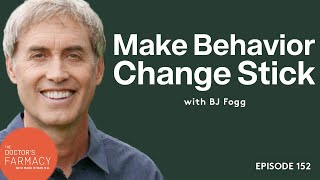
Dr. BJ Fogg from Stanford explains his Tiny Habits method for behavior change with Dr. Mark Hyman. The approach focuses on motivation, ability, and prompts rather than willpower alone. Fogg breaks down how emotional feedback loops and small wins make new behaviors stick.
Again, so it's the feeling of success that is the secret sauce here. So no matter what program or product you look at, if it's designed for lasting change, it will only work if it helps people do what they already want to do and it helps them feel successful. Those are the overriding principles. Tiny Habits is one way of doing that, a very accessible way of doing that.
Welcome to Doctor's Pharmacy. I'm Dr. Mark Hyman and that's Pharmacy with an F, F-A-R-M-A-C-Y, a place for conversations that matter. And today's conversation should matter to you if you've ever tried to change a habit or create a new behavior and maybe it didn't go so well. Because we have with us the world's expert on behavior change, Dr. BJ Fogg from Stanford University. I've been a fanboy of his for a long time. Many of my friends have trained with him and I have total FOMO about it because he has really taught me and been a guide for me in my life about some of my own behaviors that I wanted to change that I was pretty stuck with. B.J. is a wonderful, wonderful guy. Aside from being a brilliant scientist at Stanford, he teaches people how behavior works. And that way they can actually create things that are good for them, that are good for business, and that are good for everybody in the world. So we all want to change our behaviors to do good things. And how do you do that is a question. And you've probably been asking yourself many times because you've probably tried and failed many times, like me. He's a behavior scientist, he's an innovator. He's director of research lab at Stanford University since 1998. It doesn't look that old. He's created new models to explain the dynamics of human behavior. God, if we understood behavior, we could change everything, right? These models lay the foundation for a system called behavior design, and that's the focus of his lab at Stanford for the past decade. He's really focusing lately on things that are going on right now, like helping people with coronavirus and challenges they're facing as a result, and also teaching people who are involved in climate change. and professionals how to actually get people to change their behaviors. He's personally coached over 40,000 people in performing new habits. He's used his breakthrough method called Tiny Habits, which is pretty awesome. And he explains this method and broader aspects of behavior design in his New York Times bestselling book, Tiny Habits: The Small Changes That Change Everything. And that's the book. And I've got a dog-eared with lots of little flippy things that I love this book. So I'm really happy to have you on the podcast, BJ. Welcome, welcome.
Thank you, Mark. I'm so happy to be talking to you.
Okay, so we know that we have some big problems in the world. And I'm a doctor and from my perspective, we have problems with chronic disease in particular, which is impairing so many aspects of our lives. It impairs the quality of our health. It impairs the quality of our relationships. It impairs our ability to work and be productive and function at a high level. It impairs our ability to parent, to pursue our dreams, to be active, to do all the things we might want to do with our lives. And yet it's very difficult for us to change behaviors that are impeding that. And also to look at some of the bigger issues we have around the social problems we have, the changes in our thinking, in our disparities of our opinions and divisiveness in our society. Things like climate change. How do we change our behaviors around math that matter? I mean, we all understand these problems. but so many of us struggle to make those changes in our own life. And how do we get the bigger world to change in terms of businesses and governments and things that really matter? So tell us a little bit how you got into all this crazy science of behavior change and why what you do is so different.
Well, it is very different. So, and the work I'm presenting in Tiny Habits and my research is a whole new way of thinking about behavior and whole new set of methods for behavior change. It's not the old stuff that is just summarized. It's completely new models and new methods. And how did I get into it? I just have to rewind to my cultural upbringing. I was raised Mormon in California. And in that tradition, there is a lot about regulating your behavior, modifying your behavior, optimizing who you are, There are restrictions in terms of what you can drink and the smoking and so on. And so I think I just grew up in a culture that had a lot of attention related to behavior change and optimizing yourself. I mean, Stephen Covey comes from that tradition.
Oh, really? Yeah.
So Stephen Covey is like, you know, friend of a friend and, or before he passed away. And, you know, so that's the seven.
Habits of highly effective people.
Yeah, so there's a lot in the water of Mormonism that has to do with human behavior and becoming a better person. And in fact, in the Mormon doctrine, as I understood it back when I was practicing Mormon, there is definitely the idea that you are here on this planet to get better and better and eventually get perfect. So the idea that we human beings can eventually become perfect is part of the culture and part of the project. Of Mormonism.
Wow, so maybe we already are perfect and we just have to realize that we are. I think that's probably, but that could be a challenge, right?
If you're- I wish I were smart enough back then to have said exactly that Mark, but that's not how they see it, okay? They're here to experience and learn and so on. But I think that really helped me and then it became a challenge, right, BJ?
Because if your goal is to be perfect, It's almost impossible to achieve. So it could kind of be a struggle and it could be a setback.
Definitely a setback for me. So there was probably a time, my mid-20s, about the time that I was also coming to grips that I'm gay, and that wasn't gonna work with Mormonism. And then it wasn't lining up- oh, that. And then it just wasn't lining up with the plans I had for myself, or my pants had for me, and so on. But the idea of almost this obsession with perfectionism really got in my way of making progress. And there's just so many. I mean, it got to the point, Mark, and I've never shared this before, so I did the what a good Mormon boy would do. You go to Brigham Young University. I wasn't a very good fit there, but the honors program kind of saved me, 'cause that was like my home.
And did you know you were gay then?
Coming to grips with it. Coming to grips. I went into therapy there. But the perfectionism even came down to as I was walking along campus, it was like, oh, do I take this sidewalk or this sidewalk? There's a right and a wrong answer here. I've got to figure out what it is. And then, I mean, and so that's how it compounded in my life. And then I was able to set that aside and say, no, I'm good the way I am. And I, so on one hand, the whole Mormon upbringing, I think, helped me in some ways. On the other hand, the focus on perfectionism, I think it really was something I struggled with and had to get over to be happy.
Well, I mean, in a way, your work is the antithesis of perfectionism. It's like the celebration of small little wins that sometimes seem silly, but actually build a life of success, right? Floss one tooth, do one push-up, take one step, you know, say one prayer, whatever it is that you want to do. And I think it's sort of ironic that it's sort of embraces the imperfection that we are as human beings.
Yeah, and I think about it in general as it's lowering the bar. Don't have this high bar that you must clear. Lower the bar. and embrace the fact that you succeeded in getting over the bar. And if you do more than that, terrific. If you do 20 push-ups rather than two, awesome. But you don't raise the bar on yourself. Yes. Set yourself up to succeed.
So if you're 300 pounds, you know, I'm gonna run an Ironman next month. You go, I'm gonna walk around the block, right?
Yeah, part of the trick, or not trick, are part of the skill of doing tiny habits effectively. is picking the smallest new habit that will also have meaning to you. I mean, it can get so small that it's completely trivial, and that's not a good selection. So pick something that's really, really small, but will also have meaning and build from there. One of the misconceptions in the Tiny Habits Method, and I just used a word that implied it builds from there, is that you start small and then you raise the bar, like two push-ups and I have to do four and six and eight. And yes, you start small, but doing the baseline, the smallest version, the tiniest version is always okay. So Mark, you told me before we actually started recording that you're kind of doing a lot of push-ups right now. Yeah, so yeah, I'll tell my story.
So, you know, I read about your method and I don't want to spill the beans, but you have a method called B equals map. which basically describes that you have to want to do something, you have to have the ability to do something, and you have to have a prompt or a trigger that will remind you to do the thing. Did I get it right?
Yeah, right.
Okay, so I'm like, turned 50 and I'm like, I just been running my whole life and biking and doing yoga and I just loathe any kind of strength training. Because anytime I tried to lift weights or do a push-up, it would just hurt. and I'd feel sore afterwards and I was really uncomfortable. I was like, this is not for me. And it was just hard to do and I didn't enjoy it. But then I read about your work. I'm like, all right, I'm gonna try this. So I'm like, I'm motivated to get stronger because I'm getting older and I know that's important as a doctor. I definitely have the ability to do it, although I'm not very good at it because I don't do them and it's hard. And I don't like, I like to do things that I'm good at and things that are really a struggle. And then I had the motivation, I had the ability, and then I needed a prompt or a trigger, and I decided, well, I take a shower every day, and because I live in a giant barn, it's an old converted barn, it's up on the top floor, I have a long way for the hot water to get upstairs, so it takes a while for it to heat up. So while I'm waiting for the water to heat up, it's like I'm going to try to do push-ups when I'm waiting for the shower to heat up. I think I'll start with one push-up and work my way up, and now you know, I can do 50 push-ups which is pretty awesome. And I sort of weight training and it sort of led to a whole like then I got a trainer and so it's like it led to changes in habits that I want to do but I just it was so hard I never wanted to do it.
Good for you and for people who haven't tried push-ups a lot 50 is a lot. There's a huge difference between 20 and 35 and 35 and 50. So Mark, congrats.
Yeah, I'm 60 years old, so it's all right. Not so bad.
You know, and so in the tiny habits perspective, that would be considered a meanwhile habit, meaning you're waiting for the water, you have this limited period of time where you can turn on the water and you're not doing anything else. So meanwhile, you do push-ups in that interval. Did you find yourself doing push-ups other times in the day, or did it generalize?
No, I never did. I never did. I never did. And then I started getting more focused on weight training. So it took a number of years. So it maybe took like six or seven years before I really took the next steps to get a trainer and to start doing more. But it was interesting. I couldn't have done that, I think, if I hadn't sort of broken that hurdle and made the little changes.
And I see that a lot. I started teaching tiny habits, started sharing it with people in 2011.
But you didn't call it that then, right? You called it this.
Well, I called it three tiny habits. Yeah, I called it that from the beginning. I called it that. And the program was called three tiny houses because people were working on three. And, you know, because I'm a measurements guy, I like studying things. I like numbers. I like researching stuff.
I would.
Evaluate it week after week after week. And one of the things, one of the measures I brought in, I think I did it the first year, was to look at the ripple effects of doing two push-ups or flossing one tooth. Did it lead to other changes? Did the vast majority of people answer yes? And did it lead to breakthroughs doing something bigger? And on average, week by week, we would 18% of the people reporting that they stepped up and did something bigger. Now that's within five days. So there's, and then I started calling it, and this is not part, it's not in the book, I started calling it a springboard moment where people are going along, and I guess I was thinking of gymnast vaulting, like they run and they're taking these tiny little steps and they go, boom, and they do something big. And that's going to happen pretty reliably, and it seems to be a function of feeling successful on the tiny things, and then opens up to doing something much bigger that you wouldn't have done before.
So let's dig into it a little bit. So this is a very scientifically based model. It's not just some cockamamie idea you came up with while you were taking a shower, or maybe you came up with it then, I don't know. But it's something you've studied extensively at Stanford. It's backed by enormous amounts of research.
And.
You really have created this whole fog behavior model and talk about these three things that come together at the same moment and why they're important and sort of what you've learned, how it's so different than everything else that we see about behavior change.
Yeah, and so tiny habits emerged for me looking at my own behavior model. There's a graphical version with an X and Y axis. The behavior model came together for me in 2007, and it goes like this. This is a little bit of repeat when you said Mark. A behavior, any behavior happens when there's motivation to the behavior, there's ability to the behavior, and then there's a prompt. And when those things converge, the behavior happens. If any one of those things is missing, it does not happen. And then when you graph it out in two dimensions, which I could draw or show poster, I should. There's a relationship between motivation and ability. If something is hard to do, and in order to do it in my model, because there's a line that defines what action happens if it doesn't, something's hard to do, then you have to have high levels of motivation. When motivation drops, you can no longer do hard things. My graphical version of my model shows I put on the other end of the model, if something's really easy to do, and this is what led to the tiny habits breakthrough for me, I think it's really easy to do. Your motivation can be high or middle or even low. It's really, you can like, flush out to awesome or a glass of water. When I saw that in my own model, I was like, oh, this. What this means is if I make a new habit really, really easy, easy to do it. I don't have to worry about my motivation level very much. All I need to worry about is time. And that's what, then, as I started hacking my own behavior, and this is about 2010, then it was like, oh my gosh, it is so easy to create habits. I can't believe it's easy. I gotta share this. I gotta see how people find this works too.
Yeah. So, BJ, what were those habits that you were able to figure out how to change that got you to figure this out? for yourself. What were those things?
Flossing. Flossing was one of them. And because there was a moment when I was doing the flossing habit where I figured out how important emotion was, ways of snacking, because I gained some weight. You know, I wasn't. I didn't think of myself as heavy, but I gained more weight than I'd wanted. It was habits around productivity. It was. I don't know if it was in the first year, but then I started doing two push-ups after I pee. So then it was, I will do two push-ups usually I do more, but the baseline was three. So they had to do with work, relationships, health, and then once you can create habits readily, it's like no big deal. It's like, oh, I'm in the habit of playing my flute every morning. And you can wire in the habit. Now, there are some habits that are hard to form and I think we'll get there. But for the most part, if you focus on new habits that you want, there's a way to design them into your life. And that's what Tiny Habits is all about. That's what the book's all about. And so the book is doing two things at once. Number one, it's presenting an absolutely new way of thinking about how behavior works. A new model. and a new set of models, and which I think is really groundbreaking. I think it's, the behavior model is a big deal. And then it's also telling people how to apply this in a really easy way in their everyday lives. So in writing the book, I was trying to do both at once, and I hope it was successful. You did.
It's very good. But you know, you talk about what's different about it. And other behavior change models have been studied and it's one of the banes of existence. If you go to your doctor and he gives you a prescription, there's only a 50% chance that you'll fill it. And if you fill it, there's probably a 50% chance that you'll take it. And so doctors do all these great things. Unless you're a surgeon, you have the patient lying unconscious on the table, you can do whatever you want to them. To get patients to do what you think is right for their health or what you think will help them, whether it's take a pill, I mean, taking a pill is pretty easy, right? Forget eating better, exercising, meditating, getting eight hours of sleep, building your social network, relationships, all those things are so challenging. And it's why we're seeing this incredible global epidemic of chronic illness. Yeah.
Well, Right now there are two medical doctors who are part of my boot camp this month. And one of them is from Ireland. And he, after class three, I think, or after class two, he emailed me and said, BJ, I now see for the last 20 years I've been doing this exactly wrong. And I felt kind of bad. But also he is creating a behavior change program for his patients in other position. So now he can do it right.
What?
One of the systematic problems is focusing people or yourself on something abstract, like, oh, I gotta exercise. That's an abstract thing. It's not a behavior. We'll often call those things behaviors, but they're abstraction. And then the next thing that goes wrong is people just think, I just need to motivate myself. But that combination of trying to motivate yourself towards something. abstract does not work very well at all, whether you're changing your own behavior or somebody else's. In fact, with, this is kind of an oversimplification, but in my work in Tiny Habits, rather than motivating the distraction, it makes something very specific really easy.
And so that's, so I do three jumping jacks, right?
Yep. And make it really easy to do. And so you're not worried about motivation and you know exactly what the behavior is. One of the differences between, and I think this doctor, this would be one of the issues, an expert when you say, no, eat more leafy greens. An expert in his or her mind knows what that means, but an amateur might go, I don't know what that means.
Grass. Eat grass.
So experts that are prescribing like, hey, you need to change your diet, more leaky grains. They're not understanding that perhaps their patients are totally confused. So instead they need to be very, very specific. Here's what I want you to do. Now eat bok choy and broccoli and.
17 leaves of kale.
Yes, every evening and steam it or saute it and cook it this way.
Right.
So really, it's. what is exactly the behavior and here's how to do it. And that is a much more successful approach than most.
Geez, well, no wonder. No wonder we have such a problem, because all doctors say is eat less and exercise more and lose weight. Good luck with that.
You know, I don't know if you want to go that. I'm gonna go here and you can change it if you want, but. just everyday people don't even have the right guidance. I mean, for most people, if I were to walk out on the street and say, oh, how do you lose weight? I would wager 90% plus would say, oh, I just have to exercise more. And that's the, you know, that's what.
People, which is actually a false idea, right? Right.
And so, so people, so they're like, oh, if I only could get myself to exercise more, I could lose weight. Well, they're headed in the wrong direction. They haven't been given the right behavior, which is mostly nutrition behaviors, as you know, and the right way to make those into habits. So there is, and why that idea that exercise is the key to weight loss, why that keeps living on and on, I have no idea.
Oh, I'll tell you why.
Why is that so persistent?
Well, because it's, you know, the mantra of the government and the food industry is calories in, calories out. is a secret to weight loss and it has nothing to do with nutritional quality. And so it doesn't matter whether you have a soda or broccoli, as long as they're the same calories, it's the same amount of energy. And if you can exert more exercise to expend that energy, as long as you're in calorie balance, you'll stay the same weight. If you're exercising more than the calories you're taking in, you'll lose weight. But scientifically, that's just not true because all calories are not the same. and some calories like sugar and starch actually cause you to spike insulin, which makes you store fat. So I've written about 16 books on this, but it's, it's really extraordinary. And hey, everybody, it's Dr. Hyman. Thanks for tuning into the doctor's Pharmacy. I hope you're loving this podcast. It's one of my favorite things to do and introducing you all the experts that I know and I love and that I've learned so much from. And I want to tell you about something else I'm doing, which is called Mark's Picks, it's my weekly newsletter, and in it I share my favorite stuff, from foods to supplements to gadgets to tools to enhance your health. It's all the cool stuff that I use and that my team uses to optimize and enhance our health, and I'd love you to sign up for the weekly newsletter. I'll only send it to you once a week on Fridays, nothing else, I promise. And all you have to do is go to drhyman.com/picks to sign up. That's drhyman.com/picks, P-I-C-K-S, and sign up to the newsletter and I'll share with you my favorite stuff that I use to enhance my health and get healthier and better and live younger longer. Now back to this week's episode. And one of the things I read in your book that I really liked is I use it all the time, which is, you know, people internalize this message of it's your fault. It's your fault you don't exercise. It's your fault that you're overweight. Shame on you. But you said, I'm here to say it isn't your fault. and changing your behavior isn't as hard as you think. And I think that's really an essential message because people are stuck in this idea of self-loathing, self-hate, and discouragement because they're not having the willpower, the motivation, and they beat themselves up about it. How do you address that with people?
I didn't understand that's where everyday people are until about coaching. It was probably two or three thousand people. This would be 2011.
So, You're a slow learner.
I was in my little bubble of Stanford and high achievers and CrossFit type people, right? So I'm in this very selective, selective kind of world. And I'm coaching 300 people a week about in Tiny Habits through email, but there's email exchanges and about 2,000-3,000 people in. Somebody wrote me and she said, oh my gosh, BJ, thanks to you, I now see that I've enjoyed a lifetime of self-trash talk. And in Tiny Habits, what we do is we teach people to say good for me and feel successful and raise it. And so she wrote to thank me. She says, this boom has changed my life. And I paused. This was a huge moment for me, Mark. It's like, that is where people are really at. And then I started reading all the emails and my interactions with People were different. And I was like, oh, people have so many ways to say, I did a bad job, I'm insufficient, I lack willpower, which is, and that's why in the book, when I say that, that was in some ways a little bit risky, because it's just inviting a lot of criticism, but it's true and it's accurate. And so to say, look, if you haven't changed, it's not your fault. You just didn't have the right way to do it yet.
That's right.
Welcome to Tiny Habits. Now you do and now you can do it and it's not about willpower or discipline. It's about design. You design new habits into your life. You don't force them or you don't use discipline, motivation or willpower. It's a design challenge, not a test of somebody's character.
I think that's so important to say that because I see this all the time as a doctor. People beat themselves up. They trash talk. They have self-loathing, they'd get discouraged. And I just love this part of your book, 100 Ways to Celebrate and Feel Shine. And you have like 100 ways to celebrate yourself and to celebrate the little successes and the tiny habits and builds and builds on a positive feedback loop. And I think that's a really key part of behavior change is these positive feedback loops. So it's like, oh, by the time I could do 10 pushups and I wasn't, in pain for a week in my chest muscles. I was like, oh, this is fun. And then I want to do more. And it's like, and you just, I felt good and I want to do more. So I think there's these little tiny strategy you have throughout the book that really help people to break free from some of these really discouraging and debilitating beliefs about themselves that limit themselves in their lives and limit themselves from actually doing the things they want to do. and it's so important. You talk about this idea of behavior design. So it's not just random. You're actually thinking about this sort of, you know, if you want to do certain things, like if you want to, I don't know, build a house, you have to put the foundation in, you have to put the framing in, you have to put the, like, there's a design feature of how to get things to work. And we've been going about it all wrong when it comes to behavior change, which is why we're not changing our behaviors at a scale that we need to, because many of the problems we're facing in our society are behavior change problems. And you're pointing this out so well. So what are the other strategies that aren't working that people do? Yeah, because I think it's helpful if you understand, you've talked about this model, it seems pretty obvious. You have a motivation to do something, you have the ability to do it, and you have a trigger or a prompt. And that seems like a very simple model, and it is, it works. I've used it. But on the other hand, what is pushing against people that is limiting them?
Well, we talked about the idea of people even focusing on the wrong thing. Like if your aspiration is weight loss and you think it's about walking on the treadmill at the gym, focus on the wrong behavior. So that's one of the systematic problems. Another one of the problems is the idea that you set this really lofty goal And then you just have to keep yourself motivated toward that lofty goal. Now, in my work, I don't use the word goal. In fact, in the book, I talk about why I think it's a bad idea to use that word.
Are you gonna put a whole bunch of goal-setting people out of business?
I know.
Make their lives out of helping people set goals.
Not totally opposed to the goal thing, but it's not a winning strategy. The fact that I've even written down a goal and I'm like, Now I'm gonna just keep myself motivated toward this goal. If it's hard to do, you're not facing the reality that your motivation is going to shift over time. The idea, and we can come back to that if you want, and so the goal is setting people don't get super upset with me. I break it into aspirations and outcomes. So there's a type of goal that's an aspiration, there's a type of goal that's an outcome. So rather than using an ambiguous word, because I'm really big on precision, let's use When it's an aspiration, like earlier Mark, you said you wanted to get stronger. That's an aspiration. And then you find behaviors, specific behaviors that will take you there. An outcome might be somebody might say, Wow, I want to lose 20 pounds. That's an outcome. Then you find specific behaviors that will take you there. So in either case, you start with what you want to achieve. This is part of the system in the book. And then you figure out what behaviors are the right ones for you. to take you there. So you don't guess at the behaviors. There's a way to figure out one of the best behaviors for you, either to that aspiration or the outcome. And you, I'll go to a slightly different spot. Another one of the misleading ideas is that repetition creates the habit. So if you can just keep yourself doing the behavior, it'll become a habit. And that's not true at all when you look at what the research. So the people that are advocating this, and they're very popular books and there's a lot of the culture that's saying repetition creates habits. That's not true. You're being misled by those books and that thing. When you look at the research that most people cite, it shows that repetition correlates with strength of habit. It gives no evidence whatsoever that repetition causes the habit to form. So the correction in my book, what I tried to make very clear, is it's emotions that create the habits. So that's one of the myths myth busters in the book. Other things include like you have to set a goal.
Why doesn't repetition cause habit change?
Well, I have quite a long, so I'm training the tiny habits coaches we go through this thoroughly. And the reason, I mean, the question really is why do people think it creates habit change? Right? That's really the question. Why do people think that? Well, because they've been told that for years. So when you look at the research, it does not say that. So, yeah, I'll give you an example. Like for me, just to be a.
Little devil's advocate, I had back surgery recently, and I really, you know, don't like swimming long distances. I've never really done it. I love swimming, but I just like go out for a little bit. but I had to swim for half an hour. And at first, I was like, ugh, and oh, it's so far and I have to swim back because I swim in the lake and it's like, I was resistant to it, but I knew I had to do it because I couldn't do anything else. But over time, the more I did it, now I look forward to it and now I can do it and I don't have that mental resistance that I have.
Yeah, and the way to think about that, it wasn't a function of repetition, it was a function of your feelings Successful, you're seeing progress, right?
Okay.
So notice it resulted, like if you had to do the swimming and you never felt successful, you would not have, eventually once you haled, you would not have created a habit out of that.
Okay, all right.
So people are, first they're misleading you in these books and blogs, but when people think that repetition is the key to creating habits, They think, oh, I've got a, and one of the memes is it's 66 days. Not true, but that's what's out there. So they think, okay, in order to create an exercise habit, I have to repeat it 66 days. Oh, I don't have time for that. I'm going to wait till I have time. They look at behavior changes something to dread, something to endure, something that might be painful, and none of those is helpful. Instead, you can change your behavior by feeling happy and joyous. Now, when you look at what has worked, your example is a great one, Mark, when it has worked, what will always be true is that there was an emotional component where you felt more successful or it relieved some negative emotion.
Yeah, or pain or in the habit. Right, that's great.
That's what it is. And so in tiny habits, we don't leave that to chance. I have a chapter that's like emotions create habits. And then we give in the book specific techniques and the coaches that coach people in tiny habits help people find exactly what techniques do you use so you can feel that emotion at exactly the right times to wire in habits really, really quickly. And the better you are at feeling that emotion, that positive emotion on demand, the better you will be at wiring and habits.
So that's an interesting piece. So it's the B, which is behavior, equals motivation, ability, and prompt, but there's also the emotion in there. Yeah.
Yeah, well, let me sketch it out. So when I say behavior, I mean all types of behavior. Habit is a subset. So within, like if I were drawing a diagram, within the big circle, that is behavior. MOTIVATIONAL ABILITY PROMPT applies to all behavior types. It applies to habits, it applies to stopping behaviors, it applies to one-time behaviors, it applies to temporary behaviors like taking an antibiotic. Then when you get down to the subset of habits, those are behaviors you do quite automatically. Those are different than the other types of behaviors. What creates the automaticity is the emotion. So the positive feedback, the emotion, I have people focus on the emotion of success, the feeling of success. That's what makes that behavior automatic and puts it in the category of what we call habit.
Powerful. And you talk about how this starts to change people's identity, the way they think about themselves and see themselves. Can you tell us more about how that happens?
I can't say this is the magic because I'm a scientist, but this is awesome. What happens, and we see this in our data week after week, is when people do something small and feel successful about it, like they're flossing one tooth, they're doing two push-ups, or steaming broccoli for dinner, that feeling of success also changes how they think about themselves. oh, I'm the kind of person who can take care of my teeth. I'm the kind of person that eats steamed vegetables. So they don't change their identity by, like, going and listening to a motivational talk, at least in Tiny Habits. They change because they see evidence that they are changing and they're seeing the effects of that. And that identity shift can happen really. quickly. We see a lot of evidence for that within five days. And it seems to be a function of people seeing evidence and feeling successful in their quest to change. And it doesn't have to be like running a marathon.
So it's like a feedback loop. It's a positive feedback. Yeah.
And when people acknowledge that and see that, and part of the program and part of the book is like, Hey, look, recognize you are successful. I might be tiny, but you're still changing. That then shifts people away from self trash talk, the thinking that they don't have enough willpower to seeing themselves in a whole new light. And the phrases that come back to us, I was like, now see I'm the kind of person contained. I can follow through. I can achieve whatever goal I have. And it goes on and on.
So it's the positive feedback loop.
Yeah, yeah. And I don't talk about it exactly in those words as positive feedback, but that's exactly what it is. I mean, we talk about it as emotions and but it is this positive feedback that affirms you're succeeding. So it's the feeling of success that wires in the habit and also motivates you to continue. So it has those two functions.
Hmm. Right, well this is powerful and I think it sort of breaks us free from one feeling bad about ourselves because we don't change because we have the wrong map, literally. And now we got a different map that we should try out and see if we can try to adjust our behaviors according to this model. And I think, you know, you have the two ends of the spectrum where your motivation can be high and your ability might not be high but that motivation can overcome the ability that's not so high. And you can also have an ability that you have for sure that's super easy and not that much motivation, but that's also easy to do. So, there's a whole way to engage with this. It's kind of across the spectrum of behavior change. But, you know, as I sort of studied behavior change, because, you know, for me as a doctor treating chronic disease, most of it's driven by behavior, right? Eating the wrong foods, not eating the right foods, not exercising, sleeping, meditating, the social connections, all those things are so driven by behavior. It's not, you know, 80% of health issues are not something that can be addressed at the doctor's office. They have to be addressed, you know, where you live, eat, work, play, pray, you know, all that's where health happens, right? So, you know, I really, for so many years, focused on the, you know, sort of the minutiae of biochemistry and physiology and genetics and the microbiome and all the metabolome, all this cool stuff about how the body worked as an ecosystem and systems biology. And it was just so fascinating to me. And I knew how to help people, and I could if they did what I told them to do. But the problem was getting them to do what I told them to do. And they were those OCD patients, or there's just highly motivated patients who literally would follow directions and they would get better. But the majority were just struggling. And then I went to Haiti after the earthquake, and I wanted to volunteer like many people did, and I had the opportunity to go. And I met a guy named Paul Farmer who discovered that he was trying to address some really big challenges in the world around TB and AIDS in countries where they were really just ignored. I mean, poor countries like Haiti and Africa and people just were giving up on these populations because there were so many changes that had to happen for them to actually take their medications and do the right thing. It wasn't like we didn't know what to do. and he realized that he used something called accompaniment as a tool for change. He created this whole model called accompaniment. It was this French word in Haiti, but essentially it was peer support. It was people helping each other and helping each other, supporting each other, helping each other be accountable to one another. And when I came back from Haiti, I met Rick Warren, who was a pastor at Saddleback Church, a faith-based minister. and I'm a Jewish guy from New York, so I don't know what do I know about that, but we got to talking after he came to see me for a visit and he told me how unhealthy his church was. I said, why don't we start a healthy living program in your church? And put it through these small groups that he had. He had 5,000 small groups. I was like, wow, this isn't a mega church, this is thousands of mini churches. So let's put in this curriculum and see what happens. And I thought, you know, a couple hundred people would show up. There were 15,000 people that signed up the first week, and they had more people there than any other event they'd ever had, whether it was the 9/11 services, the Obama-McCain debate, and these 15,000 people worked together in small groups supporting each other, and they lost a quarter million pounds in a year and got rid of all sorts of chronic illnesses. And all they did was help each other, hold each other accountable, support each other, encourage each other. And I think that's a big key piece. This is Chris Stockus's work about obesity being contagious. But it's also true that health is contagious, that behavior change is contagious. And if all your friends are going to yoga and drinking green juices, you'd probably be healthier than if all your friends are, you know, drinking beer and, you know, eating Cheetos and McDonald's. Right. So I think we have to really get clear about, about the, the other component of behavior change, which I think is this, the social networks that we, we live in and around and with, because it's such a powerful so I'm curious about how you address that. And we've done this at Cleveland Clinic and what's interesting, BJ, we've started to do the research on this. We'll be publishing it soon, but we found that we've compared our one-on-one visits with the same doctors for the same kind of conditions compared to group visits with the same doctors and staff. And we find that the people in the groups get better and get better faster and get even better than one-on-one visits. which is bizarre.
Yeah, let me map it out. What's going on there? And, okay. And, and what everyone listening to this should understand is behavior change. There's a system behind it. It's system. It's not like random stuff, but it's not been outlined until tiny habits. I mean, that's why I'm sharing the system. Like, here's how this works.
Tiny habits. But.
Starting in 2011, when I started teaching this, I said, Look, people, there are three ways to make lasting change. One is have an epiphany. Guess what? You can't design for that. They happen, but you're not going to make one happen and your doctor's probably not going to make it happen. So take epiphany off the table. Number two, you can redesign your environment. And this is where the social people number three is you change in these tiny ways. So this program is about the third one, but yes, changing your environment is it works together with the tiny habits method. So what you're leveraging, there's a few things that social brings to the table. As you have a new social environment around you, then it makes the good behaviors easier to do. you become aware of what other behaviors you can do. So it's not just motivation that the social group provides. Yes, they provide motivation. Yes. But they also, let's say you're hanging out with people who are trying to eat healthy. It's like, oh my gosh, you're eating kimchi. Why are you eating kimchi? Oh my gosh, I'm gonna start eating kimchi, right? So connects you with new behaviors. Yes, it hits the motivation. So I'm going through the behavior model. it can make behaviors easier to do because they can teach you how to do it or they can guide you to do it or they maybe like deliver kimchi to your doorstep. And then finally prompt social can prompt you. They can serve as a reminder. So if people can change their social environment, that's a super, in fact, it's so important that a whole year of Stanford Lab. This is what we focused on. We called it Change Together. And we looked at the different patterns of how social, there's not just one pattern. There's a variety of patterns. There's not 50. There's like 20 of how social works in successful programs to create this ongoing change. And so, but it functions in that way. I mean, so quick summary, the big picture is There's two reliable ways to change. Change your environment, change in these tiny ways. When you redesign your environment, you connect with new behaviors. Yes, you can increase your motivation and it makes it easier to do and there are prompts. So it's hitting on all of those things. And with tiny habits, often what you do is you adjust your environment to make. So it's really this loop. Any changes shift your environment leads to more and so on. So there's a loop, this isn't in the book, there's other work where I've shared this. Those are the only two ways to change and social such a role if you can immerse yourself in the right social group. And the household is one that I've long, long, long championed change together as a household.
Yeah.
But even that is really hard for some people to do.
Yeah, I think that's really true. So what you're saying is this is really complimentary. tiny habits and changing your environment, which is really your social network, even, you know, in your house. I mean, I literally changed my house as when COVID happened, I had to change so many things in my house because I wanted to incite the right habits. So I got exercise equipment. I did all the things that I had, I created a special room where I put all the stuff that I want to use because I really didn't have that before. And so I made it easier for myself and I created those little triggers. so it's helpful. There's something else I want to talk about, which I'd like to understand from the behavior change point of view, which is the opposite of what you're proposing that I often use as a doctor. If someone's 300 pounds and I tell them have one less Coke and they're having 12 Cokes a day, they're not going to really see a change. maybe they will, I don't know, but they're probably not. But on the other hand, I've heard examples of where these things really work. For example, Walmart has these tiny change habits things. I don't know if you were involved with that or not, but it kind of reminded me of your work where they're like, make really small little changes. So there's this one woman who didn't want to, he was very overweight woman, didn't want to give up her Doritos or whatever she was eating, or Cheetos. So she decided she'll eat one less a day from the package. So the first time she would, eat all of them except for one, and then she did all of them except for two. And then by the end of the month, she was not eating any. Now that that certainly can work. But what I've found is, is when people are struggling with really significant issues, if I can get them to experience a massive shift in how they feel quickly, that it drives their motivation that then helps them continue. So, for example, I'll put be people on relatively, for them, it's mostly how I eat, but it's a relatively extreme diet of getting rid of all processed food, getting rid of junk food, getting rid of sugar, getting rid of starch, eating whole foods, doing that for 10 days, eliminating common food sensitivities like gluten and dairy. And, I see people have remarkable changes, not just weight loss, but energy, sleep, digestive issues, cognitive function, sinus issues. I mean, everything gets better. And then they go, oh, and then they're much more motivated to continue. Now, sometimes they fall off over time, but I find those some of some like those massive changes quickly can often, you know, drill people into longer term results. I'm just wondering how you frame that.
Let me explain to what's going on. So in behavior design, Mark, you talked about this earlier. It's a set of models, including the fog behavior model. There's other models. It's a set of methods and there are two maxims. And these maxims are, if people listening or watching this forget everything, remember these two things. This maps to your example and everything that works. Maxim number one, help people do what they already want to do. So if you want to help somebody create lasting change, you've got to help them do what they already want to do. to get them to do things they don't want to do, that's failure. Maxim number two.
I can't get my wife to learn how to water ski.
Maybe. Maxim number two is help people feel successful. So it sounds like, Mark, in the cases where people did this more intensive program, they started seeing success again. So it's the feeling of success that is the secret sauce here. So no matter what program or product you look at, if it's designed for lasting change, it will only work if it helps people do what they already want to do and it helps them feel successful. Those are the overriding principles. Tiny Habits is one way of doing that, a very accessible way of doing that. There's other ways of doing it too, and it sounds like this 10-day intensive is a way of doing it because you're helping them do what they already want to do and you're helping them feel successful.
Well, that makes sense. So it doesn't really change. So you also have this thing in your book you talked about with this idea of skills of change. What are the skills of change? Because that sounds like a good thing to know about.
Yeah, so the ability to create habits and to change is a skill like driving, like searching, like speaking French. And it's never been broken down that way before, so I do that. part of the book. And there are five categories. And within each category there are specific skills. We've actually covered some of them today. One of them is knowing which habits will have meaning for you. Another one is knowing how to feel successful, even with tiny things and so on. And some people are better than others naturally. It feels just like anything else, right? With surfing, some people are going to be better at balance or whatever. but with practice you can get better and better. And so in the five-day Tiny Habits program, people learn a lot of these skills. We don't call it out in the program because we try to keep the program really tidy and short and compact. But we're teaching people about the skill of designing, about redesigning their habits if needed, the skill of celebration, which is the way you cause yourself to feel successful and there, so in the book, I talk about 24 different skills of change. I don't list them all. I mean, there's a chapter when I talk about how tiny grows to be transformative. That's why I say what you're learning is these skills of change. And once you have these skills, and one is embracing a new identity, so hit on some of these, then you can apply it broadly and it has these transformative factors. Um, and so, yeah, seeing it as a skill and not magic or not just one little tweak, there's no magical trick to changing your behavior. Just like there's no magical trick to driving or surfing or speaking French. It's, you can get better at it. You can approach it systematically, but you do need, it's helpful to have a good coach or a good guide.
So you're essentially talking about BJ is you, you sort of divine the science, if you can divine a science, of behavior change. And it pointed out that the ways that we've been trying to change the behaviors, whether dropping bad ones or taking on good ones, has really been misguided and has led us to fail and feel guilty and feel shame and feel like it's our fault. And that there really is a different way of thinking about it. And that it is a very specific skill that's scientifically derived that you can apply every day in your life that works. And it's not just some airy-fairy thing from positive psychology, but there you are, Stanford professor, you've got the full weight of that behind you and all the science behind you. And you've been able to show this not just as a theoretical idea, but you've been able to actually apply this across individuals, businesses, and far more. Can you talk about what you've seen in your work as examples of people and organizations and businesses that have actually transformed as a result of this work?
Wow, where shall we start? Individuals and then work up, I guess?
Yeah, yeah. Give me the full spectrum. It would be helpful for people to understand how this applies because I think we get the basic framework, but then it almost seems too good to be true. In real life, you've played this out and it actually comes to fruition.
I get emails every day, people thanking me about, oh my gosh, BJ, I've tried everything. And finally, they found the online five-day program that's free or the Tiny Habits book. And they just, you know, if people don't follow directions, it doesn't work. Because sometimes you say, oh, I'm gonna do tiny habits and I'm gonna do 20 pushups. And it's like, guess what? That's not tiny enough. Okay, but when they, you know, follow the system, they see that they can create these habits and yeah, they're doing push-ups and they're flossing or they're taking vitamins or what have you, but the bigger impact is this identity shift and the five-day program is really designed. I designed it and iterated to really build people's confidence. They can change and that's one of the things we measure is how much did the confidence increase that they can change, which is more important than if somebody's flossing or if somebody's lifting a dumbbell twice, is confidence they can change. And so in the book, I tell they're all true stories in the book. So as a scientist, everything in the book, including the longer stories, had to be absolutely true. So there's a story in there of a woman named Juni, who had a sugar addiction and then applied the Tiny Habits Method to untangle that sugar addiction to the point where she got free from sugar and then discovered all these aspects of her life that were better, richer and better now that she wasn't under.
How did she do that? How did she do that?
Well, what she did.
I'm sure everybody listening to this podcast wants Yeah, including me.
Okay, so the right way to think about a habit that you want to get rid of is not breaking it, it's untangling it. Breaking, like a lot of things in the world of behavior change, we're using the wrong words and we're setting the wrong expectations. Breaking is the wrong expectation. You don't suddenly break a habit like that. So she looked at what her sugar Her specific habits around sugar, like, oh, I need a snack here, I need ice cream here, whatever. And then she found what was prompting and motivating those, and she untangled it piece by piece. And so think of it as a big tangle, and you take the easiest tangle first and get rid of that, and you work your way toward the middle until it all comes free and clear. So that's the overall way to think about it, how an individual might do it, I think is very individual, which is why it's a system and you use the system. And so the way June did it might be different than other people struggling with sugar. But certainly look at the sugar addiction not as a single habit, but as a tangle of habits. Understand what's driving those and then take the easiest one first and tackle that.
And just like if you have a pint of ice cream in your freezer, you probably don't want to have it there.
Yeah, I mean, I, how did I get there?
I don't know, I just kind of walked in and jumped in the fridge.
That's kind of like a redesign. You know, the book is not that prescriptive about what exact habits to form. People should be looking at you, Mark, for that, which I love. You know, he's like, here's the exact habit. My book is about how to create any habit.
Any habit.
And look to Mark and others for, you know, what nutrition habits. But the one place that I kind of shift in the book is I talk about the fridge and redesigning the fridge and I call it super fridge. And I get my prescription.
I like that.
Hey, make the fridge the center of your health quest and look at it as a friend to help you eat healthy things. And here's how you do it. And We've done it. It's called SuperFridge. In our SuperFridge, guess what? No ice cream allowed, no pie allowed. And the idea is basically this. You open the fridge and everything in there you can eat at any moment. There's no restrictions. Even in the middle of the night, you could eat anything in there and it's all ready to go or it's chopped up and ready to be prepared. So that's SuperFridge. So you invest in your environment once a week. Restock it. So then eating on your game plan is tiny and simple throughout the rest of the year. Yeah.
So that, what about on an organizational level or a bigger change you've seen happen as a result of the work?
Yeah, I can't mention the company, but a very large healthcare system wanted their employees to be healthier. So I created a product for them, which is essentially focus mapping. which I talk about in the book, that they could do as groups. So their unit-based teams would go in, have a 45-minute work session together, and walk out of that meeting understanding what are the specific behaviors that we as a team are going to implement. So they were able to bring a behavior change system to their employees that one, helped the employees do what they already wanted to do, and mostly that helping people feel successful wasn't actually so much part of that product. From a methods perspective, this is more like boot camp that people come to work with you. There are ways, there are methods for behavior change. People designing a very large financial institution that everyone knows the name of, and they're a good one. They're not one of the bad guys, one of the good guys. They use the methods of behavior design to figure out what should this online tool do or what should our app do. So they're using behavior design to really understand their customers and design successful change solutions for their customers. So it goes all the way from sugar addiction to group change to designing products for change. Maybe that's why Amazon two weeks ago picked Tiny Habits as the number one book of the year so far in business and leadership.
Wow.
Mark, I went, well, I'm happy, but no, I took all the business stuff out. But I guess I really didn't because you can use the methods in a business context. And so great.
Congratulations. Yeah.
Yeah. So anytime you're looking at behavior and how to design for change, your design is relevant. And the best source of that right now is the book Tiny Habits because it does walk you through what those methods are. And you can apply it whether it's a sales organization, whether it's a startup, or whether it's a massive organization that simply wants to change the culture and have more communication internally. And that's a behavior change challenge.
Amazing. So if people get the book and I want everybody to get it. It's called Tiny Habits: The Small Changes that Change Everything, which it sounds like it's true. And I think it is because it certainly helped me. And I think I understand the way we have to sort of break free of some of the old ideas about behavior change. And this is really a roadmap for that. If people could only apply one thing, what would you want them to do?
Probably remember the two maxims and apply it throughout your life. whether it's with your spouse, your kids, or your employees or yourself. Help people do what they already want to do. Help people feel successful. Those are the high level guides and applying it to yourself. Help yourself do what you already want to do. Help yourself feel successful. That would be, that's the message if I had to just bring it down into two sentences.
One of the things so great about this book, Tiny Habits, the small changes that change everything, is it's just full of practical fun things. For example, 300 recipes for tiny habits and 15 different life situations that you can use to really help you improve your life and feel better and do the things you want to do. Because we all have those things we want to do. We just don't know how to get there. And that's what this does. And we can be successful. And it's such a great map. And there's also so many things you're offering, BJ. They're just so great. If people go to tinyhabits.com, they can learn about the book. They can get a free five-day course. Tell us about that. You've been mentioning that, but tell us about this five day course people can sign up for.
Total time investment during the week is 40 minutes. So it takes about 15 minutes to get started over the weekend, about five minutes a day. And it's the fastest way to learn about habits and to figure out what works for you. So that's kind of the appetizer. And then from there, you can go to the book or you can do the course again. And if you really want to start using it, coach others. We have a certification. and Tiny Habits. That's like for people that want to use it professionally and that's terrific. And then I have a ton of videos and other things online, but the book really brings together behavior design and tiny habits in a way like never before. And Mark said, Thank you for spotlighting it and helping me share it. I so appreciate that.
Of course, you know, and the certification program is so great because, you know, the best way to learn something is to teach it. so that's why I wrote so many books, because I want to learn all this stuff and become an expert. So I have to learn about it. I think if you want to really get solidified in your own life, not just be a professional who can help people, which is, you know, what we need more of. I mean, I, I think, you know, your certification program is such a fantastic idea because, you know, my vision and dream has been for us to create literally millions of coaches, millions of health coaches and Community health workers who can help us really transform our health care system and our chronic disease epidemic. And then of course live all the lives dreams we have. So it's not just about health, it's about all of it. And that's what's so great about your work. And I've been such a fan for so many years. It's great to finally have you on the podcast. I encourage everybody to pick up a copy of Tiny Habits, the small changes that change everything. And it works. So thank you so much, BJ. I encourage everybody to check it out, tinyhabits.com, you can learn more about I've got them at bjfog with 2gs.com as well. And enjoy, enjoy your success, everybody, because once you start this, there ain't no going back. See, I went from one pushup to 50 pushups and I'm going all the way to 100. That's my goal. I want to 100 pushups when I'm 100 years old. How do I get there? But it's not a-- so thank you all for listening to the Doctor's Pharmacy podcast. If you love this podcast, please share with your friends and family. on social media, leave a comment. We'd love to hear from you. Talk about habits that you've changed and how you've done that. We'd love to know about that. Subscribe wherever you get your podcasts and we'll see you next time on the Doctor's Pharmacy.
More from AI




This Is Why 99% of Skin Conditions Don't Heal — And What Dermatologists Won't Tell You






Why you need to start strength training today #strengthtraining #healthyaging #fitness
