Separating Fat from Fiction
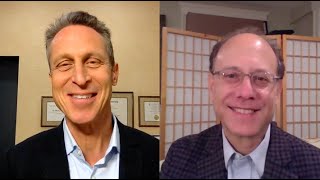
Dr. Mark Hyman interviews Harvard nutrition expert Dr. David Ludwig about why calorie counting fails for weight loss. Ludwig's research shows food quality and insulin matter more than calories, and different macronutrients affect hunger and metabolism in ways traditional diet advice ignores.
So welcome, everybody. This is Dr. Mark Hyman. Welcome to the fat summit. And today I have one of my favorite humans on the planet, Dr. David Ludwig, also professor at Harvard, who has been one of my main teachers and mentors and is actually one of the main stars of my new book, eat fat, get thin, because I really am not a scientist. I just read scientist work. And David's the work. that has inspired me the most and he's really been a pioneer in helping us rethink the idea that all calories are the same, rethink the idea that fat is bad, rethink the idea of how we're taking care of our children in terms of the food policies we have. So he's really a pioneer in this world and he's got an amazing resume that's pretty impressive. Harvard, Stanford, MD, PhD. He's the director of the OWL weight loss clinic at Torrance Hospital, one of the largest and oldest weight loss programs. He's really pioneered work on how food is not just calories but information that regulates your hormones and metabolism and body weight. And he developed really pioneering work on the glycemic load diet, which is really about how we understand the context of our diet, how it affects our blood sugar. And, you know, David, I first, you know, got to know David because I read some of his papers back in, like, 15 years ago, and, and I was like, wow, this is an amazing paper. He took a group of, like, kids, and he divided them into three groups. They gave one group like an omelet, one group steel cut oats, another group like oatmeal, and he measured their blood. He looked at what happened to their hunger, and it was like the most fascinating study because they were all the same calories. I was like, oh my God. Even though the food was the same calories, it had a tremendously different effect, and it sort of blew my mind. And so I was like, I gotta call this guy and talk to him. I'm like, you know, but who was I?
I was like a nobody doctor at the time.
And I called this big professor at Harvard. I'm thinking, he's not gonna talk to me. But like, he took my call, and we were like-- I wasn't a professor at the time. You were an assistant professor.
Fortunately for both of us.
You were still a big deal. And I was like, wow, you took my call. And like, he just, we'd become friends. And anytime I really want to know what's going on, I check out David's work. And he's an editor at JAMA, the journal of the American Medical Association. Contributing writer. Contributing writer. But you're not on the editorial thing somewhere?
Yeah.
I write.
He writes all these articles.
Leave the editing to somebody else. Yeah, but like if you're looking for a scientist who's got street cred, I mean just to tell you who David is, you know, he gets asked to give speeches all the time and he has so much integrity, he doesn't take any money from the food industry. If he goes to have to go to Las Vegas to talk to all the food industry people, he will pay his own flight and he'll pay his own hotel, he won't even take money for a cab fare, he's that guy. And you know, there aren't many of that guys in medicine or science because the whole thing's corrupted. and he's one of the few who's actually asking the hard questions, saying the hard things, and doing it in a way that it's just transforming healthcare. And I'm just so excited to have you as part of the summit, as this conversation. And I'm really excited about your new book that just came out, which actually I kind of stole a lot of the ideas from your research, including my book, but I'm sure you did a better job. And it's called Always Hungry, which is why We're Always Hungry and what to Do About It, which we're going to get into in a big way. David, I want to start by just sort of having you start with the end a little bit of where you got to. One of the things that I started explaining who you were about this study that I read about all calories not being the same has led you to this place that it's not about so much how much we're eating, it's about what we're eating that matters. It's not really about counting calories. that is matter, but it really affects our overall focus to shift their perspective from the how much, which is what we're all focused on, less calories, right, to the what and how did you come to that and how does that work?
Well, first of all, thank you for the incredibly kind introduction, Mark. It's been an honor to know you for, I guess, these past 15 years or so, to watch your career Skyrocket over the last 10 to 15 years. And it's a real pleasure to talk to you today. You know, I got my start in nutrition through the back door. I trained as a medical student, medical resident, pediatrics and endocrinology, never really taking much in the way of nutrition. As we know that medical schools.
As.
For, you know, I think having all of four hours dedicated to nutrition in the curriculum, even though diet causes most chronic diseases in this country. We spend a lot of time learning about drugs to treat those chronic conditions, not a whole lot about diet. But for me, that was a blessing in disguise because I was never indoctrinated in the standard model of obesity, calories in, calories out. And in fact, began to think about nutrition from the perspective of an endocrinologist, meaning how does food affect our hormones, our metabolism, and the expression of our genes? You've used the term food is information as much as it is calories. And so I began to design studies. Well, I should say that during the first few years of my career as a pediatric endocrinologist, I was using the standard treatments, a low-calorie, low-fat diet to treat children and their parents in our clinic. I early on got gotten interested in obesity and obesity research was focusing on genes and, you know, molecular mechanisms. But while our studies in the basic laboratory were fascinating in revealing underlying biology, we seemed to be using the same approach that had been developed a century ago in the clinic when bloodletting was still in fashion. Right.
Yeah.
Which is focused on calories in and calories out.
Eat less, exercise more, right?
Yeah, exactly. Eat less, move more. And if that worked, we'd be all looking for something different to do during our days. In fact, that approach, you know, I.
Would have to find another job.
Yeah, or early retirement, maybe. There's abundant evidence that calorie-restricted diets do not lead to long-term weight loss. And with each week, a new study emphasizing that low-fat diets, which have been the primary way to reduce calorie intake, I mean, if you're interested in lowering calorie intake, You've got to love a low-fat diet. Fat has more than twice the calories per gram of protein or carbohydrate. It's very tasty and very energy dense in terms of foods. If you pour on olive oil onto a salad, you're eating something which is, or for that matter, full-fat dairy products like cheese, Dark chocolate, you're eating some of the highest calorie dense imaginable foods. And yet, time and again, low fat diets have done less well, not better, than higher fat diets.
The thing is, it's not a math problem. It's not a math, it's not like, oh, it's got more calories than carbs, so we should just eat less fat and lose weight.
Yeah, well, the calorie balance model works really well if you're a toaster oven. You can measure the calories going in or the heat going in. the heat coming out and you'll come up with just the right answer. Humans aren't.
We're not toaster ovens.
We're not toaster ovens. The problem is the issue is both the problem with the standard mindset but the great opportunity to devise much more effective long-term approaches is the observation which has also been known for decades if not a century which is the body weight is under biological control. When you start cutting back calories, it's not just that the system empties, drains out its excess calories, the body responds and adapts. And we know what those adaptations are.
It sort of backfires on you, right?
People tend to overeat and become heavy because they're hungry. I mean, that's the main reason. There are other reasons, psychological factors, our environment, But people overeat typically because they are hungry. And if you cut back on calories, what happens?
You get hungry.
You get hungrier. And the other thing that happens is metabolic rate drops. So you've got this untenable situation. Your willpower may say, I've got a weight problem, I've got a cut back calories, and I'm gonna stick to a diet. You may have the best of intentions, but your body says not so fast. It's going to start fighting. The more you cut back on calories, the hungrier you are, the slower your metabolism becomes, and the more you have to keep cutting back in order to maintain that degree of weight loss. That's a battle between mind and metabolism that we're destined to lose.
That's so powerful. idea that if we've all been sort of fed is if we eat less calories, we're gonna lose weight and that we should restrict our calories to lose weight and that all calories are the same. So it doesn't matter like where they come from. As long as you eat less of them, it's okay. But what you're saying is it actually slows your metabolism and it actually makes you hungry and you always fail. Like that just doesn't sound like good news. So. So, like, what I'd love you to share is how you've kind of done these elegant. to prove that you can shift your metabolism to actually being faster, being less hungry, and losing more weight even eating the same calorie count. That's the kind of mind-blowing stuff that you've done that I want you to share because nobody else has really looked at it like you have.
So if we're trying to examine this question, are all calories alike?
That's a question.
It's a very provocative question. In physics, of course, all calories are like, use the toaster oven metaphor. If you're wanting to question that model and ask from a practical standpoint, is it appropriate to say that all calories are not alive? How do you test that? You could give people different foods and see how much they eat. We know that tasty foods are going to make people overeat over the short term. That's not really a test of this calorie alike calorie different model. So what we decided to do was jump across the equal sign in the calorie balance equation and ask the question, do the nature of the calories going in affect the number of the calories coming out? And so the way we did that was to take in a study we published in JAMA, I mean what you're.
Saying is if you eat different kinds of calories? Do they come and burn faster or slower? Can you check that out?
Yeah. Can the kinds of calories you eat alter your metabolism in ways that standard science and medicine would see as relevant to the success of long-term weight loss?
Yeah.
So we, in the study 2012, published in It was a feeding study done in a crossover fashion. So we took 21 young adults with high BMI, high body mass index, who'd been weight stable, brought their weight down by 10 to 15%, stabilized them at that new lower level, and then fed them for a month at a time one of three diets. And that was done in a randomized fashion. so there's no bias involved in that. So everybody consumed each of these three diets and they represented basically the full spectrum of macronutrients. So on one end we had the conventional low-fat diet, 20% fat, 60% carbohydrate. The other end was the classic Atkins diet with a whopping 60% fat.
Yeah.
It would give a nightmare to a.
Cardiologist, a nutritional nutritionist.
In the middle was a Mediterranean, we call it a low glycemic index diet. We can talk more about that term. I'm sure many of your listeners will know that term glycemic index. We had 20% fat, 40% fat, and 60% fat. pretty much the whole spectrum. You can do even more than that, but you think if something was going on, we should be able to see it. And so we studied them after this weight loss when their metabolism is already stressed on one of these three diets. We found that as expected, total energy expenditure—Dr.
They were all the same calories, right? So you just changed the ratios of protein, fat, and carbs, but the calories were the same.
Brought their weight down, stabilized them, and gave them the same calories going in on each of them.
You fed them the food. It wasn't like you say, oh, just try to eat like this. You actually gave them the food, which is a way better kind of study.
Yeah. We fed them everything they ate for this, what was a seven months protocol, basically everything they ate. And during the key points where we collected the data, we admitted them to the hospital so we could not only feed them, But we could keep them under 24 hour a day observation to prevent people from sneaking off and having a bacon double cheeseburger, if they're on the, well, if they're on any diet, frankly. So what we found was, and we measured total energy expenditure by something called stable isotopes, doubly labeled water. It's a very precise way to get energy expenditure over several days with people living their normal diets. It's important.
It's a way of double checking on people.
Yeah. If you lock people up in a room to measure their metabolism, you're affecting a lot of you're affecting their physical activity, other factors. What we found was that total energy expenditure, the total number of calories being burned off, plummeted on the low-fat diet, as was expected, and as has been seen on many other studies dropped by more than 400 calories a day. That's a big drop. So you're going to be feeling cold, tired, hungry. That's going to be a bad predictor for weight gain. The low-carb diet saw no significant decline in their energy expenditure at all. So it was not different from pre-weight loss. The low-carb diet had completely abolished.
Low-carb high-fat.
The low-carb high-fat diet, exactly. The Atkins-like diet completely abolished this negative adaptation to weight loss. And the low glycemic index Mediterranean diet showed an intermediate value. That difference between the extreme diets was about 325 calories a day. That's equal to the the energy in an hour of moderately vigorous physical activity in effect without lifting a finger.
So it's like exercising without getting off the couch.
The study, at least in proof of principle, argues that in a meaningful way, all calories are not alike to the body. The kind of calories going in alters the number going out, and if that's the case, and the low-fat diet, the worst, we really have to be rethinking our basic paradigm.
Yeah, it's incredible, David. Incredible. So, I just want to point out that there's a lot of people doing nutrition research, but there are very few what I call super scientists who are meticulous and thorough and think through the design and actually cut out a lot of the objections that people have. Most nutrition research is very poorly done, and it's also often population research where you actually can't even draw conclusions so David's research is unique in that way and that's why it's so interesting. And one of the set of points I want to dig into about this study is when these people had a slower metabolism by 300 calories a day, did it affect their weight change at all? Did the group eating the low-fat diet lose less weight than the group eating the higher fat diet?
Dr. Well, we did it for just a month at a time and we locked the calorie intake and it really wasn't enough time to see their weight change based on their energy expenditure alone. I mean, as expected, the weight started to drift. There was a little bit of a change in the expected direction in their body weight, but remember, we just locked them in. So, we're, you know—.
But if you would expect that.
They.
Would lose more weight over time, even on the same calorie balance.
If this adaptation, and this is a short-term study, so we don't know if it applies to the long-term, but if that 325 calorie difference were permanent, that would be basically the whole obesity epidemic. If you translate that 325 calories a day into permanent weight change, you're looking at about 30 pounds. when you reach your new stable weight. And that's pretty much what the population has gained over the last 40 years.
Yeah, unbelievable. So, one of the things that I want to ask you about is getting into the biology of obesity because you're one of the few people who I think understands that. And I've read everything you've written. So, I have some idea of what you think, but it's so to rethink the nature of why we get fat. That's an important question that nobody's really asking, is why do we get fat? And how do we stop that inexorable slide into obesity that we all seem to be going into? So I want to dig into the biology of obesity. When you talk about how fat affects us, what is actually happening to our hormones and our metabolism? You saw this phenomena, but can Can you explain it so that we can understand what's actually happening in the body?
Yeah, sure. Well, the premise of our book, it's— Always Hungry. Always Hungry.
It's not what you're going to be when you read the book. It should be always called Always Not Hungry.
Yeah, well, it's a question mark. And the program in the book is called the Always Hungry Solution.
Yeah, it's not that you're always going to be hungry. It's like, are you always hungry? Because if you read this book, read.
This book and be happy to talk to you more about it if you'd like. So the premise of this book-- unpack.
The book and what you kind of-- yeah, unpack it.
Is a little provocative, which is that overeating doesn't make you fat.
Crazy idea.
Not over the long term.
And you're a professor at Harvard and you're saying this nonsense? Of course overeating makes us fat. Is that what makes us fat? Tell us why that's true.
I am now a professor at Harvard. That is true. The process of getting fat makes us overeat. Something has triggered our fat cells to suck up and store too many calories to hoard those calories so there aren't enough for the rest of the body. From that perspective, it's understandable what's happening with our hunger and our metabolism. The brain doesn't realize that there are too many calories and fat size. It just sees there's too few in the bloodstream for the needs of the brain itself and the rest of the body. It makes you hungry to solve that problem. It begins to decrease metabolism to solve that problem. If the problem is not enough calories in the blood and you just cut back on calories, You make things worse. You'll lose weight for a short period of time, but your body's going to fight you back. So the question is what is triggering our fat cells to hoard too many calories?
The obvious culprit—They don't eat fat cells, they just want to eat all the time.
Yeah, why are they, they're like unruly children who are hoarding all of the marbles for themselves and not sharing with the rest of the body. Think of them.
And they're belly fat cells, right? It's not just any fat, not your butt fat, it's your belly fat.
Well, it could be anywhere, but it's typically a predominance in the central adiposity in the belly. It's like thinking of fever as a problem of heat balance. Too much heat in, not enough heat out. That would define fever. But we wouldn't tell somebody with a fever, fever to take an ice bath. Why? Well, it would work. It would lower your temperature, but what's going to happen? You're going to start severely shivering. Your blood vessels are constricted in your body's attempt to fight that intervention. You're going to feel miserable. Imagine taking an ice bath without a fever, let alone with. Ice baths are not popular treatments for fever. Even though it adheres to the heat in, heat out model, aspirin works more effectively because it lowers the body temperature set point. That's what we need to do in a more effective treatment for obesity. We need to lower the body weight set point. Once you do that, weight declines naturally. You're naturally less hungry, your metabolism is running better, and you're working with rather than against your biology. The big problem here is the refined carbohydrates that have crept into our diet during the low-fat years. Not just bread, pasta, cookies, crackers, the low-fat twinkies even sugary beverages people are beginning to understand. These raise insulin levels the most. Insulin is the ultimate fat cell fertilizer. This is just endocrinology 101. Someone with diabetes who gets too much insulin will gain weight. And, someone with nuance at type 1 diabetes, who used to be called juvenile diabetes, they're always losing weight if it goes unrecognized for a while. They'll invariably lose weight even if they're eating 10,000 calories a day.
Yeah, that's amazing, right?
Without insulin, you can't store calories.
Yeah. That's interesting.
And so the solution is to, it's not your fault. It's not your fault, you're fat. And that's a big myth because you're fighting your biology. And the answer is to get biology to work on your side, not by cutting back calories, which doesn't change the dynamic. It makes it worse. It's by changing what you eat so insulin levels drop, And then there are other influences on the fat cells that we should talk about. Get the fat cells to calm down, open up, release their calories back in the body. You suddenly feel an intense sense of well-being. Hunger drops, cravings vanish. And we've looked at this in brain studies with magnetic resonance imaging.
Yeah. And what happens?
The cravings turn off. Sometimes within one within one single meal, the area of the brain called the nucleus accumbens, which is ground zero for addiction, in one meal of a fast-acting carbohydrate versus slow-acting carbohydrate, even just the same amount of carbohydrate, the same calories, one lights up the nucleus accumbens and the other does not, quiets it down.
And if you're hungry, tricked milkshake study.
If you're hungry, it's one thing. But if your nucleus accumbens gets into the act, it's game over. Then your ability to, because the nucleus accumbens relates to reward, craving, and saliency, you can maybe ignore hunger. But if your motivation is just emptying out of a cup with holes in the bottom.
Yeah, it's not Let me stop for a minute because I want to break this down because there's so much juicy information. I want to make sure everybody gets this. In this study, what happened was you took two identical looking and tasting milkshakes, one with a really fast-acting sugar carb and one with a super slow-acting one that didn't really jack up the blood sugar. You fed it to these overweight guys and you look at their brain under this MRI and you look at their blood and you saw what happened. and it was amazing because it was exactly the same calories, exactly the same protein, fat, carbs, fiber, everything was the same. So it couldn't be like, oh, it stimulated their pleasure center because it tasted better. You kind of took that out of the equation. And then you found that their brain lit up like a Christmas tree with the ones who had the fast acting sugar, the addiction center just turned on. And then they were hungrier and their blood levels of insulin and sugar were all higher and everything changed, but it was the same exact calories and the same exact ratio.
So, same ratio. So, we tried to do this in a double-blind fashion. Same calories, same protein, fat, carbohydrate, controlled for sweetness.
Yeah. Done in a blinded fashion, so people.
Didn'T know what they got. That's why I said trick milkshake. Yeah.
Well, they liked it. It was a trick. When was a trick?
Like, when was a low sugar milkshake? Well, one was a standard milkshake, which is loaded with fast acting carbohydrate. I guess the trick one was the slow one. And we did it in a double blind fashion so people couldn't try to psych it out. Sometimes placebo effect. If you think you're getting something, that could affect brain function.
They didn't know which one they were getting.
So we saw as expected that blood sugar rose initially very fast after the fast-acting carbohydrate, insulin rose more, but then it bottomed out a few hours later. At four hours, which was the time we were most interested in, at that time people reported feeling hungrier after the fast-acting milkshake. And then when we looked at the brain, every single subject—and I've never seen this before in a nutrition study—usually there's some variability. You're lucky if 10 people go one way and two the other. Maybe you get statistical significance in this every subject responded the same way that their nucleus accumbens was more active after the fast acting milkshake. And so we got very strong statistical significance and could make a clear statement about that.
And that's why it was in JAMA. And that's why, you know, that was.
In American Journal of Clinical Nutrition.
Oh, okay. Well, I was 20. It's a good is a good article. And the other thing about it was that it kind of underscored the powerful addictive nature of sugar. It hit the same area as cocaine or heroin. So that's pretty serious.
Dr. Yeah, I don't think this is unique to sugar. It relates to all fast-acting carbohydrates. It's going to be bread. Dr. And in fact, there was no fruit dose. at all, which is people have been frequently focusing on fructose as the bad actor. Just to cut to the chase there, in my view, you pick your poison. Fast-acting fructose can wipe out the liver in high amounts. But fast-acting fructose has a very gentle effect on insulin. Fast-acting glucose is okay on the liver at first, But it raises insulin levels the most, and that has an effect on the liver indirectly as well as the rest of the body. So, I don't think it's really—this is the classic sugar bad, I think we've got to move away from the sugar bad, starch good model because white bread raises blood sugar more than table sugar.
You were one of the first guys that said the glycemic index matters, and it's like, guess what? Red has a higher glycemic index than table sugar. So we should be not so dumb and think about complex and simple carbs because that's not actually how it works. Dr. Pompa:Yeah.
And I'm not saying that fructose is as good as glucose. I'm saying glucose is as bad as fructose.
Dr. Justin:Right, right. They're both that. So I want to go back to what you were saying before about the biology of fat cells because the fat story also connects to the brain. want to just loop back to that for a minute and then come back to the biology of the fat cell. The implication is that if you eat more fat—and I've talked to other researchers about this, like Kevin Hall—that it actually shuts off the hunger and craving in the brain. Sugar lights it up, but how does fat turn it off?
Well, in any nutrition study, we don't know if it is the thing that you're eating or the thing that you're not eating because of the thing you're eating. Is it the fact that the fat is inherently good, which it probably is, or is it the fact that when you're eating more fat, you're displacing mostly refined carbohydrate? When we were told to focus on decreasing fat and saturated fat, what happened was we did. We wound up not eating more fruits, vegetables, and legumes. We wound up eating more refined carbohydrates, starch and sugar. So, you know, when between bread and white bread and butter, the bread is the less healthful component.
So, you're going to pick the bagel or the butter, you pick the butter, not the bagel.
So, you really don't know, you know, I'm not arguing that saturated fat is a health food, but it clearly was overly demonized for the last 40 years and had huge inadvertent consequences in altering people's eating habits and driving the intake of processed carbohydrates. So is it the fat that's doing something good or the absence of the carbohydrates? And I think the last part of it is a key point because when you eliminate the carbohydrate, your insulin or and especially the refined carbohydrates, your insulin levels plummet.
Go down.
But you're going to be hungry. Where do you get those calories from? You could get them from slow acting carbohydrates. You could get them from fats. You can get them from protein. In practice, the slow acting carbohydrates are hard to consume in enough quantity. The lower the fat you go, the more likely you're going to replacing those calories with high glycemic and carbohydrate. In practice, I think raising fat is the easiest way to do it as to whether everybody should be on a high fat diet or some people really can get by with moderate levels of fat or even relatively lowish fat perfectly well is an interesting question about individual variability and susceptibility.
Total differences in our population genetically about camp. I've seen it as a physician, but not everybody responds the same way. So that's clear. But I want to go back to this fat thing because what I understand from your research on the biology of fat cells and your hypothesis that overeating doesn't make you fat, but being fat makes you overeat, is that it's sort of simplistic how I'm going to explain it, but that when you eat sugar or refined carbs, insulin levels go up and insulin drives that available fuel from the meal you just ate into your fat cells because they're hungry fat cells, right? Is that right? That the fat cells suck up the available fuel and all of a sudden you feel hungrier because all that calories and fuel and free fatty acids and ketones are out of your blood and then your metabolism slows down because your body thinks you're starving even though there's so many calories stored in your fat cells. and then you're hungrier and so the whole thing just gets all messed up. So you store fat, you get hungry, you store metabolism. It's like a bad combo for losing weight.
Yes, metabolic double whammy. So think about it this way. The people, there have been dozens of force-feeding studies, just as there have been starvation studies done in controlled settings over the last 50 years or so. When people regardless of their starting weight, are force-fed so that they gain 30 pounds, they're miserable. They want nothing to do with, they're just as unhappy as the participants in the starvation studies. And as soon as that force-feeding protocol ends, what happens? Their weight comes back down to where it started, or even overshoots. They wound up lighter than the people on the starvation studies. That, I think, illustrates why overeating doesn't really make us fat. Yes, you can gain a few pounds or lose a few pounds by changing your calorie balance, and that gives the illusion of conscious control, but that only lasts until biology kicks in. The biology is kicking in because those high insulin levels are fertilizing the fat cells, causing them to hoard too many calories, and you can't fight that over the long term. We've got primal parts of the brain, the hypothalamus and other areas, that are designed to prevent us from becoming hypoglycemic and having too few calories. And it's not just glucose, it's also fatty acids, which are a key fuel. When the brain perceives that, it activates primal mechanisms that go back hundreds of millions of years in evolution, we're no match for that. So what we do have control, we don't have control over the total number of calories we eat over the long term. We do have control over quality. When you change quality, calories fall. When you focus on quality, the calories will fall.
You mean you'll eat less calories?
Well, ultimately you'll either eat less or or your metabolism will not fall with weight loss. It'll be relatively faster than the combination of the two. But when your fat cells open up and release calories, you feel intense satiety. We also feel satiety. It's the same feeling that if you ate too large of a Thanksgiving meal, you're going to be actively disinterested in food. Your brain areas involved in hunger and cravings are going to shut down, and you're going to actually want to avoid food. That's how people following weight loss surgery feel. You can get that, and that's why they lose weight for so long. You can get that, you can bypass the bypass by bypassing our highly processed diet.
It's like a gastric bypass without the pain of surgery, vomiting, and malnutrition, basically, is what you're saying.
There's that.
That's great. I think it's amazing. I've had, I basically look, I'm a practicing doctor and I just read people's research and I've taken the work that you've done and I've applied it to my patients and over and over again, it works. People lose weight, they're not hungry, they feel better and it's just astounding. And I'm so glad you wrote this book, Always Hungry, because you've now taken all this life work that you've created, it's told this story and you've unpacked it over decades. You unpacked it meticulously, methodically, and unpack the story so that we can understand it. And it's in this book, Always Hungry, which I'm just so excited about. I gave you a quote. I'm going to help you promote this because everybody needs to read this book.
Yes, your quote is on the COVID And thank you.
And you even came to your house and you made me a meal from the book, which was so great. And it was like lamb with all kinds of fat. And my favorite kind of fat is actually Lambat. That's actually my secret like pleasure is Lambat.
And, but just to add that there are, you know, my wife and I, you know, we are, you know, we thought it was really important to have vegetarian versions for all of our recipes and meal plans. And so, you know, there's options for meat eaters and vegetarians.
It's absolutely so, so, and it was, but your book is full of these recipes that are creamy, satisfying, delicious meals. And I want you to tell everybody about the study you did. It was sort of like a trial and what happened and what people experienced. And you obviously...
In our pilot?
Yeah, in the pilot study.
So just to be clear, the pilot wasn't research. We didn't have a control group. We wanted to see how the program that we had developed for the book, it's a three-phase program with three weeks of meal plans and about 75 recipes. And then other supports, because we didn't talk much about this, but in addition to lowering refined carbohydrate and replacing that with fat, you want to look at other influences on the fat cell. And the three key ones are stress reduction, quality sleep, and enjoyable physical activities. Not to burn off calories so much, but to improve insulin sensitivity and to keep your body from getting too sedentary. So we walk the program, walks the reader by hand through all of these systematically. The first phase is 50% fat, 25% carbohydrate, 25% protein. So it's a very high fat, lush diet full of rich sauces and spreads, nuts and nut butters, full fat dairy, avocado, dark chocolate, olive oil. It is so lush that lowers insulin levels and within a day or two. We did this pilot with about 235 volunteers from around the country, and we just did the program with them to fine tune it. to find out which recipes needed a little last minute tweaking and what worked. And we did that last year. And the stories appear of these participants appear throughout the book. And I want to say that every story is authentic. You read a lot of diet books.
They make stuff up.
They call them composites. Composites means the author kind of sits back and thinks about what an ideal patient he might have had once did. And then that's the story. Every story in here is absolutely real. And, you know, you just, you can't make this stuff up. We saw people within, before the first pound was lost, most characteristically, the Cravings would turn off just like that brain Imaging. Yeah, we heard people who had been afraid of a lot. And we got people. Out America, including Walmart shoppers in Middle America who maybe aren't as up on some of the higher fat alternatives in the last few years, they've been following low-fat diets and were frightened. They thought that if I eat these foods, I'm going to gain 20 pounds, not lose 20 pounds. And they consistently reported within a day.
Or two, it's like epidemic, right?
The cravings turned off. hunger decreased. And then within a week or two, the foods that they depended upon, the cookies, chips, crackers, you know, drinks, sugary drinks, they not only weren't attracted to them, but they found them unappealing. Like they would take a bite of a cookie and they said, you know, all right, you know, but what was the big deal? Yeah, that is not willpower. That's some primal in the brain change. And, so, our approach is really focused on molecular mechanism, molecular medicine. It's trying to change the body in a way so that it serves your needs and doesn't undermine them.
You don't have to fight with willpower. That's so great. I mean, that program works. And, what's so amazing about it is exactly what you said. I know panic when you say, I want you to cut out sugar and refined carbs. They panic. and they start negotiating, well, can I have this? Can I have that? Can I have this? And you know they're addicted, right? And they don't believe, I've never been able to stop. I've never been able to conquer my cravings. I'm completely powerless. And like you say, within days of actually jacking up the fat, cutting out the sugar and refined carbs, all of it changes.
And people actually get freedom from this food prison that they've been in that they have no control over. Dr. Yeah, the well-being and time in many studies of women, mainly middle-aged women who had given up, who had been depressed and struggling that for years, giving up their medications during those 16 weeks. Why should it be so surprising that the quality of our foods would affect not just our bodies but our emotions and our well-being? Right. The last thing I want to say is that there's some people, you'd asked earlier about individual differences and do we need everybody or what? There's some people, and we live in a country where two-thirds of the population, probably, likely based on just body weight, have significant metabolic problems, if not severe insulin resistance and dysfunction of their beta cells that make insulin. Most people are going to need substantial reductions in total carbohydrate and processed carbohydrate. But there are some people, but that may change. And we just published a study that suggested that after just one month on a lower carbohydrate diet, you kind of reset your beta cells that let you then eat more carbohydrate and get away with that.
Be more resilient.
So the first two weeks is this 50% fat, then the phase two is 40% fat. And you stay on that until your body weight resets. and you get to this lower weight. And then the third phase is you find your individual tipping point. If you can tolerate a little more carbohydrate, go ahead. Have a baguette when you're traveling in Paris.
But only in Paris. You can't have it in New Jersey because the New Jersey bread is different than the Paris bread.
Maybe you have a little bit of an everything bagel. You can tolerate it. All right, but if you're the sort of person that really can't, the phase three of the program is designed so that you discover that yourself. Nobody's telling you what you can and can't have. You experience it. We encourage people, try to have some, if you get negative reactions, you've seen how good you felt, your body will be your own teacher. Once you've experienced it, you just don't want to go back beyond your limits. And if you do, you know, have a stressful time, you fall off the wagon, you can always just go back to phase one.
Yeah, that's true. I always say the best doctor in the house is you, your own body. If you listen and pay attention. And the thing is, David, most people don't connect what they eat with how they feel. There's a total disconnection. And what you're saying is when people did this program—and it's basically the same thing I recommend—is actually they start to notice not just weight loss, but all sorts of other health conditions get better or go away? What kinds of things happen when people started eating more fat and cut out the sugar and refined carbs?
You know, I just, well, I think the first thing is the cravings turn off, well-being improves before the weight first pound is lost. And usually waist circumference decreases. If you're going to lose, here's a little thought experiment. If you're going to lose four inches off your waist. Is it better to lose that and lose 10 pounds or lose 20 pounds? You probably know the answer because you're Mark Hyman. It's actually better to lose 10 pounds, not 20 pounds, because the four inches off your waist tells you how much fat you've lost. The total weight that you've lost is going to include lean tissue. And even people who have quite high BMI still have more lean tissue than fat tissue. if you could lose 10 pounds of fat and zero pounds of lean tissue, you're going to be much better off. It's going to look better. You'll have much less risk of weight regain than if you lose 10 pounds of fat tissue and 10 pounds of lean tissue.
Yeah. You want to do more fat loss. That's great. That's what this does. That was what was fascinating when the study you did years ago, you published a study on animals. actually giving them a high fat or a very low fat diet. The two diets were, if you're talking.
About the Lance's, the Lance's, the Lance's, the Lance's, the Lance's. Yeah, the Lance's. The Lance's of 2004. We took rats identical strain, randomized them to get the same diets, again, the same protein fat carbohydrate, just high glycemic index, fast acting, or slow glycemic index, low glycemic index, slow acting.
But also higher fat.
No, the study was controlled.
Oh, it was just sugar.
Okay. Okay. Yeah, it was just fast acting versus slow acting. And we found that we started having to put the fast acting carbohydrate rats on a low calorie diet because they were gaining at the same calorie intake, they were gaining more weight. So we had to do what you're supposed to do, put them on a diet. We kept their weight the same, and then we looked at their body composition. At the same weight, the high glycemic index rat had about twice the body fat mass. Its bellies were just filled with fat. The low glycemic index rats had bellies almost totally devoid of fat. So at the same weight, we did what we were told to do.
You're gaining weight, you cut calories, and guess what?
You get fatter. we succeeded in preventing weight gain, the animal's heart disease risk factors and diabetes risk factors were sky high.
So, you're like what we call a skinny fat person. You look skinny, but you're actually fat on the inside, skinny on the outside, right? Tofu.
Tofu, right.
Thin outside, fat inside. But also, what I've seen in some studies, when you eat more fat, you.
Actually increase your muscle mass. Yeah, so you can—How does that work?—do that in that study we did it by, I think the key is lowering a highly processed carbohydrate. It just becomes at low fat diets if you're eating 20% fat. And I'm not saying that there have been some populations that have eaten low fat diets in a pretty healthy way, Japanese traditionally.
But.
The lower the fat, the harder it is to avoid the refined carbohydrates. And there are some people who have many people who have insulin resistance and other metabolic problems that just can't tolerate that no matter what carbohydrates they're eating. So the easiest thing to do is bump up the fat. We go to 50% for a while, and then you find your tipping point.
That's like heresy, 50% fat, right? That's almost when you look at it, it's so delicious, right? It's so great. It's such good news, right? We were all suffering for years with low-fat this and low-fat that, and now it's like, hey, you can have fat again.
And, I don't think most people have to stay at 50%, but it resets the metabolic slate. So, then you can begin to come down and find your own tipping point.
Such great work, David. Such amazing work. The other thing I wanted to point out before we close is you've been a huge voice in food policy. And, you write these brilliant editorials that are like, I call them ninja science. So use the science to show how stupid what we're doing is and you do it in a way that's very polite but actually is like putting a dagger in the heart of the food industry and in our policy makers. And I'd like you to sort of talk about some of the big ideas that you think could actually make a difference to change our food system and get rid of this obesity epidemic that we're all suffering from. It's affecting us economically, it's affecting us socially, it's really crippling families and communities and really even affecting our standing in the world. So how do you sort of see us getting out of this?
Well, I think the first place to start is why do we live in an environment where the healthy choice is the hardest? Why isn't the healthy choice the least expensive and the most convenient? Now, this tends to degenerate into an argument between liberals who want government intervention and conservatives Maybe I should use the word progressive rather than liberal progressives versus conservatives who think the government should just get off our back. But I think that this argument has polarized.
No more nanny state. Right?
What's that?
No nanny state. Yeah, you know, nannies do, right? Nannies protect our children. I think that's a good thing.
Yeah, well, but people argue we're adults and we don't need protection. The problem is, that the government is already in up to its ears in food policy. We don't have a free market for food. The markets for all sorts of things are highly influenced by government regulations. We want that to be the case. Do you want the government to just say, listen, car safety is a matter of personal choice. We're no longer going to enforce any regulations or rules around seatbelts or standards or anything and you go figure it out yourself. We would never think of doing that because not just because we'd be horrified, we wouldn't be able to figure it out ourselves, but our decisions would affect others as well.
That's right.
And food is no different. The government is already involved in food policy through subsidies and supports, through policies that date back to the Earl Butz era, you know, in the mid-century, even labor laws that allow fast food companies to pay their employees so little and require them to, in effect, get subsidized by welfare, you know, by SNAP, food stamps and the like. In effect, subsidizing fast food and junk food makers in all sorts of ways. Yeah, and then the back end, we're.
Having to pay for all the diseases they cause through Medicare and Medicaid, right? So we're paying on the front end, paying on the back end, we're subsidizing.
The agriculture industry, and it's like it's a mess, right? So the answer is just, you know, what we would do, we proposed recently in a piece in this one, it was in JAMA, a small tax on all processed foods and take all that and put it to subsidized Whole Foods. And since we eat so much more processed foods than Whole Foods, a small tax on that would lead to a massive reduction in the cost of fruits and vegetables, for example. We think that alone would have a massive impact on public health. But for the public, I think what we all can do is vote with the fork, as well as with the ballot. Every time we choose to eat something, we make a purchase, we're committing a political act. And that act has implications not just on our body, but on the food supply, on the behavior of corporations. We also have to start thinking about voting based on politicians' policies around food. You know, that's really one of the top issues.
And why don't we-- Most of them don't have any.
Why didn't we hear about this? the debates. Why aren't we hearing about this in the political debates? Politicians should be expected to lead, and if they're not willing to lead, we had Food Day in October, which I believe you were involved in, Mark, at the New York Times. There is growing awareness. There are pockets of grass fires that are a lot light around the country, and we need to consolidate around a coordinated vision. And I think get out of this polarizing debate of whether we want the government to intervene or not into how can the government, which is already involved, intervene in a way that aligns profit and public health and not creates motivation to undermine public health by the food industry.
But like, you know, but the food industry is so tied in and the lobbying is so big and they're so intertwined in policy making government that our policies don't match science, right?
Another key part of this is actually campaign finance reform. As long as the Center for Responsive Government, I think the name is so it's an expose, a website that does exposes, found that the food industry is giving at least $50 million a year to politicians. And so who, you know, who's interested in Monsanto?
I mean, Monsanto gave 30 million just to defeat one proposition in California on GMO labeling.
Well, that's not even considering legislation. It's just talking about donations to politicians. And if you get, you know, a few hundred thousand dollars from the food industry for your election? Is that going to influence a little bit your votes on these matters?
You wrote about this, but I talked to Ann Veneman, who was the former Secretary of Agriculture under Bush, and I said, Ann, it was very forward thinking. And she's part of the Bipartisan Policy Commission and really looking at this obesity question, food policy. And I said, Ann, how come the USDA, who does the food Food Stamp Program, the Food Stamp Program, how can they spend $4 billion on soda for poor people and like on the back end have to pay Medicare and Medicaid? I said, why is that? I know you have and I said to her, how come, you know, the USDA dietary guidelines don't match science policy and they recommend three glasses of milk.
A day, which you've also written about as nonsense? Non-fat. That's, you know, it's okay to drink. It's okay to drink. non-fat sugary chocolate milk, but you can't buy simple whole milk. It's not available.
And it's so contradictory to the science that we have. And I said, how come we can't make science in the policy? She goes, Mark, she says the food industry has a lock on Congress and the White House. And I'm like, how do we do that? How do we figure that out? And I think that's the challenge. And I think we need to figure out how to attack this. And it's hard. I mean, I met with the vice chairman of Pepsi. the other day. I had dinner with him and he was like, Mark, I said, why are you using high fructose corn syrup in your soda? Like, why don't you use sugar? It's just better for you. Like, I think it's better for you. And we can debate that too. But, like, I think there's value there. And, like, and because some, it's like, not just 50 50, it's like 75% fructose and its effect on the liver and so on. I said, I said, why don't you do that? He says, Mark, he says, we're in business. Like, the government is actually paying for us to use this by subsidizing it and making it cheaper. So yeah, I'm going to use it because it's cheaper. But like, I'm sorry, this is how it works. And I think that's kind of a scary statement coming from somebody like that. I think we have to really, as a society, begin to take these issues on and take a stand. Doctors, hospitals, healthcare systems, and really stand up for this.
This is a $1 trillion a year industry. There ain't nothing more political than food.
No, it's true. And yeah, I don't know if you're going to the Food for Tomorrow conference. Did you hear about that New York Times conference? I'm excited. I'll tell you about it. I'm going. It's exciting. So I think, David, you're one of the people I look up to in this field. You are taking a stand for the right things. You're doing the right science. You're doing now incredible studies, big studies. that are going to change the way we think about calories forever. If anybody really is interested in this issue of sugar, fat, policy, follow David. Check out his website. Check out his book. You will always be enlightened and delighted. Thank you, David, for joining me tonight and enlightening us about the biology of fat. Any last words of wisdom?
Well, it's been great talking to you. I think let's just Just remember that with just the community of people listening to this Skype session, if we got 100,000 people to demand change throughout the country, that is going to have massive effect. That's going to be felt. Vote with your fork and vote with the ballot.
That would be amazing.
I think together we can begin to turn the tide.
So here's the problem. promised then, when this summit comes out, because we're pre-taping it, I'm going to figure out how to create a petition. You and I will figure out what we're going to ask people to sign and ask the government to do, and then we'll send it around as part of this summit so people can actually take action. They don't just sit there and listen to us, but actually they can be part of the change, which is really exciting. You up for that? Sounds good. Okay. All right, David.
Thank you so much. Have a great day.
More from AI




This Is Why 99% of Skin Conditions Don't Heal — And What Dermatologists Won't Tell You






Why you need to start strength training today #strengthtraining #healthyaging #fitness
