Simple Hacks To Feel Better In Five Minutes
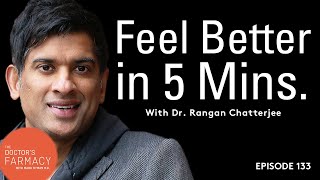
Dr. Rangan Chatterjee and Dr. Mark Hyman discuss quick habits that improve how you feel. They cover behavior change science, why small daily routines stick, and how to make health practices easy enough to actually do.
And this is what we have to do in behavior change. We have to help people feel successful. They've got to feel good. And if they feel good, they're going to continue doing things.
Welcome to the Doctor's Pharmacy. I'm Dr. Mark Hyman, and that's Pharmacy with an F, F-A-R-M-A-C-Y, a place for conversations that matter. And if you've ever tried to change your behavior and failed, around your health or anything else, this is the podcast you want to listen to because it's with my friend, an extraordinary doctor, healer, teacher, educator, inspiration for me and millions of others, Dr. Ranjan Chatterjee. I got to know him years ago before he was famous doctor. He's really one of the leading physicians in the UK focused on health and wellness and functional medicine. He's been the most listened to on podcast in the UK. His podcast, Feel Better, Live More is basically the number one podcast in the UK and Europe. His first three books have all been number one Sunday Times bestsellers. That's the London Times, I think, right?
Yeah, that's our equivalent of you guys in New York.
His latest book, Feel Better in Five, which everybody should get a copy of. It's incredible. Feel Better in Five. Five minutes is all you need to fix your health. and wellbeing. It's a smash hit in the UK. It's sold 100,000 copies in just seven months. It's been published in the United States recently. Professor BJ Fogg, who's one of the world's leading experts in human behavior, calls his book one of the best habit change programs he's ever seen, deceptively simple but remarkably effective. And I know you and I both been inspired by BJ Fogg. He's regularly on BBC news and television. He's been featured in many international publications, including the New York Times. Forbes, the Guardian, Vogue, and his TED Talk, How to Make Disease Disappear, has been viewed almost 3 million times. And, he was also the main star and host of an incredible BBC television series called Doctor in the House, which is an incredible show that highlights how if you go into people's homes and teach them the basic skills of healthy living, based on the principles of functional medicine, you can see remarkable transformations. People with diabetes, with migraine headaches, with all sorts of chronic ailments, literally disappeared using very simple principles you're going to learn about in the podcast today. So welcome, Rangan.
Rangan Thank you so much for having me back on your show.
Oh my God, it's great. You were here before, you're going to be here again. I'm sure you're one of my favorite humans. And besides all those incredible accolades, one of my favorite things about you is you're a lead singer in a rock band. And you perform all over Europe. You're like the Indian version of the Beatles or something. So I just think you're one of the best humans and such a good heart and your wife is so lovely and your kids are so sweet. And so that really matters to me. And I think you have a lot to share about how to fix our global health issues, our personal health issues. And I'm just so excited to have you on the podcast.
Well, thanks, Mark. Obviously, last time I came on your show, we were face to face in your studio. It's not possible at the moment. I was hoping to get out to America to have this conversation face to face. But the times have changed, right? So we're doing it over the internet.
It's true. And you know, it's hard during COVID to actually often deal with our personal health because of the psychological stress, the social isolation, the lack of access to things that we might have had access to before, the economic stresses that people are feeling, the uncertainty, and that often leads to maladaptive behaviors. drinking too much. I think in South Africa, they closed all the liquor stores. They didn't consider it an essential business. And also, people are eating more junk food and processed food. They're not going to the gym. They're not going to yoga. They're not exercising. So we're seeing this downturn in people's health related to COVID-19. People call it the Quarantine 15 or the COVID-19 pounds that you're gaining. and the problem with that is that we know that if you're just a little overweight, your risk of death is two and a half times that of someone who's healthy for COVID-19. If you're obese, which is 42% of Americans, and I don't know how many percent, probably 37% of people in the UK, your risk of death is 12 times. 12 times that of someone who's metabolically healthy. So we're gonna talk about the things that matter today, which is how do we stick to behaviors that are hard to stick to, whether it's healthy eating, whether it's self-care, whether it's exercise or meditation. And your book is just such an incredible treasure trove. And I'm honestly jealous. I wish I wrote this book because it's just so good and it's so full of practical tips. And I tend to get lost in 600 studies and all the data. And you know, you just have created this incredible manual for how to live better and feel better in five.
Yeah, Mark, I mean, first of all, as always, you're very kind. You give me a very warm welcome to your show and said some very kind things. But I think what you just said there really highlights why I wrote this book in the first place. So for me, I understand that there's a lot of health information out there. You've written some Fantastic books. I've written two books prior to this where I've given people a lot of information. People go on Instagram, they see a great meme and they feel inspired and go, yeah, yeah, I love it. I like that one. I'm going to press like and I'm going to give that a heart. But often inspiration is not leading to action. People read something, they like something, they think they've done something, they haven't done anything. They just like to post on social media or they bought a book But that doesn't mean they've actually done anything. So I set myself the goal of writing a book about action. How do you actually take action on your health? And I think I say it early on in the book, I say, look, if you want more of the science about this, but my recommendations, go to my first two books, or go to any of your books. The science is there. But what I really try to do, Mark, and I really seen in the UK that I think I've managed to do that given the impact it's having, given the amount of people who are finding it really useful, so I've tried to distill everything I know for almost 20 years of seeing patients, distill it all down and go, okay, if you want a book that's going to show you what to do and how to do it, I'm just going to give you exactly what you need to do. And I'm really proud of it. It may not seem like this. I mean, you've obviously written, what, gazillion books? How many books have you written now? 15? Something like that. 20?
I think 17. Yeah. Maybe 18. I don't know. I gotta look.
Yeah, you bring a lot of books, right? And it may not seem that way when you look at this one, but this was the hardest book for me to write because it's, for me, it's easier to put more information in and give you more science and give you more to try and back at what I'm saying. And I think that has a place and that has value. But I really challenge myself to go, no, only put in exactly what that person needs to know. so that they go and do the behavior. So I like you, I'm very passionate that the majority of what we're seeing as medical doctors is in some way related to our collective modern lifestyles. And I really wanted to show people how do you make behavior change in real life? Why is it that you bought 10 books before you read it, you tried it for three or four weeks, you felt great, but then over the coming months you slipped back into previous patterns. And the book came out pre-COVID-19, but in many ways it's taken on a new level of importance in these kind of unusual times in which we're living, where a lot of the things that made it easy for people to engage in good health behaviors, like, you know, going to the gym, going to yoga class, those things have been taken away from people. So in many ways, although I think this plan worked beautifully well Pre-pandemic, I think it arguably works even better in the pandemic because pretty much everything can be done from home. And again, everything in the book takes just five minutes. Now, you mentioned BJ Fogg in the introduction. You know, BJ is a good friend of yours, good friend of mine. What was interesting is this was actually a few days after I recorded the last conversation with you for my stress book.
I remember you were headed up to go to his training program.
Yeah, I had already written Feel Better in Five, but then I went to his two-day boot camp.
Before you get into that, who is BJ Fogg? Why should we be caring? And what has he contributed to the science of behavior change? And then tell us about your experience.
Yeah, so BJ, I think you could probably make a strong case for saying he's the world's leading expert in human behavior. He sort of wrote the manual on human behavior. All kinds of amazing people that people know about, Nair Rial, James Clear, the founder of Instagram, they've all studied under BJ. They've learned his principles. I think, actually, you may know this more, that Instagram was actually one of his class assignments for his students. So I think back in maybe 2007 at his class at Stanford, I think the story goes something like, guys, photo sharing is going to be really big in the future. There's apps and technology coming out that's going to make it really easy to share good photos. Can you guys create something that takes advantage of that? I think he's got the original Mark sheet that he gave to Instagram. I think he gave it a very high combination, said a very high chance of success. So this is a super influential guy. A lot of the technology we use and many people listening and watching this, Mark, on a daily basis, they will be using some of the principles and technology that BJ has studied and done the primary research on. When BJ did read my book and actually gave it such a fantastic endorsement, I was really humbled actually. And what was really remarkable, Mark, and I think you'll resonate with us as a practicing clinician, is that I figured a lot of this stuff out over 20 years of seeing patients. I figured out what works and what doesn't work. Why have I asked that patient to work out three times a week? But it comes back four weeks later saying, I've not managed to do it. and then by tweaking how I recommend these interventions to people, suddenly I see levels of success going up. And what my 20 years of clinical experience has taught me is exactly what BJ's 20 years of clinical research-- sorry, his research has taught him. And it was a real beautiful meeting of his research mind and my clinical experience, and the principles were the same. So, maybe I could give you an example of a patient as a way.
Of sort of... Before you give us that example, I just want to share something because I think that most people don't realize how little training healthcare providers and doctors get in the science of behavior change. And yet, that is all that we're about. Okay, take this medicine. 50% of people prescribe their drugs actually fill the prescription, and those who fill it, only about half of those take the medicine. And then when you look at the regular recommendations around lifestyle change is eat better, eat less, exercise more. And we tell people to do that and they come back and they fail. And it's predictable and it's completely unscientific how we're doing this as healthcare providers. And what you're doing is taking the latest science of behavior change and you're actually implementing it in a practical model for people in your book, Feel Better in Five, your daily plan to feel great for life because people are failing and you don't want them to fail. And even, you know, I see with my recommendations, they're often too much or too big or too intense. And some people will follow them if they have enough stress or enough pain or enough conditions that they're really willing to take a plunge, right? They're really on 10 medications and have diabetes and they're just like sick of being sick. They'll do something. But you're talking about for the average person, how do you actually build these daily habits. And in his book, Tiny Habits, is this really all about this strategy that you use in your book? So tell us about this patient now that we sort of set the stage because we have to sort of admit that we've failed as a profession in understanding how to actually create behavior change.
Dr. Mark, just before I tell you the patient, just to sort of follow on from what you're saying, not only do medical doctors not have enough training in lifestyle and nutrition full stop, even if we then go and learn about that, we're not learning about behavior change. So we may then know the science of Lysol and nutrition, but we don't know how to help our patients actually stick to it. Because it's not, you know, knowledge is not enough. Knowledge does not always lead to long-term action. And that's what, that's what we're seeing. This is where I think health coaches can be so valuable, because a lot of health coaches understand behavior change. They understand how do you help an individual create these new behaviors? But I think this patient that I saw, I think really illustrates this beautifully well. So I think it was about seven or eight years ago, 42 year old gentleman comes in to see me in my practice and he's struggling with a lot of the problems that many people are struggling with these days. He was a little bit overweight, he was low in energy and struggling with his mood. These are pretty common problems. I had a chat with him and at the end of the conversation, it was very clear to me that there were various aspects in his lifestyle that were contributing to the way that he was feeling. We discussed a number of options and the one he really liked was strength training. He said, Doc, strength training. I've not done that since I was a teenager. That sounds really good. I'm in. It's going to help my brain health, my mood, it's going to help me lose weight. Yeah, I want to do that. I said, okay, great, you want to do that? Grill. And then he says to me, he says, okay, so what shall I do? Should I do 40 minutes, three times a week in the gym? I said, yeah, that would be amazing. If you can do that, go fantastic. So he walks out the door, big smile on his face, feeling good about himself, feeling really motivated. And I make a follow-up appointment for four weeks time. Four weeks later, he comes back in. I call him into my room. He walks in, this time he looks different, his shoulders are stooped over, he's walking a bit slowly. I said, Hey, look, you know, how are you getting on? How's the gym? Is it making a difference? And he said, Dr. Chastin, I've not actually managed to go much yet. Work's been really busy, I've been really tired, the gym's about 25 minutes away from work. I've just not got around to it, I'm really, really sorry. And I remember, Mark, in that moment, it was a very transformative consultation for me, because in that moment, I didn't think, why has he not done what I've asked him to do? I said to myself, Rangan, listen, you're clearly not giving him advice that he feels is relevant to him in the context of his life. And so I thought, okay, I'm going to change that. I took off my jacket and I said, hey, look, I'm going to teach you right now a five minute workout where you don't need to buy any equipment, you don't need to join a gym, and you don't even need to get changed. And he looked at me bemused. I said, okay. So I taught him five bodyweight exercises and then modified them to his ability level. And I said, can you do that? He goes, I can do that. Easy. I said, okay, I'd like to see it for 5 minutes twice a week in your kitchen. And he said, what kitchen? 10 minutes a week. I said, yeah, can you do that? He goes, yeah, of course I can do that. I said, okay, I'll see you in four weeks. Four weeks later, Right? I call him in. This time he walks in chest puffed out, big smile on his face. I say, Hey, how are you getting on? He says, Doc, you know what? I started off doing it five minutes twice a week, but I love it so much and it's so easy to do, I now do it for 10 minutes every evening before I have my dinner. And so he goes from not being able to do anything to doing 70 minutes of strength training a week. And Mark, that has continued for over five years. And not only has he done that, that has led to what I write about in the book that I call a ripple effect. That change did so much for him that he now gets up in the morning, he meditates for five minutes, he goes for a walk every lunchtime, he eats better, he sleeps better. All of these ripple effects started with him being able to make a change and stick to it. And Mark, I've seen this over and over again. And I think if we really dissect that and you use the lens of behavior change science, you understand so many factors in that literally mimic BJ's research, mimic the behavior science research and how you help create successful behaviors. So rule number one, there are six rules that I write about, but rule number one is you've got to make it easy. You have to make it easy. So let's just forget about health for a minute. Let's talk about business because people will really understand this. So I'm guessing most people listen to this shop on Amazon at some point. I mean, I think if they didn't before COVID they certainly do now given that was the only shop I think opened for about three months. What do Amazon do? Right? Well, what Amazon does is very clever. About five years ago, they moved to one-click ordering. and their profits are estimated to have gone up by $300 million a year. Why would that be? Well, because in the past, Mark, and I can remember this, I'm sure you can remember this, to make a purchase, you had to go through four or five steps. You'd go to your basket, you'd then confirm it, you then have to type in your card details, confirm, place order. Every time you have to take another step and go to another screen as a reason to back out from that behavior. Right? So you didn't do it. Now, before you've even blinked, you've got something that's arriving the next morning with Amazon Prime, right? So Amazon understand that if you make something easy to do, humans do it. Netflix understand that. The reason Netflix roll one episode into the next episode is because before you've had a chance to realize, it's midnight, I need to go to bed, I've got work tomorrow morning, you're straight into the next episode, and you're like, oh, I just watched one more. YouTube do the same thing, right? I'm not having a go at these companies. These companies understand behavior change and they use it to get you to buy more or to spend longer on their platform. But when we come to human health and our own behavior, we don't do that. We think, oh, it's got to be hard. It's got to be about deprivation. It's got to be about punishment. But no, we don't apply the simple rules. So what did I do for this 42 year old chap? I made it easy. I made it so easy that he could do it in his kitchen. He didn't have to buy any equipment, so he couldn't say, oh, I don't have this equipment. He didn't even need to get changed. He does it in his work clothes when he gets home. So I made it super easy. That's rule number one. You've got to make a behavior easy. Hi everyone.
Hope you're enjoying the episode.
Before we continue, we have a quick message from Dr. Mark Hyman about his.
New company, Farmacy, and their first product, the 10-Day Reset. Hey, it's Dr. Hyman. Do you have FLC? What's FLC? It's when you feel like crap. It's a problem that so many people suffer from and often have no idea that it's not normal or that you can fix it. I mean, you know the feeling. It's when you're super sluggish, your digestion's off, you can't think clearly, or you have brain fog, or you just feel run down. Can you relate? I know most people can. But the real question is, what the heck do we do about it? Well, I hate to break the news, but there's no magic bullet. FLC isn't caused by one single thing, so there's not one single solution. However, there is a systems-based approach, a way to tackle the multiple root factors that contribute to FLC. And I call that system the 10-day reset. The 10-day reset combines food, key lifestyle habits, and targeted supplements to address FLC straight on. It's a protocol that I've used with thousands of my community members to help them get their health back on track. It's not a magic bullet, it's not a quick fix, it's a system that works. If you wanna learn more and get your health back on track, click on the button below or visit getpharmacy.com, that's getpharmacy with an F, F-A-R-M-A-C-Y.com Now back to this week's episode.
Rule number two is where do you put this habit in your life? Right, so this is, you know, any habit at all, and I know you've spoken to BJ as well, so BJ's got this, Behavior change model, that any behavior happens when motivation, ability and trigger come together at the same time. And if there's time, we can dissect it. But that last one is really important, trigger. Any behavior needs a trigger. So a trigger could be you just remember, oh, I remember I read in Mark Kiyama's book that I should meditate, right? Oh, I must meditate today. Sure, that works. It just happens to be a very unreliable form of trigger because you're reliant on your memory. the next best form of trigger is a post-it note, like a note you put on your fridge or in your laptop screen. So when you open it, you've got a prompt to actually do a certain behavior. That's better than your memory, but it's not as good as the best one, which is when you stick on your new behavior onto an existing behavior that you already do without thinking about it. Basically, you stick it on to a habit. And that's the secret, because what do I do every morning? I've not been to a gym now, I don't think, for about two years, Mark. But I work out every day. So what do I do each morning? Well, I make coffee. I like coffee. And I weigh out my coffee beans. I pour it into the, I pour the water on and it brews for four to five minutes. In those four to five minutes, I don't go on Instagram. I don't go on my emails. I do a body weight workout in my kitchen, in my pajamas. Right?
So, I'm not sure I could do that before coffee though. That's the problem. Hey, they might need a coffee.
Yes, Mark, that's a really good point, right? So this is very individual. I have figured out what works for me. That's the perfect time in the day for me to do it. So I'd like to think I'm in pretty good shape and I think five minutes of strength training every day, consistently done every single day. I don't think I missed a day in about two or three years. I honestly don't feel I missed a day because I didn't miss a day about brushing my teeth. I don't forget to brush my teeth. No, I've created a habit around brushing my teeth. I don't forget to have my morning coffee. So because I'm not forgetting to have my morning coffee, I don't need a prompt to remind me, oh, Rong, and you forgot to have coffee today. Right? No, I'm going to have that. And I suspect many people listening to.
This also have something in the morning that they want to do. Right? So, yeah, I have a similar, I have a shower that is in the top of My house, which is a barn. So it's to get from the, you know, water heater downstairs, upstairs takes like a few minutes, like five minutes. And I'm like, well, you know, I'm waiting for the shower to heat up. I take a shower most days. I'm just going to do like push ups because I really hate push ups. And it was like about 10 years ago and I started like, okay, I'm just going to do like one, like a few push ups before my shower start with 10. And now I'm like up to 50 push ups. And it's it's like I always get triggered. I'm like, oh, I'm taking a shower.
The water's heating. What am I going to do? Wait around.
And it's this perfect moment. And I think that's what you're talking about connecting it to an existing behavior.
Yeah, because you've got to remember a habit is a behavior that you're doing without thinking about it. So if you connect it to an existing behavior, you're already going to do that habit anyway. And then you need to take you're taking memory out of the equation. And again, people need to experiment with what are those habits. For me, it works around coffee. For some people, it could be when they come home from work before And I appreciate at the moment, people may not be traveling to and from work, it could be the end of the work day. When the laptop goes down, maybe that's the trigger before you then go and put the television on or before you go onto Instagram. Maybe the trigger is when your laptop goes down, let's say someone's in a conventional job and let's say at 5:00 PM it goes down, maybe then they do a five-minute yoga flow. Right? Because people think it's not enough, Mark, but here's the thing, these things add up very, very quickly. And why I like people starting small is if you start small, people will increase it of their own accord. This is what that gentleman there, that 42 year old chap I mentioned at the start of this conversation, he increased it to 10 minutes a day. And actually now he's on 15-20 minutes a day. But he did that not because I told him to do it, But because he started doing it, he starts to feel good and he thinks, Hey, I can do this. And he starts to increase it himself. Or as if when he set himself the target of 40 minutes, three times a week, he couldn't even get going in the first place. And so you've got to make it easy, stick it onto an existing habit. So if people are listening to this, I would ask them to ask themselves, when they had tried to introduce a new behavior into their life in the past, I bet that one of the reasons why it may not have turned into a habit is because they didn't follow one of those two key rules. Now, it's obviously not always the case, but by and large, I find we don't follow one of those two rules, and that's why we don't manage the states of those things. Now, in that case, I just really important part as well, I think it's important for people to understand Did you notice what I said about his body language? So when he comes back for the first time, he looks sheepish. He looks a bit ashamed of himself. He was reinforcing the identity that he already had of himself. I can't stick to health plans. I'm not a health person. I can't stick to any of these things no matter what I try. But then when I flipped it and I made it easy for him, boom, he comes back. He said, yeah, I found five minutes twice a week, really easy. So suddenly his identity starts to change. He starts to take on the identity of somebody, oh, I can stick to a health plan. Hey, Doc asked me to do 10 minutes a week. I'm now doing 10 minutes a day. I've superseded what he asked me to do. I'm a success. And this is what we have to do in behavior change. We have to help people feel successful. They've got to feel good. And if they feel good, they're going to continue doing things. But if we make them feel bad, if we shame them and say, oh, well, you've not been to the gym once. I mean, are you really going to take your health seriously? You know, that just doesn't tend to work. And Mark, I think you were very astute at the start when you mentioned, sure, some people don't need this approach. I will accept that some people are so sick and have tried so hard for so long to get better, they will do anything. Why they will literally do anything. You know, they've gone through, let's say, A health crisis, maybe they've gone through a divorce, a bereavement, some kind of significant life event. Sure, sometimes people can change overnight. But for the vast majority of us who haven't reached a pain point that's that bad yet, we need to follow these principles. And as BJ said, it sounds deceptively simple.
Yeah.
But this is where the effect is. So, Mark, you mentioned COVID related weight gain. Can I just say we're recording this in August, right? The book came out in January in the UK, right at the start of the year. And what's really incredible is that so many people have messaged me on Instagram saying, the 5 Program has helped me lose weight. I've lost two stone or three stone, I think. What is that? That's like 30, 40 pounds I've lost over the year, slow and sustainably. And what's interesting, Marcus, you could say, well, why would that be? Food doesn't play a huge part in this book, right? There's 30 or 40 five-minute health tips, and I say to people, you just got to choose three, right? One from mind, one from body, one from heart. We could talk about that a bit later if you want to.
Yeah, but one of the things that I never heard before that's so brilliant in the book that you're going to explain is this idea of health snacks. And it's not actually food. It's just these little moments of health that you insert into your day based on these principles, and you call them health snacks for your mind, body and heart.
It's just brilliant. Yeah, well, it's a bit of a play on the word snack. You know, one of them technically is a snack, but most of them are not. They are just little bite sized doses of health promoting behaviors that actually are fun. And that's the other thing I'm really trying to instill in people with this book is that health doesn't need to be about deprivation and punishment. In fact, if you don't enjoy health, you're going to struggle to make it last. A lot of these interventions, these recommendations, these health snacks, most of them are fun, they're enjoyable to do. So actually, you can have fun and be healthy at the same time. I know you know that, Mark. I know that. But many people still feel they've got a choice. I can either enjoy my life or I can be healthy, but I can't do both. But actually, it's simply not true. And the reason why this is- It's the opposite.
It's hard to enjoy your life if you're not healthy.
Exactly, which is, you know, my podcast is called Feel Better, Live More because I try and encompass that. When you feel better, you get more out of life. Everything, you get more out of your free time, your relationships, your productivity, whatever you want, you get more out of it. So, you know, you mentioned COVID related weight gain. I think it's super important just to really hammer home why could a book like this help people lose weight even though I'm not giving them a brand new diet to follow. Well, we know from the research that about 80% of people change their eating behavior in response to stress. Different research will give you different numbers, but it's about 80% from the research I've read. About 45% of us eats more in response to stress, 35% of us eat less in response to stress. So it does completely make sense then, in the time of a pandemic where many people are having their lives turned upside down, where many people feel anxious, scared, worried, nervous. It makes complete sense that many of these people are going to turn to food as a way of making them feel better and coping with that stress. So is the solution for them to be told about a different diet? Maybe, maybe not. Maybe the solution for some of them is to help them address the emotions behind their stress, which if they can bring their stress levels right down, maybe they won't seek those eating behaviors like the cookies in front of the television at 10:00 PM in the evening. Maybe they can find another way to de-stress. And that's why I'm amazed and so pleased to see that this program helps people lose weight as well. And I think it's because I've taken a real holistic approach to health. I've split health up into three areas, mind, body, and heart. And I think many of us overly focus on one area. We focus on our favorite area. and we neglect the ones that aren't our favorite. I'm human being, I do the same thing, right? So I'm not criticizing anyone. We're all humans, we're all imperfectly perfect, right? Doing the best that we can. And so I really, I remember when I was writing it, I was thinking, how do I make it really simple for people, but yet still cover 360 degree health? And I think mind, body and heart does it. Mind is about mental health. So I say choose one five minute health snack for your mental health each day. And then body is about moving the body.
Give us an example of what those health snacks for each area.
Okay, so I believe in giving people options, right? So I give people all kinds of options. So in the mind section, I think there's about 10 different health snacks. You don't have to do them all. Nobody's got time to do them all. Choose one and stick to the same one every day because that's how you create a new habit. so it could be a breathing exercise. So there's, there's, there's two really cool five minute breathing exercises in the book. One is a Zen practice called breath counting, you know, where you just simply, you sit down, you breathe in, and on your, when you're breathing out, you count number one. Breathe in on your second out breath, you count number two, just in your head. And the goal is on each out breath, up to five, you go one, two, three, four, five. then you return to one again. It's remarkable, Mark. I've done this exercise and once I got up to the number 30 before I'd realized that my mind had wandered and I was just automatically counting. So it's a really good exercise to help us train our focus and our concentration. And again, I went through a period of time where I was doing that every morning when I woke up and I found that my focus and my craving for sugar, I found actually was a lot reduced in the day when I did this, which I found really, really interesting. So that's one option people may like. For anxiety, one of the first recommendations in the book is what I call the morning download. So this is where we download all the junk and anxiety that we've accumulated in our brains overnight onto a piece of paper. This is like the practice of journaling, basically. And I've given people two options. I said, journaling, you know, when you wake up, you've often got anxieties whirring around your brain and your mind. And if you don't do anything to process them, they can stay there all day. They can impact your relationships. They can impact the way you feel about yourself and your stress levels. But simply writing them down on paper, literally and metaphorically, takes them out of your head, puts them down onto paper. And it is really transformative. And I say to people, you can write anything you want. Right? No, it's not going to be, you know, it's not the manuscript for your next book. It's not a letter to your boss. It's whatever you want to write. Now, for some people, they think that's incredible. And I remember the week after the book came out, a couple of people messaged me and they said, Doc, it's really interesting. I didn't realize I was worried about anything until I started doing this. And there was four or five really key things in my life that I was worried about. that I was writing down every day, but it was buried inside their brain. So they weren't even aware of it. So that's another one that they could do for their mind. But if that's too free form, if people prefer a bit more structure, I've created this exercise called the five step release. So these are five simple questions you ask yourself basically to help. And it's really good if you've got anxiety or you really struggle with a lot of thoughts and you can't quite focus. and it's called a five step release. So if you're interested, Mark, I can talk you through it.
Go for it.
Go for it. Okay. Yeah. So I think people find this super, super useful. So the first question is, what's one thing I'm anxious about today? So you just write down, I'm anxious about this today. What's one practical thing I could do to prevent or prepare for it? That's question number two. Question number three, what's one reason it's probably not going to be as bad as I think it is? Question number four, what's one reason I know I can probably handle it? Question number five, it's what's one upside of the situation? And I could tell you, Mark, it is so simple, but it is so effective. And I really would challenge anyone listening to this who struggles with anxiety. So pause, rewind that, write those five questions down. It's not going to cost you anything. Try it for the next few mornings when you wake up and just see how it makes you feel. Because I've seen over and over again that it makes a massive difference. So that's another option. Another option is nature, five minutes of nature in the morning or five minutes of flow. Look, in fact, let me tell you this story, Mark. I think you'll really like it. A 48-year-old lady with really bad migraines. She's busy, she's a busy mother, she's got three children, husband's in a busy job. And she was coming to see me and we tried a few things, but I really got the sense that stress was playing a big part in her migraines. And I appreciate there's all kinds of other things that one can do with diet, with magnesium, but with her, I thought, okay, stress is a big player for her. But she was an A-type personality, right? She was busy all the time rushing. I says, I don't have time for any of that. I suggested yoga once and she said she gave it a try for two weeks. She goes, oh, Dr. Jassy, yoga's not for me. I don't have time for all this. And so I was chatting with her and it turned out that she was quite into coloring books, you know, adult coloring books basically. I don't know if there's a big trend there in the US like there was in the UK, but people find it a really incredible mindful exercise of unwinding when they're coloring in. So I said, would you consider that? She goes, yeah, well what difference is that going to make? I said, okay. Why don't we give it a go? Go into it with an open mind. Anyway, we tried a few things and ultimately she said, oh, I can't stick to it. And then what we did, I said, okay, look, what does your morning look like? She goes, I get up, the kids are rushing around, I need to get them ready for school, I don't have any time for myself. I go down, I make myself a cup of tea, and I sort of try and get through the morning. I said, okay, so you're going down to make a cup of tea. Do you need a reminder for that? No, of course not. I said, do you need a notification to say, oh, make a cup of tea? He goes, no, I do it every morning. It's what I do. I said, okay, perfect. This is where we can stick on your new habit. So if you want to do coloring, why don't we stick it on there? I said, what do you mean? I said, okay, so next to your kettle, you're gonna remember it's in the UK, right? So people drink tea here as opposed.
To, I think you guys are more.
Coffee drinkers, I think. Yeah, for sure. You put the kettle on. I said, okay, so before you go to bed the night before, I want you to make sure your coloring book and your crayons are next to your kettle. I said, it's really important. Okay, fine. So this means she comes down in the morning, puts a kettle on and straight away she sees coloring book and crayons. She has a visual trigger to remind her to do the behavior. So we're making it really, really easy for her. So she makes a cup of tea, she sits on the kitchen worktop drinking the cup of tea and just for five minutes, Chaos is going on in the house with her kids, but she sits there coloring in. And I'm not kidding you, Mark, within two weeks her migraines went down by about 50%. And after six weeks they had almost gone apart from on really stressful days.
Now, that's amazing.
I'm not saying it happens in every case like that, but the point I'm trying to make is she thought she didn't have time for it. She knew she wanted to, she knew it made her feel good, But once we started applying the rules of behavior change, which most people do not apply, they think, oh, I'm going to fit it in when I've got time. No, no, no. There's a system, and if you follow the system, you're increasing your chances of success. Made it easy, stuck it onto a habit, gave her a visual trigger. Boom, she does the behavior. And it really can be that simple, Mark. So, again, for people listening who are struggling with stress, maybe that might be one that appeals to you. But if it doesn't, Don't worry, there's all kinds of options because I really believe, like you Mark, in personalized health. I don't think we should be forcing people to do things they don't want to do. Out of all those recommendations in mind, choose one. Just choose one. Right? Choose one and do it at the same time every day. That's what gives the impact. I could people with the example of a toothbrushing Mark, right? So a lot of people think, oh no, I can't do it every day, but I'll do a one hour session on a Sunday. so I say, okay, when you brush your teeth, do you brush your teeth every day? I'll try it with you, Mark. So, do you brush your teeth every day?
Yes. Morning and evening?
98% of the time. Okay, so maybe 99. 99, you do it, okay? I'm guessing you do it for two minutes roughly in the morning, two minutes roughly in the evening. Okay, so you know that if you give your dental health four minutes a day, then, you know, over the course of your lifetime, you're going to be looking after your dental health. But when it comes to everything else, we think, no, no, no, we've got to do a big one hour session twice a week or three times a week. And I'm saying, hold on a minute, is your mental health, is your physical, is your emotional health not also worth the same as your dental health? Is it not worth a little bit every day? And I find this is the approach that works for most people. Now, if someone's listening to this and they go, yeah, but I find it no problem to work out for an hour, four times a week, fine. and many people have asked me that. I said, okay, fine. So that means that you've already got that locked in. But are you also doing something for your mental health and also something for your emotional health or what I call your heart's health? And often people find this framework so useful because even if they're already doing one of them, it helps them identify their blind spots and go, like, you know, someone, in fact, the lady who helped me design the book, it's a really beautiful design. She said, Rangan, it was really incredible. I thought I was really healthy because, you know, I did Pilates regularly. I'd go for a walk every day. But I realized I neglected heart health, which is all about connection. And since she got the book, and this is eight months ago, she now every evening, she started off phoning her mother for five minutes. And now it's moved on. It's sometimes it's a mom, sometimes it's a friend, but she knows that human connection each day is critical. And she's found actually, as many people have, that actually once they get that right, they start to engage in less unhealthy behaviors. Let's say sugar, alcohol, often Mark. We engage in those behaviors because we're not getting this nourishment in our hearts. We're not connecting with people. So we're missing out. So we try and fill that hole in our hearts with another behavior, whether it's cookies, ice cream, alcohol, binge watching Netflix, going on Instagram for four hours straight. We're looking for we're yearning for that connection that we're missing. And that's why this heart health piece, I think it's the most important piece in the book. I put it at the end because.
I thought- and you don't mean your cardiovascular health, you mean your emotional heart.
Yes, it was a bit of a play on words again. So the way I talk about it, as I say, when I say heart health, I've been in, I went to Edinburgh Medical School and I was taught about the heart. I was taught that heart, the heart is a muscle, it pumps blood and oxygen around the body. Now that is true, right? That is the physical kind of function of the heart and the heart muscle. But heart's got another meaning, hasn't it? Heart's got a meaning that poets and artists and songwriters have been waxing lyrical about for years and that's what it means to be a human being. that is our hearts connecting with other people. And we know if this sounds a bit woolly for people, we've got hard science on this. There's good research now showing that the feeling of being lonely may be as harmful as maybe smoking 15 cigarettes per day, being lonely. Or if you, the feeling of being lonely means you're going to die, you're 50% more likely to die earlier, 30% more likely to have a heart attack or a stroke. Being lonely and not having that human connection is a really important part of health. And I guess in these sort of pandemic times when a lot of our social connections are being taken away from us, it's become even more important. So there are actually more health snacks in this section of the book than any other section because that's the importance I give to this section. There are gratitude games there that people can play. there are little writing exercises people can do for themselves. But I've gotta say, my favorite one, and I think you already dig this one as well, and it's one that I try, it's something that I call the tea ritual in the book. And the tea ritual is one of the five minute heart snacks for health, and it's to do with connection. So, I'm married, I've got two young kids. Now, it's very, very easy for us to be so busy, that we're like passing ships, right? Yes, we're present in the same environment. We're doing what our kids need to do. We're working. We're sort of eating together or whatever, but we haven't really spent any quality time together. So the tea ritual, and again, it's not just for couples or partners. If you have a flatmate in your apartment, it can work as well. But it's just the commitment is for five minutes a day, My wife and I will put our laptops away, our phones away, we'll make a cup of tea and the goal is that we're gonna, without any distractions, ask each other how we are. Now, Mark, some people may be thinking, you,'re a medical doctor to me. Like, why do I need to hear this stuff about relationships from you? First of all, I'd say you don't have to. It's the first thing I say. But the second thing I say is, I really feel from what I see time and time again, this lack of nourishing relationships in our life, the fact that we're so distracted now, we're not being present with the people that mean the world to us. I know that feeling, you know, I'm not perfect here. I sometimes will, you know, pre-COVID, I'd walk in sometimes, I'm still sort of trying to answer emails or get back to someone on Instagram, instead of being present with my wife and my children. It's very, very common. And I found that when we put the kids to bed and before we do anything else, Mark, we sit down in the kitchen and we make a ritual around it. It's a nice green teapot, we make some mint tea, and we sit there. The requirement is we do it for five minutes. Now, I don't at the end of five minutes say, Hey, babe, look, we're done. Five minutes. It's time to get back on my email. No, of course, sometimes the five minutes leads to 10, leads to 20, leads to 30. But the commitment we make is five minutes because why five minutes underpins this whole book is this. Five minutes is a small amount of period of time. It's a small amount. It's small enough that even the busiest person feels that they can fit it in.
And if you don't have five minutes, you got to really look at your life and what's going on.
It's long enough. It's long enough where if you do it consistently, you will experience a benefit. And I can tell you, when my wife and I do the tea ritual and we fell off at the start of lockdown, we stopped doing it and it had an impact on our relationship. And it is amazing, five minutes of dedicated connection time really knocks onto all these other areas. So again, if people are listening to this, if they're in a relationship, it could be with your children, it could be with your children. Are you inside all day with them and they're around? Great, but have you spent some real quality connection time? And Mark, I've done a few Instagram videos on the tea ritual and people love it. Yeah. I honestly think Mark, 20 years ago, you wouldn't need two medical doctors like us talking about this. I think that was inbuilt into culture two years ago. You come back from work, you don't have any more work to do till the next day, you have your dinner and then you'll connect over the evening. It's only now in the modern era where we finished it and then we're back on our computers, we're back on our emails, we're back on Instagram. And I'm not having a go at that. I'm just saying just be mindful of making time. So, yeah, I'm just trying to give people examples.
I agree. I mean, I found the same thing. My wife and I, you know, we're both busy, but, you know, I decided to have a special ritual called what's Up Below. And we have coffee in the morning. We sit down on the couch. We sit down outside and we just deeply ask of what's not on the surface of all the normal stuff, like how you doing on the service, but like what's up really below in your life? What are the things you're dealing with that make you happy, make you sad, make you cry, make you laugh? Like what is it that really is up for you? And so that what's up below, it's very much like how are you doing? And it's a coffee because it's America. But it's a very powerful tool to stay connected. and to stay connected not just on a superficial level but on a deeper level is a different form of nourishment. I mean, we need heart food, we need soul food, we need body food, we need mind food, and all these healthy snacks, these health snacks that you talk about are really so simple. It's such a simple idea. And we think health has to be such this onerous thing that we strive towards that we always fail at. It makes us feel bad about ourselves that then we sort of in this vicious loop. And your book is really, Feel Better in 5, this book is really a way for people to understand how to break that pattern, break that cycle in little incremental steps and tiny habits, as BJ Fogg calls it, that allows you to really succeed. And then, like you say, you don't just stop at five minutes talking to your wife. You might be talking to her for an hour about whatever's going on that really matters to you guys.
And it has- and you know, you can do this with kids as well. Like people often ask me, Mark, what about children? If, you know, we're not, I'm in my garage at the moment, which I just converted to a podcast studio, and you're the first person who's actually talking to me in it, so I'm very honored that it's you. But just there, I could see my kitchen on the wall next to our fridge. My wife, me, and my two kids, my son is 10, my daughter's seven, we have our own charts. We've got our own mind-body heart charts. So they have chosen their mind snack, their body snack and their heart snack and we all tick it off each day. So we have a reminder in our kitchen of us doing our daily habits. And that's something- you- get the gold stars.
So I had those when I was in kindergarten.
I love those. Yeah, but you know what? It works because the kids do it not because daddy's told them the benefits of a breath practice, which I've tried to do, but I'm not convinced that that's making the difference. No, they want their tick on their chart. Right? And that's a key part of behavior change success, is celebrating your success, right? So we don't do this. So let's flip it. Let's flip it for a second, Mark. So what do a lot of people do when they feel low or depressed? They go to chocolate, right? They eat a bar of chocolate. And what happens? They feel good. So they're wiring in the emotion, when I feel low, I have chocolate, I then feel good. That is very powerful because it's a very powerful behavior sort of loop, which is next time you feel low, oh, I could have chocolate because that's going to make me feel good for a minute. And I'm saying we do it for bad habits, we don't do it for good habits. So you want to spend a few seconds luxuriating in the feeling. Let's say you've done a workout. Right? And there are, I think there are about 10 five minute workouts in the book, none of which require equipment, none of which require gym. A lot of them are super fun. Feel good about it. Go, oh, you know what? I was feeling bad before. I've got loads of energy. Spend a minute to celebrate that success. A great way of doing it is ticking it off on a chart. That's why we have these charts on the wall. I think actually on my website, there is a mind body heart chart that people can download and print off for free. You know, if they don't want to get the book, just print off the chart, put it on your fridge, choose one mind snack, one body snack, one.
Heart snack, and each day, take it off.
And Mangan, what's the link to that chart?
I should know this stuff, but I don't.
DrChatterji.com, feel better, I think. I think it's DrChatterji.com/chart, I think, C-H-A-R-T. I think that's where we put it. But I'll send it to your team so you can have it in sort of in the show notes. But it really does work and I say it works for kids. Mark, it works great for adults as well. We like to know, we like to see a visual reminder that we are being successful. Let's say you've had a really bad week, it's been super stressful. Let's say work's been tough. You can still look at that chart and go, you know what, 21 times this week, I have done something proactive for my physical, mental and emotional health. And you know what? That feels good. It helps to balance out all the stresses that we have in life at the moment. So, you know, I know it sounds simple, this stuff works, whatever you want. And if you're if you're listening to this and actually you don't have a health problem, you just want more focus, you want to improve your athletic performance or you want to improve your longevity. What I did, Mark, because I appreciate some people like a bit more guidance. Because I do say, look, choose the ones that you want. But I realize with 40 or 55 minute recommendations, some people will get stressed out trying to choose just three. They'll go, no, I want to do that one and I want to do that one. So what I did is I created this beautiful 22 different things. 11 things you want more off, 11 things you want less off. And I have pre-chosen a combination of three for you. So if you want to take thinking out of it and you want to say, Hey, I've got anxiety. Tell me what to do. I have chosen what I consider to be the three best health snacks for anxiety. If it's depression, I've chosen for you. If it's type 2 diabetes, I've chosen for you. If it's longevity, if it's better concentration, better sleep, more energy.
It's sort of like personalized health snacks for you.
It is. Exactly. Because I don't know about you, Mark, but one of the struggles I have when writing books and I'd be interested to know what you say to this as someone who's written a lot more books than me, is I like you believe in personalization of any recommendation. Yet when you're writing a book, it's kind of, you don't have the luxury of seeing that individual in front of you so you can actually tweak it. So it's always a challenge for me is how do you allow people to make personalized choices in a sort of prescriptive book. And the way I tackle with it here was I said, you can choose, but if you don't want to choose, here are a few things to get you started. I mean, how do you approach that?
Well, I think it's just a really incremental for me. I just like to get people started on something.
And.
If people have what I call NEP syndrome, which prevents them from changing, NEP stands for not enough pain, right? So they're not motivated enough to actually create a massive change, which can create massive shifts in health, right? So I do people, put people on, for example, on a 10-day reset, literally a dramatic change in diet and lifestyle for 10 days to see how different they can feel. Because if you just do one little thing, it might take longer to see the changes happen, but it'll happen. So I think it's very personalized. I think your book is just so brilliant and the personalization. For all these different health conditions, you've literally pre-personalized all these different health snacks to have the maximum benefit for those particular issues.
It's just to try and recognize that you said everyone's different, right? Some people will love the choice. Some people go, cool, I get to choose. That doctor's not telling me what I need to do, I can choose. But some people will find the choice overwhelming and they will want, you know, they'll want a bit more guidance. So I'm trying to, you know, basically like I do in my practice, personalize it for the individual. But you mentioned the word motivation, Mark. And I wonder if I could just expand on that a second.
Yeah.
I really think motivation gets really misunderstood in the sort of context of behavior change when we're trying to improve our health. So people think motivation is enough. No, I don't think it is unless you have enough pay, as you just highlighted. You know, if things are so bad, Yeah, sure. I think motivation is enough. Certainly it can be enough for the first few weeks, the first few months. But for a lot of people, it really isn't. And then when you look at the research, it's really interesting. Motivation goes up and motivation comes down. What BJ, what Professor Thagard calls it, is the motivation wave. So it comes up, it goes down, it comes up, it goes down. The biggest mistake people make is that a lot of people make that their New Year's resolutions or their health plan at the peak of the motivation wave. They're assuming that they're gonna be super motivated. Yeah, I'm gonna go to the gym five times a week. I'm gonna meditate for half an hour a day. I'm gonna go for a walk every lunchtime. Sure. And for a week or two when they're feeling that motivation, they do it and they feel great. But then what happens is that life gets in the way. They've had a bad week at work or they've gotta take their kids somewhere. and their back away, and it all falls off. So they go from everything to nothing. But when you understand that motivation goes up and down, if you make your plan, your health plan or your resolution, if you plan for it at the bottom of the motivation way, then it means you're always going to do it. And this is why five minutes is so important, because motivation and ability to do something are sort of they work to together, right? So if you're really motivated to do something, you will actually do a behavior that's very hard to do, right? You will. If you have that, you've seen that over and over again in your clinic, just as I have, if people are really, really struggling, they're very motivated, they will do hard things. But when your motivation is low, you will not do a behavior unless it's easy to do. and that's why that sort of underpins this whole program is it's easy. So even when you're tired and stressed, you can still do it. As I say, all the five minute workouts, they can be done in your own clothes. You do not need to get changed. If you want to get changed, sure. But remember, I do my five minute workout in my pajamas every morning. I don't get changed into gym gear. Right? Now, some people like getting changed into gym gear and that makes them feel good. that is completely fine. But I'm saying don't let that be an obstacle. Here in the UK, Mark, there's a sports wear company called Sweaty Betty for women. And I've met a couple of patients before who, unless they have the latest outfit from Sweaty Betty, they wouldn't work out. It was their excuse not to work out. And look, I'm not, I'm sort of very, compassion and understanding when I hear that, because people, I think, have been conditioned by society to think we have to look a certain way when we work out. And I tell you, I had this, one of my podcasts, I spoke to a guy called Sanjay Rawal about running, and we were chatting about these tribes, these hunter-gatherer tribes who run, who run every day. I love Sanjay, by the way.
He's a good friend. He's brilliant, isn't he?
It's absolutely amazing. I think it's one of the most listened to on my show so far because it was so, he so incredible. We had a really lovely conversation. What was really striking is that these running tribes, they don't have one outfit for living and one outfit for running and one outfit for working out. No, they've got the clothes that they wear and if they're living, they're living. If they're running, they're running, but they wear the same thing. And it just made me think, how far removed are we from a basic human right, which is to move our bodies each that we think we can only do it when we have the right, you know, sweat removing t-shirt and the right shorts and the right shoes.
I mean, yoga clothes and running clothes and weightlifting clothes and tennis clothes and biking clothes. And again, I can't- Different shoes for each one.
Yeah, if you like them and you have them, that is great. But what I'm saying is, Don't let that be an excuse. You can work out. Everybody listening to this can do a workout in what they are wearing right now. And you know, the simplest workout in my book is what I call Five Minutes of Dancing, right? So a lot of people think working out or moving their body is not for them. Okay? So most people like to dance, especially if people aren't watching them, right? So if people are at home, And if you want to get moving but you don't know where to start, I challenge you, go into your kitchen or your living room or your bedroom, put on one of your favorite tunes for five minutes and have a little boogie. That is movement, that counts, right? It doesn't have a special name, it doesn't have a special class you need to go to or spend money on, but you know what? You'll be releasing endorphins, you'll be improving hormone release all over your body, you'll be burning off energy, your mood will be elevated. And if someone's feeling sad, put an upbeat tune on and dance to it. It is almost impossible to feel low and anxious when you're dancing to an upbeat tune. You simply can't do it.
My favorite one for that is Happy by Pharrell Williams.
I just love that song. Yeah, exactly. And so again, how do you do it? Make sure on your phone, if that's where you listen, or if you have I'm a bit old school, I still got a CD player in my kitchen. That's what I like. But make sure you've got tunes ready on hand when you're feeling down or you think, oh, I'm going to do my five minutes of dancing now. Here is my playlist. What you don't want to do, and it's the same with workouts, you don't want to go, okay, it's workout time now or it's dancing time. Which tune am I going to choose today? Because then what you have is you can spend 20 minutes scrolling, going, oh, no, I'm not sure I danced that one yesterday. Oh, no. Before you know it, the time's gone, you haven't done anything. Or by the time you've worked out whether you want to do yoga or Pilates or strength training, you know what? That procrastination takes time and energy. That's why I say when you're starting this plan, choose the workout you like and do it every day, the same one. Because it's, you don't, for example, brush your teeth one day, Mark, right? You don't on a Monday go, oh, I brushed my teeth today. And then on Tuesday go, Hey, I brushed my teeth yesterday. So, I tell you what, today I'm not gonna brush them, I'm just gonna floss them. And on a Wednesday, you go, I brushed, I flossed. Today I'm just gonna rinse. The reason it's a habit is because you've done the same thing every day at the same time, and you can absolutely do that with health. And Mark, I know for some people this is a new way of looking at things. They've been conditioned into thinking, It's got to be hard. It's got to be difficult. And if you're listening to Mark's podcast and you listen each week to all your amazing guests and you have implemented health changes and you're doing great with your health, fine. I'm not asking you to change anything. I'm not saying go to this five minute plan. If you've already got something working, that's great. But there's many people who will be listening who have tried over and over again. and it's these people really that I wrote the book for to say, you know what? Health is not as hard as you think it is. Health can be fun. Health can be enjoyable. Health can be something that helps you to get more out of your life. And actually beyond that, this plan will help you change the identity of who you are as a human being. When you start sticking to these three health hacks a day, you take on the identity of someone who prioritizes their own health, who takes their self-esteem and their self-worth seriously, and that will impact your health, but it will also impact your relationships. It will impact, you know, your interactions with your work colleagues, it will impact how you parent your children. And all I'm asking people is five minutes, three times a day, that's 15 minutes a day, is all I'm asking. And I say at the back and frequently asked questions, I say if Three house hacks a day is too much. You know what? Fine. Start with one. Right? Start with one, but do it every day at the same time. Yeah. And that's the key. That's how you build a habit. And you can think it's too easy. You can ignore it. You can go for that one hour, four times a week. And if that works for you, great. I am really, really pleased for you, I promise. But if it doesn't, I honestly would urge you to give this a go.
So Ryan, this has just been so brilliant. And it's It's broken down some of the challenges that people have around behavior change and around sustainable behavior change and about figuring how to motivate themselves and also addresses the myth of willpower because willpower is not something that actually works most of the time. You can white knuckle it for a little bit, but you have to actually make these things part of you on a daily basis. And this marriage of medicine and behavior science and the science of how to create health with the science of how to create healthy behaviors is just brilliant. I've never seen it. put together in such a beautiful, simple way, as in your book, Feel Better in Five, your Daily Plan to Feel Great for Life. It's just a tremendous book. I think everybody needs to pick up a copy today. And before we close, I'd love to ask you, what are your health snacks every day? And how do you implement this to support your own health and well-being?
Yes, Mark, that's a great question. So, I've got the foundation sort of built into my life now. So I do now mix and match a little bit, but I can only do that because I stuck to the same thing at the same time every day for a prolonged period of time. So what do I normally do, right? So I will do my mind snack first thing in the morning. So I would start off and I did this for a good year or so. For me, it was a breath practice. So I would start every morning before I did anything, before I made my coffee, I would do five minutes of breath counting, and I found it a really wonderfully relaxing way to start the day. Then I would go into the kitchen, I would make my coffee, and during those four or five minutes while it was brewing, I would do a workout. So I initially was doing body weights, but I actually do also keep some dumbbells in my kitchen, so I will mix and match that, but essentially, until the beeper goes off for me to plunge my coffee, I am working out. Now, here's the truth, Mark. Sometimes the beeper goes off, I plunge the coffee, and before I drink it, I'll do a few more. So often it'll be 10 minutes. That's the truth. But then I get to then sit, drink my coffee. I normally read something positive there just to make me feel good for the day and really enjoy and take that moment. But then in terms of the heart health snack, I actually do two a day. Okay, I do two a day now. And what is the tea ritual that I mentioned? So that's when the kids are in bed, my wife and I will sit there for five minutes and we all connect for at least five minutes. Although we fell off it a little bit during lockdown, that wasn't failure, Mark. That was a reminder that, oh, when we don't do this, our relationship isn't as close as it is when we do it. So again, reframe these things. That wasn't failure, that was education. That was like, oh, This is important. We need to get back to that. But the other thing I do is a gratitude game. And I don't need to find time to do this, Mark, particularly over lockdown, because I'm having my meals every evening with my wife and my two kids. So over dinner, we play a gratitude game. We all go around answering three questions. What have I done to make somebody else happy today? What has somebody else done today to make me happy? What have I learned today? And, you know, it's a beautiful game. It helps connect you with the people around you. It helps you feel good because you're reflecting on the positives. But again, Mark, just to hammer home the same point about behavior change, because it's part of our evening meal, I don't need to find time in my day to do my gratitude. No, I have dinner every evening with my family. Right? I don't need a reminder to say, Rangan, look, you've forgotten to have dinner. You've got to have dinner tonight. No, I'm having dinner. So that is now one of our heart health snacks is one we do as a family. That's beautiful. I really hope by sharing that, Mark, I'm not saying people have to do the same one, but I like humor. I'm a busy guy. I've got lots of juggling balls, whether it's weekly podcasts, seeing patients, writing books, caring for my elderly mother who lives nearby, whatever it is. I'm like many people, super busy, but I do prioritize my health. And Mark, I will also say, and I know this because I was a carer for many years before my father passed away seven years ago. Why I moved back to the northwest of England is to help my mum look after him. He had lupus, kidney failure, he was on dialysis. I know that there will be many carers listening to this Mark who will say, I don't have time for myself. I'm caring for someone else. I'm looking after someone. And I really hope, and I have seen this in the UK, that many carers have found this really helpful for them because they're like, oh, I couldn't do that actually. I can do that. Having been a carer and still for my mum, I am now again, I really want to give that message of hope to carers that you can afford a better time each day to look after yourself. Not only will you be helping your own well-being, but it will help you look after whoever you're looking after.
Yeah.
In a more relaxed, stress-free way.
I mean, the beautiful message of your podcast and your books is this whole idea that if you feel better, you can live more. You can be more engaged in the things that matter to you, in the relationships that you care about, in the work and your purpose in the world and your own well-being. And it's such a simple idea, but it's so powerful. And I think that we neglect ourselves in the service of our greater missions. or other people or whatever excuses we have. But in your book, Feel Better in 5, you've created literally hundreds of ideas for people for these health snacks for mind, body, and heart. And there are thousands more that people can create that aren't even in the book. But the whole idea is how do you design your life for success? And you're saying basically it's not by saying, I'm going to run an Ironman marathon next month. It's by doing five minutes three times a day for mind, body and heart. It's such a simple, beautiful message. I'm just so honored, Rangan, that you came on our podcast, that you shared this incredible idea, which is a real breakthrough in medicine, I think, that needs to be implemented across healthcare. It's all in your book, Feel Better in Five, which people can get everywhere. They get their books on Amazon. You can go to the website for the book. It's called called Dr. Chatterjee. That's D-R-C-H-A-T-T-E-R-J-E.com, feel-better-in-5.com, Feel Better Live More podcast, which is fabulous everywhere you find your podcasts. Thank you for your incredible service and work in bringing these ideas to humanity and being such a good human being in the process. So, grateful to know you and be part of helping you share their story about making these incremental changes that make all the difference. Thank you so much, Mark.
Thanks for having me. Thank you so much, everybody.
If you loved listening to this, please share your thoughts and comments. Tell us how you've made those little incremental changes that have changed your life. We'd love to learn from everybody. Share this with your friends and family on social media. Subscribe wherever you get your podcasts. And we'll see you see you next time on the Doctor's Pharmacy.
More from AI




This Is Why 99% of Skin Conditions Don't Heal — And What Dermatologists Won't Tell You






Why you need to start strength training today #strengthtraining #healthyaging #fitness
