The Harmful Effects Of Glyphosate, The Most Common Agrochemical
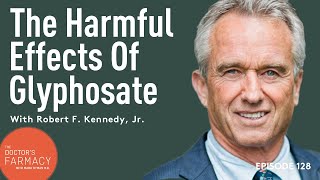
Dr. Mark Hyman talks with Robert F. Kennedy Jr. about glyphosate, the herbicide in Roundup, and its health and environmental effects. They cover Monsanto lawsuits, how the chemical got approved despite safety concerns, and the corporate influence shaping pesticide regulation.
You can't sue the producer of a toxic chemical until science on that chemical and that particular association and the particular harm reaches a certain threshold.
Welcome to the Doctor's Pharmacy. I'm Dr. Mark Hyman and that's Pharmacy with an F, a place for conversations that matter. And if you're concerned about chemicals in our food, particularly glyphosate or weed killer called Roundup, which is on 70% of our food and has been linked to cancer and microbiome issues and lots more health concerns, then this podcast is going to matter to you because it's with my friend and activist lawyer Robert F. Kennedy Jr. Who's an extraordinary guy. We've known each other for many years. We've traveled the world together. We've kayaked and rafted in Peru, in Chile, we've gone through many adventures, near-death experiences, and it's just been a pleasure knowing Bobby because not only has he an activist leader, environmentalist, but he's also a heck of a lot of fun. So Bobby serves as the president of Waterkeeper Alliance. He's the chairman of the board and chief legal counsel for the Children's Health Defense and of counsel to Morgan & Morgan, which is a nationwide personal injury practice. He was the chief prosecuting attorney for Hudson Riverkeeper. And when he was involved with the Hudson Riverkeepers, he helped hold General Electric accountable and had over a billion dollar settlement to make them clean up the Hudson River from all the PCBs they dumped in there. He's a defender of the environment and children's health and he's had many, many successful legal actions. He was named one of Time Magazine's heroes for the planet for his success in helping Riverkeeper lead the fight to restore Hudson River. This group's achievement has helped spawn 300 waterkeeper organizations around the globe. He also was a co-host of Ring of Fire on Air America Radio. I was on that show once. He served as a distant district attorney in New York City. He's worked on environmental issues across America and has helped many indigenous tribes in Latin America and Canada negotiate treaties protecting traditional homelands. He's credited with leading the fight to protect New York City's water supply and has done so much good in the world. He wrote a number of great best-selling books, including Crimes Against Nature. He went to Harvard Law School. He graduated from the London School of Economics and got his law degree from the University of Virginia Law School. and is just an extraordinary man. Welcome to the Doctor's Pharmacy, Bobby.
Thank you, Mark.
Thanks for having me. Okay, so I want to just sort of give people a little bit of a background on glyphosate, 'cause I recently wrote my book, Food Fix, which talks a lot about the farm system, what's wrong with it, and glyphosate is really at the center of that conversation, 'cause it is a weed killer that's used on farms to prevent weeds growth, particularly around GMO soy crops and many other crops. It's incredible blockbuster chemical from agriculture. It's been used all over the world. In fact, according to the EPA, 220 million pounds of Roundup, which is glyphosate, were used just in 2015. In California alone, there's more than 10 million pounds used every year. It's the world's most commonly used herbicide. It accounts for 72% of all pesticides and agricultural chemicals around the world. And since 1974, we've put on 1.6 billion kilograms more than 3.5 billion pounds on crops in the United States alone. It's on 70 different food crops including corn, soy, canola, wheat. So if you eat a slice of bread, a bowl of Cheerios, a sushi roll, a plate of pasta, slice of pizza, chicken nugget, there's a good chance one or more of its ingredients was doused in Roundup or weed killer before it left the farm. In fact, Cheerios have more glyphosate per serving than vitamin D and vitamin B12, which are added to enrich the cereal. It's even been in commercial honey. So it's a big problem. It's linked to cancer. listening to all these health issues. So, Bobby, take us back to the origins of glyphosate and how it's become such a prevalent chemical and why it's so bad for us.
Well, you mentioned the Hudson River in my work on the Hudson River and my first case on the Hudson was getting, as you said, General Electric's PCBs at the Hudson. The manufacturer of those PCBs was Monsanto. And I told, and I've had so many cases against Monsanto over the years. I told Mike Papantonio, who did the radio show with me and who was my law partner for many years, some really, really big cases, including the dark, the case that Mark Ruffalo just made the movie about, Dark Water, which Pap and I represented about 4,000 people and a team of attorneys. who had been poisoned by C8, which is the active ingredient for Teflon, which DuPont had discharged from his plant in Parkersburg, West Virginia, and poisoned the entire community, knew it, and kept it a secret from everybody. But anyway, I told Pat at one point, because we were talking about all my different involvements with Monsanto, and I said, if my life were A Superman comic, Monsanto would be Lex Luthor. I feel like I've been struggling against that my whole life. And my first consciousness of Monsanto was when I was a little boy because I met Rachel Carson when I was a kid. You did. And she came to my house.
For those who don't know, who was Rachel Carson?
Rachel Carson was probably the Most people would say she was the central figure in the environmental movement as the kind of founder of modern environmentalism. She wrote a book, she was an extraordinary woman, she was a brilliant marine biologist, she wrote a whole series of New York Times bestsellers that broke, every one of them broke records for the length of time on the New York Times bestseller list. It was not only a very gifted marine biologist, and interestingly she was from I think, reading Pennsylvania. And she never saw the ocean until she was 22 years old. But she was 180 IQ and she was a brilliant writer and a brilliant communicator and had this gift of empathy for all creatures.
She wrote Silent Spring, which was sort.
Of the... And she wrote Silent Spring and Silent Spring was a really important book because Up until she wrote that book, nobody did not believe that the chemical industry was what it pretended to be, which was this huge boon to American prosperity. Better living, better chemistry, right? Better living. It had helped us win the war against fascism, and now it was going to help us, it was going to allow us to win the war against the insects and create free food, abundant food for everybody. She wrote a book that for the first time disclosed Americans in very, very clear language with very well-sourced science. The price we were paying for that temporary cheap food solution was actually imposing enormous costs that if we had known about them, we would have never taken the deal, not only to human health, the term Silent Spring indicated that it was going to eliminate the birds and the insects and things that a lot of people didn't think that we really cared about that much. But she showed us why we should care about it. And in fact, it was a very prescient book about 90% of birds, songbirds in America have disappeared since she wrote that book. 90%. Since she wrote that book, We're living in a very different world today than I grew up in and then you grew up in. She was attacked viciously by Monsanto and a lot of people, you know, looked at what Monsanto did during the Roundup cases, which I was just on that legal team and they said that they, Monsanto took the blueprint from the tobacco industry, but Monsanto really was the company that created that that blueprint or how do you quash dissent against your product? And the tobacco industry did it very masterfully for 60 years by manipulating science and creating doubt and they were able to escape any regulation of a product that was killing one out of every four of its customers who used that product as directed.
Cigarettes.
Monsanto really was the mastermind for that, those techniques. And they hired Hill and Knowlton and Edelman, and they, you know, they created these PR firms that really, from the ground up, went out to lie to the public to hire these phony scientists. We call them biostitutes.
Ha, biostitutes. That's good.
You know, to generate tobacco science, junk science, just to sow doubt.
Yeah, that's what the industry does too.
And that was their, you know, that was their strategy. But when Rachel Carson published this book and it was published in Cereal Farm and the New Yorker magazine, and then it went on to, you know, then the book was consolidated and I think it was, it stayed for many, many months on the bestseller list. I believe, I remember 62 weeks or something that it was number one on the bestseller list. And that could be wrong, but I think that that's right. They mounted a very, very concerted and deliberative attack against her. They sent these white-coated lab scientists, medical doctors, every community in the country to lecture about the benefits of pesticides and how Rachel Carson was crazy. And they went out and they found third party front groups with integrity, institutions in our society who would secretly co-opt with payoffs, et cetera, then go out and act on their behalf without their fingerprints on it. And they got the American Medical Association. to condemn Rachel Carson. They got Time magazine, Life magazine, Sports Illustrated, the American Garden Clubs, all of them to attack Carson. And if you read the contemporary critiques of her at that time, they almost all use the same language and they often attack her very personally. You'll read that she's a spinster, which was the modern, you know, the contemporary euphemism for lesbian.
Oh, no.
So they're really trying to discredit her, and she never defended herself. She was dying of cancer at the time. But I'm very proud that my uncle, President Kennedy, stepped in and he defied his own USDA, his Department of Agriculture, which had already been captured. It was a captured agency, was bought and owned by Monsanto. Even at that early date, the food industry owned the USDA. and you know that's a huge problem.
It is.
Yeah. And they were attacking her and he had to go against them. He created an independent, he got Jerome Whisner, who was his chief science advisor, to put together a panel of scientists with impeccable credentials to go through every important, relevant material assertion in her book. and to validate the science. And they came back and they absolutely vindicated Carson. But at the time that I met her, when she visited Hickory Hill, she was under attack. President Kennedy's vindication of her ended up being an important part in planting the seeds for Earth Day, which happened seven years later. first earth and the passage of Fife for the federal insecticide fungicide and rodenticide act in 1973 in the ban that year of DDT. So DDT had wiped out a Peregrine Falcon, which had gone extinct on the East Coast, and of course it was causing health impacts that people didn't know how to assess or evaluate.
Yeah, on humans.
Right, and Monsanto, it was a flagship product from Monsanto. The loss of that product was the biggest pesticide in the world at that time, was something that they had to quickly repair. They found at that time a tank scalant, which is a chemical that was used to remove metals and accretions of calcium and other compounds from the inside of metal tanks. That was glyphosate, and that's why it had been developed. But at some point in glyphosate's history, Somebody had thrown a bucket of it out in the lawn and noticed that it killed everything. And Monsanto took a look at that and said, we can make an herbicide of that. During the first decade of its use, it was a conventional herbicide. Farm workers would strap a tank of glyphosate onto their backs and they would go through the corn fields.
Yeah.
In the early days, right after the planting, when the weeds were at the same side, were competing with the corn, saplings, and they would spray the weeds and kill the weeds to give the corn time to grow high enough so the weeds could no longer compete. The spraying took place very, very early in the season before there was any food on that plant. And then in 2000 or in 1994, Monsanto or glyphosate was not a particularly noteworthy herbicide at that time. It had many, many competitors in the marketplace. And something changed in 1994, which was that Monsanto introduced Roundup Ready corn. And what had happened is they were dumping glyphosate or the Roundup out in the grass. At one point, they noticed that there was a weed that was not being killed. And they said, that wheat is immune to glyphosate. Let's take a gene out of that wheat and put it in corn and make the corn immune to glyphosate. And that was really the first big GMO crop. And now you could fire all those farm workers and you could fly an airplane spraying pesticides and saturate the entire landscape with just one guy. And everything would die except for the Roundup Ready corn. And it changed the face of agriculture across the planet. Within a few years, most of the corn was Roundup Ready corn. Virtually all corn grown today is 95-98% of it is Roundup Ready corn. It's Roundup, it's Monsanto's corn.
Yeah, they sell the seeds and they sell the herbicides. It's a closed circuit.
It's a closed circuit. And they also implant in the, they've done other genetic manipulations that creates a plant that reflects the sunlight, certain spectrums of light. You can actually fly a plane over the cornfields with a special camera, which is what Monsanto does. they can photograph it, and they can know from the air which are Roundup Ready corn and which corn is a natural corn. And they have a list of all the people who have paid for their corn. If you're a farmer and you happen to have their crop on your property and you haven't paid for it, then they sue you. That's one of the things that makes them very notorious. Those lawsuits against individual farmers, a lot of times they've got Roundup corn on their property because of drift. Because, you know, the corn drifted onto their property, but it's not what they bought.
Wait, wait, just to recap that, that's important. So basically what happens because of wind, there's a farmer who has regular natural corn and a farmer who has Roundup Ready corn, and it drifts over to their farm and it starts growing.
And then Monsanto sues them because they're growing their. There are seeds that become pollinated. They're patented seeds. Right, by the patented seeds have fertilized the seeds, the natural seeds, the heritage, you know, corn of the farmer. So the next year, he's got to round up ready corn or a large part of it on his property and then they sue him and make him pay for it.
Wow.
So.
Not only are they poisoning farmers, they're trying to make a profit.
And then, and then something happened in 2006. Between 1994 and 2006, Roundup Ready corn, GMO corn, and they developed soy and sorghum and, you know, everything was Roundup Ready. Yeah, everything except for wheat. And then in 2006, they discovered that Roundup was a desiccant. So that, and what that means is if you spray it on a crop, it will actually dry out the crop. And one of the big enemies of the farmer is that if there's rain around the time of harvest, their crops can get wet and then they get moldy and then it ruins the entire silo. Yeah. And so what What Monsanto did is they began telling farmers, Spray this on the crop, on your wheat, right before harvest or at the time of harvest. And it was so popular that about 85% of the Roundup that has been used in history has been used since 2006. A large part of that is, as it does again, and what that meant, Mark, is for the first time they're spraying it on food.
Yeah.
Right at harvest. Yeah. And for the first time, not early.
In the season when it may have a chance to wash off, but actually just before you're going to eat it.
Right. And they're spraying it for the first time on wheat because there was no such thing as Roundup Ready wheat. Yeah. They started spraying it on wheat as a desicant. And so 2006 marks the day when suddenly these gluten allergies began exploding. Celiac disease and all these kind of wheat problems that we started seeing in this country. If you measure back and say, when did it start? You can look and draw a red line. It's 2006, and it's the year that they began spraying it on wheat. What happened is after we'll get into.
Why that is in a minute. We'll get into why that is in a minute. We can explain the the mechanism. So.
In order to bring, and we know that Roundup is associated with all kinds of illnesses, right? With gluten allergies, with celiac disease, definitely with non-alcoholic fatty liver cancer, with colon cancers, with kidney cancers, and with many, many other problems. But you can't sue somebody. You can't sue the producer of a toxic chemical until science on that chemical and that particular association and the particular harm reaches a certain threshold. That's called Daubert. Federal rule and most of the states have rules that follow Daubert. And what Daubert says is, The purpose of Dalbert is they don't want somebody coming in and going to a jury and saying, that this perfume made me insane.
Right, right, right, right.
Because they want to make sure that there's enough science that you can't just bring a weird theory or a marginal theory.
It's a level of evidence to the.
Jury and have the jury decide on that. So the judge has to say.
The.
Science on this is actually mainstream enough, it has passed the threshold that I'm going to allow you to explain this to the jury. And so we couldn't sue on Santa, even though we all knew it's causing all these problems, we couldn't sue them on it. Until 2015, in 2015, the IARC, which is the International Agency for Research on Cancer, and just stop for a second and tell you who IARC is. IARC is an agency back in, I think it was the 70s, people realized that a lot of things were carcinogenic, that were increasing your risk of cancer, and different countries were regulating them all differently. and they were regulating them different substances and different compounds and different elements, and they were regulating them with varying degrees of good science. So the major Western countries said, you know, none of us really has the capacity to round up all the science in the world and the best scientists and figure out what's carcinogenic and what isn't. So let's create all of us together.
And that's part of the WHO, is that right?
Yeah. And we'll create an agency and they ended up headquartering it in France. And every year it looks at certain associations, certain vectors. For example, it might look at coffee one year, might look at cell phones one year, might look at PCBs or whatever, or tetrachloroethylene or polyaromatic hydrocarbons or any compound. And it will bring in the best scientists in the world in that area from every country in the world. And it will assemble all of the literature on that association. It will have them read all of that literature. There may be thousands of studies and then make a determination about whether it's a definite carcinogen, where it's a probable carcinogen, a possible carcinogen in both or not a carcinogen in both animals and human beings. It looks at the animal studies separately, the animal studies, the mechanistic studies like petri dishes, et cetera. Mark will say that's a probable carcinogen. And that happened in 2015.
For glyphosate.
For glyphosate, but with only one association with which was an unHodgkin's fumA. Even though we have a pretty good idea it's causing many, many, many, many, many other problems. And there's really strong science on those other problems. None of them had hit the threshold where we could take it to a jury. And just because IARC says it is not enough. The judge has to make an independent determination. Now, even though, you know, the agencies all over the world, take what IARC says as gospel, for example, in California there's a law called Prop 65, which says that anything that's carcinogenic has to be labeled as such at the place where you purchase it. And the way they determine what is carcinogenic, what isn't, is what IARC says. So if IARC says something's a probable carcinogen, it has to be labeled in California. And there are at least 10 nations and probably 50 jurisdictions around the world that do the same thing that say whatever IARC says, you know, that just goes with the law.
They just go with the law.
Yeah. And, but still, the judges in this country are not allowed to say whatever IARC says passes to Albert. They have to make an independent determination.
Hi everyone. Hope you're enjoying the episode. Before we continue, we have a quick message from Dr. Mark Hyman about his new company, Farmacy, and their first product, the 10-Day Reset. Hey, it's Dr. Hyman. Do you have FLC? What's FLC? It's when you feel like crap. It's a problem that so many people suffer from and often have no idea that it's not normal or that you can fix it. I mean, you know the feeling. It's when you're super sluggish, your digestion's off, you can't think clearly, or you have brain fog or you just feel run down. Can you relate? I know most people can. But the real question is, what the heck do we do about it? Well, I hate to break the news, but there's no magic bullet. FLC isn't caused by one single thing, so there's not one single solution. However, there is a systems-based approach, a way to tackle the multiple root factors that contribute to FLC. And I call that system the 10-day reset. The 10-day reset combines food, Key lifestyle habits and targeted supplements to address FLC straight on. It's a protocol that I've used with thousands of my community members to help them get their health back on track. It's not a magic bullet. It's not a quick fix. It's a system that works. If you want to learn more and get your health back on track, click on the button below or visit getpharmacy.com that's getpharmacy with an F, F-A-R-M-A-C-Y.com Now.
Back to this week's episode. Once we got that decision from IARC, A couple of firms, you know, mainly Bob Hedlund, here in Los Angeles, another firm called the Miller Firm in Virginia, and Morgan and Morgan and Weiss, Luxenberg filed suits and they began collecting cases and advertising for them. And so two years ago we had about 14,000 cases at six firms. It's massive. Tom Hedlund had about 1400 and we filed on a lot of suits.
Now were these all individuals who had glyphosate exposure and non-Hodgkin's lymphoma or other things?
Only for non-Hodgkin's lymphoma. They had to have non-Hodgkin's lymphoma and they had to have a strong evidence that it was that they had a long-term exposure. It took life of say And then we chose our first, I mean this is actually a very cool story. If you want to hear it, the first case, you know when you bring these cases, they're called mass tort litigation. It's not a class action suit. Each case is treated differently separately and you try each one individually.
So there would be 14,000 different trials.
But what happens in practice? is after you have tried out six or eight of those cases, everybody kind of knows what the case is worth. And the company will then come and settle because having all those outside cases, it creates so much uncertainty. What is that?
And it is a huge impact because Bear Stock, which bought Monsanto, not a very good idea.
Well, let me tell you what happened. We brought this case and it is kind of an interesting story because At the beginning, the six firms were all working together and we had to decide strategically where should we bring the first case and which case should we bring? What's the best case to get a good judgment? And there's another complication because the firm that wins that contest is the firm that gets the biggest payoff from that case, 'cause he owns the case. We're all gonna work on it. But Mike Miller's firm kind of won the contest. He had sharp elbows and he had a really good argument that Dwayne Johnson's case was a really important case.
And Dwayne Johnson was the first case that was tried, we're glad to say.
It was like a two- Dwayne Johnson was an African-American high school groundskeeper. and part of his job had been spraying glyphosate on the, you know, to control vegetation around the school. As it turned out, he had a backpack dispenser, a tank that was leaking all the time, and sometimes it would cover his whole body. It would kind of explode and he would be covered with glyphosate, but he wasn't worried about it because it said on the label that it's safe as and it had a picture of a guy spraying it with no protective gear.
Well, Aspirin kills about 40,000 people a year. So maybe he's right.
And he got worried because non Hodgkin's lymphoma is like autoimmune disease. It can attack any organ in your body. It can attack his skin. And his skin, he would discover it was fatal. and he hasn't died yet, but he was, even when we brought the cases, doctors were saying he had three months to live. His body was covered with, he was really, he was a very, very handsome man and he had a very happy marriage and wonderful wife and wonderful kids and his body was covered with postulating lesions. He couldn't, he loved swimming, but he could no longer swim because he would It grossed other people out, you know, who were using a swimming pool. So it really destroyed his life in so many ways and took his life or was, you know, his destiny to take his life. And he was a very good plaintiff and had, you know, the exposure was very clear. Mike Miller was supposed to bring the case. He's a Virginia law firm. But about two weeks before we were going to bring the case to trial, Mike Miller, who's my age, 66, was injured in a kite surfing accident in Cape Hatteras. He rigged the kite wrong upside down and it lifted him up and slammed him against the pier and it broke his back, broke a lot of ribs. And he called us from the hospital and said, you know, we're gonna go forward with the case, but you guys are your firm with this bomb headland needs to step up and take a bigger responsibility because you know, he couldn't be there. And he assigned his partner, Tim Litzensberg, to lead the case. And about a week later, we were on the phone with our firm, was on the phone, or Bob Hedlund was on the phone with Tim Litzensberg, and he had a grand mal seizure while he was on the phone strategizing about the case. And it turned out that Bob Hedlund really had to take the lead in the case. I think it was a lucky thing because it was a kid, a bombheadliner who had been working on this case for two years named Brent Wisner. And he's a brilliant attorney. He looks kind of like Jonah Hill. And he has just a genius mind and an extraordinary capacity to communicate with a jury. He is unflappable. Total command over the science and.
A.
Very, very unusual ability to be able.
To.
Translate very complex scientific concepts to people who may not even have a high school education.
Yeah, could get.
And the first case we had was in San Francisco. We had that trial and he asked the jury in the end for 300 million. We were saying, Brent, you can't ask them for that much. Because, you know, that's a big strategic consideration at the end of a trial.
Yeah.
How much you ask? Because if you ask too much, the jury will, it's some act of overreaching and the jury may punish you.
Right.
And he said, I'm gonna ask for 300 million. He asked for it. They gave him 289 million. It was a very highly educated jury. We had a couple working scientists on that jury and others who are very, you know, all college educated, many advanced degrees. We did the next trial, Amy Wagstaff tried the next trial in federal court in San Francisco and we expected that we could lose that case. We had a judge who was very hostile to her and we couldn't read the jury very well. We won $89 million in that. That was two and a half months later. The third trial we tried in Oakland and at the end of that trial, Brent, we had that meeting the night before the closing argument and Brent said, I'm going to ask for a billion dollars. And we said, no, you can't do it. He went ahead and did it. They came back with a $2 billion judgment.
$2 billion.
And what you were saying, about the impact on Bear. So when we were picking a jury in the first case, in the Dwayne Johnson case, Monsanto, and one of the most brilliant corporate maneuvers in history, sold itself to Bear for $63 billion. And we were already picking a jury. Right.
This wasn't after the cases were tried, right?
Or... This was when we were picking a jury on the first case.
Really?
The transaction.
Why would they want to do that? Crazy.
I don't know. And then I think, I don't know what Monsanto told them, but clearly Monsanto must have told them that they were going to win the case.
I mean, their stock price went down 34 billion dollars.
After the first case, it dropped 17. on the second case, it dropped Bears. Share price dropped 30% and then it dropped ultimately 50% in the third case. It soared between 30 and 50. But I saw a couple of weeks ago, I saw that the Wall Street analysts were evaluating Bears total value as a company at 63 billion. Which is the price that they paid for Monsanto.
Crazy. And they just fired the CEO. The board just fired the CEO of Bayer, right?
The chair. But Bayer's value today is the same price that they paid for Monsanto. So the entire value of Monsanto has been completely erased.
Wow.
Which is, to me, you know, justice. yeah, that company was a bad company.
They brought us Asian orange, DDT, PCBs, dioxin and glyphosate.
Yeah. Also, they bought cereal and, which is a pharmaceutical company. Yeah, but it. They owned a sugar substitute.
Nutra-Sweet.
No, the other one.
Aspartame.
No, aspartame.
Yeah.
They had a niche and finding all.
The bad chemicals and selling them really well.
Because nobody else wanted to touch and that was Monsanto. And then they had, you know, they had a corporate culture that was like a cowboy, you know, black hat.
Well, their motto is essentially we need this type of agriculture to feed the world. I know people have been in Monsanto and their mantra is we need to feed the world, we need GMO seeds, we need these herb sizing chemicals in order to feed the world. And that just isn't true. When you look at the data, it's really clear that you can grow as much food or more food, better food without all those chemicals, without those seeds. And this has been demonstrated all over the world. And like in Europe, there's been incredible studies where they don't allow GMO foods there. And you can look at the amount of pesticides and herbicides. They use is far less. And the yields are no worse. In fact, maybe better.
The soils are just are better and they're more absorbing carbon and, you know, the soils are the biggest carbon sink. Yeah. And we've destroyed that using glyphosate. And then, you know, of course, you look at, you look at the insects and what's happened to the biodiversity and the amphibians and everything. And we don't know which of the pesticides particularly, but. clearly glyphosate is eliminating, you know, there's 13 that we know are being exterminated, exterminated from the planet.
So glyphosate also kills the insects?
It either kills them directly or it interferes with the shikimate pathway.
What is that, Bobby?
Or it's part of the microbiome, it's the way that the microbiome essentially communicates with itself. And, you know, one of the things that Monsanto said from the beginning is that glyphosate is safe because it doesn't interfere with any human system or organ. But that was before we understood the importance of the microbiome, which is actually our largest and probably our most important organ. I mean, you know, the brain is important, the heart is important, But the microbiome is the largest organ and without the shikimate pathway, it simply doesn't function.
So, this is something I don't think people realize. I mean, yes, they've heard of the cancer glyphosate connection, but people don't understand that glyphosate is toxic to the microbiome. And, you know, small amounts can have a big impact. And just for example, the Impossible Burger, which is a GMO soy burger, has 100 and time 10 times the amount of glyphosate that's needed to destroy your microbiome in animal studies. And, and we're seeing, like you said, increases in celiac expression because 35 of people have the celiac Gene, but not everybody gets it. One percent usually get it. But the rate of celiac has gone up 400 in the last 50 years, and the rate of gluten sensitivity has gone dramatically up. And it's because, in part, perhaps because it's destroying our microbiome and we get changes in the gut flora, which lead to leaky gut, and then the gluten starts to create problems. So how does the glyphosate interact with the soil? Because you just mentioned soil and being a carbon sink, and we've talked a lot about this in some podcasts, the importance of soil for helping sequester carbon and reverse climate change. How does it affect the soil microbiome?
It destroys the soil microbiome. And because of that, it makes the soil kind of impervious. The soil is no longer, it cuts off the relationship between the soil and the atmosphere and it seals the soil off so it no longer acts as a carbon sink.
Yeah, I mean, you've got the microbiome in your gut, but you've also got the microbiome in the soil. And that is what makes soil work. It's what allows the plants to extract the nutrients, it allows it to hold carbon, that actually sucks the carbon out of the air.
Glyphosate basically turns soil into dirt. So, it's lifeless.
So, what's next in this whole glyphosate story? Because you're in the center of it, you've tried these cases, there's more cases coming, and recently the EPA announced that glyphosate was safe, which seems preposterous given all this science. What's going to happen next?
During the trial, we got a hold through discovery of communications from the White House that showed that President Trump had sent during the trial a message to the leadership of Monsanto saying, We have got your back. And that basically is the way that EPA has been behaving. But the thing is that Even before Trump was utterly captured and utterly corrupt, the pesticide division was working hand in hand with Monsanto for many years. There's a guy who ran the- GT:.
It was also a revolving door of people.
It was a revolving door, but they had a guy in there called Jez Roland who was running the pesticide division who was communicating inside information to Monsanto. And in fact, when the Another federal agency, the Agency for Healthcare Research. Oh, no, it was the ATSDR. The Agency for Toxic Substances Review had decided to do its own task for the National Toxicity Program. It's tests of the toxicity of Monsanto, of glyphosate and Roundup. Roundup is actually much more toxic than glyphosate. Yeah. Roundup is the formulated product which has these adjuvants in it which makes glyphosate which amplify the toxicity.
And you can buy that for your lawn, right? Right.
You can buy it for your lawn. And they had a guy called Jess Rowland who was head of the pesticide division. who sent a note to Monsanto saying, I'm gonna kill this study by the ATSDR. I'm gonna pressure them to kill this study. And when I do that, you guys need to give me a medal. Oh, we had that email.
Wow.
And the judge wouldn't let us show the email to the jury.
Why?
You know, the judges are funny. They don't know, you know, we thought it was relevant, but the judge It was too prejudicial.
Well, it was.
It was incriminating. They should have seen it. But anyway, they still gave us $2 billion because of all the other stuff.
Well, that's the reason they gave them.
$2 billion is because we had reams of that kind of material, these secret communications that showed Monsanto was running EPA. And they were telling EPA, they all knew that that Roundup was causing cancer. and they were working together to hide it from the public, to derail tests, to discredit tests, to take the mice out of tests that were getting kidney tumors and to do all of these really deceptive, falsified science, fraudulent science.
So these big food and ag companies, they're terrified of lawsuits because of discovery where you can get all this information. from emails and communications. And, you know, there was a bill introduced in the Congress a number of years ago called the Cheeseburger Bill, euphemistically, which prohibited lawsuits against food companies for obesity. And it was passed in the Congress, it was defeated in the Senate, but then they found out a way to get it in states all over the country, which prohibits people from suing fast food companies, which they're terrified of because of exactly what you're talking about. And I think it's such an important I think for the public, they don't.
Want to win the lawsuits. They want to make sure you can't bring the lawsuits.
Exactly, and now you did and you're discovering all this dirty laundry that is the intersection of where Big Ag and the government have been colluding to suppress information that's hurting the public and it's kind of shocking. I mean, even for me to hear it, the level of the relationships, the revolving door between Monsanto executives, the EPA, the USDA, the FDA, it's kind of terrifying, right?
Yeah.
And what are the kinds of things that you found in that discovery that were sort of surprising that kind of illustrate that way in which our government's.
Co-Opted by the chemical elevation of the science? I mean, at one point- They knew it was cancerous. Very early on, yes, from the beginning they knew it was cancerous and the way that they would let, in fact, EPA originally said it's an, it's initial licensing for Roundup said it is a carcinogen. And it, and they based that on a, on a study, on a mouse study where the, the, I think, I don't know, 70 or 80% of the mice got kidney tumors. And you add another, they brought a, a Monsanto and we got all of these internal documents from the Monsanto that show they were going to pay this scientist a huge amount of money to come in and dispute those findings. And the EPA let them reopen the test and he came in and claimed that he found tumors in the control groups, but he never showed those tumors to anybody. They throughout the study and Monsanto had to promise to redo this study. And in 40 years, they've never redone it. The whole thing was based on fraud from the outset. And it was, as you say, it was EPA acting as a sock puppet for the industry that it was supposed to regulate. EPA had completely been co-opted. And for all those years, it was colluding directly. And it was extraordinary, really, the the control that Monsanto had over the pesticide division, where they had their own guy running that division for her.
Within the government.
Within the government, running EPA's pesticide division and making sure not only the pesticide division didn't regulate Monsanto, but that no other agency in the government was allowed to look at them. He would go out and kill studies by other agencies.
And there were no whistleblowers in the agency, whether it was Republican or Democratic, presidents?
Well, you know, there are periodically whistleblowers.
But- But you think, you know, maybe the Clinton administration, Obama administration might have sort of dealt with this, but why wouldn't they? Are they scared of Monsanto?
Or are they- you- know, agency capture is pervasive.
And- that's an important sentence. Agency capture is pervasive, and that is exactly true in every aspect of the government, including and especially the food... And.
It'S not just revolving doors. There are a million different little ways that agency capture occurs. And it's not even... Oftentimes you'll see high-level officials, high-level officers from polluting corporations who are brought in to run the agency or lobbyists. Even more than that, people who work for those agencies, first of all, the budgets, the agencies are controlled by governmental committees. and the committees, like the pesticide committees and the health committees, the companies, the industry knows that those committees have to be controlled.
In Congress.
In Congress, because they write the budget for the agency, so they have tremendous control over what the agency does and does not do. And so they will work very hard to make sure that they control the chairman of those congressional committees who have oversight over the agency. And then, you know, that's a way to engineer agency capture. The other thing is- yeah, I mean.
Almost 100% of the ag committees in the House and Senate are highly funded and the members are highly funded by-.
Right, and it comes from the ag companies. The ag companies, the chair of those committees will always be the biggest receiver of, of chemical and big ag, it's going to be Cargill and Smithfield and Monsanto who are paying that guy. He's given millions and millions of dollars over the career of that politician. He's bought and sold and owned. He is a sock puppet for those companies. The other thing is, another instrument of agency capture is that Most people have, when they work for the government for 20 years, their pension matures and they're going to get a 50% pension, someplace 100% pension or the rest of their lives. So at that point, they will often leave the agency and go work for industry and then they're collecting two salaries. The industry has an open door for those people and everybody knows it and they're going to pay them huge bonuses, very, very big. And so when those are the people who run the divisions within that regulatory agency, so that's the guy, because he knows he's been there for 20 years.
So he knows everybody.
He's in charge of the division.
He saw the relationships.
Everybody else in the vision is working for him. They take his lead because their salaries all depend on him. He knows that he's preparing the groundwork so that he can have a soft landing at Monsanto or wherever else. He needs to do them a bunch of favors while he's still in office there. And then on the 20th year he can go over and work for the company. But everybody in that agency is being schooled in that. Oh, you know, the whistleblowers get weeded out and they get sent to, you know, offices in Dubuque and they can't cause any problems.
And it's- There's an example of what you've talked about with this corporate kleptocracy, right? Which is this concept that our government's been co-opted in ways that is scary when, you know, when you talk about it in general as a, oh yeah, the government is influenced by corporations, you could dismiss it, but when you hear the depth of the discovery that you did with the Glyphosate case in Monsanto, all these relationships come out, all these communications come out, and it's frightening as a citizen to think about who's running the government.
Right. Yeah, it's not us anymore.
No, how do we deal with that? I think the lawsuits, litigation, is this the is the thing that we have to be doing more of in the food industry?
I mean, you know, that's a bigger question. It's about how do you, how do you halt the free fall, the devolution, which has now become a free fall of democracy into corporate kleptocracy and to ultimately plutocracy. It's the big, you know, the end game that Eisenhower warned us about in, on January 27, January 17, 1960. The military-industrial complex. And said, you know, the biggest threat to America is not a foreign enemy. It's the military-industrial complex, which will destroy democracy, which will turn America into a national security state, and an imperial country abroad, and a national security state at home. And it essentially transformed this model democracy into a plutocracy. And for 40 years we've seen this systematic attack on the institutions of government, regulatory agencies, and the American middle class, the things that really made America a stable democracy. And at this point, the Citizens United case was probably the biggest assault on the integrity of democratic institutions.
Can you talk about what that is? People might not know what is this assault on the United States?
Citizens United was, we had a law that was written in 1907 that made it illegal for corporations to give political campaign contributions to federal officials. And there was a period in American history in the 1880s and 1890s period that we know as the Gilded Age, when we really did lose American democracy. America, by the end of the Gilded Age, it had very little claim to being a democracy anymore. It was being run by large trusts, by, you know, the Standard Oil, by the oil trust, the Sugar Trust, the Morgan Trust, the Mellon Trust. And they all were on interlocking boards, on the, you know, on all of these big industries, which were monopoly controlled, and railroads, the steel industry, the sugar industry.
That's what Teddy Roosevelt came in and was a bustler, right?
Well, a whole bunch of things happened was you had a populist movement which was in the agricultural areas and you had a progressive movement which was in the city and they kind of blended which were people who were fighting this takeover of our country by large corporations. And then you had muckraking journalists like Sinclair Lewis, Ida Tarbell and Upton Sinclair, Upton Sinclair, and many others who came along and who were directly attacking informing the American public about corporate takeover. And then you had a very charismatic leader, Teddy Roosevelt, who came in and who was willing to stand up to them. And in the first 10 years of the, of the 1900s, we passed the Sherman Antitrust Act, which, you know, which allowed us, gave us a tool to reduce the power of corporations. We passed a graduated income tax that made wealthy people and corporations for the first time pay their share of the cost of our democracy. We had minimum wage laws for the first time. We had child labor laws. We gave women the vote. We abolished the, you know, there was no direct election of senators. At that point, senators were chosen by the state legislatures who were utterly corrupt. So it gave the capacity. It was said about, in Pennsylvania, none of the members of the state legislature were for sale because they were all owned by Standard Oil and Standard Oil wouldn't sell any of them. And Standard Oil could choose whoever was senator of Delaware, was senator of Pennsylvania, etc. Because they controlled the legislatures. And that was true in virtually all the states. And then corporations were putting huge amounts of money into the political process. We passed all these laws, but the most important law we passed in terms of reclaiming democracy was a law that was passed in 1907 that forbade Contributions by corporations to federal elected officials. Yeah. And 100 years later in 2008, you know, the Thomas court, the court was once again taken over by a corporatist who then threw out that law and said, we're gonna, you know, and that was Citizens United. What they said was that Money was speech. And if you had money...
It was free speech.
The First Amendment prohibited anybody from telling you who you could give it to and who you couldn't. And so it basically gave constitutional sanction to legalize bribery.
Wow.
It legalized bribery.
So that was the beginning of the corruption.
And that was the beginning of the end.
I remember I heard I heard Senator McCain talking once and he's a Republican. He says, you know, until we turn back the tides on Citizens United, we're not going to have a real democracy anymore. And remember the other thing you told me once, Bobby, was the other big catastrophe in our democracy was the repeal of the Fairness Doctrine. And so tell people what that is.
And why it's such a big deal that it was repealed. And let me just say another thing, you know, from the beginning of our national history, People, you hear people today saying, you know, the big enemy is big government. And that's true, you know, particularly if government is reading our mail and our emails and, you know, and reading every communication that we have and torturing people and doing all the things that American government now does that it didn't used to do. Yeah. That's scary. And putting in 5G everywhere without, you know, anybody being able to object about it.
That's a new podcast we'll do on 5G.
But from the beginning of our national history, our most visionary political leaders and beloved political leaders were warning Americans that the biggest threat to democracy and to human rights and civil rights is going to come from corporate power. And that's why Thomas Jefferson wanted to illegalize corporate charters because he said we can't create these entities that are immortal. they have no soul, they have no sense of right or wrong, and are going to become predatory on democracy. And then Andrew Jackson fought against the banks. There was a long history of this. Teddy Roosevelt, who is a Republican, said that America will never be destroyed by foreign enemy, but our democracy will be subverted by malefactors of great wealth who would wrote it from within. Eisenhower, who was a Republican, in his greatest speech ever warned Americans against the military industrial complex. Abraham Lincoln, the founder of the Republican Party, probably the greatest president in American history, said during the height of the Civil War in 1863, I have the South in front of me and I have the bankers behind me and for my country. I fear the bankers more. And Franklin Roosevelt said during World War II that the domination of government by corporate power is the essence of fascism. And Benito Mussolini, who had an insider's view of that process, said the same thing. He complained that fascism should not be called fascism. It was corporatism. because it was the merger of state and corporate power. And what we have to understand as Americans is that the domination of business by government is called communism. The domination of government by business is called fascism. And you know, our job is kind of walk that narrow trail in between and keep big government at bay with our left hand, big business at bay with our right. You know, and the only way that we can do that to have real representative democracy, functioning democracy, is if we have an informed public that can recognize all the milestones of tyranny and that we have an informed independent press that is speaking truth to power and we don't have those things.
I remember seeing that movie Vice about Dick Cheney and there was a scene in the movie where Roger Ailes was talking to the vice president at the time, George H.W. Bush, and Bush said to him, you know, we're talking about the fairness doctrine to get that repealed and fix that. And that was the birth of Fox News, right?
Yeah.
And the end of independent fair media, the end of the Walter Cronkite era where you could actually listen and wasn't just a bunch of nonsense.
Even the network news and CNN and Fox are all run by corporations.
I mean, it was terrifying to me.
I mean, you look at the advertisements for 5G for the farm, by the pharmaceutical industry, by the oil industry, the food industry.
I mean, I was some more of a...
They're not going to, you know, though, Anderson Cooper is not going to bite the hand that feeds him.
I mean, I was mortified. I was in the green room, I was about to go on TV in Washington yesterday, and I saw Good Morning America, and they were serving Wendy's breakfast sandwiches to the entire audience. They were munching down on them on television. They had a big ad afterwards for Wendy's. And I'm like, this is what our democracy has come to, and our news has come to. It's really terrible. Bobby, you are such a wealth of knowledge of history. You really enlighten us about this whole Gilead story and how important it is that we actually litigate to actually bring awareness and to create discovery for these companies to show what they're really doing. And I think you're just a real hero in my mind, Bobby, that you're telling the truth, speaking truth to power, and getting these companies to be accountable for their bad behavior. And we need more people like you out there doing this because I think our democracy is at stake. And I really thank you for all you're doing, Bobby.
Thank you. Thanks for everything you do. You're my hero.
Thanks, Bobby.
Is that a Red Bull that you have in that cup?
No, it's not Red Bull. It's water. It's a tea. So thank you for listening to the Doctor's Pharmacy. I hope you enjoyed this conversation. If you love this podcast, please share with your friends and family. Leave a comment. We'd love to hear from you. Subscribe to every year podcast. And we'll see you next week on the Doctor's Pharmacy.
More from AI




This Is Why 99% of Skin Conditions Don't Heal — And What Dermatologists Won't Tell You






Why you need to start strength training today #strengthtraining #healthyaging #fitness
