The Secrets To Disrupting Your Life On Your Own Terms
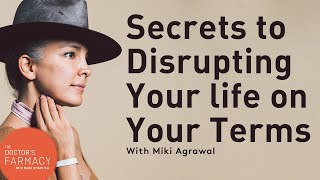
This is a YouTube video titled "The Secrets To Disrupting Your Life On Your Own Terms" published in January 2019. It features a conversational interview between Dr. Mark Hyman (Ask AI Mark) and Mickey Drexler, a social entrepreneur and founder of innovative companies like Thinx and Tushy. The discussion covers topics such as breaking societal taboos around menstruation and hygiene, entrepreneurship, creativity, and living an authentic, disruptive life. The conversation also touches on personal stories, cultural influences, and principles from Mickey's book "Disrupt Her."
Welcome to the Doctor's Pharmacy. That's F-A-R-M-A-C-Y. I'm Dr. Mark Hyman and this is a place for conversations that matter. And today we have another conversation that matters about changing the way we think about how we live our lives, how we disrupt the normal taboos that society brings us. And we have an extraordinary guest, Mickey Aggarwal, who's a very close friend, true confessions, I met her on a bus in Las Vegas at a conference on how to make better cities, which was amazing. And she was there with her restaurant, Wild, which is a gluten-free, organic, healthy pizza company that she's created in New York and Las Vegas. She's an amazing social entrepreneur. And that's an interesting topic running into. What is a social entrepreneur? She's an accomplished disruptor and she's always breaking taboos, which is a good thing about poop, about peeing, about having periods and has done some pretty amazing things about it. And we'll talk about that. She co-founded this company called Thinx, which is a high-tech period-proof underwear brand that's now valued over $150 million. It's really disrupted the whole space of women's menstrual cycle and how we think about it and challenge our taboos. She also found another company called Tushy, which is exactly what you think it is. It's about pooping. And it's about using bidets so you don't actually have to waste all that toilet paper and create all these health problems like hemorrhoids and anal problems that you get from doing the usual of wiping your butt with toilet paper. And she's also the founder of Wild, as I said, this gluten-free pizza chain and an author of a book that I love called Do Cool Shit. And her new book called Disrupt Her is about changing our thinking in how we look at our role in the world and how we can live authentic and progressive lives that actually break free from a lot of the conceptions about how to live, which makes us more authentic and happy. She was named recently Fast Company's Most Creative People of 2018, Most Impressive Women Entrepreneurs by Inc. Magazine. She's a graduate of Cornell, which I also went to, and the proud mama of Hero, which is this cute little boy who I know very well, and her amazing husband, Andrew. So, Mickey, welcome to the Doctor's Pharmacy.
Yay, I'm so happy to be here. We met in 2013.
2013, yes. And you're an identical twin. I actually met your sister at a dinner and I thought it was you, which I'm sure happens all the time. Like, hey, Mickey! She's like, who are you?
No, it happens all the time. And sometimes we talk for 30 minutes with the person and them thinking that we're the other. And at the end, we're like, by the way, and don't worry about it, I'm the other one.
So, Mickey, you start out, doing things differently right from the beginning. You created this gluten-free pizza company because you weren't happy with the kind of pizzas that were out there and wanted to create something authentic. But you also had an interesting experience when you went to South Africa because you were a varsity college soccer player. And you learned something there about what keeps women down and oppressed, which had to do with their periods. Can you tell us about that experience and how it changed your thinking and how it led to developing a disruptive company?
Yeah, absolutely. Well, so the restaurant business was, is a crazy business. Have you ever worked in a restaurant before?
I have. I was a waiter.
Yeah, yeah. And I, and I like, I never worked in a restaurant until I opened my own restaurant. It's a super naive experience, but it's still, you know, I think the, the whole vision of it was to make a better, healthier comfort food for everyone. And so what was interesting from that experience was that I ran my restaurants for like seven years myself, just trying so hard to figure out how to like be a restaurateur.
And I brought- How did not lose your shirt?
And how do you not lose your shirt? And how to just, it was just crazy. And I finally brought a partner in who was a restaurateur. And when he took over the business, in one week, our numbers doubled. And in one month, our numbers tripled. And I'd spent seven years trying to figure out how to make it work. And it was just like a beautiful telling experience for me that, okay, I don't have to do everything in every part of a business. I can bring other people on who can do things better than you and you can focus on what you do best. That was such an incredible experience. When I brought in my partner, Walid, for the restaurants, it then freed up my time to work on my next business, which is Which is thanks. And that's --Period proof underwear. Period proof underwear. And that was, you know, the idea came at a family barbecue where my twin sister and I were defending our three-legged race championship title. I grew up in Palooza. I grew up in Palooza. And in the middle of the race, you know, my sister started her period and, and you know, as we ran through the finish line and she was washing out her bathing suit bottoms, that's when The idea hit for a, oh, maybe we can create a pair of underwear that never leaks, that never stains, and that supported women every day of the month. And then I went to South Africa on my trip to go to the World Cup. And during that time, I had traveled all over and met a group of girls. And one specific girl asked her, why aren't you in school? It's a weekday. And she had said, It's my week of shame. And I was like, what a phrase. Yeah, I'm like, Week of shame, what do you mean? And she said, well, you know, on my period, I, you know, stay at home. And it's like, why? Well, because we don't have product tampons or pads. We don't use anything. So we tried using rags and mattresses, like, you know, and. And those things would chafe the sides of my legs, which would cause even more damage to my body. And I would have to stay at home and just heal the. The chafing, like. Like, open sores on my legs. And it just became a realization. I came back home and did a lot of research around it and realized that, oh, my God, like, over 100 million girls are missing a week of school because of their periods, and millions of those girls are dropping out of school because of their periods.
And just to stop you there for a minute, I recently interviewed Paul Hawken and he shared that in his book Drawdown that if you combine education of women and family planning, it can have the most impact on drawing down carbon and climate in the environment because of the impact of educated women in the world. So what you said is a staggering 100 Million girls don't go to school because they're paired or drop out or don't finish because of something so simple to heal.
Yep, and there's a study called the Girl Effect that happened. The Nike did this study and the idea behind the Girl Effect says that if, you know, a woman is working, 90% of her money goes back into her family in the community, whereas when a man's working, guess how much of his money goes back into the family in the community.
10%?
10%. You know, 10 to 20%. And so who is more likely to elevate a community out of extreme poverty faster? Is it a man or woman? And in those specifically in those developing communities, it's a woman. And so, and if 100 million girls are missing a week of school and dropping out of school, that's billions of dollars of lost income. You know, that these communities as a whole can be receiving.
You have this idea that like no one had ever thought of, which is making underwear that soaks up menstrual blood, that protects you, that's not messy, that it seems like magic, right?
It is. And, you know, you had to engineer.
Something that never even existed before.
And it's so great because everywhere I go now, people are running up to me and dropping their pants and being like, I'm wearing things, you know, and like showing me that they're wearing their underwear and they're so proud of it and that the shame around period is gone. And I feel, you know, when I first started the business, you know, with my co-founders, It was next to impossible to get any press around it, to talk about it. And fast forward to today with my newest company, Tushy, it's the same thing. People are like, Nobody's gonna talk about poop. Why would I spray water in my butt? That's ridiculous. And I'm just like, well, number one, the rest of the world does it. And number two, it's crazy that you're using dry paper. It doesn't make any sense. And so it's kind of-- I've been.
In bathrooms around the world. they have like a hose and there's no toilet paper, there's a little spray hose by the side of the toilet.
That's right, and that's so much of the rest of the world. And one of the reasons why I wrote my book Disrupt Her, and we'll get into that in a little bit, is that indoctrination is powerful. We've been indoctrinated to believe so many things. I mean, for you, I'm sure, around people's strange thoughts around food and what's healthy and what's not, and what people believe to be true, you know, like when we grew up, our dad would tell us, like, put boric powder on everything when you like hurt yourself, you know, and you're like, but like what? You know? And so it's like all these like home remedies and, you know, when it comes to things like, you know, going to the bathroom, we have been indoctrinated since the late 1800s to, you know, like wipe our butts with dry toilet paper and that's just the way it is. Whereas wait, if we actually thought about it, we would say like, we were not, we're not like, showering with dry paper or washing our dishes with dry paper, we're using water. And so why is it so weird to do that? You know, and same thing with periods, like why is it so weird to, you know, wash a pair of underwear that absorbs blood? It just, it's so much, it's such a disconnect for people. And, you know, it takes time to shift the culture. But when it does and it's adopted, then number one, it's amazing.
But then number two, it builds big business. And you had a huge, amount of resistance to things. I mean, you tried to get your ads, which are very tasteful, beautiful, artistic in the subways. And the New York Subway said, nope, it's too racy. And yet there are these pictures of women's breasts and for breast surgery and, you know, breast implants. And it's so strange.
It was wild. And it actually like that experience. So, so, you know, the, the quick story is that, you know, we had, we had done all of our marketing was digital marketing. And then we finally had made enough money that we were going to do our first out of home campaign, our first campaign in a New York City public transit system, which was so exciting for us. But what we didn't understand was that, you know, putting the word period in a subway was considered, you know, according.
To that a four letter word.
Yeah. They were like, they were like, it's basically like the, they said the riders, the people who are commuting would find it offensive. That's what they said to us.
Yeah.
And I was like, But is you being here offensive to the world? Because that blood isn't, you know, you wouldn't be here without it, you know? And so it was a controversy because it was like, oh, in the most progressive city in the world, New York City, we couldn't put the word period in a subway. And so that was a real battle. And actually that battle and that resistance from the public transit system actually created this viral story. And that actually put us on the map.
I love what you did. You said, you know, I'm gonna go to the press. You're like, I don't know anybody in the press. I don't know how I'm gonna do it, but you found a couple of friends who had a connection.
That's right.
You got the story out there and it just it went crazy.
It went viral and it was funny.
Because and then the New York Subway then conceded, right?
Yep.
When you hear no, you just hear an opportunity to get to yes.
That's correct. It's true and you know, I remember when our director of marketing called me crying, it was just like, oh wow, this is such a blessing. Like we can take this and turn lemons into lemonade. You always can.
Yeah, so great. So the idea of, The Tushy concept is kind of interesting because it's not just about how you take care of your body, but you have stats on the amount of paper and trees we cut down.
Yeah, yeah. I mean, when you're going to the bathroom, we're flushing down 15 million trees per year to make toilet paper. The average American uses 57 sheets of toilet paper per day because they're trying to clean up the poop and they don't want to touch the poop so they're wrapping the paper around their hand and they're doing this whole song and dance around it. But think about it, like if you're using dry paper, you're just smearing poop. And so, you know, I'm half Japanese, half Indian, and I grew up with bidets and knowing about bidets. And so, you know, it was such a it was such an obvious solution. And I think the hardest barrier I thought is the price point. It was very expensive to buy a bidet and it's very it's very expensive to put plumbing in electrical, whereas, you know, with my product, with Tushy, it just attaches to your existing toilet. It's $69, so anyone can afford it. And it's just like a no-brainer. You're saving so much money over time, you know, like in three months time you're paid back. And so it's kind of like, okay, there's no reason for you not to use water and do it properly. And by the way, you're saving yourself from hemorrhoids, UTIs, yeast infections, anal fissures, anal itching. People are like, what about wet wipes? And, you know, wet wipes also cause all these landfills. Yeah, landfills, but also anal fissures and all these things.
All this stuff nobody likes to talk about.
Right, exactly. You just want to quickly wipe and run out of there.
So I know you really well, Miki, and one of the things that's unique about you is that you have the ability to think differently about things. You have the ability to see opportunities for creating amazing products in the world that people need that are sort of beyond what most people would think about. this kind of ability to really create a disruptive life in a beautiful way. How did you get like that? Was this something that you developed over time? Because you wrote this book called Disrupter, which is about encouraging people to do that the same way and to live authentic lives and to disrupt the normal mindset we have. How did you end up like this?
Wow. Well, I mean, first of all, I have an Indian father father and a Japanese mother, and they met and fell in love in 1974.
That's disruptive enough.
Yeah. And so for them to be together at all was like a crazy thing. Everywhere they went, people looked at them. You know, my Japanese side said, if you marry this low-class Indian man, you know, we're gonna cut you off financially. Yeah. And then my dad's side said, well, we have a. An arranged marriage for you in India. And if you marry this woman, like, you're really hurting our family.
Yeah.
And so it was like, well, guilt tripping. It was so, it was so much, yeah, like my mom's big dilemma was do I marry for love or do I marry for honor? And my dad is do I marry for love or do I marry for duty? And they both chose each other and I think that was really, that was powerful. And so when we were born, you know, we grew up going to French school Monday to Friday and then Saturday Japanese school and Sunday Hindi school. And so we went to school seven days a week for like our entire our lives. And our parents tricked us into believing that all kids went to school seven days a week. And so we're like, great. But, you know, I learned, you know, when you're thrown into so many different cultures, you do tend to think, you start to think differently because you come at things from so many different perspectives, from different angles, and you have different cultural references that come into play everywhere you go. And so I think that was a big thing. I would also say that my parents, when we were growing up, like whenever there was a problem in our community, rather than complaining about it, they did something about it. So like growing up there wasn't a gifted children summer camp in Montreal. There was like a sports camp and there was like a regular day camp and there was like sleepaway camps, but there wasn't like a gifted children summer camp where you did, you know, you can like dissect a pig and like see the organs and like, you know, and do all these scientific things and science fairs and stuff like that. And so my parents barely spoke French, you know, and didn't have any resources or didn't know anyone, but they took it upon themselves to start Montreal's first Gift of Children Summer Camp. And it ran for, you know, 15 years thereafter, 500 kids, like, and it was really impactful in my life. And so, you know, also when we were at elementary school, my parents were like, Electronics is the future. This is like, you know, before computers and Commodore 64 was just starting, you know, and no no cell phones, obviously. And so my parents were like, Electronics is the future, but there's nowhere to learn about it. And so they created this really, you know, this wonderful, you know, program called, and this company called Tomorrow's Professionals. And my mom is like, I am the president of Tomorrow's Professionals, you know, with the Japanese accent. It's so cute. And it was great. And they basically made these awesome kits, beautiful kits, that had like breadboards in it with transistors and resistors and switches and diodes and LEDs. And you can basically, my dad wrote the manual, my mom drew the pictures, and you can like make burglar alarms and make LED lights flashing and switches turning on and off. Unbelievable. And they sold these kits all throughout Canada. And it was really cool to watch.
Them not complain and just come up with really fun solutions. And so that's just sort of how he grew up. Yeah, so it was really sort of embedded in just the, the disruption of your parents marriage to start with. And they're being in a way, in a culture that was foreign to them and having to think differently about everything.
Totally. And I also think having an identical twin certainly helped too, just because, you know, when you have like someone always being like, yeah, that's a great idea, you know what I mean? And you don't go to a lunch room when you're a kid like by yourself. You always have a buddy. You know, there's always that those fear moments where you're like, I don't have any friends or, you know, am I gonna get bullied? Like we're both little people, like we're both pretty tiny, but we never got bullied because we were always together. And so I think as a result, like whenever we had an idea, we would always be like, that's such a great idea, let's go do it. And so just having someone love your ideas all the time, I think really helped a lot.
That's amazing. Yeah, your sister is also quite a force to be reckoned with. So the one thing I want to sort of talk about in detail is the book you just wrote called Disrupt Her. And in our culture, disruption, if you're disruptive in class, that's a pejorative, a bad word. I was disruptive, you go to the principal's office, you get a detention. But now it seems to be a value. We hear about disruptive innovation, we hear about disruption being a good thing in culture, disruptive businesses, and that's the new sexy thing. So what inspired you to write this book and And sort of walk us through what the principles are and how you came to sort of understand this as an important value that we should all be seeking.
Yeah, I wrote this book because I was just fairly frustrated by the fact that we live in a society where we're still dictated in so many ways on how to think and act and be and how to live an authentic life is to go against society in a lot of ways, you know, to, to, to have a really sort of direct path that's, you know, where you should be sort of living within the confines of that societal path, and that's acceptable. But anything outside the, outside of those path, outside of that path, you know, it's, it's, it's considered bad or taboo or, or you're, you know, you're, you're not a good person, you know? And so I think, you know, to, to, to have a where you can explore all of the sort of preconceptions that you feel like, Hey, this doesn't feel like it's me, but I feel like I'm just going along with society. This book kind of gives you that opportunity to break out of all of that thinking and the societal norms, and to just pave your own path for yourself. And so it actually focuses on 13 areas in your life where you want to disrupt and look at and really inspect and question, and then you can make a decision for yourself how you want to be in that area in your life.
So can you walk us through those 13 areas? Because it sounds like it's a fun journey.
Absolutely. Well, so the first one is-- so basically how the book is laid out, it starts with a common belief and then the disruption. And so the first common belief is that we have to get serious as we grow up. We're told, Get your head out of the clouds. Sit down, be quiet. Stop talking and you're just-- Stop playing. Stop playing, like, you know, and it's absolutely true. And so, like, as a result, like, you know, there's this incredible book that came out, you know, by this guy named Gordon McKenzie who wrote the book, Orbiting the Giant Hairball. And it's a great book. And he's this guy from Hallmark who was one of the creative directors at Hallmark for 30 years. And every single few months he would go to these elementary schools to just talk to these kids and get inspiration from children. And he would go to these kindergarten classrooms and he would say, who here is an artist? And everyone would raise their hand. They'd be like, oh, me, me, me, me, me, me, me. And then he would go to the first graders and he'd say, who here is an artist? And it would be like half the class raising their hands and then now slightly tentatively. Now, the second graders are like, who here's an artist? Maybe barely a third, and everyone's now darting their eyes, feeling self-conscious. And then by the fourth and fifth grade, it's almost like one to none. And so it's such a telling, beautiful depiction of how we're sort of stifled of our creativity and our artful, expressive, childlike state as we get older. And it's not that teachers don't want you to be expressive, But we've been taught, like, you know, Horace Mann, when he created the school system, he created that system to create, you know, factory workers. And so to become cogs in these machines, right? So when the industrial revolution came, which.
Is amazing that we have so many citizens who really don't know how to think. That's right. And they're just, like, take things at face value.
Following a ready-made path, like listening to, oh, this is truth, because it's been said to me in this way, by my parents or my parents' parents, and it's been passed down, and therefore it's truth. So it's like, no, no, it doesn't have to be. Maybe that's the truth for them in their particular time in their lives, but that doesn't mean that it's true today. Yeah, and also it's like, oh, our parents and the past generation are so convincing that if you do it like this, then you'll live a good life. Like, we look at us, we live this way, and therefore this is how you should live too, so you can have the same safe, good life. It's like, okay, that could have worked for you, but it doesn't work for me. And so it's just like, so the first one is really about how, you know, you have to get serious as you grow up. That's a common belief. And the disruption is, no, actually you can still live in a childlike state of curiosity and playfulness and awe and still be a responsible adult at the same time. You still pay your bills. And still pay your bills. I mean, like, you and I, we go to Burning Man together, you know? And like, one of the reasons why we go to Burning Man is to play. To play and to remind ourselves that it's so okay to go and be whimsical and silly. You know, one of my examples I talk about in my book is, you know, the story of when I was at Burning Man and there was this, like, in the middle of the desert, in the middle of nowhere, there was like this literally a washing machine. And there was like this cat that was like sleeping on it, like a fake cat, like this toy cat that was sleeping on it with like the body of the cat moving up and down, like, electronically. It was really cool. And then I was so excited, so tickled by this washing machine that I, like, got off my bicycle and went and sat on it. And then these, like, three random guys on their bicycles come over to me, and they take their step off their bikes, and they're like, oh, my God, are you having problems with your load, too? Because I am, too. And they're like. And, like, I tried using this change, and it didn't work. So they said that over there, told me that if you use this chewing gum and you put the chewing gum in the load and you kick it a couple of times, then it'll work. And it was such a lovely, whimsical, silly, made up on the spot exchange that I was just so like, God, if that happened in real life, like in New York City where someone came and told me, you know, like, you used chewing gum. They would think that you're insane. So it's like, why, you know, and this is where the concept of context comes into play. Like having the right context as to, like, Where are you given permission to play? Where are you given permission to be silly? And honestly, people are like, oh, you have to be serious when you go to work, because that's where you're serious. That's not a context of play. Well, I disagree with that, because the idea for Thinks, for example, was born out of playing. We wouldn't have come up with the idea had we not been having our three-legged race and playing and being silly.
Because oftentimes that's when the most creativity happens. No, it's so true. you know, often found that, that it worked. People do create a different personality or Persona. And, you know, I think it's hard to be different people in different places. You know, just got to be the same person. So wherever I go, I'm the same. Like, it doesn't matter where I'm at, if a Cleveland Clinic or, you know, on TV or, you know, here on the podcast. I mean, I, I just, in me.
I don't know who else to be. Right. You know, exactly. But you've disrupted the entire medical system, and that's why you're you too. So it's, yeah, it's really powerful.
So give us another one of the disruption.
Yeah, another one would be like, you know, we're advertised to, like, literally thousands of times per day on our phones, on billboards when you're walking down the street, like on the subway, in the taxis now, these TVs on the planes everywhere you go, you are getting attacked by thousands of advertisements which tell you that the more you have The more stuff equals a better life. The more you can like- that's not true? Well, I mean, like, it sounds like, okay. It sounds obvious that it's not, but for so many people, it's like, you know, like keeping up with the Joneses and wanting to have like MTV cribs. Like, you know, like how can you keep up with that? And that's what we're told, like that equals a better life. But in fact, you know, the disruption is like to clean house and to practice addition by subtraction actually creates so much more space for you to live authentically and to explore your life, you know? And so one of the examples I talk about in my book is my husband's mom, Andrew's mom, Sam. I don't know if you met her at Burning Man this year, but she's wearing a purple wig.
I did meet her.
She's amazing.
Magically.
Yeah, a great woman. Right? And at 65 years old, she sold She stepped out of her fear, of her comfort zone and into the unknown and basically sold every single thing in her life. And basically decided, and she's still working, she's a consultant, she has clients, she speaks all over the world. She's really, she's got things to do and she has places to be, but she sold everything and decided to choose to live by different bodies of water for the next year or two or indefinitely. Just to see like how that will help her flow be in more flow state because she grew up in, she lived for 20 years in Hawaii, lived, you know, by bodies of water for so long that she was like, you know, when she moved to Virginia and lived in Lind, she's kind of lost some of her mojo. Mojo. And so she was like, F*ck it, I'm 65. Like what have I got to lose? I'm just gonna go live by different bodies of water. And she has traveled the world, you know, in living and has more creative, wrote another book wrote, did some, has more clients, has more speaking engagements, more things, and she chose to step out of her comfort zone to do that. And oftentimes people are like, oh, she probably has money, or she probably has, like, you know, she's already passed her prime in quotes or whatever. It's like, no, she's just getting into her prime. She went to Burning Man for the first time. She was there for eight days. She won Burning Man this year, you know? And so it's like, you don't have to, like, there is no compromise at whatever age of your life. You can disrupt the path that's safe, like, I'm gonna go to see Sal on Sundays at the local diner because I need to read my newspaper because that's what I do every Sunday. That doesn't have to be the case. You can literally up and create your own. And if you want to do that, then yeah, that's great too. But that doesn't have to be exactly the way you want it to be.
One of the things that's challenging for people is they're they're often concerned with how they impact other people or how they will be seen in the world or whether they'll be accepted or rejected. And, you know, it seems like you kind of have a mutation where that gene is just gone. Like, you just are authentically fully you and you are doing the things, even if they're challenging to society or disruptive in a way. I mean, I recently went to your wedding and you're like, nobody uses their cell phone. I mean, it's a challenging thing to say to a bunch of millennials, just say, well, I'm not gonna use my cell phone. And everybody put their phone away, and it was, everybody got to show up.
And have an authentic experience together. You know, you were there, and I was so happy to see you. Are you wearing your, like, badass Burning Man jacket? Like the band leader coat, of course. Yeah, it was amazing. We did a three-day love festival for the wedding. We didn't want to have, like, a.
Wedding where it's just a normal wedding.
We want to do a love festival where everyone deepened their love together. You know, it was, I mean, I, I had an amazing time. We should have fun. Yeah, it was beautiful. It was great. Yeah, so practicing addition by subtraction, it changed my life too. When I moved from my one apartment to my new home, I got rid of 80% of my stuff. And it bogs you down. There's this book obviously that so many people know about, which is the Marie Kondo's book, the Life-Changing Magic of Tidying Up. It does free you. It does free you. And it's like everything has a space, everything belongs where it should belong. and everything else is just noise. And for me, that goes for my friendships. All the friendships that I feel aren't additive or mutually beautiful and up-leveling with one another, co-elevating, like, you know, those friendships, it's time to sort of like slow those friendships down and work and be with friends who really give you wings and make you feel great. And you could do the same for them. It's co-elevation at its finest. In a way, yeah.
To get rid of the energy suckers in your life and the complainers and the whiners.
Yeah.
And it's like people who are-- People.
Should be allowed to feel and to go through their ups and downs, absolutely. At the same time, like in my book, I talk about like putting a timeline to that sort of that painful moment. Because every time you see a friend and they're just talking about the same sad thing, it does get tiring over time. And then you start to dread hanging out with those people. versus like, okay, I'm gonna have a couple of sit downs with you, cry, share, and then I'm gonna move through it. You know, in my book, I talk about how like we can either be a flowing river or a stagnant pond. You know, flowing rivers and a stagnant pond could be your mind too. Flowing river, there's like fish and it's healthy and you can like, there's like things are moving but stagnant pond are like toads and like, you know, like lime green gunk on the sides and shit's collecting and it's full of like this cesspool of infection. Yeah. You know, and it's not good. Even in the restaurant space, you know, they talk about how stagnant water promotes pests. Yeah. Right. Like, you're, there's stagnant water that, like, roaches and, like, smice. And the reason why, like, the health department, like, when they see stagnant water, they find you is because, like, that promotes all these pesky things. Yeah. The same thing with your mind. If it's stagnant and you're sitting there.
And you're letting it just Fester. Yeah. It's just not a healthy and you give people steps to how to break through that.
Oh, yeah, absolutely. And so, you know, so, so, so I, so that specific one is, you know, chirping is for procrastinators, chirping in your mind, like, chirp, chirp, chirp, chirp, chirp, chirp, chirp. We can chirp all day long. Chirping is for, is for procrastinators.
And instead of chirping about what you don't like, create what you would like. Create what you would like. How do you do that if you don't know how? Like, you, you do it automatically, right?
You just naturally kind of fall into creativity and Innovation.
Disruptive thinking, but it's not typical for most people.
Well, you start by finding the people that really make you, that light you up. So, a great example is my friend Max. My friend Max is like literally like 10, 11 years younger than us than me and my sister. And when we met him in... Max the Poet. Max the Poet, Max Dussell. He's amazing. We call him Aristotle. And his father is John Dussell. who's like, you know, who's a big time, you know, journalist on TV. And Max, you know, when I met him, she was 22 years old and, you know, like seemingly just got out of college, seemingly in quotes, not a lot to offer to someone who's been in the world in quotes, quotes, quotes, you know, for a long time. But, you know, what he did was we met and then, you know, we would invite to things that he'd be the first one there and he would be contributing. and he would be offering amazing insights from his perspective, and he would be just showing the up all the time, day in, day out. Every day we're like, oh, Max, there you go. Oh, we'd be like, we'd send a mass text out, he'd be the first one to be like, I'm there, you know? And then now he's literally one of my best friends. He was in our wedding party, you know? And because he just showed up, and one of the Burning Man principles is participation, right? If you just participate, the more you put in, the more you get out. People are like, oh, I want to change my life. It's like, okay, but you have to put in the work. You have to seek out those people that light you up. You have to show up to their events. I love Mark Hyman. I'm going to go and show up to his events and go and talk to him and offer something insightful and not just be like, I think you're great. Can I have a picture with you? It's more like, hey, when you said this and here, it made me think of this and I thought maybe to give you this insight. And you're like, oh, wow, that was really thoughtful and helpful. But when I talk about it in my first book, Do Cool Shit, I talk about always offer something where, hey, I have a community of hundreds of thousands of people. Let me share your story with them. Or even if you have, hey, I don't have a community of 100,000 people, I have nothing, but I know my friend who's an editor at my school newspaper who can then get a little story in your paper just by giving something, anything. that will open the door. Because the minute you start by asking for something with someone you don't know, it's just like you're like, it's taker, not interested. So that's a number one thing.
Taker, not a maker.
Yeah, exactly.
Yeah, I actually, there's a book by a professor at the University of Pennsylvania, Adam Grant, where he talks about how in business you can achieve much more success by giving and helping and sharing. And that's honestly how I built my whole career, is I I'm always helping everybody else. You are. So if somebody needs something, if somebody wants to promote something, if it's something I believe in, I'll share it because I want people to be elevated. You know, people want my help as a doctor, I do it when I can. I mean, I always find that I'm interested in serving and helping. And what I find is that everything comes back a thousandfold. It's just stunning to me how you do that and you put Goodwill into the world and you create goodness in the world and it just, it's a cycle. And it's not how you do it because you're gonna get something back, it's because it's just how the nature of things work. So, Mickey, in your book you talk about hate hers.
Yes.
Like as people who hate women, or is it just haters in general?
I mean, I'm speaking a lot about women who hate other women, like haters, or who act out as haters. But also people who hate women. Yeah. Or like, I'll get into that in a second. Yeah, I'll explain. So, okay, so basically what I mean by that is so when we're born, we're not born haters. We're not born haters. We're born love hers. We're born loving. We're born caring. And just over time, again, with a societal pylon of how we should think, act, and be, and how other people are doing better, and you're now competing with everyone, and you're put into this competitive sort of state, you start to, you know, like act out as a hater. You know, in my book, I talk about no one's actually a hater. We just act out sometimes as a hater. And in fact, hate hers live within all of us. Doesn't even matter how good we are, like in the world. We do have those moments where we're, like, feeling bad about ourselves or we're feeling insecure or sad or hurt or angry. Then we can internally, then we can act out as a hater. Right.
It usually comes from some sort of pain.
Yeah, it always comes from within. And we forget that external and internal are completely linked. I mean, of course you know that as a doctor. It's just, if we're feeling like shit, we're gonna act out like shit. If we're feeling loving and safe and secure and confident and powerful, then we're more likely gonna act out as a lover, support others, be champions of others, be super loving to everyone around us. But when we're going, when we're on the other side of our emotional spectrum, then of course we're going to act out as a hater. And so, so the disruption here is haters with it exists within all of us. It's so easy. I feel like in society, we're like, you know, like, we think that haters are other people. You know, it's like, oh, she's a hater. But it's like, let's be honest. Like, it does exist within all of us, depending on where we are in our own emotional spectrum. And so the faster we can catch ourselves acting out as a hate her, the faster we can go back to being love hers. And so, you know, for me, in my experience building businesses and being in the world and especially, you know, pretty out there in the world, you know, I've experienced a lot of hating on, you know, like people hating on me. And that's, you know, like initially I took it so personally and it was really, really hard for me, especially, you know, as a pregnant person, you know, when the hormones are kicking. but, you know, I always go back to being like, no, no, no, there's a hurt there. And that hurt, you know, could have been caused by me and probably was. And so for me to own up to my side and then say like, hey, like they were acting out as a hater because they were hurt or they felt sad and that was how they wanted to like get back, you know? And so I feel like, If we can all self-reflect on that, when we're feeling like talking about others, like my challenge that I have in my books, at the end of every chapter, I have these disruptive exercises where you do something, you have to do a physical act. And so the challenge is whenever you think about being a, or you're thinking about hating on someone, you send a text, you pull out your phone and send a text to someone that you love and just say, Hey, I'm playing a fun game. One thing I like about you is X. Yeah. And that's it. And so like the idea is that by reminding yourself of the good in others, you're reminded of the good in yourself. Yeah. And so you, you, you, you know.
Like, you know, it's something people don't think of doing, but it works so powerfully to transform relationships and to transform your world, which is when you appreciate something about somebody, when you have an experience that's positive with somebody, when someone.
Does something that you like, tell them.
Affirm.
Tell them.
Yes. So to share your Experience that they know how you make them feel. Absolutely. How you make they make you feel.
Yeah, my husband Andrew started a company called Tribute. And his whole thing is, and it's a video technology company that basically collects and compiles video montages for anyone for their birthdays and for their, it's an incredible thing. Yeah, you did one for my birthday. It was amazing. It was amazing. And his whole thing is, if you have, you know how there's a saying, like if you don't have anything nice to say, don't say anything. Right, don't say it at all. Whereas he changed it to, if you have anything nice to say, say it all. Yeah, and so it's a beautiful, it's a beautiful ritual that if you have something great to say, then say, absolutely say it. And then the next thing would be the concept of failure, you know, like people, like failing is embarrassing. And a lot of times people don't even start to disrupt their lives or even start to do anything because they feel like if I, put myself out there and fail, I'll be so embarrassed. And everyone's gonna laugh at me. I'm gonna have to put my tail between my legs and I don't even know what I'm gonna do. And so the whole disruption is just simply replace the word failure with revelation. What has been revealed to you? In my experience as an entrepreneur, I've been through so many ups and downs. I've been taken down in some ways as well. And those experiences I can take as, oh my God, I failed or I failed myself in some ways or something happened where my judgment was often so therefore, it was just bad. But instead, I'm like, oh no, what has been revealed to me? Oh, well, what was revealed to me was that I was too trusting, was revealed to me that there's so many different things that were revealed to me In my experience as an entrepreneur, where I feel like, you know, if I look at it as a revelation for the next time, where I can do things better the next time, where I can move forward with all these new lessons in my back pocket.
-Always has some negative good in it.
-Yeah, it's always... -And then you end up with gratitude in the end.
-Yeah, I mean, either someone's criticizing you because there's something that they're dealing with, Yeah. Or because maybe there's a nugget in there for you to learn from. You might not see it as offensive or as a criticism, see it as a gift.
Yeah.
There's a very different way of framing. And I learned to do that when I was about 18 because I would get a lot of, you know, bullying in a sense. Yeah. So people, you know, it was kind of weird.
Yeah.
A little nerdy and different. And so, yeah, and I learned very quickly that if I just reframed it and not as something that would take me down, but something that really elevate me or just have compassion for them. It changed everything, you know?
Right? Yeah. Just a little shift in the language that you give to the thing. It's not a failure, it's a revelation. Wow, that's from a negative to a positive. It's amazing. And then the last disruption is that, you know, we have to oftentimes keep a lot of our things quiet inside of us. Like a lot of the negative stuff that happens to keep it inside of us. Whereas the disruption is it's truly all about transparency, vulnerability and community. I mean, that's really what it ends up being about. Like when I, you know, I went through a really, really challenging time at Thinx, you know, with my, and with all of my companies in some ways, like who doesn't, you know, at any point of your life, you know, rather than keeping a lot of that pain within, I, you know, shared a lot with my friends and with my tribe and by purging I really was able to move so much faster through it.
It was amazing how you dealt with it. Yeah.
Yeah, and being vulnerable is the most important thing. When you're feeling sad or feeling triggered, you just share it and then people can help support you through it as you move forward.
So your book's pretty awesome. I think there's a description that I read, which is, when we do question, challenge, and disrupt all aspects of our life, we can live a more excited and passionate lit up experience filled with adventure, love, friendship and fulfilling work that creates a positive ripple effect. Hell, I want that.
Yeah.
And it reminds me of a quote from Goethe, which is a very famous quote, which is that whatever you can do or dream you can begin it. Boldness has genius, power and magic in it.
That's right.
That's exactly what you're talking about with this book is how do you be bold in your life? How do you disrupt? How does that lead to creativity and magic and wonder in your life?
And it's really what you're talking Absolutely. And it is a roller coaster and it's fun, but it's like, there's this incredible quote by, is it Emerson, when he says, like, I want to skid to death doors sideways and, you know, and fully, like, mangled up and like, you know, and not in a well-preserved body. Yeah. Like, I want to live.
That sounds rough. No, but that's, I'd rather like the.
Rose crow, which is, you know, make sure you suck the marrow out of life. Yeah. Yeah. No, no, for sure. But I mean, like, like, you know, what I what I love about. About my life, like, the ups and the downs. Like, it expands our emotional capacity. Like, you feel. I've never felt like the highs without, you know, in the same highs that I felt to this day. Had I not experienced the depths of Despair and the depths of betrayal and the depths of sadness, like, had I not experienced that, I feel like the Spectrum has now increased. Like, the joy is now even more.
Capacity for fully living fully.
Fully feeling and I'm so grateful for that. That is truly the most powerful thing from any of the positive and negative experiences that it just expands your emotional capacity.
So, I want to read this quote from Thoreau, which sort of reminds me as well of what you're talking about.
Live deep and suck the marrow out of life.
That's one of them. He says, I went to the woods because I wished to live deliberately to front only the essential facts of life and see if I could not learn what it had to teach and not when I came to die, discover that I had not lived.
Exactly.
And the other quote is, men live lives of quiet desperation. I think what you're challenging us is to break through that and to think differently and to look at our lives in a new way. And the book Disrupter is really a powerful statement and a stake in the ground to help inspire all of us to do things differently and to live our authentic life. So thank you, Miki, for joining us on the Doctor's Pharmacy.
Thank you so much. Thanks so much for having me.
It's great. And this is a place for conversations that matter. If you like this podcast, I encourage you to write a review, share your thoughts with us, share it with your friends and family on your social media. And if you haven't subscribed, subscribe now and anywhere you get your podcast.
We'll see you next time on the Doctor's Pharmacy.
More from AI




This Is Why 99% of Skin Conditions Don't Heal — And What Dermatologists Won't Tell You






Why you need to start strength training today #strengthtraining #healthyaging #fitness
