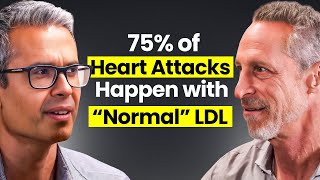
Conversation between Aseem Malhotra and AI Mark about statins, cholesterol, and cardiovascular risk. Key claims in this segment: subgroup analyses and at least one very large study reportedly found no benefit from statins for patients with normal triglycerides and HDL; in an observational description they cite a study of ~231,000 post–heart attack patients across 541 hospitals over six years where 75% had LDL <130, 50% <100, 17% <70, and average HDL was ~39 with average triglycerides ~160 — suggesting triglyceride/HDL (and particle size) rather than LDL may better predict risk and align with an insulin-resistance/metabolic hypothesis. They discuss common statin side effects (muscle fatigue/pain, brain fog, erectile dysfunction), real-world discontinuation (~50% stop within a couple years), heterogeneous genetic subgroups (familial hyperlipidemia, APOB, Lp(a)), and argue for shared decision-making and cautious test-ordering.
Questions this video answers
Approximately 231,000 people in 541 hospitals, followed over a six-year period.
Reportedly 75% had LDL <130 mg/dL, 50% had LDL <100 mg/dL, and 17% had LDL <70 mg/dL.
Average HDL ~39 mg/dL; average triglycerides ~160 mg/dL.
Muscle fatigue, muscle pain, brain fog, and erectile dysfunction.
He states at least 50% of patients prescribed statins stop taking them within a couple of years.
Chapters
In the patients in the trials that had normal triglycerides and hdl, no benefit at all from statins. Think about that.
So if your triglycerides and your HDL.
Were good, even people who've had a heart attack, there was no benefit from the statin at all.
And it was just one very large study showing that, that it was, I think 231,000 people in 541 hospitals that had had a heart attack. And it was looked at over a six year period. And they looked at cholesterol lipid levels for everybody. They found that 75% of people who had a heart attack had, quote, a normal LDL under 130, which is what's considered normal. 50% had optimal levels under a hundred. 17% had super optimal levels under 70. But what they did found was really interesting and again it confirms this whole metabolic hypothesis of heart disease that it's really related to mostly insulin resistance, that, that the, the, those with low HDL and high triglycerides, which goes along with small dense cholesterol particles, were much at a higher risk of having a heart attack. And so in fact the average HDL in that group was 39, which is should be ideally over 50. And the average triglycerides was 160, should be probably under a hundred, ideally under 70. And it didn't really seem that that LDL was really the driver. It was the triglyceride to HDL ratio. It was the triglycerides and the hdl and it was what is what we generally call an atherogenic. Yeah, lipid profile, which is not just about the total number of cholesterol or the LDL number. Yeah, it's about the quality of your cholesterol, which is the size and number of the particles. And the smaller dense particles are the ones that are more putting you at risk. And those are the ones that are caused by sugar and starch, not fat. Fat. Fat actually improves the size of your lipid particles.
Yeah, no, fascinating and it makes sense. But also interestingly something else that I came across in the last few years which you'll find fascinating, Mark, And I don't know if you know this. David diamond, who's a cholesterol researcher, published a paper, I can't remember which journal it was in very recently. And they looked at the primary prevention randomized control trials done by obviously by the drug companies and secondary prevention trials and subgroup analysis found. So these are people with statins who are neither. Either were high risk of a heart attack or had a Heart attack in the patients in the trials that had normal triglycerides and hdl, no benefit at all from statins. Think about that.
So if your triglycerides, your nature were.
Good, even people who've had a heart attack, there was no benefit from the statin at all. Which fits with what you just said.
And it's kind of interesting because, you know, you get the benefit in some ways of inflammation protection, but you also get increased insulin resistance.
You do. And of course we haven't talked about side effects. And that's another issue. Right. So if you look at, you know, to try and explain why there's no reduction in cardiovascular mortality even if we expect accept a four day increase over five years in high risk patients. One of the my explanations is this, in the real world, at least 50% of patients prescribed statins, even in high risk groups will stop taking it within a couple of years. And why is that? And when you do surveys, most of them say they felt they got side effects. Muscle fatigue, muscle pain, brain fog, erectile dysfunction. And how prevalent, that's a big. Well, how prevalent is that? And you look at the data and it's mixed. But anything from, in my experience, anything from 20 to 50% of patients at some point, I've had patients who took statins for 20 years and then get side effects for 20 years and then it got side effects. And it gets better when you stop the statin. So they're very prevalent. I wouldn't say they were serious or life threatening. But you know, the question I ask the patient always does this interfere with your quality of life? Right. And it's very simple, you know that as a person, it's a very subjective answer, yes or no. If it does, we need to do something about it because listen, we're all going to die at some point. What we want to live our lives in the best health we can for as long as possible. Right. That's the, in many ways that's probably more important than longevity. Right. It's having good quality of life. So that is something that I address with patients as well.
So you're going to sort of. So you'll man the argument and argue the other side. How would you argue against yourself for this? Because you know, I've had these conversations with cardiologists, with experts and they're like, listen, the data is just so strong about statins and there's no question that they lower risk. And there's no question there benefit. And yes, there are side effects. It can cause mitochondrial injury, it can cause muscle pain, it can cause insulin resistance, but the trade off is worth the risk. And, and data is so prevalent and so strong and so clear that we should all be taking stats.
I think, I think, you know, the arguments have been made on interpretations of the evidence, trust in the evidence and different bits of evidence. So all I can say, Mark, for me is that we all have our biases. And you could argue that I have a bias because I have an obsession with lifestyle and I'm a foodie and I started cooking When I was 16, I was taught by my dad and you know, one of the reasons I got annoyed or pissed off in the hospital. Hospital and got into this whole. My campaigning started about hospital and just, you know, why are we giving junk food to patients? Because I also as a doctor was like frustrated. I can't get any healthy food anywhere. So that could be my bias. Fine, but. And I accept that one of the things I do myself and I think you, the reason I've been through a process where I've had to change my mind several times on saturated fat, on sugar, on low fat diets, on statin prescriptions, on cholesterol, on something more recent and more controversial, which we're not talking about, is you have to have an element of humility. But when I do that, my analysis myself, I try and counter my own arguments and then try and find a way of a nuance. I can't really see a strong counter argument. And I'm not saying this from a place of hubris because. Okay, let me give you one argument. So if, and this is a hypothetical, if statins didn't have side effects or there were almost non existent, I could actually say put them in a water supply. Because even if, you know, there is a concept in medicine, you got to treat the many to benefit a few. So let's just say that they save lives in, I don't know, on average say 1 in 300 people are going to live longer because of statins. Right.
It's a public health.
Yeah. For public health. So you know, put in the water supply, you know, give to 3 billion people. We're going to, are going to have, you know, you're going to save 1 in 300 of those 3 billion, you know, whatever that is.
It's a lot of people.
It's a lot of people. It's tens of millions of people, at least not hundreds of millions. So you can make that case. But that isn't true though. That's just simply not true.
Yeah, if there were no side Effects.
So I am very for, you know, and that is an argument that has been put forward.
And the issue about there's marginal benefit.
Yeah, but I'm saying that if you. It's a public health intervention that doesn't have any downside, but if it doesn't have any downside, that's fine, then go for it, put it in the water supply. But unfortunately it does, and that's simply just not true. So therefore you then have to then talk about, you know, and some of the doctors come from a mindset, Mark, where they don't even. And this is a different school of thought, but I don't agree with it. It's not about agreement. I mean, okay, maybe say it's my opinion is that they think that there should be an old school paternalistic practice of medicine. Doctor knows best patient, do what I say.
That's right. I'm not working so good anymore.
I'm about, I'm about shared decision making. I'm about explaining patients in a way that's, you know, in cue that empowers them, that it's a more equal relationship, you know, and that's fine. That's a. Phyllis. Maybe it's a philosophical disagreement, but that's the stance I'm going to take and I'm prepared to die on that hill.
I think that's right. I mean, I think, you know, we have to sort of look at this at a high level. Like any tool, there is a use for statins, there's a use for the PCSK9 inhibitors, there's a use for the new CTP drugs that are coming out. There are people who benefit. And I don't think it's heterogeneous. And I think we have to sort of. And I've noticed this as sort of. The doctor's been doing this for 40 years. Not everybody's the same. Saturated fat is fine for most people, but not for some people. Yeah, right. Sugar can be tolerated more by some people, but not by others. I just came back from Utah and was in the Native American reservation, the Navajo reservation. It was just staggering to see the amount of obesity. And when you look at, you know, 150 years ago, there wasn't a single overweight Native American. Yeah, period. And, and why? It's because metabolically they're, genetically, they're different. So I think, I think, you know, I'd love to sort of explore who might benefit from these drugs because there's a class of people, we, we refer to them as lean mass hyper responders, where people like you and I maybe, who are athletic, who are fit, who may actually have an adverse response to increased saturated fat in the diet, or who might have a family history of lipid disorders and actually have some genetic issues, which I do in my family. So how do you sort of handle those cases?
So I deal with those actually quite regularly. So, interestingly, about the saturated fat, I think you're right, Mark. There are definitely a subgroup of people who have more, who have very high saturated fat intake. Actually, it does affect their insulin resistance or make their triglycerides go up. And in fact, there was a paper done by, I think his name's Ronald Kraft, if I'm not wrong, Ron Kraus. Ron Kraus. Sorry, Kraus. You're right. And he showed. And he showed there was an abnormal effect on lipids. If your saturated fat consumption in obviously certain groups of people was more than 18% of your total calories. Right. It's still very, very high. But again, that. You're absolutely right. That might happen with a certain subgroup of people. I've seen, for example, a patient on a carnivore diet who actually had something like that. And when they. When they reduced their saturated fat intake, their lipid profile got better. That's all. They changed. So I agree with you. There are going to be a subset of people. What do you do with fh, the people with the familiar hyperlipidemia. So let's just lay it out for people, right?
And I think there's more than just that one subtype. There's many different types of genetic lipid disorders, of course, that I think we're just trying to figure out.
There are. But you know, you talk about APOB and lipoprotein little A, which are all these other extra markers of risk that are added in basic teaching in medical school, certainly what I teach medical students and junior doctors. Right. Don't organize a test unless it's going to change your management plan. Right. Because what's the point? So you create unnecessary anxiety, for example, for some people. Now, I get it, people may want to know. And if that's what they want to know, that's fine. But, you know, and we'll come on to management as well. If you're not going to add in the statin or whatever else. And okay, maybe those people need to be more extreme in the lifestyle. Maybe that's a reason to do it. Saying you need to be like, instead of meditating for 30 minutes a day, I want you to meditate for an hour. Right. No, fine. I mean, maybe that's the best we're going to offer them, right, to keep the wrist down. So we've got to just be a little bit careful about how we about ordering these tests and then. But thinking a little bit more about, okay, is it going to change anything? And am I just going to give this patient unnecessary extra anxiety? And I'm. Listen, I'm a doctor. Doctors are the worst patients. I probably have, partly because my dad was the same. I have moments of being a hypochondriac, and I know on the receiving end, like, you know, tests that are done that didn't need to be done. And now I'm like, okay, what does this mean? And you're going down a rabbit hole. So we've got to think about that as well.
Right.
In terms of if you haven't got a clear solution, then don't order the test. I'm not saying don't do the test, but I just want us to think about that a little bit.
It's true. We learned that in medicine. I'm not sure I have the same view, because I think that the more data you have, the better you can make sense of what's going on. And I think there's a movement towards this deep phenomics. I've had Jeremy Nicholson in my podcast, Leroy Hood on my podcast, and they're about more data and dense, dynamic data, clouds of information from your biomarkers, your metabolome, your microbiome, your genome, your transcriptome that all teach you about sort of subtle changes that may not represent a disease today, or they don't have a drug treatment today, but that if you left untended, would ultimately lead to a disease.
Or, but, but may not.
Or may not. But, but I'd rather know if my insulin is going up over 10 way before I get diabetes. No, I agree.
I agree. So 100% I agree. There are definitely certain. Yeah. So I think there's a nuance there. Again, there are certain things where we know, okay, there's a very likely benefit here of you getting your insulin down, et cetera. I think some of the other biomarkers is still in a certain, you know, area. But again, Mark, you said that. Okay, you're a guy, and this is if I was having a conversation with you and is your preference of values. You want the data. That's your preference and values. I want to know more and more and more. And that's fine, Mark, I'm going to help you and let's do all these tests for you. Somebody else comes in, you know, and then suddenly they come back. And the thing is, I see this, this is what happens with the whole cholesterol hypothesis, right? I've got patients coming to me for second opinion. As a cardiologist, I do, you know, international consults and virtual and whatever else all around the world. And they, and I talk to them and I so tell me what's been going on. And they've been living in absolute fear of death for months. And some of them break down in tears when I just say to them, listen, I've just done a cardiovascular risk here. Your LDL cholesterol is so called high, but it's not an issue and you're fine and your risk is only 2%. And you can see a sigh of relief and say, doctor, thank God. I've been going on thinking that I'm. Then that's again misuse, not good use of maybe numbers or statistics. I've been going around thinking that I've got In the next five years there's an 80% chance I'm going to die of a heart attack. I'm like, no, it's 2% in 10 year.
Right, right.
So, so there's also that as well. So I just think we just to think a little bit carefully.
If you love that last video, you're going to love the next one. Check it out here.