Time To Go In
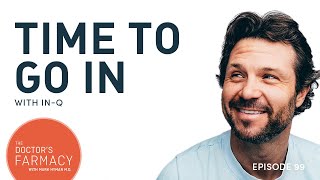
Poet IN-Q talks with Dr. Mark Hyman about his new book Inquire Within, reading poems like '85' about late-life love and 'One Little Dot' about climate change. They discuss how poetry and meditation can slow us down and reclaim attention from technology.
Questions this video answers
March 25, 2020
60 illustrations by Mustach (London)
Inhale — personal poems (a poetic hero's journey); Exhale — social and political poems (change yourself, change the world).
Chapters
Where does creativity come from if not empty space? You know, infinite possibilities is empty space.
Hi everyone. Just wanted to let you know that this episode contains some colorful language. So if you're listening with kids, you might want to save this episode for later.
Hi, I'm Dr. Mark Hyman. Welcome to the Doctor's Pharmacy. That's pharmacy with an F, F, A, R, M, A C, Y. A place for conversations that matter. And today's conversation matters. If you care about your soul and you care about love and you care about family and you care about making the world a better place. Because our guest today is doing that every single day, day in, day out. I've known him for many years. I've been a fan. Actually, we haven't got to hang out that much but a little bit. And his work is telling stories through poetry that change people's lives. And I'm so excited to have him here. His name is inq. He's a national poetry slam champion, an award winning poet, a multi platinum songwriter. His groundbreaking achievements, including being named to Oprah's Super Soul 100 list of the world's most influential thought leaders, that is no small feat. He's been the first spoken word artist to perform with Cirque du Soleil. He's featured on A, E, ESPN, HBO's Def Poetry Jam, sports rapping poetry on ESPN. That's great. He's inspired audiences around the world, including me, through his live performances and storytelling workshops. And many of his recent poetry videos have gone viral with over 70 million views. And I'm really excited to have you here in Q. Thank you for joining the Doctor's Pharmacy.
Thank you so much for having me, man. I'm a fan of yours as well.
So you know, I was checking out your book that's coming out, Inquire Within a Book of Poetry. And you know, poetry sort of kind of in a way in our fast digital culture, people just don't take the time to deep dive into poetry. And it is one of those things that shapes people, that moves people. It's different. It's different than a novel, it's different than non fiction book because it brings us together in ways and moves us in ways together that other words can't. And just to share a little bit about your book, it's a book that contemplates universal issues of love, loss, forgiveness, transformation and belief. And your book Inquire within shines a light on our lives and provides a wholly unique and dynamic lens through which to think about ourselves and our world. It's Rhythmic, it's original, it's authentic, inspiring. It's a journey to the center of the soul, which I think is a good place to be today in our chaotic world where we're so far away from our soul. Inquire within is a provocative, entertaining debut from an award winning poet. You'll never look at poetry again the same way and you will probably never think about yourself and your place in the world the same way. So I'm so excited. It's really a tremendous book of poetry, I think. Something that we need to be focused more on as a pause from the chaos of life to savor what really matters and to think about things that really matter in a different way. So thank you for doing that. Thank you for doing that.
Appreciate everything that you said right now, really, it touches me, man. I think that one of the reasons that I wrote the book and that it was entitled Inquire within is because I had to inquire within myself to create it. And the person that's reading it and holding it in their hands, they have to inquire within the pages and ultimately inquire within themselves. Because when you think about this modern day society that we're in, consumerism, the culture basically trains us to look outside of ourselves for validation over and over again.
I mean, I think the best way to solve that would be to turn the flip function off on the phone. So people can't do selfies.
Right, right. You know, it's funny, I was visiting the prison that Mandela was in for years and years and years in South Africa once, and as we were passing his cell, somebody took out their phone and took a selfie of themselves smiling in front of the cell. And I was like, they are not present to why they're there or the experience that he had.
Yeah.
And they're not reflecting. So I think really that's what I was talking about is everything is trying to take from you. It's trying to take your attention, it's trying to take your money, it's trying your likes, your information, your love. And technology is this incredible thing that was, you know, created to bring the world together. And yet with all of this technology and the Internet and even what we're doing here today, you know, we'll never be able to quantify the ripples of this getting put out into the world. And that's wonderful, it's a really beautiful thing, but it's also isolating people. People feel more alone than they've ever felt in their entire lives. And they don't feel a Connection beyond their screens. And so I think there's a difference between, you know, using these tools and these tools using us, you know, and, you know, if. If you think about what people need more than anything else right now, it's actually being quiet to find their own answers. You know, if I don't know something, I automatically look on Google or, you know, I look in a book. You know, I try to find the answers outside of myself. And really, people need to inquire within. And I hope that this book winds up being a window for them to do that within themselves.
So good. Which is so powerful. And for you, I mean, it sort of was sort of a sideways journey into being a poet. You never sort of set out to be a spoken word poet.
I don't think there's any straight way journey.
How did you get into this? Because it's like a very novel career and you're smashing it.
Thank you.
But how, you know, I'm like, I would love to get up and say poetry and tell stories all day, but like, how am I going to pay the rent? But you figured out, you know, how to do this in a way that's so powerful, that moves people and people gravitate to you. So how did you get from, like, have knowing intention to being a poet to being this killer poet?
Well, first of all, it took me a really, really long time to figure out how to monetize it. I mean, I was not doing it for money or, you know, fame or anything like that. I was doing it because I was passionate about storytelling and sharing my experiences through this particular art form. But I started out rapping when I was 13 years old. And, you know, I grew up in a single parent household. My mom's a school teacher, my dad wasn't around. And so I think freestyling, initially, when I fell in love with it, was my first form of meditation. Because when you're freestyling, you literally can't think of anything else but the next word that you're saying. You know, it puts you in the moment like nothing else can. And it provides an outlet for you to get thoughts and emotions out of your system that you might not have another avenue to do. So. So that was a huge thing for me. And then when I was 19, I wound up in an open mic for poets in Los Angeles called the Poetry Lounge.
Oh, isn't that where like Jack Kerouac and all those guys? Or was that. That was a different.
No, I don't think Jack Kerouac ever came to the lounge. But they were part of the beat movement. Yeah, this was kind of the spoken word movement. And it was a different time period, but the talent was insane. And it was the first time that I ever, from an audience standpoint, saw people being celebrated for their vulnerability. I mean, if someone would get up and say something true, you know, it's 350 people in the audience every single Tuesday night, and they would be like, oh, whoa. You know, and snap and, you know. So there was a lot of alchemy that was happening in the room of taking these stories and this pain and transforming it into something beautiful. And I just never left. I started doing my rapping a cappella. People responded and that was the beginning of me becoming a poet.
It's true, we make sense of the world through story. Yeah, I tend to be fact driven and more concrete, but the truth is that we change through story. We change through our emotional context and through having our heart touched in our soul mood. I mean, that's what actually drives people to change and grow and learn and. And it's such a gift to be able to take that.
Can I just say something off of what you said? Because I, I feel that you actually are incredibly good at taking facts and turning them into story. Yeah, like, that's something I've seen that I've seen you speak a number of times. And every single time you engage the audience, you make them lean in, you put it into your books. And I think that's very important is to find a way to make facts entertaining for people so that they walk away with something specific that they can then apply to their life.
Yeah, yeah, it's true. But, you know, it's the artists that. And the creators and the sort of dreamers that actually change the world. Right? Yeah, it's like, it's that, like that old Apple ad think different and it's the disruptors. And I think in our world where we're so all disconnected from each other and we're so not in our soul journey, the. This book Inquire within is. Is such an invitation to get back to that. And, you know, I, I think, you know, we're so distracted digitally that we've lost the ability to just be with ourselves. Yeah, I grew up. I'm 60 years old, so I grew up with no cell phone, with no Internet, no email, with no texting, with no social media. And it wasn't until I was, you know, God, it was like in my 40s. That really has started to come on.
Right.
And I, And I remember those times of just Savoring of just being, reflecting and wandering and walking and it's necessary. And, you know, I, you know, really been focusing more and more and like leaving my phone at home.
Yeah.
And not bringing it. And with my wife, for example, I gave her a present which was a little box. And she's like, oh, it's such a nice box. I'm like, no, no, I put my phone in the box and leave it there for the weekend.
Right.
And you get the gift of my presence. You know, that's beautiful. And that's what. And she started crying. And, you know, I'm not always good at it, but I realized that, you know, I thought I did it for her.
Yeah.
And when I had that weekend to myself, I just was able to lay on the floor and listen to jazz and play with the cats and not have to look at my phone every seconds, you know?
Yeah.
It's such a. It's such a horrible habit that takes us away from the. Those spaciousness. From the spaciousness of needing me, able to actually connect with ourselves. So.
And also it's like, where does creativity come from if not empty space? You know, infinite possibilities is empty space. So that's why people practice through meditation. And my meditation practice has been, you know, a non negotiable part of my life. But that's one avenue to finding that space. Even just sitting down and being in nature or being by yourself in the silence and seeing what comes up, you know, but not using a mantra or an anchor to get down, which is, as I said, non negotiable for me. But there are other ways to find that space and to find that silence. And you might be surprised at the answers that come out of that.
Yes. It's so true. I mean, how I became a doctor was I basically grabbed my backpack, filled it up with a week's worth of food, and just walked for a week and just walked and walked. I went backpacking in the Shenandoah Valley and all by myself. And I just had this incredible spaciousness and time to really reflect and be and think.
And do you remember the moment that it clicked in for you?
Yeah. I'm like, I really want to do something where I'm in contribution and service and, you know, actually add something to the world. And.
I felt like, why not? Because I wasn't pre med at all. It was after I graduated from college. I'm like, okay, now what? I got a degree in Buddhism, so what the heck am I going to do?
That's cool, man.
I'm not going to Become a monk. But the principles of Buddhism are about healing. It's really about healing the mind and healing the soul, and it's all sort of connected. And it just sort of took me to, like, okay, well, why don't I try being a doctor? And. And it sort of worked out. It's been okay.
Well, you've also been able to bridge those two worlds.
Yeah. Yeah.
But it was.
It was really taking that long, extended solo walking, being in nature with no nothing. You know, just me and my backpack and my little camp stove and sleeping pad. You know, I don't think we had Patagonia back then. It was. It was just a really special moment. And I think it's.
It's.
I'm actually. My wife and I were talking about it last night. You know, my life is so on.
Right.
I'm doing so many things because I feel compelled to be a contribution to what's good in the world.
And you have momentum, so you want to, of course, follow your enthusiasm and your momentum.
Yeah.
But I'm like, you know, we're just talking about, like, I think I want to take a week or two and just go have a solo journey. I don't know what or where or how, but I. I feel like, you.
Know, I absolutely support that. I think you should a hundred percent do it. I mean, even just people, you need to. Yeah. People think you need to be around other people to feel less lonely. Nature can make you feel really connected, just being with nature. Because, you know, it's like, I was thinking this the other day. The birds aren't singing to win a Grammy. You know, they don't want to go platinum. You know, they don't.
They don't want to get on Oprah.
They don't care, man. They are in nature. They are nature. And so when we're around nature, it is, as you said, an invitation for us to step more into the moment and to fully be present.
You know, that's so true. You know, a lot of art comes from pain.
Yeah.
And you talk about some of the challenges you've had about your dad not being around. Yeah. You know, growing with challenging environment, some of the setbacks and failures you've had. And you also say how it can be our greatest celebration. So how do we sort of reframe challenges in our life to a place where we can grow? And. And how have you done this for yourself?
Well, the celebration comes from the transformation, you know, So I think you have to celebrate it first. You have to. You know, everyone's so afraid of their pain. In our society, we are so fucking afraid of our pain, man. And everyone's finding ways to run from themselves so that they don't have to feel it. But the reality is, is if it doesn't come up and out, it will manifest itself in other ways in our lives, and there's nothing really to be afraid of. And so if we could find a way to celebrate our pain, to feel through it, to release it, to transform it, that is a pure form of alchemy. And you can do that through creation. You can do that with sharing. You can do it in many, many ways. You can do it through yoga, you know, athletics, activities that you decide to do, sitting with nature, as we discussed. But you have to do it. And the first thing is to not try to hide from it within yourself or with other people, because we might have different circumstances, but we're all going through the same human experience.
And, you know, for you.
You know, the challenges you face sort of, I imagine, were what. What spurred you to start to write and to speak your truth and to talk about the hard things.
Yeah, right. I mean, it certainly was the biggest outlet for me. You know, poetry ultimately has been the biggest outlet because, you know, and even when I teach workshops, all I'm really doing is providing people an opportunity to explore these moments who have changed who they are through this particular art form. And when they do something like that and they choose something that's moving and meaningful to them, they get the story outside of their system. And when they can see it, they have more separation from the story. And the story doesn't own them as much, so they have a sense of empowerment. And then when they give it away and they see the mirror of humanity in other people's eyes, they have a sense of feeling less alone. So I had that same experience. I'm trying to provide people the same experience that I've had with poetry over and over and over again. And all the things that I'm writing are really just, you know, either me purging or praying.
Yeah.
But they're reminders to myself of the life that I want to live.
Yeah. So powerful, you know? And I think in the telling of those stories, there's something that happens, and it's happened to me many times. And I've listened to you.
Say, your poetry, it's almost like a. It's like a crack that happens, like something snaps where you shift your perspective, where you see things in ways you didn't see them before, where you make connections you didn't make before, where you're inspired in ways that you didn't realize you need to be inspired. You're emboldened to make changes based on, you know, what happens from the raw telling of the truth in that form. And it's sort of unlike anything else. I mean, you can watch a movie, you can listen to music, you can watch a play, and maybe it'll do some of that.
Yeah.
But there's something sort of magical, and I. I think, you know, you've really been able to sort of break through some of those stories that you where. Your origin stories. How do you help people break through the stories that they create for themselves?
Well, first of all, I just want to piggyback off of what you said. Some of my most incredible art experiences have been in the audience, watching poetry, other poets getting up and sharing their lives.
Yeah.
I mean, it's really been transformative for me. So I think that inspired me to do that within myself, and now I hope that I'm inspiring other people to do that within themselves. When I do the actual workshops. You know, as long as people start in a place that's true, and then they give it time and space, the poem will surprisingly almost write itself. And that's my process. I mean, people ask me all the time, where do you get your inspiration from? And I just say, I pay attention. I pay attention if something moves me, you know, if something annoys me, if something inspires me. And then I start there, and then I try to get out of the way.
Yeah.
You know, because I'm the vehicle and the obstacle for my art.
It's more of downloading than writing, is that it?
Yeah, but it's downloaded through my experience, so it's like I have to be there. You know, like, people always talk about the ego. You know, how to lose the ego. You can't lose the ego. You know, your ego is a part of humanity. There's no way to lose your ego. But you cannot operate from your ego as much.
Right.
You know, you can find a way to know that your ego is a part of you being, you know, involved in this human experiment or this illusion of separation, you know?
Yeah. Speaking of separation, what effect did your father's absence have on you? And how did it sort of be a force for good in your life, even though it was sort of back? Can you talk about that?
Yeah. I mean, I have a poem that I explore this in the book. It's called Father Time, and it really kind of delves into my whole experience. And ultimately, it's about Forgiveness, full circle. You know, it came to me forgiving myself and forgiving him and being grateful, you know, because who would I be without that experience? I certainly wouldn't be who I am today. I would be someone else, but I wouldn't be who I am today. And that's the thing is every single thing that happened to us, whether we understand it or not, we choose to be a victim to it or to be empowered by the transformation that comes from it. And I mean, it's not a product, it's a process. And I'm still, of course, working on it, but I have a lot of peace with that subject in my life now, so.
Great. It sort of reminds me of a book by Ram Dass, who just died called Grist for the Mill. And everything is grist for the mill. Everything is sort of juicy stuff for us to do our soul work with.
Yeah.
And I think even in our culture, the whole idea of soul work is not something we really think that much about anymore. We're so outward focused and in some ways we've been co opted by, you know, large tech companies and large businesses that are actually capturing our attention. Designed to be addictive. Right. That so usurps our free will and that drives us into choices that don't serve our good.
Right.
And serve their good.
Yeah.
And in a way, poetry is like a, like a, like a sword that cuts through all that.
Yeah.
I think it brings you back to what it is. True.
I think poets have a responsibility, like all artists, to speak truth to power, but they're also speaking truth to illusion. Yeah. You know, there's this mass distraction machine that is always trying to take, you know, and poetry doesn't want anything from you.
Right.
Other than to be.
Hi everyone. Hope you're enjoying the episode. Before we continue, we have a quick message from Dr. Mark Hyman about his new company, Pharmacy, and their first product, the 10 Day Reset.
Hey, it's Dr. Hyman. Do you have FLC? What's FLC? It's when you feel like crap. It's a problem that so many people suffer from and often have no idea that it's not normal or that you can fix it.
I mean, you know the feeling.
It's when you're super sluggish, your digestion's off, you can't think clearly or you have brain fog, or you just feel run down. Can you relate? I know most people can, but the real question is, what the heck do.
We do about it?
Well, I hate to break the news, but there's no Magic bullet. FLC isn't caused by one single thing, so there's not one single solution solution. However, there is a systems based approach, a way to tackle the multiple root factors that contribute to flc and I call that system the ten Day Reset. The ten Day Reset combines food, key lifestyle habits and targeted supplements to address FLC Straight on. It's a protocol that I've used with thousands of my community members to help them get their health back on track. It's not a magic bullet, it's not a quick fix. It's a system that works. If you want to learn more you and get your health back on track, click on the button below or visit getpharmacy.com that's Get Pharmacy with an F F A r m a c-y.com now.
Back to this week's episode.
We can talk about poetry all day, but I'd love for you to share a couple of poems for sure. The first one I really want to hear is in the book Inquire within which Everybody Should Get. It's a phenomenal doorway to wisdom, the soul, to cracking open parts of yourself that probably need to be cracked open. And the first one's about love. So can you tell us a little bit about it and then share the poem with us?
Absolutely. And I appreciate you saying that, man. So this first piece is called 85 and I originally wrote it because I used to live in this little back house and the woman that owned the main house, her mom moved in at a certain point. Her name's Dolores, she was in her 80s and we shared a kitchen together.
You and grandma? Yeah.
And basically we would say we'd have coffee, we talked about life and love and my ex girlfriends at the time, you know. And I came to really love her, man. You know. And after she was there for about six months, I woke up one night, it was like three in the morning and I had this big window and I could see the lights from the ambulance outside the blinds and she was getting taken away on a stretcher. I watched her and she was still alive, but she was having major health complications. And I went and I visited her in the hospital and she had tubes in and out of her system and she had a really high fever and she didn't recognize me. And they said that she was in real trouble. And so I sat with her for a while and I just basically said my goodbyes because I thought that that was her time and I didn't want her to suffer anymore. But she got better and they ended up Getting her better enough to where she could move to a retirement community. And after about a month of her being in this retirement community, I went and visited her. And we were literally, like sitting outside and, you know, she was in a really good mood. We were in the garden and I was like, dolores, why are you in such a good mood? And she leans in and she goes, I met a guy. And so in the months she's 85, she literally met a guy and they had started dating.
Wow, love that.
And I just thought that was so beautiful, you know, not only because love could be around any corner, but because I thought her life was over. And not only did she survive, she was excited about something again. Yeah, she was surprised by something again. And oftentimes at any age, people just become obligated to the choices that they're making ossified, you know, and they just, like, look around. They're not surprised, they're not excited. And I'm curious, what will I be like in my 80s? What will I wear? You know, what will I want to be enthusiastic? Yeah, probably the exact same thing, but, like, what will I want to explore, you know? And so that's where this poem. Amazing.
Give it to us.
I want to fall in love at 85.
Go on shuffleboard dates and dance to hip hop from 95.
We would also listen to the song.
Staying Alive.
But only for the message. Otherwise we'd keep away from disco. It's depressing. We'd rock matching tracksuits and rope gold chains. We'd look like Run DMC but in their old age. We'd take aerobics classes and wear by focal glasses and eat at IHOP and hold hands at Sunday masses. And when it comes to the bedroom.
Well, nothing much would happen in the.
Bedroom because we're 85, but we would still be down to take a walk or take a drive or sit and talk or have a drink, watch the passersby ask each other why and how and who and where and when. And then we'd laugh and cry again.
About the people we had been.
And I would touch her withered skin and comment on how thin it is to keep in something infinite.
And she would smile sweet and blush, then tell me that I think too much.
She's right.
I think too much. It's always been a problem.
But then again, that's how I made.
My green like the goblin. When I was in my 20s, I was eating top ramen, counting up my pennies, saving up to go food shopping. But now I'm 85.
And somehow I feel more alive.
I turned my hearing aid up and.
Bumped Jurassic 5.
Or the Jackson 5.
I read the sports page while she peruses classifieds. We like antique stores, garage sales, and barter buys. And when it comes to the bedroom, well, hopefully every once in a while, she lets me knock her boots into the floral patterns of our bedpost, then hold her head close like death isn't chasing us. Planning on erasing us and replacing us with better versions of us. Reshaping us, remaking us, then recreating us with new identities so we can make new memories. Hush, little baby, learn to walk and talk and think and lie and feel and fight and love and die and never get the answers why she dips a joint of grass and wheat grass and we get high.
Her hair is silver as the moon in the Miami sky We still pop pills but it's not the Molly anymore. Whenever we can't sleep, we listen to the ocean floor.
She got a sound of the CCD.
For me from the Brookstone store, and ever since, I've been snoring like a.
Like a.
Like a really good metaphor for snoring. Sorry. I go blank sometimes. What? I'm 85. I'm not complaining. I'm just happy that I'm still alive and happy that I have my better half by my side. Super fly. She doesn't look a day over 75.
When I first saw her, I was totally in awe. She was classical, so I was like, yo, yo, Ma.
That was all it took, a single look, and I was shook. I fell for it like some loose shingles from our Spanish roof. And I'm a lover till she loses every last root and has to glue dentures to her gums to chew solid food. Ooh, now that's real love. Dude.
That'S some push comes to shove. Love.
Not when it's convenient Love.
Hospital bed love.
Feed her ice chips Love.
Never leave the room Love.
Sleeping in the chair Love.
Pray to up above.
Love.
Have to pull the plug Love.
Miss her in my bones love.
Everything.
About her Love Die within a month Love can't live without her love.
Love.
The only reason that we are alive.
And none of us should have to wait until we're 85.
Wow. Made me cry. Holy shit.
Wow.
I don't think I've ever cried on my podcast before.
It's all good, man. Thank you for listening.
What touched you about it?
Oh, wow. See, that's the thing about poetry. You can talk about it all day, but then it's like spiritual surgery.
Yeah.
And it Just, it's like I found myself having the chills, laughing, crying, like, just longing.
Remembering what's important, remembering what I want.
Remembering what matters. And like, yeah, it's like, wow.
Holy.
You know what, man? Like, first of all, I appreciate your. Your vulnerability because it makes me feel closer to you. You know, I see that as strength and it makes me feel connected to you in a deeper way.
Yeah.
And I have the same experience. I mean, I. I cried the first time I wrote that because it was reminding me of the same things that you're talking about.
Feeder ice chips. Love, man. Wow.
You know?
You know, and I mean, I wonder, does the. Does the book come with a box of Kleenex? Because I think you should do a package thing where the book.
Well, you know, it's interesting. The book has, you know, there's two ways to consume it and both are different. You know, the book has 60 illustrations. So we worked with an amazing artist named Mustach in London, and he created these really, really deep and layered illustrations around the concepts of the poetry that help to kind of bring you into a.
More, you know, connected experience. And it gives you something else to look at. And then the way that we formatted everything and the way that we put the order is meant to bring you through this conceptual through line. There's two halves. There's Inhale and Exhale and. And Inhale is personal poems. And so it's almost like my own poetic hero's journey. And then Exhale is social and political and it's change yourself and then you can change the world. So that's one way to. To kind of consume it. And then the other way is the audiobook, which is me, you know, recording all of these poems. And then you get to hear the rhythms and the stylistic things, the voices that I'm using. And both are interesting to do on their own, and then they're really fascinating to do together. And this is literally, it's the first.
Time I've ever had a home for my art.
I've been writing poetry for 25 years. So someone asked me the other day, they were like, how long did the book take? And I was like, 25 years? Yeah, 25 years, pretty much. I mean, I've been working on it over a year. But then one of the oldest poems in the book, the father piece, is 14 years old, and it took me 10 years to make that 14 year old poem. So. 25 years.
All I can say is Rilke has some stiff competition.
You know, my favorite poets, who gets the same way Inside, under your skin and into your soul. Wow. So we could talk a lot more, but, you know, that was a. That was a within poem and I would love you to share. A without poem. Yeah, a poem about being in the world and what we all need to do is in community to actually deal with the real issues we're facing. And, you know, one of them I talk a lot about on the podcast is food system and climate change. And, you know, we were recently at an event for a non profit called Kiss the Ground, which everybody should check out, which trains farmers and creates educators around regenerative agriculture.
And.
And you did this really compelling poem about climate change and the earth and the soil and, you know, it's something I know a fair bit about, but I just really opened my eyes in so many ways and I'd love for you to share that.
Yeah, happy to.
I hope I don't cry in this one, too.
Oh, gosh.
You know, I'll say one thing before I start.
I watched the State of the Union last night.
Oh, God.
With everyone else. And he didn't mention climate change one time. The biggest existential threat to humanity right now was not even mentioned.
No.
And it just made me so angry.
Yeah.
You know, so this is a poem that, that I wrote about climate change because climate change doesn't give a. About our nations, it doesn't care about our religions, it doesn't care about our races. You know, if a spaceship showed up right now, it doesn't care about anything, man. You know, it is the great equalizer.
That's true.
So I think we need to all wake up to that.
You know, it's interesting. Just a little side note before you start on the poem, I just. I just bought this book, We Are the Weather by Jonathan Safer Foyer, who, you know, the first two chapters have nothing to the climate change. The first chapter is about how every molecule of air we take in, you know, contains other molecules from people who breathe breaths on the planet, from Julius Caesar to Hitler.
Right.
You know, like, and going back forever. So we're literally breathing in the breath of Jesus Christ. We're breathing in the breath of Moses and Muhammad and Martin Luther King and whoever walked the planet.
And.
And we all are all the time in every breath. So we're so connected through so many different ways.
Right.
So we're all one community, and we all are connected in. The second chapter was about how During World War II, you know, the United States, even though it was in an imminent danger of attack, hunkered down and created victory gardens. All the lights went out at dark, so U boats couldn't see where we are. But even inland they did. They had planes flying over in Midwest because they were trying to tell people, we need to be part of this. They had people ration their food. In fact, people got healthier because they ate less sugar, flour, and other things. So we came together as a nation to fight a common enemy.
Right.
And we did it through sacrifice.
Right.
Actually prevented the ultimate sacrifice, which was the end of our. Our world as we know it.
Yeah.
So I think it's the same kind of thing. We need to get that we're all in this together and then we get that we need to make changes. So share with us your poem.
Yeah. Can I just piggyback on that for a second? Because that is exactly right. It's not even climate change. This is a war. We need to all look at this like it's a world war against our.
Own behaviors of greed.
You know, I mean, it's crazy that we're still profiting off of the suffering of people and the planet and that we're okay with rewarding that. And this fucking ridiculous argument that like, well, America could change policy, but the world is huge and there's a lot of other places that are using energy at a quicker pace. It's just we should be leading by example.
Yeah.
It's not even an argument that's worth discussing.
Yeah.
You know, so it is an actual responsibility, an existential responsibility. You're not going to have to convince kids that climate change is real. They're going to be experiencing it on a moment to moment basis.
So. I mean.
Yeah, yeah. Just the, you know, sacrificing our children's future.
Yeah, yeah. And so this is something that I wrote about it. It's called One Little Dot. And.
It'S really ultimately about definitions and ownership of this particular issue.
It's true. Because most people feel disempowered.
Yeah.
We can't do anything. But you, you bring it back home.
Yeah. And I've felt that way many times.
Yeah.
And yet here we are.
How can something this big be invisible?
The environment is everywhere and yet it isn't visible.
Maybe if we saw it, we would.
See it's not invincible and have to take responsibility as individuals.
How can something this big be invisible if it's all around us? It should show itself on pure principle. The scientists are certain that the damage is residual and climate change data is reaching levels that are critical. Yet somehow that's political.
We argue over math.
Our citizens are too cynical. To believe in facts. We make excuses and hold on to the recent past. We don't want to sacrifice, so we refuse to ask. I grew up in a city. It's all I ever knew. So even now I have nothing to compare it to. I have to hit the park to see more than a tree or two. I have to visit nature like it's in a fucking zoo.
But California was wild before the parking lots, before the mass malls, before designer shops, before the strip clubs, before the sea change, when mountain lions roamed freely over freeways, before the fast food, before the freeze frames. We live around a bunch of dead shit these days.
It's not an argument for better or.
Worse, it's an observation on how we've been treating Mother Earth. See, we protect what is ours. My land, my life, my house, my kids, my job, my wife, my dog, my car, my country, my culture. But when it comes to nature, our perspective is external. The planet, the forest, the ocean, the sky, the mountains, the valleys. Always the Nevermind if it's not me, never mind, I'm too busy all the time. And without the ownership, we ignore the warning signs. Just look at all the species on the planet that are dying. The coral reefs, the honey bees mysteriously dying. One fourth of all the mammals that exist are dying. A third of all amphibians are at the risk of dying. We're on a path to mass extinction. It's almost like we're trying because we're relying on an atmosphere that we've been frying. I could use more statistics, but you probably think I'm lying because over half the politicians we elect deny them. Well, since when did their opinions outweigh the science? I thought experiments were fundamentally unbiased.
Capitalism uses nature as its example and excuse for competition. The only problem is we've removed it from the ecosystem. Profit and balance in the market are attainable, but growth without a conscience is completely unsustainable.
I mean, a lion doesn't kill all the gazelles.
Why do we have to have it all to ourselves? Pretty soon there'll be nothing left but concrete and cars. And when you see an animal, it'll be like seeing a movie star. The planet, the forest, the ocean, the skies, the mountains, the valleys. Always the Nevermind if it's not me, never mind, I'm too busy all the time. And without the ownership, we IGN the warning signs. Our planet, our forest, our ocean, our skies, our mountains, our valleys. Always we always mine. My planet, my forest, my ocean, my sky, my mountains, my valleys. Always we always mine, always ours Always yours.
One little dot in trillions of stars. One little dot.
It's all that we've got. We just forgot that none of it's ours.
We just forgot that all of it's ours.
One little dot in trillions of stars.
Wow.
Wow. Yeah. It's easy to. It's easy to make it their problem.
Yeah.
Not my problem. And I think it's so different to shift the frame to thinking about this as something that matters to us.
Yeah.
Like that. That ownership conscious question is just so not in the dialogue. And I think that's why there's so much polarization. It's like, you know, I always joke, everybody's favorite radio station is wifm. What's in it for me? But the definition of me needs to be a little bit bigger. Right? Right. Because without all this, there's no me or we or us. Right?
Yeah. And I'm. I'm once again relearning that every time I speak the poem and finding new ways that I can do that for myself when I fall back asleep.
Yeah. You know, wow, this is such incredible work. I, you know, I. I heard a lot of poets and, you know, there's. There's a difference about your work that has, you know.
Deep spiritual lessons in it that are, you know, I think a lot of posts try to imbue in their poetry, but it's really hard to do. And I'm. I'm just so moved every time I hear you. Like, I'm so grateful that you're doing this work in the world.
Thank you, man.
Everybody needs to get this book. Inquire within, get the audiobook and get the book, get them both and listen them together, read them together.
And slow down. Slow the heck down with your life so you can just be. And, you know, poetry is kind of like meditation in a way. It's just like a. I remember when I was in my 20s, I would like, sometimes climb a mountain with a book of poetry and just sit and read the poetry or sometimes read it out loud.
Was there a specific book that you're thinking?
Well, actually, yeah. I mean, I remember sitting like.
On.
The coast.
In California, like Tabanga Canyon, up on the hills, looking over the ocean on this sort of, you know, escarpment, looking over. And. And I had Rilke poems by Rilke. It's a German poet from the early 20th century. And I. It's just. It's such beautiful poetry.
Which book do you remember?
I think it was a Duno Elegies. Okay. And it just, just was so much about love. And you know, like, he talked about this concept of in seeing, like, you know, seeing somebody's soul. And I think that's, you know, like, honestly just sitting here talking to you today. I'm like, you know, I've been going through this process of myself just sort of rethinking what I'm doing and how I'm being and how I want to live and, you know, what matters?
What have you been thinking of and what have. What have you been aspiring?
You know, when I was in my 20s, I was just in the more being stage.
Yeah.
And then for the last 30 years, I've been in the more doing stage. And I want to get back to being a human being instead of a human doing right. And not dealing with 400 emails a day and not having to be in 10 cities in 20 days and just, just do good work, but really change what I'm doing because I think I'll be more effective.
Right.
I'll be happier. And I. I'm craving it. I feel like, you know, I'm craving it. And I got a lot of joy from the things I do. I get a lot of nourishment from my family and friends. I get a lot of good. But the. Just the unplug and just be. It's just funny because my wife literally were talking about that last night about me taking a week or two and just taking a walking, walking tour like I did before. Just walking.
It's necessary. I really think it's like a necessary part of.
The recharging process, you know, like a pilgrimage. Like, absolutely. You know, and when you do that also, you remove all of your stories and you're just in the world.
I know where. I know where I want to go. I've dreamt of going my whole life.
Where would you go or where will you go?
Well, Mount Kailash.
Where's that?
Mount Kailash is in Tibet. And it's this. Oh, God sacred mountain that is, I think, 17, 000ft.
And it's a pilgrimage site. And. And Buddhist pilgrims come to this mountain and they literally do prostrations. Every step is a prostration around the entire mountain.
So a prostration, like a walking meditation.
Literally. They like, like you've seen Buddhists bow down. So they literally bow down, get to their knees, go flat on the ground, fully extended. Extended. Like you're in a boat pose.
Yeah.
And then stand up, take a step and do it again. Bow down, prostrate yourself.
Got it.
And do that. That's how they go around the entire mountain.
That's amazing. That would. What a sight that would be to see.
It's a heck of a journey. But it's, it's something that I've long wanted to do and you should dreamt about.
You should a thousand percent do it.
There's a great book by a guy known Robert Thurman called Circling the Sacred Mountain. And it's. I read the book and I just, I'm just so hungry to go on that journey.
Look, I know you have. First of all, far be it for me to give advice, but I know you have such an amazing life. You have such amazing.
This thing that you've built really impacts and influences people in a positive way all around the world. And as I said, there's no way to quantify it. But also the thing that you need to do to feed yourself will also feed other people. And I think you should please, please, like, as a gift to me and to yourself and to everyone who looks up to you and to, you know, who gets stuff from your content. You know, please do that. I got a chance. I came back recently from India and I was able to be at a monastery with the Dalai Lama for this guy named Lama Senkapa. His 600 year celebration into transcending into nirvana. He was one of the earlier teachers of Buddhism and it was the first.
Eating because he's 600 years old.
He's a really good guy, very energetic, you know, plant based for the most part. No. Anyway, so this was a big celebration for him though, because he was one of the teachers to the Dalai Lama. And so we get a chance to meet the Dalai Lama. And it was unbelievable, man. It was like a small group of us and literally thousands and thousands of monks that came to celebrate this really special thing. And, and so when we met the Dalai Lama, he comes in and he sits down and we all kind of gather around him like children looking up to somebody who's reading a storybook. And he goes like this, he goes.
Compassion.
And then he continued on. I didn't hear anything else he said because the word compassion.
Was like. I had never heard it before.
Yeah.
You know, because it's not always what someone says and it's not always how they say it, it's who says it and what they've been through.
Yeah.
And I could just feel his experience of compassion when he said that.
Yeah.
But being in that environment, being in that new environment where I get to take off all the stories that I have, it was necessary. And then I came back, recharged to re. Approach my poetry career.
It's so true. We need those experiences, and, you know, we all live our little narrow lives. And I remember being in Northern Nepal, I met this Tibetan doctor because I wanted to study about Tibetan medicine. I went and sat with him for a day, and he told me a story. He'd been in a Chinese gulag for 22 years, tortured and beaten and deprived of everything. 22 years. Finally got out. I said, what was the hardest part about being there? He says, well, it was the moments where I thought I was going to lose compassion for my Chinese jailers.
Wow.
I'm like, whoa.
Wow. Whoa.
Okay, so I got. I got some work to do here. So, Inkyu, thank you for the work you do in the world. Thank you for being the sword of Manjushri, which is the Buddhist. The Buddhist.
Symbol of someone who cuts through the illusion with wisdom.
So thank you. That dude's a lot to me, man.
You're that dude. And everybody's got to get this book. Inquire within.
Yeah, and the audiobook, by the way. If you get the book, reach out to me on social media. You know, I'm at NQ Life. Let me know that you got the book. Post about it. I want to spread the word as much as I can. I literally never had a home for my art like this, and so self promotion has always been an issue for me. Promoting this book is a joy.
No, it's great. Everybody. Everybody's got to get it. And. And I think it'll be great even to, you know, gather with your friends and read the poems out loud to each other and, like, have that. I mean, this. That shared experience. I mean, I. You know, I literally feel transformed just sitting here. I feel like I got a private poetry by a superstar. I'm like, whoa, Feel so blessed.
And.
And I'm grateful for you and everybody. Check it out. Inquire within on Amazon. It's available now. Please get it. It'll. It'll move you. It'll wake you up. It'll inspire you. I'm already like, wow.
More from AI




This Is Why 99% of Skin Conditions Don't Heal — And What Dermatologists Won't Tell You






Why you need to start strength training today #strengthtraining #healthyaging #fitness
