Treating Post-COVID, Or Long Hauler, Syndrome
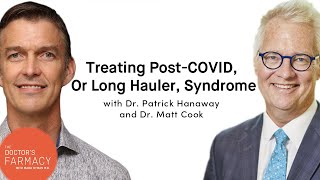
Dr. Patrick Hanaway and Dr. Matt Cook discuss functional medicine approaches to long COVID, including immune activation, mitochondrial support, and IV therapies. They explore why research funding lags and which treatments might help when standard medicine has few answers.
Where I'm going with the patients that I'm seeing at this point in time with post-COVID syndrome, and I've got a number of them now, is really focusing on immune activation, using mushrooms, using those kinds of things to help support their immune system, to reactivate it, as well as mitochondrial support.
Hi, I'm Kaya, one of the producers of the Doctors Pharmacy podcast. Most of us are now familiar with post COVID syndrome or long hauler syndrome in which patients who have had COVID-19 experience lingering or long lasting symptoms. Dr. Hyman recently spoke with two of his colleagues about how they are approaching the treatment of these patients. Here he is with Dr. Patrick Hanaway.
All right, so let's say someone gets COVID, they recover, and we're seeing this phenomena in up to 87% of hospitalized patients, so it's probably less if you're not hospitalized, but I see this in many of my patients who are not hospitalized who get what we're calling post-COVID syndrome or long hauler syndrome. And it's very reminiscent of what happened with Epstein-Barr and chronic fatigue syndrome. In fact, SARS, the original SARS, 40% of those who survived at three years had chronic fatigue syndrome. And that's a staggering number. So what is the functional medicine approach to looking and dealing with with this post COVID syndrome. And what's the recovery model?
These people who are having, let's say, the post COVID syndrome, they have other underlying issues that are going on. They have other underlying triggers. And it may be related to, you know, heavy metal toxins or organotoxins or mycotoxins or hidden infections or antigens or celiac disease or some other process that's going on that has to be taken care of and looked at. Also, it's not like you're just gonna treat the post COVID separate from everything that's going on in their bodies. And so we've got to dig into what is the root source. And the way I think about it is, I talk about those roots of the tree, which are the intrinsic aspects of our lifestyle, but then there's the soil. It's the exposome. If you're exposing the roots of the tree to poor soil, you're not going to be able to get healthy. And that's where we want to bring our focus. Absolutely.
I mean, what you're bringing up, Patrick, is really important is that the body is a system. And there are a lot of things that perturb or disturb the function of that system. and functional medicine is about finding out what those things are that disturb function. What are those things that optimize and enhance function and getting rid of the things that are making your machinery gummed up and providing the things that help you run optimally. And I think that's a very unique model. It's not something that we learned in medical school, but it is really the foundation of functional medicine. And it's super powerful for all sorts of things. And I believe that this is where functional medicine will shine as we start to see millions of people with post-covid syndrome.
Whether we're working on someone where we're trying to prevent them from having a severe illness or treating them for post-COVID syndrome, or working with them at any point in severity. The approaches are actually similar. The specifics change, but the approach is the same. And that is what we're working to do is work with the system of what's happening with the gut microbiome and how it informs the immune system. What's happening with the activation of the cytokines and the overall inflammatory response process that's going on. what's happening in relationship to the exposome and risk factors that you have, what's happening with metabolic health in terms of the ability of the virus to be able to attach to the receptor in the first place. Taking all of these things into consideration, we start looking at risk. And so from a nutritional standpoint, we're saying, well, what can we do to mitigate risk of, as you said, of obesity, of metabolic syndrome, and work with that, you know, the kinds of approaches beautiful paper by Deanna Minich that I helped her out with, you know, goes into all of that. And we talk about, you know, what ends up coming down to what looks like a low-carb Mediterranean diet, you might call it a Pegan diet. You know, it's like the, you know, it's that kind of approach that's going to help our overall metabolic health and well-being one of the things where, where I think one of the key impacts of the, of the SARS-CoV-2 virus is, is actually on mitochondrial health and well-being and we see the changes in the mitochondria and the ability to produce energy being significantly impacted. Now, whether that is a direct effect from the SARS-CoV-2 virus or it's a side effect or a sequelae from the hyperinflammation that's going on, we see that being affected. And we see that also in so-called post-COVID syndrome or working with long haulers. Interesting to me that when we look at places like Mount Sinai and other that are setting up academic centers for this. They're thinking about it as we have a vascular problem, you have a pulmonary problem, you have a GI problem, you have a cardiac problem, you have a neurologic problem, you have a psychiatric problem. And I look at it and I'm saying like, well, gosh, there's muscle problems and there's cardiac problems and there's brain problems. And gosh, those are the three places that use the most energy in the body. Maybe this is related to the mitochondria. So when you start talking about, you know, other kinds of outside the box therapies, ozone and things of that nature, you know, that are not that they are experimental. They've done some interesting studies in Italy early on looking at that. But to me, they're working on the antioxidant capacity and improving the efficiency of the mitochondria so that there's energy production. And we know that mitochondrial health and immune health are intimately related to each other. So here we are talking about, for instance, those IV nutrients of vitamin C and NAC and glutathione that are all going to have an impact mitochondrially, they're all gonna have an impact on oxidative stress. It's a similar constellation of things that may actually be used for cancer and for cancer scavenging in terms of vitamin C. So it's fascinating there. But with the post-COVID piece, I'm really focusing on mitochondrial function and being able to mobilize and feel like that's really where the essential aspect of it is, which as you said, is not dissimilar from the Epstein-Barr virus work from the mid 80s with Paul Cheney and others in terms of what do we do, how do we actually help those people who have some kind of post viral fatigue syndrome and where I'm going with the patients that I'm seeing at this point in time with post COVID syndrome, and I've got a number of them now, is really focusing on immune activation, using mushrooms, using those kinds of things to help support their immune system to reactivate it as well as as mitochondrial support and whether that's NAD, various vitamins, N-acetyl cysteine, CoQ10, there's a whole array of different components that get built into that phosphatidylserine and others. And so I use products that are really focusing on that PQQ as well as CoQ10 and CoQ10. So, come back to the dietary aspects, really ensure that there's not high glycemic foods, no processed foods, and focusing on good fats and good pure amino acids, clean amino acids, or proteins that people are taking, doing that, and then focusing on the immune system and the mitochondria. That's where I go.
I do believe that it's going to be a combination of Bistal, foundational lifestyle therapies, diet, exercise, sleep, relaxation, stress reduction, and then all the same nutraceuticals that you do to prevent and treat it. And then for people that get stuck, I think there are adjunctive therapies like intravenous therapies of IV and AV, IV vitamin C, IV glutathione, phosphatidylcholine, and even things like ozone can be extremely effective intravenously. There's also peptides and exosomes and a whole category of things that are used to help people break the cycle. And I've seen these therapies work in a number of patients. So I'm hopeful. I think there needs to be more research on this. We need to move forward. The challenge is that I don't think that many people are funding any research on this because it's not like at the end is a product or a drug or a vaccine that's going to make billions of dollars. So we're kind of stuck. But I do believe that these therapies are out there now that they're available, that there's enough evidence to create a rationale for their use and that they're safe and potentially very effective.
Dr. Hyman also spoke to Dr. Matt Cook, who is using many of these.
Therapies to treat his patients. For post-COVID, I think I break it down into two categories, whether people are remote or whether they're in person. If they're remote, I have everybody taking this peptide thymosin alpha 1. And I'm having people, if they've had COVID, take this peptide for three to six months. And I'm noticing people- Every day? Every day. and so when they do that, people tell me, God, I feel a lot better. And I've had a lot of people remote that had a lot of symptoms, and then they start taking, it's just a little insulin syringe, and they just inject like a 10th of a CC every day. And when they inject this tiny amount of fluid, it starts to regulate their immune system. And I'm, I'm seeing it help basically almost all post-covid symptoms. And so is this kind of thing.
Good for you going lime or this.
Also, it turns out it's also really good for lime. It's also, I put everybody that has SIBO leaky gut and GI inflammation on it. And so it's a, it's kind of an all-purpose worker horse peptide that turns out to be great for either it, I think for prophylaxis to prevent from getting COVID. And, and so anybody that if, if, if one person in the house gets COVID, I put everybody else in the house on this peptide. If you have it acutely, it helps. And there's different dosing that we do, depending on whether you have an acute or you don't. And then finally, for these long haulers, these people that have this COVID for a long time, we're doing that. And it's been really, really helpful. I like other peptides also. I like thymus and beta-4, which is also really good for regulating the immune system. And I like BPC-157, but not for everybody. And there's some issues with that.
It's a whole list of peptides.
There's a whole list.
They're used for all kinds of different things. And I think that, you know, this is really an interesting emerging field of medical therapy. So, what do you do for people who are here in the office that you see have post-COVID and how are they doing with the treatments?
So, my feeling on this is interesting is that everything that works for pre-COVID and everything that works for treating acute COVID works for the long haulers.
Exactly, right.
Yeah. So, ozone probably number one. Vitamin C, glutathione.
Well, venous vitamin C. Intravenous.
Intravenous ozone. There's a vitamin called NAD, which seems to stimulate your mitochondria and it's a ubiquitous molecule in the body that has all, it's basically a signal of your energy stores. And so we use that. And interestingly, one of the first things that happens when you start treating people with NAD is their vascular health starts to improve. And the reason is that cells love NAD because it's like money to a cell.
Yeah.
And so it represents potential energy. And so then if you put a molecule in a vein, the first thing that's going to happen is it's going to try to diffuse out of that vein. And then when it tries to diffuse out of the vein, it's going to get absorbed by the cells that line your vein and artery. And so then what happens is you improve the health of those cells. So I have a lot of people that come with vascular problems that I start doing NAD and they get better. Well, guess where COVID goes to your blood vessels. And that's why people have so many problems with their heart or their kidney or their brain because it's inflammation in the blood vessels and then it can leak out and then get into the nerves, which is why we're trying to put something in the blood vessel, whether that be ozone, whether that be vitamin C, whether that be glutathione, whether it be NAD, I've submitted IND for exosomes to the FDA. Yeah, research proposal. And so we're going back, we're on our exosomes. Exosomes for exosomes. Yeah, we're going to do a randomized clinical trial with exosomes for COVID.
Amazing.
And so I think we're going to get approved in the next day or two. We're like two or three rounds deep with the FDA just going back and forth with the PhDs.
So there's a whole realm of medicine out there that that is just emerging over the last few decades. It's still on the margins that you and I are in. Places like Cleveland Clinic, they've introduced functional medicine. They're starting to do this more and more in different health care centers and hospitals around the country. But it's unfortunate because people really have trouble accessing this. But I think the work you're doing and stuff we've done at Cleveland Clinic that I've tried to do over the years is really trying to break ground. So this is more accessible for everybody. Because ultimately it has to be covered by insurance. It has to be accessible, the cost has to come down, and it has to be something that people can get access to. Right now it's hard, but I think people should have hope and there's a lot of stuff they can do that isn't that expensive. Diet, lifestyle issues, sleep, exercise, the right supplements, and even some might be treatments may not be that expensive. So I think there's ways to get yourself healthy in this time that people really need to focus on. And the challenge for us is that, you know, we just go about our lives, we're busy in this and that, but Now more than ever, people need to think about their personal health, not just for themselves, but for their family, their communities, for their society, and really the world, because we're really facing this pandemic that's not going away, and we need to be smart about how do we protect ourselves and make us more resilient in the face of it.
Functional medicine is the science of creating health and resilience and making your system an inhospitable place for disease. In every infection, there are two factors at play: the microbe and the host. While we can't control the microbe, we do have extraordinary control over us, the host. If you'd like to learn more about anything you heard today, I encourage you to check out Dr. Hyman's full-length conversations with doctors Patrick Hanaway and Matt Cook. If you enjoyed this episode, please consider sharing it with a friend and leaving us a review below. Until next time.
More from AI




This Is Why 99% of Skin Conditions Don't Heal — And What Dermatologists Won't Tell You






Why you need to start strength training today #strengthtraining #healthyaging #fitness
