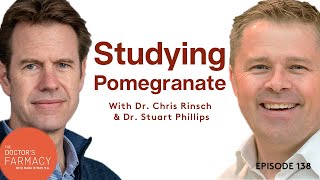
This is a YouTube video titled "What’s Been Learned From Studying Pomegranate" containing a recorded conversation from October 13, 2020, featuring Ask AI Mark interviewing Dr. Eduardo Gonzalez. The discussion focuses on the discovery and health benefits of urolithin A, a compound derived from pomegranate metabolism by the gut microbiome, and its effects on mitochondrial function.
So, there's this compound that you've studied and you basically figured out how to actually extract and make, which is called urolithin A. And just for those who are listening, this is what's so interesting about biology. You eat a pomegranate, which has these ellagitannins in it, which is one of these phytochemicals. So, you eat a pomegranate and that chemical interacts with your microbiome. And then if you have a healthy microbiome, it might produce a beneficial chemical called uric acid. But if you don't, it might not. So what you've done is sort of discovered that this molecule is so powerful in regulating mitochondrial function and you really done years and years of research to bring it to market. So tell us about uric acid. How does it work? How does it affect mitochondrial function? and how did you kind of figure this out? Because there's a million plants out there and a million chemicals. So this is sort of like, you know, kind of like a needle in the haystack, right?
Good question, Mark. So it all started with, for us, with the pomegranate. We were looking at the pomegranate and, and thinking about what type of health benefits it could bring. And, and we started looking at the compounds inside of the pomegranate. And, and this led to us understanding more about compounds like ellagic tannins, which are a big family of compounds. that are quite large inside of the pomegranate. And upon studying them, we understood that they were transformed, as you were mentioning before, into urolithin, in fact, into a range of urolithins, which are metabolites, through the gut microflora processing. And it was originally thought that this is just part of the processing and the digestion of the pomegranate. And so wasn't sure, you know, were these urolithins actually doing anything in the body. So we started looking at them. And it was at this point when we were looking at urolithin A that we saw lo and behold that it was acting on mitochondria and improving mitochondrial function.