Why a Vegan Started a Regenerative Farm with Animals l Doctor's Farmacy with Mark Hyman, M.D. EP4
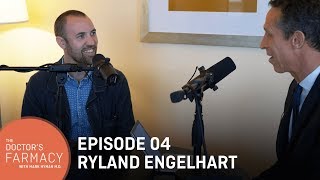
Ryland Engelhart, a vegan and co-founder of Cafe Gratitude, explains why he started a regenerative farm with animals. He discusses how livestock can improve soil health and help reverse climate change through sustainable farming practices.
Today's guest is Ryan Engelhart who's an icon in the world of food nutrition. Someone I met a number of years ago and have been inspired by. He actually got an interesting title for his job which is the Mission Fulfillment Officer which means how do you fulfill your mission? Which is a great thing. He's a connoisseur of cafe gratitude in Gracias Madre which are vegan restaurants through Throughout California, they're iconic. They're in songs like Jason Mraz's song about the Gratitude Cafe. He's a co-founder of Kiss the Ground, which is a nonprofit organization that educates and advocates about the connection between soil and human and planetary health. And there's a book by that name, Kiss the Ground, and a movie coming out, which I read the book and it really was a game changer for me to understand the connection between soil and health. and food and the planet and climate environment. It was just a beautiful story about something that most people don't understand and don't connect the dots on. And he also is the co-creator of the award-winning transformational documentary, May I Be Frank. He's an entrepreneur, an activist. He uses restaurants as a platform to inspire more gratitude in our culture. And once I was in your restaurant and I was, my wife and I were not in the same state and we decided in that moment we were gonna send each other gratitude messages every morning and every night when we were not together. And so I actually was inspired by sitting in your cafe. He speaks on sacred commerce, on tools for building community and regenerative agriculture and regeneration. So, so glad to have you here, Ryland. And I really enjoyed knowing you, meeting you, and I want everybody to understand your story. So, you know, you're very focused on food. You're very focused on sustainability. You're focused on health through food. And your family started the Gratitude Cafe, right?
Yeah, how did that happen? Cafe Gratitude. Yeah, it was a co-creation of my father and stepmother back in 2004 in San Francisco. They had a very crazy idea. My dad likes to say, start some, there's a roomie quote that says, start some big foolish project. like Noah. And Cafe Gratitude was his big foolish project. And it really was not just to offer people the healthiest organic plant-based cuisine, but it really was to invite more gratitude into our culture. And can we actually transform the conversation of something's missing, something's wrong, What do I have enough of right now? What am I fulfilled by right now? And by recognizing that and calling that forth in my consciousness and my awareness, that actually gives me a different experience of life.
It's totally true. You focus on what's right instead of what's wrong. It changes your life.
That's right.
Even if there's a lot of wrong, which often there is in the world, It doesn't serve you by over focusing on that and it actually changes your ability to actually create a world where what's wrong can be fixed if you come at it with more gratitude.
Yeah, for instance, I just received a text message from my sister and she's sitting at the bedside of one of my dearest sweethearts of my life. the longest relationship besides my relationship with my wife. And she's on the verge of passing from cancer. And yeah, what I'm present to in the loss of that life is I'm present to how much I love and care for people and how much I waste time not communicating that and not being honest about how much people mean to me.
Yeah.
And so, yeah, even when there is a problem or a great loss, you know, when it brings forth, it can bring forth a well of gratitude for what we do have. And so, yeah, that's really, we started Cafe Gratitude to bring forth or a remembrance of more gratitude in our world. and using food as the carrot, literally, to bring people in the door.
Yeah, it's really transformational. I think we often think that we should wait to tell somebody something good or they know we feel this or that about them. And we're very quick to complain or to criticize about what we don't like. But often we miss those opportunities to say to people how much they mean to us or how we experience them or what gifts they give us just by their presence. And it's a much better way to go through life and things just turn out when you do that. It's really true. So Cafe Gratitude is a vegan restaurant and you and your family have been vegan for a long time.
Yeah, it started off actually as a raw food restaurant. It was a raw food transformational gaming parlor. Meaning, and I don't even know if I shared this with you early on, but before we even created the restaurant concept, my parents had developed a board game, a transformational board game, to bring forth the philosophy or the practice of cultivating gratitude in your life. And so, like, Monopoly is about, you know, charging people to stay in hotels. This was a game about reflecting on where you might be stingy in your life and where you could be more generous, or where are you feeling insecure and what's an element of worthiness that you could acknowledge that you are. And so literally the board was on the table in the restaurant and you came in to-- or you came in probably for food, but then the server would not only just take your order, but they would actually invite you to a view of life to play the game. And those remnants, the-- Eating and theater together, yeah. Yeah, and the essence of that is still there. You probably remember there's a question of the day at Cafe Gratitude, what are you grateful for? The server asks you as part of your service or what inspires you or what moves you from your head to your heart.
Questions we don't get every day.
No, exactly. And so not only are we curating your healthy bowl of sauteed greens and quinoa and delicious tahini dressing, but we're also curating a potential conversation about what you're passionate about. And hopefully that, you know, our intention is that we not only ignite health and wellness in the body, but we're igniting conversations and sparking new ideas that ultimately would cascade into people's lives.
Yeah, and that's asking that question to me at the restaurant by the server. That's what inspired me to think about my wife and how grateful I was for her and how we started this little ritual, which is really changes your life. It's really simple, but it's powerful. So in terms of your food philosophy, your family was focused on raw food, then vegan food. as a health choice, as a social choice, as an environmental choice, as a human animal rights choice, right?
So... Yeah, absolutely. We were, we, you know, as a family, we'd been vegan, vegetarian since birth. I'd been, and, you know, I like to joke that depending on what spiritual teacher my dad was listening to at the time, it was a varying degree of rigid rigidity, whether it was like, macrobiotic, vegan, vegetarian, we were allowed to have Ben and Jerry's. I remember that was a big shift when we were allowed Ben and Jerry's.
Like an ice cream a tera.
Yeah.
Except for ice cream.
Yeah, exactly. But yeah, we really the thought was from an environmental perspective it makes, you know, more sense to not eat animals from a morality or animal welfare, looking at the way that most animals are raised is a complete atrocity. The environmental impact is just astronomical, the resource intensive nature of it. Yeah, I mean, there's just so many bad things about the consumption of meat. And yeah, so we kind of were like, yeah, we're gonna promote something totally different and we're gonna really stand by plants are better for you and better for the planet. And we definitely were very, we were powerfully on that. We were right about that. And we were very strong in our perspective about that.
You had your opinion.
Yeah, we had our opinion. And yeah, and I would say still from an urban perspective, you know, most human beings, we live in urban centers completely disconnected from nature. And food is probably one of our most intimate relationships with nature. And we put that nature inside of ourselves and that nature then gives our nature. And, you know, so, From being in the city, the thought is, well, I want to honor nature and I want to just, I'm going to eat kind of whole foods, I want to eat plants that feels like it's less, it's going to be better for my body, it's going to be better for the planet, it's going to be better for the animal kingdom. And in a lot of ways, that is absolutely the truth, and I still stand by that. I agree. And, you know, one, you know, again, and I'll allow you to ask some questions too. But yeah, so the perspective continues to grow as we continue to learn. And one big transition point for me was I was in New Zealand at a healthy living conference. I had a very kind of humbling and awakening moment where I got to witness six experts talking about Can human beings sustain themselves on planet Earth? The experts were asking if humanity, in general, if we could sustain life as we know it. And basically the six experts were talking about the different regions, bioregions of the oceans and the rainforest and the poles and man's impact on those areas. And it was a very dire, straight, real conversation. where they were sharing the amount of desecration that we've done to this planet. And the last guy who spoke was a guy by the name of Graham Sait, and he basically spoke about the biological principles of how for the last 500 million years, the planet has cooled and heated and gone through ice ages and then come back to all the different phases over that period of time and basically communicated that photosynthesis had been the driver to really cool the planet. That the way that we don't have more carbon with the conversation of climate change, we don't have more carbon now on planet Earth than we did before. There's just a lot of it released in the atmosphere. And all that carbon...
It's where the carbon is that matters.
Exactly, that it's just out of balance. Carbon is not our enemy, carbon is not a problem. it's just when it gets out of balance, it's out of balance. And the beautiful nature of nature and, you know, the most important function on the planet, photosynthesis, actually has the potential to pull enough carbon out of the atmosphere back into the soil and that each individual who eats three meals a day could catalyze that function and our food and our food choices and our diet could not only be the source for regenerating the health of our bodies, but actually could be the source of regenerating and reversing global warming. This is a huge... And I was like, wait, you're telling me that I've been selling people on the value of organic food for the last 10 plus years and I've never heard this. This is crazy. This is the most exciting opportunity that I've ever heard on the... Wait, everyone else who's very intelligent and we're listening to or saying, yeah, we have to reduce our emissions, we have to basically have to slow the bleeding to the planet. And now I'm hearing that there's actually a way completely to reverse and heal the whole thing. Well, feeding people healthy food. And no one knows about this?
Yeah, it's crazy, right?
So I was like, this is the most compelling, inspiring story that I've ever come across. And it just, there was like this very specific, you know, people talk about, you know, these game changing moments or these, you know, spiritual moments or these, you know, transformational moments where it was literally in my heart, in my mind, I could feel the truth of this idea. And I could feel it and see it. It was so real and so tangible and so profound. And not only could I feel it that it was real for me, I could actually see it becoming the reality for the state, the general state of consciousness. I could see that it would be a household conversation that people would understand that, support that, and get behind that as a pathway forward. And I was like, and for whatever reason, little old me was like, I don't know, I guess this is my role, this is my purpose. I'm to be the messenger for soil, messenger for this opportunity of hope.
You're the dirt pusher.
Yeah, that's right. I'm gonna be the dirt pusher. And I've been that for the last five years. that it's been an amazing, amazing journey and really understanding the full ecological principles of photosynthesis and soil and microorganisms and how carbon flows and how water flows. I want to get into all that.
Yeah, sorry.
No, that's good.
It's good. In fact, it's happening because it was a massive New York Times magazine article. I saw that. Can Dirt Save Us? That's right. Which is exactly about this topic. And so just to back up a little bit, I think There's no disagreement, I think, anywhere in people who understand the science that our current way of growing animals is bad for the animals, bad for the planet, and bad for us. That we have 70% of our agricultural lands are used to grow food for animals, for human consumption. That about 70% of our water, which is only 4% of our fresh waters, or only 4% of the water on the planet, or 5% if you count like Baikal in Russia, but I don't count that because of Putin. And 70% of that is used for again, irrigation, growing food for humans through agriculture that supports animals. And that it creates increased climate change through the way we have increasing methane from the cows, as well as the way we grow the food for the cows, the soil depletion, the water depletion. It's just a massive problem. not to mention the inhumane conditions of the animals. So that is clear. And I think the message that we're all hearing is eat less meat, don't eat meat, become a vegan. And you had a very different aha about this coming from being a vegan, believing all these things to saying, wait a minute, we need to include animals in this process. Can you tell me more about that and what your family has done in this level?
Yeah, absolutely. Yeah, so we went to, we bought a farm in Northern California and we call it, it's called Be Love Farm. And up until that point we had been running a vegan restaurant for six years and we thought, we'll go start growing our own vegetables for our own vegan restaurant. That makes the most sense. And then we started, you know, we started, we went to the farm, we started growing vegetables, and we started to see what we needed to grow vegetables, which was a lot of inputs. And to grow organically, those inputs are usually the nitrogen that comes from cow manure. Right.
And I think most people don't realize that their broccoli is a carnivore because they're putting bone meal and oyster shells and stuff to grow the vegetables.
Yeah, there's a lot of animal inputs that go into growing vegetables. The way that cows can cycle fertility is an amazing, amazing thing. And that's actually one of the things that I learned when I was in New Zealand is really that Animals have co-created the healthiest ecosystems, the healthiest grasslands on the planet. So the topsoil in the Midwest of this country was generated over hundreds, thousands of years of grass-eating animals grazing in groups, being moved by predators, and that group of those you know, consolidated bison or elk that would be moving, they would come into an area, they'd eat their grass, poop and pee, and then they move on. And ultimately that served as a very, very regenerative system. So, yeah.
We had 60 million bison in America creating tens of feet of topsoil that we've been mining and not putting back. And people think that the animals destroy the soil, but actually they do the way we grow them now. the agriculture of growing corn and soy, but it wasn't like that.
That's right, yeah. So topsoil and grassland has been co-created with animals. So to think we can keep healthy soil going in a long-term vision without animals is, you know, 500 million years of evolution says that that's the best way to do it. So to think we have some better idea is a little arrogant.
So that must have been a confronting realization for a vegan.
Yeah.
I was like, what? Wait, you meet?
Yeah, no, it was a humbling moment. There's a beautiful kind of collaboration of words, which is that humus, humility, and human all come from the same Latin root of and for the earth.
And humus means soil.
Means soil, exactly.
So- About the stuff you put on your pita bread.
That's right. So yeah, it was a humbling thing to say, this is the path, this is the truth, this is the way, and then say, well, we had it mostly right and there's a subtle distinction that has to be understood at a nuance level that really is, yes, 99% of the meat being produced in this country and around the world is coming from a degenerative system. And thinking really, really deep through what will be not just sustainable, because sustaining a broken system sustains a broken system. Sustainability, and that's actually the broken nature of that term, is that we've already degraded so many systems We don't want to sustain that. No. Yeah, exactly. There's another fun, it's like you ask someone how your relation to your marriage is, oh it's sustainable. No, we don't want a sustainable relation.
It thrives.
We want it to grow, we want it to regenerate, we want it to renew. And so that's what's so exciting about this regenerative movement and the term and the understanding of regeneration, which is really that human behavior and activity can actually have, no matter how degraded a system is, it actually continues to get better over time. And designing our systems and our agriculture to really support that. And that really is, you know, that's.
A-- that's the big idea.
That's the big idea. And that's, I mean, that's a 10,000-year, you know, assumption and relationship that were challenging and shifting. Because we mostly, we have a term called leaving the land fallow, which means agriculture or our interaction with it degrades it, and then we go away from it and nature will hopefully heal it, regenerate it, and then we can come back and destroy it again. Instead of seeing that our interaction can actually create a trophic cascade of benefit and healing and regeneration.
Radical idea, but you told me you got a lot of hate mail from your community about thinking about regenerative agriculture and including animals in the agricultural cycle and even eating the animals that were grass-fed.
Yeah, so I mean the truth is we started on the farm, we started working with cows and having them be the great cyclers of nutrients because without the cows, we were going to continue to bring in manure from a farm that was treating their cows far worse than we were. You know, CAFO, confined animal feedlot operations. So we're going to bring in manure from some really gross system or are we going to take responsibility and care for our cows on the land in a beautiful way? And yeah, then we had two cows that One was full-grown male that we didn't have space for on the farm, and another one had a blood disease. And we wanted to walk through that process and be honest with ourselves and honest with what it is to see and facilitate a piece of land knowing that there is going to be continuous things living and dying, and that is the cycle of life, that is the law of life, that everything that dies becomes the food for something else.
Including us.
Including us. And yeah, we wanted to be open and honest and walk through that process ourselves and look at it in the face. And we told that story on our blog and it became a big reaction point and people felt betrayed. And so yeah, the vegan community was definitely angry and reactive and people definitely, we had protests and We protested at the Gratitude Cafe.
Yeah. Milton Vegans storming the gates.
Yeah.
Cafe Gratitude, yeah.
And again, I get it. I have compassion for when our identity is so hooked on something being the right thing. And someone said recently, when we say I know, we're making an enemy. There's a right and a wrong. So the moment we're standing in such an assuredness is, I know this is the right way to go.
You have to be open to what the truth is.
Yeah, can we continuously be humble enough to learn and allow new information to be revealed and be honest about, this is my understanding up until this point. Yeah. And I remember having-- That's a lot of courage. Yeah, I mean, and I'm grateful that my family has been willing to be honest with their process and not just pretend like we didn't learn something, we didn't understand something more deeply. And so, yeah, I'm grateful to have role models of people who are willing to discover something truer than last year and be honest that, okay, last year I was mistaken or last year I didn't fully understand something fully and being willing that in a year from now, I could be saying a different story. We were righteous about raw food was the only way, and life force energy and everything needs its enzymes and all this stuff. And now there's a whole other shtick that many of those people who are, including myself, who are saying that raw food was the only way and only plants. And so, yeah, may we continue to be honest and humble enough to learn and be public about what we learn. It's important.
I remember during the whole low-fat era, I was wrecking many of my patients to eat low-fat diets. And as the science changes, you have to say, you know, as having integrity with what you think to go, okay, well maybe this was wrong and maybe this is how the evolution of science went. You know, when science shifts, like you recognize that this sort of new paradigm of how do we reverse climate change, not just create sustainable or reduced emissions, but how do we literally reverse climate change? It sort of brings up a big issue of how do we shift our thinking? And this is really unusual to have someone who's willing to have the courage like you do, who's doing something so much in one way and getting, Wait a minute, this is only part of the story. And that we have to think things differently. I think that I would like to get into more of the detail because You know, what you learned was so profound. And I remember when I was 40 years ago, I was studying biological agriculture and was studying about no-till farming and about perennial foods and about, you know, the soil and reading the Soil and Health by Albert Howard and One Straw Revolution. I was really into gardening and farming and, you know, even understanding the kind of Waldorf agricultural principles of planning with the cycles. It's a whole other level than organic. And I am seeing this new surge of thinking around agriculture, which sort of changes this whole conversation of meat's bad, eat less meat. I mean, we can get into the whole idea of whether meat's healthy or not for health reasons, but from the environmental reasons, I think there's a real question there. And I think from the moral reasons, I respect people who feel like that they don't want to eat meat because they're a Buddhist monk or they have a belief about animals they wanna protect. I honor that. But I think we have to really be honest about the health questions and honest about the environmental questions. And it's what meat you eat that matters. And I think you can either contribute to the benefit of the climate or the harm it by what you choose to eat. And that's a very empowering message. And so take us through how animals.
Actually.
Create this reversal of climate change. 'Cause it's not something people really think of, like, well, if you eat less meat, you're gonna fix climate change. Well, maybe if you eat more of the right meat, you're gonna be better at fixing climate change. It's a radical idea.
Totally, yeah, totally radical idea. And I would say for, there's kind of like the big marquee or the big billboard is eat less meat. And then there's a small, once you've kind of, got that at a very overarching macro level and you really want to get into investigating and being really, really specific about what you eat and the impact of your food. That's where it comes down to, and that really goes from kind of sustainable, what can I do to have less harm? It's like, yeah, eating less cafos eating less industrial agriculture is going to have less harm.
Yeah, that's a no-brainer.
And then if you really want to get into the nuance, nuts and bolts of agriculture and grazing and how do we take a piece of land that's been degraded and actually have it come back to life and how do we have areas where water can't infiltrate into the ground to re-fill up the groundwater. And by having this, you know, rotational grazing or this insurgence of animals on a piece of land and bringing life back to it, not only are you having more forage, more varieties of biodiversity and different species of plants emerging, but you actually have the ability for water to infiltrate and actually restore rivers or creeks that have not been dried up for, I mean, it really, it is, you know, when you really get present to, we as a human species could actually work and design an agriculture to where, by putting a variety of plants or trees or animals back onto a piece of land, that alchemy could actually have that whole ecosystem come back to life. There's a really beautiful video called How Wolves Change Rivers, where it basically shows the reintroduction of wolves back into Yellowstone National Park after 80 years. And within six years after those wolves were introduced into Yellowstone National Park, there becomes this unprecedented emergence of new life that was, you know, and the first thing those wolves did is they ended up killing some, you know, deer, some foxes, some elk. So they came into a system and they, you know, they thinned some of the herd out, but they basically kicked something, what they call a trophic cascade, which is basically a keystone species comes into the natural environment and that keystone species kicks a life cycle into gear and even though certain things do die, it creates this optimum balance where life overall just gets healthier and healthier in the overall ecosystem. And so that's really the thinking of, you know, we have this, let's say we have this dormant piece of land and we put 200 head of cattle on that land and we have those.
Human natural migration patterns.
That'S right, we move them as if they were migrating, being moved by predators, they keep them close and they're only in a certain area for a short period of time and then they keep moving and in that system, that system gets healthier over time and they bring not only health to that environment but they are healthy animals and for those people that eat meat, that herd can be thinned and producing an amazing nutritious, healthy nourishment for people who do choose to eat meat.
So about 40% of the world's land is grasslands, and we're not using them in this way today. And I wonder at scale, can we scale this regenerative agriculture model using animal husbandry, and could we produce as many animals as we are now, or do we just not have the space?
You know, I think there's a lot of, a few different perspectives on that. What I, you know, Alan Savory, who, you know, people say he's controversial, he's, you know, anecdotally he's communicating, you know, truth about what he's observed and he's observed so many areas of the desert. The Great Green Wall, that's right. You know, and he's saying it's not even like, do we have enough, he's saying we need to use the animals to actually revitalize these these dormant and dying desertifying areas. I mean, they say, you know, 40-40% of the planet is desert. Desert, yeah.
And we're losing, we lost a billion acres of farmland to desert.
Yeah, I mean, the reality is that United Nations came out with a report that said we have 40 more harvests on our topsoil, basically our top soil.
Mining our soil. It's like not a renewable resource unless we actually start to renew it.
Exactly.
So, that's the biggest thing. You know, to me, the whole concept of how this works is fascinating, right? Because when you till soils, you erode it. When you plow soils to grow food for human consumption, you're depleting the soils. The soils can't hold organic matter, they can't hold carbon. And I began to realize that we didn't think of the rainforest as the sink for carbon and don't cut down the rainforest. But grasslands in a sense are the rainforest of the landmass around the prairies. That's right. And so we don't think of how do we save the grasslands or how do we preserve or even rebuild the replant grasslands. But that's actually what we need to do. And it's much easier to do than replanting rainforests. And it actually generates food without cutting down these rainforests to grow more soy and corn for the cows. That's absolutely right. And it's also fascinating to me that the water issues we see flooding and the droughts are all related to this enormous shift in climate, but it's also related to how we grow the food. And if we actually create the soils with this animal grazing practices, we can actually sequester enough carbon to take us back to pre-industrial eras. And we then also can hold water in the soils, which then don't lead to droughts. And I remember seeing this movie, it's called Rancher, Farmer, Fisherman, and they show this guy who was a no-till farmer in Kansas, and his partner, his neighbor, was a regular till farmer. It was a huge rainstorm, and his neighbor's farm was just flooded. And his was perfect, 'cause all the water went into the soil instead of on the top and running off and creating more erosion and creating more floods and problems. So it's interesting how this all works as a whole cycle.
Yeah, and again, it goes so deep, but if you have poor soil, it takes to infiltrate a half inch, takes 30 minutes to, on soil that has good carbon content, healthy soil, it takes 30 seconds to do what would take 30 minutes for infiltration rate. So the reality is it's not as precious as water is in life right now, we're not, you know, we could have all the water coming down, but if we're not able to maintain it and have it where it's valuable at the base of the root to be dispensed up into the plant, it makes no difference. So, you know, the cascade of myriad of benefits is just so, so remarkable.
The other thing I learned was pretty amazing is that, you know, it's not just about doing this for the health of the animals or our health by eating better meat or regenerating soil. But that it's absolutely essential because of how we're farming and growing food. We're releasing so much carbon in the environment and methane that it's acidifying the oceans, which is causing the phytoplankton to die. The phytoplankton produce half of our oxygen. So we're going to suffocate and cook to death because of the rising temperatures of the air. and the depletion of the oxygen. So this is like an imperative.
It is. Yeah, we've had some campaigns where, you know, build soil, save our oceans.
Yeah.
Because more and more of the carbon is falling into the oceans, turning into carbonic acid. And yeah.
And the work you're doing is so critical, because I'm hearing this start to be talked about in circles which I never imagined. talking to the Vice Chairman of Pepsi or the head of Nestle for North America, talking about how those companies, which are the biggest food companies on the planet, focus on the supply chain and regenerative agriculture as a solution. And that's just really heartening to me because people are beginning to understand that this is an issue. But I think your work is just pretty profound and I don't think anybody's really connected the dots like you do. And I think the book Kiss the Ground is really amazing. So what do you hope to do with the nonprofit Kiss the Ground, the movie's coming out. We want to get it in Sundance, in theaters, on Netflix. Hopefully it'll start to change minds just like Food, Inc. or Supersize Me. What's your hope and what do you hope to achieve with this initiative? Your nonprofit Kiss the Ground.
What was the initial impulse was that for whatever reason we were going to have the ability and the means to change the paradigm so that regenerative agriculture would be understood enough to where it could be adopted by the mainstream. And our approach at this time is we have an educational curriculum that we're developing and going to be releasing this year for school children, sixth grade science, core science, basically insert right into sixth grade science where they're learning about photosynthesis and then they would learn about the carbon cycle and how soil affects human health as far as nutrition, as well as understanding the ability to build soil can sequester carbon and reverse global warming and that our plate of food can be the catalyst for that. So giving children that understanding so that they are in the next 10 years they're really taking that path on. And then we have, you know, a really amazing, robust storytelling media department program where we're just creating content we created the soil story was the first piece media that we launched, which was a huge, you know, it really was a game-changing piece of media that really had the movement gather around and go, okay, this is what we've been seeing, talking about in white papers and very intellectually kind of dense.
You can see it on kiss the ground.com, right?
Absolutely.
I've watched those videos. They're compelling and they're clear and they're easy to understand.
And then, yeah, so we're launching the regenerative agriculture story this year, which would be the third in the trilogy, which is really going to articulate at a very deep and clear level of giving people a real understanding of what regenerative agriculture is and defining that term. And so that, again, we can just further get clear one, what it is and what it's not. Because, well, it is, as you said, you've been talking to the CEOs and chairman of Nestle and Coca-Cola. It is the great opportunity for greenwash, and it's the great opportunity for changing the world.
Trust but verify.
Yeah, exactly, exactly. Believe in God, but tie up your camel. Yeah, so, yeah, so.
Believe in God, but tie up your camel.
So, yeah, so there's a huge opportunity, and there's a huge opportunity for the corruption and co-opting the marketing element of it. And that's where the work is to really maintain that this actually has integrity and reality.
It's true. There's all kinds of organizations that pop up. I saw one the other day, it was a guy who wrote an article in Forbes magazine about the failure of the environmental working group in analyzing pesticides and how much of their thinking was flawed, saying that we should avoid certain foods because they're high pesticide content. and I looked at who was the author and he was some scientist and of course he worked for CropLife and I looked at what's CropLife? That sounds like an interesting positive organization and it was all about sustainability and this and that. I looked at who are the sponsors? DuPont, Monsanto, Cargill, you know, I mean like it was like frightening. It's all the pesticide manufacturers and the GMO manufacturers and it's just a front group to kind of promote disinformation and they're publishing in magazines like Forbes, which you think has scientific integrity or journalistic integrity and they don't, which is kind of frightening. So I'd like to just conclude by sharing with you a quote from a book I read 40 years ago called the Soil and Health by Sir Albert Howard, who was the father of organic agriculture. He says, the whole health of the planet, of the soil, and of humans is one great subject. And I think that's what we're coming around to. probably 80 years later after you wrote that book. And the work you're doing is just so extraordinary and it's so groundbreaking and it's also so courageous because it's actually moving with what's actually happening in the world and creating solutions that we hadn't thought of. And it's extraordinary and I'm here to help any way I can. I think I'm on the advisory board.
You are, thank you.
Kiss the ground now. Absolutely. Full disclosure because I think it's such an important issue as we begin to think about the food we have. We can't just say eat better, we have to think about how do we create the food system that allows us to do that and that's exactly what you're doing and it's amazing.
So we've been talking to Rylan Englehart. Yeah, I just want to say one last thing, you know, we all hear the term we are what we eat, but we actually are what our food eats. That's right. Healthy soil is what makes healthy food and if we want to be healthy we need to maintain and assure and rebuild our top soil. Absolutely. Thank you so much. Yes, soil farmers, absolutely. That's right.
We are not what we eat. We are what we are eating, eight.
That's right.
I love that. So we've been talking to Ryland Engelhart, founder of Cafe Gratitude and Kiss the Ground. Check out his stuff, kisstheground.com, check out his restaurants, and thanks for listening today. Please leave a comment or review. We'd love to hear from you. Subscribe to this podcast on iTunes and stay tuned for the next episode of the Doctor's Pharmacy, a place for conversations that matter.
Awesome. Thank you.
More from AI




This Is Why 99% of Skin Conditions Don't Heal — And What Dermatologists Won't Tell You






Why you need to start strength training today #strengthtraining #healthyaging #fitness
