Why Americans Have 20x More Dementia Than Amazon Tribes
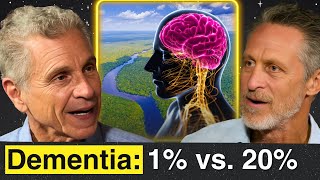
A conversational YouTube interview (AI Mark with Alberto Villoldo) arguing that Amazonian peoples have far lower dementia rates (1/100) than Americans (1/5). Villoldo attributes resilience to traditional diets, sacred plants that act as NRF2 activators, BDNF-promoting nutrients (DHA), healthy microbiome (e.g., Saccharomyces boulardii, Akkermansia), and lifestyle practices (ketosis, autophagy, ceremony). He discusses mitochondria, senescent cells and senolytics (fisetin/quercetin protocols), psychedelics' role in neuroplasticity, and the need for integrated body–mind–spirit healing. The clip references his book Growing a New Brain and offers practical recommendations (broccoli sprouts, cycling phytohormetic compounds, tryptophan/5-HTP, polyphenols, senolytic short protocols).
Questions this video answers
Amazon: 1 out of 100; America: 1 out of 5.
Around age 35 (as stated).
Sulforaphane from five-day-old (homegrown) broccoli sprouts (claimed ~85% bioavailable).
Saccharomyces boulardii (noted to leave the gut after ~6–7 days).
Fisetin and quercetin as senolytics; described as a 'hit-and-run' intervention lasting about 4–5 days, repeated several times per year.
Chapters
In the Amazon, the rate of dementia is 1 out of 100 people. In America, it's 1 out of 5 people. And primarily women. You know, women have a stronger incidence of Alzheimer's. So what did they know about the brain that we didn't in the laboratory? How did they protect it? And we found it. We found the secret.
So, Alberto, it's so great to have you back in the doctor's pharmacy.
Good to be with you, Mark.
So for those people listening, we've been friends for 25 years. We've been to the Amazon together. We've taught workshops around the world together. We're now together at your House and Center cafe here in New Mexico. And, you know, I'm recovering from back surgery, but we're not going to talk about my back today. We're going to talk about the brain.
Let's talk about the brain that's kind of close to your back. It's a little bit higher, but, you.
Know, the bottom end of my brain. And you've written this new book which has a very provocative title, which is called Growing a New Brain.
That's right.
So why do we need a new brain? What's wrong with our brain?
Well, I'll tell you what's important here is to understand that we grow a new brain already anyway, every seven. Every 20 days, an entirely new brain. You know, at different rates of speed. We grow new body every seven years. You know, skin cells every seven days. The lining of your gut is every three days. But we thought the brain didn't repair itself. Remember in college, we learned that you only had so many neurons and every.
Shot mess them up with drugs. That's it.
Every shot to chemo is 20,000 brain cells.
Yeah.
Today we know not only do we have stem cells, but that every neuron, through a process known as protein synthesis, regenerates itself.
That's really remarkable. So what you're basically saying is that the science of the brain is sort of in a new era. What we used to think about the brain, we now are completely reevaluating and realizing that we have the capacity to impact our brain in ways that we never thought possible.
Precisely.
And I wrote a book about this 15 plus years ago called the Ultra Mind Solution. Fixing your brain by fixing your body first.
Precisely.
And you previously wrote a book called Growing a New Body, which is based on a lot of the work we did together in two courses. Yeah. But this Growing New Brain book is very intriguing to me because it kind of challenges our notions about a lot of the work that I Think you do, which is shamanic healing energy medicine. Shamanic energy medicine, trauma and dealing with a lot of the things that are, we think of as psychological.
In fact, I'm going to put on my, my shaman's Shaw. There you go. You know, I started out in a brain laboratory at San Francisco State and then I went to the Amazon, but I noticed that Gabor is using his.
I like that, I like that, I like that.
And today I think we have to become neuro shamans, you know, rely on. Because we studied the brain and we're looking at the hardware. But what about the mind? None of this brain scientists have anything to say about the mind.
Well, that's it. I mean the joke was that the neurologists pay no attention to the mind and psychiatrists pay no attention to the brain. But the truth is we have to do both. And so when you started in this work, you were really coming at it from the perspective of psychological healing.
I was coming in spiritual healing, energetic healing.
And you realize you maybe came up against a wall and couldn't fully help people resolve a lot of their psychological, emotional, spiritual issues unless you also help them heal their brain. Hence growing a new brain.
Repair the brain. You got. Our brains are broken today and we know the list of the things that are breaking the brain, but we really don't know yet how to repair it, how to upgrade it. How do you upgrade the brain to create psychosomatic health? That's what we were investigating at San Francisco State. And when I got to the Amazon, I shut my lap down.
Wait, I just want to stop there. You said psychosomatic health. Now we've all heard of psychosomatic disease. It's all in your head. Yeah, you're talking about the opposite, right?
How do you do that? We know how to create psychosomatic disease. Basically it's a stress hormone, you know, adrenaline, cortisol, the, the amygdala running the show, you being angry all the time. You're going to get sick. We know that. But how do you create psychosomatic health and come to the optimize brain function, Come to the state that the ancients used to call gnosis, which is direct knowing, which is we think it's knowing all that happens when you operate from the lower brain where you think you're know all. Take a 15 year old kid, you know. Yeah, yeah, why don't you leave now, home now honey, while you know everything. But we're talking about upgrading the brain so you know the all and, and you come into the state of gnosis, where you understand how nature works, where you understand how you can create health.
And it was so easier back then, right, with the indigenous people and the Incas 500 years ago. And the descendants of those Incas are the people you study with. And they didn't have environmental toxins, they didn't have social media, they didn't have shitty, ultra processed food. So what are the kind of insults that we've now had to deal with that have caused our brain to become so dysregulated that we're seeing this rampant crisis of mental illness that we're seeing increasing violence? We just recently saw a shooter try to take out President Trump. I mean, that's just terrifying to me. Right?
Yeah. Anxiety, the violence, the projection of the shadow. The enemy is the other, and we don't see it in ourselves. So we know these psychological mechanisms. But when I shut my laboratory down, I was in the biology department, not in psychology, but in the biology department. And we had a small brain lab, and we were in the section where you keep the brains, the formaldehyde. I was surrounded by 200 brains.
Yeah.
Pickle brains.
So bad.
Oh.
I actually recently tested my biological toxins, and embedded in my cells is still the formaldehyde from when I was in med school dissecting cadavers.
Two years. Two years in that lab surrounded by brains, and I couldn't get a second opinion from any one of them. It's a d. It was a terrible thing. Then I shut it down and I went to the Amazon to see how people protected the brain. Remember, Native American peoples had no writing, they had no record keeping. So how do you protect the wisdom, the knowledge of a tribe, of a society, of pyramid builders, of architecture? Because it's all stored in the brain, the mind of the elders. How do you protect the brain of the elders when you don't have writing? When you. What happens if you forget how to make fire? That could be a big problem.
Definitely.
So that's what I began to study. How. And I was funded at that time by Big Pharma. I was a medical anthropologist. And they wanted to know the next.
Big cure for all the drugs in the Amazon they can reap and harvest.
Precisely because in the Amazon, the rate of dementia is 1 out of 100 people. In America, it's 1 out of 5 people.
Wow.
And primarily women. You know, women have a stronger incidence of Alzheimer's. So what did they know about the brain that we didn't in the laboratory? How did they protect it? And we found it. We Found the secret.
Really?
Yeah.
Okay, lay it on. Totally, Dr. Waldo. What are you talking about?
I'll tell you what it is. I'll tell you. It's about restarting systems that shut down at about the age of 35, which are the detoxification systems, which are the NRF2 activators. That's what we know them to be.
What was that big word? I know what it means. I bet most people listening know what an NRT activator is.
I can't, I can't pronounce it, but.
NR factor, kappa, kappa, beta.
Yeah, yeah. It said it's a protein that sits on the cell membrane. They're like the Navy seals. And when they're needed because some outside insult, they go in from the cell membrane into the nucleus and they begin to switch on the genes to create health and silence the genes that create disease. Now, this was only discovered about 20 years ago.
Johns Hopkins researcher. They found in the laboratory is that these systems, which are the master detoxifying systems, begin to shut down at the age of 35. But today we know how to turn them on again. We know that we have to get to password protected regions in our DNA to switch on these systems because biology invest heavily on the young.
So what's the password?
The password are certain plants that are DNRF2 activators. And we know what many of them are, and the Amazon is full of them. What we found in the Amazon was that actually we found this with our friend David Perlmutter, that the sacred plants, not the teacher plants, those were the psychedelics, which we can get to a little bit later. But the sacred plants were the ones that switched on your detoxification and regeneration systems. And today we know what they are. You know, five day old broccoli sprouts. Broccoli is a huge NRF2 activator. Coffee is an amazing NRF2 activator. But there's the hormetic curve, the hormetic effect. If you do it for more than five days in a row, you begin to shut down the very systems you're beginning to turn on again. So you got to cycle them.
This is a really important point you're making because, you know, all these plant compounds that we think of as medicine can be medicine for us, but they're actually the defenses for the plants. So they're, they're poisons and the dose makes the poison. And what you're saying is these are, I think this is phytohormesis is the actual term I've written About my book on longevity, because it's such an interesting concept that these stress molecules in plants, and the more stressed a plant is, the more it makes of these defense molecules.
Precisely.
The more it activates our body's own embedded longevity repair pathways.
And you gotta have the ones that are bioavailable. Like the most bioavailable one that we know is sulforaphane, which comes from broccoli sprouts. 5 day old broccoli sprouts, you got to chew them well. Imagine you're a rabbit trying to eat a broccoli. And then there are these toxins being produced, which is the defense mechanism that all plants have. That for us becomes medicine at the right dose. And that will switch on these very same systems. Because the body thinks that suddenly you're consuming a poison and it'll mount a huge antioxidant defense. It'll start producing glutathione, which shuts down. Normally at about the age of 35, will begin producing superoxide dismutase, a massive production of these. But if you keep eating those broccoli sprouts every day, it'll shut them down. Say, hey, this is not poisonous.
Right. Because your cells upregulate and downregulate in response to the environmental use. That's why you get alcohol tolerance or opioid tolerance. You need more and more to have the same benefit, right?
Precisely. And this is what the Amazon indigenous people discovered. Without knowing what an RF2 stands for, they just know that these were the sacred plants that promoted longevity.
But they weren't eating broccoli sprouts in the Amazon.
No, they have a bunch of other. Una de Gato, cat's claw. There's 50 others that are extraordinary. But we can't get them in the west because we don't know the quality that we're getting and we don't know how accurate the dosing really is. It's all in the dosing.
There's other ones, like curcumin.
Curcumin is an amazing one. But curcumin is 5% bioavailable, whereas sulforaphane from 5. Deal. Broccoli sprouts you grow at home. You gotta turn your kitchen into your laboratory.
There's all gonna be hippies and grow sprouts in our kitchen now.
Totally.
We used to do that in college.
Five day old broccoli, homegrown broccoli sprouts are 85% bioavailable. So do your curcumin, do your golden milk, but be sure that you pay attention to it. It's in my book, my most recent book, which is the Grown Body Cookbook.
Yeah.
All of the science is there, but now for growing a new brain, we need the NRF2 activators and the things that will promote neuroplasticity and neurogenesis.
Yeah. And there's other things you talk about besides these plant compounds. And you talk about the other major factor that needs to get turned on to repair the brain called BDNF in the.
Precisely. Bdnf.
What is bdnf?
BDNF stands for brain bdsm.
It's bdnf.
Bdnf, bd Brain derived coming from the brain neurotropic factors, factors that regenerate the brain. Now this switches on the production of stem cells so that one of the best BDNF inducers is mother's milk.
Wow.
But it's hard to get at the health food stores. You know, you can't get it. But because mother's milk is 50% DHA, Omega 3 fatty acid. DHA, Omega 3s are promoters, turn on the production of BDNF. So does exercise, meditation. But the classic, the best One is, is DHA. It's Omega 3. And in fact, you know, I'm an anthropologist, but the Native American peoples in North America used DHA as their money, as their currency.
Yeah. Well, it was, right?
It was a fish called. What was that fish called? The candlefish. It was so rich in oil that you could put a wick in a dried fish and light the wick, light your fish, and it would be your candle.
It was in the Pacific Northwest.
Yeah, the fish, Pacific Northwest. And they would extract, extract the oil. Even today, they still do it 100% rich in DHA. And that's what they used to trade with. Also it turned on the higher brain production of stem cells and it repaired the hippocampus, which is why there's so much trauma today. Today, trauma has become as common as air.
What's the hippocampus and how does trauma impact that?
The hippocampus is the learning center in the brain. And it's rich in cortisol receptors. I mean, it's full of cortisol receptors. And when you have trauma, when you switch on the fight or flight system, and it's not fight or flight that does it. Fight or flight, you get to fight, you get to run. It's when you can't fight and you can't run. If you're six years old and an uncle is fondling you. You can't fight, you can't run. You freeze, and you get into freeze. And when you get into freeze, your brain is to wash in cortisol and adrenaline. Now, if your mother wasn't sure that she could rely on her partner to take care of her and her baby, you were born with your fight or flight turned on the HPA axis, hypothalamic, pituitary, adrenal axis. Your brain, with specific cortisol and adrenaline, go right through the placental barrier. So the Hopi have a saying that before you're born, that you have a twin, an invisible twin. All of us do. And before we're born, the twin looks out of the uterus to see if the world is safe. And if the world is safe, it says, come, come on, come on, let's go out into this world. It's loving. And if it's not safe, part of you is not born. And you're born with soul loss, what they call in native societies, they call soul loss. So you have to do a soul recovery. But when you're born incomplete like that, we know the brain chemistry now.
Yeah.
So this is that you're born with your fight or flight switched on. That damages your hippocampus. You cannot have a new experience. You cannot learn. You can't store memories. That's what the hippocampus does.
Seeing you in your book, you talk about sort of how we. We need to heal our bodies, to heal our spirit and our mind. And can you talk more about that? Because it's really kind of goes to what you're talking about. You know, the Carolyn Mace used to say, your biography becomes your biology.
Yeah.
And what you're essentially saying is that your biography, your story gets transmuted into biological signals along with all the various other things that we're exposed to in our modern world. Our processed food, the environmental toxins, chronic stress, digital overload, et cetera, et cetera, et cetera. But in order to actually, really heal and to become whole human beings, we both have to heal the brain and the mind and the soul and the.
Body, you know, and, you know, in the west, we practice medicine by specialty, you know, geography. The neurologists don't talk to the GI docs. And most of what's happening in your brain is coming from your gut.
Yeah.
So there's no people that do the entire system. And this is what I do. Yeah, yeah. You and two or three others said, I know, but this is what the shamans, the indigenous people do. They look at the entire system, and not only the entire body and mind, but how you're relating to the ecosystem, to nature, and to the family system, and to your destiny. Like an important part of the healing is finding out what is it that you came to do here in this world. And when you go on that quest, even if you don't find out what it is you came to do, but you're looking, searching for it, suddenly the universe has your back. Mother Nature begins to support you in your healing. And this is what I learned in the Amazon, because, you know, I was in the biology department, and in biology, you believe that Mother Nature, that Gaia, the planet, loves her species, but she doesn't care about the individual members of the species. You know, she cares about the species. You and I are expendable. But the Shamas believe that the minute you come into service of the Mother, that you become an Earth keeper, that you become conscious of the impact of your actions in the Earth, that she takes a personal interest in you. And then magic begins to happen. They call it magic, we call it health.
So that. So that one of the things that I stopped doing, I always used to bless my food. You know, I stopped blessing my food. Now I ask my food to bless me. This is coming from the Mother. So. So your return to the Mother is so important because what happens at that point is that you heal shame. And shame is the most bedeviling, befuddling, toxic emotion that we can have. Shame means I am not worthy, I'm not a good person. And that's the very first experience that we have emotion in the west, because our mythology, see, when I was in the Amazon, I would ask people, what's your mythology of origin, your first story ever told? And our first story ever told is we got banished from the garden.
Bite that apple, and we're screwed for.
Life because we were ashamed. God comes and says, where are you guys and why are you hiding? And Anna says, because we are ashamed. So we heal the shame. The shame is the deadliest.
Toxic emotion that we can have. And the way we heal it is by returning to the mother and finding out that she loves us.
And part of that you're talking about in. In the book Growing a New Brain is really about how to use food and lifestyle strategies and supplements and other tools to help actually sort of repair a lot of that damage.
That. Look, you can't grow a new brain on French fries. No, you can. You gotta have French fries for dinner. The right neuronutrients to be able to do that. And an essential one of these is. Is tryptophan.
Ah.
So, you know, tryptophan is a precursor for serotonin. And serotonin is ubiquitous. It's everywhere in nature. So trees have it, butterflies, plants have serotonin. And for us, it's a neurotransmitter for a plant. It tells you when to go flower. But I suspect it does that for us too. When do we blossom?
Haven't you seen a plant that looks kind of depressed? You know, it's kind of saggy and.
Yeah, give it a. Put a little bit of tryptophan. And today we can order it from Amazon.
You know, it's in that plant food that you put in your.
You don't have to go to the Amazon. You can order it from Amazon. And it's tryptophan or 5 HTP. It's a precursor for serotonin. And serotonin is what repairs the hippocampus. Yeah, this is absolutely the key. And we're serotonin deprived right now. Our foods are devoid of serotonin. And 100 years ago, a pea, a sweet pea, had twice the amount of tryptophan than it does today. Because we're breeding foods for sweetness, starch, not protein. Precisely.
Tryptophan's an amino acid.
It's an amino acid. We have a hunter gatherer genome, evolved 2 million years ago. Our DNA hasn't changed that much in 2 million years. When we were hunter gatherers, primarily we were gatherers. So scavenger gatherers. We would find roadkill and bring some meat home. But most of the time we were gatherers, and the animal protein was very scarce. So the transport system to get tryptophan into the brain gives priority to the three amino acids that are the branch chain amino acids. Valine, isovalene and leucine. Prioritizes them because we had such little for thousands of years. So little animal product. Then tryptophan has to take a second place because you need these for protein synthesis. But today we're serotonin deprived. And that's why so many people are in the SSRIs, which are flooding the brain with serotonin to help you stabilize your mood and your hippocampus repair. Yeah, and the hippocampus is what. Where learning happens.
So actually, when you're talking about this, because, you know, for years I've done diagnostic testing which allows me to look at the effects of inflammation on neurotransmitters. And so we measure something in the urine that is called Quinolinic acid, which is a byproduct of tryptophan 5H2 metabolism. When there's inflammation, that diverts it away from producing serotonin to produce this very toxic compound called quinolytic acid, which is found very high in people who are depressed or have autism or dementia. And it's, it's, it's, I can tell immediately if someone has brain inflammation. The question is why? And so, yeah, a lot of the disruption in serotonin regulation, I think, is because of our inflammatory diet, gut microbiome. And you do talk a lot about the gut brain.
We do talk.
Tell us about this framework of how the brain repair has to also start.
You know, the thing I really don't like about being interviewed, but by you, Mark, is you've written about half of the stuff already, you know, but luckily I don't read all your books, so I come up with my own.
But we're coming at the same thing from two different lenses, totally. The shamanic lens and the medical lens.
Precisely.
We end up in exactly the same spot.
Precisely. And the thing is that today we have to become our own chief scientist because we can't rely on the science. You know, the editor in chief of the British Medical Journal wrote that at 50% of the articles that they publish are bogus, they're bad science. But we just don't know which 50%. So we have to be very careful, researchers, find out who we trust, and especially when it comes to probiotics and comes to the gut, because the probiotics we buy at the store are only 1% of the whole gut probiotic system. Which are the aerobic ones, the oxygen breathers. 90% or 95% of our gut is the non oxygen breathers, the anaerobic ones, that nobody, you can't buy them, you can only feed them and hope that they grow, that they grow and they get strong, because that's where you produce serotonin. Your gut transforms tryptophan into serotonin and then it gets taken by the vagus nerve and by the bloodstream across the blood brain barrier and into the brain. There's this little teeny bit of serotonin produced in the brain by the raphe nucleus, very one out of a million neurons, our serotonin producers. Most of it comes from your gut. If your gut's broken, you're not producing serotonin, which then the pineal gland, once it gets to your brain, if it gets to your brain, turns into melatonin. So you can sleep.
Yeah.
And if your fight or flight system is attenuated, it's toned down. If you're not in constant alert waiting for danger or who's the shooter that's going to come by. Know what kids are most terrified of today is going to high school because there's such. You read about such danger. If your fight or flight system is toned down, then the pineal gland can not only produce melatonin, but it will begin to methylate serotonin, which is a triptamine, and you end up with Di2 dimethyltryptamine, which is ayahuasca. Whoa. Which is the brain produces. And all of the psychedelics, by the way, work on serotonin receptors in the brain. So lsd, lsd, mdma, psilocybin, lsd. Ayahuasca, which is the most powerful psychedelic known to humans, is produced by the brain. That's why we have receptor sites for it. But you have to get the serotonin in there and then you wake up the higher brain. And this is what allows you to create psychosomatic health. Because you had the experience of oneness, of communion, of belonging, you understand how life works and how you're part of it.
Wow. And so. So part of the healing of the brain, you're saying, is healing the gut. How do you. How do you recommend people do that in your book?
Well, you know, there's a dozen books written about this, including a couple by you.
Yeah, yeah.
Of how do you repent.
I'm curious of what you've learned. Know a different set of lenses looking at how you start thinking about the gut. You know, for example, visiting you in. In Chile, you have this big bunch of raspberries that's kind of a culture medium for a probiotic called Saccharomyces boulardi that's really powerful in regulating.
This is the key for us, the work that we do is a product called Saccharomyces boulardi, which actually a yeast. So it's not a really a probiotic, but it's yeast that. That acts like the United nations peacekeeper inside the gut. And it begins to regulate the colony. And it gets rid of Candida, which has taken over the gut of most people in America today. Candida is a yeast that proliferates the minute you take antibiotics and you can look at your tongue. And if it's got a white film on it, you've got Candida. Now, the purpose of Candida, everybody should have a little bit of this yeast.
And there are many other yeasts and.
Fungus that grow, but especially of Candida, is to ferment you after you die. This is like nature's garbage disposal, like.
The Last of Us TV show where they get eaten by the mushrooms.
This is it. Yeah. So, but you don't want that to happen a day too early, of course. So Saccharomyces boulardi, and this is in my website, I've got. You got instructions in my books, is actually a yeast that competes with Candida, brings balance to the gut, especially to this kind of dark area, this, this kind of black hole that we have in our guts of the, of the anaerobes, the non oxygen breathers, and it brings balance to them and allows them to proliferate and it gets rid of the bad parasites, it gets rid of the H. Pillory, for example. There's a really good science behind the use of sacromycin and it's been used with babies and children for 50 years to stop diarrhea.
Yeah, it's quite incredible. In fact, they use it in clinically, in medicine for people who have C. Diff as a treatment.
Precisely.
Diff, which is because of Clostridium bacteria that can kill you. I had it, it almost killed me. And yeah, it's a power, it's a powerful compound. We call it a yeast against yeast.
This is. And the beauty of Boulardi, a sacrament Boulardi, is that it doesn't stay in your gut, doesn't colonize. It leaves after about six, seven days.
You know, one of the things we see a lot on our stool tests when we do stool analysis is a reduction in something called IgA. That's an antibody, the first line of defense of your immune system.
Right.
And when you say Covid antibodies, those are the defense against Covid. Right. So you have a system in your gut which interacts with the outside world. And typically when our guts being such a mess, we see a lot of people with suppressed IGA levels and the saccharomyces helps to bring it up. So you're talking about these sort of ancient organisms that we've symbiotically evolved with to help regulate our biology and restart and renew processes that have been going on for hundreds of thousands of years. But we kind of messed them up.
You know, if you want to see animals in Africa, you, you go to where the food is, that's where the animals go. And that's what these bacteria did in our gut also. They went to wet the food. Yeah. So they get to eat first and then they eat first and then there's actually, about 10 levels, 10 layers of probiotics in your gut. And then we get to eat less because one layer, they begin to break down our foods. So Boulardi is an excellent remedy. And then you've got to feed the others. And what do they feed on? They feed on the stuff that you don't digest.
Yeah. One of the most interesting things I discovered in last year is, especially when I got sick with, with ulcera colitis after C. Diff, was this whole body of research not just about fiber, not just about prebiotics and probiotics, but about polyphenols, which are the phytochemicals that you're talking about from these sacred plants that actually feed the good bacteria too. So they actually love that stuff.
You got to feed them. This is the best way because the probiotic market is an $80 billion market annually. And most of the stuff doesn't work. Unfortunately. There's some good ones, but none of them work with the anaerobes. The only way to work with them is with ubiquinol, with, not with quercetin, with quercetin, the polyphenol rich compounds that will feed them. And the fiber also is really important. So beginning with the gut, and then you find the keystone species. So in the Yellowstone national park, they shot many of the wolves, drove the wolves away, and they found that the whole ecosystem went out of balance.
Yeah.
And they reintroduced the wolves and the ecosystem went right back into balance. And one of the keystone species is the Archimancia municipalia. So if you work with these keystone species, they bring order to the ecosystem.
Yeah. Akkermansia is really important. We've done a lot of work on the podcast talking about it because it's such an important thing. But I had very low levels when I had colitis and I took pomegranate green tea and I took cranberry in high doses.
Yeah.
Every day in concentrates. And it regrew my Akkermansia.
Yep. It's incredible how quickly they respond. But you got to get rid of the bad guys first. Sometimes you have to take gluconazole or you've got to take something to get rid of the, of the, of the yeast, which colonize very rapidly. And then you've got to reset your vagus nerve, because the vagus nerve is the transport as a highway taking serotonin to the brain.
Wow. So we've covered a lot here. I, I, I, we've covered, you know, the ancient ways that our brain is designed that we can actually activate to grow a New brain and to deal with both the mind and the soul and the biological things that go wrong with our brain as a way of actually accelerating our growth as human beings. Because at the end of the day, this is what it's about. Health is not just about, you know, being healthy, not sick. It's about actually being able to express your life in a way that's fulfilled and whole and alive. And if you don't have mental, physical, social, spiritual, emotional, brain health, body health, you're not going to get there.
You're not going to get it. Yeah.
So there's a bunch of other stuff you talk about in the book that I think is quite interesting. What is this whole idea of mitochondria? Yeah. And we've written a book on power up. I think it was called power up.
The brain or power up your brain.
With David Promoter, who's a really good close friend. He's been on the podcast, incredible neurologist. And I was like, that was your kind of first foray into out of the shamanic work, into like the.
Well, see, the mitochondria. See, the thing is that there's nothing more spiritual than biology.
Yeah.
100% to begin with. I mean, it's a miracle.
It's like the dow. I call. Call the DAO of biology. Like the dao physics. Yeah.
And the, and the people that, that say, the psychologists are great. You. It's good to be able to tell your life story to someone, but you can't. You can tell your life story, but how do you change your story when your story is deeply biological and it's not just what happened to you when you were little? So the perspective that I learned from the shamans in the Amazon is that trauma is not what happened to you. It's a story you wrap around it. There are no traumatic events. They're only traumatic experiences. And to heal that experience that's been damaging your hippocampus, you got to support your hippocampus. You can't write a new story about your life journey until you begin to repair the hippocampus.
How do we do that, doctor?
You cannot. You gotta change your brain to change your mind. You can't change your mind without changing your brain. That means intervening with the hippocampus, first and foremost, repairing the gut. But the quick fixes are things like L tryptophan 5 HTP, the precursors for serotonin. And in six weeks it begins to work and you begin to feel happier. Serotonin, you know, it's a happy Molecule.
Yeah.
So then you have to go on the quest, and the quest is the quest for what am I doing here? Why did I come to do in this life? Did I come to spend another year in therapy?
What is your personal quest? And how can you make a difference in the world, leave this place, a better world than the way you found it. And that's what's going to bring you then you're not going to be fighting with your body. You're not going to. You're going to begin to shift your priorities to eating natural, seasonal, local, organic. To becoming kinder, gentler person, to forgive more easily and to love yourself and to make your way back to the garden, back to Eden. You got to drop the whole shame story, which is I am not worthy. You only do that. You cannot do it through psychology. You got to do it by returning to the mother, by becoming an Earth keeper, a steward of our planet in your own little way.
When I hear you saying in the subtext there is that re establishing a relationship with nature is really critical here. And nature is our biology. And unless we understand our biology, everything from our gut microbiome to our mitochondria to all the different things that affect us, we're not going to be able to get there.
Yeah, you can never be disconnected from nature because you are nature. Yeah, you can be disconnected in your own head, but you are nature. You embrace your nature and you recognize that you're on a spiritual quest to find out who. Do you know the three ancient questions that every spiritual tradition has? Who am I? Where do I come from? Where am I going?
And, you know, the church answered that for us for a long time. And then science came around and said, you didn't. You came from a primordial soup. Who am I? You're a bunch of molecules. And where am I going? Nowhere.
Right. Disorienting.
But the spiritual traditions are about you finding, going on the quest. You begin by asking the questions, but you gotta get to the higher brain. The problem is that our lower brain, our limbic brain, the Neanderthal brain, needs ceremony in order to change. And that's why you have ceremonies in every culture, every society in the world.
Well, what's interesting is that most doctors around the world do ceremony.
Do ceremony.
That's how they heal, with ceremony. Quick story. I was. I was in Mongolia on this horseback trip where Genghis Khan, you know, rode his horses. And it was an incredible trip. And I got the worst fricking hiccups that wouldn't go away for three Days they literally were thinking of evacuating me for a case of terminology medevac on. We got to this little village and it was in remote Mongolia and I don't even know where it was. And there was a year, one year, and there was a family lived there. And apparently the elder women woman there was a shaman among her other duties of herding goats. Sure. And yaks. So she brought me in her yurt and she took these stones and bones and this kind of sacred objects and kind of threw them and kind of read what was going on with me. And. And then she took my shirt off and she put rancid yak butter all over my belly and started rubbing and chanting and rubbing. And after three days of pure misery and actually fear because there's a lot of serious things that chronic hiccups can mean, like cancer. I was like, oh my God, am I got cancer? They went away. I don't know ceremony or they just would have gone away anyway. But the point was that these ancient cultures, their healers are also embedded in both nature and in ritual.
Yeah. And the ritual is so important because you're giving the person permission to get well. You're giving them permission to explore something new in their life. That's why we have graduation ceremonies. That's why you go into the military. It's full of ritual and ceremony. You need permission from the healer and from yourself, and you need to go through a little rite of passage. It doesn't need to be yak butter on your chest and your genitals, you know, so the. It needs to be a small rite of passage that you create with your provider. Sometimes it's prescribing a medication that'll do it. But if you can also orient the person towards their quest, put them on a quest. Ah. Then healing is accelerated tremendously. But to be on a quest, you need the brain nutrients and the neuro nutrients are the stuff we're deficient in.
Yeah.
And you need to detox the brain because we're exposed to so many, so many toxins. Remember, the body in its wisdom stores toxins in fat.
Yeah.
And the brain is 70 fat.
Yeah.
And this is the kind of fat you don't want to lose. You know, when you go on a diet.
Yeah. It's so interesting. You're talking about the brain and fat and the decline of our brain function. And, you know, one of the things as a functional medicine doctor is I'm always looking for, you know, what are the emerging scientific discoveries that can help us to kind of help our patients. And there's been a new set of diagnostics which allows us to see things that we could never see before, like imagine the discovery of the microscope or the telescope. And now before we had to sort of, we kind of knew everybody's poison. Like, if we did autopsy studies, we could do biopsies of fat tissue. We can measure. Everybody's just a load of. Got a load of pesticides and dioxin and ddt, plastics and phthalates and diet, you know, pesticides and bpa, you name it. But we never can measure that in real life, humans, very easily, because in the blood, it kind of goes into your fat, most of it. And there's a new test that I've been doing out of Germany that measures intracellular toxins. And I have one patient with dementia and another one with Parkinson's, which are both neurodegenerative diseases. And we're seeing more and more of these problems.
They're rampant.
They're rampant. And what was amazing was we can now measure these levels of cellular toxins, and using a process of replacing the fat in the cell membrane, we can get rid of them using phospholipids, which is what their cell membranes are made of. It's really quite amazing.
You know, the. Especially when you look at the statistics, if you get to be 75, one out of two people will have diagnosable Alzheimer's. If you get to be. I'm sorry, one out of three, you get to be 81 out of two people.
Yeah, this is.
This didn't exist 100 years ago before Dr. Alzheimer's got to put his name on this illness he identified in the Amazon. The thing that amazed me is that the incidence of dementia is 1 out of 100 people. There's very little heart disease.
That's 1% there and 20% here.
20% here. It's crazy. And it's, of course, related to our lifestyle.
So learning how to grow a new brain, pretty important topic.
It's really important. And remember, the brain is fat, so you got to give it the good fat. You cannot turn on the higher brain until you go first in a ketogenic diet. And it doesn't need to be, you know, eating meat three times a day. But you got to go into autophagy. You've got to go into start recycling cellular waste and eliminating. And we know how to do that. Now. The beauty of it is, not only do we have the diagnostics, we know how to reverse this stuff. We know how to create a new brain. We know how to help people grow a healthy brain. And that's not only going to prevent the dementias, is going to let them step into this place of gnosis, of wisdom.
Yeah, it's interesting. You know, we've had Chris Palmer on the podcast. I'll probably have back again, who's a Harvard psychiatrist talking about mitochondria as the core dysfunctional unit that is causing most mental illness, everything from autism to schizophrenia to depression and bipolar disease. And then we have to treat the mitochondria. But you're also saying that in terms of the aging brain, and not just. Not just that, but also just having a healthy brain we really have to focus on.
You got it.
So how does that come up in.
Your book, you know, the Mitochondria? It's a big section on mitochondria. And how do we restore mitochondria? They're fuel factories inside every cell. And your brain and your heart have the highest concentration of these fuel factor energy factories in mitochondria. But then not only producing energy, they are actually in charge of the death clock. And whoever runs the death clock runs the show. They tell cells when they need to die so new ones can be born, so regeneration can take place. But mitochondria have. They're actually. They don't belong to us. They are actually bacteria that join our cells, form the eukaryotic cell millions of years ago, so that it cut a deal with these multicellular organisms saying, hey, I'm going to give you energy. You keep me protected, keep me warm, keep me safe. And that's what they do. But what they do is they turn. Basically, they store energy in the form of sunlight.
Yeah.
Of ATP. Of a molecule called ATP. Adenosine triphosphate. This is like the. Those sparklers that kids use. And when they're depleted, that energy goes from being ATP to adp. Adenosine mono amp. Adenosine monophosphate. Your fuel tank is empty.
This process of storing energy, of processing energy, of protecting the mitochondria, who have 38 genes and a ring that are unprotected because our DNA is 24,000 genes in a double.
Your brain cells have more mitochondria than any other cell in your body per cell.
And they are the feminine life force.
Like 20,000, 15,000 per neuron, per cell.
Yeah. And we only get the mitochondria from our mothers. So they're what the. I heard the Amazon shamans saying, you know, your people, their feminine life forces, very weak. And then David Perlmutter said To me, of course, it's mitochondria. That's right.
That's right.
Because we get it from the mother. So how do we protect, repair? And here's where we get into zombie cells.
Yeah, tell us about zombie cells. These are the zombies, like.
Like the ones in Haiti, the spiritual.
No, you're not talking about that.
We kind of. Because zombie cells, these cells are neither living nor dead, and they're actually a cancer protection mechanism that every cell has. So if a cell is not able to copy its DNA's information accurately to a daughter cell, mother cell, their mother cells and daughter cells, they're no daddy cells. If it doesn't copy correctly, it'll neuter that cell. So it cannot replicate, because we call that metastases. So it'll neuter it, but it won't kill it. So these cells are not able to reproduce. They're neither living nor dead, but they're mitochondria. They become fat and swollen and are starting to produce chemical signals, Chemokines, cytokines that are pro inflammatory and they're very toxic. But it's a cancer protection mechanism. But when you have too many of these, remember the problem here is the copying. If the copying is not accurate, they get neutered. What interferes with the copying is a signal to noise ratio or all the toxins we're exposed to. These cells begin to build and we end up with cancers. These senescent cells are called. And they were discovered by James Kirkland at Mayo Clinic, who did a beautiful gerontologist who said, I'm tired of prescribing walkers in wheelchairs. How do we begin to deal with the causes of aging? And he found that there were senolytic agents that actually switched on the kill switch, turned it back on in these cells, and you could get rid of them. You could do away with.
You could kill the zombie cells, which are also called. Senescence is. Senescence is aging. And senolytic means to kill aging. Yeah, kill the aging cells.
Kill the aging cells.
So how does that work? How do you do that?
Well, you. We don't know exactly. At least I don't know how they work. But they seem to switch back on the kill switch in mitochondria.
And what are the therapies they're using?
And those therapies are combining things like quercetin and fisetin. Fisetin is made from strawberries.
Yeah.
And quercetin is polyphenol. It's made from onion skins for a variety of products, natural products, and It's a hit and run intervention, four or five days. And I have a senolytic protocol that we use in our retreat center in Chile that you've been to and in four or five days you do away. It's a one and done treatment that you need to repeat. We're finding out three or four times a year because we got 40 years or 50 years of senescent cells in us and that what that does is to basically reset the system. You don't have this burden of zombie cells that you need to, that you're, that you're functioning with. It cleans you out.
Yeah, it's true. Also there's a great study out of Israel where they looked at, I talked about in my book Young Forever where they use hyperbaric oxygen over 60 sessions. I actually am doing it right now. I just came from it because of my back surgery to help heal the wound. But the beauty of the hyperbaric is that it, it actually creates a stress, but it also kills the zombie cells.
Yeah. And this is, I think essential. Absolutely essential. Our protocol is not only fisetin, quercetin, which is commonly used for this because this will kill the zombie cells. But how do you get rid of them? You got to work on the transport system and support the liver and eliminating them. We're combining it with alpha lipoic acid and with liver support including glutathione or glutathione to help to transport and eliminate them out of the body so they not just sitting there.
This is amazing. We're talking about mitochondria, zombie cells and microbiome, serotonin, you know, but see this.
Is trauma, this is plant based. This is working with. And the reason you're going to hear a lot more about senescent cells because we're getting to molecular solutions to, to pharmaceutical solutions. But this is available today. Fisetin is strawberries. You'd have to eat 30 pounds of strawberries to get the same effect.
You can take it as a supplement.
But it's an amazing supplement. Four or five day intervention that lowers your burden of these toxic cells that are pro inflammatory.
Yeah. One of the things that, you know.
It'S so fascinating is that, you know, we can start to embed these practices into our daily life. And you, and you, you've written this book, Growing a New Brain, which is not just talking about the theory, you talk about case stories you talk about.
And how to do it and how to do it. Yeah.
So can you maybe share some stories about how this would be applied what are the kinds of things people are doing? How does it work?
First, let me share a story about how I kind of got into on this track. Because I was running a small lab at San Francisco State. We were looking at can we create psychosomatic health? What are the mechanisms? And I got frustrated at one point, shut the lab down and went to the Amazon to see what they did. People that had no technology, but they had the plants, the natural world, the plant world, and the mind, the power of the mind to create. We know the placebo effect is the most tested medication in the world because every pharmaceutical is tested against placebo. And we know it's extraordinarily effective. I mean, it's 68% as effective as morphine in the case of gunshot wounds. Amazing. So I began looking at what's the placebo effect? We don't know what the mechanism is, but we know it works. We know it works even when the person you're giving the sugar pill to knows that it's a placebo.
That's amazing.
It's extraordinary. A lot of the shamanic healing is based on mobilizing this resource that we have to create health that we call, that we dismiss derogatively as a placebo that's just a sugar pill. Well, most of what you're getting in your pills that you take, well, you're.
Activating your psychopharmacology because I always say the best pharmacy is the one between your ears.
The one between your ears. Yeah. So this is what I became interested in. And so how do we do that for ourselves? Well, meditation seems to be one of those things. Practicing inner peace, breathing practices that begin because that's the interface between your.
That can allow you to self regulate your physiology and your nervous system. So I think we have to discover what works for us. We have to provide the brain with the neural nutrients, the support, get the serotonin. We're serotonin depleted right now. This is things that we can do immediately. And then turn your kitchen into your laboratory, then take part in. Why this number of people are calling the experiment of N is equal to one.
Yeah.
Where you have, you know, in medicine, if you have a research project, you want N, the number of participants to be as big as possible. But here the experiment is n is equal 1. My experiment is called Alberto. You're Mark.
I love experimenting on Mark.
Yeah, me too. And the thing is that if you don't do the experiment, you get to be in the control group.
And the control group is deadly statistics. You want to be an Outlier in that bell curve. So we need to take control of our brain today, not outsource it to our digital devices like we've done. Our memory functions are all outsourced to our digital devices. I was writing one of our blogs today and I said this thing popped up. Do you want help with writing this blog? It was chatgpt asking me if wanted me to do it. Soon we're only going to be here to clean the machines, so we need to really upgrade our brain, take the next step in human evolution. Because the one interest couple. Interesting details. There are 40 million species in this planet, more or less, and only three of those don't have a death program in their DNA. They're humans, dolphins and whales. Every other species in nature has a death program. There are no grandmothers in nature. Nature, there's, there's. They're eliminated. Whereas we have not only have grandmothers, but we can live 30, 40 years after menopause. No menopause in nature. It doesn't exist.
Interesting.
Nature is doing a biology experiment with humans, dolphins and whales and longevity. And to take part in that experiment, we need to be proactive in it. We need to attenuate the systems that create psychosomatic disease, the, the amygdala, the production of cortisol and adrenaline, and switch on the production of the psychedelics that the brain produces. To awaken the higher brain, it requires the psychedelics.
Well, let's talk about that. I was, I was going to close with this because I think, I think this is really an important framework because historically we thought of psychedelics and as causing psychological effects, but, but now we know they're causing biological effects and literally structural and functional changes to the brain.
Incredible.
For example, by increasing BDNF and other brain trophic nutrients, things that are helping the brain grow, repair, heal, reduce inflammation and, and things like, you know, DMT from Ayahuasca from, you know, the bufo from the Sonoran Desert toad, the, you know, psilocybin medicines, mdma, which is synthetic chemical, lsd, synthetic chemical or. But that comes from a plant ergot. All these are, are things that have been around for hundreds of thousands and.
They all act in serotonin receptors and.
They act on the serotonin receptors. But what we're now learning about them is that they can really create profound, lasting changes in the brain in a way, grow a new brain. What can you kind of tell us how you think about that?
It's amazing. If you've seen the brain on drugs, on psychedelics, you find that there are 20 to 30 times the amount of neural networks.
Not the Richard Nixon brain on drugs with the fried eggs.
Not the one with the fried egg. Yeah. And the problem is that many. So we're doing this experimenting without a traditional sacred structure. So every culture that works with psychedelics knows that you need a diet to prepare for it. A diet that's rich in serotonin for ex and some of the MAO inhibitors. And you need to prepare a sacred space, a safe space. Not just drop some acid or give somebody some ketamine. But even then, tremendous healing happens. So that's the chemical effect is what we're looking at. Other societies looked at the sacred. What was the environment? How do you create a safe space? How do you are able to commune with the divine in whatever form you encounter it? And thus part of what we're looking for, that we don't have the answer for that.
That's true. I think it's true. But I think what's sort of exciting to me is this sort of revolution in brain science and the revolution and trauma healing, the revolution in psychedelic medicine, the revolution understanding the body as a system and network. All these things are coming together. And I think it's going to change everything we think about the brain, the mind, our lives, totally.
It's going to open up the door to explore the mind.
So what does the future look like? Tell us about how you see the future.
I am very optimistic. I see the future as tremendously exciting. I think that there have been five extinction events in the planet before. We're living in this, in the fifth one right now. Started about 15, 20 years ago. More species are dying than the previous one. That's when a gigantic meteorite struck the Earth and wiped out 90% of life forms.
Wow.
During extinction events, nature seems to take the foot off of the brake and step on the accelerator. Evolutionary accelerator. So it's not only evolution in between generations, but now within generations that we can become a new human.
Epigenetic reprogramming.
Epigenetic reprogramming to become a new human being that can have long life, long health, and can become a keeper, an Earth keeper, steward of the Earth and can experience her and his divine nature.
So beautiful. Alberto. I mean, you know, I think of it a little scientifically too, which is that this concept that's emerging from our scientific discovery in a way. You know, we talk about shamanic healing, we talk about energy medicine, we talk about kind of healing from trauma. This fundamental concept of epigenetics, which is relatively New. It's the idea that there's a control system regulating our genes, that our genes are fixed, but which ones are turned on or off is regulated by this sort of master coder. And the coder is the epigenome, and that gets programmed generationally. So trauma can be transmitted generationally?
Totally.
The impact of toxins or crappy stuff. Food is transmitted generationally, and those impacts are found downstream two or three generations down. So if your grandmother was exposed to glyphosate, you're at risk for all sorts of cancers and deformities. Right. If your great grandmother had a trauma, then that might be embedded in your DNA. Like the Holocaust survivors.
Precisely.
Children and their children and grandchildren have.
Very low levels of cortisol. That been happening for generations.
So it's exciting. And what you're talking about, essentially, is using the site of science to reprogram the epigenome so you can evolve within one generation. So there was this debate between Darwin and Lamarck. Darwin was like, species evolved through natural sex selection over time. Mark was like, species come, fixed as they are. They're both right in a way. In a way. Right. And so these traits. And he was like, traits can evolve even in a generation.
So I think very rapidly.
Yeah, very rapidly.
Not only that, but we inherit not only the toxic legacy of our ancestors, both biological, chemical, emotional, but also the gifts, the extraordinary gifts of resilience, of courage, of endurance, of brightness. You know, and we have to begin to tap into that instead of. Our psychology today is so.
That's beautiful.
It's turning. It's turning us into victims. You know, I never heard that.
That's. That's one of the most beautiful things. I love that. Tell us more about that, because I think that's a great thing to end on, which is this idea that we not only inherited bad stuff, but good stuff, and that makes us into human beings that we are. That are all the good that we are.
It makes us into beings that are incredibly powerful, that have tremendous potential and possibilities and can be part of a grand plan of dreaming our world into being. We are the sons and daughters of heroes, of people that had so much courage, that crossed the Bering Straits, that survived under conditions that were. That were sitting around a fire, looking at the stars and realizing we're not alone 10,000 years ago. We have that in us as well. And we need to awaken. It's so easy to find what's wrong now. We got to begin to awaken what's right within us.
That's so beautiful. So, Alberta, tell us how they can find more about your book, about your work, about your website.
The book is called Grow New Brain. It's out now, and it's, it's in bookstores and Amazon, and it's and it has some risky practices in it, too. So I've got to caution you on that because some of these are meditative kind of journeying practices. And the my website is called the4winds.com. The4winds.com. And what I do today is to train modern shaman neuroshamas. That's why I have my scarf on.
So beautiful. Well, thanks so much for being back in the doctor's pharmacy.
Great to be with you again, Mark.
All of our wisdom and knowledge.
Yeah. Thank you so much.
If you love that last video, you're gonna love the next one. Check it out here.
More from AI


Why Younger Women Are Getting Breast Cancer at Record Rates (And How to Reduce Your Risk)




This Is Why 99% of Skin Conditions Don't Heal — And What Dermatologists Won't Tell You




