Why Cultural Competency Is Key To A Healthy Population
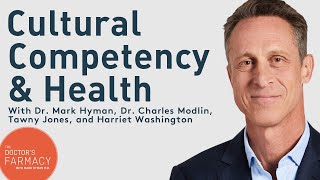
Dr. Mark Hyman and guests including medical ethicist Harriet Washington discuss racial health disparities and historical abuses like the Tuskegee Syphilis experiment. They explore how culturally sensitive healthcare and community engagement can address gaps in underserved African-American communities.
Coming up on this episode of the Doctor's Pharmacy.
A lot of people in the black community are really fearful of going to the doctor and they're fearful that the doctor is going to use them as a guinea pig. And that really contributes to a lot of the health care disparities that we see.
Hi, I'm Kaya Perowich, one of the producers of the Doctor's Pharmacy podcast. The coronavirus pandemic has shed light on the massive health disparities that have long existed in our society. Black, indigenous and people of color are far more likely to get sick and die from the 10 leading causes of death due to a range of factors. Among these is lack of access and the cascading effects of racism, prejudice, stereotyping, and unconscious bias on minority health. Earlier this year, Dr. Hyman spoke with colleagues at the Cleveland Clinic and medical ethicist and award-winning author Harriet Washington about these issues.
We're here at the Cleveland Clinic in Cleveland. There's many Cleveland Clinics. Our first guest is Dr. Charles Modlin, who's been a great partner with us at the Center for Functional Medicine. So Dr. Marlin, what's your sense of what the reasons for the disparities are in the African-American community?
So you touched on lack of access to quality care. I mean, that's a huge one. There's also a lot of distrust that many African-Americans and minorities have about going to the doctor. We've all heard of the Tuskegee Syphilis experiment.
Can you just give a background on what that is?
So that was where the Department of Health and Human Services, the Public Health Service Department of the United States. That was back in the 20s or 30s, I forget the exact decade, where they actually treated roughly about 800 men, black men.
It went up until the 70s.
Yes, right. They followed several hundred men, black men who they knew had syphilis, because they wanted to study the natural consequence of untreated syphilis in this patient population. And during that time period, and they.
Had penicillin, they could have cured them, but they didn't.
Oh yeah, they actually had the cure. The cure was available. They could have cured these men and actually during that time period the men suffered, many men died and they actually passed this disease to their partners. And the word got out in terms of what was going on and that spread across the black community in terms of what was going on, that experimentation. And so that still resonates amongst the black community and other minoritized groups we.
Had a lax is also part of that.
Exactly, experimentation. So a lot of people in the black community are really fearful of going to the doctor and they're fearful that the doctor is going to use them as a guinea pig. And that really contributes to a lot of the healthcare disparities that we see because a lot of the medications on the market have been developed and designed and tested just in- For white people. Especially just in white men in particular. A lot of disparities that we're talking about actually exist in women also.
Distress of the medical system in the black community came up again in Dr. Hyman's conversation with Harriet Washington.
So what happens is that the concern among African Americans about food issues is often not publicized by the news. It often remains under the radar. Or even worse, it's mischaracterized. I lecture frequently not only to medical schools and medical ethics institutions, but also to communities. And it is actually the most frequently cited issue.
So what are the conversations?
I'm not even speaking about food issues for the most part, but it always comes up immediately.
So what are the conversations you're talking about?
Well, there's a lot of understanding. First of all, there's a lot of concern about the importance of eating well and maintaining health on one's own because many people have justified trust issues with the medical establishment and frankly want to avoid it as long as they can. I don't think that's the right approach, but I understand why they think that.
And for people who don't know why the history of the Tuskegee experiment was.
Essentially- Not really Tuskegee, actually.
It's everything else.
Oh, really? That's a whole other conversation. Just quickly for those who don't know. My book, Medical Apartheid actually focuses on that. Yeah. There's a long history of abusive medical research with African Americans and the focus on Tuskegee, but the other studies were actually much worse and were very dense. I have 15 whole chapters, and only one of them It mentions Tuskegee. Wow. And not only in the past, but in the present, there are present day issues. There's one going on right now that I'm involved in, in Baltimore, of course, happening in Baltimore, where we have young black men who are being actively recruited into studies without their knowledge, where they're going to be forced into hypothermia as treatment for gunshot wounds.
Wow.
Yes, really chilling. Anyway, these concerns mean that many African Americans seek to avoid getting sick, avoid the healthcare system and they focus very heavily on food as a way of doing that. And so they often come with very precise questions to me that I can't answer, but they're concerned about not only eating the right things, but even concerned about brands. The brand of the bottled water they drink. It's like the last talk I gave, which didn't deal with nutrition at all, I was asked by a lot of people who were taking notes, which brand of bottled water should they should they eat? Or they'll talk about the fact that they avoid meat, that they have a vegan diet, and they also avoid dairy. I mean, they're very meticulous, it's very precise, and there's a great deal of concern about this. But I've noticed that it typically doesn't get addressed in the news media. And I'll leave any of you to speculate why that would be, but it's something that you don't see addressed in other, you have to be in the community to see and hear this.
Dr. Monlin further explained this in his conversation with Dr. Hyman, and you'll also hear from Dr. Hyman's colleague, Tawny Jones.
Who leads clinical operations at the Cleveland Clinic Center for Functional Medicine. You have to be culturally sensitive, culturally competent. You have to establish a relationship, you know, with the community. And so I just want to emphasize that you have to be very careful in terms of how you engage the community, because you could actually do more harm Yeah. And you know, you could really, you have to be able to resonate with the community. You know, it says, you know, nobody knows how much, nobody cares how much you know until they know how much you care, you know? So that's very, very important.
Yeah, racially and ethnically sensitive is my first step in creating programs in our community and creating programs for our providers. Because I think about the patient experience first. The patient is always paramount.
Yes. Yes.
You know, for, I know we were trained at the Cleveland Clinic. The patient is our North Star. So it's the most important person that walks through our doors. And so when I think about that, I want them to reclaim their life. I want them to have access to a program that makes them feel comfortable coming into. And I think this is where the community-based talks, where we get out front in front of these individuals and start to share very candidly, share this information and say, you know, this is the number of patients that have died as a result of this. And let me tell you how that could have been prevented. and really have an opportunity for them to share in that conversation. We don't see that in our communities. We'll do a health fair where we have one snapshot in time where we bring that information to them. And then months or another year will go by before we get back in front of those individuals. And I think that this needs to be a more concerted effort where it's ongoing. There should be weekly meetings, whether it's at the church, whether it's at the community center, whether it's in a space where they feel we're comfortable going to where we can share all of this information in a way that they understand it. You know, health literacy is real, so they don't necessarily receive it well from physicians. But we're the community workers who can help with this. Those, you know, coaches or individuals who are just inspired to be in the health space and who want to, you know, partner with health care organizations.
You know, you recently started with the Center for Functional Medicine, this program at Langston Hughes. with the very underserved African-American community. Can you tell us how that's going, what the response has been? Because I think people say, oh, people don't really want to get better. They just like the way that they're going. And they don't, like, maybe they know already what to do. They're just not doing it. What happened?
One kudos I will give to the Cleveland Clinic is it has a strong footprint in its community. And it is really focused on community-based initiatives to help improve the health and provide self-preventative measures in teaching and education for individuals that we would either serve out there or we're gonna serve in here in the hospital setting. So one way or the other, we're gonna get 'em. Yeah, so we can take a preemptive strike and do it the right way or we can see them on the back end. And, you know, I think we prefer the former.
So how are those people responding in that?
Very well. These individuals at Langston Hughes come back every week. And this is a 10-week program, but they have made the commitment because we are, one, removing the barriers and we're creating a space where it's very comfortable for them to come in and learn. We're not using terminology that would be offensive to them. We're not putting- How do I make sure I don't? We're not putting information in front of them, you know, 12 syllable words that they would have no idea. We go over their laboratory testing because you hear H1, H1, H1, hemoglobin. And you hear hemoglobin and you hear lipid panel and you hear all of these terms and it's just overwhelming and you think, oh, my gosh, Oh my God, is that bad, good, or indifferent? But you don't wanna ask your doctor because you feel like it, well, he'll think I'm stupid. And so, you know, we have those social stigmas that we carry around with us. So I don't wanna do that. But in this space, we just assume that we're gonna start everybody at square one. And let me tell you what a hemoglobin A1C does to your health. Let me tell you what a lipid panel does. People, and they are- How was this striking? To watch them, they're so immersed in this conversation and they're like, oh my God, for years I've been wondering, What a lipid path, that's what that means.
And they're doing it and their blood sugars are dropping and their blood pressure's dropping and their weight's dropping.
They feel better. That's awesome, yeah. Educating healthcare providers on the historical and current day practices that exasperate racial health disparities is an important step in creating a healthier population overall. If you'd like to learn more about any of the topics in today's episode, I encourage you to listen to Dr. Hyman's full length interviews with his colleagues at the Cleveland Clinic, as well as his conversation with Harriet Washington. If you enjoyed this episode, please consider sharing it with a friend and leaving us a comment below. Thanks for tuning in.
More from AI




This Is Why 99% of Skin Conditions Don't Heal — And What Dermatologists Won't Tell You






Why you need to start strength training today #strengthtraining #healthyaging #fitness
