Why Food Should Be A Factor In Treating Mental Illness
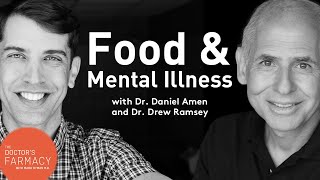
Dr. Mark Hyman, Dr. Daniel Amen, and Dr. Drew Ramsey discuss how diet and nutrition affect mental health and brain function. They argue that food, vitamins, and lifestyle changes should be part of treating mental illness, not just medication alone.
From a brain perspective, what we've learned is you're not stuck with the brain you have. Probably the biggest advance in neuroscience over the last 20 years is this concept of neuroplasticity, that you are not stuck with the brain you have. You can make it better.
Hi everyone, I'm Kiah Perowitch, one of the producers of the Doctors Pharmacy Podcast. Currently, one in five Americans live with mental illness. and unfortunately, despite its prevalence, social stigma is still a big problem. Even more shocking is that the past methods of treating mental health disorders didn't actually look at what was happening inside of the brain or incorporate the role of food into treatment and prevention. Dr. Hyman recently sat down with Dr. Daniel Amen, who has been paving the way for a new type of psychiatry. His approach looks at the actual brain.
And uses an integrative approach to prevent and treat disease. the brain is an organ and your brain can have problems just like your heart can have problems. But most people who see a cardiologist have never had a heart attack. They're there to prevent them. So I am trying to create a psychiatry where people know their risk factors and they attack them as soon as possible so that we can prevent depression, we can prevent bipolar disorder, we can prevent ADD, or if we can't prevent them, at least we treat them in a whole person, functional medicine approach. I mean, what an idea. And when we do that, their brains look better.
Thank you for reframing mental illness to be primarily a brain disorder that can be fixed by fixing your body and then fixing all these other circles, right? Because it's much easier to fix your other circles if your brain's working, if you're not mercury poisoned or your thyroid's not working or your you're not B12 deficient or vitamin D deficient or you're not pre-diabetic, all those things will mess up your brain, right? So, it's much easier to do the work of actually creating meaning and purpose in your life and being happy and dealing with the psychological issues if your brain's working properly.
No question about it. And if you've been traumatized, and so many people have because they've been raised by parents who have brain issues, then it changes your brain in a negative way. So, put the brain in a healing environment. the psychological work becomes so much easier.
So why is it so prevalent today? I mean, every 14 minutes someone commits suicide. Every 8 minutes someone dies of a drug overdose. 51% of the population at some point in their life have some mental issue. A quarter of the women population in this country are on antidepressants. Like, what's going on?
Our food system is broken, right? I mean, 70% of us are overweight. 40% of us are obese. I published two studies that show as your weight goes up, the size of your brain goes down. which should scare the fat off anybody.
Size and function of your brain.
Size and function of your brain. I've heard you say that many times. And because the fat on your body is not innocuous, it increases inflammation, it stores toxins, and it takes healthy hormones and turns them into unhealthy cancer-promoting forms of estrogen. And so if you just think about that, that one thing by itself, our food, I actually think is responsible for almost half of the mental health challenges in America. There's this fascinating study from Australia where they looked at two outer islands. One of them had fast food restaurants, the other one didn't. And then they looked at their omega-3 index. And the island with fast food restaurants had significantly lower omega-3 index and five times the level of depression. Think about that.
Yeah, of course.
With the food. Well, and that's one of the reasons I'm a fan of multiple vitamins, because we're basically a vitamin deficient society with deficiencies in magnesium and vitamin D and choline and vitamin B and C, Bs and C. And so I just think it's a smart thing to sort of hedge your bet. 97% of the population's low in omega-3 fatty acids. They have sub-optimal levels. I actually did a study of 50 consecutive patients who came to our clinic. we're not taking fish oil. 49 of them had suboptimal levels.
I mean, it's striking when you start to look and test, which most doctors don't. I mean, you actually are scanning people's brains. I scan their bodies through testing that looks at all these variables that most doctors don't look at.
Right?
How many doctors look at omega-3 levels in your body? Most don't, but it's essential for my practice because I can't tell what's going on if I don't know what's happening?
No, it's 25% of the membranes in your brain are made of omega-3 fatty acids. And so if they're low, your brain's not going to talk very well to itself. Yeah.
I mean, if you're listening, I think most people, and I think this is true, I've seen it in my family, I've seen it in my patients, most people with some type of mental disorder, there's a stigma. There's a sort of a blame game going on. and there's a shame about it. What your work is really doing is stopping that, saying that's just nonsense. It's like, would you shame somebody for having cancer or diabetes or an autoimmune disease? No, you wouldn't. You would try to sort through what's going on and look at the biology, and that's what you've done. So tell us why people suffering from things like depression, anxiety, bipolar disease, ADD, panic disorders, bipolar, schizophrenia, even addiction. Why should they be hopeful now?
Because if they see it from a brain perspective, what we've learned is you're not stuck with the brain you have. Probably the biggest advance in neuroscience over the last 20 years is this concept of neuroplasticity, that you are not stuck with the brain you have. You can make it batter.
Dr. Hyman also discussed the powerful relationship between food, depression, and overall mental health with psychiatrist, writer, and farmer Dr. Drew Ramsey.
There aren't many psychiatrists around who are.
Talking about gut flora and mood or the immune system. That's changing. I mean, that's one of the exciting things happening now is as food, as medicine, is becoming more of something that gets embraced and gets understood is really critical, especially to prevention. I think we're just seeing more, you know, people talk about the microbiome, right? There's a randomized clinical trial on for straight up clinical depression. last fall using a probiotic, where we have two randomized clinical trials looking at the Mediterranean style diet to treat clinical depression. So it's an exciting time right now.
And they showed benefit.
They showed tremendous benefit. I mean, it shows so much benefit. I mean, you know, if you fail antidepressant treatment right now, you get one of the treatment protocols, we get put on something like Abilify and an atypical antipsychotic, augmentation strategy, that's your evidence-based protocol. Yeah, nasty drug. No. That's what they use to treat schizophrenia. And then it crossed over. I like a bill of five for what we call a little ego glue. I mean, when you need it, a bill of five could be a good medicine. But what's interesting is the number needed to treat to get that right and find that right patient it works for is about 10. With the Mediterranean style diet, with the trout trout show does, the number to.
Get that right for it to help one person was four.
And, you know, compare that, you know.
So that means you treat 10 people to bill.
Find nothing happened.
One person gets better. Food you treat Four people with food.
And one person's better.
It's a much better drug than the drug.
I mean, it tastes better. It has fewer side effects. And it's whether you need a vilify or not. I think the part that concerns me and concerns you is nobody gets food to start with. Nobody gets much instruction around food when you get out, put on medications ranging from, hey, this is how long you're going to be on it, or hey, there's a little weight gain. Let's really dial in your diet. We don't mention food. And that's just, that's a huge, you know, beyond the meds, it's just a huge blind spot, both for health care in general, but really for mental health and that, hey, your brain consumes more food than any other organ in your body. Every other field of medicine, you go to cardiologists, you know, we might not agree with the advice that they give, but at least they talk to patients about food. The number one change I want to see is I want us to stop meeting patients when they're mentally ill. I want us to start meeting patients and helping them stay mentally well because the most powerful tool that I have as a psychiatrist is the power of prevention. And no one comes to talk to me or think about talking to me or fights the stigma to talking to me until they're late in the game.
And.
And that's great. I'll. I'm gonna get them better wherever you. Wherever you meet me, I'm gonna help get you better. But I'm gonna help you get yourself better, actually, is the way to put it.
But.
But I hope that what changes and what is changing is that we start having a language to talk about our mental health and recognize that we have this. I think people think about folks like you and me, one of the things I love about you is you talk about being depressed and people think, oh, you're a brilliant, successful physician, you're an innovator, you don't have depression. And it's like, no, you do and you have. And that's what I hope is gonna change.
So if someone's listening and they have depression, anxiety, mental health issues, what are the ways of eating that actually cause a problem? And then we'll get into what are the ways of eating that actually can fix the problem.
Yeah, that's such a great question. Let's start with the problem at the end of your fork before we tell you the solution. And the problem at the end of your fork, a lot of people know those words that, you know, everybody knows I'm about to say sugar, everybody knows I'm about to say trans fats, everybody knows I'm about to say processed foods. And so the surprise is it causes everything.
Cancer, diabetes, Alzheimer's and depression.
And I think what's really striking to me as a psychiatrist interested in behavioral change and as an eater and as a parent, how do you change those from being concepts to being behavioral and action-oriented items in your own life? And so what's causing the problem very simply is not getting enough of the right nutrients. And I would argue for a lot of Americans missing a set of nutrients. Americans are not getting phytonutrients because they're not eating plants. Americans are not getting seafood because they eat 14 pounds per year period, and it's fish sticks. It's not the seafood that we would want them to eat. They're not, you know, this is not shrimp ceviche and wild salmon. And they also, there's, I think, a problem that isn't just around the food choice, but is around, I would say, the missing spirituality of food. And that people have, we've lost our soul about food. And when you tell people to eat well, there's a notion that, well, that costs too much, or it takes too much time, or I don't know how to do it. And I think those are our missing lies. And I think it's just, I mean, my mama taught me how to cook and she's taught me that recipes start with olive oil or butter, garlic and onions. Pretty much. And then you add in, what are you putting some vegetables in that and you're good, right? You put in some meat in that, you're good. You, and so, it's pretty much how I cook. Yeah, I mean, and what I'm shocked by things like, when we make our lentil soup at home, we make a lentils, carrots, celery, and that's it. We put it in a crock pot. And I love serving that dish for people like, wow, what's in here? It's like it's lentil soup. Yeah, carrot, celery, a little pinch of sea salt. So anyway, those are what's on the end of the fork that's causing the problem is first of all, people aren't eating with the fork, right? People aren't taking a deep breath and engaging their digestive system and people aren't in any way offering up gratitude or thanks for the most people. Some of you all are out there doing that. So those kind of things, it's not just that that garbage is on the, you know, it's not even in your fork, it's in the package that you're eating or that it's on the go. It's that we've lost that notion of.
Where it comes from.
From and valuing that.
Unfortunately, most medical programs don't include nutrition education. So many psychiatrists and physicians in general aren't as empowered as they should be to prescribe a healthy diet. And sadly, our overconsumption of unhealthy, ultra-processed foods are only making matters worse when it comes to our mental health. Thankfully, the medical field is starting to awaken to the power that food can have in optimizing brain health and full body health. It is one of the many important things that should be taken into account when treating mental disorders. If you'd like to learn more about the topics covered in this episode, I encourage you to check out Dr. Hyman's full length interviews with Dr. Daniel Amen and Dr. Drew Ramsey. If you enjoyed this episode, please consider sharing it and leaving us a comment below. Thanks for tuning in.
More from AI




This Is Why 99% of Skin Conditions Don't Heal — And What Dermatologists Won't Tell You






Why you need to start strength training today #strengthtraining #healthyaging #fitness
