Why Health Coaches Are Behavior Change Ninjas
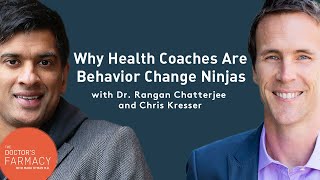
Dr. Mark Hyman, Dr. Rangan Chatterjee, and Chris Kresser discuss why health coaches are better at changing behavior than doctors. Doctors lack time to coach patients through lifestyle changes. Health coaches fill that gap by providing the sustained support people need to actually stick with new habits.
Health coaches, when they're properly trained in these modalities like motivational interviewing, character strengths, positive psychology, goal setting, accountability, they become what we call behavior change ninjas.
Hi, I'm Kaya Perowne, one of the producers of the Doctors Pharmacy. Behavioral science shows that most health plans, whether they are about losing weight, exercising more, or quitting bad habits, aren't designed to last. And we know that a doctor's recommendation to change your diet and lifestyle is rarely the magic bullet for improving health. In Dr. Hyman's recent conversation with Dr. Rangan Chatterjee, Dr. Chatterjee shared a story about helping a patient of his implement a sustainable exercise routine. And he spoke to the value that.
Health coaches offer in supporting lasting behavior modifications. 42-year-old gentleman comes in to see me in my practice. And he's struggling with a lot of the problems that many people are struggling with these days. He was a little bit overweight. He was low in energy and struggling with his mood. Okay, these are pretty common problems. I had a chat with him and at the end of the conversation, it was very clear to me that there were various aspects in his lifestyle that were contributing to the way that he was feeling. Okay, we discussed a number of options. and the one he really liked was strength training. He said, Doc, strength training. Yeah, I've not done that since I was a teenager. That sounds really good. I'm in, you know, it's going to help my brain health, my mood, it's going to help me lose weight. Yeah, I want to do that. I said, okay, great. You want to do that? Grill. And then he says to me, he says, okay, so, you know, what shall I do? Should I do 40 minutes three times a week in the gym? I said, yeah, that would be amazing. If you can do that, go fantastic. So he walks out the door, big smile on his face, you know, feeling good about himself, feeling really motivated and I make a follow-up appointment for four weeks time. Four weeks later he comes back in, I call him into my room, he walks in, this time he looks different, his shoulders are stooped over, he's walking a bit slowly, I said, hey look, you know, how are you getting on? You know, how's the gym? Is it making a difference? And he said, Dr. Chastity, I've not actually managed to go much yet, you know, work's been really busy, I've been really tired, the gym's about 25 minutes away from work. I just not got around to it, I'm really, really sorry. And I remember Mark, in that moment, it was a very transformative consultation for me because in that moment, I didn't think, why has he not done what I've asked him to do? I said to myself, Rongen, listen, you're clearly not giving him advice that he feels is relevant to him in the context of his life. And so I thought, okay, I'm going to change that. I took off my jacket and I said, hey, look, I'm going to teach you right now a five minute workout where you don't need to buy any equipment, you don't need to join a gym, and you don't even need to get changed. And he looked at me bemused. I said, okay. So I taught him five bodyweight exercises and then modified them to his ability level. And he said, I said, can you do that? He goes, I can do that easy. I said, okay, I'd like to see it for five minutes twice a week in your kitchen. And he said, what?
In the kitchen?
10 minutes a week. I said, yeah, can you do that? He goes, yeah, of course I can do that. I said, okay, I'll see you in four weeks. Four weeks later, right? I call him in. This time he walks in, chest puffed out, big smile on his face. I say, hey, how are you getting on? He says, Doc, you know what? I started off doing it five minutes twice a week. But I love it so much and it's so easy to do. I now do it for 10 minutes every evening before I have my dinner. And so he goes from not being able to do anything to doing 17 minutes of strength training a week. And what that has continued for over five years and not only has he done that, that has led to what I write about in the book that I call a ripple effect. That change did so much for him that he now gets them in the morning. He meditates for five minutes. He goes for a walk every lunchtime. He eats better. He sleeps better. All of these ripple effects started with him being able to make a change and stick to it.
We have to sort of admit that we've failed as a profession in understanding how to actually create behavior change.
And Mark, just to sort of follow on from what you're saying, not only do medical doctors not have enough training in lifestyle and nutrition full stop, even if we then go and learn about that, we're not learning about behavior change. So we may then know the science of Lysol and nutrition, but we don't know how to help our patients actually stick to it. Because it's not, you know, knowledge is not enough. Knowledge does not always lead to long-term action. And that's what we're seeing. This is where I think health coaches can be so valuable because a lot of health coaches understand behavior change. They understand How do you help an individual create these new behaviors?
Many people desire change but lack the tools to really make it happen or keep it going. Last year, Dr. Hyman sat down with functional medicine practitioner Chris Kresser and they discussed the growing need for health coaches and how they can help people reach their full potential.
And in writing unconventional medicine, my last book, and doing that research, I learned, you know, what you've already knew, I'm sure, is like there's going to be a shortage of 52,000 primary care providers by the year 2025. and more.
And more, probably.
And they're already, that's arguably not even enough. Like what they're defining as enough is not enough to really serve people. The average visit with a doctor is 10 to 12 minutes. Some say now with new residents, now it's as low as eight minutes. That's barely enough time to say hello and write a prescription. It's just, what's the symptom? What drug can I prescribe to suppress that symptom? And so, you know, I realized that most healthcare is self-care. As you said, like at least 80%, if not 90% of healthcare really happens outside of doctor's offices, even a functional medicine doctor's office. So, you know, a patient might come see me three or four times a year, but the other 99.9% of the time- They eat three times a day. They eat three times. Yeah, exactly.
They sleep every night.
They sleep every night and have to manage their stress and deal with all that stuff. And behavior change is hard. And we could argue that doctors aren't the right People to make these changes because they don't get the training and nutrition, as you pointed out. But also we need to lead, they need, they should be focused on doing the stuff that they are uniquely trained to do.
Yeah.
You know, procedures and tests and treatments and all of that. That doesn't make sense for most doctors to spend an hour talking to someone about nutrition. It's not the most effective use of their time. So, you know, health coaching, if someone is trained properly, and we can talk a little bit about that, They can, you know, complete a training in a year and it doesn't require medical background. You don't have to be, you know, go to pre, go through pre-med in, in, in school and do, you know, med school or anything like that to become a health coach. So we can scale that impact. And there's so many people out there, I imagine quite a few who are listening and watching, who are so passionate about health and they want to use that passion to make an impact. And maybe they had their own health story like you have and I have, or They want more meaning and purpose in their work. They want to wake up and feel excited about what they're doing and that they're changing lives. And this is like a profession that is just growing hugely. It's one of the fastest growing professions that there is in the US now, along with other health professions. It's already like a $6 billion market and it's just going to get bigger because the writing is on the wall. Changing our behavior is the single most important step we can take to preventing and reversing chronic disease. I'm more convinced of that than I, I ever have.
So true. And it's, and it's, it's powerful because people can have a huge impact on each other.
Yeah.
And, you know, if I, you know, I'm gonna ask you in a minute, if you were King, what you would or Czar of the world for a day, what would you do? But if I were, I would, I would basically create a million or 10 million Community Health Workers.
Yeah.
AKA health coaches.
Yeah.
And, and I think that would make a difference because the truth is that most of the things that people need to do, like you said, do not require high level medical intervention. And you can clean up 80% of the problems without ever seeing a doctor.
Health coaches, when they're properly trained in these modalities like motivational interviewing and character strengths, positive psychology, goal setting, accountability, they become what we call behavior change ninjas or change agents. They are experts in asking powerful questions, helping people to discover their own motivation first, For change.
The why.
Yeah, the why. So a good example of that is like imagine a middle aged woman who's got, you know, or, or, you know, maybe in her 60s, she's got type two, she just got diagnosed with type two diabetes. The doctor says, you need to change your diet. And forget about what the advice is, 'cause often the advice is not good there, but let's say it's even the right advice. And the, and she, the doctor can't figure out why the, the patient's not changing. For that patient, that's not enough of a motivation for whatever reason. But if in working with the health coach and the health coach asking her questions, discovers that she just had her first grandchild was just born. And she loves that grandkid more than anything and wants to see that grandchild grow up and wants to be at her wedding when she gets married. And when she taps into that motivation, that's when everything shifts.
Studies have actually shown that working with a health coach can help people make sustainable and long-lasting changes. this person is there to cheer you on, keep you accountable, and help you create a plan to reach your goals. If you are interested in learning more about working with or becoming a functional medicine health coach, you can check out Chris Kresser's ADAPT program as well as the Functional Medicine Coaching Academy. Thank you for tuning in to this episode of the Doctor's Pharmacy. If you enjoyed this episode, please consider.
Sharing it with a friend or leaving us a comment below. Until next time.
More from AI




This Is Why 99% of Skin Conditions Don't Heal — And What Dermatologists Won't Tell You






Why you need to start strength training today #strengthtraining #healthyaging #fitness
