Why Meditation is the New Medicine with Emily Fletcher
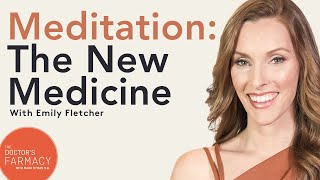
This is a YouTube video titled "Why Meditation is the New Medicine with Emily Fletcher" created in February 2019. It features a conversational interview between Ask AI Mark and Emily Fletcher, a former Broadway dancer turned meditation teacher and founder of the Ziva meditation technique. The discussion covers the benefits of meditation for stress reduction, performance enhancement, biological effects, and practical approaches to meditation in modern life. The conversation is detailed and explores both personal experiences and scientific insights related to meditation.
Hi, I'm Dr. Mark Hyman.
Welcome to the Doctor's Pharmacy. That's F-A-R-M-A-C-Y, a place for conversations that matter. And I love the conversation we're gonna have today because it matters, and it matters to me, which is about meditation with my meditation teacher, Emily Fletcher, who's an extraordinary woman. Besides the fact that she's a meditation teacher, she was a Broadway star dancer. I had a dance off with her in Greece once at an event, which I lost because she's a Broadway dancer and I'm just a schlubby doctor. doctor. I actually kind of got my leg up pretty high. She's founded something called Ziva, which is an extraordinary method of learning meditation and created the Ziva technique. And she's really one of the leading teachers of meditation in the high performance space. She's got an amazing book coming out. In fact, it's out and it's called Stress Less, accomplish more, which is a very different take on meditation because most people think that meditation is just staring your navel, living in a cave and like becoming enlightened for enlightenment's sake. But you're talking about in a way that's in the context of the modern world and how we can actually do the things we need to do in a more effective, powerful and amazing way, which is kind of cool. The Ziva Technique is a powerful trifecta of three things. One, mindfulness, awareness, right? Whatever, we'll get into what that means. Meditation, which is sort of the core practice that sort of like exercise, you got to do it if you want to get fit. And manifesting, which is not usually kind of thought of in the meditation world, but it's designed to help you unlock your full potential. And the benefits of this approach is that it helps you decrease stress, which we all have and is never going away, helps relieve anxiety, improve sleep, it certainly did for me, improve your immune function, increases productivity and extraordinary performance. So since I started meditating, I found the love of my life, my business is rocking, and I'm happier than ever. And I'm kind of addicted to it is the truth. Now, she's been shown, her work's been shown on the New York Times, a today show, Vogue, ABC News, she's named one of the top 100 Women in Wellness to watch and I would agree with that. She's taught more than 15,000 students around the world and has spoken on meditation for performance at Google, Harvard Business School, not so bad, Viacom and Wanderlust Festival, not to mention A-Fest, which is where I met Emily. And Emily and I had an interesting, interesting experience at the beginning of this because I did this little exercise with Emily where we during the course had to look in each other's eyes for five minutes. If you ever tried to look in each other's eyes basically without blinking or stopping for five minutes, it's not easy. And when I realized through that exercise who she was, I really trusted her and I felt like she was the real deal. And so what she had to say about meditation really struck me. And that point in my life, things were going okay, but I just felt like I didn't have everything I wanted in terms of the quality of my life. I knew how to eat, I knew how to exercise, I did yoga, I learned all kinds of stress reduction techniques, whether it's taking hot baths and saunas, or maybe it was walking in the woods, doing different things that I practiced. And I had done meditation before, but I never really came back to it after I went through medical school and my career took off, family, and it just was challenging because I didn't have very much time. And so I convinced Emily to teach me meditation and promised her I would help her, she did. And I committed to it and I just did it. I didn't try to think about it, analyze it, figure it out. I just did the work. It's like if someone says, okay, do 20 push-ups and you'll be fitter in a month. I'm like, all right, I'm just gonna do the 20 push-ups and I can ask a lot of questions. And it really profoundly changed quality of my life, quality of my experience, my reactivity, my level of stress, my sleep, my mood, my relationships, my ability to actually be present where I've been like just going at a thousand miles an hour. It was like a vacation that I got twice a day. And, and I've been consistently doing it with, you know, a couple of times that I skip a day or, you know, an episode or a day is twice a day, but it really has changed the way I see things and think about meditation because I've I've studied it, I've learned about it, I've read about it, I know it's important, I recommend to my patients, but, you know, I was like, well, I'm good, you know, like I'm good, you know? And I realized it wasn't that good.
I could have been better. So thank you, Emily, for joining us on the Doctor's Pharmacy. This feels a little surreal because I've.
Been listening to your podcast on repeat while I'm nursing my newborn son, and it feels so exciting to be here. Thank you for having me. Yeah, well, it's great to have you. Now, not everybody knows your story. It's a fascinating story about why you got into meditation, and then we're gonna get into what the Ziva approach is, science of meditation, some of the things that people wonder about, which is the right kind of technique. But first I want to understand what was your experience that had you direct yourself toward meditation?
So as you said, I was on Broadway for about 10 years before I found meditation, and my last show was a chorus line. So for the folks that know it, it's the gold leotards and the high kicking, which is probably why I beat you in that dance off.
Definitely. She's almost six feet tall, and her legs are at least half of that. It just goes pretty high.
So anyway, my last show was a chorus line. My job was to understudy three of the lead roles, which means you show up to the theater each night and you have no idea which character you're gonna play. Sometimes I would start the show as one character, halfway through that would change me to a different character, or worse, I'd be chilling in my dressing room doing my taxes and someone would get on a loudspeaker and say, Emily Fletcher, we need you on stage. And I would start panicking, grabbing all my costumes, running down seven flights of stairs. And sometimes I would be on stage before I knew which character I was. I just looked on the line, be like, well, there's no Val. So I guess I'm Val and into a six page which some people are very good at, I am not one of them. So I was living my life in this constant state of anxiety. I was feeling overwhelmed. I never knew when I was going to be thrown on. My sleep got really bad. I started having insomnia for about 18 months, which as you know is terrible. It's not good. I started going gray at 26. I started getting injured and it was very confusing to me why I was living my dream on Broadway doing the thing I'd wanted to do since I was a child and I was miserable. So thankfully this amazing woman was sitting next to me. Her name was Dionne and she was understanding five of the leads including Cassie which is very difficult and this woman was crushing it. Every dance, every song, every bite of food was a celebration and I was like, excuse me.
What are you drinking?
Yeah, why do you know that I don't know? I want to have some of what she's having. And she said, I meditate. I was like, oh god, I rolled my eyes and I thought one of you. And she said, no, it really helps my performance. And I didn't believe her so I kept going gray, kept having insomnia, kept sucking at my job. And this is like, oh poor little Broadway star, but it is really embarrassing to be be on a Broadway stage in a leotard in a downlight in front of 2000 people just sucking at your job and knowing it. It's just invulnerable and embarrassing. And then, anyway, it was a downward spiral. Long story short, I went to this meditation talk, liked what I heard, signed up for this course, and on the first day of the first course I was meditating, I did not know what that meant, but I was in a different state of consciousness than I had ever been in before, and I liked it. And then that night I slept through the night for the first time in 18 months. And that was 11 years ago. And I've slept every night since until I had a baby, but that's not insomnia. So then everything started getting better. My life started getting better. Like you, my performance started getting better. I stopped going gray. I didn't get sick for eight and a half years. And so I thought, why does everybody not do this? So I left Broadway, I went to India, and I started what became a three-year teacher training process. And then I came to New York and I opened up-- Everyone does, just pop up. You know, just whatevs, just a thousand hours of meditating and transcribing books in Sanskrit by hand. Then I opened up Ziva and as you mentioned, since then I've taught 15,000 people to meditate. We started the world's first online meditation.
Training, which I'm really proud of. Pretty awesome. Yeah.
Zivameditation.com/online. Yeah, or yes, that's great.
Yeah, you know it, you know it by heart. Yeah, because I give that all my patients every time I see them. I love it. One of my patients, you gotta go to do this.
Thank you. It's cheap, it's accessible, it's affordable. Yeah, that's why we made it because not everyone can come to New York or LA and work in person. So we created this online course and now the book to make it even more accessible so that anyone can afford it, anyone can get it anywhere.
So a lot of people hear about meditation, it's mysterious, it seems vague, it seems a little bit culty, and certainly I've seen that happen. My way is best, or this is the best way, or that one sucks, or it's like the meditation wars, should you do mantra-based meditation, mindfulness-based meditation, should you do visualization, should you do this, should you do that. how much, how long, when, where. Help us sort of navigate this landscape, because I think people get put off by that. And they also think it's tied to incense and candles and cushions and temples and everything has to be perfect. And what I love about what you teach is you can do it on the subway.
That's right.
Which I often do.
Yeah. On a plane with your kids screaming in the next room.
I get the headphones with this noise cancellation. That helps, but.
Yeah, it helps a little. So I think the reason why there are the meditation wars, or it feels a little culty, is that once you find something that works for you. And once you see the proverbial face of God, you think that, well, this must be it. This is the capital T truth. And I like to think about God as a disco ball. And they were all looking at the same thing, but you might see purple and I might see red and someone else might see green, but if that's the truth for you, or the first time that you've seen it, you think that that is real and you're willing to defend that. And so I think- the first person.
You fall in love with, you think that's it.
Yes, this is it. And so I think if we pull the lens back a little bit and see that all of it, all roads lead to Rome. All of it is making us, moving us towards the most amazing version of ourselves. So, to navigate the landscape a bit about meditation, mindfulness, which is what most people are practicing, most of the apps out there, most of the YouTube videos, most of the drop-in studios are what I would call mindfulness. And mindfulness, I would define as bringing your awareness, the art of bringing your awareness into the present moment, which is so powerful.
Like paying attention. Paying attention. Like Aldous Huxley book, where there was this, magpie that kept repeating, pay attention, pay attention, pay attention, pay attention. Yes. It was like the siren call of his book and his community. Or, you know, Marie Forleo's husband or.
Partner is a acting teacher and he has this technique where he says, I'm back, I'm back, I'm back. Because in acting, you know, your mind will go down a rabbit hole and you just, I'm back in my body, I'm back. And so, yes, it's the art of bringing your awareness into the present moment. And in this day and age where we've all become bulimic of the brain and we're all just ingesting technology day in and day out, I think that that skill is very valuable. However, mindfulness- I can't really throw it up.
It would be great if you like purge it.
Well, that's actually what meditation does. So the mindfulness is very good at dealing with your stress in the now. Like my boss yelled at me, I'm going to do 10 minutes of my app and I feel better in the now, like a state change. Whereas meditation, which is, as I teach at Ziva, is different than what most people have experienced. That's actually inducing very deep healing rest in the body, rest It's about five times deeper than sleep. And when you do that, when you de-excite your nervous system, you create order and it allows that lifetime of accumulated stresses from your past to start to come up and out. Whereas meditation is all about getting rid of your stress from the past. And in that we're actually inducing rest that's about five times deeper than sleep. And when you do that, when you use the meditation tools, you de-excite the nervous system. When you de-excite something, you create order. When you create order in your cells, it allows for that stress, that backlog of accumulated stresses we all have in our cellular and now we know epigenetic memory, we allow that stuff to come up and out. And it's that accumulation of stress in our brain and bodies that makes us stupid, sick and slow.
And- that doesn't sound fun.
Stupid, sick and slow. That's not how I want to go through life.
No, stress makes you stupid. We're making t-shirts actually. Stress makes you stupid. It actually also makes you demented.
It's one of the causes of dementia. Stress hormones, cortisol actually shrinks the memory center in the brain. Such another reason to get your buns in the chair. And so then the third piece that you mentioned, which is manifesting, which is more of like the visualization or prayer, I would define manifesting as consciously creating a life you love. It's getting intentional about what you want your life to look like. And while that might sound simple because it is, I'm always fascinated by how infrequently people are doing that, how infrequently people stop to really ask, well, how much money do I want to make? Or what's my dream vacation look like? Or what's my dream partner look like? Instead, we just complain about our current circumstances instead of getting intentional.
So that's really the trifecta of Ziva Mindfulness.
Mindfulness meditation and manifesting.
But there's mindfulness meditation. Yes. So people can get confused.
What's the difference? Yes. So I would define mindfulness like the technique wise is where we are directing our focus. So if you're doing a guided meditation of any kind, I'm putting that in the mindfulness camp because by definition you are directing your focus. And in mindfulness, a smaller part of the brain lights up, but very, very bright, which is different than Ziva meditation because the whole brain lights up, but not as bright. Because it's almost one is about focusing and the other is about surrender. One is about coming back to your body and it's a bit of a shorter leash. Mindfulness is actually derived of styles of meditation that were originally designed for monks. Thousands of years ago. And so it's a little bit more austere, it's a little bit more disciplined, it's a shorter leash. You know, come back, come back to the breath, come back to the work, come back, come back. Whereas in Ziva, there's a much longer leash. I call it the lazy man's meditation because you're allowed to have thoughts, You are allowed to drift into that sleepy feeling. You are allowed to let the technique go.
I call that napitating.
Yeah, well, your wife has outed you out there.
I can't tell if I am actually sleeping or if I am meditating in some deep state of consciousness, but it is fun.
And if you look, if your life is getting better, then who cares?
Yeah, so there have been very different techniques. You mentioned mindfulness, which is bringing awareness back to the breath. the present moment. There's mantra-based meditations, there's visualizations, and they've all been developed to help raise consciousness. They were never developed to really help you deal with your boss or your wife or work or bad situations or too much social media. And they all have different roles and purposes. Why is it that you sort of picked this mantra-based ancient style of meditation.
Well, to be very honest, the meditation portion of Ziva, that was the first style I ever found. And it was so profound. I mean, it cured my insomnia on the first day. And like I said, I didn't get sick for eight and a half years. And I always prided myself on being a seeker. I read every self-help book. I went to all the therapists and I was always seeking, seeking, seeking. And it almost became a part of my identity. And then when I found meditation, I was like, oh, I'm not a seeker anymore. I'm a listener. I found it. I'm a finder. It's right here. It's inside of me. And that's sort of an esoteric explanation, but what's happening neurochemically is within 30 to 45 seconds of starting, your brain and body start flooding with dopamine and serotonin, which are bliss chemicals. And so we stop looking externally for.
Our fulfillment and we start to be able to access it internally.
And- you- binge on mantras instead of binging on munchies and cookies? Exactly. Exactly. Yeah. And so that was, it was the meditation portion that really changed my life. But then when I looked around, I saw there were so many ex-meditators, right? The world is filled with ex-meditators. Every time I speak at a conference or go to a corporation, I was one. Yeah, you were one, right?
I mean, when I was younger, I would be in 10-day meditation retreats, meditating 12 hours a day and, you know, loving it.
But, yeah, but then we all get busy, right? So like every talk I give, I say, all right, I want everyone to raise their hand if you've ever tried meditation. And it's 2018, so almost every hand goes up. And then I say, All right, how many of you guys have a daily practice that you do no matter what? And about 90% of those hands go down. And that's why I wrote this book. I want to bridge that gap. It makes me sad. Stress less, accomplish more. Stress is making us stupid, and it makes me sad that a lot of people start and quit based on either misinformation or doing a technique that wasn't originally designed for them, one that was designed for monks. So they feel like they're failing because they're trying to clear their minds and then they can. and none of us will do anything for very long that we feel like we're failing at.
Yeah, you have to be in a meditation retreat for eight days till you get 10 seconds of nothing.
Exactly. But this, it's like within 30 to 45 seconds, you're like, Ooh, this is different and it feels nice. And then your whole life gets better because it's designed to make you better at life. It's not designed to remove you from life.
So that's very interesting. So these techniques often were developed by Traditions like Tibetan Buddhism and other Buddhist Traditions to help people achieve a state of Awakening. They weren't designed to help you cope with stress. They weren't designed to make you happier. They were designed to. To actually train your brain into different states of Consciousness that allow you to access places that most of us can't access. And you're saying there's a different approach that can actually take you to a similar place, but it's sort of a more sort of tricky route where you get to kind of bypass some of that being in a cave for nine years and you can actually be in your life. And like you say, meditation isn't about...
Getting good at meditation.
Getting good at meditation is about getting good at life.
That's right. And so, you know that delicious feeling for anyone who's ever taken a yoga class when you lie down at the end and you have that delicious shavasana What the Ziva does is that it just fast tracks that hour-long yoga class. It allows you to get into that delicious headspace of the shavasana right off the bat. And that is valuable if you have a busy life because you might not have time to go and take an hour and a half yoga class. You might not have time to go to a 10-day silent retreat, but you need to handle your stress because if you're not managing your stress, it's managing you. And as you've said on this podcast before, stress is related to 95% of all disease. And so it's not just, I think we have to reframe meditation as, oh, well, that's a luxury thing. It's like a pedicure for my brain that I'll get around to when I have more time. It's like, no, we have to reframe this as the single most important piece of mental hygiene that we need to.
Be practicing every day.
One of my missions at Ziva is to make it mental floss. It's mental floss. I want to make it as rude to leave your house without meditating as it would be to leave your house without brushing your teeth. It's like, that's gross. You need to handle that. Yeah. And as Mama Maryann said, she said, we need to be more disciplined. We need to take care. We need to strengthen our fortitude when it comes to these spiritual practices. Yeah.
I mean, I always thought of it as a nice to have, you know, you gotta eat rice. It is something that I, I look forward to that, without which I start to, I'm like you, before you came over, I was like, I'm gonna go sit and meditate. And I could have, like, you know, I could have taken a nap. but my wife laughs because I can lay down and I can't take a nap. I lay there for an hour. I mean, I sit down, meditate, and sometimes within five minutes, I'll be napitating if I really need you to. And it's just fantastic. And I wake up and I feel more connected to myself, more connected to the people around me, more present. And I think that's part of the problem with life today is that we are in a state of constant activity, motion, and we can't easily stop and just be present and appreciate those things that are so important. It's the small little things, right? It's a taste of a cup of tea. It's this feeling of, you know, your partner touching you on your skin. It's watching the light or the leaves or super...
The sound of your son's laughter.
Yeah, you have a little baby. And so we often miss those things which are the actual beautiful things that make up life and make it amazing, and we can miss them. And I feel like I've missed often years just by being in the doing and not in the being. And it allows, paradoxically, by being in the being allows you to be more actually in the doing. It's like this weird thing. And that's why your book, Stress Less, Accomplish More is also about meditation for extraordinary performance. So let's talk about that, because I never would have thought that meditation would help performance, but it clearly does. We've seen sports teams do it, we see CEOs do it, we see business leaders having their employees do it. I mean, we've got a guy like Mark Bertolini at Aetna, who is the CEO of one of the biggest insurance companies who's super into meditation, yoga, teaches his employees to it.
Yeah, they said that it saved them $3,000 per employee per year after they that I think was actually mindfulness training and that it's saving their employees about three hours or giving them their employees three hours of additional productivity time per week. Yeah. So I think that actually these two points are very linked. How meditation could increase your performance and this just spending your whole life doing and not being. And this is something I call the I'll be happy when syndrome. Yeah. You know, I'll be happy when I graduate. I'll be happy when I get a job. I'll be happy happy when I go on vacation. I'll be happy when I can get some Wi-Fi and answer my work emails. I'll be happy when I get married. I'll be happy when I get divorced. I'll be happy when I have a kid.
I'll be happy when this kid takes an effing nap.
You know, it's just, we just, it's like a mad magazine thing. I'll be happy when. Yeah. And our little. Our happiness becomes this carrot that just gets further and further and further away, and then we die. And that's only sad if you never realize that your fulfillment was always inside of and every spiritual text has been teaching this since the beginning of time. What you seek is in you. We have it painted on our wall at Ziva. And I think that that's fine to understand as an intellectual concept, but it's much, much more powerful to be able to experience that viscerally, tangibly, every day, twice a day. And that in no uncertain terms is what this practice does. Because when you start to realize that your fulfillment is inside of you, and you start to realize you actually can access it in a self-sufficient sustainable way, you start to be able to deliver that fulfillment to your life, to your family, to your job, instead of seeking fulfillment in those places. So you actually transition from being neediness, looking to be fulfilled, which is an addiction really, and you turn into fulfillment looking for need. And I see this in you so much. You're always helping, you're always healing, you're always contributing, you're writing books, you're starting clinics, you're starting movements, you're looking at politics, of how we can change food. And that is not... You may have been doing that from a place of ego at one point in your life, but you are not doing that now. You are doing this from a place of, How can I give? How can I uplevel? And I find that the paradoxical thing that happens is when you get your ego out of the way and you are not looking for validation in your work, you get the validation that you want.
-Yeah. And, you know, one other beautiful side effect is that so many of us are not able to distinguish between our thoughts and who we are. We kind of conflate them. So, it's like this one-dimensional way of being which doesn't separate you from this crazy inner dialogue that we have that says all kinds of stupid things. We all have had at times when we believe the stupid thoughts in our head, even if they're not true. we make up our own reality. And it's a way of exercising your brain in a way to refocus your life on the things that are true and matter and helps you create that separation. It's like slowing things down in slow motion so you can actually see the craziness of your mind and not listen to it. So it's really powerful. Like when things happen to me or difficult things I can have a reaction or an emotion or I can have a negative thought like I'm going to die or this is never going to be good. And then I can kind of go, wait a minute, that's just a thought. It's not true. It's not me. It's just a stupid thought and I can pass it by. That's very hard to do unless you practice. And that's why they call it practice. I mean you can say, well I want to lift 100 pounds over my head and dumbbell. Well, if you haven't practiced, you're not gonna be able to do it. But if you practice, you can actually do it. And that's a very powerful thing. So, you get to sort of not conflate the thought that drives the feeling, that drives the action. It breaks it all down. You afford yourself the luxury of being.
Able to respond versus react. And the thing is, when you're stressed, your body will launch into involuntary fight-or-flight stress reactions. That fight-or-flight thing is involuntary. We're not choosing to flip that person off on on the highway. We're not choosing to scream at our kids. We know better. I actually will say to my students, if I were to give all of you $10,000 and a plane ticket to Hawaii, every one of you could write a self-help book. We know how we should be acting. Eat more vegetables, call your mom more often, go to bed before midnight, exercise every day, and meditate. It's not that hard, right? We know intellectually. None of us are doing it. Why? Because we don't act in accordance with what we know. We act in accordance with the baseline level of stress and our nervous systems. So if you are stressed out, it doesn't matter if you've read Eat, Pray, Love or not. It doesn't matter if you've read the Seven Habits of Highly Effective People, because you're not using the executive function of the brain. You're in that amygdala, you're in that fight or flight, and so you are reacting instead of taking that moment like.
You said and say, that's just a thought. That's just a negative impulse. I don't have to act on that. And it's not necessarily religious. People conflate religion and meditation is the same thing, but it's not necessarily even though it came from those traditions. And a lot of people who belong to specific traditions feel like it's the devil or it's awful. And I've had that experience working in different communities. And, you know, it's really not. And it can be very disconnected from those things and yet bring you to the place that all those traditions often want to help you get to. So it's this paradox.
Yes. I actually had a rabbi take my class here at Ziva this weekend, and I felt so happy because It's just a beautiful illustration of this is not in conflict with any religion. My analogy is that most religions, self-help books, I liken these to software upgrades. They're operating systems versus the meditation is upgrading your hardware. It's actually defragging your brain computer, the actual machine, so that you can run whatever software you already have. So if you're a Christian, I think meditation will make you a better Christian because it's allowing you to act in accordance with what you know. Now, if you are Jewish, it allows you to practice those principles with more elegance and ease. If you're atheist, we're probably going to talk in about three months just because you start noticing the serendipity and synchronicity.
But what people call that thing, I don't care. Yeah, it doesn't matter.
Yeah.
So let's talk about the science of this, because it's fascinating. It's not just that it helps you have better performance, better focus, better energy, better sleep, better sex. But there's some real biology behind it. which I don't think the monks who developed this or what Buddha was thinking about, but it turns out that it's a very powerful healing tool. It's really meditation is medicine. Food is medicine, but I also have come to realize that meditation is medicine and that it can be applied for all sorts of issues that people have and that it actually creates a healing response in the body. You know, drugs actually shut off a pathway or block something. they interfere with your biology to stop a symptom. Meditation actually is a tool that helps to activate all the healing mechanisms. So what are those mechanisms that get activated?
Yeah, so when we get stressed, and what a lot of people don't know is that when that adrenaline and cortisol starts to flood our body, those chemicals are acidic in nature. So when your body becomes acidic, it becomes inflamed. And that inflammation, as you well know, is the basis of a lot of different chronic diseases. and so with meditation, not only are we getting rid of that adrenaline and cortisol, but we're starting to flood the brain with dopamine and serotonin, which are alkaline in nature. So we're changing the pH of the body. And if we go, if we look at why the human body reacts to stress in the way that it does, we really need to cut back in time a few thousand years. Say we're hunting and gathering in the woods. Saber tooth tiger jumps out with the intent to kill. First thing that will happen is digestion will flood with acid because you don't have, you can't afford to spend that energy digesting your food, you need all hands on deck to deal with a tiger. That same acid will seep onto your skin, so you don't taste very good if you get bitten into by the tiger.
That's why stress can premature your aging.
Because it makes your skin- It makes your blood clots if you get bitten, you don't bleed to death. That's right. It makes your nervous poos, it makes your bladder and bowels evacuate so you can be light on your feet, and it also dampens your immune system, because.
Who cares if you're going to get.
Cancer if you're about to be killed by a tiger. Again, we need all hands on deck for this threat.
It basically activates you to be a super duper power machine to run as fast as you can or fight as much as you can. But if you're in that state all.
The time, it breaks down your system. That's right. It's not bad for us to get stressed. It is terrible for us to stay stressed. And because our modern demands are no longer predatory attacks, when we get stressed when our boss yells at us, we never outrun our boss. We never fight, physically fight our boss. We're not as physical as we used to be. Sometimes you feel like oh yeah, sometimes you might feel like it, but this is why a lot of people think that exercise is their meditation. I hear this all the time. Emily, I go to the gym and I run it off or I box it out.
Yeah, I go on a bike ride.
And clear my space. And look, exercise is great for you and exercise is very good at getting rid of your stress in the now, but if you want to deal with a dog that barked in your face when you were 10 or your parents divorce when you were 12, we have to give the body rest. That was five. Sorry, tricky. Right, and that stuff, it gets imprinted.
In our cells and we got to rest.
In order to get rid of it. Yeah.
So what are the other things that happen biologically?
Well, one thing that's a fun benefit that not that many people are talking about is the sex piece. There's a whole chapter in the book called From OM to OMG. And that's what's happening there is if your body is stressed, again, procreation is not really top of mind. The meat suit is not that interested in making mini meat suits. if it's afraid for its own survival and its own life. So, when you get your body out of that chronic fight or flight, you get out of sympathetic into parasympathetic, you can start to have some energy for.
Things like procreation or pleasure. You also mess up your hormones. Actually, they've done studies where they looked at guys who were watching their sports team and if their team lost, their testosterone went down. The stress of the loss of their team.
If their team won, their testosterone levels went up. Man. Which is pretty interesting. Now, see, this is a great reason for people to be rooting for their partner's teams. Yeah.
And infertility is a huge issue. You write about in your book. And a lot of work has been done on this at Harvard and other places where people just couldn't get pregnant and they start meditating and be mindful.
Yeah. We have a bunch of Ziva babies right now, myself included. I was 39. I got pregnant on my first try. We have, I had a 40, there's a woman in the book who was 42 when she came to me. Her doctor she was not even a candidate for IVF. And then she started meditating and two years later at 44, she went back to her doctors and she had the fertility markers of an 18-year-old. So we oftentimes conflate maternal health with maternal age. And so a lot of people think, well, as I age, my fertility goes down, but that's not always the case. If you are getting healthier, it's possible to a degree, to a point, you could become more fertile. Absolutely.
It improves your immune system. It actually lengthens your telomeres, which are these little end caps on your genes, on your chromosomes that determine your aging. So literally you can kind of reverse the biology of aging through meditation.
And this is some fascinating new science, and I read the Telomere Effect, which I think is so exciting, but we've all seen it. We've all seen that 60-year-old yogi who's meditating and doing yoga her whole life and has the most glowing skin and bright, clear eyes and is super strong. And then we go back to our high school reunion and someone's been drinking and sitting on the couch every day. You're like, whoa, you look 30 years older than you are. So we know that stress ages us expeditiously. You want proof of that? Take a look at any president the day they take office and that same president four years later. So we know stress is aging us.
But now we have the proof.
Yeah.
And then even stem cells, we're all talking about stem cell injections and stem.
Cells, but meditation actually improves stem cells. this is so exciting to me. I know you talk about this. I don't know a ton about the.
Stem cells, but I love that you do. It's great. And also, it seems to have the ability to rewire your brain, like you were saying, to increase the connections, to improve the connectivity of your brain, which helps you learn and focus.
Yeah, neuroplasticity, the brain's ability to change itself. And I would also strengthen something called the corpus callosum, which is that thin white strip that connects the right and left hemispheres of the brain. and we've known for a long time that meditators have thicker corpus callosums than non-meditators, but we weren't able to prove if it was causal or correlated. But now we know that the longer you meditate, the thicker that thing becomes, which cool party trick, but why would I want a fat corpus callosum? Well, everybody should, because it's quite literally the bridge between your critical mind and your creative mind, your masculine and your feminine. It's the thing that allows you to come up with those creative problem solving ideas when your boss is yelling at you, or perhaps even more importantly, So you get into a fight with your partner and it gets really heated, and then you shut down and you retreat to the bedroom. And about 2 hours later, you start coming up with all these hilarious witty comebacks and you're like, why? Why could I have thought of that in the moment? Well, my theory is that the thicker your corpus callosum is, the easier it.
Is for you to come up with.
Those creative ideas when it counts, when it's go time. Although it may not be good to.
Use those to undermine your relationship. No, not undermining it, but just responding versus reacting, even with your partner. Yeah, it's true. I think that's one of the most powerful things I noticed. is that, you know, I always was pretty good at being self-aware and not reacting. But the truth is, I would react inside. And I learned how to modulate that on the outside. And what happened to me as I started meditating and over time, I noticed that the activation wasn't happening. So I'd go, oh, my wife said this. She's unhappy. I can just be with it and I don't have to respond to it or react to it.
I can take it personally.
Yeah. And it's awesome because I used to, we, I mean, we never fight because I just, like, she says something, she might be upset, you know, she's a woman. She's had, you know, more likely to be in touch with herself and point out things that aren't working. And I'm like, oh, you know, and it's awesome. But before I would get defensive or I would feel offended or I would try to kind of explain it or no, I'm just like, oh, and I listen and I'm present and I know that it'll pass and I can be just with it in a different way. It's really profound. And I would say, you know, maybe I found the right person, which I think I did, but I also feel like the working on myself, you know, it's like, it's almost like instead of finding the right partners, how do you be the right partner? And I found it so powerful to transform the quality of my relationships, even at work, just being more able to be present and not react and people freak out when things happen or this one changes or quits or something doesn't work out. And I just go, well, it's okay. We'll get creative, we'll figure it out. And it's really changed. It does lead to a much higher level of performance and function and ability.
If we go back to the fulfillment piece for the relationships, I find that a lot of us approach romantic relationships is a place where we want to go to fill ourselves up. We say, well, I'm 80% fulfilled. I'll get my partner to give me the other 20%, but that's impossible. No one can make you happy. Your happiness is not lying on the other side of any person, place, or thing. And then you get in the relationship and you're mad at them because they didn't deliver you that 20% that you wanted them to. They've now failed you. But what I think meditation allows you to do, because you're tapping into the very source of fulfillment, you're flooding your brain and body with dopamine and serotonin, You're 100% fulfilled so you can bring that to your relationship. And it's their job to be 100% fulfilled on their end and they bring that to the relationship. And then it becomes this beautiful dance and compliment versus a dance of neediness.
Yeah, it's not 50-50, it's 100-100.
Yes.
Yeah, I think that's really true. I think the, you know, there's also sort of something I want to bring up around the meditation, which I think puts people off. It's like, like, well, you know, I have to have a quiet room. I have to, you know, have my candles and my incense and my cushion and not be disturbed.
And my singing bowls and my gong.
You know, it's nice to be in a meditation hall in the mountains, and that's awesome, you know. But the reality is most of us don't live in that world, and I certainly don't. And I found that, you know, remember the first time I was sort of hanging out with you. We were at an event and we had a, as part of this event, there was a party on a boat and we were coming back from the party and the boat was just crowded with people and it was loud and noisy and you were just like sitting there like with your legs outstretched on the bench just deep in meditation. I'm like, wow, that's impressive. That seems like doable because I often do it in places where I'm on a plane ride or where it's not your typical place or I'll just go in a room in my office in Cleveland Clinic and I'll shut the door and I'll sit on the floor and meditate. It really changes my whole state very quickly. I often do it not to be enlightened but I often do it because I feel the quality of my life improves. literally immediately. It's not like, oh, if I do it for six months, I'll notice something. It's literally like, open my eyes, world's different.
Yes.
I'm happier, I'm more rested, I feel more energetic, I'm more focused, I have less anxiety. I just really amazed at how wonderful it is and it's easy to just think you can't do it because your life isn't structured for that. Yes. You can. And you might not always be able to do it twice a day. but it's so powerful and easy to do. So talk a little bit about the practicality of it and what it is and also the myth around the fact that people say, well, I'm not good at meditating because my mind won't shut the heck up. Yes.
So this is the number one reason why people think they can't meditate. They think that the point is to clear their mind. And I don't know who this dude is who's telling everybody to clear their mind, but Mark, we gotta find him and we have to teach them how to meditate. Because then people sit down, they're like, All right, Brain, stop thinking. Sure, we'd like a snack. I wonder what Mark Hyman would think they should eat. Now I'm thinking about Mark Hyman during my meditation. Oh, no, I suck at meditation. I quit. And that's the beginning and the end.
Of most people's career.
And it makes me sad because they potentially- Just think about me that they.
Go by my name.
Just think about Mark Hyman and then your enlightenment. But it makes It's going to be sad because people potentially rob themselves of a lifetime of bliss and fulfillment because they're judging themselves based on misinformation. So the good news here, if you've ever tried meditation, and if you're sort of cooking dinner and tuned out, like, listen up, this is super important. If you've ever tried meditation and felt like a failure because you could not clear your mind, the good news is that the mind thinks involuntarily, just like the heart beats involuntarily. So trying to give your brain a command to shut up is as impactful.
As trying to give your heart a.
Command to stop beating. It does not work.
To slow down, though.
You can. Yeah. Impressive.
Yeah. And you just change your breathing and. Yes.
So. And then that's what a lot of techniques do. They use the breath as a tool to slow things down, or they use the breath as a tool to focus. And that's all great. But to your point, those are more monastic practices, and they require a little bit more quiet or calm or Focus. Whereas what we do at Ziva is designed to be integrated into your life. So you can do it on that boat, you can do it with your kids on a plane, on a train, and. And so, it's not about quieting the mind. It's not about clearing the mind. It's about inducing deep healing rest so that you can get rid of that backlog of stresses from your past that's making you stupid, sick, and slow. Yeah.
I have to admit, I once meditated while I was getting my teeth cleaned. I do it too.
I meditate at the dentist all the time.
Sometimes, if I don't have time, I'm getting a haircut and I'll tell them.
I'm just going to take a nap. I always do it at the salon. I'm getting a pedicure. At the dentist, my dentist My dentist is like, you don't salivate, Emily. It's very odd because it's a de-excitation going on.
Yeah, it's powerful. So, people are thinking about wanting to meditate. There's a lot of ways they can start.
This is the big thing I would encourage folks to do, is that if you have a practice right now but you're not seeing a return on investment of your time, if your life is not getting better in marked ways, then maybe research and find another technique, maybe find a teacher that resonates with you, find something to where if you're going to make an investment of your most valuable resource, which is your time, make sure that you're getting a return on that investment.
So if you were a queen for a day and had autocratic power to change something in our world, what would that be?
Well, I feel like this is a trick question because mine's so easy. I want everyone to meditate really truly. And I am a recovering control freak. If I could make everyone meditate, I would.
It's true. It's true the solutions to so many of our problems are based in us being more connected to who we are as human beings, more present.
It changes what we eat.
It takes care of our biology.
Our relationship with food, how we consume products, what we buy, how we relate to our families, our co-workers, where we want to spend our money. It really changes everything.
More meditation cushions?
I like a chair or a couch.
Yeah, couch.
Yeah.
And it's also, you know, I found I do with my partner, my wife, and we keep each other accountable. And sometimes I don't want to do it in the morning. She's the one doing the afternoon. So we kind of, we kind of buddy up and help each other.
It's really important to have a buddy, especially if you live in a town where there aren't that many meditators.
It's nice to have some accountability. And there's days you'll, like, really want to do it.
Other days you're like, I'm just gonna do five minutes. And then I'm like, 10 minutes.
I'm like, oh, just another five minutes. That's really the trick. Just get your buns in the chair. Because once you're there, you're like, I'm just gonna keep going. Exactly, yeah. So, I really love your work, Emily. You're a real light in the world. It's not all woo-woo and strange. It's pretty straightforward. And your book, Stress Less: Accomplish More Meditation for Extraordinary Performance is a great addition to our understanding of how to make this practical and combine meditation, mindfulness, and manifesting all in one. So, I love it. Go to stresslessthebook.com/ mark /Mark.
Yeah, we made some special things for you guys.
And you'll get all sorts of wonderful free gifts. You'll get a guided meditation, a very, very powerful set of tools and resources. Anything else they should know about where to find you and get your work?
Yeah, so the easy places are ziva.com, zivameditation.com, or stressless the book.com/mark.
All right. Well, thank you, Emily, for this amazing conversation. I think if we could have a dream for a minute to manifest something, it would be, I would say everybody should meditate every day, at least for five minutes.
It would make the world so much more enjoyable, really truly.
Yeah, I resisted meditation for a long time because I thought, oh, I studied Buddhism, I meditated my whole life when I was younger. I know what I'm doing. I do yoga, I exercise, I know all the tricks, and I feel good, but I was just full of it. and resisting the inertia of actually having to stop and sit and do something. Again, like I said early on in the show, I cannot be without it now because it makes me so more effective and happy and productive. So, the time that I spend doing that is not time wasted, it's time gained.
Yes. And this is going to be my new thing. If people say, I'm too busy to meditate, I'm going to say, if Mark Hyman has time to meditate, you have time to meditate.
Pretty awesome. So, thanks Emily for being on the Doctor's Pharmacy. if you like listening to this podcast, please share it with your friends and family on social media. Leave a review. We'd love to hear from you. And we'll see you next time on the Doctor's Pharmacy.
Goodbye, friends.
More from AI


Why Younger Women Are Getting Breast Cancer at Record Rates (And How to Reduce Your Risk)




This Is Why 99% of Skin Conditions Don't Heal — And What Dermatologists Won't Tell You




