Why We Have The Worst Health Outcomes Of All Industrialized Nations
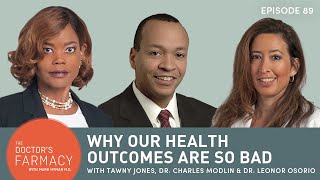
Dr. Mark Hyman talks with Cleveland Clinic doctors about why Americans have worse health outcomes than other wealthy nations. They discuss food deserts, healthcare distrust in Black and Hispanic communities, and how the food industry shapes what people can eat. Community interventions and systemic change are needed to fix these inequities.
Chronic disease doesn't work in isolation. One in four have two or more.
Welcome to the Doctor's Pharmacy. I'm Dr. Mark Hyman. That's Pharmacy with an F, F-A-R-M-A-C-Y, a place for conversations that matter. And today's conversation I think matters to many because it's about health disparities and lack of equity in health care and the disproportionate suffering for the poor and minorities in this country that is really unconscionable in a society that is focused on equity and wealth, which we certainly don't have evenly distributed. And our guests today are an extraordinary crew from Cleveland Clinic. We're here at the Cleveland Clinic in Cleveland. There's many Cleveland Clinics. Our first guest is Dr. Charles Modlin, who's been a great partner with us at the Center for Functional Medicine. He's a kidney transplant surgeon, a urologist. He's the executive director of the Minority Health Program here, and he's the lead for public health at the Cleveland Clinic. He's on the member of the Board of Governors, the Board of Trustees. He's a big shot here at Cleveland Clinic. And I just honored that he's been interested in our work. And we've been partnering with creating a minority men's health program at part of the Functional Medicine Center to help minority men, which are often neglected and don't talk about their health and aren't comfortable sharing, putting them in a group that allows them to actually get healthy together. And we were very skeptical that they would wanna do it or participate, but they all want more and keep coming back. He's been named by the Atlanta Post as one of the top 21 black doctors in America. He's graduated from Northwestern University and Northwestern University Medical School. And he's really an extraordinary physician and leader in healthcare. Dr. Lenora O'Sario is also here at Cleveland Clinic. She's an internal medicine physician. She received her license from the state of Ohio in 2001 and she's been instrumental in opening Lutheran Hospital Hispanic Clinic, which connects to Spanish-speaking patients and Spanish-speaking physicians. She really has a place in her heart for the Hispanic population here in Cleveland and is really focused on trying to create better and improve services. The other day we were part of a meeting which was trying to understand how we better serve these needs and address these health disparities in this community. Lastly but not least is Tanya Jones who has been here with me since the beginning of the Center for Functional Medicine and has literally helped me stand it up and is a pioneer in thinking about how to bring functional medicine into Cleveland Clinic into the world and has developed something called Functioning for Life which is a powerful model for community-based solutions where we put people in groups and helps them create healthcare change. She's been leading our center here and is really, I think, one of the most guiding lights here at the clinic and in her community. We've done a lot of community stuff together. We've worked with cooking classes in underserved areas. We're creating a program at Langston Hughes, which is really serving the needs of these really poorly served patients, African-Americans who are struggling with obesity and diabetes. So just as a little background, welcome all to the podcast. Thank you. I'm so glad to have you all here. and be able to talk about these issues. I just want to give a little background about where we stand as a country. Public health research has documented that racial disparities in health and healthcare is a real problem in this country. When you're looking at the 10 leading causes of death, including cancer, stroke, and heart disease, if you're African American or Hispanic, you're far more likely to get sick and die than white Americans. They have a lot of negative health predictors genetically. There's more predisposition to these diseases. There's lack of access. There's lack of understanding of healthy health behaviors. and I think there's just discrimination throughout the healthcare system and also, you know, in our policies. And when you look at the data, it's pretty scary. African-Americans are twice as likely to get diabetes or probably, you can tell me more, Dr. Modlin, they're probably three or four times more likely to have a need for kidney transplants. They're more likely to have amputations. If you're African-American, you're more likely to, you know, be obese and have more infant deaths and so many different issues that also affect the Hispanic community like diabetes and obesity. and hypertension. And, you know, it's a problem of access. You know, these communities don't have access to good food. They don't have education. They have culturally embedded ideas that keep them from actually getting out of that situation. You know, when, when you're looking at food insecurity, these communities are far more likely to be food insecure. I think 22% versus an average national food insecurity rate of 12%. And they don't have supermarkets. You know, we walked around Cleveland here. Tawny and I went around to a place called Rallies, which is a very poor quality McDonald's that they wouldn't even have McDonald's because that's an upscale restaurant in these communities. And it was frightening. They had, you know, lack of access to anything that was resembling food in there. And, you know, Hispanics and African-Americans are less likely to own cars and, and they're less likely to have grocery stores in their communities. And when you look at the data, if you don't have access to these things, you're not able to actually change your life. So I want to sort of get into this because it's, it's It's sort of embedded in our policies, it's embedded in our healthcare system, and it's sort of this neglected area where we really live in the third world in this country, in these communities. It's not really what we'd expect as part of American healthcare. So, Dr. Sarian and Modlin, these communities are really impacted by health disparities. What do you think the biggest reasons for these disparities are?
Okay. Well, I think speaking for the Hispanic population, we tend to live in a tight-knit community. In general, we live more in impoverished fostered area. Like you said, we don't own cars, so we rely on public transportation. Our Hispanic culture too, we brought up the women that we take care of the family first, not ourselves.
Not themselves.
And then the men are brought up to provide and they don't want to miss work. I have a lot of men that do factory jobs and they get points taken out from their jobs, so they're afraid of getting these points that can lead to them being fired. So they won't come even if we have evening or Saturday. ours. So our culture is that we take care of the family but not ourselves. So Hispanics are really unlikely to get preventive such as mammograms, colonoscopy, pap test, blood work, and there's also this culture of faith. The church is very central as it is in the African American population, but God will heal me. I feel good. I don't have to go to the doctor.
Not dying yet.
I'm not dying. I'm young. There's nothing wrong in my family.
You mentioned they're afraid to go and they won't go to the last minute often.
Right, right, yeah, because they're afraid to lose their jobs, they're afraid of they're gonna find something and I don't have time to keep taking off work because if I'm a diabetic, almost two-thirds of Hispanics are likely to be diabetic. Two-thirds of Hispanics are likely to be diabetic. Yeah, and one-third are likely to die from complications of diabetes. And when I started my Hispanic clinic, I'm Bolivian by descent, but most of the patients I see are Puerto Rican. And I was seeing people in their 30s, 40s getting stents, being on dialysis, getting amputations. And I'm thinking, I started practicing in 2000. I'm like, why are we still getting amputations if we have so many medications, so many hospitals? But I just wasn't understanding the disparities in the Hispanic community.
And so besides the fear of losing their job or the focus on taking care of themselves and not on their family and not themselves, What are the other drivers that are the social determinants that are limiting their ability to get care or to actually do self-care? It's not just access to our healthcare system, but it's the 80% of the things that happen in their community that are driving them towards disease that aren't the healthcare.
Right, and it's a big part, like you were mentioning, is the food. There's bodegas or little convenience stores that have the foods from Puerto Rico, let's say, and so they're not eating healthy because they're afraid to lose the culture. Also in our communities, in our Hispanic communities, there's a lot of fast food places. So if you have a limited budget, if you can go to McDonald's for five bucks and get a lot of food versus getting kale versus getting quinoa is a different price range. And so that, and also if you don't have a doctor that understands your culture, because a lot of Hispanics, if we're very touchy, we're very close. If a doctor sits way far and is at the computer and not looking at you, A patient will not come back. You could be the best board-certified, have so many degrees, but if you're not close proximity and you're not paying attention to this, the patient will think that you don't care about them. A lot of Hispanics too want their families to be in the exam room. So some doctors get intimidated. Why are there five people? So if you don't let those family members in, they won't come back to you either. Or if you don't speak the language or have a way to translate why you're taking certain medications. Because if you're a diabetic, you're gonna be on five, six medications already. And if you don't explain why they're taking that, they're just not gonna take it.
So Dr. Marlin, what's your sense of what the reasons for the disparities are in the African-American community?
So you touched on lack of access to quality care. I mean, that's a huge one. Poverty obviously plays into that. So there are health system factors, there are health provider factors, there are patient-driven factors, genetic hereditary factors, but also health literacy plays a major role. A lot of times in the black community, people don't necessarily know what they need to know to take good health care of themselves. For example, black men don't necessarily know that they should start screening for prostate cancer at the age of 40, whereas white men, unless they have a strong family history, need to start screening, not until they're about 55 years of age. So health literacy, lack of awareness and knowledge of how to take care of oneself plays a major role in what we're seeing in terms of the incidence of the healthcare disparities that we see. Hypertension is a silent killer. We all know that untreated hypertension can lead to heart attacks, strokes, kidney disease, peripheral vascular disease.
And they just don't go in to get checked.
Checked out. They think if you don't have any signs or symptoms or pain or discomfort, you feel fine. You feel fine. I mean, prostate cancer, you don't have to have any signs or symptoms or pain or discomfort to have prostate cancer. Nowadays, most prostate cancer is diagnosed with a blood test. You know, the PSA, the prostate specific antigen blood test. And we also like to do what we call a digital rectal examination. That's fun. A lot of black men, and we don't actually have to do the examination, but. you know, the blood test is more sensitive, but a lot of black men, if they think you're going to do that examination on them, they think you're going to violate them. They don't want to have any part of that, you know? So there's a lot of fear and anxiety about that examination also.
Sure. Spoken as a good urologist.
So a lot of lack of health literacy, a lot of myth and misconception, a lot of stories about what's going to happen when you go to the doctor. There's also a lot of distrust that many African-Americans and minorities have about going to the doctor. We've all heard of the Tuskegee Syphilis experiment.
Can you just give a background on what that is?
So that was where the Department of Health and Human Services, the Public Health Service Department of the United States, that was back in the 20s or 30s, I forget the exact decade, where they actually treated roughly about 800 men, black men.
It went up until the 70s.
Yes, right. They followed several hundred men, black men, who they knew had syphilis, because they wanted to study the natural consequence of untreated syphilis in this patient population. And during that time period, and they.
Had penicillin, they could have cured them, but they didn't.
Oh yeah, they actually had the cure. The cure was available. They could have cured these men. And actually, during that time period, the men suffered, many men died, and they actually passed this disease to their partners. And the word got out in terms of what was going on and that spread across the black community in terms of what was going on, that experimentation. And so that still resonates amongst the black community and other minoritized communities.
The whole story of Henrietta Lacks is also part of that.
Exactly, you know, experimentation. And so a lot of people in the black community are really fearful of going to the doctor and they're fearful that the doctor is going to use them as a guinea pig. and that really contributes to a lot of the health care disparities that we see because a lot of the medications on the market have been developed and designed and tested just in white people. Especially just in white men in particular. A lot of disparities that we're talking about actually exist in women also.
Yeah.
But so a variety of reasons for health care disparities. Some of them are a lot of their, there are a lot of genetic determinants of some of these disparities that we talk about also.
So, Tawny, you and I work together a lot, and you're, you know, you're someone who grew up in the inner city in Cleveland. You saw firsthand what these communities are like. You, you know, you grew up in the, in an underserved community, and you saw the challenges that are faced by the people who live there and, and this sort of Legacy of repeated Cycles of this thing happening over and over with poverty and lack of access and obesity and disease. I mean, We were recently at an event where there were a bunch of young students learning how to cook. It was a culinary school as part of the community college and there was a young woman was there and she was an African American woman who lived, I think, in the projects and said her mother had to take two buses, two hours round, sorry, four buses, two hours round trip just to buy vegetables for her family. And then in her family, there were people with amputations and who can walk and diabetes and kidney failure. It was just heartbreaking to hear because even though there's some level of awareness, people have a hard time getting out of that. There's a lot of assumptions that it's just because people are lazy or they don't want to do anything for themselves or they don't want to get healthy and they just want to have their soda and Doritos. How do you address that?
I definitely don't think it's that they're lazy or unmotivated or don't want to move in the right direction. I think we have a broad assumption society that all opportunity is equal, and that's not true. So racism, unconscious bias, prejudice, and stereotyping all play a role in the opportunities that are available to individuals. And if you just think about unemployment, for example, in comparison to Caucasians, African Americans are still at risk for the same level of unemployment today as they were in the 1960s. That's a reality. So let's talk about the cascading effect of being unemployed. Well, now I'm at risk for poverty. If I'm at risk for poverty, then I probably don't have access to or I won't be able to retain my housing or transportation or I won't have access to those things. And so if I don't have that, then how am I going to get to the grocery store to get healthier food options. You know, taking a bus, that young lady's story was my story as well. I remember taking, we had five children and two adults in my home growing up in the inner city and taking a bus and carrying bags, you know, as much as you could put in your arms was what we had to work with. And so you opt towards getting processed foods or the least healthy options because they have a, you know, fresh fruit foods and fruits and vegetables have a shelf life. And so, you're gonna get the sugar-laden foods that'll keep you full and you feel satiated, you feel really good about that, but you don't realize the impact is having on your health. So very much a cascading effect. And then if you're- Do they connect.
The dots and say, okay, I'm eating these foods and this is why I'm overweight or have diabetes?
Not at all. Not in most cases.
Because we believe, okay, well that seems like a obvious thing to most people. It really is.
It's not. We're healthcare workers. And then you also have to think when you're in that mind space that I've lost this, I don't have that, I don't have access, the opportunity I was passed over for that, you're probably not seeking out the social support that you need in order to help you manage those issues and concerns. And if you don't have that social connection, then you're probably going to move into a space of psychological, distress and depression. And so once you get there, it's just a matter of time before you move into isolation and that feeling of loneliness. And that's, you know, for many people, the point where they just give up. And so it's not that they don't want to do better. I know a lot of hardworking people who are struggling to make ends meet. I interact with individuals every single day who are gainfully employed, but struggling to make ends meet. And their reality is, well, health, my health takes a back seat when I'm trying to figure out if my lights are going to be on next week and my gas is going to be on next week. So those are realities we have in our community, African-American community, and I'm sure it's the same for Dr. Osario in the Hispanic community. We've just normalized these feelings of not having or depression or discontent with life. We just deal with it. And as she said, we rely on our spirituality to keep us grounded and keep us from, you know, totally checking out of life.
So is there any insight in these communities about the way in which our society, our government policies, food corporations are targeting them in ways that are making them more sick and fat and and disabled. I mean, we know, for example, that based on good data from Yale that in targeted marketing, it's focused on African-Americans and Hispanics for all the worst foods. We know that the availability in these communities is less of these foods. We know that the grocery stores don't want to go there. We know that there's a level of sort of almost also internalized racism where they don't actually know this is happening and they think this is their normal culture. I just was sharing a story earlier about a Hopi chief who I was on a rafting trip with and he was very overweight, I mean severely overweight, diabetic, on insulin, was throwing up sick, just walking down to the boat and I said, well, you can fix this. And he's like, well, how? I said, well, you have to give up starch and sugar and flour. He's like, well, how are we going to have our traditional Hopi ceremonies? And I'm like, well, you know, What do you mean? He says, well, I mean, we have foods, we have our ceremonial foods. I'm like, what are those foods? He goes, well, cake and cookies and pie. And I'm like, those are not traditional foods. I think, I have a friend. I have a friend who is an African-American guy and he's very into health and good food and he goes to the South where he's from and his family makes fun of him for eating all the white people food. And I think, you know, what they don't realize in these communities is that that they are eating the white people's food. That it is all this processed industrial food is basically another form of racism.
Yes.
And how do you address that in these communities? How do you get them to sort of wake up and see, oh, this is not what's good for us. And this is keeping us down, that our kids can't learn, that we can't focus, that we get all these chronic illnesses, that we can't work because we're disabled. I mean, how do they see that?
It's a tough battle because the media, so even if you're on YouTube or you're on your iPad or your phone, there's a lot of information with food. And in our cultures too, we have celebrities that are endorsing junk. So we have Sprite, we have Burger King, and our young people look up to these African-American and Hispanic celebrities. And so that has to be one of the reasons that we have to stop those endorsements because kids are looking up to these celebrities. Well, LeBron James looks good, you know?
He's drinking that Sprite before he goes on the court. Right, right.
That has to stop. And we don't do a good job of educating people about sugar grams and fat grams and reading labels. So we try to do that with each office visit as well to really know what you're putting in your body. Because there's no way we're going to make a headway with obesity or diabetes or hypertension if we we're not being accountable what we're feeding ourselves.
I think we need to start in the schools with the young kids also probably, educate the young kids. And I think the same is true, I mean the advertisers target the black community for smoking as well. We've seen that in the past as well.
Yeah, so I mean I was recently at an underserved school in Cleveland here and one of the, they failed, got an F the last 15 years in their school district. and I walked in, said to the CEO of the school system, I said, well, can I go see the kitchen? So we walked through this massive kitchen in his high school. There was not a stove or an oven. There was a deep fryer. They were reheating ovens, like microwaves. And he didn't even realize that. I'm like, look, where's the cooking stuff? Nowhere to cook anything. Deep fryers and microwaves. And then I walked down the hall. I mean, he said 43% of those kids are absent from school. 1% are ready to go to college and they're prepared by the time they graduate, One percent is ready. And I walked down the hall and there was this young Hispanic girl walking down the hall with a double fisting, like slushy in one hand, it was 32 ounces, and another 32 ounces soda in the other hand. And she was very overweight and it's like, it's just so embedded in its schools, 50% of them have fast food in the schools, like Domino's Pizza and McDonald's Monday and Taco Bell Tuesday and Gatorade. Gatorade. And they, you know, they have these competitive foods, which is just kid has to compete between a pizza and a healthy food, they're not gonna pick the healthy food. And it's 80% of contracts with soda companies have ads in the stalls of the bathroom, like Coca-Cola ads. And it's so embedded and it's so deliberate and it's so insidious that it becomes part of their culture. And they essentially hook them like addicts early on. And that's Right, you're right, Dr. Modlin, schools like that's the place to start, but it's very tough because...
I think what you're doing here today to raise awareness in the minority communities that this is a social injustice as you've named it, you've termed it. Actually, I think it was in 1964, I forget the exact year, Dr. King actually said, of all the forms of injustice, inequities in healthcare are the most shocking and the most inhumane. I mean, of all these civil rights activities in which he was engaged, he said these health disparities are the most shocking and most inhumane.
It is.
So I think what we're doing here today to raise awareness that this is a social injustice is a starting point. Because I think heretofore, I think the minority communities have not really seen this as a form of racism. I think this is the starting point. where we can actually make a big difference.
I agree. I think it's a form of food racism.
Yes.
I'll add to that. I personally had not heard that perspective until you raised it.
Yes.
And to have more physicians, because physician in the black, any community, is a well-respected individual. You're considered smart. You're considered at the top of your game. And so you, as an individual, you know, getting in front, on stage, in front Of African Americans, and I've seen this done dozens of times, they're captivated by that perspective you bring that you are being targeted. You are, these companies are going after your race. It's a form of prejudice that you might not see. You consider it to be what's quoted as white people food, but it's not individual choice. Food is not white or black. Language is not white or black. These are not white or black things. These are true issues that we just have not been able to address. And if I recall, when I was in school, we never had access to healthy food options. I never remember having a salad as part of my lunch. I never remember having a choice of vegetables or a choice of fruits for my lunch. Pizza was prime hamburger, similar to what we saw in the school system that we visited. you know, all the apples were sitting there, but the hamburgers were almost gone. The french fries were almost gone. And the students were there and they were all, you know, 90% of what we saw, the students were overweight. But I can't blame them because they have not been exposed. Their parents have not been exposed. So we have a long way to go on education and we have to be comfortable naming it, what the problem is. And that's where we lack. Nobody wants to call it out.
I mean, it's true. Our food system is a form of social injustice and it particularly affects the poor and minorities in this country in ways that are, you know, causing so many deaths. I mean, we're talking about gun violence and that's real. I mean, you know, 70,000 people die every year from guns, but, you know, 700,000 people die every year just from bad food, from heart disease alone and when you add it all up, it's literally half the country is suffering maybe more African Americans, you know, 80% of.
African American women are overweight, you know, and I think I think what you pointed out also, what you'd written, your zip code is the bigger determinant of your health outcome than your genetic code.
That's right.
Yes.
So, I mean, moving forward, I'm actually going to actually be a champion in terms of getting the word out about this social injustice. I mean, you know, we're the leaders in this area. And I mean, I applaud you for actually bringing this to the table and to our attention. because we can make a difference.
Yeah, it's huge. There was a Baltimore pastor, an African-American pastor, who said, you know, we're losing more people to sweets than the streets. And that's really true. And I think it's not something that these communities really understand. And it's insidious, you know, like in New York State when Bloomberg wanted to pass a law that was going to prohibit large amounts of volume sodas. They hadn't selling more than the 16 ounce soda. Guess who came out against it? so you don't remember the African American Hispanic community. Why? Because the NAACP and Hispanic Federation are funded by Coca-Cola. You know, why are food stamps, which are supposed to help food insecurity and help provide nutrition, spending, why are we spending $7 billion a year on soda, which is $30 billion a year, 30 million servings a year for the poor, or why are we like spending $75 billion, most of which is for junk food? making these patients sick and fat instead of helping them eat real food. Why? Because the big food hunger networks, which oppose any restriction on any of these junk foods or soda and food stamps, are funded by the food industry. So it's a really insidious thing. And I remember being in Atlanta when the movie Fed Up came out about sugar and obesity, and I was met with Bernice King, And she was very excited about this and she talked about how non-violence also means non-violence to yourself as a value. And we decided to show the movie at the King Center and a few days later after we organized the whole event, I got a call saying, no, we can't have the showing at the King Center. I'm like, why? She said, well, you know, the King Center is funded by Coca-Cola in Atlanta. I went to meet with the dean of Spelman College, which is the largest African-American college in the country, I think, and for women. And the dean said to me, 50% of the entering class of African-American women has a chronic disease, hypertension, diabetes, obesity. These were 18 year old girls. And I said, well, why are there Coke machines all over the campus? Dispensers and fountains. And it's like a carnival. And she said, well, because a lot of our funding comes from Coke. And one of the Board of Trustees is from a very high up person in Coca-Cola, first Bellman College, an African-American woman. And I just like, how does the community not rise up and say, how do we stop this?
Because I think the sugar industry is causing a genocide in our population. And sugar and fat are addictive. The more you eat, the more you want. And you're craving it, and you don't even know you're doing it. to yourself. And that's the hard battle too with patients because they feel like with all the anxiety, depression and stress, they feel relieved when they have- For a minute. Per minute, right? But they eat more because they want, it's like a heroin, right? They want that high again and feel relieved. So it's very hard to stop it in our patients.
It's true. I mean, in a sense it's a new form of slavery. And slavery actually in part was built for the need to produce sugar cane. So a lot of our slave trade was driven by the need to produce more sugar. And now that very sugar is causing another form of slavery and I think injustice. It's pretty scary. So how do you think we can sort of begin to address these big issues and get these communities to wake up and say, hey, wait a minute, we're not going to let the man do this to us anymore. We're going to rise up. and understand this as a social justice issue. And, you know, whether, you know, we've got Cesar Chavez about farm workers protection, you've got, you know, groups around Black Lives Matter advocating for justice in different ways, or environmental racism is now understood as a thing, but food racism is not really understood.
No, and I mean, you bringing it up is an excellent point. And I think there has to be education in medical schools for future doctors, because that was never taught. taught. I think the churches have to play a big role. I think the pastor should have a sermon about that, because if we say, you know, your husband would be alive today, your child would be alive today, your uncle wouldn't have to have bilateral amputations if they gave up the soda, if they gave up the Twinkies and sugary cereals, if we made it personal and say that this is, we're trying to create memories and our life and be a healthy, we don't want ADHD, we don't want to, the lack of exercise too is amazing to me because people say I have back pain, I have knee pain, I can't exercise. I'm like, yes, you can, you can get up. We're really such a sedentary lifestyle where everything, we have apps that deliver food. So, I mean, I don't under, like, I want us to, because we were just killing ourselves. We're creating in the Hispanic community, there's so much fatty liver, which which can lead to cirrhosis and the amount of liver transplants and deaths.
Liver transplants are from sugar.
Yes, from sugar.
From flour, right?
But we have the apps that deliver bad food, I guess. I don't know that any apps deliver good food.
Give me some stacked quinoa to deliver. No, no, these are all fast food.
You are too.
Not here. And I think we need to stop the sugar industry. I mean, they're lining our politicians. Nobody's protecting us. There's a website called the Dirty Dozen that shows what's full of pesticides. Why is that? Why do we have to buy non-GMO and know what pesticides? I think if I go to a supermarket and I want to buy fruit, I shouldn't have to decide if, okay, organic or not organic, right? I mean, why is nobody protecting us? I think that's why cancer is on a rise, too, because our food is contaminated, but our politicians are not doing anything anything about it.
Yeah.
And the other thing that people don't realize is that a lot of these health disparities exist in food and farm workers, which comprise more workers than any other industry. There's 20 million food and farm workers, and they're often brown and black, and they're often unprotected. And the Fair Labor Act, which is in the 30s under Roosevelt, which was developed to protect workers, did not cover food and farm workers. Why? Because they were African-American for the most part, so they weren't protected. and that's why they often earn less than minimum wage. They have no health benefits. We have to cover them with Medicaid and food stamps, and they're often at high risk for diseases such as pesticide related conditions, and they're struggling. And again, we're eating all this food, but what is happening to people who actually provide the food? That's a whole another level of health disparity that exists in those brown and black communities.
But I think we have to help people connect the dots. We know this because we're healthcare workers, we're exposed to the impact of what unhealthy options do to our bodies. We can suggest to someone that if you don't change your diet, you're probably going to die. That's hard for a person to receive. It's hard for a person to understand. They want to know the why. How do I change considering my limitations? You want me to exercise? There are no parks in my community. I can't walk to the corner because outside. Yeah, I can't send my children out because human trafficking is at an all-time high. I just watched that on the news last night. So people are aware of their surroundings and the issues that are plaguing their communities and them as individuals. And so they start to layer these excuses on excuse, excuse, excuse, and not to their fault, but in their world, it's their reality. and they don't have a way out. They don't have an option. And I think this is where the community-based talks, where we get out front in front of these individuals and start to share very candidly, share this information and say, you know, this is the number of patients that have died as a result of this. And let me tell you how that could have been prevented and really have an opportunity for them to share in that conversation. We don't see that in our communities. We'll do a health fair where we have one, you know, one snapshot in time where we bring that information to them. And then, you know, months or another year will go by before we get back in front of those individuals. And I think that this needs to be a more concerted effort where it's ongoing. There should be weekly meetings, whether it's at the church, whether it's at the community center, whether it's, you know, in a space where they feel comfortable going to. where we can share all of this information in a way that they understand it. You know, health literacy is real, so they don't necessarily receive it well from physicians. But we're the community workers who can help with this. Those, you know, coaches or individuals who are just inspired to be in the health space and who want to, you know, partner with healthcare organizations.
So you, you know, we started with the Center for Functional Medicine program at Langston Hughes with the very underserved African American community. Can you tell us how that's going, what the response has been? Because I think people say, oh, people don't really want to get better. They just like the way that they're going and they don't like maybe they know already what to do.
They're just not doing it. When you know- what happened?
Yeah.
So when you know better, you do better. And I'm a firm believer that people will do the right thing if you guide them in the right way. And so we were able to partner at one Kudos I will give to the Cleveland Clinic is it has a strong footprint in its community and it is really focused on community-based initiatives to help improve the health and provide self-preventative measures and teaching and education for individuals that we would either serve out there or we're going to serve in here in the hospital setting. So one way or the other, we're going to get them.
Yeah.
So we can take a preemptive strike and do it the right way or we can see them on the back end. And, you know, I think we prefer the, the former.
So how are those people responding in that?
Very well. You know, we were reticent.
Yeah.
So we were reticent about offering a shared medical group visit appointment in this underserved area, in this community center. We were a little bit unsure of how the uptake would be. But these were individuals who were somewhat invested in their health because they do go to the community center. There's a gym there. they do line dancing and they do some yoga and you may see a few on the treadmill. So they have some sense of, okay, I need to do something differently. But we were able as functional medicine to bring the medical management component to them and say, you know what? We're going to dive into your nutrition. What are you eating? If you leave from yoga and line dancing and you go to McDonald's down the street, you probably just undid all of that effort. and you have to be comfortable to say that. So we spent a significant amount of time training our team on what the issues were in the community, where the disparities were, what the challenges were as far as the food desert and their access and their understanding of what the concerns were, why individuals weren't opting towards healthier lifestyles. And these individuals who were selected to be in the program, we only had capacity for 15 due to the space. and now we have a waiting list. They have been so engaged in their health. They didn't know what a health coach was. They didn't know that sleep was tied to their overall well-being. They didn't know that stress management was important for them to help their blood pressure. They had no clue that movement and simple movement movements that they can do at home, even if you can't get outside, that they were able to do those and it would affect their health. So we were able to really drill down into their concerns, create a safe space for them to come together, share their stories, provide access to food for them. So again, sometimes we have to help individuals connect the dots. They're liking it. They're loving it. They're resisting it.
They wanna learn.
They are eager to not only learn, but to bring their families in and to bring their friends in. And so I visited the center and one of the ladies tapped me on the shoulder and she said, I need you to make sure you get my family on that wait list. And so now it's, you know, creating a demand that wasn't there before for these types of services in the community. So it's not that people don't want it, it's that they don't know that they have access to it. They don't, they haven't been exposed to it. But once we work- which is hard to believe, right?
For the average person listening, I imagine it's hard to believe that but people don't know that soda is bad for you or don't know that eating a lot of processed food is not good for you.
LeBron James drinks it. She just, you know, so this is my vision.
He's got muscles.
Right, and diet coke is, you know, it's a diet. So why can't I have a diet coke? Unless someone is explaining to them, which is what our dieticians and our coaches go in to do, unless someone says, no, actually that's worse than a regular Yeah. They don't have that scent. It's zero calories on the label.
Well, because a lot of the messaging goes out there, it's your fault. It's just about personal responsibility. If you just eat a lot of junk and you exercise and got off your couch, you'd be fine. And that's what the food industry tells us, that our government tells us that all calories are the same and that if you just manage that, you'll be fine. And in truth, it's not so simple. I was shocked, you know, when I worked with, and was a poor white family in South Carolina, how they just did not know what they were eating and they didn't know what to do and they were desperate to do the right thing. And once they got a little bit of information, they literally were able to transform their lives. And the young boy was, you know, morbidly obese. I mean, it was like, had diabetes practically at 16 years old, adult onset diabetes. And he was like, you know, he was worried because I said, you,'re 50 body fat and a guy should be 10% over 20 is terrible. and he's like, am I going to be 100%? No, you have like bones and you have some muscle. But he got to understand what was going on. He wasn't stupid. He says, but I feel like I'm an alcoholic being working in a bar living in the community I'm in, but he was able to figure it out. He lost 138 pounds and now he's in medical school. And if you just give people a chance, he was one of the, you know, in a poor community that's done food stamps and disability, they had no education. I mean, it was just It was really an extraordinary story, which kind of helped me understand that it's not about personal responsibility, it's about being in a toxic food environment, not knowing that you are, and not knowing how to get out of it.
I saw that story, but the thing about the Langston Hughes thing.
When you.
Go in there and educate the community, you do it in a special way. You're not going in there, you're not accusatory, you're not pointing the finger, you're not blaming them. You talk about the food deserts, but you also talk about the food swamps also.
It's food apartheid.
Yeah, it's food apartheid. You have to be culturally sensitive, culturally competent. You have to establish a relationship with the community. And so I just want to emphasize that you have to be very careful in terms of how you engage the community, because you could actually do more harm. And you could really, you have to be able to resonate with the community. It says, you know, nobody, nobody knows how much, nobody cares how much you know until they know how much you care, you know?
So that's very, very important. Yeah. Racially and ethnically sensitive is my first step in creating programs in our community and creating programs for our providers. Because I think about the patient experience first. The patient is always Paramount. Yes. Yes. You know, for, I know we were trained at the Cleveland Clinic. The patient is our North Star. So it's the most important person that walks through our doors. And so when I think about that, I want them to reclaim their life. I want them to have access to a program that makes them feel comfortable coming into these individuals at Langston Hughes come back every week.
Yeah.
And this is a 10 week program, but they have made the commitment because we are, one, removing the barriers and we're creating a space where it's very comfortable for them to come in and learn. We're not using terminology. that would be offensive to them. We're not and we're not put to.
Make sure I don't.
We're not information in front of them, you know, twelve syllable words that they would have no idea. We go over their laboratory testing because you hear H one a ahmoro amoglobin and you hear hemoglobin and you hear lipid panno and you hear, uh, all of these terms and it's just overwhelming and you think, Oh my God, is that bad, good, or indifferent? But you don't wanna ask your doctor because you feel like it, well, he'll think I'm stupid. And so, you know, we have those social stigmas that we carry around with us, so I don't wanna do that. But in this space, we just assume that we're gonna start everybody at square one. And let me tell you what a hemoglobin A1C does to your health. Let me tell you what a lipid panel does. People, and they are- that was a striking- to watch them, they're so immersed in this conversation and they're like, oh my God, For years, I've been wondering what a lipid path, that's what that means.
And they're doing it and their blood sugars are dropping and their blood pressure is dropping and their weight is dropping.
They feel better. That's awesome. Yeah. And I think, like I was saying before too, produce and vegetables are expensive. You have to teach people what to do with this and that it's simple because you don't want to spend a lot of money and then it doesn't taste good or I don't know how to cook it. So doing little simple recipes and we try to incorporate in the Hispanic clinic the Puerto Rican flavors. So it kind of tastes better actually than some of the starchy foods that they have. But we have to show people, we can't assume that they know how to cook these vegetables because it's intergenerational. If you grew up eating processed foods and your grandmother fed you, didn't cook, you don't know how to cook vegetables.
So wait a minute, you're a doctor. you work at Cleveland Clinic and you're teaching people how to make Puerto Rican food.
Yes.
Okay. Tell us more about how you're actually breaking through these barriers. Because that's one of the beautiful things about Cleveland Clinic is there's all these innovators here who were thinking out of the box and who are starting to bring food as medicine into their practices. And how is that being received and how do you break through the resistance.
In these populations and get them enrolled? Yeah. Well, I founded the Hispanic Clinic in 2013 with the blessing of Cleveland Clinic. I founded it because I wanted to break down the barriers of transportation, of language, of the culture. And we have a lot of doctors there that do colonoscopies. We have GIs, we have surgeons, we have psychiatrists. Because in the Spanish population, too, they don't want to use a translator to say, I'm having suicidal thoughts, or I'm depressed, because it's shown as a weakness. weakness usually, so they don't want family members also to be translating. And so when I started practicing, I was just seeing the high amount of diabetes and high cholesterol. And the key, what I found out, is the food, because there's a lot of starch, there's a lot of fat, there's even a drink called- Dr. A lot of refined oils. Dr. Refined oils, yes. And there's a drink called Malta, which is like a glorified Pepsi, and it has like 48 grams of sugar, but that is a staple in the Puerto Puerto Rican. So I was just taking that away and getting used to the ingredients of the Puerto Rican because I didn't grow up eating their foods. But that was the impetus to deal with this population because otherwise if I don't deal with the food, I'm just like a dog circling my tail. I will never ever get the hemoglobin A1C, their diabetes under control.
You can pile on all the medications you want.
Yeah, yeah. More medicines are not the answer. It's getting at the crux of where are the closest grocery stores? What can we substitute? And people love quinoa. We're substituting that with the rice.
That's a Bolivian food, right?
Yeah, exactly, exactly. And so, I told them it's filling just like rice. Or if you don't have money, you can eat more beans, more fiber than...
Maybe quinoa and beans are cheap as...
But if you don't know what it is. I grew up, I didn't know what quinoa was. until I grew up and became an adult. So if you've never been exposed to that, I didn't have avocado until I was an adult.
Yeah, that's true. Although the Kuma story is kind of tragic because it's become a in-hip food. Right. And now the people in those countries that grow it can't afford it because the price has gone up.
Right.
And they're all eating processed rice and other food. Yes. And they're all gaining weight and becoming obese. So it's like these sort of interconnected consequences.
I'll just say another contributing, and we don't really think about this, you know, medicine now is we're all subspecialized. I mean, that's kind of the tendency. I'm a urologist in addition to a transplant surgeon. We have all types of surgical subspecialists and a lot of times we don't really act as, you know, Dr. Osorio is a primary care, you know, provider. I don't know nearly as much as.
She does about, you know, primary care.
But you need a kidney transplant, you're the guy. But the thing is, when a patient comes to us, we have to still remember that we're physicians. And so I say that because I recently saw a patient with a hemoglobin A1C of like 14.
For those who are listening, that is ridiculously high. I mean, normal is less than five and a half. And that means your blood sugar is like 800 or something.
So he came to me with urinary frequency, getting up at night, nocturia, and all these kind of symptoms. And as you know, all the time, I mean, I could be fooled to think that maybe that's a prostate issue. I mean, it could be. but probably because of his blood sugar being high, spilling sugar in his urine.
And so, everything's the prostate.
It's not everything is the prostate. So we have to not just think along our specialty lines, we have to step back and think about general medicine and think about the type of foods they're eating and the environment they're in. And that's how I got interested in overall health and healthcare disparities. After I finished my transplant training, I was able to look at the medical landscape and that's when I really became aware of this healthcare disparity crisis. You know, in the next 20, 30 years, the majority of the population is.
Going to be minorities.
Yeah.
African Americans, Hispanic, Latino populations. Not going to be minorities anymore. Exactly, we're going to be the majority.
But we have a seven to eight year shorter life expectancy. I mean, you look at that zip code profile.
And in the poorest communities, it's 20 years less. Yes.
Oh, yes.
Like being in the third world. Exactly. now you can go online and check your zip code.
Oh, exactly.
And determine what your life is expecting to be.
So what we're talking about is a national crisis. I mean, you know, you talk about the gross domestic product and how it's going to really affect the overall economy and bankrupt America. I mean, we have to solve this crisis now. And again, as you're adequately pointing out, a lot of this is related to the food that we're eating and not having adequate access to healthy nutrition in these minority populations, but it's only going.
To get worse if we don't do something about it. I mean, you're a kidney transplant doctor. The main reason for kidney transplants is.
High blood pressure and diabetes, which are caused by diet.
Right.
And it's untreated, it's unrecognized until late stages.
People showing up in the ER with.
Kidney failure, they didn't even know they had kidney issues.
So you're trying to put yourself out of business, basically.
Well, we need to shut down the dialysis centers. That would be a and they're expanding the number.
It's going the opposite direction.
And I think more of these multidisciplinary approaches to health care is necessary. Dr. Motl and the Center for Functional Medicine, we partnered on this Minority Men Shared Medical Appointment and really thought through the experience from a male perspective. And his specialty is just that. But we also have the nutrition and the behavioral health and lifestyle management component. get locked down. So when we marry our two areas together, the program is just unbelievably welcomed by the individuals who have participated.
I mean, and typically African-American men avoid health care.
It's not that.
And when you started the program, you're like, well, we better only do six weeks because they're not going to want to come and they don't want to talk about their problems. And we're, and you, we're pretty skeptical. So what happened?
Well, you know, I told Dr. Motley, I said, Dr. Motley, we don't really do six weeks. It's not enough. And he said, no, Tawny, it's gonna be hard getting these people in. And, you know, let's just start here. And I said, okay, I respectfully stood down. But, you know, I know what I know. I've done this for a very long time. And sure enough, these men are like, when is the next program? Why did it only last six weeks? How can we come back together? So we've created reunion opportunities for them to reconnect. that power of social connection, married to medical management, is something that you don't see, that you don't experience, especially in the African-American community. You don't have a place that you can go to and talk about your prostate issues or your blood pressure issues where you are isolated. Yeah, absolutely. We are in silos, you know.
And men, a lot of these issues cause also ED issues.
Yeah, sexual dysfunction. They don't want to talk about that. And so we were very sensitive when we put the curriculum together. And Dr. Motley said, Do you have any men who can facilitate? And I said, uh-oh, we're in trouble. But I tell you what we're going to do. We're going to have one of the top, one of our top physician assistants who is very culturally sensitive, who is well trained, well skilled. She's going to work with them. And I promise you, they will be receptive. And he sat in every single one of those sessions. and tell them what you learned from her. From the physician assistant.
Well, you know, first of all, she established a great rapport on day one. I mean, she pulls them out individually and, you know, does a physical examination and goes over the labs, explains, you know, what each laboratory analysis means, why they're doing it. And, I mean, they open up to her, you know, quite nicely. I do an individual session with the men with her outside outside of the room and we open up and they talk about certain issues. Kevin, the educator, I mean, it is-- yeah, health coach. He's quite great, but they have no hesitation opening up to Sarah. I mean, you know, there's no issues there whatsoever.
And to each other.
To each other.
And to each other. And that helped them feel connected in ways if they hadn't and talk about things that were hard. And they kind of got over the that sort of traditional historical.
Oh, yes.
Aversion to health care.
Right.
Absolutely.
And their health improved.
Yeah. We've had some men stop smoking.
Yes.
Weight loss, significant weight loss, blood pressure lowered. You know, they're A1C, Lord, lipids, Lord. So. And it's hard getting them out at the end of the class. They're oftentimes staying behind to talk with each other and share their stories. They're motivating. each other. And so it's just a beautiful scenario to witness how engaged they are in their health. We need to do more of that. Now, who would have thought functional medicine would have been connected to urology in such a way and deliver this program 10 years ago, you would have never thought to do that. But today it's the best way to manage chronic conditions. And as you said, when we have 50% of our population suffering from chronic disease. And chronic disease doesn't work in isolation. One in four have two or more. So if this is how we're trending, then we need to think very differently. We need to be outside of the box, or either we need to make that box a lot bigger in order to combat these issues. And I think that's what our goal was.
And we know these populations are far sicker, as I mentioned at the beginning. they're costing our health care system far more money. And yet it's not something that's even on the radar of how to address within the health care system. So, you know, you've talked to Dr. Modlin and Dr. Sari about how do we create health equity performance measures that incentivize health care organizations to reduce these health disparities? In other words, how do we make it worth their while financially to do the right thing? So what are the kinds of things that we could measure and what could be happening as we move towards this value-based payment system where we're gonna be paying for outcomes which is going to change the way we're going to think about these issues. Because before, the more amputations you do.
The better you are.
I remember there was a program in New York, there's like 800,000 diabetics in New York, and they had a nutritionist in the hospital and they were seeing dramatic reductions in amputations and they shut the program down because the hospital revenue was going down because they weren't doing amputations. You don't want to pay $50 for nutritionists, but they pay $5,000 for an amputation.
So how do we begin to sort of change that? Well, I think we have to have, as Tanya was saying, a multidisciplinary approach. We have to get the big three: the diabetes, obesity, hypertension, and down. And we can measure that. How low has your hemoglobin A1c dropped because we've been able to provide fresh food and recipes? We've been able to provide exercise because even doing 15 minutes in your home of cardiac exercise three times a week is better than nothing. But we have to teach people what type of exercises or show them the apps if they have a smartphone what they can do. Dancing. Yeah, dancing. You can do it's free. You put your music up and you can work up a sweat. And I think if we do get money, a lot of my patients are Medicaid, Medicare. If we get incentives for the hospitals, they will continue to support us.
So you think shifting Medicare and Medicaid reimbursements to pay for these kinds of community-based programs, to pay for nutrition classes, to pay for cooking classes, to actually help people learn the skills and change their behavior together is what's going to shift things.
Right, right. And the cost of that is not nearly the cost of any hospitalization or any transplant.
Yeah. Are you hopeful?
I'm very hopeful. I'm very hopeful. That's what wakes me up in the morning, is that drive to help other people and make a difference in their lives. And it's just we have a long way to go, but I'm hopeful. But I feel like the opioid crisis, it's an obesity crisis, it's a diabetes crisis, and we have to wake up and we have to work together because we're just all, a lot of our family members are dying way too soon.
Yeah.
How about you, Dr. Modlin?
How do you see this shifting? You know, our primary care- if you're in the leadership of Cleveland Clinic, you're.
Thinking about these issues. You know, in the organization. The primary care providers, they have a program called stamp, stop, now and manage patients. And they have a certain amount of time every week where they can actually look at their patient profile and they can determine which patients have not been getting their labs drawn, which patients have been missing appointments, and they can proactively call those patients, just say, why haven't you been coming in? Why haven't you been getting your bloods drawn? And just try to proactively manage those patients to stay on top of them. to prevent them from getting ill, to prevent them from getting readmitted to the hospital. You know, it's really to the hospital's best advantage to keep patients out of the hospital. You know, it's cheaper for the hospital to try to manage patients, you know, in their homes and not-- It's going to that direction. Exactly.
It hasn't been like that before.
But that's the way it's going to be. Hospitals are going to be-- penalized, you know, by having patients readmitted. When patients are discharged and readmitted within 30 days especially, there's going to be, you know, penalties.
So how has your initiatives around health disparities and raising awareness been received by the leadership at Cleveland Clinic?
Yes.
You know, I think over the years it's, I think it was a little slow initially. You know, we started the health fair back in 2003 and there was a or ramp up several years to get the health fair started and then the minor emergency health center. But, you know, I think in recent years, I think it's been more accepted. Now we have a population health program. We have our community relations, community outreach program is more proactive these days. So, you know, it's definitely being more well received now.
Because you said it's true that the majority, you know, of our diseases are these lifestyle-driven diseases caused by diet. And if the predominant population affected by this are the minority populations, and they're the ones we're seeing here at Cleveland Clinic, we're taking care of them, we're gonna lose out if we don't actually figure out how to get them healthy. So, it seems like there should be a more focused approach on addressing this from an organizational perspective. How do we think about where the cost centers are for us? where the disease centers are and how do we actually fix that? It seems like it would put a lot of fire underneath addressing these health disparities in the communities because it's in our best interest.
Sure. Well, I've actually had several meetings and I'm happy to say this with our chief strategy officer, Josette Baron, and I've met with several of our institute chairs to start specialized centers throughout the organization. I call it Multicultural Health Center of Excellence. We've started a minority stroke work center, for example, in our neurological institute, heart and vascular, multicultural cardiovascular care center, and a program in our DDSI center.
The digestive institute.
Digestive institute, different centers and different institutes throughout the organization to address a lot of the disparities in these specific specialty areas. We're going to, you know, that way we can actually work together patient navigation, patient education, you know, research. We also have to train the, you know, new and upcoming generation of health care providers around a lot of the stuff we're talking today about the health care disparities, the diverse causes of these health care disparities. But the leadership really is, is aware of this. Dr. Mihalovic, the CEO, Dr. Weideman, Dr. Sabani. I mean, those are all the leadership. The leadership here at Cleveland Clinic understands this now. They've embraced it, you know, and because we understand that this is the way we have to do it, you know, value-based medicine. So I'm appreciative of the fact that you're here. We have a strong functional medicine program five years now. You just sell party last year. You had a party last night. And you guys, I didn't know that you guys could dance so well. I got some moves. So you're over Langston, you're leading the way, you know? But no, I mean, you know, things are actually heading in the right direction here at Cleveland Clinic. A great Hispanic clinic now. You started one day a week, now you're five days a week. Yes. You know, so I mean, things are really, we have an LGBTQ clinic over in Lakewood. Lakewood. Because they have a lot of health disparities that are unique to that patient population also. Disparities in the pediatric population, we have to be aware of some of those disparities also. But a lot of it does rest in the food and the food deserts that you've so rightly pointed out. And it is a social injustice. You've actually raised awareness in my mind. Oh, you know, so I'm going to go out and raise awareness in the community. Thank you.
Yeah, that's so great. All right, so final question to all of you. If you were a king or queen for a day and you had the power to change something in health care or policies, to actually improve this system? And what would they be? And I'm also going to jump in, even though I don't usually, but I'm going to jump into them.
Okay.
All you got to go is-- I'll start.
I would implement, since I'm queen for the day, no fast food at all in any state.
In the entire United States.
In the entire United States.
Bob McDonald's.
Yes.
Yeah.
That is no longer allowed, you know, like alcohol prohibition. You're not going to allow that.
That did work out, though.
And then I would have the resources to take down the sugar industry because they control our politicians and we need policy change. Our government needs to be able to protect us and not.
Get rid of fast food and shift policies that address the sugar crisis.
Right, and that can make food, fruits and vegetables affordable.
Affordable, yeah. Fantastic. Okay, great. Dr. Modlin.
I would actually echo what Dr. Osuri said, but I would actually elevate this to a crisis status so that the United States Congress, President of the United States, every healthcare organization would recognize this, that this is a crisis state that we need to address this right now immediately and allocate the funding so that we can address this.
I think that's right. I think that which needs to happen is to be sort of sort of a national and obviously global awareness and bringing together stakeholders to solve this problem, which is affecting all of us, whether you're Democrat, Republican, Black, White, Hispanic, it's killing us all. Our economy, our families, our communities, yeah, our children's future.
So I'll speak from an administrative standpoint first, and then I'll jump into a personal wish, since I am queen for the day. Coverage, reimbursement. for the services, nutrition and health coaching, just so the world knows health coaching is not recognized in the industry as a billable service. So I guess that says to us.
We'Re doing the right thing instead of the wrong thing.
Right. Stress and lifestyle behavior change is not recognized as important enough for coverage through insurance companies. So we have to offer those services without payment. In addition to that, I would request that nutrition be covered. today, if you bill with an obesity code to an insurance company, no payment. So you mean to tell me if I go to see a nutritionist and I'm obese and I want to change my health, I'm at risk of receiving a bill that I can't afford to pay? So it would be unlimited nutrition, unlimited health coaching. And then from a personal standpoint, there would be funding so that when Dr. MotlIn does his fairs or when he opens wants his Multicultural clinics or Dr. Osario wants to expand her diabetes clinics. We can do that on a larger scale. It's not once a year, twice a year. It's every month. It's as often as necessary to bring these individuals together. We get them here. That's our opportunity to impact change in their lives.
Yeah, those are great. I, I think all those are fabulous. I would add that I think that health care organizations, doctors and need to stand up and understand and speak out about the power of food to cause disease and the power of food to cure disease, and to call for a national emergency to actually address this. Because before doctors and hospitals got paid, the sicker patients were. Now with changes in the Obamacare legislation that pay for people to be healthy instead of sick. In other words, if people kept coming back in the hospital, you kept getting paid. So it was fine. Now you don't get paid if they come back. You're, you're, you're out of out of pocket. And so that's going to drive the change. And I think if we can get doctors and hospitals to really speak up about the food and to make basically hospitals healthier, because I, I was admitted here, and this is one of the best hospitals in the world, and I was terrified at the breakfast menu. I really had to call to get food from somewhere else. Anyway, this has been a fabulous conversation. Thank you all for joining us in the Doctor's Pharmacy. Thank you. And if you love this conversation on the Doctor's Pharmacy, please leave a comment. We'd love to hear from you. Share with your friends and family on social media. Wherever you subscribe, you can subscribe to.
This podcast and we'll see you next.
Week on the Doctor's Pharmacy. Thank you. Thank you.
Hi everyone, it's Dr. Mark Hyman. So two quick things. Number one, Thanks so much for listening to this week's podcast. It really means a lot to me. If you love the podcast, I'd really appreciate you sharing with your friends and family. Second, I want to tell you about a brand new newsletter I started called Mark's Picks. Every week, I'm going to send out a list of a few things that I've been using to take my own health to the next level. This could be books, podcasts, research that I found, supplement recommendations, recipes, or even gadgets. I use a few of those. And if you'd like to get access to this free weekly list, all you have to do is visit DrHyman.com/picks. That's DrHyman.com/picks. I'll only email you once a week, I promise, and I'll never send you anything else besides my own recommendations. So just go to DrHyman.com/picks. That's P-I-C-K-S to sign up free today.
More from AI




This Is Why 99% of Skin Conditions Don't Heal — And What Dermatologists Won't Tell You






Why you need to start strength training today #strengthtraining #healthyaging #fitness
