A Deconstruction Journey: I'm Not Impressed by Anyone's Cult with Dr. Jamie Marich | Ep 135
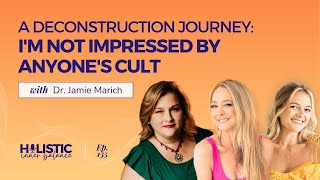
Dr. Jamie Marich discusses her memoir about leaving a high-control religious group, exploring how cult dynamics hide in mainstream religion and therapy. She explains EMDR and other tools for healing from spiritual abuse while holding both compassion for people inside and clear naming of the harm they cause.
Chapters
Foreign.
Hello.
Welcome back to the Holistic Inner Balance podcast. I am Hadley of Happy Healthy with Hadley, and I'm here with Dr. Nicole.
Hi. Hello.
Oh, my gosh, you guys, this is my favorite interview that we've ever done.
And I know she says that for a lot of interviews, but I think that this is literally your favorite.
I think it really is. Like, you can see me just so lit up. Yeah, well, and I cried. I. Like, there's. Yeah, there's a lot here.
So.
It just. Yeah, it hits really close to home for me, and I think. Think it's going to. For most people. I think there's a lot, A lot, a lot here. And so we are interviewing Dr. Jamie Marich, and she is a clinical trauma specialist, author, and recovery advocate from Ohio. She founded the Institute for Creative Mindfulness and developed the Dancing Mindfulness Approach. She has a PhD in human services, and she's written five different books. Some of them are EMDR Made Simple, Dissociation Made Simple. And her most recent one is called you Lied to Me About God, and that was released in October 2024. And we go deep into it. It is. There's a lot, a lot here. She's known for her advocacy and mental health and LGBTQ plus issues. And this book spec dives really deep into her experience with religion and spiritual abuse. And it really just is. It's so. It's so resonant, and it's. There's so much nuance, which, you know, we love to talk about nuance here because it's not her saying, like, screw religion or anything like that at all, you know, and we. And we talk about finding our own. Our own relationship with God and all of that. And so you guys, I think, are going to love it. So shall we get into it?
I think we should get into it and just, you know, if you're in a place right now where you may not be in a space to hear about really difficult topics like abuse and trauma and religion, then this is your official trigger warning. And so take care of yourself. And maybe you listen to it in bits and pieces. Maybe you pass on this one, but just make sure that you take care of you first. But otherwise, if you guys are here for it. I know I am.
Yeah. And you can always come back to it later, too. That's the beauty of the podcast, is when you're in a space where you feel. Feel like you can handle it, then we're here for you.
Yeah.
All right, let's do this, girl.
Amazing.
Let's go. Welcome Jamie I'm so, so happy that you're here. Absolutely love your work. And you just wrote an amazing book called you lied to me about God, a memoir. And you've been in clinical practice, you've been a self healer. You've been doing this work for a minute. And this book is in many ways one of the most important things I think, that you've written that you were saying that you just. This is your favorite. You love this.
Yeah, I, having written many books now, they. They are all special to me in their own way. I often tease that an author's most recent book is their favorite child, metaphorically. Yet this one, even though it is my most recent book, means the most to me of any book that I've written or put out there because it is so purely my personal story. Many of the other books that I've written, and I've done a lot of writing for clinicians, I will say, have a memoir, ish quality, where I do share about my lived experience. Yet I knew that in writing about spiritual abuse, religious trauma, the dynamics I write about, I had to do it as a memoir. And I think in reading it as a memoir, you can tell that I have some professional training and it is very personal for us. What are on the pages?
Yeah, yeah. I was really struck by the way that you were able to pivot between really radically accepting how, if I may, how fucked certain things were and. And then pivot into this just incredible compassion. Like for your mom. You talked a lot about how there were some things that were really not acceptable, not okay. But then in the other hand, that you saw where she was coming from and so the ability to. Yes.
And.
Or there's something you said when we were just getting started before recording, what was it you said?
The both. And I mean, I live both. I live in the both. And. And for any therapist or healers listening to this, you may recognize that as dialectics, it's the philosophical principle off of which dialectical behavior therapy was created, although it predates it being a therapy. It's this idea of both and. Or another simpler way to look at it is two things can be true at the same time. I can love my family very deeply. I can even appreciate my mother and in many ways my father very deeply. And I can still have forgiveness for them and can still hold them accountable or call out a lot of the systemic problems that I think are fueling the types of religious trauma that parents like them give to their children. So, yes, two things can be true at the same time.
So can you tell us a little bit more about that as you did, the preparation for this book and the writing? What came up for you as like, I have to tell this story?
Yeah, it's been a process because I don't think this is a memoir I could have written at the beginning of my career. I just didn't have the level of preparation, I think, as a writer, as somebody who had the lived experience with navigating being personal in a field where that is not looked at kindly in many ways. Because even amongst trauma therapists, there can be this sense of we need professional content and data and data and all these things to justify what we do. And we. It gets too complicated when we make it too personal. So the fact that I've had 20 years of having to wade through being a person with a story and trying to build a professional career, I mean, that made it the right time for me to tell this story. I think every book I've done, especially in the last five years, has progressively gotten more memoir ish from the trauma and the 12 steps to dissociation Made simple, where I tell more and more of my personal journey. And now it's like, here, here. Here's all of it. So I think that's why now felt like it was the right time. And if, if I may, like, when you drop the F bomb, I definitely am like, yes, of course you may. The political climate in the United States is a lot of what fueled this as well. Because when we hear a phrase like Christian nationalism, and I'll try to speak in a way where I'm keeping political parties out of it, but I grew up in Christian nationalism. I knew what that looked like when I was a small child. And I just felt as I saw so much hatred and division in the country over. I don't even necessarily think it's over religion, but religion has been used as the tool in creating a lot of these power wars that we now see ourselves in. I just felt that my personal story had some connection that needed to be shared, that this is what growing up in extreme religiosity could do to a child. And I look at my story and I even know I did not have it as bad as some others. I think the unique twist on mine was that I had the two Christian denominations I was being raised in. The Catholicism on my mom's side, the evangelical movement on my father's side. And so I have the unique added twist of seeing what two religions that technically can't stand each other within Christianity, what they have in common. In a lot of their hate based devices and whatnot. So I just felt I had a lot to share, being that I did grow up into brands of Christianity, if you will. So it just, it just felt like the right time. And even now, as we prepare for what might be ahead, I'm getting even more folks reach out to me, just thanking me for writing it. And I, I, I knew that in writing this I might make some people mad or create trolls and all of that, but I also knew that there were people out there to be helped by reading in a way that they could connect, that they're not alone. So now is the perfect time. So here it is. Long answer to a very short question.
Yeah, yeah, this, it's been something that's been on my heart for the past few weeks. And you know, growing up I was also, I grew up Christian, went very far away from it for a while. Now I'm, you know, I have a relationship with God.
And.
The other day I was actually, I'm so at the time of this recording, it's December 3rd and I love Christmas. Like, I'm a big Christmas person and, you know, I'm like listening to these podcasts and you know, obviously like getting into the Christmas spirit and stuff. And the other day I just like started sobbing because I was like, this thing that could be so amazing for all of us, this thing that is just love born into the world and like whatever has just been weaponized and made into such awful. I'm getting emotional.
Yeah, yeah.
Just like you're, I've been following you on Instagram and like your content has been so helpful in just like making sense of things and. Yeah, thank you, thank you for the.
Work that you're doing.
Thank you. Thank. No, thank you for the compliment. And I resonate with that experience of this could be so beautiful. Yeah. I've had many of those moments throughout my travels. Having worked in Bosnia, having traveled around the world and having been in Jerusalem. Those are two examples, for instance, where I just sensed into this, this could be one of the most beautiful places on earth. This could be the most holy place on earth. This could be the, this could be the most wonderful time of the year. Truly, if we focused on, I don't know, I don't want to say the things that matter because certainly different things can matter differently to others. Yet I, I, I just, let's just leave it at. I relate to what you said about, yeah, this could be and it's not. Yeah.
So one of the things that you said that I really was interested in talking more about is you said. And maybe it was a quip, but it was really, really intriguing for me is I'm not impressed by anybody's cult.
Yes, yes, tell me more.
I want to hear more.
And I will preface that by saying one thing I write about in the memoir is I really got started to feel a certain kind of way when I was feeling some of my students were wanting to turn me into a cult leader or have called me something like a guru. It's like, no, I'm, I'm not your guru. I, I'll accept the title of teacher if we look at teacher as somebody who leads you to realize that you have the answers within you. But yeah, I, I've long had this radar since becoming a professional clinician because I've been licensed now going on 20 years, that when I came into the field and started getting trauma training, EMDR was my first modality that I got trained in significantly, and I now train in it and have written some books in it. But my bells and whistles went off around some of the dynamics I saw with people trying to make the founder a cult leader. And I've seen that with other forms of therapy as well, like ifs internal family systems. And I really don't believe that either of the founders of these systems necessarily, necessarily wanted that. But I think people have made that happen because people want somebody to give them all the answers. People want somebody to save them. If we're being dramatic about it, and I'm not saying that's, that's everybody, but I think even in US politics, it's not necessarily one candidate that's the problem. It's the fact that we can hold the presidency in this cult like position of we're going to have this one person who will come in and fix everything for us. And anytime I see these cultic or cultish dynamics, it just reminds me a lot of how I grew up. And I grew up in two mainstream religions, to be clear meaning denominations of Christianity that were right out there on Main Street. And so I was not, as I like to say, in the kind of cult you would find in a Netflix documentary. Part of what I mean when I say some people had it. Worse yet, when I watch those documentaries about the various cults and cultic systems, I relate to so much when I first started earnestly looking into spiritual abuse and religious trauma as a construct based on what I experienced growing up in religion, I relate a lot to what people who have gone through perhaps a more traditional cult have experienced and so I think there's just a lot of things that can become cultic. There can be this devotion around the founder of something or there can be this obsession with. I know we were chatting about this before the formal interview. Well, if I just do this one practice, then it'll be cleared, it'll be done. And that to me can almost be a bit of a, I don't want to say magical thinking, but promotes this idea that one thing is going to fix it. And I don't think we as people, we're just more multi dimensional than that.
I resonate with what you're saying there. And I think that, that, and I'll use the term magical thinking.
Okay.
Has been such a, a bedrock in my psychology where I magically think and I don't even realize what I'm doing. And it, I became more aware of it when working through my fear of flying.
Your book. Yeah.
Yes. Where I, my, one of my big trauma responses is I fawn. And so for, for those who aren't listening, it's. If you can appeal to the, the person or the entity or whatever that's in authority, then that can create safety. And you know, that was, that was trained in me from a very early age, having an authoritarian Marine parent who is very corporal. And then growing up, I grew up in the Missouri Senate Lutheran Church, which is like.
Oh, yes, really.
It's like Protestant Catholicism is very rigid.
And very well put. Yep.
Thank you. And, and so I'm getting on these flights and I'm being incredibly nice to the tsa and I, I, I think I'm a nice person. But this was the reason for it wasn't out of a place of abundance and joy and love and kindness. It was out of a. If I'm inadvertently unkind to this person, then karma or God or something is going to smite me and that plane is going to fall out of the sky.
Yes.
And so all of these, like little millions of little moments, probably throughout every day of my life, flying or not, were based in this magical thinking of trying to manage what had been installed in my nervous system, the unconscious, and later in my consciousness, is that I'm trying to prevent terrible things from happening with magic.
And I, grown up religious, will do that to you. Yeah. That's been my experience with it. I remember as a young flyer, in my teens, into my early 20s, before I had fully deconstructed, I don't think I ever prayed so obsessively as when I went on a plane.
Yeah. And then when the Plane doesn't crash. You're like, it worked, right?
Yeah. Right?
Oh, yeah. I had that with, with my health, with food and my body and all of that. It was my magical thinking was, if I can just find this one diet or if I can just find this one workout program, or if I can just find this one thing that's going to be the thing that makes all of my problems go away. I was like, this is the problem. And of course, it was a symptom of internal challenges, but I was like, this is the problem. And once I figure it out, figure out the way to the one thing that will solve this problem, then, you know, everything in my life will be better. And I think, I think most people have it at, to some extent in, in one area or another.
Well, Hadley, think about like when you were a baby and you had gas in your tummy. You're pre verbal. You have no idea. And then your caretakers are the ones that help you by relieving suffering, giving you gripe water or laying you on your tummy or whatever, feeding you. And then when we get older and we get bronchitis and we go to the person in the white coat and oh, my body is broken. Please, person in authority, please fix it. And so it's like we, we come in and we have this inherent, inherent need to defer to those in authority. And so that.
Right.
That that program is already there. And then it's like you're talking, Jamie, about these infrastructures that are then put in place.
Yeah.
That. That are going on with. They're going with that.
And I just want to add, I never, when I go down this line, I never intend to shame people who are looking for relief because I know what it's like to be that human being that wants relief. And I think there are treatments out there, I think there are approaches we can do that give us a good amount of relief rather quickly. And I don't ever want to disparage anybody's quest to find that. But as holistic folks, I don't know if you have ever studied Saint Hildegard of Bingen. She is, you know her.
My mentor is a Franciscan monk.
Yes.
And so he, he bought me her book.
So.
Yes, please tell us about it.
Yes. So I adore Hildegard. Again, I am away from the toxic parts of religion that hurt me, but I still have a lot of connections to the saints and spirituality that's sustaining me. So the group that I do a lot of work with, Abby of the Arts, I write about them. In the, in the memoir, a very progressive Christian, you get to choose the.
Things that, that really, that are there to serve you.
Can I tell you where my brain is going?
Yeah, go.
So, Hadley, you always have these brilliant things to say. And then I'm like, but this is what my brain is saying. So as, as I'm saying that, I'm thinking about a pastor that was like. And don't you dare cherry pick. And so I have this, like, part of my brain that's like, I have to find out what's truth versus what's a statement of faith.
Yeah.
But then by deciding something is truth, I am making a statement of faith and I want to pick what works for me and what feels true. But then I'm. Then I'm. It's like a confirm. Right, Jamie?
I see. Go there. Yeah, let's go there. Because I heard the cherry picking line in both the evangelical church and in.
The Catholic Church, and I think they're also cherry picking.
Yes. And they correct or they're inter. They're interpreting things a different way. Right?
Yeah.
And I think it is a common line of defense used by people whose power is threatened, you know, to give religion a break. I hear it in therapy too, where I have hung out over the years with a lot of EMDR purists who are like, use the protocol exactly as it's written. It's all you're ever going to need. And what I teach is that EMDR plays well with other therapies if you let it. And I think there are some of us who naturally are more integrative, and there are others of us who want more of the, the pure way. But, but a couple kind of counters I can argue to that. You know, even though he was a flawed man, you know, a great man in a lot of ways. Mahatma Gandhi. One of my favorite teachings of his is that everyone holds a piece of the truth. And I think that is a fundamentally more Indian way to look at things than a Christian Western centric way to look at things. And I, I know, and this is why I don't regret getting involved in a yoga ashram after having had so many experiences with Christian religion. I, I did deepen a lot of my study with yoga, which was my intention for going there. And I learned one of the most beautiful teachings of India is the teaching of Sanatana Dharma, which is. And I write about it in the memoir, and I'm very much simplifying it here, but it's this idea that the things that we have in Common is what is really true. Everything else is just detail. So when I think about what are the things that the great faith traditions have in common. This is quoting another colleague, Reverend Dr. Sherry Palace. It's love and letting go. The idea of love as. As the base, as the core, that. That love is my religion, to quote the song, the Marley song. And that letting go and surrender is. Is key that we don't have all the answers. So for me, that is what's true. And everything else is just detail. So the whole. Don't cherry pick. To me, that is something delivered by a person whose authority and power is feeling threatened. Because you can also argue that in other spiritual paths, the cherry picking is the mosaic. But what is really true can never change.
Thank you. Everyone has a piece of the truth. And the things that we have in common is. Is really the truth is looking for those commonalities, which you said is love and letting go.
Oh, it's so good.
And that's what I do with Ayurveda, too. Like Ayurveda says. I mean, Ayurveda is a Vedic philosophy and everything.
Yes.
And so it's like, you know, they have the doshas, so we have the different. The differences between people.
But.
But the central point of Ayurveda is actually that we are all more similar than we are different. And so there are things that we can all do for our bodies and, and our minds and our spirits to. That we don't have to differentiate between people, though. We can do little things to tweak things. It's all. We're all more. More alike than we are different.
Yeah.
Beautiful.
This so is so good.
Yeah. I'm having fun having these conversations.
Yeah.
So as we, as we come to the end of this, this beautiful connection, this beautiful time together, what is something else that you want to make sure gets shared, gets conveyed to the audience, to the people that hear your story?
It's a beautiful question, and I think we covered so many of the bases here that Keep being good to yourself. Keep realizing that your outside helpers are just that. They're. They're helpers. They can be great facilitators. They can be great teachers, to use a word we use during the interview. Yet your own deep healer lives inside of you. You are that healer.
You are that healer. I love that. And in dbt, we call that wise mind. Right. And. And then in ifs, we call that self. And in Christianity, what's your. The Holy Spirit. Spirit.
And so, yeah, kind of Buddha nature, you can think of it I recently did an interview with Dick Schwartz. I'll send it to you because I think you might like it. We were both interviewed about parts on a podcast. And, yeah, the whole idea of capitalist self, you know, it's also a very yogic idea. Like the one conscious self, I think, like. And I guess I'm just saying that word can get a little triggering to some people who have dissociative identities, because it's very much like. But we're all selves. And saying that there's one Kappa less self can feel a little. So on behalf of the community I belong to, of people with dissociative identities, I just want to put that out there. But, yeah, if it works for you to think of it as capital S self, great. I think a lot of what Dr. Schwartz writes about s self I see as Buddha nature, or I see as this idea of Sanatan Dharma that. That I talked about. The thing that connects us. And something else yoga philosophy would say about that is that is the you. That is universal, unchanging, and timeless. And all these traumas that have happened to us, all these experiences that cut us off from that. Yeah. It's work to heal them, but that. That one constant, call it what you. What you need, friends, is there for us to tap into. Yeah.
Sometimes it's just slow medicine.
Slow medicine. Thank you.
Yeah.
Big fan of slow medicine.
I'm a big fan of instant gratification.
Why not both? Like, let's go to the both ends idea that started this. You know, There is nothing wrong with wanting some instant relief. Yes. Yeah. But it's also realizing that some of the things that are truly worthwhile need to come slowly. Yeah.
Like next day spaghetti. Always better the next day.
Yeah. Well put. So good.
Thank you so much for joining us. This has been one of my absolute favorite conversations.
Me too.
We are honored. We are touched, and, yeah, I hope we can do it again sometime.
I love that. All right, everybody, thanks for being here, and we'll see you next time.
More from Dr.

Did you known that there are 3 stages of iron deficiency? Which stage are you in?








141. How to Tap into your Inner Self for Ultimate Wellbeing with Dr. Christian Gonzalez

140. Hacking the Vagus Nerve to Calm the Nervous System with Nicholas Hool, Ph.D.

How to Tap into your Inner Self for Ultimate Wellbeing with Dr. Christian Gonzalez | Ep. 141