Be Different to Make a Difference with Tayo Rockson | Ep. 137
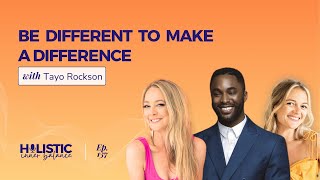
Tayo Rockson, raised across five countries by age 17, talks about being a Third Culture Kid and using cross-cultural experience to drive inclusion. He shares coping strategies like journaling and vagus nerve activation, and explains how inclusion practices directly impact organizational outcomes.
Questions this video answers
Be Different to Make a Difference with Tayo Rockson | Ep. 137
Nigeria
Five countries across four continents
15
Use Your Difference to Make a Difference — page 63
Chapters
Foreign.
Welcome back to the Holistic Inner Balance podcast. We are here today with such an amazing guest who we are obsessed with. Tayo Roxon, who is the author of Use youe Difference to Make a Difference and has a number of TED Talks, has a podcast with over 700 episodes. He's really incredible, just prolific in his writing and his speaking and all the things. And we are today talking about identity and we are talking about inclusion and diversity and really getting like digging in to all of these things and how it can impact our mental health as individuals and then also as collectives as, you know, different institutions, different educational systems wherever you are in, in a workplace or just in family systems. And we are going to dive into all of that today.
Let me tell you a little bit about your new favorite human being, all y'. All. So this is out of his book, this is his bio, and there are so many more things that we could say, but I want you guys to be able to get to the episode while you're like doing life. And so Tayo Roxann, he's the CEO of UID Management, a strategic leadership and consulting firm that helps corporations improve their bottom line by incorporating diversity, inclusion and social justice strategies. He is an authority on cross cultural competencies and international branding strategy. And as Hadley said, he hosts a popular cross cultural podcast called as Told by Nomads. And he's been featured in media outlets around the world, including where I got to meet him on Tamron Hall. And I'm telling you, we get into a really, really great conversation. Some, some highlights is no one person has one identity. We get into perfectionism is its own system of oppression. We talk about our non negotiables, we talk about truth, we talk about business and sour gummies.
So you talk about sour gummies for a while, you'll love it. We also talk about our favorite word, which is nuance. So we go deep into, into all of that. And yeah, it's really, it's really good, you guys. You're gonna love it.
Are you ready to jump in?
Let's do it.
Hello, Tayo, meet my good friend Hadley. She's my co host here at Holistic Inner Balance. And Hadley, meet Tayo. I feel like kindred spirit. We met in the most beautiful, fun way. We got to do Tamarind hall together.
Yeah. Yeah, that was a fun experience. So it was, it was good. How have you felt since then, by the way?
So grateful. So grateful. I've been. It was really fun when the she launched, I think like three little excerpts about It. And then my book went to number one for anxiety and phobias, and so it's really fun and exciting and this is like a masterpiece.
Oh, you're way too good. Way too good.
So good.
It's so good.
Oh, well, thank you both.
I've been loving it. I've been. I'm not fully. I'm not fully through it all yet, but I've been loving it. And I've been also binge listening to your podcast as well.
Yes.
Which is fabulous.
Well, thank you. I'm. I'm pivoting soon. I. You know, so. Because it's like every time you need a new direction and I. That was. Was 2012. So 13. Yeah. Almost 10 years of my life. And so.
Wow.
Yeah. I was getting drained and burnt out and all those things, and I was like, I need to honor my current self, so it'd be interesting. Yeah. And I. I started your book, but I'm gonna. I'm still going through it, so. I love the tips. You have so much information, so I feel like I have to take notes every time, like, okay.
Oh, yeah, I didn't know that.
So.
Yeah, it can be anxiety provoking just to look at it. It's like when it came, when I got my first edited draft of like the book, you know, they sent out the pre order books, I was like, this is a beast. This is like a tome.
I.
So.
Because I read it like via PDF, like, oh, you did? So I did before. Before it was published. And so when I got the book in the mail, I was like, damn.
This is why it took me so long to read.
That's a.m. so how do you two know each other?
We met through mutual friends.
Yeah, we met. We like e met through mutual friend. And we were e friends for like a year almost, I think. And then we finally met in person because we're both. Well, I'm from Michigan and Nicole lives there now, so.
In Michigan.
Yeah.
So we just like cackled like lunatics the entire time we hung out together.
Understandable.
Which is. Which is the promise of a great friendship.
Yeah. Yeah. Lunatics being the bond, everyone.
Exactly. This is. And we're like, let's just record our lunacy and make a podcast. So it's just like an outlet for our fun friendship. And. Yes, it's great.
I love it. I love it. That's good. It's good.
How have you done since. Since we were together last. So this was October, right, when the show was recorded?
Yeah, it was October. It came out of the 29th. My birthday was the next day. There was the elections, and then.
Yeah, yikes.
Yeah. That.
It was just not a great time to have a birthday.
Yeah, I know. It was just. And then. Yeah, just been preparing. I'm from Nigeria, as you all know, so going there in, like, less than two weeks. So been planning and then pivoting as well, because the current administration or the next administration is not going to be a fan of a lot of my work. And so it's about working with people in my circle to figure out how to repackage it in a way that's, I guess, more palatable for audiences. But, yeah, you know, yeah, just figuring out that. But, yeah. Yeah.
I'm in awe of you. Like, everything. Like, literally, I'm like. Because I've been having these conversations with people, you know, like, after the election, and it's just like, what do we do? What do we do? And you are the leader. And like, it is really.
We don't know what to do. But, you know, to your point, a lot of what you wrote in the book and what you believe as well, Hadley, is. I've had to figure out a ground myself and not try and be thinking about the forward and the worst possible outcomes. But, you know, it's going to make a good story someday.
I kind of want to expand on that is with this podcast, by the way. We just hit the ground running and we just go. It's super informal. And so I'm curious about the idea of the pivot. And how do we find. And how are you figuring it out as you go? The nuance between I'm pivoting and I'm almost compromising or sacrificing my voice and my truth and my message, and maybe a fawning way, as opposed to pivoting in a way that feels more authentic, more empowered, and also perhaps more palatable for the audience that you're trying to target. Like, how are you. How are you doing that?
Well, the first part for me is just to remember the big picture. So I created this big picture architect for myself, and I was like, okay, you want to ensure that people effectively know how to connect across cultures and are eternally curious so that they are, you know, recognizing what each person needs to succeed. Right. That is something that we have struggled with throughout civilization. It's the reason for a lot of the wars we've had. People couldn't agree on a certain religion or a certain idea, a certain law. And then. And show. Okay, that's the big picture. Then you start creating your List of non negotiables. All right, Are you willing to water down your message for profit? And, you know, I don't feel good about that. So I'm like, no. If someone tells me that I have to, you know, edit out certain words that will benefit the people that I want to be seen, I'm like, all right, can't do that. And so you start going down through that list, and then you have to look at yourself, and then there's a forgiveness that has to happen. Because a lot of my work is mission based. And I keep thinking, okay, and I work and this is my therapist. Am I doing? Am I sacrificing or am I going away from what I believe to be true just so I can fit in or go along? And then it's about figuring out what the truth of that is versus what you think the truth is. And so somewhere in between, I start working along the way. So I have my non negotiables, I have the big picture, and then I understand. All right? At the core of what I want to do is to make sure I continue to study humans and how and why they behave the way they behave. It doesn't matter what administration exists. We always will be eternally curious. Teams will companies. We want to know how teams work together from different backgrounds. People want to know how to negotiate certain strategies and people in relationships who want to know how to deal across certain dynamics. And so start talking about it in those ways. And they're like, all right, I feel better about myself. Right? It's like that. The peaks and the valleys of that. But, yeah, that. That's how I've gone about it, at least.
I love that. And just thinking about your book, I love that in your book, you talk about the. Obviously we talk about, like, bias and. And identifying your internal bias and all of that, but you also identify, which I don't see talked about as much. You identify your core values.
Yes.
So it's like, these are the things that I'm not willing to compromise. So, like, that takes it to a whole new level, I think.
No, it does, Hadley, because I. Even when I'm teaching my students, I sometimes I just ask them randomly, hey, can you tell me what your five core values are? And almost, I don't know. There are very few people in the world that can actually tell you that off the top of your head. And I always say that that's an indicator that you're not living life intentionally. You're only reacting, you know, And I feel like we live in this reactive World, as opposed to reflective world. And so those core values, I feel like, are things that help us move away from performative actions, but they also help us ask those deep, deep questions. You know, I'm sure many of us have been in toxic relationships or many of us have had to set boundaries along the way. We lost sight of a value or two, and then we just sort of accepted things that never really resonate with who we truly wanted to be. Right, yeah. So who you are, who you think you want to be, and who you want to be, you keep going around that path, and it's like a cyclical.
Who do you. Who do you want to be?
Well, I. I want to be remembered as someone who eternally brought smiles to people because of how much I reminded them of their potential. And I also want to be, you know, remembered as someone who opened the path for previously unrecognized cultures. And so it's a big ask. Right? But the reason I like setting goals so big like that is that even if I don't achieve them, you end up growing into someone that could achieve them. So along the way, you know, you. You stumble across a couple of stars on the. On the way to the moon, and I'm like, you know, something happened, or you inspire the next person to take the baton from you, and then that person, you know, does something and. Yeah, so.
That is such a great answer. I love that.
Oh, thank you.
Hadley, who do you want to be? Yeah.
Well, I want to be someone who helps people uncover their capacity to be able to make the changes that they want to make in the world and have the kind of energy that they. That they need in order to, like, fully realize their full potential and.
And.
And put for, like, move forward the causes that they care about. That's the thing that I'm, like, most. Most passionate about, is helping people actually have the capacity to do that, because there's a lot of burnout. There's a lot of.
Oh, my gosh. Yeah, that's amazing, Hadley. Yeah, but we got to turn it Back to you, Dr. King. Yeah, but that's amazing, Hadley. The capacity. Yeah. Yeah.
I love that capacity. Like, it's so empowering. It's like giving people the bandwidth, the capacity. And I feel like you both have that, too, because it's like reminding people of their potential, opening up pathways for previously unrecognized cultures, and then helping uncover capacity, realize your full potential. So I feel like you two have, like. It's like running in similar shooting star streams. I love that. Mine, mine. I borrow from this writer, Samuel Hahnemann, who wrote this in the 1800s. And it was the goal of the doctor. And when I read this, I was like, doctors could do this. This is a thing. It doesn't. What. That's not my experience. And so what. His name is Samuel Hahnemann, and what he says is the. The role of a doctor is to help a person heal themselves in such a way that they are able to use their vessel to obtain the lofty purposes, meanings, and goals of their place on earth in such a way that obliges wonderment by those looking on.
I love that one. Obliging wonderment.
Obliges wonderment. So basically like the tldr. Because I'm like, trying to figure out my own way of wording this. Basically, I want to help people show up as their total true selves in a way that everyone looking at them's like, what the hell is that? And how do I get it?
Yes, it's. It's incredible because we have like a through line, you know, this capacity showing up as yourself, you know, creating space for people that don't normally feel seen. And it's, you know, at the end of the day, I think that's the ultimate human experience where I think at our core, we all want to feel seen, recognized for who we are. You know, and sometimes we. Not sometimes. A lot of times we wear all these masks, right? You know, willingly, unwillingly, and consciously, unconsciously. But what you're saying, what have me saying, is giving people permission to be themselves and to even become their best selves by daring to do the thing that people may have told them they couldn't, or they have told themselves they couldn't.
So in this process, you talked about who you were, who you are, who you want to become. Do you mind sharing with us your story?
Absolutely. So, yeah, I was born in Nigeria. I ended up growing up in five countries and four continents by the time I was 17. But born in Nigeria at a crossroads. Nigeria's at a crossroads. We are experience in a series of military dictatorships. I spent the first 10 years of my life in and out of three military regimes, and two of them were just these heinous dictatorships. And in between, my pops is a diplomat. So we make a pivot to Sweden for two years when I'm one years old and my middle brother is born there. But we're going back and the chaos around me, I'm starting to know now. Know manifests itself in. In an interesting way where you. You mute yourself, right? You have to watch what you say so you can come back home. You don't know who you're going to offend because again, it's a military dictatorship. So you got to make sure you're not saying things that could be whispered up to the powers that may be. And then we transitioned to civilian rule in 99. And my, my, my father's job as a diplomat begins to just take off more regularly. Like the sanctions against Nigeria are raised so we can, you know, freely interact with other countries. And so, you know, so I then got to spend my middle school in Burkina Faso, which is a French speaking country in West Africa. And it was an international school, so an American international school. Here I'm this, you know, this black Nigerian kid, you know, just different accents in an American international school and in a black country, but in a white school with another, with another, you know, language on top of that. And so, you know, you're trying to fit in and, you know, it's, it's just an interesting experience. Right. Middle school comes its own set of challenges. I come back to Nigeria, I go to boarding school and I, you know, I stay there for, you know, till I graduate and then brief detour to Vietnam where my father was posted in my senior year. And then from Vietnam, I go to Virginia for school and. Yeah. You know, and then in and out of America since then. So, yeah, journey.
My dad was a marine when I was a kid and we moved I think like 13 times in 13 years or something like that. And so even to this day, when people ask me where I'm from and they ask me about my culture, I'm really confused. Yeah. And I wonder if, if that may be part of your experience too, is figuring out like, who am I? And how do all these pieces fit together? Especially when you're so little and you're so young and so you left when you were less than 1.
Right. And then back.
And then back. Yeah. Tell me about that. Like that, that idea that, that identity and culture and who I am and how did, how are you navigating that?
So I've started and stopped and started a few series of books. And one of the first lines is always, I've always been on this quest to find out who I am. Who I am is the central question of my life. And I, you know, I think for many people it is. But yeah, I mean, I grew up having this experience called the TCK Experience. The third culture, kid, is when you spend the formative years, you know, of your life in and out, you know, of you know, cultures outside of your parents cultures and your culture. So you just mixed and. Yeah, I started really asking myself that question when I was in Burkina Faso, you know, this 10 year old kid. And at that time, it's a very small school, about 120 or so from pre K to, you know, grade 12. So everybody knows each other, small classes, but you, you want to, you want to fit in, right? And I played sports. But everybody, you know, defines cool in a different way. And you know, I'm coming in here the. Without the added benefit of knowing some people who've known each other since they were kids. And so you, you start cosplaying to certain people wearing different masks. And in the process I, that I started like realizing that I do have anxiety. I didn't know then, but I would have all these moments where I would start stammering and I would spend nights that I could just mimicking TV shows. She's all that 10 things I hate about you. I'll like, try to, you know, find a Freddie Prinze Jr. Line, you know, Heath Ledger or, or, you know, I'll watch, you know, Will Smith from, you know, Fresh Prince or pick up something from Martin, and I'll just be like, okay, you know, try to figure out my cadence. And, you know, it wasn't really who I was, but I was just trying to figure out what, what was, was cool and all these things. And you know, in retrospect, there were a lot of stressful moments. You know, I, and I remember having a conversation with my, you know, my therapist. There was a school therapist at the time, and I'd never had a therapist at the time. And I, there was one day I was stressed and you know, eighth grade, and I just casually say, ah, yeah, I don't know if I want to stay here on, you know, continue. You know, I'm just making a comment. Is she, you know, is she. To her credit, she's like calling my dad and calling everybody, oh, you can't leave here. And I'm thinking, oh, that was just making a statement. How do I do that? You did. And I, and I'm freaking out because my father is Nigerian, I'm Nigerian. And I know. And you know, in our culture this is, you know, this stigma. I'm like, I can't believe I'm gonna have my dad leave his own office just because I made a comment that I wasn't intending to sound the way it sounded. And I'm gonna be in so much trouble over this. But it was those experiences where I, I, I felt like I was showing up as one thing, but I, I, my real self wasn't going to be accepted. And so then that was who I was for middle school. And when I came back to, to, to high school, it was more like, all right, fine, no, I'm gonna try to be this, this person who is just firm in his own resolve. And it was, I became this black and white guy, was like, this is right, this is wrong. Almost like I was reacting to all that, you know, and I ended up being the, the head boy, which is the equivalent of your student body president. And in a boarding school. Again, everybody knows each other. But even though I was seen as a student leader and elected to be the student leader by my senior year, I also felt like I was given, I wasn't, you know, allowing myself to have the nuance. I was just trying to live up to a certain idea almost because I felt betrayed by what I was doing in middle school. And then when it came time for college, I just remember signing this contract with myself that I would just allow myself to be right. And like, I don't know who this person is, but it's a combination of all my experiences. I don't need to try and forcefully define that. And I've been on that journey since. You know, sometimes it's good, sometimes it's bad. But I had that, those series of ups and downs. And you already know, Dr. Kid, I, I had the first panic attack in, in my, you know, boarding school when I was 15. And now we know why. You know, I just had so much in without an outlet, but it just started manifesting.
Oh, I love that you talk about nuance. We talk about nuance all the time.
One of my favorite words. Yeah, yeah, yeah, yeah.
Yes. And I, I, I definitely relate to that need, like, as a kid and, you know, into my teenage years and stuff, of just trying to figure out, like, what's right and what's wrong.
Right.
And then in college realizing, like, there maybe is no such thing as either or, Right.
It's a great place to be because then it can be freeing. But then you have to also reassess some environments that you, you know, you came from because they're going to be inevitable challenges. You know, it could be family members, all that. Like, no, it's not what we taught you, but you're like, no. Well, I'm, I don't know if I agree with what you said. Right. Yeah, I think it's gonna have to be okay that we disagree on this one. Yeah. Yeah.
Oh, yeah. And then, you know, of course, in college, I, like, became like a, you know, like, social justice warrior. And then, you know, and then learn to refine my argument.
Yeah, that is the part. The refinement that was. That was high school for me. It's like, you don't tell. You don't have to. You know, you have to go into a big speech every time you think something is wrong and start. But I was, you know, I was that dramatic. I was like, okay, just. Just calm down. You know, it's not a.
It's not that.
I resonate with this. How spicy. I learned the word insubordination from my flute teacher. What does that say about Alice and Nicole? Oh, my God.
It's true. Yeah, yeah.
Insubordination.
I mean, you just wanted to do things. You were just curious. You're right. Right. Actually, that curiosity that I've always had, I allowed myself to do that more freely. I used to get punished for that by teachers when I was a kid because I've always been energetic and hyper, but they just didn't know what to do with my energy. And I was like, well, what about that? What about that? What about that? Is that true? Yeah, yeah.
That energy is one of your superpowers. But.
Oh, I agree right now. I used to shame myself for that, though.
Well, it's because it's not convenient to have someone who thinks for themselves and asks questions and is really energetic when you're trying to wrangle a bunch of kids who are all like that. And so we have so many kids who have this amazing. These unique, amazing superpowers. And just the educational infrastructure isn't built to support that. And so then we all walk around and we're all like, I have adhd. I'm restless. I have neuro atypicalities. But rather, what if we did have a society or a culture that actually honored those superhero strengths? Like, I wonder what it would have been like for your younger self to be free to ask all the questions and to be really energized and to do anything that came up for you, like, whoa.
No, it would have been amazing because I would have not held so much in. That's one of the reasons I became a writer. I love writing in general, but I would always write in my journals, just internal thoughts I had, you know? And I remember I go to therapy regularly now, but I remember feeling betrayed by the therapist, even if she was doing a job. But. But in my head, I was like, I wasn't articulating the Way you're saying, I was just like. I meant, like, you know, it was a frustrating day. Sometimes I feel like I don't want to be in this school. I won't be here. You know, all that. But it was just, you know, I was just despondent, and I thought I was voicing this out. But after that, I started internally writing things almost as a rebellion. I'm not gonna talk to you anymore. I'm gonna do that. But that came from the stigma that I had adopted where I felt like I couldn't trust people with information, and I had to unlearn that before. But if I had that infrastructure in place where people were saying, you know, it's okay to feel this. You might get a headache. You're very good about saying the body parts. You might have your heartbeat this way, and it's okay. Come to me, you don't look weak. Blah, blah, blah. Yeah, I would have been in a. Interesting space there. Yeah.
And then also for those who are listening is. Is having thoughts about our exit strategy and feeling like, I just don't want to be here anymore when suffering is so great. Is that is of a normal way to feel? Obviously, it's. It's a whole different story if it goes into the thinking about, like, how to hurt yourself or making intentions or plans. Like, that's. That's concerning. But had I had my now self been there with your past self, I would have been like, yeah, that makes sense. Tell me more about that. Let's unpack that. And honored. All vibes welcome. Instead of like, I'm here for you only if they're good vibes. Otherwise you're in trouble and I'm calling your dad and this whole whole rigmarole. But then also, I have to just, like, high five your younger self because journaling is such a brilliant trauma. Informed, innovative, somatic processing activity. Like, there are very few things that you could have done that were more powerful within that level of agency that you have as a teen.
Well, thank you. I still have some of my books, especially from the high school, and. And it ended up being freeing, but it was. I always tell people it helped me record observations, and I tell people to do that to themselves. Record the observations around you and within yourself. And even if it's something you don't like, well, why do I always react this way? Why am I jealous here? What makes me feel unfulfilled here? And you can start to notice patterns, and you just get better about recognizing your own triggers, and the better you recognize your triggers you know, you can get to the point where you can have changed behavior. I always say, you know, in order to have changed behavior, you need to be able to recognize your. Your triggers. And so it's so important to be able to be that reflective and have a place to write these feelings out.
Yes. And I love Dr. Kane, that you said that. It's a somatic practice too, because I think people don't really know that because they're like, oh, I'm just writing things down. So this feels very mental, but actually, actually like your body is moving by writing it down. You know, you're moving less if you like type it out on a computer or like you like type it out on your phone or. But if you're writing it with your hand. Totally somatic.
Yes. Pads. What was your. What was your. So I journaled, like it's tayo. I think it's so beautiful. We both journaled. I have like stacks of notebooks that I've been pulling out of the basement.
They're random pieces of paper I've been writing.
Yeah, same. Yeah. Kindred spirit, I'm telling you. And so I have like stacks of old journals and I like looked back them recently and I was like, oh, girl.
Whoa.
Like, Hadley, what was yours? Like, what was your main coping skill?
Well, I wish that I could say it was very healthy. Like journaling. No, I did journal, but it was more like it was like writing down just like what happened during the day. Because like with books that I read, I'd be like, oh, like this is how you're supposed to journal. And I didn't really write about like my feelings. However, I guess one healthy thing was that my parents were super parent, so I was reading books like Don't Sweat the Small Stuff for Teens, like seven Habits of Highly Effective Teens.
Oh, yeah.
But I will say my coping strategy was eating. It was not. It was like a. It was just overeating. And it was very effective for not feeling any of the. Like, I didn't know that I was emotional eating because I didn't feel any of the emotions. It was very effective in not feeling those emotions. So then I had to do a lot of unlearning and then doing. Do a lot of emotional, like work with that to stop the emotional eating and everything. So yeah, it's very self aware. Yeah.
Well, I'm curious to hear your thoughts on this because both of you study this. I noticed that the higher my anxiety, sometimes the, the bigger my sweet tooth is. I, you know, I just. And to your point about overeating. I'm talking about four bags of just gummies where I'm like, what. Where I'm just. Just eating the thins. And it. It just makes me feel better. Then I instantly regret it, of course. But I don't know if there's a connection with sugar and anxiety or just unhealthy eating, but it. I've noticed that in myself over the years.
Absolutely. Yeah, it is, it is. It helps you. Like, it actually does calm you down. Like, it's grounding to have sugar or even, like, stuff. The salty taste, the sweet taste, all of those things does help us ground down. And we probably don't want to be eating four bags of gummies. Right. And we can find other ways to calm down. Yeah, but, yeah, no, there's. There's an. A very much a direct correlation. I mean, I'm sure Dr. Kane can talk about, like, the actual mechanism of how that happens, too.
There, There are so many magical things to say about that. But what sticks out to me especially is that you were craving gummies, which are kind of sweet and sour.
And sour, yeah.
And so we know that the act of swallowing and sour flavors in particular. Remember we were on tamarind and she had that dish of candies, and I licked one of them and it was so sour, I was like, sour. It's. It activates vagus nerve and vagus nerve calms the body. So eating in and of itself, but then also what we crave. And then Hadley, from an Ayurveda perspective, sour. So he's craving sour in particular. Tell us about that.
It's grounding. So sour, sweet and salty. Those are the three grounding tastes in Ayurveda. And so we. That's what we crave when we are, you know, needing that. That immediate grounding. Now, there are other things that we can do for immediate grounding.
Yeah.
I mean, but. And, and also it's not bad or wrong that that's what you do or that you have done. And. Because when you, you know, I talk a lot about, like, the emotional eating cycle, and there's a whole, like, there are different stages to this cycle. And one of the stages you mentioned, which is immediately regretting it.
Yeah.
And so a lot of times we will beat ourselves up about that, and the beating ourselves up actually perpetuates the cycle. You are more likely to do it in the future because you feel that guilt and that shame from it. So a lot of people think that they need to be like, more mindful eaters and they need to break out of the cycle before it happens. Or even, like, during, like, you know, stop myself at one bag of gummies. Or, like, and we can stop ourselves in those areas, but we can also break out of the cycle from afterward. Instead of feeling that guilt and shame, like, really just tuning in and being like, what led to that? Can I give myself some compassion, understanding what happened here and, like, actually dig into that, and that will stop the perpetuation of that cycle as well.
Interesting. We'll see. Both geniuses. Thank you so much. I just. I had a feeling because it's something that, you know, I. I noticed, and I'm like, I know I shouldn't be doing this. My. My. I feel like my dentist is. Is perched up the wall there just watching me like, no. Oh, my gosh.
Your dentist is on one shoulder.
Yeah, yeah.
And you've got a gummy bear on the other shoulder.
Yeah, No, I have the dentist here, and the. The. The marketing company say, no. Get us. Feed your system. Give us your dollars.
Yeah, yeah. And yeast. Don't forget yeast. It's like. It's like the little shop of whores. It's like, sugar, feed me.
Yeah. That Candida really wants that sugar. Yes.
Oh, my gosh. So this is like, identities. This is parts. This is like, part of me craves the. The gummies. Part of me feels bad about the gummies. And so in your book, this is a segue, Believe it or not, gummies are a segue. Is in your book on page 63. So, by the way, this is my good friend Tyo Roxann. He wrote. He's done so much work, but he wrote, use your difference to make a difference, how to connect and communicate in a cross cultural world. And this is just a brilliant book. And so in this book, you have a section on identity. And what I really appreciate is that you ask the first question out the gate. Are, what are your multiple identities? And so I actually want to do this exercise together.
Let's do it.
Great idea.
Yeah. And so actually, because, Tayo, you've had a chance to think about this, I want Hadley to answer first.
Okay.
And then Tayo, I want to hear. But it's neat because you guys have very different cultures. I have different cultures. Then we can start to explore the assumptions about other people's identities based on culture, based on experiences that we've had, that we assume that they've had, and kind of use that as an inroad because I. I feel like culture is a really big, important part of your conversation. That you're having in this world, Tayo. And so I want to make sure that. That we get to lean into that during our conversation today. Is that all right?
No, Please. Let's do it.
Sweet. Okay, Pads, what are your multiple identities?
Okay, well, I'm a woman. I'm in my 20s, though. I'm turning 30 very soon. I'm excited for 30, honestly.
Oh, okay. This is good. I like that. I never know what it is.
Yeah, right. I know people. People are scared of it. We did actually podcast about aging and fear of aging and all of that, so. No, I'm. I'm excited about it.
I.
I am a white woman. Let's see. Class identity. Upper class, I would say, you know, growing up, thought that I was upper middle class. Looking back, everyone says that. Who's upper class? So it was more upper class than I initially thought. Oh, gosh. I mean, just other identities. Like, I think of myself as, like, a. A theater kid. Like, that's, like, a very big part of my, like, upbringing.
See.
Like, health and wellness is, like, a big, big part of my. My identity now. Yeah, those are some of the ones that come to mind.
I love it.
Yeah. I don't know if there's anything else I'm missing, but, yeah, there's a lot of layers. Yeah.
So. So if you're doing this exercise with your. Your consultees or your students or your clients, like, how would you expand on that or teach on that, Tayo? Like, what comes up?
You know, I will often open up with the fact that you. You know, the world is an interesting place. It tries to put us in a box. But if you really think about yourself, you have many interests. You probably woke up today trying to fit into several of those things. And so for you, in this workplace, in order for us to get you to be the best employee, the, you know, the best colleague, it's important for us to figure out things about who you are so that we can work and cater to those strengths and also understand the things you don't like and why you don't like them. And I think normally when you go to workplaces, people might just react to you, like, oh, he doesn't. He's never. I don't like the way he talks. Why do you talk like that? And you never really understand the reasons behind that. And so if you see someone who is very excitable, you know, early in the morning, that might be because this person likes running five miles every morning, and they're, you know, they're awake, and you could See them differently based on the fact that you know that now. And maybe not as an annoying pest as you initially, as you initially thought. And then, and then the other thing is interesting is when you start learning about people's interest, it allows you to create potential shared experiences. Because then you start realizing, I didn't know he'd do that. I didn't like that. What do you think about this? Let's do that. And then you have these bonds that move past that former relationship and you can just start proactively reaching out to someone, which then makes working together easier than it would have been in the past because it's not as awkward to start a conversation. So it's that. And then I just, you know, and then we start going. And then I model. I think it's very important for people to model. And so I'll say, you know, you know, looking like, looking at myself like you, you can say, you know, Nigerian, black immigrant, but extremely nerdy bookworm, a gym rat. Someone who loves a classic romantic comedy as much as he loves, you know, a thriller, you know, or gangster flick. You know, avid writer and you know, big brother. You know, I see myself as, you know, big brother because I have two younger brothers, but I'm also part of big brother, big sister. And you start getting all these things where people are really, oh, I didn't know, you know, and, and then it's, it's, it's an interesting way. And then, oh, something you probably not know about me. My favorite superhero is Superman. And then. Wait, wait, wait, what do you mean Superman? Why Superman? Why not Batman? Tell me more. And then you start going into all these things and so that, that's how you, I do it. You know, give them a brief context, allow them to envision it in their world, then model. And then they start getting enthusiastic because they can see that it can go anywhere.
Okay, that's so good. And so, and so it allows, it's kind of an open ended side door into what it means to be human as opposed to like the closed ended questions that we might ask or like, where are you from? Well, I am from. I have no idea because I moved. Yeah, right. Versus like what are you. Tell me about like all of the use like who are you? What are all the, the things that make you uniquely you? Tell me about all of that.
Exactly. And it gives you permission to do the same things you all want people to do. You know, your, your goals in some ways to guide people to the North Star. But when you start giving permission to actually Be more than whatever they're defined by, not just by their job title. There's an interesting thing that, you know, people experience with school, with work and all that. And I always try to bring that type of things to that type of thing to my student or even my friend group, it's like, hey, that's. You don't have to show up with this. I understand if you're having a bad day, it's okay. I understand if you're having a good day, I understand if you just want to focus on this, I understand if you don't like going out to this place, it doesn't mean we can't be friends, but this allows me to understand you more. And so it's. It's one of those things.
And all vibes welcome.
Oh, you all. Oh, go ahead. Sorry.
Oh, I was just gonna say all Vibes welcome.
All Vibes, exactly. You're the model. And with students, it also allows me to figure out how to craft projects for them. Right. This semester, I asked them the learning styles, and I was able to. I gave them a midterms, cater to their learning styles.
Right.
You know, kinesthetic learners, you know, people like audio, all that. So there's that as well. Just allowing them to learn in their best way.
How do people respond to these. This level of depth, of emotional complexity and depth in different workplaces, especially when you have people across cultures, there's a.
Lot of skepticism because, you know, people will be like, whoa, no. You know, obviously there are a lot of people, and it could be justified in some senses, who don't feel too comfortable revealing aspects of themselves because they, you know, my fear, retaliation, or, you know, they want to give too much to information or something. But. But. And then there are others who would. They would just embrace it. They're just like, yes, especially during the pandemic, I remember where there was this craving for connection and. And community. And so anything that really got them to think outside of work was just welcomed. And, you know, all vibes are welcome there. And so I think it depends on the industry. It depends on what's happening in the world, and it depends on that, you know, and all those things. So context, nuance, like we're saying.
I love it. I. I also wanted to ask you about, like, you know, people might be listening to this and being like, yeah, you know, like, inclusion work is really important, and, like, based on my values, I want to do this work. Some people might have a little bit more skepticism, like you were saying, in, like, the. The different places that you that you consult in and everything. So I wanted to ask you, like, how does it, how have you seen it actually improve not just the individuals who are within the, the company or the institution or whatever, but how does it actually like drive results for that institution, Results for the company as a whole and yeah, the community as a whole.
So I see a lot of the work I do as something that connects the invisible to the visible. Right. Maybe it's a bias. It's invisible, something you're struggling with. It's invisible. The many layers of you usually invisible and you're connecting into the visible. And so in terms of policies, it allows a lot of companies to end up expanding whatever resource they have. Like, oh, maybe they had a mental health resource, but it catered to the extrovert as opposed to the introvert. Now you understand, okay, so this allows some sort of privacy. This allows a feedback loop that can go here. You know, regardless of that someone is a mother but doesn't talk about, but then because their mother, they have to go up, show up to work at a certain time and leave at a certain time. It led to some assumptions that, be that this person is not as involved in workplace, but they're trying to be a mother. But now you have resources and an employee resource group where parents and, you know, can work together and talk and share resources. You have young students or, or young interns or older employees who are trying to fit in, but they feel like sometimes the other people think they're out of touch or different generations. And then you start understanding. No, we, we have a group for you here. These are the resources here. It impacts the way you lead, the policies you have, but also just understanding the people around you because you start seeing them more. And I always tell people, you don't have to show your full self in the workplace. I want us to get to a place where you are comfortable with the amount of self that you show while understanding that showing those layers are not going to be punitive. So you have the psychological safety to, to do that. And so that those are the ways that I've seen itself and the conversation and doesn't end up being like that in, you know, in the long run because sometimes people like to simplify it into one or other things. But then when you start with what you were saying, the multiple layers of who you are, you're like, oh, I need this, I need that. I struggle anxiety, I struggle with depression. It gets triggered. My burnout happens here, this. And they're like, oh, I know what to do. For you. You should go do that.
Yeah. So, yeah, you had mentioned, like, way at the beginning of this call, you had mentioned performative action.
Yes.
And I would love to, for anyone who doesn't know what that is, if you want to just speak to that a little bit and how we bust through that so that what we're doing is not performative action and instead is actually helpful.
Well, in the theater of our world, we have very, very interesting actors and actresses. You know, some give Oscar winning performances and some give Razzie winning performances. But a lot of people now know what the cliches are because of the influx of information. And you can say it, you can drill it down to a slogan or something. Right. And what I feel like that does is it doesn't allow us to understand how a saying became a cliche or why something is more important to someone. And so I feel like, especially even since COVID we started hearing all these words that we now know. Oh, yeah, no justice, no peace, black lives matter. You know, me too, all these things. But we don't spend enough time understanding what led to that and why someone wants to say me to why someone is saying black lives matter, why someone's saying, you know, no justice, no peace. And so it's in. And then what would happen is the news outlet to say this or certain, you know, TikTok or influences or whatever would say something and then you feel like you get the sound bites. However, I honestly feel like that dehumanizes the people that you claim to want to be an ally and an advocate. Advocate for. Because you're not reflecting on the level of privilege you have and the advantage and the advantage it gives you. And so I'm going to use myself as an example. I have privileges as well as, you know, things that I. That I might not be as privileged in. Right. Being a man is something that is a privilege in many instances. I live in New York. I can walk at 9pm without really worrying about my safety in certain areas. And many women can't do that. Right. That's a privilege. It doesn't mean that sometimes when I go to the airport because of my citizenship, I end up going to long lines or having more questions. Those two things can coexist. But people who are sometimes performing feel like once they've said the word and they've understood, they've. They've created a policy or they've thrown money at something that they've done the job. But no, you haven't. It's about understanding, well, why does the problem exist. And how can now. I can now now use my resources other than money to ensure that I'm in. The communities around me are not perpetuating these things. And so they get. That's, that's just the, the extra step that you have to take, you know, in terms of that. So.
Yeah. Will you say a little bit more about like the. Yeah, the. How you can have privilege in some areas and, you know, not in other areas and stuff too? Because I think that's really important.
Yeah. You know, it comes down to the. I always say this, you know, in a world of nuance, we're governed by binary options. Right. Yeah.
Writing that down.
Oh my gosh. Sound bite.
And so someone could look like me. So we could have, you know, two other black people here. Right? And you could make the same. You can make an assumption. But maybe me being a Nigerian gives me an advantage here versus someone who defines themselves as another citizen or vice versa. Or you could have someone based. Who has a different shape and looks the same, but because of how society views certain shapes, they could, you know, instant access, go in, come out, all that. And then you could have someone. This is very invisible, who struggles with anxiety and depression, will present to someone who is very confident. And so he or she, they are in a room, you know, filled with so many people who apparently present as confident. But that person is struggling due to all the, the, you know, the triggers and the sounds and all those things. But the way you've catered the environment is you've made an assumption without understanding who that person is. And, and it's. I just. It's a dance of life, right? You, you just have to understand where you are allowing someone to have a better advantage, whether it's not on purpose or on purpose or whether you yourself have an advantage. And then how do you then create a safe space or an invitation for someone to say, hey, before we start this event, these are the items that we're worrying about. But just so you know, if you need a break, there's a break room here.
More from Dr.

Did you known that there are 3 stages of iron deficiency? Which stage are you in?








141. How to Tap into your Inner Self for Ultimate Wellbeing with Dr. Christian Gonzalez

140. Hacking the Vagus Nerve to Calm the Nervous System with Nicholas Hool, Ph.D.

How to Tap into your Inner Self for Ultimate Wellbeing with Dr. Christian Gonzalez | Ep. 141