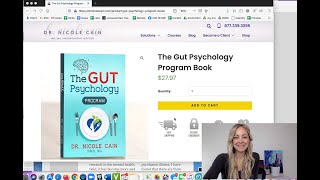
Dr. Nicole Cain gives a spoken preview of her 61-page digital book "Gut Psychology," which teaches how to eat to heal the gut and regulate the enteric nervous system to improve mood, anxiety, focus, and sleep. The book is organized into four modules that combine science (gut–brain links, neurotransmitters like GABA and serotonin) with practical guidance (grocery shopping, label reading, protein/fat/carbohydrate choices, fruits & vegetables, recipes, meal prep), includes homework/journaling, quizzes, references, and is tied to an optional course and social/community resources.
Chapters
Hey there. This is Dr. Nicole and I wanted to give you a chance to get an inside peek at the Gut Psychology Program book, which you can find at my website@drnicolecane.com and so here is the book. It's a digital book. And so that means that when you access it, it'll immediately be sent to you and you'll have a digital copy which you can print if you want, or you can keep it with you on your device, your computer, your iPad, or your phone. And, and so here's the book and I wanted to show you just a little bit of the book that you're going to be getting because it's really great, it's amazing content, I'm really proud of it. And so let's actually go to the book that itself. I'm going to minimize this window. And the book is 61 pages and it's basically written with the intention of teaching you how to eat in a way that heals the gut and, and regulates the enteric nervous system, which is the highway of connections that are in your gut that communicate to your brain to regulate your mood. This means that your gut will impact depression, anxiety, concentration and focus. And there wasn't really anything out there that educated us on how to eat. Every diet that I could find was based on a philosophy. And, and it wasn't necessarily a philosophy that emphasizes how to teach you to eat regardless of what dietary program you subscribe to. And so the Gut Psychology book was born. And in this book we have four modules and each module is laid out by talking about the science behind what the diet Gut Brain link is. And it has tons of references and resources and tips for success. And at the end of the book there's always journaling so that you can actually take it from concept and put it into action. That's one of the biggest things that I see is people will read and consume a ton of material. But then the question is always, well, now what? I'm not a cooking genius, I'm not a dietary genius, what do I do? And in this book I have information on how to prepare your food, how to shop at the grocery stores, tons of stuff. So I just want to kind of scroll through this and look at a couple of high yield things. And so just to get started, when you're thinking about getting the Gut Psychology book or even the course which will take this book and then I'll walk you through every single module and I'll teach you about all of the details in this book and expand on that and be with you every step of the way. The things that are going to help you be the most successful are written here. So one is the buddy system. It's is finding somebody that you can do this project with, someone that you can shop with, brainstorm with, recipe, plan with, or just hold each other accountable and call each other and be like, hey, what are you doing today? How is this chapter treating you? How did you feel when you made these changes? And then the second is healing the gut. And so sometimes I have clients call me and they've been doing all of the right things with their diet, but the problem is that they have an imbalance of bacteria in their gut or there's inflammation or damage in their gut, or maybe they're reacting to the foods that they're consuming. So working on doing gut healing will be really important in making sure you're getting the most bang for your buck. We also talk about making it a habit. And one of the things I'd love to discourage is don't get overwhelmed if you read this and you just make one change that is one step closer to the life that you want and to healing. And so that is huge. And then the next thing is to spice it up and so wander through different aisles in the grocery stor. Maybe you typically don't shop or watch some cooking channels or get some cooking books and get creative in the kitchen. And so I want to show you. So those are our tips for getting started. And then I wanted to show you a couple of the high yield components of this book. And so module one, we talked a lot about grocery shopping and how to select food and really how to get started. And so we're writing down in this homework assignment in particular what, what you learned with the previous pages and what is actually in the foods that you're eating. And one thing that a lot of us don't know is how to read labels. And I teach you that in this course. And so I actually have you go through your kitchen, look at your food items and if there's any problems in the ingredients based on what you learned, then we actually go and do some work and trying to find replacement items. So that's just one example of the homework that is included in this. The second, the second module is we really start to zoom in on protein. And one of the jokes from medical school is that we all were eating chicken and cheese at the time. And then by the end of our medical training, our diets had changed quite a lot. So we work on identifying what protein is, what kind of protein you should be eating, what proteins are going to get you the goals that you want. And I have so much information in here for you. In particular, I work quite a lot with anxiety. And so there may be food that you're eating that's increasing your anxiety. So for example, we know that GABA is relaxing neurotransmitter, it's anti anxiety. And so if we don't have enough gaba, then we may deal with anxiety or panic or even irritable bowel syndrome, which can be characterized by constipation alternating with diarrhea, even high blood pressure and pain. And so I talk in here about how you could change your diet to increase gaba. And so that's really empowering. And I want to make sure that we emphasize that. We also talk about serotonin, melatonin, both of those are really important for mood regulation, energy and sleep. We talk about epinephrine and norepinephrine, which are important when it comes to anxiety and energy. So there's tons of stuff in here. I think you're really gonna like it. And so then we have the next module where we focus quite a lot on fat, oil and carbohydrates. And there's this big debate about fat and is fat good for you? Should we do more of a keto diet, A fat free diet? If I eat fat, what kind of fat should I eat? And I answer all of those questions here. So if we continue on looking at some of the next pages in the book, I wanna just emphasize here on page 44 and is fruits and veggies. And I talk about what veggies to avoid, what veggies to eat. I even give you servings and we talk about what in the veggies actually helpful for you. So you're gonna love this chapter. It's really yummy and really good. And so then we get to the end of the book here, which I'm scrolling through, and we talk a little bit more about application. And so I have a quiz where there's answers that are up in the book. Reed, make sure that you're reflecting on it and pulling out those high yield pieces. This is another great reason to do it with a friend, is you can quiz each other and become true gut psychology masters, where you can then help others eat in a way that's going to help them have control over their mood and their guts. And that's the heart, and that's the goal. The last thing I want to show you is that this book is backed up by tons of references. It's backed up by tons of information and I have all of those references that are included here as well as my over 10 years in the expertise of mental health and working as a naturopathic physician. I've put a ton of information in this here for you and I believe that you're going to get great results. And so if you start with the book and you love the book, then maybe you might also like the course and so check that out. Otherwise, I'm here for you in the Anxiety Breakthrough one Week Challenge group. If you have any specific questions, I would love to answer them for you. And so thank you for watching this video. If I can do anything else, then let me know. My name is Dr. Nicole Cain. You can learn more about everything that we have to offer you to turn the page on anxiety to improve your mood, every single bite that you take. And you can learn more about us at www.drnicolecane.com. also check out we have tons of free resources on our social media pages which are rnicolecane and and our YouTube channel. And so make sure to stay in the loop. Join the Facebook group where you can access me and my team directly and I'll see you next time. And as always, here's to your next chapter.