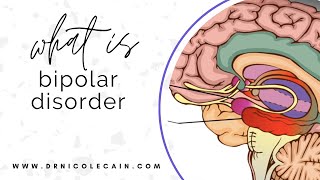
Dr. Nicole Cain explains bipolar disorder as alternating depressive and manic episodes, usually diagnosed before age 25. Untreated mania can cause lasting brain changes. Treatment combines conventional and integrative approaches.
Chapters
Bipolar disorder is one of the most common mental health diagnoses in the United States. And one of the first things I talk with my patients about is what is bipolar disorder in our culture, people often say someone is acting bipolar when they have a mood episode where they shift from really happy to really sad, or maybe they become really angry quickly. This is not the same thing as bipolar disorder. Bipolar disorder is characterized by a two alternating and completely separate states. The first state is depression, and the second state is called mania or hypomania. Brain imaging shows us how the brain can behave very differently in bipolar disorder. There are several structures that we focus on when assessing for these differences. We have the frontal lobe and the amygdala and the hippocampus. In depression, we see that the frontal lobe is more active. The frontal lobe acts as a regulator, and it can be the brakes for your brain, and that can stop behaviors. The amygdala is the emotional center of the brain, and that can be turned way down. So the person may feel more lethargic, unmotivated, and sad. In mania, on the other hand, the frontal lobe is turned way down, so the person is more impulsive and reckless. The amygdala is is turned way up, and the person experiences intense emotions, whether it's elation, paranoia, irritability, or fear. And then we look at the hippocampus. The hippocampus is involved in memory. There's been many studies that look at the hippocampal involvement in bipolar disorder, and we see that there's actual changes in that tissue. The hippocampus is very important for memory, and that's why sometimes we see people who have had manic episodes even remember what happened. People with bipolar disorder can shift in and out of these episodes, which can last days to weeks to months. Most people are diagnosed before the age of 25. When trying to uncover the root cause of why someone developed bipolar disorder, we look at things like genetic, environmental, and neurochemical factors. All of these come into play and can affect the way that somebody's brain and body develops. It is important to treat bipolar disorder. There is an increasing amount of evidence showing that manic episodes actually cause damage to the brain. There was a publication in the American Journal of Psychiatry where researchers looked at MRI scans of different brain structures, including the frontal lobe, the amygdala, and the hippocampus. They found negative changes in the brains of those suffering from bipolar disorder as compared to those who had not. Bipolar disorder also can wreak havoc in your personal life. With you being on a constant seesaw going back and forth between these mood episodes. It makes it hard to maintain a job, stable relationships, and to even feel stable within yourself. It's so helpful to get treatment so that you can heal the brain to prevent these kinds of changes and to help you start to feel like yourself again. The good news is Bipolar disorder is completely treatable. I have had the honor and privilege of working with hundreds of patients who've gotten control of their moods. Bipolar disorder is no different than any other diagnosis. By helping your body heal, by helping yourself get to the root cause of your symptoms using age old wisdom and integrative medicine, you can truly feel like yourself again. Go to www.Dr.nicolecane.com to read testimonials of real life patients and to see videos for inspiration. Learn more about how you can get started.