Learn how to Make Your Own Panic Pack today
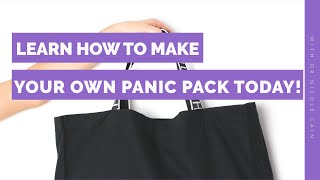
Dr. Nicole Cain shows how to build a portable panic pack with items like straws, bubbles, stones, and ice packs that work on breathing and sensory grounding. Each tool targets a different part of a panic attack: short straws slow your breath, cold packs reset your nervous system, tactile stones ground you in the moment.
Chapters
Do you deal with panic attacks, and are you ready to know exactly what you can do in order to stop panic attacks in its tracks? Well, that's what we're going to talk about today is how do you deal with panic attacks in the moment? In a way that's going to reduce the intensity, frequency, duration of a panic attack, but also prevent panic attacks from occurring in the future. We find that what we resist will persist. And by addressing the panic attack in the moment in a way that will help your body express and then move through, will reduce the likelihood that the panic attacks keep occurring. What we're going to talk about today is how to make a panic pack. And I have a complimentary podcast where I go through a guided imagery for about 20 minutes exactly how to use this panic pack and gives you ideas on exactly what these different things could look like and be for you. And I'm gonna share with you today what I have in my panic pack. So let's angle the camera down so you can see what we have here. And I'm gonna show you my panic pack. So the first thing that you're going to need is a pack to put this in. I got this at Rebel in downtown grand, and I love it because it has a nice little grabby thing that I can hang it from. I could also zip it up so things don't fall out and keep it in my car or bring it in my office or slip it in my laptop bag. I really like this. It's a good size. And so go to support local, go to a local store and find a little bag that works for you. And then we're going to talk about what's going to go in our bag. So the first thing that we want to think about is the breath. And we know that the breath does a couple of things. One is that when we get really anxious, our muscles start to break down sugar so that we can have energy to run from the dinosaur or run from the bear. And when it breaks down sugar, it releases carbon dioxide. And carbon dioxide in excess amounts can change the ph so that we become more acidic. And it can also interrupt a lot of metabolic pathways. And so one of the things that we do inadvertently when we're anxious is we stop breathing, and then we're not exhaling out the carbon dioxide, and then that stress pattern gets much worse. So one of the ways to help. I have two strategies for helping with breath. One is to blow out through a straw. So I got this pack of plastic reusable straws, and then I Cut it in half, because you want it to be just a couple few inches long, because otherwise you're going to feel like you're not getting enough air. Then you breathe in and out through the straw. And so what this is going to do is it's going to slow down the breath, direct the breath. It's going to focus the breath. And the actual behavior of blowing through something like this is part of why people will turn to cigarettes when they're feeling really anxious or stressed. And instead of using a cigarette, you can use something like this to breathe through it. And so I put this in my panic pack. I have a. I just have two that I have just in case, and so we're gonna put those in there. And then the other thing that we could do with the breath is bubbles. I think bubbles are amazingly fun because, number one, bubbles are super cool, and number two is you get to see the outcome of the breath. And so in order to blow a good bubble, we're gonna blow a bubble in my kitchen here. In order to blow a good bubble, you have to focus and slow down the breath, right? You can't just hyperventilate. You have to have a good breath. So that exhale is quite a lot longer than it might have been had I been just breathing. Especially stress, anxious breathing. So I like these. These were $2 at Target for a whole pack of them. Like, this whole pack was $2. And then you can make your own bubbles with dish soap and things like that. And so I like to carry bubbles around, and I would definitely recommend putting that in our panic pack. And one of the other things that we also want to do when it comes to anxiety, we want to think about what's happening with the nervous system. And so some people, when they're really anxious, they feel like their nervous system can't handle any more input. And other people feel like their nervous system is shutting down and they need more stimulation and input. So in response to this, I have two things. I have headphones. I have a fresh pair of earplugs. And so I would put these in a separate little Ziploc bag so they're not like floating around in your panic attack pack. But bring your headphones. I have my dongle already attached to my headphones. And then bookmark the panic podcast that I made for you. And so you'll have that bookmarked, and you'll be able to pull that up. You'll pull out your headphones. You'll be able to listen to that if you're somewhere where you're feeling overstimulated. Like if you're having a panic attack and you're at a theme park or you're out and about and it's just too much. Having earplugs where you can kind of block out some of that stimulation is really super helpful. So I put these two in a nice little Ziploc, and we're going to put that in our panic pack. So we have these things in here. So we've been talking about what you're going to do in order to build your own panic pack. And we're working on strategies that are going to help you deal with panic in a way that's going to reduce the likelihood of the panic coming back and will also reduce the frequency, intensity, and duration. So we started by talking about the breath. We talked about the breath with a straw, the breath with bubbles. And then we talked about stimuli, and we talked about earplugs and headphones. Because I don't know about you, but it's the worst when I really want to listen to something or I need to listen to something, and I can't find my headphones or I can't find the dongle anywhere. So having that in here is really helpful. So other things is we want to think about texture. In the 4S model that we created for the ACT method, we talk about how texture can bring us back into our body. So I have two different types of stones. I got these from my yard. One is a little bit more rough, and the other one is more smooth. And sometimes people like to make worry stones where you can rub your thumb in it. There's this nice dent in here that feels like perfect for the thumb to fit right into and rub. And so sometimes holding something, rubbing something can be really grounding. It can bring us back into our bodies. The other thing that I really like about earth elements and rocks in particular is I remember one time I was having a really difficult week with stress, and I was talking to a girlfriend of mine. We were hiking in Scottsdale, Arizona, and I asked her, what do you do when you feel totally overwhelmed? And she's like, you know what? Part of the human nature, part of the human brain is to try to make sense of things and to draw conclusions. But when you look at these rocks around us, we can look at them and analyze them, have 20 brilliant people looking at them and analyzing it. Doesn't change the fact that a rock is a rock. And that's a mantra that I live by now, is part of why I love the Desert so much is that you have all of these beautiful things around you that are growing in the most unhospitable climate, and yet they grow and they thrive. And you know what? I can be anxious, I could be confident. And it doesn't change anything about this rock. A rock is a rock. And so for me, these are really grounding. And I like to put them in my panic pack. So. So we're put them in here. And another thing that we want to think about with the nervous system. So we talked about hearing, we talked about touch. Sometimes we can feel visually overstimulated. And so I have this cheap pair of sunglasses that I'm going to put in my panic pack. And so if I find that either I don't want to engage in eye contact, other people, and I just need a little bit of privacy, or it's too bright, the sun is too bright, the infrared lights are too bright, whatever that is. Having a pair of sunglasses that are handy for you where you can have that protective barrier from the stimuli and other people can be so nice. And I can tell you that whenever I need my sunglasses, they're like crushed under my car seat or I left them at home or something like that. So put some sunglasses in your panic pack. Okay. Still really lightweight. Look at that. Still super skinny. A couple of other things that I have here we also want to think about. So scent brings us back into the body. It's very grounding when we're panicking. The logical prefrontal cortex of the brain is shutting down, so you can't think logically. You can tell yourself all day long, like, this isn't a rational way to feel. But your reptilian brain is trying to protect you. And so the reptilian brain, your brain stem, that part of the body, that part of the brain is in fight or flight mode and it's making all of these neurotransmitters, all of these hormones trying to put you in a state of fight, flight or freeze. And it doesn't listen to logic or ration. And so we have to use tools that bring us back into the body. And I like oils for that. I have grapefruit here and I have ylang. Ylang. Ylang. Ylang is awesome for anti stress, anti anxiety. And I think grapefruit is just so refreshing. And so in the meditation that I made for you, I recommend you use one at the beginning when we're actively anxious and then we switch, switch to the second one. When we're putting things away, we're putting them In a protective box, a protective trunk. Because then you're changing the input and stimulation and the message to the brain. In terms of picking an oil, make sure that you pick something that's therapeutic. I have brand better essentials that I really like. They're physician grade, they're really high quality, I have no affiliation with them. And so when it comes to picking an oil that works for you, the scent is less important as to how you feel about it, how you like it, and it's more about the quality and what's going to work for you. So I would have two. We're going to put these in our panic pack. Almost done building our panic pack. I have a couple of other things. One of the other things is taste. And so we want to bring ourselves into our body, remember, get the attention of that reptilian brain. And a couple of ways to do that is ginger chews are really good. Trader Joe's, for example, they have really yummy ginger chews. There's a little bit of sugar on it and ginger is really good for inflammation. Remember we were talking about the breathing, the ph change, getting inflammation, getting acidosis. And so ginger is really good for counteracting some of that. I also have Omega 3 gummies that I just simply put in a new Ziploc and then you can replace that every week. And I like Omega 3 gummies by Trace minerals. It's high doses for gummies because a lot of times it's basic gummies are mostly deliciousness and low vitamin. But I like this because it's got a little bit of sugar in it, it's got some magnesium which can reduce anxiety, it's got some minerals in it and it's got the fish oil and the fish oil is really important and really helpful for the brain. And the gummies take a little bit longer to chew and it will bring you back in your body so that you're taking something that's fairly therapeutic as opposed to just eating chocolate bars or something. So what I would do is I would just put these in a little Ziploc and put them on my panic. Alright, we have just a couple more things. One is the ice. You can actually go on Amazon and they have packs that if you break it, it'll have a chemical reaction and it'll create an ice pack. And so you could get something like that. If you don't want to order something online and you need it quick and you want to make your panic pack today, you can get a Ziploc and put some ice cubes in there and just put all of your panic pack in a cooler and carry it around with you in your car. If you are in an emergency situation, oftentimes going to the bathroom where there's cold water that can bring you back in your body. But the actual ice pack, that chemical reaction ice pack, is really cool because you can take it hiking, you could take it anywhere where you're not going to have access to a freezer. And when we use this, we specifically want to apply it to the area of the face that's going to be stimulating your cranial nerves. And so with this, you would just simply press it against your face and hold it there for 30 seconds, emphasizing the area around your eyes, under the eye, the eyelids, and hold it there for about 30 seconds. You could also place your face in a bucket of ice water and hold your breath there for 30 seconds. I like this because if I'm on the go, I don't want to have to dunk my face in water. So this can work really nicely as an alternative. What this does is it evokes what's called a dive reflex. And a dive reflex will help reduce the speed of your heart, it'll reduce your blood pressure, it'll reduce that kind of fight or flight and bring you more into a state of relax. And so this can be really helpful. And then you can just find those online. And so we're gonna put this in the panic pack. And so I have a patient or I have a friend, or I have anxiety, can bust this little guy out, break it up and place it on the face. And then the last things I want to show you about is you can include in your panic package supplements and tinctures and medicines that are going to be helpful for you when you need the most. And I saved them for last because I want to encourage you to try to use these other therapies instead of going to a pill for an ill or supplement for a symptom. And the reason for that is because I want you to start to get power over the anxiety instead of palliating the anxiety. That being said, when we need support, we need support. And using smart pharmacology is a game changer. So if you've been prescribed something for your anxiety, then put that in your panic pack and try to use your other tools in addition to it if you need to use that medication. And the same with the supplements. My two supplements that I would put in my panic pack are theanine. That's T H E A N I N E 200 to 600 milligrams is really good. And I'll put the actual bottle in the panic pack because then if somebody, if something happens and people need to know if I took something and what it was, they'll have the name. Otherwise you could just write the name and the dosage on a Ziploc bag and put that in there too. But in my panic pack, the bottle fits in there right nicely and it's still really lightweight. It fits perfectly. And then the last thing I want to show you is the power of tinctures. And I've talked quite a lot in some of my previous posts about the beautiful power of kava and lavender. And I love tinctures, they're pretty climate safe. I do it in a two ounce bottle so that I can travel with this, all of this that I have. The sizes you can bring on an airplane, which is nice because I hate flying. It makes me very stressed and anxious. And so having a panic pack on an airplane is amazing. And so when you're doing kava and lavender, I just do a 5050 blend. It helps with the taste. Kava, when it's an active, really good potent kava, it will make your tongue tingle just a little bit and then that's cut by the flavor of the lavender. And kava will help reduce anxiety. It has been shown in the research to work as effectively in a lot of cases as benzodiazepines without the side effect of feeling mentally dulled. And so if you need to perform and you're having anxiety, this is probably a much better go to than taking a medication. And lavender is anti anxiety, it's relaxing, it also lifts the mood a little bit and it can help with sleep, panic attacks, anxiety and all sorts of good stuff. So I would put my 2 ounce tincture in my panic pack and then we zip it up and we are good to go. And so today we've been talking about a panic pack as a complement to listening to the anxiety panic attack guided imagery that I made for you. And so make your panic pack, you can do this from all ingredients that you could find locally and carry it with you so that you feel empowered to get your life back from anxiety in the moment. And this is going to give you alternatives to a pill for an ill and a supplement for a symptom. You can actually get to the root cause of your anxiety and get your life back. I would love to know what you would put in your panic pack, if there are other things that have been really helpful for you or that you would like to suggest for, please share it in the comments. There is no right way to build a panic pack and I would love to hear what works for you. So we are going to be doing Facebook lives on topics that are especially related to mental health and anxiety. My mission is to help you get your life back and to put out as much valuable free content as humanly possible. So if there are topics that you'd like to hear more about, leave a comment or send us a dm. And I would be happy to put some stuff together for you and also make sure that you check out our Anxiety warriors group. This is a group that I created where I can interact more intimately and more personally with you and give you support and more of a protected atmosphere. And so Haley will put the link for that in there. And when you join that group we have a couple of questions just to make sure that you're not a robot. And one of the questions does request your email address and I promise we won't spam you. The email address is so that we can send you a seven day anxiety Freedom challenge that I created. It's all free. It's just me supporting you and loving on you best I can. So go and check that out. And I cannot wait to see you guys on Wednesday. I'll be back here one o' clock Eastern and I'll be here Fridays also one o' clock Eastern. I love you. I honor you. I am Dr. Nicole Cain. You can learn more about me and my practice by going to www.Dr.nicolecane.com. thank you so much for being here. I'm going to pop on and make sure that there aren't any questions that I can answer quickly here for you. And it looks like we are good to go, which means I explained it well, right guys? So anyway, I love you. I'll see you soon. Bye.
More from Dr.

Did you known that there are 3 stages of iron deficiency? Which stage are you in?








141. How to Tap into your Inner Self for Ultimate Wellbeing with Dr. Christian Gonzalez

140. Hacking the Vagus Nerve to Calm the Nervous System with Nicholas Hool, Ph.D.

How to Tap into your Inner Self for Ultimate Wellbeing with Dr. Christian Gonzalez | Ep. 141