Why Traditional Therapy Isn't Working for Anxiety with Dr. Russell Kennedy, MD | Ep 136
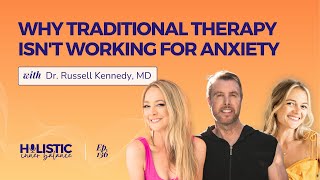
Dr. Russell Kennedy argues traditional talk therapy misses trauma stored in the body. He teaches locating the "alarm" in your body through sensation, pendulating between that alarm and safety memories, and using cold exposure or movement to rebuild your nervous system's sense of safety.
Chapters
So for those, thank you so much for joining us. We're the holistic inner balance. I'm Dr. Nicole and of course we have happy, healthy Adley who's here. And then we're joined by a dear friend of mine, Dr. Russell Kennedy, the Anxiety MD. Heal your anxiety, don't just cope with it. And he's a physician, he's a neuroscience expert, somatic intuitive, certified yoga instructor, meditation teacher, and he's also hilarious, so standup comedian. And he struggled in his past with crippling anxiety for decades and he's healed anxiety and he wants to teach us all how to heal anxiety too. He has written an incredible book, the AnxietyRx that I highly recommend. It's a revolutionary new prescription for anxiety relief from the doctor who created it. Find him over on instagram @the anxietymd. And also if you wanna dig in more, he has a program that I love and I can't wait to actually go in and audit it and learn from you. The Mind Body Prescription for Permanent Anxiety Healing. Mbrx. And you could find all of that information on, on his brilliant, beautiful website. And so this conversation is for you if you are Amongst the roughly 301 million people or 4% of the global population with anxiety and you've been told that you're the problem and that anxiety is a life sentence. And so I'm really, really eager to dive in. And so Dr. Russell, tell us a little bit more about yourself and what I didn't cover in that really beautiful intro that I'm sure you covered at all. Flattered by.
I don't, I don't think there's any more to me than that. I think you covered everything about me in that one little segment. Okay. I was born to a very dutiful registered nurse mother and a psychotic, non aggressive, non violent bipolar father. So my childhood was not the most stable table. I, I like to say that my, my mother was neurotic and my father was psychotic. So my own psyche didn't stand much of a chance. So I grew up in an environment where, you know, I was afraid a lot and then I overachieved. That was my way of escaping, escaping anxiety was to become an overachiever. So I became like an athlete and, and a doctor and, and a stand up comedian and all this sort of stuff. But I was always running, I was always running away from my anxiety and it wasn't until I really decided to turn directly and LSD certainly helped me do that by showing me that my anxiety was actually in my body more than my mind. And we can talk about that for sure. And just getting really frustrated, spending thousands and thousands of dollars. Luckily I was a doctor, I could afford to be a patient, you know, because therapy's freaking expensive and just wasn't getting any help. So I finally figured out that anxiety was more of an issue of the body, old trauma that's held in the body, that's reflected by the mind, than actually by the mind itself. And that's why I believe that most therapies that try and change the mind specifically don't work. And I have legions of people who have, are seeing me who said, I've been in therapy for 5, 10, 15, 20, 35, 40, 50 years, and talk therapy really didn't help me. So it was really developing a somatic focus, you know, something that draws on internal family systems as well. Somatic experiencing is one of the modalities I'm trained in, but just taking a different perspective because traditional allopathic therapies, psychiatry, psychology, have had 50 years to help us with anxiety and they really haven't done such a good job. So there's my intro. How's that?
You know, I was. I'm listening to the myth of normal right now.
Nice.
Yeah, yeah. And what you're saying is so reflected in this work, which is considered groundbreaking, is this book that Gabor Mate wrote. And he was talking about how much of trauma, much of our response in a trauma form occurs or gets instilled in the body. And this is before verbal development has even taken place.
Yeah.
And so it's like, it's like we're looking in the attic where. For the flood. The. The flood is happening in the basement, but we're looking in the attic. We're completely missing the conversation for most.
People, which is why they don't work and why people feel like, oh my God, I'm going to have this for my whole life. Because there's so many people that I see. I remember when I was a gp, like a full time gp, and I would get letters back from, say, the oncologist saying that the patient failed therapy, you know, cisplatin therapy or whatever it is. And it's like the patient failed therapy, really. And it's no more true than in, in emotional issues, you know, so if the patient failed antidepressant therapy, you know, that's how doctors talk to each other in a way. And I'm not against doctors, I love doctors, by the way. But it is this thing that it's somehow the patient's fault if these Traditional therapies that don't work, by the way, don't work on you. So people just feel there's enough stigma around anxiety to start with and mental illness to start with. And when you start saying that you failed therapy or you've done thousands of dollars worth of talk therapy or even, even things like EMDR and tapping and stuff, which have benefit. Absolutely. But it's expensive. And people go through thousands of dollars trying to get themselves better, and they don't. And they feel worse because they've spent all this money and they're still kind of right back to where they were.
Yeah, I resonate very much with that. We talk a lot about EMDR here. And one of the limitations I found, at least in my personal experience, and I think I have a lot of fetal trauma, like infant trauma that occurred, is that it often requires a linguistic bridge to get you from point A to the center of the ball of yarn. And for me, I just don't have the language. And so a lot of it's somatic. But I am an enneagram3 and a perfectionist. And so I want to do the EMDR correctly.
Right.
And when it's really quite somatic based and I'm working with a clinician who's more top down, even in emdr, it can create this feeling of failure and frustration. And I. And then we're told we can't get better. Hads. Do you resonate?
Yes. I was just thinking about how I also. I also am an enneagram3. We've got a lot of. A lot of achievement going on here. And, yeah. Wanting to do it right. And even wanting to, like, tell the therapist what they want to hear also, which, like, that's a big one for me. Like, I need. I need a therapist to constantly, constantly be like, no, but like, what are you actually thinking? Because otherwise I will revert to just telling them what they want to hear.
Which is not uncommon. Like that. That is very. That is very common, especially among anxious people. Because the thing about anxious people is we've been going to the brain gym for overthinking for, you know, decades. We're good at thinking. We're really good at thinking. We're not that great at feeling. So that's the thing. It's like, okay, you give me a choice of, of, you know, going to a curling bond spiel or going to a softball game. I'm going to go play softball because I'm good at softball. Curling, not so much. Right. So we stick with what we're good at. So if you're good at thinking, you're much more likely to stay in that realm. And the downside of that is the better you are at thinking, typically the less better you are at feeling. And you need to feel it to heal it. So you need to be able to go in there and feel it. And we overthinkers try and feel our way out of a thinking problem, and it doesn't work that way, but it has the illusion of working like cbt. And those things have the illusion of helping because you're understanding that, you're bringing it up to the forefront, you know, you're not ashamed of it anymore. There's a bunch of things in there that help us feel better about it in the short term, but we're kind of dangling people over the gates of hell because that's not the road to true healing. It's coping. It'll help you cope. And most evidence based, science based therapies will help you cope better, but they're not actually getting to the root cause of the problem. So the little analogy that I draw is you're in a rowboat, there's a hole in the hull, it's filling up with water. The water is the stress. So you can bail water out, lower the water a bit and feel better about that, but unless you go under, unless you go deeper and patch the hole in the hull, you're always going to be bailing out water. So it's one of those things like how do we go deeper, how do we patch that hole in the hull? And, and I think things like emdr, things like psychedelics that sort of get into that unconscious programming that, that is at the root of most of our anxiety, depression, eating disorders, personality disorders, everything. If we get at the root cause of those things, there is something in the person that feels like, hey, I'm actually getting at the root cause of this rather than just putting, you know, rather than just bailing water.
Totally. And I think there, there's like, there's a curse of knowledge too with these like traditional based therapies. And you know, for people who, stuff like there's, there's, we know so much and so we can talk in circles around all of it, but we're. Yeah. Not getting to that body based somatic root cause.
Yeah. Because we need, Right. Like we're very, we're intelligent creatures, human beings, so, so we need the cognitive part for sure. But with, and, and my wife's a somatic trauma therapist, so we talk about this all the time. But if we don't have that body based route, that body based safety, there's nothing for the, the cognitive stuff to build on. So it, but if you try and build things the other way around, if you try and fix the thoughts first and then go in and fix the body second, you're not going to succeed at that because you're not getting at the root cause. If you build the safety in the body first, then a lot of these cognitive structures, these names, these like attachment theory starts making more sense and it grounds us in that sort of cognitive construct. But we do that because we're in this body based feeling of safety to start with. If you're not, if you don't feel safe, doesn't matter what the theory is, how good it is, how appropriate it is to you, it's not going to stick. You have to build the body first and then the brain second.
I want to get into this and I, I have patients who I've had these conversations with where it feels like it's one extreme or the other. It's like a fire hose to the face and I can't make it stop and it's too much, so I don't want to feel anything. And then we pendulum swing to the other extreme where I feel like a zombie because of the Zoloft that I'm taking or the Xanax that I'm taking. And so how do we begin? So somebody's listening to this conversation and they're like, okay, I, I don't know how to even begin that process. And I'm on my medications and if I get off of them, then it's going to be crisis. So tell us, tell us where to begin.
I would start with finding the alarm in your body, right, so, so Christmas is coming up, so there's no better place to get fired up than visiting your relatives at Christmas. Like that will trigger 80% of us. So I tell people, you know, this is a great opportunity when you go home for Christmas, really scan your body and see, you know, when your mom is saying, are you ready yet? You know, you take so long to get ready, come on, you know, can you feel in your body where you feel that? And I get people to scan, you know, somewhere between your chin and your pubic bone. Because usually there's a part of our brain called the insular cortex and it kind of mediates mind to body and body to mind, and it relates through the center of the body. Often, so often we'll find a place in our body. It's around usually around our chest, but it can be our throat, it can be our belly. That feels like it's, it's. It's painful or pressure, you know. You know, the feeling of, of being heartbroken, going through a breakup. There's an actual physical pain that we have in our chest. There's an analogous pain with alarm, with the old trauma that, that we stuff down into our body. Some people will feel it in their belly, Some people will feel it in their heart. Some people feel it in their throat. With me, it's kind of in my solar plexus, where my ribs meet together. And it's just finding that and then sort of saying to yourself, okay, is this feeling, Is it superficial? Is it deep? Is it pain? Is there pleasure? Is there a color associated with it? Is there a temperature? Is there something like really get drill down into the sensation of what this alarm feels like. Because this insular cortex probably made this sensation in your body when you were 8 years old and your father was on a binge, or you were five years old and your mother was screaming at you. Your brain creates these body memories. And I believe that we feel the same way in our body now the way that, that we did when the trauma first occurred. So if we can start getting into where we feel that in our body, it's a really great place to start. Because that pain represents the younger version of you that wasn't seen, heard, open to, understood, loved, and defended. So when we do that, when we find that, that place in our body and we commit to seeing the younger version of us hearing them, what do they have to say? Being open to them, not closing. Because a lot of times, as the adult, we don't want to go back to the child because the child holds all our pain. Understanding them say, I understand you. I will love you. I will defend you. This is the should mnemonic that I, that I put in my book. This is what you should have got when you were a child, and you can give it to yourself now. So these little should acronyms see here, Open to understand, love, and defend. You can start doing that to this alarm that's in your system. Initially, it might feel quite disingenuous. It might feel like, oh, this feels really weird. Like when you first talk to yourself in the mirror, you know, it feels really weird. But over time, because that child in you so badly wants to be connected to, they will find you. It may take a while, but they will find you if you stay consistent. And I think that's one of the things that the reason why therapy is so difficult is because initially moving away from anxiety becomes painful because we have used the worries as a way of making the uncertain feel a bit more certain. And when we do that, we get this dopamine hit in our brain, and it kind of gets us addicted into worry. And when we're addicted into worry in our brain, we're no longer feeling that pain, that alarm that's in our system. So we get operantly conditioned to worry because. And the worse the worries are, this is why worries get worse. As you get older the worries. The worse are. The worse the worries get, the more likely it's going to pull you away from that alarm that's in your system, which actually prevents you from healing in the long run. So it's really the first thing I would do is see if you can start localizing where you feel the alarm in your system. When you feel anxious, get out of your head and start going, where do I feel this? I have a little mnemonic that I, or acronym that I, that I call or mantra that I call sensation without explanation. So when you get into this feeling, when you're feeling quote, unquote, anxious, which I like to call alarmed, where do you feel that? Like, where is it in your body? And just stay with the sensation of it. And even though it's uncomfortable, but you. Your whole life, you probably spend. As soon as you feel that consciously or unconsciously, you shoot up in your head and you start to worry because that does. It does give you a temporary respite from that pain. But we never actually deal with the pain.
Yeah. And then we have these. These feedback loops. Right. That perpetuate that. And. And so it's like a problem that may have originated in an event or a lack of an event. Maybe there's something that should have happened that didn't, like neglect or unmet needs or attachment or it's something that did happen that was bad and scary. Scary and difficult. And then the body will store that. And I love the description of. I'm so into the neuroscience piece is brilliant. With insular cortex as a mediator. And then the sensation and noticing it and allowing yourself to feel it, to heal it, and then, then going into the feedback loop. So we have the chemical imbalance theory, which, you know, came around as a whim in the 1960s and got disproven in 2022. And we're just all kind of scratching our heads and asking the question, well, what is it then that's causing anxiety and depression? And I feel like, what you're describing could really be the root of most things that people are coming in with. So you and I love the language of anxiety. Hadley, you love the language of the doshas. But I feel like it's what you're teaching us and all of your work is teaching us is how to think differently about our thoughts, our feelings, and our sensations. Yes.
Yeah. How to become curious about them. Because once you become curious about something, you start engaging the rational prefrontal cortex. If you're not curious about something, the emotion just takes you over and you believe that that's what it. You are. The emotion, which, when you were a child, you pro. It probably was. Probably did feel like everything. So when you get curious about, I wonder where this. This pain is coming. I wonder where this jealousy is coming from. I wonder where this. This, you know, feeling of neglect is coming from. It's like, okay, can you search your body and see where that might be anchored? You may not find it right away, but just making the intention starts opening a door that's never been opened before. And you'll be surprised. I'm really surprised at how quickly people can find their alarm, because they've never actually looked for it. No one's. No one's in therapy has ever said, okay, well, they may say, you know, how does that make you feel? Or, where do you feel that in your body? But that's the limit. That's where they go. It's like, oh, I feel it in my heart. It's like. For me, it's like, okay, is it superficial? Is it deep? Is it a pain? Is it a pressure? Is it sharp? Is it dull? Does it have a color? Does it have a temperature? Like, I go deep, deep, deep into it. Because. And sometimes, like, people will describe things to me. Like, it feels ice cold and. And boiling hot at the same time. And I go, perfect. Because we are dealing with the unconscious mind, and the unconscious mind doesn't know rules, right? So something can feel frozen, cold, and boiling hot at the same time. So whenever I hear something like that, I get really excited because I know I'm on the right track. Like, I know I'm in the right ballpark that I need to be. To be able to sort of help. People say, this is the root cause. This is. This is what we need to heal so that your anxiety has a chance to. To fade away. Because this is what's driving your anxiety. You know, there is this process called interoception, where your mind is constantly reading your body. And if you have this, what I call background alarm. These old unresolved traumas and wounds in your body that were never resolved, they resonate a certain pain or a certain, you know, temperature, color, whatever it is, and they get reflected up into the brain. And the brain, being a meaning making makes sense machine. When it feels this discomfort, when it feels this pain, it makes worries that are completely consistent with that pain because your mind is trying to make sense of this whole thing. And when we do that, we actually lose the root cause of the problem. Because as soon as we label it with something, we've turned it into a left brain construct instead of a right brained feeling. Now, I'm not huge on lateralization, but it's, it's a good contract to be able to explain it.
Oh, that's so good.
And I love that you bring in the curiosity because you were talking about how a lot of times we cling to that worrying because it sort of makes, it makes us feel like we, we know. Like, yeah, we're clinging to the known and curiosity is basically just opening up to the unknown, which, you know, is the scariest thing.
Yeah.
Unless you add faith to it. So that's what I often tell. Okay. Once you get into this sort of curious state, can you add faith to this situation that you're in that not in a Pollyanna way like this will all work out, but just in kind of, can I give it the space where I don't have to know the answer? Because sometimes, you know, oftentimes when we get traumatized as children, two things happen. One is we lose faith in the world because our parents were supposed to protect us. And the second thing that comes up is that we start believing that everything is up to us. And if you start to believe that everything is up to you and your family and you're seven years old, is not going to go well for you. You know, Dr. Phil would say, how's that working for you? Like that is not going to go well for you. But it's, it's because it's not challenged. We develop these kind of lone wolf kind of, I have to fix it. It's up to me. I will help mom, I will help dad. Especially if you're the oldest in the family child. This is the oldest child syndrome for sure. So they start thinking that everything is up to me, which basically you just lose faith. Like there's no faith that things will take care of you. You know, there's nothing there because you have assumed that everything is up to me. And this is, I, I see this A lot. When I go, When I go to the gym, I listen to these motivational talks from all these guys like Eric Thomas and, and, you know, Matthew McConaughey to some extent. But a lot of them are really aggressive. It's like, you gotta get up at 4 in the morning, half an hour before you go to bed at work, work, work. You know, I don't believe any of that stuff. But I also know that when I'm listening to those things, I know it's charging my brain up with a bunch of dopamine. I know it's like, okay, so I stay at the gym longer, I work out a little bit harder. So I know how this stuff bleeds in and, and how we can actually, in a way, I don't like this term hack, but we can sort of hack our physiology so that we can move out of the kind of the stuckness, the dorsal vagal shutdown, to use polyvagal theory, we can move out of that because that dorsal vagal thing, that. Hiding behind a tree, thinking there's a predator on the other side and being afraid to move, that's part of our human physiology. But once we start moving, then we start seeing, oh, you know what? This actually works for me. But you have to keep practicing it. You have to keep going into your body and, and, and really finding that place that is alarmed. And then on top of that, finding another place is something I, I do with my, my clients is, okay, where's the alarm? It's like, okay, for me. I'll use me. It's in my solar plexus. It's hot, it's purple, it's sharp. It pushes up into my heart, it pushes out of my. My solar plexus, pushes into my, my spine, and then I go, okay, what was the best time in your life? Well, probably the best time in my life was when I was. Met my second wife or one of the best times of my life. You know, it was an instant connection. We went camping for our first date and just. It was just a magical weekend. The weather was great. Everything all worked out together. Now I go into that feeling, like I can feel that feeling in my chest. It's like, okay, can you go into your alarm now, which is in your solar plexus? And then can we go back into that feeling of, you know, being at the lake, enjoying just how. And just how did the water feel? Know it was cold, but it was nice. And just the laughter and the, and the fun and all that. Okay, now let's go back into the alarm again. And you pendulate back and forth and you start teaching the alarm that this isn't all of you. This isn't the. The. The everything. Because when you were a child, this was all of you. The alarm in your system did feel like all of you because you didn't have the agency to be able to escape your situation. But now you do. Now you do. Now you can start pendulating back and forth between these two things. So there's a bunch of techniques that I will use once you find the alarm to be able to make friends with in a way, because it is the younger version of you. So once we see this and you start getting some confidence that you have control over this situation, everything, the dominoes start to fall. Then you're not in this sort of victim based. I hope my doctor fixed me. I hope these supplements fit me. I hope this, this new program I'm on fixes me. It's up to you to fix you.
Yeah. And the things that they're doing aren't working clearly. Yeah.
Yeah.
And so it's not you. It's, you know, as you're those who are listening. It's not you. You are not the problem. And I would argue that. I think, Dr. Russ, you would agree, is that your anxiety isn't the problem. Your anxiety is your body's attempt at creating a solution to a problem.
It's the child in you asking for your attention. You know, the little thing that I think if you. If you had a child who. Who'd lost their parents in a grocery store and they were crying and they were coming up to you with, you know, holding their hands up, would you pick them up? Yeah. You know, you. If you're female, for sure. Male. I don't know what these days, but, but, but you'd pick them up. Right. But we don't do that for ourselves. We have that same child in us. Holding up their hands like, help me, help me, help me. It's like, no, no, no. You hold way too much pain. I'm not gonna. We don't do this consciously or on purpose, but effectively, this is what's happening. You know, when you reject your alarm, you're rejecting that younger version of you that's asking to be seen, heard, loved, and defended.
I want to pivot back to the. The point about faith that you were bringing up, because I really personally resonate with that. Where I started out, very, very Missouri Synod Lutheran. I'm now in recovery Lutheran. So very strict. It's like the Protestants take on Cathol. And I was told that there's a big white bearded guy in the sky that's watching me, judging me, and would smite me if I did something wrong, even if I thought something wrong. And so I put my faith in this and used a lot of magical thinking to try to manipulate the higher powers to not smite me. And so Even as a 30 something year old adult, I was afraid, I was very, very afraid of flying. I would go to the airport and fawn like a boss. I'm like fawning to the TSA people, I'm fawning to the Starbucks person, I'm fawning to the flight attendants because I believed that if I could store up karma credits, then the plane wouldn't crash. Sure. And so the question that I feel like I'm really eager to explore a little bit more about that is what does it mean when we start to think about faith and meaning and power and powerlessness when it comes to how we exist in a world of suffering?
Yeah, I think that's a great question. I think faith is a feeling. I don't think it's so much of a thinking. I think hope is a thinking, but faith is a feeling. And I think cultivating that feeling of faith, like, okay, it's not like, oh, don't worry, everything's gonna be okay. It's really this sense like, oh, you know what? This is uncertain. And I'm okay with that. I'm okay with the uncertainty. In fact, I think I can even embrace the uncertainty because uncertainty is part of the fun of life. If you knew everything that was going to happen, life would be kind of not that much fun. So I think it's learning that faith is a feeling. It's something that's cultivated too. It's, it's, it's not something that you can just sort of pop, although you can. You know, I do this with my, my worriers. I said when they're worried about something, it's like, can you just sit in the moment that the faith, that this may actually turn out just fine? They don't want to, they don't like it because in their own minds they feel that the worry is actually keeping them safe. Which is one of the, the hard parts of healing from anxiety and worry is there's an unconscious part of you that believes that the worrying is keeping you safe. So when I get people to release, that causes the more anxiety. Right. Like I had this patient who called me up and said, doctor, I'm, I'm, I'm I'm worried when I'm not worried.
Yeah.
Like, yeah, so. Because the worrying has provided something for you when you were younger, and it did provide you with a distraction maybe of some kind, something that pulled you away from this alarm in your body. But now it's like, how do you have faith when you're so used to worrying? And that is something that you have to cultivate over the course of time. And I think it's just doing it with little things, just little uncertainties. I'll tell people, when you go into a restaurant, you look at a menu, just, can you relish the uncertainty that you could have the. The cheeseburger, the. Or the quesadillas? Like, you could. Like, there's uncertainty there. So it does. It doesn't have to be this massively charged thing, that uncertainty means death. Right. You could just look at uncertainty or, you know, your route to work. Can I take a different route to work today? Can I do something differently and just embrace the uncertainty? I may not. It may not. It may get me there five minutes later. You know, I'm going to take this road. You know, instead of that, just. Just start embracing uncertainty in its smaller forms so that you kind of open the door to embracing it in the larger form. Because really, if you can. If you can have a worry and you can go, I'm just going to leave this to faith, which is what I do now. And I'm really good at this now. But it took a while to get there. It really did. And just leaving it to faith goes against that childhood strategy of I'm gonna worry because worry keeps me safe. The opposite of that is, I'm just gonna let you know, basically, anxiety, if you really break it down, is uncertainty intolerance. Right? And faith is the best antidote to uncertainty on tolerant intolerance is you could just go, yeah, I'm just gonna leave this to faith. So many times in my life I've left things, you know, like my new book. I was supposed to get it, like, the day after it got published in September 17th, and UPS lost it. So it's like, oh, my God, I don't have this book. So I sent it to them, and it took them a month or so to figure it out. And that's. In the meantime, the publisher sent me another 25 books. So on back to back days, instead of just getting 25 books, I got 25 books the first day and 25 books the second day. So now I have 50 books to distribute to my friends and my family. And that kind of stuff. So just, just waiting, just waiting sometimes is just like the best thing, is just allow things to be what they're going to be and have faith that things will turn out. And I think, you know, for us, when we had trauma as children, we couldn't have the luxury of just waiting to see if things would work out, because even though most of the times they did, sometimes they didn't. And our brains are much more attuned to protecting us from negative experiences than they are enjoying positive ones.
Yeah, I love that, I love that you say the relish, the uncertainty, that really stood out to me because it's really like our souls, whatever you want to call it, that part of ourselves that we can't really like, intellectualize, they crave uncertainty. Really, like, really and truly, we don't, we really don't want to know what's going to happen next. And so that's like, relishing the uncertainty has been a really big thing for me is like, ooh, actually, could this be exciting instead of scary? Could this be exciting?
I love that.
Doing that regularly will start building that muscle, right. So you can start being curious about, wow, this is uncertain. And I can just, I can just sort of suspend myself in the curiosity of what could happen rather than, oh, this is going to go bad, this is going to go, this is going to happen. I'm going to lose my keys and I'm going to like, you don't have to do that. You know, chances are if, if there was a solution to your issue, you'd know it. Most human beings are fairly intelligent. You'd know it. So ruminating on it, you know, with this assumption that all of a sudden our brain's just going to go, oh, hey, you know what? I was just testing you. I actually had the solution all the time. All, all the while. Here it is, right? It's not. Your brain doesn't work that way. It's, it's, it's, you know, it's being able to say, this is uncertain. And my, my friend Kyle sees, talks about that too. It's like, this is uncertain. And I can love that, you know, you know, I'm feeling not too great about myself today because I, you know, didn't help the lady with her bag into the car, but I can love that about myself or whatever. So it's just going against the typical knee jerk, negative approach that we have to ourselves and just allow the fact that there's, there's more than one way of doing something.
I'm feeling kind of called out by myself right now. So. So I'm the type of person that when I watch a movie, look at the Wikipedia, I need to know. If you want to know the end, Paul is like, oh, God, you're looking at Wikipedia. Or if I'm reading a book and the book is so delicious and it's so good, I have this, like, juxtaposition between I don't want it to ever end, and I need to read it faster and faster and faster because the intolerance of waiting for it to end is greater than my need to relish it ending.
Yeah.
So.
So how. How familiar was uncertainty for you when you were younger, Nicole?
I, I. My entire existence was uncertainty. When. When I was little, my dad was in the military, so we moved all the time. One time I went to school. This is Nicole's therapy session. I went to.
That's fine.
Yeah, this is. Yeah, had. Thanks. You're here, too. I get double therapy. I went to. I went to school, and when I came back from school, my room was all packed up, my button collection was missing, and we moved. And so a lot of uncertainty. And then for a year, my dad, a year and a half, he went and worked in the Philippines, and we did it as kids. We didn't know where he was. So there's a lot of uncertainty.
So it's, you know, there's a lot of uncertainty, intolerance in, you know, going to Wikipedia, finding the thing. So.
Yeah.
Can you say, oh to yourself, Nicole? This is your pattern. You want to find this. If you want to really read this movie, find out about this movie, that's okay. But if you want to just sort of suspend it and just sort of see what happens, that's okay, too. So there's no judgment on either way. You know, you're not sort of saying, oh, you've got to do this now. You've got to just, you know, throw yourself into the pit of uncertainty and just, you know, enjoy it and relish it. It's all about really awareness and getting a degree of separation and. And the fact that you have a choice to be on to. To be uncertain or not. Because when you were a child and they were packing up your room, you couldn't really well say, no, I'm staying here. Let's get my button collection back, because you guys can go, but I'm going to stay here. Right. So it's just like, can you draw that one degree of separation from your uncertainty? And then if you choose, you know, to. To read up on the Movie. Go ahead. Because you've made a conscious decision at that point. It's not like the. The autumn automaticity of it is running your life. You have made a decision to go and either read about it or not read about it and just see how it goes.
From a place of power.
Yeah, that choice, you know, and I think that's the thing about us kids that didn't have a whole lot of certainty growing up is that we didn't think we had a choice. So we put ourselves into situations where we don't have a choice. You know, we. We overextend ourselves. We become people pleasers. We look after everybody else. We don't look after ourselves because there is a certain certainty in not looking after yourself because that's how you grew up.
Hadley, I. I hear. I hear you in that. People pleasing, taking care of other people. Yeah.
Yeah, that's. Yeah, that's my. That's my story.
Is your mo.
Yeah, yeah, yeah.
So what did you get, Hadley, out of looking after other people? When you were younger? What did you perceive you got?
Well, a lot of it was feeling like, I'm good enough. Like, it was. It was achievement oriented. So it was like, if I were to achieve things, if I helped people enough, if I did these different things, it was. Then I would be enough. Then I would be worthy, all of that stuff. My parents were amazing and super loving and like, you know, really, really praised us for the achievements and stuff. And so that's where. That's where my.
Did you have a rather destructive romantic relationship when you were quite young?
No, actually, I didn't.
Okay.
I did. Okay.
Maybe it's you that I'm reading. Maybe it's you that I'm reading. But, you know, I don't advertise this very much, but you'll see in some of my things, it's like I'm talking to someone and I'll go, who is Rose? And I go, oh, Rose is my grandmother. Rose is the only person I ever felt that ever loved me. You know, like, stuff like that. Or who's Rodney? It's like, well, Rodney died in a car accident or motorcycle accident, like two months ago. Like, I get these little flashes sometimes. I wouldn't say that by any means. I'm psychic. I can't figure out what the Powerball numbers are, but I do get these funny little things with people. So it might be you, Nicole, that I'm. I'm picking up on there. But there was just something about Hadley and her and her sort of need for need for control and something about a swimming pool.
Yeah.
Yes. Okay. Yes.
The.
I was a swimmer. Okay. And really, really wanted. So I was also in theater, and I, you know, on the days of the shows and stuff, I would not get nervous, but on the days of swim meets, I would get so nervous because I was so, so afraid of being the last person in the pool. Like, I never was. I literally don't think I ever was actually the last person in the pool, but I was so scared that I would be the last person in the pool and I would be a failure. And people, you know, it would. They would do, like, that pity clap of, like, the last person. I was like, oh, my God, I don't want that to be me. So, yes.
Yes, I definitely see a swimming pool. And the other thing is, like, when. When were you the last person? Like, you're not a twin or anything like that, are you?
No, not a twin. Not a twin. When was I the last time?
When you were younger, where you were the last person?
I was typically picked last for sports.
Okay.
And then also I was there. Like, I ran for student council. I. I've told Nicole about this, but I ran for student council, like, probably four or five times and didn't get it any. Anytime, which my mom, like, loved. She's like, it's building resilience. This is great. I'm so glad that you keep going.
Whatever.
You know, she was very supportive of me failing, which was good. But, yeah, there were a lot of moments like that, you know, different, like, auditions and things that didn't turn out. Most of my friends were super popular.
Right.
And I wasn't at, like, you know, every one of my friends was either on prom or homecoming court, and I was always, like, popular adjacent, like, as friends.
Well, you look like one of the, you know, blonde, pretty, bubbly. You know, it's like, this is. This is your sort of prototypical popular girl thing. Okay, we'll do one more thing and then. And then we'll kind of move back to the pop thing. Were you left alone at a train station at some point?
Oh, gosh, I don't think so.
Okay. Just weird stuff. Weird stuff. Anyway, no, we don't want to hijack the. The thing, but everyone. I get into these little things. Like, okay, where does this come from? Right. Okay.
Because now I gotta ask my something for you.
Ask your parents.
Oh, you'd be amazed how many times that. That I see anxious people and they go, my. My childhood was. My. My childhood was typical. Summers in Rangoon in the Spring. We'd make meat helmets now. And they would say, my childhood was great. I go, okay. And they'd say, well, why am I so anxious? It's like, okay, go back and ask your parents if you had a separation from them before the age of five. And the number of people that would come back and say, oh, Mom. Mom had to go into the hospital. She had to go into the ICU after I was born for three weeks, so I didn't have a connection. Or they took my older brother to Disneyland and left me with the. With the. With the aunt knuckle. Like, the number of separations for people when they're younger that, you know, there's that phrase. It's like, children are resilient. No, they're not. They're not that resilient, actually. They don't show their pain overtly, but they're not that resilient. So it's just, you know, some of the separations that we get when we're younger really affect us. They really create this sort of template, you know, even in our DNA, to sort of. Even the methylations of our DNA that make us look at the world and make our bodies look at the world, as in something we need to be protected from, as opposed to something we need to grow into.
Yeah. Well, now that you say that, I started kindergarten with my grandparents because my parents were on a vacation in Europe.
So. Okay, that's stressful. There you go. To be little and to do something so uncertain and so big and. Yeah, yeah, yeah.
And it wasn't a great. The kindergarten wasn't a great experience. My parents actually ended up moving me to a different school. And so, yeah, so, you know, there is that.
Yeah. So you never know. Like, a lot of these things. Like, one of the things that I deal with quite a bit is I tell people just, like, when. Like, when did this happen to you? When is this. When is this a replication? Because people will say, you know, I was fine until my divorce at 34. It's like, no, you weren't actually, you know, that. That time. And at 12, where you're, you know, your parents got divorced or whatever, that's still in you, right? And then it's like, it was still in you. And then when you went through the divorce yourself, everything came out because there was a lot of an extended grief reaction that wasn't actually dealt with at the time. So it's funny how we attribute. We ascribe, like, oh, yeah, like. Like Brene Brown talks about not getting on the Bearcats. You Know, I don't know if you've read her her books stuff, but she's. Yeah, I guess it's had a cheerleading kind of team and that kind of stuff. And I would bet that she's had this. She had disappointments before that and just, that just made it way worse. So it just, you know, we're pretty programmable when we're younger and I think it's the, the big question is, can we overwrite that programming? Basically.
Yes, you can.
Yes, you can.
The answer is yes.
Get Nicole's book Panic Proof. Yes, you can. That's what she was going to call it originally, yes, you can. But then she eventually called it Panic Proof.
It's my next book. Yes, you can.
There you go. There you go.
I really, I really appreciate that. And so some of the take homes that, that I feel like I'm getting out of this is number one, is that you aren't the problem. It is not a life sentence. You can rewrite that program. There's a reason for the anxiety. And traditional therapies are bound to fail. The standard medical model is not designed to look at the root cause. And it's just designed, as you were kind of describing earlier, it's to help you better cope with it. But some of these coping strategies may be perpetuating that worry cycle. I know that my Wikipedia is for sure and that's the only way that I worry. And so that's just one little thing. It's fine. And yeah, I know myself perfectly same.
It's like that T shirt that says I'm in my own little world, but it's okay, they know me here.
What?
I've not seen that.
That's so funny. No, I'm writing that down. So it's. I think anxiety fundamentally is uncertainty intolerance. Right. We can't. And, and if you had experiences with uncertainty as a child that worked out. You don't freak out when uncertainty shows up. But if uncertainty was very, very painful for you when you were younger, if you were abused, you know, experienced great loss, were abandoned, rejected, bullied, had to mature too early or were shamed. You know, these things build in our system and they create a groove. You know, they create a groove. And I think those of us with anxiety feel negative, much more negative than say the average person, whatever the average person is. So when we get into something, we've, we've sort of grooved ourselves to look at the worst case scenario. So often we drop into that place so quickly that it really hijacks our physiology and when it hijacks our physiology, it just reaffirms the fact that were in this worrisome situation. So the one, one of the things about human beings, it's, it's unfortunate is that when we get into survival physiology, when we get scared, when we get worried, when we get stressed, we secrete epinephrine, we secrete cortisol, stress, the so called stress hormones. And those stress hormones shut off the rational parts of our brain. So then we actually make more worries because we've got all these survival chemicals running around in our brain. And on top of that, we've shut off the rational part of our brain that would tell us, hey, these worries aren't going to happen, they're not real. So we get double whammy, we make more worries and we believe the worries. So this begins the cycle. And I think there is sort of an anxious temperament that shows up because this becomes a self fulfilling prophecy over time. So it's realizing, okay, how can I separate the feeling of alarm from my body from the compulsive, automatic, seductive worries of my mind? And once you start separating the two, because anxiety isn't one thing, it' too. It's the anxious thoughts of the mind and the alarm in the body and they hook together and they snowball on each other. So if you can pull them apart and allow the alarm to be there and just stay with it and allow the worries to be there and just stay with them without giving them a whole lot of credibility and look at them with curiosity, then you start breaking the cycle apart. And when you start breaking the cycle apart, you start seeing that there is another way to live, that you don't necessarily need to constantly and vigilantly keep yourself protected. You can actually experience uncertainty and not go down the rabbit hole.
Okay, I love that visual. That is so good. Like now I'm going to constantly be thinking about pulling that apart. That's so good.
And that's what faith does too. Like, you know when you have the alarm and you track where your alarm is and that's what I get everybody to do initially is like, okay, find your alarm. Now notice how seductive, how much your brain is going to scream at you to start worrying. And the analogy that I draw is cold plunges. So I do cold plunges. I'm not the ice guy. Like I can't do the really stupid ice baths, but I can get into pretty cold water. And initially when you get into cold water, it's like your brain says, hey, get the hell out of here. This Is her. This is terrible. Like, no, no, we're not doing this. We're not doing this. And you sort of say, no, no, no, we're going to stay in this for a while. And he's staying for about 45 seconds. And it still hurts, it's still painful, but after about 45 seconds, you got to go, okay, well, I guess I can handle this a little bit. And then after another 45 seconds, you kind of, oh, yeah, I still don't like this. Don't like this, but I can stay here. So the analogy is the same thing happens with your alarm. As soon as we start feeling that alarm, either consciously or unconsciously, immediately your brain says, let's start worrying. Let's just start worrying. Because that's what's worked for you as a child and maybe as an adult to some. To some extent. But if you can stay in that discomfort of alarm, the longer you can stay in it without hooking into those worries, the more you start teaching yourself, oh, I don't have to actually feed the cycle each time. And once you start breaking the cycle, you start seeing that you can break the cycle, and then you become empowered in the situation. You're not this passive sort of, you know, cork in the. In the water that's being bobbled around everywhere. You actually have some say in the situation, yeah, I can stay with this alarm. I don't like it. I don't like staying in the cold, but I can stay with it. And then. And then you learn, like, yeah, I've got some resilience. I can actually stay with this alarm. I don't like the feeling. It's painful, but I can stay with it. And it's a million times better than going up into my head and start adding thoughts to it, because that never ends.
Injury claiming agency, because you're choosing, only you're in charge, choosing to stay. And it's like, it. It's like when we. When we go into an autonomic arousal cycle when we were powerless and trapped and out of control and we were children, is that arousal gets activated, and then we aren't able to rescue or free ourselves. And so then it's like the somatic reenactment that keeps happening. And so then you're teaching us strategies to actually go into that arousal from a place of power, and then choosing when and how to take yourself out of that arousal, whether it's now, I'm. I've spent 45 seconds or whatever in the cold plunge and I get out, or it could be maybe High intensity interval training. So I'm going to run. Run or. Right. I know Bessel van der Kolk teaches about high ropes courses and other things, and those are the things that are going to expand us, because if we don't do those things that are painful and uncomfortable, like getting in a cold water plunge, anxiety can make our world smaller and smaller and smaller. And so I really appreciate that and I wanted to emphasize what you were saying is like breaking that cycle between alarm and to worry, trying to control it, have sense of power with worry, but rather staying in that discomfort than breaking that cycle.
And then you can use faith while you're in there. So while you're in that alarm, it's like, okay, I don't like this. So if you need to think something, think, I can have faith in this. I can have faith in this. Pain for a purpose is one of the other things that I say. This is pain for a purpose. I don't like this feeling. I. My brain is screaming at me to start worrying right now, but I'm just gonna stay with this alarm even though the alarm hurts me, even though I'm. But I'm certain of the pain of alarm. The thing about the thoughts is that they could just go on endlessly. Like, you could just continue making the worst case scenario and the worst case scenario, and you can make it worse and worse and worse, and then you just groove that alarm anxiety cycle so deeply into your system, you don't even see the possibility of escaping. And I think that's true with a lot of traditional therapies. They don't see anxiety as alarm in the body and anxiety of the mind circulating on, like, feedback, looping on each other. They see anxiety as an issue of the mind alone. So when you break those two things apart, then you're actually getting at the root cause and you're not perpetuating the original problem. And when you perpetuate the original problem, of course, like you said, Nicole, that you're going to go into a sympathetic state. When you're in a sympathetic state, you lose the rational part of your mind that would actually help you get out of that state.
That's amazing. And so practicing again and again and again, like, you're saying, like, like, oh, I'm gonna embrace the uncertainty if I'm gonna have a taco today or quesadillas. And, yeah.
The feeling of it, like, just.
Yeah.
And just see how you handle. Like, when you. When you're. When you're out, you know, ordering something, it's like, is. Is it quite uncomfortable for you to sort of like, oh, well, I'll just have the quesadilla. Like, it's just like, it's just easier. Rather than staying in the discomfort of the sort of limbo state that you're in. Can you stay in that limbo state for a little longer? Can you say, okay, what would quesadilla be like? Okay. And what would a Cheesebury. You know, and just stay with it as opposed to just immediately punching out. Because uncertainty is something that you have to avoid at all costs.
Hmm. I'm going to do that today. My alarm, for the record is, is. It's always. Whenever I work with my therapist, it's always like here to here. So I have like the whole. Hadley, where's yours? Do you have.
It's pretty much the same for me. A lot of times it'll be like a knot in my throat, like lower throat area, but sometimes it's like chest, heart. So it kind of moves up and.
Down between there and. So what I. I want to see free for you. Dr. Russell's. Your homework is. I see that you have anxiety hypno meditations and it says coming soon. And so I'm kind of curious.
Yeah.
If, if you could get on that.
I. Well, I think it's in the MBRX program. I'm pretty sure I'm creating one now that is. That is really about tolerating your alarm. And, and yeah, stay present with the alarm. And I'm getting a lot of feedback from a lot of different people because it's kind of like I just released one called a meditation, which is basically sort of a meditation and motivation at the same thing. Because like I said at the gym, I listened to all these like Google record, you know, that sort of stuff. And I find that it works. Like I'm not yelling at people for their anxiety, but I am sort of forcefully kind of saying, you can't be a victim. You can't be a victim and heal from anxiety. So it's kind of like a, like a beta version, a prototype. So I do these things and I try and figure out, okay, what would work based on my theories of anxiety and what's happening.
More from Dr.

Did you known that there are 3 stages of iron deficiency? Which stage are you in?








141. How to Tap into your Inner Self for Ultimate Wellbeing with Dr. Christian Gonzalez

140. Hacking the Vagus Nerve to Calm the Nervous System with Nicholas Hool, Ph.D.

How to Tap into your Inner Self for Ultimate Wellbeing with Dr. Christian Gonzalez | Ep. 141