Dr Yvonne Oswald Appears on The Reading Circle with Marc Medley

Dr. Yvonne Oswald discusses her book Every Word Has Power, exploring how language shapes behavior and health. She covers the 4-Hour Breakthrough Blueprint for clearing limiting beliefs, the difference between low-energy and high-energy language, and why childhood programming affects how we learn and communicate.
Chapters
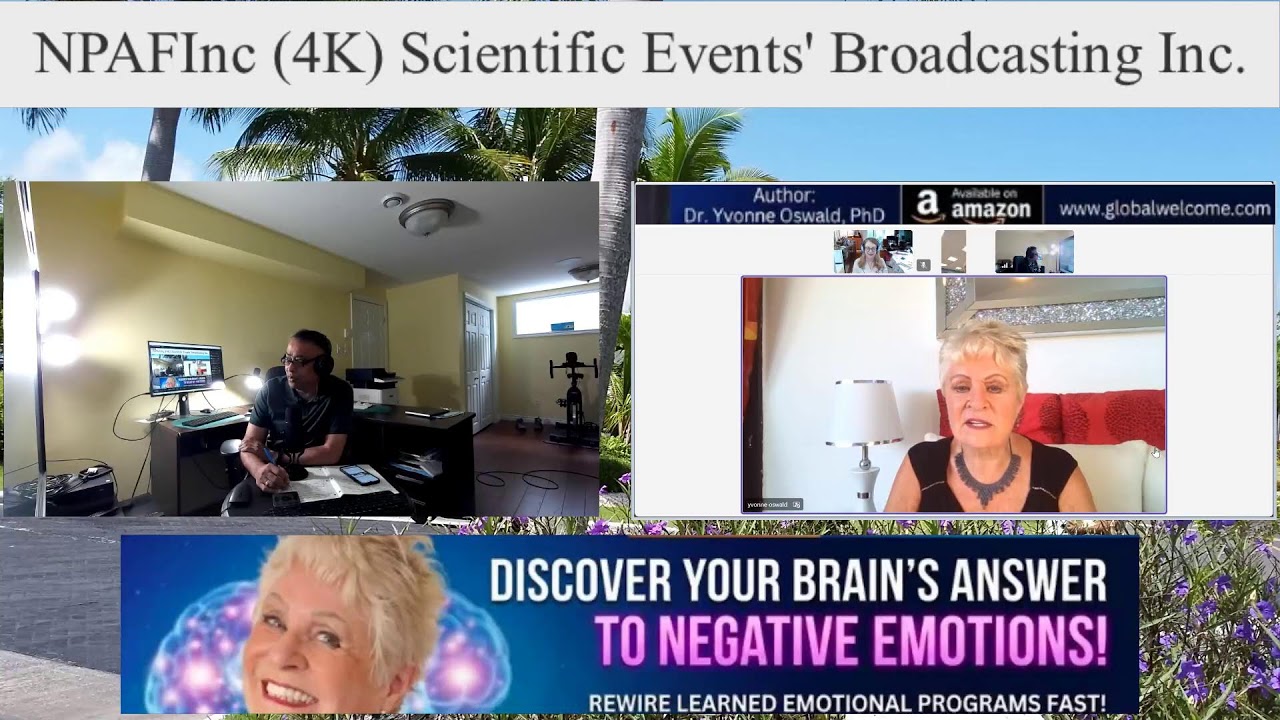
Listening audience, my guest is here. She has been on the show years ago and we reconnected. And as I said, on any given weekend, she can be anywhere in the world. And in this particular weekend, she is in the Dominican Republic. And that is none other than Yvonne Oswald, PhD. Dr. Yvonne is the award-winning bestselling author of Every Word Has Power, now in 11 languages. Dr. Yvonne Oswald is at the leading edge of the new field of Human Behavioral Technology. Ranked in the top 5 in the world global NLP gurus, she has an outstanding reputation for her exciting, innovative, fun, and interactive trainings in corporate, public, and private sectors. She is a renowned and respected international keynote speaker, communications and sales trainer, master trainer of NLP, and master trainer of hypnosis. U.S. national awards include NATH Most Unique Contribution to the Field of Clinical Hypnosis for her unique techniques in changing negative self-talk and DNA transformation, and the COVR Visionary Award nomination for Mind Magic, her pioneering process of clearing a negative emotion in less than a minute. Her work with war vets, sexual emotional abuse, post-traumatic stress syndrome or disorder, and depression is outstanding. Dr. Yvonne Oswald Oswald's unparalleled 4-Hour Breakthrough Blueprint is a remarkable innovation in a field of neurological medicine. Ladies and gentlemen, welcome to the Reading Circle Microphones, Dr. Yvonne Oswald. Dr. Yvonne, good morning again.
Good morning. I'm thrilled to be here, Mark. Thank you.
Well, I am thrilled to have you, and I love the accent. And I told you, I think the last time you saw, I love the accent. I am thrilled to have you on as— what she's probably saying, what accent?
I was just gonna say, I actually like your accent too.
But I am thrilled because your topic, the topic of your book is a passion of mine. I'm constantly telling people and they look at me like I have 3 heads sometimes when I said, you know what, be careful with your word choice because your words literally have power. There is also a book out that says whatever you tell your body, it does something. I'm trying to think of it. Your body hears every word you say, something along those lines. That you can literally speak sickness into your body.
Oh, totally. And it's been proven that 80% of your self-talk is negative anyway on a normal day, and those low-energy words actually lower your immune system physically.
Correct. Now, I just want to— you said low-energy words, because see, that's— and the thing is, it's a—
to—
in order— again, over the years, for me, it's been a process in terms of it's learned behavior in terms of how you phrase things. And as you just said, that self-talk. Because see, people— I think a lot of people discount or take for granted the self-talk. It's one thing for them to be talking to somebody like me and you were talking right now. It's another thing of the thoughts and the words that's going on inside of your head.
Exactly. Yeah. And the thing is, Mark, I used to call them negative and positive words. And then I realized when I looked up positive, that it actually has a whole different connotation now to how it had, how it was years ago. If you look positive up now, you come up with HIV, you come up with positive for hepatitis C, positive for COVID. It's a whole different connotation. So when I say low energy words and high energy words, that's really what I'm wanting people to get, realize that there's a big difference. When you use low energy words, you're living in your amygdala. When you use high energy words, you're living in your prefrontal cortex, which is up and left, and it actually activates your nucleus accumbens, which is your reward center. So you feel good, and everybody listening to you feels good too.
That's absolutely right. Now folks, the title of the book is Every Word Has Power: Switch on Your Language and Turn on Your Life. And it's about communications. And this is the thing, because I think, you know, you're absolutely on point whenever you said the we almost got reversed based on the various diseases in the use of our word positive and negative, because negative has now become a good thing and positive was a bad thing. So like, if you come up negative— if you come up negative with COVID that's good. If you come up with positive COVID, that's bad. But it's the exact opposite of how we were raised to understand the word positive and negative. You're absolutely right.
Yeah, exactly.
So I'm going to read it. Quickly from your preface: Your words will set you free. The very words you speak and think are your personal vehicle on your journey to happiness. They program both your destination and the speed with which you get there. Words change your DNA sequences by recreating your future and creating quantum possibilities that allow you to take control of your destiny. Words and Your very character. Take your place in the sun and learn to design your life intentionally now. Now a lot of my friends, you know, I will tell them, you know what, have a great day on purpose. Have an intentional great day. I love that phrase. And see, so, and that's what I, you know, a lot of times I'll sign off on that or if I'll text them and say, you know, just have a great day on purpose. But I don't think, you know, talk a little bit about how did you get into this? How did you, 'cause I know I have a passion for it, but this is what you do. How did you get into this whole notion of words having power and changing things? Changing our language and how we think and say things, right?
Well, actually, it was actually when I had my child, when I was, uh, I was an older mother, and when she was about 2, I found myself— she was crying and pulling up my skirt, and I remember thinking, if you don't stop doing that, I'm going to give you something to cry for. And I thought, I actually thought that, and I was actually about to say that, exactly what my parents said to me. And I actually stopped myself in mid-thought and said, I'll be with you in a minute, my sweetest. Let me, let me put you in the front room while I'm making dinner. I said, you should watch TV for a while. And I actually stood there at the sink thinking, wow, what else have I said that I had no idea that I was saying? And it took— I actually made myself a promise that I would not say no. And it was 3 years before I could actually say that I didn't need to say no. I would say, if you do that, this is the result. Please do this, please do that, rather than don't do. Because if you say, uh, don't touch that to a 5-year-old child, they hear only the keyword, exactly the way the unconscious mind works. So though the child will hear the word touch and immediately will touch it, and you know, the parent says, don't touch that, well, I just touched it. Hello, you told me to touch it. Because the unconscious mind doesn't hear negative. So if I say to you don't think of a pink elephant, you have to think of a pink elephant, right?
Correct.
So if I say no problem, or you— I'm directing you to think of problems. If I say, uh, not bad, you actually mean quite good. You— when you say not bad, you actually mean quite good. So, uh, the word bad— funnily enough, I was actually teaching in, uh, in Boston, and I was— I actually was saying, so the word And I couldn't actually remember the word bad. And I was like, what is the word for not good? And someone said bad. I'm like, that one. I'd actually trained myself so well to actually delete the words out of my whole, my head and my vocabulary that I couldn't even get to those low energy words anymore. It was fabulous. Big difference in the way you, also in the way you feel about your inside your head. It kind of feels, very much like there's much more space in your mind when you think in high-energy words.
Now, you're absolutely right, and you bring up an excellent point. And again, I've had this conversation with folks as well in terms of what the subconscious recognizes, and you hit it. Yeah, it doesn't recognize what comes before whatever it is that you're saying don't do. It does not hear the word don't.
Exactly. The word don't has to be completely cleared from our vocabulary.
No, it really is. Same thing with can't, same thing with— yeah, like she said, any of these, these low energy words. And it, and it's something— and again, for those of you in the listening audience, this for some of you may be the first time you've ever heard this thought or this concept in terms of really giving some conscious intention and attention to the words that you're saying and how much the words you're saying could be resulting in the results that you're getting.
Yes, exactly.
I will give an example, and my sister doesn't listen to the show and she will hate me for sharing this, but she has various medical challenges. And every time I talk to her, she talks about her legs swelling and her feet swelling. So I'm constantly saying, stop saying the word swell, because every time you say swell, guess what your feet and legs are doing?
Swelling. Yeah, exactly.
And so, you know, I'm using that as an example, but we do that kind of— we constantly focus on the condition that we don't want.
Exactly. And it's actually called an away-from motivation. And the statistics prove that 40% of people are away-from motivated. They're trying not to get sick. They're trying not to get poor. They're trying not to go bankrupt. 40% of people are working towards getting healthy, getting rich, enjoying life, getting fabulous relationships. And the other 20% are in the middle And they're kind of half and half, sometimes away from, sometimes towards. It's very, very interesting. I actually got an email yesterday from a woman who called herself the word doctor. And her whole language right through the email was negative. I was like, how can you be a word doctor if you're talking about— literally, I read it in my stomach. And what's interesting is your stomach actually feels interestingly not pleasant when you actually hear low energy words. You actually, you get that gut reaction. And the most interesting thing is when you use low-energy words, people associate them with you, not the other person. So with bullying, for instance, in schools, I often say what the bully says, the unconscious mind believes about the actual bully. So they're not only, you know, making you feel not good, they're also doing the same for themselves. Very interesting how words work. And it's that the mind is a really simple device. It's called a servo mechanism. It's a machine. So a machine can be programmed and it can be reprogrammed. And I think it was Tony Robbins said that every child before they're 7 years old hears 170,000 nos, 150,000 nos. And we've got those programmed into our minds and we have to reprogram ourselves and redirect the neural pathways so that we, we end up with a positive result.
No, you're absolutely right. I was having a conversation with my aunt last night and I was telling her, and you were talking about programming, and my, now my standard response when someone asks me, "Hey, how you doing?" My standard response is, "All is well." Yeah, oh, that's a nice one.
I might copy that one from you, Mark.
That is my standard response. Hey man, how's it going? All is well. How you doing today? All is well. And so, but you're right in terms of I have to consciously think about that response because naturally I might start saying, "Ah, I'm hanging in there. I'm just getting by." Exactly. Right. And so I am literally washing that "I'm just hanging in there" phrase out of me.
Yep, exactly. And you open your mind up to new possibilities when you use positive language too. It's very interesting how it's a natural— and it is a natural response to search for negative. When you're going through the jungle and it's a beautiful day and the sun's shining, if the leaves rustle, you better be looking out for those leaves in case it's a bear or a snake or a tiger. So it's your natural response, you know, when we go in and someone says, 'Oh, do you like the way I've decorated my room?' 'Yes, I love it, but...' And they'll always end up with what's not working in the room. And it takes, like, self-discipline, self-talk, self-awareness, really more awareness than anything else, to actually say, 'Yes, it's lovely. You did a fabulous job.
Stop.' And you know, it's what came to mind when you say— and again, because I studied this, and like I said, I'm not a guru, Guru, I'm not you, but I do study and I do believe and do understand this whole notion of word choice and the power of them and law of attraction, so forth and so on. I, one of the things I was reading one time, it said something along the lines of we don't even know how to accept a compliment, kind of what you were just saying about the rules. So if, if somebody says, oh, that's a nice suit you have on, oh, this whole thing, I've had it for 10 years, rather than just saying thank you Exactly.
Yeah, I was out last night actually, and someone said, wow, you're really intelligent. Just said, yeah. And I just said, yes, I am.
Exactly right.
It's so nice. And kids, you know, when they look in a mirror, a child will say gorgeous. And kids have that awareness that they're beautiful, and it's only adults that actually put on them different ideas. And, you know, those limiting beliefs are what we here before we're 7. And, uh, this whole 4-hour Breakthrough Blueprint that I've invented, it's amazing. I've called it Mind Super Freeway and I've trademarked it. And I literally clear all the limiting beliefs and all the negative emotions in 4 hours. And then we do a follow-up session the following week to clear up whatever came up during the week. And it's actually surprised me how effective it is. I've worked with people all over the world who are suicidal, they've got PTSD. PTSD takes about 3 minutes to clear. Oh man, there's no reason you have to go to a psychotherapist for months or years. A lot of the things that people have taken years and years to attempt to get control of, they can be cleared with NLP, with neuro-linguistic programming, in about 2 or 3 minutes.
Well, I have a lot of folks I need to refer to you. I can, because I know folks that are struggling, which I mean, and I'm saying that facetiously, but at the same time, Seriously, because, and again, I've been sharing and talking with people, it seems, and I don't know because most of my shows or many of my shows this particular year, somewhere within the interview, mental illness comes up. And I noticed in the bio we were talking about depression and you just said PTSD. But it seems as if either mental illness has always been there and we just haven't been focusing on it or hearing about it. Or the fact that now some of our athletes have come out and said, you know what, I'm struggling. Or the fact that we just went through COVID over these last couple of years. But whatever it is, seems like mental illness is the hot topic and more and more people are struggling with it. Yet I just heard you say—
You know what? I actually believe it's always been there. We've just given it a name. And a lot of people come to me and they say, oh, I've just been diagnosed with ADHD. I did a session with a guy last week. He'd actually killed a young man. His truck ran over their car. It wasn't his fault. The young man went across a, you know, meridian. And he'd been really, really not happy for 3 years. And he said, "I've got ADHD. I've just been diagnosed." I said, "How have you got ADHD? You've just sat with me for 4 hours completely wrapped and full of attention. You don't have ADHD." I believe a lot of people who are diagnosed with this ADHD thing They're entrepreneurs. Entrepreneurs typically are people who start things and don't finish them, right? They're not— they don't pay much attention because they get bored quick, you know. It's like they're really— they're very good self-starters. And we give these labels to people, you know, um, all the, all the labels I hear. I, I don't enjoy labels at all. I refuse to deal with labels, right? Really, to me, it's just that people have a not good childhood, or, you know, like you said, they're programmed as children And they have to deal with it. They've been through not fun things before they were 7 years old. And everything that happens happens before you're 7. So literally, even from before you're born, in the womb, I've had people come to me because I've been doing this work for like 20, 30 years now. And people come to me and in the womb, if mom has a not good experience, the child has a not good experience. They come into life afraid of what's going to happen because they can pick up the, you know, the neurological feelings that are going through their body from the, from the mom. So my job is to clear away the little clouds above your head so that you're in the light of God again. And once you clear the clouds, it's just simple to live in the now. It's lovely. It's— the difference is spectacular. It's so wonderful to see someone who was living just in a— what's called a closed loop, you know, really stuck in the negative part of their lives, and just opening it up and saying, you can let that go now, and it's bam, it's gone.
Magic. You're absolutely right. In terms of, I had a student, and being the guidance counselor, and the student was in there, and the young man just started reciting all these things of what was wrong with him. And, and he talked about, I, I'm trying to remember exactly how he said it, but it was kind of like he said he has like a, a Hulk or something he called that was inside of him. And the guidance counselor turned around and looked and said, who told you that? Because yeah, for a child that age, he, you wouldn't think he would, but somewhere along where he's been fed that there's a a dark side of him or a Hulk or whatever he called it. I forget how he phrased it. But to your point, that was the guidance counselor's first question was, "Who told you that?" Exactly. And so, but now going back again to like you were talking about PTSD or neg— you have folks that in their mind, the constant script is, "You're no good. You're not worthy.
You're bad." And it's the parents who do it. It's always the parents' mark. What I used to teach, you know, we were talking about that before, I was teaching in England, I've taught in South Africa, I've taught in Italy, and the kids were always fantastic. I love the kids. The parents, oh my gosh, I wanted to get those parents and say, do you realize what you just said to that child?
Exactly.
You realize what you just programmed that child with? And it's— people just look at me and go, what? You know, and often when I'm training people, well, always actually, what they'll— I'll suddenly hear an uh-oh from the, from the audience, and they'll say I'll say, what? And they'll say, oh, I may have done something in the past that I might not be happy about now. And I'm like, yep, you know, you need to go back and change that, the way you treat your children, you know, change how, you know, just praise them. They can't— they love praise, you know. And it's human nature to need a sense of belonging, a sense of love, a sense of being hugged, and most importantly, a sense of recognition and a sense that I'm important, that I mean something, that I matter. And if you can give that a child, that it, they— it's a gift beyond— it's a priceless gift. It's amazing.
No, it really is. And interestingly enough, a lot of the listening are— or so I know some, some of my listening audience right now are educators. I have some educators who are listening right now, and I'm an educator, and you just say you're a teacher, you're an educator as well. What are your thoughts in terms of those of us who are principals and, and teachers and counselors and this and another? Because a friend of mine, very close friend of mine, He has a— I love these little mantras and slogans, but he says, "What you praise, you raise." Yes, exactly.
I 100% believe that. When I was teaching, I used to stay in the classroom at the breaks because I couldn't deal with the teachers in the staff rooms. "Oh, this little Johnny, he's this, he's that." I'm like, do you realize what he's having to go through? He's 7 years old and he goes home at night and his parents are divorced and, you know, they don't think that there's a reason for the child being the way they are.
Correct.
And they're unhappy. It's as simple as that. And if you give a child praise, especially the ones who are acting out, they're acting out because they're not happy in one way or another. There's something going on. And if you can literally be that person in their life who can be the keeper of the sacred space, I really encourage my trainings, in my trainings, Just get the therapist to say, I am the keeper of the sacred space. I'm your angel. You know, and the biggest issue is that parents are saying things like, you can't be angry at me. You can love me, you can cry, you can say sorry, Mom, but the second you get angry, I'm going to get judgmental. I'm going to send you to your room. Why would you not let the child be angry? I've never heard a child yet that doesn't say I hate you to the parent at some point. And the answer to I hate you is I love you anyway. And you're still not having candy before you go to bed because I'm a good mom. Not, oh my gosh, you need to respect me and all this. It's so weird the way people think towards children. And if you can say, that's a really good thing you've done, that's amazing, you're going to be— I mean, if you think of angels, an angel is the keeper of the sacred space. An angel wouldn't say, oh, you didn't do that very well. An angel would say, how can I help? What do you need from me? That's it. And if as a parent or a teacher or a trainer, we can be the keeper of the sacred space for whoever we're with, then it makes you also non-judgmental because you're looking at the person thinking, wow, this person's going through some really not easy times. Why would I make it less easy for them? Why wouldn't I make it more easy for them?
Now, see, I'm going to steal that one from you. I am the keeper of the sacred space. I'm like, now I might text my teachers before Monday, Tuesday, but certainly Tuesday when I go back in, I'm going to share that I am the keeper of the sacred space with them. I have all my teachers that repeat this after me. Say this with me. I am the keeper of the sacred space.
And you know what's most beautiful about teaching, which I loved? I had a really, really not good childhood. You know, I was sexually, physically, mentally abused as a child. And when I was 13, my sister died, my younger sister died, and my father told me he wished I died instead of her. And it, you know, I got beaten every day. It was really— I thought that was normal. I said— and, and the, the interesting thing is kids think that their life is normal no matter how abused they are. And, uh, so interesting that when I actually had my own child and realized that, wow, you know, I need to encourage this child, she went to school and the teachers are saying things to her that I was like, that's not true. You're not going to get coal in your sack at Christmas. Why would a teacher say that to you? And the nice thing is I had one teacher I remember really clearly, one when I was 5 and one when I was 15. Both of them absolutely adored me and both of them praised me. And they were the two people that I realized that, wow, not everybody treats people not nice. There are people who are kind. There are people who are caring. And it may— it acts as an anchor in your life that, yes, you— there is hope. And the biggest thing, Mark, I'm finding with people who are suicidal, I always tell my students to look out for the— to listen for the words hopeless and helpless. When they feel hopeless and helpless, suicide's on the way. Same with sexual abuse. With any kind of sexual abuse, they're going to be— they're going to be self-destructive and 100% suicidal at some point in their lives. So it's not something you can just get over. You have to clear it out of the whole neurological pathways. You have to literally clean, clean the area up.
Well, that leads me to my next question, because I've had guests on the show who have gone through horrific childhoods, as you've just described, and yet they've made it. And then there are others who've had the same horrific childhoods that just snapped. I mean, just mentally totally off doing, but, uh, aberrant behaviors, hurting people, all kinds of, you know, because they say hurt people hurt people. But I mean, so how is it that someone like you, a guest that I had on last week, how is it that you all can have these horrific events happen on kids and yet you're able to do what you're doing and then others just don't make it?
Right. And that is why, I mean, I literally thought when I was a teenager, I want to grow up and make sure nobody ever has to go through this. Simple as that. And I had a lot of self-soothing mechanisms that I had to come up with. Literally, I used to wake up and think, am I depressed today? Yes, I'm depressed today. Okay, I'm going to go, I'm going to have a cup of coffee, I'm going to have a piece of toast, and after I do that, I'm going to get on with my day. And I literally used to get up and go and do that, and I'd find by 10 o'clock I was feeling fine. And I realized that I was actually inventing a lot of techniques to get through the day that other people weren't aware of. I think it's an awareness thing. People, we all do self-soothing mechanisms. We've all got, we drink too much, we eat too much, we work too much, you know. And every behavior begins with a positive intent. And that was one of the biggest, most relevant things I took from NLP was every single behavior starts with a positive intent. If you're 3 years old, 5 years old, and mom gives you some candy to make you feel better, that's great. But if you're 300 pounds and 30, it's not such a good behavior anymore. So with all behaviors, we actually modify them or delete them. Some people just get overwhelmed with, with how much they're going through. And of course, it's actually called the threshold point. You can have a low threshold or a high threshold Interestingly enough, people who've been through a lot of abuse quite often have a really high threshold for abuse, so they don't go into the despair, hopeless, helpless place. Um, and people— some people who've never had anything go not right in their lives suddenly come across a not pleasant event, you know, someone dying, and they totally spin out. Correct. So yeah, it's, it's how often it happens and where your threshold is. And when you go over that threshold, that's when the deciding point is whether you're going to win at life or whether you're going to just play the victim.
So all right. So that's my next question in terms of for someone who spun out, and I heard you say a few minutes ago, you can turn that in 3 minutes. How do you— yeah, because a part of that has to be the willingness to want to get out of whatever it is you've spun out of.
Yeah. That's true. And here's a very interesting thing. There's a thing called secondary gain. And some people actually thrive on getting other people to feel sorry for them. And, you know, it's like your sister with the not fun physical things. Some people thrive on the, "Oh my gosh, I've— my leg, my arm, my back," et cetera, so that they can get the sympathy and understanding. And they don't realize that that's not a good way to get attention.
Correct.
We want positive ways to get attention, great ways to get attention, um, and it's about focus. I mean, a lot of the people I see, because they've been through not good things, they're physically also not well, correct? And, and convincing them that they did it to themselves, it's like, I've got diabetes, it's in the family. Well, I've got diabetes in the family. I think just about every person in my family has got diabetes except me. Because I do 20 lengths in the swimming pool every day and I eat well and I think positively. It's like, you don't have to get those things that are in the family. You don't have to get those diseases. It's like you give it to yourself. And they're like, oh no, I didn't. No, it's inherited. Yes, because somebody made the not good decision to eat not well. Right. And, you know, the whole family group ends up like that. It's like somebody at some point had to say, this is a new decision I'm making. To, to make myself well. I'm literally healthier than I've ever been in my whole life.
And see, you bring up an interesting point.
I'm happy about that.
In terms of even that phrase, it runs in the family.
Yeah.
People think that's a, a, a way out or, or excusing or rationalizing why they may have some. And in all honesty, going back to what we were talking, low energy, high energy, that phrase is low energy. It runs in the family. Because like you say, it doesn't have to, because I'm in that same diabetic position as you are. I was diagnosed some years ago pre-diabetic, but the doctor told me straight up, look, I can keep you off medication if you change your diet and you exercise. I agreed to do it, haven't gone over the line yet, thank God. So yeah, it doesn't— that's what I don't even—
I—
that's another phrase I've taken out of my vocabulary, is it runs in the family. I don't, I don't say that anymore. But let's back up a little bit because I heard you reference NLP, and everybody in the listening audience may not understand what those three letters stand for.
Well, NLP was invented— well, invented in 1985. Richard Bandler and John Grinder got together. John Grinder was Richard Bandler's professor at university, and they said, how is it that some people produce amazing results like Milton Erickson, who was a hypnotherapist, and he literally You should just sit there and tell stories and people would change their whole lives. And they said some people, you know, don't produce good results even though they're using the same techniques. Could we study people and model them so that we can take whatever is working and make it into a replicable model that we could do again and again? And that's what they did. They actually— so, so with my students, for instance, I'm going to teach them a technique. If I'm teaching well, my students will be able to repeat that technique 5 minutes later and produce the same results. There should not need to be a learning curve if I'm, if I'm modeling well, if I'm doing it well. So they should be able to replicate exactly everything I do. And the whole basis of NLP is a lot of— it's very much in business now. People are using communication skills from it, you know, the matching and the mirroring. So that when you meet someone, you match and mirror their body language, very much like any social group matches and mirrors. So when you're walking through the jungle and you meet someone, you've got 0.15 of a second to know whether you like them or not, literally. And it's the same, you know, with teachers when— or when someone meets you, you have that 0.15 of a second to convince them that you're a nice person. And then otherwise it takes a long time for someone to warm up to you. And there are ways you can do your modeling. You can actually raise your eyebrows, smile, put your head to one side, hello, as opposed to hello and eyebrows down. A lot of NLP is communication strategies. And I know in schools we use the visual, kinesthetic, auditory model. There's also another model that's auditory digital. And my, my goal would be to get all of that in schools. I love the, the communication strategies. And it was— it wasn't until I studied NLP that the husband I was married to at the time, I realized he was auditory and I was visual. And he would, he would shout, 'You're not listening to me!' And I'd say, 'But you're not looking at me, you're not seeing what I'm talking about.' And literally using predicates and changing the predicates changed our whole relationship. It was quite amazing. And the auditory digital is about 15% of the population, you know, like the Mr. Spock and the Sheldon from Big Bang Theory. The auditory digital ones, they literally have a lot less ability communication-wise than the rest of the population. And it's not that they're less intelligent, It's just that they have a different system. So with my ex, he was auditory-digital-auditory, and I would have to say, "Can you listen to me, Yvonne Oswald? I'll explain something so you can understand it." And he'd go, "Wow, you're speaking English finally." And, you know, very interesting. I find that all the auditory kids, they're looking— they've got their ear to the teacher, they're looking at the floor. And in their reports, they'll say they don't pay attention. They're paying 100% attention. Because if they're looking at you, they can't understand what you're saying that because they have to use two systems. If they've got the ear turned to you, they understand 100%. And a lot of what goes on in schools is not learning disabilities, it's teaching disabilities.
Wow. That's deep. Talk about the power of words. But I mean, in terms of— that's an excellent point, because this is what we do. In terms of what you just described will turn around and say, "Look at me. Look at me when I'm talking to you." And I hadn't even thought about what you just said myself in terms of, you know, and I understand the whole auditory, kinesthetic, visual, I understand it, but I never thought about it until what you just said that a child could very well, that's how they're processing by looking at the floor and they ear turn to you. So the NLP itself is neuro-linguistic programming, am I correct?
Reprogramming.
That's what it stands for.
It's reprogramming the brain or reprogramming the neural pathways so that, uh, that we have a clear channel without all the noise. I mean, 35% of the population is not visual. The, the good news is that the visual kids in the class have it over everybody else. The 65% of the population, they can take in a huge amount of information all at once, simultaneously, and instantly. Someone who's auditory has to literally think about listening, and it's a linear way of thinking. The auditory, digital auditives have a linear way of thinking. The kinesthetic kids in the class have a real disadvantage inasmuch as they don't— you can tell a kinesthetic kid because they can't spell. The kids who can't spell typically are kids who haven't developed the the visual recall pathway, which is up and left.
Wow.
Super simple pathway. I had a guy in my class and he couldn't read. He was 42 or something like that. And he said, you'll notice I don't take notes. I'm like, okay, that's fine. You can learn another way. And he finally came to me and he said, I can't read. He said, I've never been able to read. And I said, oh, I said, that's interesting. I said, would you just come up to the front of the room for a minute? And I wrote the word success in two different, uh, colors, red and blue. S-U-C and then C-E-S-S. And I put it up and held it up and left for him to his left. And his head was forward, his eyes were up. And I said, open your eyes, look at the word, close your eyes, open your eyes, take a snapshot of the word, close your eyes, open your eyes. And I did it half a dozen times. I said, now close your eyes and spell the word. And he said, S-U-C-C-E-S-S. And he just opened his eyes and he said, how did I do that? And actually I did the same thing and I asked him to spell it backwards and he spelled it backwards. It takes about 2 days to teach a kinesthetic kid how to use the visual pathway.
And see, again, going back to what you said, it's not necessarily, uh, how did you say that, uh, learning disability for students is a teaching disability in terms of if If we were taught those strategies and implemented, because I'm not even saying that probably districts have tried professional development in that area, but it's a matter of not just hearing it and learning it, but actually executing it. I think we would have better success in terms of at least being aware. And it's interesting in terms of when you were talking about you and your ex-husband. I had that same situation with a supervisor when I was in corporate America. She was— she was auditory, I was visual. So I communicated with her through email, she communicated with me through voicemail. And we always missed each other. Because she would be, I said, didn't you read my email? No. Didn't you hear my voicemail? No. And we were always crisscrossing. And that relationship wasn't the best. Just because it was two different styles. But once I figured that, because that was along the time when I figured the styles out. I said, ah, this is what it is. I keep sending her emails, she keeps sending me voicemail. I'm going to start sending her voicemails. I'm going to start sending her voicemails.
Exactly. And once you recognize the systems, it's super simple to work with people. You know, kinesthetic kids, when they're learning how to spell, if you ask a kinesthetic kid how to spell tree, for instance, they'll look down and write that. That's where they're feeling it. They're thinking, how did I feel when I saw that word, right? So instead of looking down and right, you have to— if you say look up and left and spell it, they'll get it right. It's so really, really— there's some so such easy solutions to these things, really simple. And the, the auditory-digital auditory is a very linear way of thinking, and they, they take a long slow process to do things. You'll always know the auditory-digitals because they'll say, but what if it doesn't work? Well, can you explain more about it? Well, 'Can you— can we talk about in detail before we go on?' I've— I had a class in Florida, and 4 of the 5 students I had, a small class, were Auditory Digital, and I had to actually delete a whole day of training because they kept asking questions. And I would say, 'Look, I'm going to demonstrate, you're going to then go and do it, and then we'll talk about it.' Nope, they wanted to talk about it before they'd even done it, and it literally most of the whole day of the training, I had to just say, if you don't start asking questions, I need you to just go ahead and do it. They couldn't. They have to know the answer before they start. And it's, and it's very, very— it's not fun for anybody else dealing with them. It's okay for them because that's the way they do it. And the teacher dealing with them is like, can you just get on with it? And they can't because that's the way they do things.
Correct. And, and that's— see, that's where we kind of— this is the crazy thing about education. They tell us to differentiate in terms of our teaching, but then they give the kids a standardized test. So they want us to differentiate and understand everything that we're talking about this morning in terms of various learning styles, but then they turn around and give them a standardized test where everybody has to take the test the same way. And then they wonder why they keep getting— Right, they keep wondering why are we getting these low scores? But some of this, what we're talking about this morning, feeds into why we're getting low those low scores. For those of you who just joined us, I honestly hope you've been with me since 6, but definitely since 7 Eastern time. My guest this morning is Dr. Yvonne Oswald. We are talking about her book, Every Word Has Power: Switch on Your Language and Turn on Your Life, as well as neurolinguistic programming in terms of how our minds work and how you can switch the low-energy talk to high-energy talk and and get the results that you desire. Because we have so many people, like I was saying earlier, that their script is, "You're no good. You're no good. You're no good." I mean, it's almost demonic. I mean, it's like, "You're no good. You're not worthy. You're not worth anything. You're bad at this. You're this, that, and the other." Because it's interesting what you were saying about that's what the child has heard. I cannot tell you, I've had parents in my office whose child was suspended for cursing. Cursing, will come in and curse the child out in my office. Hey, Sally!
I know!
Do you understand that's what they just got, or they're coming back from suspension from?
Yeah, they're just modeling. Exactly. Before 7 years old, it's the imprinting period when everything is just accepted for what it is with no filter. So you say to a 5-year-old, 'Hey, I saw a spaceship yesterday,' and the 5-year-old will go, 'Oh, can I see one too?' You said that to a 7-year-old when the, um, when the filter's starting to come in, and the 7 to 11 is the modeling period. We don't just model our parents for their good qualities, we also model their not good qualities too. Who we model, who we admire, and we model their negative qualities. So if they've got— if they're alcoholics, we're going to model that eventually, unless there's a different program put in. And people don't realize that they're passing on that, the programming, totally unconsciously.
Correct.
And again, and it needs, it needs parents to be— I would, I would love to get into every school in the land. I can teach a full— in one day I can teach so much of NLP that teachers will change the whole, the whole teaching styles. Now, do we get a teacher and they, they literally say these kids aren't learning properly? No, right? You're using an auditory digital way of training them, think about this. And kids who are not, uh, auditory digital will not be thinking about it. They'll be hearing it or seeing it or feeling it. You know, you've got little Johnny in the room who's touching his friend all the time, and the teacher says, stop touching your friend, don't touch the book. How can he learn unless he touches if he's kinesthetic?
Right, right. Now see, and again, just having this conversation, like I'm going through scenarios as I walk through classrooms. And now you even have me thinking in different terms when I go back to school on Tuesday, of when I see some things going on, as to, okay, let's address this a different way based on, based on the conversation. So these are, these are the chapters in the book. And I'm like, we're not going to give it away because we want you to purchase the book. When, you know, at the end of the interview, I'm going to give Dr. Yvonne Oswald Oswald a chance to promote, and she'll be able to say everything with the exception of the price. But this is a book especially for my educators on the line you might want to take a look into for sure. We have Chapter 1: The Power of Clear Decisions. 2: The Power of Self-Worth. 3: The Power of Awareness. 4: The Power of Focus and Intention. 5: The Power of Letting Go. 6: The Power of Communication. 7: The Power of Relationships. 8: The Power of Spiritual Connection. The power to change the world. And then in the appendix, she has switched these low-energy phrases to high-energy, top optimistic high-energy words. So there's a list of words that you can use, low-energy words to clear from your language. And then I, I see the hapap— how do you say that? Because adaptation, I know it's the Hawaiian meditation, it's the Ho'oponopono. That's it. Ho'oponopono. That's right. Ho'oponopono.
Ho'oponopono literally means making it right twice.
That's right. I'm sorry.
Forgive me. People— we do an exercise where the Hawaiians believe there's a cord attaching you to the other person. Right. If you've had a negative experience or not good experience with them, and they— you have to forgive them, but they also have to forgive you too for that cord cord to be cleared and for everybody to move on. And it's a huge drain on your resources to have people who you resent or you don't feel good about. It's much easier just to clear the cord and say, you know, they did the best they could with what they had available. End of story. That's our parents too. At some point you have to say— you can't always say it with your parents. You have to say, I have full responsibility for myself now.
And see, this is going back to again the willingness of— because I know people who are literally they're depressed, they're suffering from whatever, whether it's bipolar, whether it's, you know, narcissism, whatever it is. But I'm listening to you saying you don't have to be stuck in that.
And the interesting thing is, here's the difference. If the unconscious mind's job is to bring things up to be resolved, so before you step and things happen, especially things like sexual abuse or violence and things, And the unconscious mind will repress it so that you're not even aware it happened. Uh, you know, a child has to survive till they're at least 11 before they can actually look after themselves. So there's— the unconscious mind has a big job to repress it. It will come up for resolution later in the 20s or in the 30s. Typically, people don't even remember that they were sexually abused till they were in the mid— they're in the mid-30s.
Wow.
And suddenly it's like, whoa, what happened? And it literally means that the second they remember they'll go into the depression, they'll go into the, the not nice feelings, because it's just the unconscious mind saying, can we talk? Is this still necessary? Do I need to keep this safety device on, or can we clear it now? So it's— you— someone who's depressed, someone who's really had a not good experience, you can't just say cheer up. That's not a possibility.
Correct.
And anger management, you can't manage anger. You have to clear it. You have to get rid of it. And there are very easy ways with NLP to do it. And of course, all the techniques I've invented over the years, I've got millions of awards. I got 2 new awards this year. I was like, wow, this is amazing. I'm number 3 in the world NLP global guru, number 2 in the world for my master's training in NLP. And yeah, I've just been recognized as one of the best businesses in Canada, number 3, you know, top 3 in Niagara Falls, even though I don't live there anymore. It's like the recognition you get when you produce spectacular results is absolutely fabulous.
Well, congratulations. And, and, and yeah, so let me ask you then, okay, because everybody's saying, you know, go get therapy, go to a psychiatrist, psychologist. Why are they not, or are they using these techniques? Because I said, like, there's a lot on narcissism and, and, and borderline personality disorder and, and all these different things, and it It sounds like, again, what you're doing could kind of like alleviate that.
It's not a disorder. What people don't realize is it's not a disorder. It's an order. It's the unconscious mind saying, can we talk? We need to clear this out of our, our, our head, right? And talk therapy doesn't work. 600 sessions— I think the statistic is something like 600 sessions produce 28% of results. Ridiculous amount.
Ugh.
Hypnosis, 6 sessions produce 90-odd percent of results. And NLP is 1 session, 100%. I mean, literally, I do the one 4-hour session. Sometimes it takes longer. And in that 4 hours, I literally say, send me ahead of time all the story. I don't want the story. I don't care what the story is. I don't care what the event is. What's important is the emotional residue that's left behind. Because that emotional residue is what's anchoring you into that situation over and over again. And when we clear the emotional residue, the event just collapses. It's just people remember the event, but there's no emotional charge with it. So PTSD, for instance, I had one young man who'd been in the war, he'd been in Iraq, and he was sitting on top of a tank and he turned around and his friend's head had been blown off. And he was repeating that in his head 10 years over and over again. And the talk therapist said, can we talk about that? How do you feel about it? Well, why would you do that? Why would you anchor it in even further? And I just said, do you want me to clear that for you? And he's like, yes please. And it takes about 5 minutes. And he just looked at me and he said, how did you do that? He said, I remember it happened. He said, but I don't feel anything anymore. And that's the whole The point is we want to clear the emotions, not— and delete the whole— I think of it as a file folder. It's a virus file folder, those negative emotions and those negative events. And if we can— you wouldn't open a file folder and keep on repeating it if it had a virus in it. You just delete the file. Once you know the name of the file, you just delete it.
Correct.
Real simple.
Now, is this something that can be done by telephone? Well, now we're into the, you the virtual, and we can do it actually on Zoom or computer or whatever.
I love Zoom. People sit in bed. Oh my gosh, Mark, people are sitting in bed having snacks with the cushions all around them, and I work for 4 hours and they can just sleep afterwards. It's fabulous, and it works even better than real life, actually. Wow.
So I'm saying, because like I said, I know some folks I can refer to you, but the question would be, would they be willing to go to you? Because that's why I keep jumping back on the will, because I say, look, I know this great person. If you see this person, you can address these issues that you're dealing with. But you know, they look at you like, what issues? I don't have any issues.
Like, oh, yes, I know. I used to think that of myself. I used to think, wow, a lot of these people have got issues. And then I realized it was me. So I tell you what, let me do a quick, quick demo. This is something I do to show people how fast something can go. If you think of a time when you're frustrated, can you think of a time when you were frustrated?
Yeah, I was frustrated yesterday.
Yeah. Okay, perfect. So with that frustration yesterday, close your eyes, think of that time when you were frustrated and make it a shape and make it— where is it in your body, first of all? Where are you holding that in your body?
Oh, you mean right now?
Right now. And you can just make it up. It doesn't even matter.
The chest.
Chest. Okay, cool. Make it a shape and make it a color. That frustration— close your eyes, make it a shape and color. What shape and color is it?
Uh, let's make it a blue circle.
A blue circle is perfect. And I want you to spin that blue circle clockwise or anti-clockwise. Which way would it like to go?
Clockwise.
Clockwise. Cool. Pop it out of your chest, tip it upside down so now it's going anti-clockwise. And then make it a different shape, different color. What shape and color is it?
Red square.
Red square. Perfect. Put that red square back in your chest where the original shape was, that going anti-clockwise. Put the red square into your chest going anti-clockwise. Lock it in and open your eyes. And now try and feel frustrated.
Okay, so, so, so, I mean, it's, it's new.
Neutral, right? You won't be able to get the frustration. It's completely neutral.
So, I mean, what you just reminded me of was, there's a— I don't know if you know the show or not, but there's a show, it was a sitcom back in the '50s called—
Hang on, hang on, hang on. Just tell me, just tell me. Go ahead and try and get frustrated. I need to hear the answer.
Get frustrated now?
Yeah.
No, I'm not frustrated.
No, exactly. It's not there. Completely neutralizes it. And that's the idea, is that we want to get back to neutral. It's, it's, it's fast, it's quick. That's a real simple NLP technique. And everyone I send home after the 4 hours takes 4 techniques with them that they can use daily to self-help. And literally, as an emotion comes up, we clear it.
So in terms of— and this is what I was saying. So, all right, I'm going to bring that up in a minute. But do you ever get into a situation where it doesn't take or the person doesn't process the exercise.
Right, the only reason something wouldn't work is if we've got the name of the emotion incorrect. So there was a lady who said she was totally fearful and we worked on phobias and fears for, oh gosh, most of the time. And then the following week she came back for her tune-up session and she was shaking and I said, what's happened? She said, "I've just been afraid all week." I'm like, "Okay, then this is not fear." I said, because we cleared fear, we cleared panic. I sat her down, I said, "What's the shape and color in your head?" She said, "It's a big angry fist." I said, "Oh, it's anger, it's not fear." 'Cause anger's the top dog emotion. And I just cleared the anger and she immediately said, "Oh," she said, "I feel amazing." She said, "What happened?" And literally because she focused on the fear, And fear, fear and anger are your two top dog emotions, you know, your fight or flight mechanism, your amygdala mechanism. She'd only recognized fear, but she hadn't realized she had huge rage underneath that fear.
Now see, that brings up another question too. Can you have like a mixture? Like, because now you're saying anger, fear, can you have like multiple? Like, not like you just gave two, but could you have like five or six going on at the same time?
Oh, you can have— I usually get 50. There's usually 50 emotions in a very big event.
Well, then how is someone— when— if they're like that, how— then that— no wonder they're emotionally unstable then.
Yeah, exactly, because they don't even know. They can't even— you know, and someone who's auditory digital is quite interesting to work with because I'll say, how do you feel? They'll say, bad. I'll say, give me an emotion in the word bad. What emotions are present? You just feel bad. I just feel bad. You know, bad. And they don't even know how to name anger, sadness, fear, guilt. So the main 4 emotions are anger, sadness, fear, and guilt. And anxiety, which is the big 21st century, 22nd century disease that's come up.
Right.
It's, um, a future-based emotion. Anxiety is something which is future-based, and by its very nature, it can't be cleared because it hasn't happened yet.
Correct.
So we call it anxiety and worry. To clear that, we actually just take someone forward past the event so that there's a successful conclusion. So someone, a very practical application of that in your classrooms and your teachers, the teachers when the kids are taking an exam, you've got this everybody, you know this, close your eyes, go to the successful completion, imagine yourself walking out of this room with a big smile on your face, feeling great about the paper you've just aced. Now open your eyes and take your exam.
Wow. And absolutely. And what I was about to say, there was an old sitcom back in the '50s called The Honeymooners, and there's an episode on there where the main character Ralph comes in and says he just come from the doctor. Doctor gave him a wonderful phrase to say anytime he thought he was gonna get angry, and it was, "Pins and needles, needles and pins, it's a happy man that grins." And so he was supposed to say every time he felt frustration or anger or whatever arising, he would just say be able to say that. But I'm saying all that to say there are things we can do to anchor in terms of when you feel these emotions coming on. Now, whether it's like you said, coloring it or putting it in shape or spinning it out, something you need to have to be able— and a lot of times they'll say, particularly in mindfulness or whatever, they'll say, just step back and take breaths. Just breathe. Just—
so, so it's a temporary fix. It's like a Band-Aid. It's going to come up and it's going to— and the biggest issue with it, it's going to get bigger and bigger and bigger. It will escalate. It will be volcano-like if it's not dealt with. If it's not addressed. So the reason you've got the negative emotions there is there's an event that the unconscious mind is saying, is this still relevant or can I delete that file? And when you ignore it and say, talk to the hand, I'm dealing with it, the unconscious mind just gets more and more insistent, saying, I need to know. Is this life-threatening still? Can I delete the file?
Correct.
And it's literally— if— and one way to clear it is just scream it out, rage it out, you know, yell at it, yell it out. I mean, sometimes we just need to vent, you know. And a really good thing for people to say when you've had a not good day, you can just call a friend and say, can I just vent for 5 minutes, please? Right. Without advice. I don't need advice. I don't need you to fix it. I just need to vent.
And that's an interesting point too, because a lot of people who quote unquote snap is because they've held everything in. Back to the power of words, all of their words are internal. They never shared them with anybody.
Exactly. And they're also taught not to share them. They're taught to repress it. Oh, cheer up, put a smile on your face. You can't do that if you're in a situation where you just feel like you don't want to go on. Right. Sorry, it doesn't work. It just brings rage up.
We just had here in the United States, in Texas, we had an 18, 19-year-old young man that went in and killed all these kids. But I was reading some of the backdrop on that. It was like, because as a child he was bullied, he didn't like school, he had a speech impediment, and the kids teased him all the time. So, but he was taking all of that in.
Yeah, and his parents started that. His parents were the ones who, uh, who were violent to him, so he had to be violent. The only way he felt better was being violent to other people.
Correct.
I know I was, I was watching an Oprah Winfrey Show once, and she was talking to a, um, a serial killer, and she said, why do you do it? And he said, when I'm killing someone, it's the only time I don't feel bad.
Wow.
I know. He said, and can you imagine that, that anger that's eating you up inside It— they— unfortunately, that child's parents are the— and grandparents, etc., are the ones who caused that issue.
And he ultimately— and he ultimately shot his grandmother.
Yes, of course he did, because his grandmother started it. And if he was living with his grandfather— grandmother, where were his parents? They obviously rejected him.
Correct.
So he was rejected, so he has to reject others. He was beaten, so he has to beat others. He was who's punished, or had to punish others. It's just a complete rage. Why would they have something I haven't got? Wow. Well, we've come to know, and it's very predictable. I mean, I'll always say to the— one of the best ways when I'm working with people, and they're, you know, when they're talking about the parents, I'll say, just think about your dad a moment. How many happy times did he have in his life?
Wow.
How many times did he— did you ever see him without responsibility? How many times did you ever see him where he was having fun? You know, and they'll say, well, not really. And I'll just say, think of— he'll never have the option you have right now to spend the next 20 years living happily, doing good things, enjoying your life. And, you know, we need to thank him for going through what he went through. So it gives us the opportunity to have some freedom. Wow.
Well, Dr. Yvonne Oswald Oswald Oswald, we've come down to the end of this interview. I'm I'm so glad we reconnected again. I read the book.
Me too.
Some years ago.
I enjoyed talking with you, Mark.
Same here. And I'm going to reread the book again. I want to go back through it again because I read it some years ago and I want to read it again. And again, for the listening audience, this is a good one. I mean, there's a reason why she has all these awards and is in, what is it, 55 languages now?
Is that what I heard?
It's in 11 languages. I'm sorry, 11 languages. It's in 11 languages. And in the top 5, that's where I got the number 5 from, 5 in the world in terms of her being—
I'm the number 3.
See, now number 3, now you've moved up. There you go.
Yes.
She's moved up from number 5 to number 3. But the book is Every Word Has Power: Switch On Your Language and Turn On Your Life. And I am in the process of constantly doing away with these low energy phrases and words And people who talk to me, they know I'm not making this up because they know I check them when they say something to me. I did it to my aunt the other day. She said, I said, speak life, because that's another thing that I'll tell people now. Speak life. Speak life.
You know what the phrase I use is? Success starts with self-talk.
Correct.
Success starts with self-talk. And if anybody listening wants to bring me into schools, I can go anywhere. I can travel anywhere. I'm super happy to do. One-day workshop for all your staff and teach all the different techniques to get amazing success. Because that's my goal, is to really make the children of the world happier and free.
Well, I tell you, we may have to talk because I may, I may press you into service at some point. You know, we might have— we can't do it on the air, but we may need to talk. Speaking of that, this is your opportunity to promote. You can promote any of your services, books, work. The only The only thing you cannot say, of course, is a dollar amount, but anything short of a dollar amount, you can do. And you know what, I gotta get some serious stuff done.
I just put my new schedule together. I'm in Switzerland in November. I'm in North Carolina in November. I'm teaching my 4-day Breakthrough Blueprint. If anybody wants to take me, get me to go to your city, 10 people or more, I'll come to teach NLP. I'll teach the Master's NLP and hypnosis. And private breakthrough sessions, obviously the Breakthrough Blueprint. And, uh, I love those. I'm going to do one a day of the Breakthrough Blueprint. It's a real, real deep session, and the results are spectacular. So, but my passion is really to make— my real passion is to never have to have to use anybody ever have to use a therapist, because anybody who leaves me, whenever you're in contact with me, I'll always give more than enough. I'll always give you more than you need to have a successful life. I love my work. I'm passionate about it.
I know that's right. Matter of fact, while you're promoting, since I didn't bring it up during the interview, I noticed that in your, in your store section, you have downloadable hypnosis, either CDs or either MP3 links.
Yes, all hypnosis. I think there's about 40. And if you go to YouTube, actually, and just write in Yvonne Oswald into YouTube, I think it was something like 6 million results came up last time I looked. Uh, you— there's videos, little videos on how to clear anxiety, how to clear, uh, how to get prosperous, how to open up your life, how to future pace, how to enjoy your life, how to clear anger, sadness, how to clear phobias. Phobia is the easiest thing in the world to clear. Just go on YouTube, put Yvonne Oswald phobias, and you can clear your phobias.
You have a channel? You have a YouTube channel?
Yes, I do.
Oh, I'm going to subscribe to it. That's why I'm asking. I'm going to have to subscribe. I have to go to YouTube and subscribe then.
And I've got— I need to upload them. I think I've got about 42 videos. I think there aren't that many videos in them. I'm so busy working that the, the, uh, the actual YouTube channel thing gets kind of interesting. Everybody keeps calling me saying, do you— we can promote your business. I'm like, please don't promote my business. I've got enough. Thank you. I just I'm good.
Well, I tell you what, that's a good energy then. I was getting ready to say that's a good problem, but I don't want to use the word problem, but that's a good energy.
Well, I'm super happy at the work I'm doing and the results I'm producing. I'm thrilled, and my goal is to just get it out to the world and teach everybody so that we can have the next generation, the next generation A whole different generation, a whole different mentality.
Well, I'll tell you what, her name is Dr. Yvonne Oswald, just like it sounds. Oswald. Yvonne, Y-V-O-N-N-E, PhD. Or Dr. Yvonne Oswald. You can look her up if you go, if you go on Google, she'll pop. And her website is globalwelcome.com. G-L-O-B-A-L-W-E-L-C-O-M-E globalwelcome.com. Anything you want to know about Dr. Yvonne Oswald Oswald Oswald is there. The contact information. Like I said, I'm serious. I got to think about it because I have to plan professional development for my team over the year. So I got to give some serious thought to that because I love the techniques you were talking about in terms of, you know, if the teachers understand what they're dealing with and they know how to, you know, go back up against it rather than than just putting everybody in the same boat. Oh, he's just bad.
Like, you can work with them with their own system. Interestingly enough, actually, Mark, on the front page of Global Welcome, if you scroll down, you'll see a brain, a brain picture, a picture of two brains. One has like red electrical energy, the other one is blue and no electrical energy. That was the results after for our Breakthrough Blueprint. I worked with a girl in Australia, she had phobias, she hadn't left the house, she was completely agoraphobic. She was really She'd been to the Amen Clinic in Australia weekly for months, and he'd been trying to do biofeedback with her. And then I said to her, you know, I said, you went for your biofeedback on Friday. This was Sunday. I said, do me a favor and go back this week and have it redone. She went back and the man called me from Australia and he said, whatever you are, whoever you are, he said, when you're training, let me know. He said, I have never seen results like this. He said, this is a different person who walked in today. And all the electrical energy in the brain was completely gone. Her amygdala was completely not active anymore.
I'm looking at the picture. I see the little red on the left on the pretest, and then on the post-test is gone.
Wow. I knew, I knew, I knew. I was so happy to have a visual because I'm visual. So yeah, amazing. He was just absolutely blown away. He just said, I don't I don't know how you did that. So, wow. Yeah, I know, it's fabulous work and I love it.
Well, again, thank you so much. Calling from Paradise. Thank you. And, and, and the interview was great. We could hear you clearly. Everything worked out. And, uh, again, I am going to reread the book. And like I said, I'm serious about the possibility. So, you know, and certainly I record the episode, so I'm going to send it to you. Uh, it'll be a YouTube link and an MP3 link. And once you get it, it's up to you, whatever you want to do with it, it's yours. Matter of fact, I see you put my promo on your website. Thank you so much. The promo for this morning's show, I see it on the website.
And I'm in New York, uh, September 30th to receive my awards for being Global Guru.
All right now, congratulations again.
I know.
All right, take care and have a wonderful rest of the time.
Bless and go and be the keeper of the sacred space for all those amazing kids.
Yes, indeed. That's— and I'm telling you, Tuesday might even be before. I might text them and say, learn this phrase.
Sure. And if you want to get me on Zoom and/or on, you know, online with them, I'd be happy to do a little, little fun thing.
All right, well, thank you again. I'm getting ready to sign off, but have a Wonderful. I enjoyed it as well, as well as it was insightful. So take care, and again, enjoy, be blessed.
Thank you. I'm going back to paradise.
All right now, take care.