NLP MASTERCLASS : Module 1 RAPPORT AND COMMUNICATION STYLES with DR. YVONNE
This content was created by Yvonne Oswald. This content was uploaded by Yvonne Oswald. This is a YouTube recording titled "NLP MASTERCLASS : Module 1 RAPPORT AND COMMUNICATION STYLES with DR. YVONNE" (created 2025-10-12). It’s a live workshop/presentation led by Dr. Yvonne Oswald teaching NLP techniques for rapport and communication: self-talk and attention limits, the 55/38/7 communication split (physiology/tonality/words), a quick “twirl and flip” exercise to release negative emotions, VAK (visual/auditory/kinesthetic) learning styles, matching and mirroring, and practical tips for first impressions, greetings, compliments, interviewing and classroom/organizational examples. The excerpt includes audience interaction (responses and brief Q&A from participants labeled SPEAKER B, Heather, Nancy), so the content is a lecture with interactive elements.
Chapters
Welcome to the NLP Rep Communication Day and, uh, communication styles. You're going to learn a lot today about yourself, about other people, about how to sell, about how to talk to people, how to communicate. So let's make a start. We're going to— I'm going to send you a PowerPoint and we're going to actually see the PowerPoint, and I will give you a copy of the PowerPoint after the class. So that's Can everybody see that?
Yes.
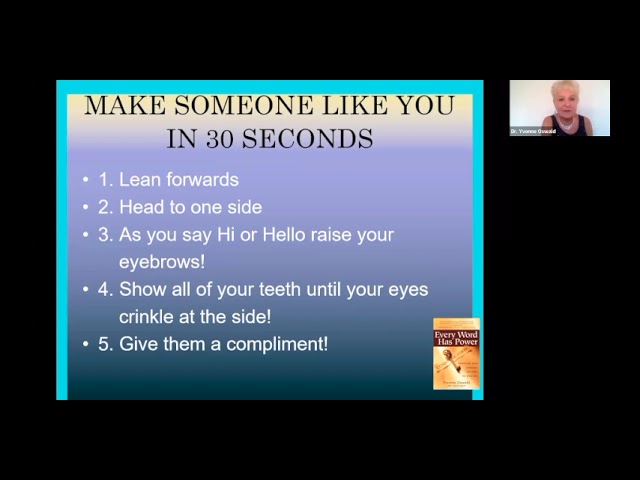
Awesome. So that's my contact information, which is very nice. The interesting thing is 100% of your results is your self-talk. Your inner dialogue produces 100% of your results. Your mind sorts out more than 2 million pieces of information every second. So we're talking like a giant jigsaw puzzle with 2 million pieces in. And what happens when we actually, when we live day to day, 80% of your self-talk is negative. So it puts them into groups of 126 and you're aware of only 7 plus or minus 2 pieces of information. So it's like you're looking at life through a little tiny pinhole. The interesting thing is people have said it's up to 11 million bits of information. It's a lot anyway. And we are looking at life through a very, very small pinhole. People who have autism quite often say that they don't have the ability to put those, those pieces of information into groups. So noise will appear to be huge. Visual, they can't, they can't see what they're looking at. There's a man called Michael Moon in Toronto, and he used to be autistic, and he's actually taught himself not to be autistic through music. So what he did is he actually, um, he, he said when he was young, as he looked around, it just looked like everything was like breaking into glass, broken, broken bits of mirror, and he couldn't differentiate between this information coming in. So it's— that's why it's so important to know how to get that information in, how much more information you're taking in one area than another, and actually be able to change it. So that's really important. So communication rapport— 55% of your, of your communication is body language. We're going to learn about matching and mirroring. And 38% tonality, the volume, the timbre, and the tempo, the loudness, the quality of the voice, and the speed. And 7% of the words are visual. And that's exactly important. So the idea that the 55% of the body language is important is if I say to you, oh, I really love your hair. Or if you watch a lot of films, actually, you'll be really interested when they say in the films, uh, I love you. They're supposed to go, I love you, and a lot of them are actors, so they're saying, I love you. They probably don't like each other off screen, actually. So it's like your unconscious mind will pick up on that. The other person's mind will pick up on that and go, there's something not quite right here. Your tonality is really— it's really important because with that tonality you can indicate a massive amount of information. Just think about someone calling your name. I had, I taught a class of 8-year-olds in England and what was so interesting was that the teacher wanted me to go in there and teach her how to do the communication rapport. And what I did is I wanted to know what system they used. And of course the easiest way for kids to learn, you to learn your kids' communication style is tell me about a safe place in nature. You don't say anything else, it's just what else, what else? So you don't say tell me about a safe place in nature, what can you see, feel, hear, or touch? Because that gives them clues on what to do. So you just say tell me about a safe place in nature. What was very interesting was there were 22 kids in the class. Of those 22 children, only 2 liked their name. Because typically when a parent has a child, they'll use the name like this, "Anne, Anne, Anne, Anne." Put that kind of tonality associated with their voice. When we speak to them with a nice, when we want to say something nice, we quite often say, "Hi honey, darling, would you do this?" So their name is not associated with a pleasant tone. And we've got to know that. You've got to realize that when you're talking to a child particularly, they need to love the sound of their name. And I got one of the kids out and sat next to me and I said, Jennifer, Jenny, Jennifer, oh Jennifer, you look so good today. Jennifer, you really do. And given that she was so young, I said to her, how do you like the sound of your name now? She said, I like it. It doesn't take long to get people to realize that the tone you use is really important. And of course the 7% words, that's what you're gonna learn about most today is the actual words we use to communicate with people and how to change that communication style so you get your point across. So we're gonna start with releasing a negative emotion. This is very good when people go into say a convention. And the interesting thing with a convention is you go in, there's 300 or 400 people, there are 4,000 people and everybody's like, oh my gosh, how do I communicate with these people? The easiest thing first of all is to release a negative emotion around that before you even go in the room. So we're going to do a quick twirl and flip, it's called. I will send it to you if you want me to afterwards. I'll send you the, the way to do it. It's a super easy way to clear a negative emotion on a daily basis, and it's very small emotions this is for. So we're going to take frustration because everybody gets frustrated every single day, and it's a super easy one to demo. So what I'd like you to do is think about a time you were frustrated this week. Anytime you like or anytime from the past. Not if it's massive big emotions behind it, just a quick frustration, you know, daily frustration when, oh my gosh, I've been on, on hold for like 20 minutes to these people, that kind of frustration. So go ahead and close your eyes and imagine where that frustration might be in your body. Mine's in my chest right now and I don't even know what it was about. Oh yeah, I've thought of 3 things it was about actually. And then you're gonna make it a shape and a color. So make it a shape, make it a color. Just make any shape up, any color. It just really doesn't matter. Your unconscious mind doesn't know the difference. So mine's a brown square. And then you're gonna spin it clockwise or counterclockwise in your, in your body. So mine's gonna be spinning clockwise. Then take it out of your body, pop it out of your body, tip it upside down. So now it's going the opposite way. Mine's now going counterclockwise, it's a yellow triangle. And then pop it back into your body in the same place. Click your fingers to break the state. And then try to feel that frustration. And it's impossible. You can't get there again. And that's what a typical NLP submodality switch does, is it changes the neural pathway of of the emotion. And remember, emotions are your survival mechanisms. So all our behaviors are based on emotions and emotions from the past. So everybody cleared the frustration? Anyone still got it? Good job everybody. If you, and sometimes we actually, I like those little, thank you Heather for the little hearts, they were really cute. So if everybody can use this every day, this is great for kids. If you wanna teach this to kids, I call it the twirl and flip. And it literally just completely takes you out of the emotions super fast. If it's got any past history with it, you'll need to use different exercises. NLP though is the quickest way I know to release negative emotions and it, it was literally 3 minutes instead of 3 years or 3 lifetimes. So let's go on to the next bit. This is interesting. This is, I wanted to put this in because I wanted to show you the difference that NLP makes to someone's brain. This was a test conducted in Australia with the, um, with the, the clinic, uh, the neurofeedback consultant, uh, in the clinic of, um, in Australia. And it actually showed the brain of a lady before she did my NLP session. And you look on the left and you can see that red mark, and that's all the anxiety, that's all the, um, all the, this, the, the things she was going through. She couldn't leave the house. She was in a real not good place. And she'd been working for years on this. And she'd been going into this clinic for every week for about 2 years and nothing had changed. Uh, and she actually went the last time on the Thursday. I worked with her on the Saturday and I said, could you do me a favor? Go into the clinic on Monday and have another test and see it. Let's, let's physically see what happened. And that's exactly what happened. When they took the second image, all of that red had gone. She completely changed her life. She was being hounded by a woman who was supposed to be a voodoo queen. And she told her if she didn't give her money, she'd have her killed. So that was how heavy it was. And literally, as she left me, she said, "That's it, I'm gonna block her on Facebook. Nobody's gonna control me like that." And when she went into the clinic, they said, wow, this is amazing. They've never seen results like this. I spoke to the consultant there, biofeedback, neurofeedback consultant. He actually phoned me and said, whatever you're teaching, I want to be there to learn it. I've never seen results like this. So that's how effective NLP is. We're going to be teaching later on, later on in a month or so, how to clear negative emotions in less than a minute. And if you're a coach, if you're a person who's working with people, if you're a school counselor, this is such, this is such easy, an easy method you can use with people to clear those emotions up. And anybody who's worked with me knows that. I know that. Good. So you have 30 seconds to make the rapport. So you have 0.15 of a second to make someone like you visually. That's because when you're walking through the jungle, you're literally walking through the jungle and it's a beautiful day and it's really nice and someone comes towards you You have to be able to make that person like you instantly. Otherwise, you know, if they're, if they're from a different tribe, and this is 200,000 years ago, this was formed when we first started forming that prefrontal cortex, the neocortex. You have only 2 seconds on the phone and you have 30 seconds to get them to trust you. So how do you make someone like you in 30 seconds? So I'm gonna show you and I want you all to do it. It's kind of funny. So it would be, uh, when you— when we walk up to people, we tend to keep a straight face if we've got any nerves happening or anything. We say, "Hello, I'm Dr. Yvonne Oswald Oswald Oswald." How do you do? And we just put our hand out, and it's a very unfriendly face. So the way you do it is this: you lean forwards as you go towards them, And the leaning forward is super important because it's like I bow to the light within you. It's literally putting you— it's saying, you know, I honor you. Okay, head to one side, doesn't matter which side, it doesn't matter how far over to the side it is too. It feels a bit false the first few times you do it, and when you get used to it, it's quite normal. You can do it even with a nod if you like. As you say hi or hello, you raise your eyebrows. So hi, Hi. So everybody please do that.
Just say hi.
Right, exactly. And it's literally those eyebrows are the biggest thing that make a difference. I was working with a young man, he was 38, very, very, he had two houses, he was an electrician, lovely, lovely guy. He was German and he was brought up with the idea that when you spoke to someone, you had to stand upright and speak like this. And he came to me and he said, I can't get a girlfriend. He said, I don't know what it is, I never get past the first date. So I said, come in, let me show you some body language tricks to do, 'cause it was obviously his body language. And he did this over and over again. And he was like, hi, I'm Frank. And I was like, this is really interesting. I said, wait, wait, wait. I said, let me do it to you. Let me see what the difference is. And as I went, hi, I said, it's your eyebrows. I said, these eyebrows need to move. As soon as you open the, or put the eyebrows up, your eyes dilate, your pupils dilate, and it gives you, it fills you full of endorphins. It fills them full of endorphins, and it just makes you feel like you're bonded. So I actually taught him how to say hi with the eyebrows up. And then he actually, he phoned me from a library not long later, and he's like, I just picked up a girl in the library. He said, She was, I just did my eyebrows at her and she just, she came and just talked to me. We're going on a date. And then he phoned me a couple of weeks later and he's like, I just picked up a girl in the supermarket. And it was literally just the eyebrow, just the eyebrows as a greeting. And it literally says, I'm your friend, I'm a really nice person. Then the fourth step is you show all your teeth until your eyes crinkle at the side. So it's lean forward, head to one side.
Hi.
And show all your teeth, as many as you can. It looks really odd. However, the crinkling of the eyes, eyes at the side, is what makes the difference. People say, you know, smile and you feel better. That's not true. If you smile until your eyes crinkle at the side, that's when you'll feel better because that floods your system with endorphins. Think about when you smile, when you laugh, it's like, "Ha ha ha," with the eyes crinkling. Think about when you cry, your eyes crinkle. Think about when you're having an orgasm, your eyes crinkle. It really floods your body with endorphins when you do that, and it floods their body too. And that's what we're doing first of all. So everybody with me? Lean forwards, head to one side. Hi, my name's Dr. Yvonne Oswald Oswald Oswald. You say your own name, of course. Show all your teeth until your eyes crinkle, and then you give them a compliment. I love your eyes. Oh, I love that necklace. How, you know, it's really giving them a compliment makes them think about themselves and not about you, and it makes you think about them and not about you. So whenever I'm doing a conference, whenever I'm teaching at a conference, I'll go around in the morning before breakfast or before I speak and I'll go over to people and say, "Hi, I'm your keynote speaker today, Dr. Yvonne Oswald Oswald Oswald. Great to see you. I love that necklace. Where did you get it from?" And they're all, "Oh," like this all over Twitter. And with anybody, when you're going into a group of people you don't know, whether it's a party, whether it's a gathering, whatever it is, As you join them, just to, to get in, you say, hi, I'm Yvonne Oswald Oswald, and then immediately give them a compliment. What happens then is they're thinking about themselves and you're an instant friend. They have no choice. They're thinking about themselves and how nice you are for giving them a compliment. So one of the things I'm gonna set you to do this week is give everybody you meet a compliment the second you meet them. What happens when we get married? The first 6 months is wonderful. It's, oh, I love it when you laugh. You laugh just like a donkey. Oh, it doesn't matter, darling. You just leave your clothes there. I'll pick them up. I'll do the dishes. I'll cook and clean as well, right? The first 6 months, everybody's, you know, whatever it is, is magic. After 12 months, it's like, do you have to laugh like a donkey? Pick your clothes up for goodness sake. And do you never do the dishes because I've done the cooking? Okay, so what happens is we get into the habit of searching for what's not right in a relationship. So that's really important to realize is that when you actually get into that relationship, when you've a few years in, we tend to just take for granted what's happening. You, somebody will walk in, you'll go, God, your hair looks a mess today. And instead of doing that, I want you to clearly with your children as well, go up to them and find something nice to say about them, make them feel good. Even speaking to, with any reason, the only thought in your head would be, does this make my teenager feel better about themselves? Because everybody has this idea of lack of self-worth, lack of, you know, lack of ability to feel like we're worthy of anything. So everybody lean forwards, head to one side. Hi, my name, hi, I'm so-and-so. Show all your teeth till your eyes sprinkle. And then give a compliment. And usually with the give a compliment, it just, you just bob forwards. Then you can, once you've done that, there's no more, there's no more work to be done. The second stage of rapport is finding something in common. So what was interesting was I went to a breakfast meeting and I paid $60 to go to this breakfast meeting years and years ago. And as I walked in, I had, I was, it was summer. So I had on my pink jacket, my white dress, my white shoes, my white handbag. And as I walked in, every single one of the women, it was a women's group, was dressed in dark black or brown or blue, dark blue suits. And I looked around, I was like, oh, I just need the poodle to be legally blonde right now. And I thought, well, you know what? I paid for my breakfast. I'm gonna go and eat my breakfast at least. Okay. And it was so interesting because a lot of them were lawyers, insurance people, bankers, et cetera. And we were supposed to talk to each other. And one lady came up to me and she said, what do you do? And I, I said, I'm, oh no, actually she said, what do you do? 'Cause she was a lawyer. And I said, I'm a therapist, I'm a hypnotherapist, I trained. She said, oh, no interest at all in that. And she walked away. I'm like, okay then. Obviously pretty auditory digital. Someone who isn't interested if it's not to do with them, right? Another lady leaned forward and she said to me, what do you do? And then she said, can you come into my law office and help people talk to each other and communicate with each other? Yes, I can. So yes, it's very definitely, it's about, rapport is not about liking, it's about matching and mirroring. It's about being like the person. People who are like each other like each other. So when people are like each other, they usually like each other. Rapport is a process of responsiveness, not necessarily liking. So in a school when someone's being bullied, it's typically because they have, they're not like anybody else. So they're dressed differently or they've not got the right clothes or, and yes, you know, parents with teenagers, they do need the Nike shoes. They do need to fit in. That age between 11 and 21 is the socialization period when they're supposed to be learning how to get on in a group, where they're placed, where their standing is in a group. So yes, they need to fit in. So it's not, it's all very well telling a teenager to be an individual. It's not useful to be an individual as a teenager. As an adult, it's great. But as a child and a teenager, they need to fit in. They need to learn how to fit in. So communication, 7% words, 38% tonality, 55% physiology. And Burt Whistle did a survey and found that in 1970 to prove that. Your learning styles. This is the, what we're going to go into a lot today. Visual people are 65% of the population and I'm one of them. You will know a visual person because they, I won't leave the house without lipstick on. I'm sorry, that's not happening. I am literally, I would not even get to the local shop without full makeup. I have to look good. And 65%, we have the advantage in schools because visual, a visual system takes in a massive amount of information simultaneously. And we can walk in a room, look around and say, "Yes, I like this." Someone who has a different system will take a lot longer. I'm gonna talk about the systems. You'll hear it over and over again until you finally get this. A visual person is quick. We're really impatient. We want it done now or yesterday, please, thank you very much. And because we're 65% of the population, usually we'll meet other people who are visual and get on. However, if you're in a business organization, the people who are visual are the ones who are upfront, the ones who are chatting, the ones who are talking, the ones— we can get a lot done fast. So it's not that we're not getting on with the job. We actually can do a lot of things fast. The kinesthetic people, and of course in a classroom we've got all the advantage because we're, we're looking around and we can take in that information all at the same time very, very quickly. Kinesthetic people, the touchy-feely ones, they're only 5% of the population. However, they're a very important part of the population. The visual people will, will do well with, with, uh, standing near you. They'll probably stand about 2 feet away from you and you won't feel like they're intruding on your space. The kinesthetic kinesthetics and will come in and give you a big hug and they'll, they'll be smiling and stroking you and touching you and you'll be like, okay, and they'll get away with it because they're all smiling and they're doing that while they're doing it. Kinesthetic people tend to be heavier in the physical body, tend to like eating, drinking, etc. And they'll go in a room and say, oh, this feels great. Visual people will say it looks great. The auditory people— oh, by the way, the kinesthetic people in school, they're the ones who can't spell. What we're gonna— I've got a little diagram later on that shows you the, uh, the where, where the, um, eyes look when we're looking at a different, a different place in our heads. You can tell how someone's not telling the truth through this. The kinesthetic people, when they're asked to spell a word, you're supposed to look up and left. For you, as I'm mirroring you, it's this way. When you're remembering a word, you, you, you literally, if you're going to spell it, you'll go T-R-E-E or S-U-C-C-E-S-S-F-U-L. Um, the kinesthetic people will look down and to their right, so that's down this way for you. And that they'll look, they'll, they'll be looking down here to notice how they were feeling when they saw the word. That's not where the word is. So typically when you ask them to spell something, they're looking here and they have no idea. A lot of people who are diagnosed as ADHD or autistic quite often are just kinesthetic or auditory. Then it's nothing to do with their teaching, their own system. It's to do with the way they're taught. The teachers don't take into account that there are 4 different languages in the classroom. The auditory people, the ones who listen, this is a very interesting group. They're 15% of the population. And when they're talking to you, they'll be looking down at the ground or over here somewhere, whichever way it is, doesn't matter. And the reason for that is they're listening to what you're saying. And it looks really ignorant for visual people. That will drive you crazy because you'll be saying, could you look at me when I'm speaking to you, please? I had a friend who did that. He was very, very auditory and auditory-digital. And he would look down and talk to me and I'd say, look, can you please look at me when you're speaking to me? It looks really unfriendly when you're looking down like that. And I said something to him and he said, say that again. And I said it again. He said, say that again. And he could not hear me because he was using his eyes. He was attempting to split his system. And in the end I said, look, I said, like you see, I'm visual. Look, literally I said, I want you to pretend to look at me or imagine you're looking at me while you're using your ears, please. And he said, oh, I can do that. And quickly he did it. I had a child brought to me who was a really very, very intelligent child and his mother had to be in the room 'cause he was 11. And I said to him, why are you here? And he said, could they just put me in the dummies class? And I said, why do they put you in the dumbest class? And he said, because I don't know. He said, I have no idea why. And I said to him, tell me about a safe place in nature. And he said, I can, and he looked down and he said, I can hear the birds, I can hear the wind, I can hear the trees blowing around. And his mother said, would you look at her when she's talking to you please? I said, I would like you just to sit there and not say a word please. I'm doing a test here, you know, don't interfere. I said, you know what? I said, I'm okay with you looking down at the floor because I know you're fully listening to me because he used all the hearing words. I said, I would like you just to pretend to look at me because then it looks a lot more friendly. So he was like, okay. And for 2 hours, he was, he, we, we did the work with him and he was fantastic. He pretended to look at me and he looked perfectly normal. His teacher had thought he wasn't paying attention because he was listening with his ear, right? And that's really important to realize is that they're misdiagnosed very often in schools. The auditory-digital class all by themselves, it's supposed to be a subset of auditory, I don't believe it is. Your Mr. Spocks or your Sheldons of the world, 15%. They tend to not use body language a lot. Auditory systems and auditory-digital are very linear systems. They're very slow. Because they have to think about it and listen. Visual is fast because we take in all the information at once. But someone who's auditory digital will want to discuss things till, till, till you go crazy. I was married to Will, who is auditory digital and auditory. He knows I talk about him, so it's fine. He used to walk into the classes and he'd say, do you all know about me yet? And then they'd say, yes, we did. And of course he would say, can we discuss this please? And I would run out the room saying, please no more discussion, let's just do it. And the auditory digital typically can, don't know how to start things and don't know how to complete things. They like the whole idea of the system. They make great computer geeks. They make great people who are in any banking system, anything which is linear. Auditory and auditory digital people are the ones to go for. In, I actually had a woman came to me and she said, we've just opened a health company in Markham, in around Toronto, 4 floors of health things. And she and 2 other people had interviewed all the people for the jobs in this health place. You know, people would come in, they'd fill in the forms, et cetera. And the interesting thing was She asked, I went and I actually got them to do the test. She said, nobody's getting on with anybody else. She said, everybody says we're a really unfriendly place. She said, I don't know why we're unfriendly. She said, they're all really nice people. I like them. She and everybody else who was testing them for the job were all auditory and auditory digital. So guess what? The people at the reception desk were auditory digital. Hello, take this form, sit down. Didn't even look at the person.. And then we, they all took the, the test that you guys took and just about everybody in the organization was auditory, digital, auditory. There's no way that, that whole communication system could work because if you're selling, you need to be visual, you need to be kinesthetic, you need to feel and see and touch you. And then you need to convince the people who are auditory digital that there's a good reason for doing this. Okay. It's very interesting when you actually, when you realize how different people are. I used to think people were really ignorant when they were auditory digital because they would want, they always say, well, why do we do this? Well, can you explain it better? And I remember a class in Florida, it was actually, I had just about everybody in the class was ordered to digital, and I had to throw out a whole day of materials because not one of them would get up and do the demonstration because they wanted it explained again. And one of them said, can we just have it explained again? I said, no, I've done the demo, I've told you what to say. All you do is read the book. You don't even need to say anything. You just need to read the script. To the other person, go ahead and do that. Well, what will happen when we do that? I'm like, what will happen is you'll do the demo and then we'll come and talk about it. We can discuss it afterwards. I finally got them all to sit down and they would be sitting there saying, well, what do you think we should do first? Do you think it should be this or this or this or this? Literally every 2-minute demo took 20 minutes because they were talking it through and thinking about it and what— discussing it. They had to completely understand it before they would make a beginning. So Typically people who are super auditory digital, very heavily auditory digital, are not self-starters. They're not, they don't initiate things. Okay. So you, you, you'll start to get the idea as we go through exactly how people are. I had a class, funnily enough, of at my house in Niagara Falls when I lived there with 8 bedrooms, people came in for trainings and one girl who was Chinese, put her hand up, she said, and Chinese people tend to have that auditory digital, they wanna be doctors, lawyers, you know, accountants and things. She put her hand up and she said, "May I go to the bathroom?" I said, "Yes." She said, "Where is it?" I said, "Up the stairs, go up the stairs, turn left as you get to the top of the stairs, walk straight and you walk straight into the bathroom." And she stood up and went. And one of the other girls in the class said, "Did she hear you?" I said, "Yes." And she's like, "But she didn't say anything." I said, "She heard me, she's auditory digital." Auditory digital people do not feel they need to give you a reply unless you ask them a question. So it's kind of interesting. She, I knew she was auditory digital. It was pretty obvious from the second she walked through the door. And she said, can I ask her? I said, go ahead, ask her. And she's like, did you find the bathroom? And then the girl said yes, because she was asked a direct question. So if someone is not answering you, it's not because they're ignorant, it's because they don't feel the need to respond. I used to say to my ex, did you hear me? And he'd say, yes. I'd say, well, why didn't you reply anything? Why didn't you go, oh, hmm, ah, like every normal person does? He said, there was no reason to. I understood what you said. So why did you need me to say anything? Okay, so it's very important that you get that when you're working with someone, you need to know what system they use, especially if you're a life coach. That's super important. And the words we use with these people, there are only 4 or 5 words you need to listen to to understand immediately what system they're using. So let's go on a little bit more. Where are we now? Matching, mirroring. So we want to match and mirror the other person. When you match and mirror someone, matching and mirroring comes from group species. Monkeys do it. Funnily enough, dolphins do it. Whales do it. A parrot will do it. If you do this to a parrot, it will start doing it back at you and its cheeks will flush really pink thinking, oh my God, she's in my club, she's in my club, right? What happens when you match and mirror someone? You're saying, I am like you, I am in your group, I'm in your species, okay? And we have to do that matching and mirroring. You have what's called mirror neurons up here on the left-hand side of your head. And people, species of mirror neurons typically will go up and start making movements like the person they're talking to. When you're speaking with someone, you need to mirror their actions and their body language and their face. Okay? So if someone says, I'm really sad right now, your job isn't to say, oh, well, cheer up, get over it. Your job is to make your face exactly like this. Oh, I'm so sorry. What can I do? Anything to help? And you, again, you're bowing a little bit forwards to make them understand that you're you're bowing to them, you're respecting them, you're honoring them. Okay. When you are speaking with someone, typically auditory digital people will stand straight like this and just tell a story. It looks so unfriendly for visual people and that you don't realize that they don't know, they're not doing anything differently. I was teaching at an IBM conference in Edmonton and of course IBM, it's all auditory digitals. I actually stopped an auditory, I actually stopped working there because I couldn't deal with teaching a class. And I would say, okay, let's stand up and do an exercise. And they would go, can we just think about it? Can we just think about standing up instead of actually standing up? I'm like, no, you have to actually do it. And then at the end of the class, and they would just sit there like bumps on logs. It was really very disheartening. There was no kind of interaction. And, um, they would come afterwards to say, that was the most interesting thing I ever heard. And I'm like, wonderful, great, teaching real estate people, fantastic. Oh my gosh, real estate people, a pleasure to teach because they'll go, oh, oh, really? I didn't know that. That's so interesting. Yeah. And they'll really interact beautifully because they're visual and they're a bit auditory-digital. They usually have a good balance of the systems. And that's what we want is is some people here today are imbalanced into one system, and I'm going to show you how to balance yourself back into— so that you get it. They should— it should be 100 across the board with 25 in each if you, if you completely balance. We've got, we've got a few people who are, who are a bit more imbalanced than others, so we're going to talk to you later individual. This is great, it's a small group, so I can work with each of you individually and tell you where to get your balance. So the physiology is 55% of communication, Mirroring is like looking in a mirror. So Nancy, if you put your left hand up and just, just, just like that, okay, this is mirroring. So as if I'm looking in a mirror at Nancy, okay. Typically with the, thank you, with the mirroring, they'll do something like this. So your job is to do the same kind of thing, but in a very minor way. We don't want to say, we don't want them to say, why are you copying us? Matching. So when, when you go for an interview, you need to be able to match and mirror the people who are interviewing you, okay? Usually if there's 3 people interviewing you, uh, 2 of them will be with you and you'll think, great, I've got this job. The 3rd person will be sitting there with their arms folded like this, just looking at you, okay? So you have to get them on board with you as you're going for the interview. If you're— and if you're in human resources, you need to know all of this Typically what you'll do is not fold your arms because that makes you look like you're being, you know, get away. You would typically just cross your fingers and, or something like that on your lap. So just hold, hold your fingers or just put your hands up over your, over like that on your lap. Then you'd talk to the other people while you're mirroring the mirror and matching this other person, the one who doesn't like you. And then you'll talk to them. And as you speak to them, you'll do this.
Yes.
And they cannot help themselves. They'll have to part their arms and start to join in with you. It's very, very interesting. I took my daughter for an interview with, oh, it was people who put adverts on the TV and it was a modeling job. And this lady was very auditory digital. Gosh, she was. And she was sitting behind the desk with a telephone and she said, Melanie's going to be interviewing you. So Melanie was interviewing me and my daughter and we were all leaning forward with our arms together and I'm like, oh, this is great. She's gonna get the, get the, the, the, the interview because we're all matching and mirroring. The three of us were all in the same position. And then the woman who was, who was the boss of the organization kept saying, well, could you just say this and could you just say that? And I kept glaring at the thing and stop interfering. We're doing an interview here. And then I realized she was on the phone and she was actually doing this on the phone. She was not matching us. We were not matching her. So what I did is I suddenly realized I had to bring her into our club. So I literally did that and she just turned around and she said, yep, she's great, she'll do. As soon as I did that, it was instantaneous. Okay. If you have a group in front of you when you're teaching, when you're training people, whether it's a big audience or anything else, you'll see someone on the front row cross the legs. And if you watch carefully, you'll see it will go right through the audience. Other people will also cross the legs even though they can't even see that person on the front row. They're going to be automatically mirroring or matching the person who made the movement. The person next to them for sure will cross the legs. And it's so interesting to watch the little movements go through. It's usually the group leader or the person who's the dominant one who everybody will start to follow and match and mirror. And it's, it's absolutely amazing when you actually really observe what is happening in the room and who's matching who and who's mirroring and who's not matching and mirroring. Um, I had a group where two, two girls, two ladies were just looking down and not saying anything. And I realized I had not included them in the rep system. And I realized they were here, they were listening to me. So I said, as you look at me, and both of them looked up and listen and hear what I'm saying and feel what I'm saying and think about it, everybody in the room then would be listening to me because I'd included every single group. So you have to know what words to use to bring everybody into the group. If my whole language used to be around speak, around looking. Look at me, see this, watch this, visualize this. And my ex pointed out that when, when I said close your eyes and visualize yourself at the top of the mountain, he said, I can't visualize, you know I can't visualize. And I said, well, how do you see something like a mountain if you don't visualize it? He said, I think about it. And that's why people say, you know, I can't be hypnotized. It's not that you couldn't be hypnotized, it's that the person who was hypnotizing you didn't understand your your system, right? So you don't ask an auditory, auditory digital person to visualize because they'll say, I can't see pictures. Honestly, I don't know how you can think about something without seeing a picture. However, they apparently do. Okay. So when they say, I don't see things in pictures, they have to then translate it into their own system. So if you use the word think about or imagine or pretend, the two best words you can use are imagine and pretend. It will cover every single system. So matching the other person's moving, they move their right hand and you move yours a second later, they cross your legs and so do you. That you can do crossover matching. So if they've got their legs and leg over knee, you can cross your ankles. You're still in their club. All right. So the whole idea is watching the person. If you're having a session as a coaching session, if you're coaching someone, If, if they're not really responding, probably it's because you are mismatching them right now. You're just check on your own body language and notice what your own body language is compared with them. The second you bring your body language in alignment with theirs, they'll start responding because you basically just put them out to the club. It's super, super interesting when you really get to know this stuff. So as a general rule, people can be divided into 4 groups. The visual, the 65%, and they use words like look, see, watch, and visualize. You'll see within the first minute of meeting someone, you hear these words, you'll know exactly what system they use. So if you ask me, what does today, what's it like today? I'll say it looks really good because I'm visual. I won't say it makes sense to today. I'll go, what are you talking about? That doesn't mean anything to me. So we'll say, look, see, watch, visualize. If you're writing a script or reading a script, a hypnosis script or a coaching script, make sure you've included every single system in there or else they will not get the full advantage of what you're doing with them. Okay. The auditory people, you use words like hear, listen, sounds like, talk to me. Um, my ex could, my ex and I could go from like just having a discussion to the Third World War in 2 minutes. Because I would say, you're not looking at me, you're not seeing what I mean, you're not feeling it, are you? Because I'm visual, kinesthetic. And he would say, you're not listening to me, you're not understanding, you're not making, it doesn't make sense what you're doing. When we did the NLP for the first time, we went, oh, now we get it. And I switched my language to his and he switched his language to mine. So I would say, come over here and actually come and discuss this with me and we'll think about it and talk about it together. And he would say to me, come and look at this and see what you feel about it. It was like instant rapport. It was like all the arguments stopped. It was really amazing. So if you, with someone who's auditory, typically they'll be looking down or not doing eye contact well. You can say to anybody who's auditory, just pretend to look at me while I'm speaking with you because it looks more friendly. Okay. Someone who's auditory digital makes sense, come to mind, think about, understand. This is the easiest system to find out. They will use the words make sense or come to mind within the first few sentences coming out the mouth. It doesn't make sense to me. Well, what comes to mind is, I don't understand that. I'm thinking about it. Okay. And of course the kinesthetic feels like touch, catch on. They'll use the words feeling. So you say, how do you feel about that? So someone visual, how does that look to you? Someone who's auditory, how does that sound to you? Someone who's auditory digital, does that make sense? Someone who's kinesthetic, how does that feel to you? I did a hypnosis session with a friend of my ex's and I figured, well, you know, So he walked in and he was fairly heavy. So I figured, oh, he's got to be auditory or he's got to be auditory or auditory. Oh, he's got to be kinesthetic because he was fairly heavy. And I said, as he closed his eyes and went into hypnosis, I'm like, oh no, I didn't think about finding his system before we started. And I said, how does that feel? He said, nothing. I said, what are you feeling? He said, nothing. 'And I'm like, okay. I said, well, what are you listening to? And he says, not listening to anything. I said— I thought, well, he's not visual, but let's have a go. I said, what do you see? He said, I don't see anything. He said, this doesn't make sense to me. Nothing comes to mind. I was like, thank you. I wrote those two sentences down and I said, if something did make sense to you, something did come to mind, what would it be? Oh, that's easy. And we were off. And I literally said those two 2 phrases over and over again. Those are the only phrases I used when I wanted an answer from him. So simple when you finally get it, it's really, and it's fun to do. He said, nobody's ever been able to hypnotize me before. And I'm like, I'm not surprised 'cause they were saying, look, see, they don't see things in pictures. Auditory digital people and auditory people do not think in pictures. So they have to, they can train themselves to think in pictures, So you can say, imagine thinking of a picture, and they'll think of a picture. But you can't just say, think, see a picture, because it won't work. Any questions so far? No?
Good.
Why is it important? A good way to remember is that visual and auditory people tend to talk quickly, and kinesthetic or self-talk or digital people talk more slowly. Why is it important to know it? Because people don't compute language that's not conveyed in their rep system. They must translate it first. Someone who is, who is auditory digital will drive a visual person crazy because they'll want to talk about it and discuss it. So Will will be fine with this because I tell the story over and over. We were going to the zoo and he downloaded the whole map of the zoo. And before we even set off, he said, "Actually," he said, "we need to just decide which foot— what footsteps we're gonna be following at the zoo, whether they were gonna be the lion footsteps or the bear prints or whatever." And I'm like, "Why don't we just go and decide when we get there?" He said, "No, we need to discuss this. We need to plan it. We need to make sure that we know where we're going the second we get out of the car." And I was like, "Are you kidding me?" This is such a waste of time because when we get there we're going to go, " Bears! Penguins! Lions!" because I'm visual, right? So I'm super spontaneous. So be aware that you've got to actually say to— if I was talking to him today, I would say, "This makes absolutely no sense whatsoever. Let's think about it when we get there." That then would have got to move into the car instead of actually attempting to make him understand that this wasn't a great idea. Okay, are you getting the idea? So why is it so important? Visual people tend to talk quickly, their voice is higher pitched. So visual people tend to talk from up in the throat and we're not distracted by noise. So two visual people can have a conversation in a room and we can be talking away, chat, chat, chat, we will not hear any noise whatsoever because we're so engrossed and so deep in rapport. And we'll be chatting away and it's only someone can, someone can drop something in the background or the, you know, eventually we may notice there's a whole group of people around someone on the floor and we'll go, oh, what happened? We won't even notice it happened. And when you're talking with a visual person, you have to say to, do you see what I mean? So auditory people usually have more tonality. So they'll say, hello, how are you? You'll know an auditory person 'cause it sounds really sexy voice.
Voice.
You know, they're the people who are the announcers on the radio or the ones who've got the podcasts who are really, really, "Hi, my name is Jim and I'm here today." And they've got this very nice resonance in the voice. They enjoy talking on the phone, they like music, but they are sensitive to background noise. It really irritates them. So what happens is when someone's very auditory, they'll say, "I can't hear what you're saying. Can we go in another room?" And you'll go, why can't you hear what I'm saying? You just don't need to listen to the noise outside. They cannot talk or be in an area or think about something that's in a noisy room because they can't differentiate the sounds enough. Okay. So they'll look, we used to have to go into another quiet room and go and find a spot where we can talk to each other without that background noise. You would think that auditory people would be able to differentiate the sound really easily. They don't. They actually cannot do that. Kinaesthetic people feel their world by doing it and trust in their gut feeling. There's the slower, deliberate phrasing and longer, complicated sentences, and this person needs to be understood. Does that feel right to you? The auditory digital people, they self-talk. Things have to be logical and sequential in a step-by-step process. Does that make sense to you?. So a visual person will be fine giving you a hug and then they'll stand a foot away from you. Someone who's auditory will stand 2 feet away from you and be looking at the floor. Someone who's kinesthetic will be 2 inches away from you, almost sitting on your knee, and it will feel okay because they get away with it. And you'll know the kinesthetic because they're always touching you, right? And the auditory digitals will be at least 2 feet away from you and will be standing totally upright. Don't even think about giving them a hug. When you give someone who's auditory-digital a hug, they tend to do this, tip back to you, or they just stand there and let you hug them, okay? In a classroom, the visual people, right on board, we've got our papers there, we're looking at everything, we're taking in everything at once. The auditory people will be looking at the floor and listening and have to be given an instruction to open the book. The kinesthetic kids are touching everything in sight, including their friend here and fiddling with the friend's hair or fiddling with their own hair And the teacher will say, can you stop touching everything? How can they understand the world if they're not touching it? The biggest thing about kinesthetics is they need to be touching. They need to be fiddling with something. They need to have the pen in hand doing this or else they don't understand what information is coming in. It's very interesting that people don't realize this. The auditory digital people will be sitting there completely upright, not saying anything. And right at the end, they'll say, but what happens if this doesn't work? 'Can we have a discussion about it?' It's like, 'Oh, please,' right? Or they'll say, 'Can you repeat that? Can you repeat that? Can you repeat that?' The auditory— the visuals have their big advantage in classrooms for sure with learning. Also, by the way, the visual pathway is up and to the left, the visual recall pathway. This is super interesting for kinesthetic kids. If you've got a child who's kinesthetic or you know someone who's kinesthetic, they can't— they're not very good at spelling. That's a big clue. I'm going to mirror it for you. So it will be your left-hand side is visual recall. So when you're remembering something, you'll look up and to the right, up and to the left. When you're actually making something up, like thinking about having a yellow car, it would be up and to the, to your right, right? You'll know if someone's not telling the truth because they will be talking to you and looking up and to the right. If someone is telling the truth, they'll look up and to the left. Okay. If you watch the interview with, I don't know, it was Barbara Walters or someone interviewed Scott Peterson. And he, she said, what happened that morning, Scott? And he said, well, this happened. And he looked down and to the left, your left. And he should have been looking up and to the left. And he was looking down and to the left. That means it was scripted. He was reading a script that he'd written in his own head. He was absolutely lying through his teeth. So when you actually see things, you know, people being interviewed— oh, who was the other one? The one with the— very, very interesting to watch that interview.
The—
ah, he killed Nicole Simpson. What was his name?
O.J. Simpson. O.J.
Simpson, thank you. O.J. Simpson interview, absolutely kept his eyes glued onto the interviewer, didn't even faze him, didn't look anywhere, didn't move. Uh, when he answered, he'd answered like this, but the eyes were glued. He hardly blinked. And then she asked him a question that he hadn't prepared, and his eyes were all over the place like this. You could see his eyes whizzing around his head searching for the answer, and you absolutely knew he was about not to tell the So it's when you, when you get how important this, this stuff is, it's absolutely fascinating. I love watching people who are acting because you can totally tell whether, whether they're in there really meaning it or not too. So rep systems, we're onto your rep systems now. This is where we're going to get interesting. Um, we're going to talk to, um, Let's talk to Ricky first of all. Are you there, Ricky? Can you unmute yourself? Ricky's not here.
Yes. Oh, there you are. I'm here. Thank you.
All right, good. Okay, cool.
I figured you'd pick me first for some reason.
No, it's just that you're there at the top of the list, that's all. Oh, okay.
Okay.
So when you've— when you come— when you finish filling that test in, you came up with the top number is the biggest number, and then going high to low. This is me. Again, communication and visual, I had 35. I had a very high number on visual. Kinesthetic, I'm 22. And auditory digital, I'm 22. And auditory, I'm 21. This has changed from when I first did it 20 years ago. 20 years ago, my auditory digital was right down at the bottom. And the auditory was right down at the bottom. And they were in the teens. So I was completely imbalanced. You know, and the biggest thing with the auditory digital is you need to think sequentially. So I wasn't a sequential thinker at all. I was super spontaneous, not doing anything except just going day by day. I had to learn to be auditory digital when I was teaching because I had to plan out when I was starting the class and when I was finishing the class, and it had to be in a line in front of me. So over the years, mine's changed. So, uh, Ricky, your kinesthetic was 31, correct?
Correct.
Good. So 31 is pretty high, and it means that you need to feel things, and you'll be— people will not be super empathetic with you because you'll tend to want, want them to feel you, and you know that you want— they'll need to feel your feelings. So if you're going out with or married to— are you married right now? Are you In a relationship?
Yeah, divorced.
Yeah, and part of the reason for that would have been that he wouldn't have understood your feelings.
Absolutely.
Yeah, because literally your feelings are super high on that one. Auditory is 28, so you're a good listener. Visual 25, so you've taught yourself to be visual. You're not naturally visual. But the auditory—
I have auditory 26.
26, oh yeah, all right, I misread it. Still, it's still visual, it's a good balance. It, you, it's actually balanced more than any of the others. Your auditory digital is 15. If you have any number in the teens, you are what's called out of awareness. So your auditory digital is out of awareness. Someone will say to you, let's plan this, let's do it like this, this is the way we need to do it, and you'll go, what? Why don't we just do it? Why don't we just get in and get on with it, right? And anybody who wants to plan anything around you won't find it easy because you'll be thinking, you'll be shooting off in different directions looking for something shiny all the time, right? So your job is to learn how to think sequentially more than, uh, feel it, okay? In communication, when people communicate with you, if you look at the top of this there where it says communicate. The top number is how you communicate. So you communicate with, with your feelings. I feel this about you. I feel that, oh, this house is wonderful. I feel I would really enjoy living here. When with the auditory, you will not like to be in a crowded room where there's a lot of noise going on. It's a very high number that you'll like. You'll like peace and quiet. You'll, you know, where you have a challenge, when you have a challenge You want to be by yourself to do the challenge. You want to, you want to really think about it by yourself with no interfering noise. So you couldn't, you couldn't address a challenge with the TV blaring and the radio on, correct?
Correct.
I have a house being built next door and I'm going crazy because it's going to be loud. With Audiotraining, you sit in position, or almost near the top actually, 100%. You won't like a lot of noise going on. With visual, the 26, it means you're a quick learner, you'll catch on very fast. And with auditory digital, because it's— you're out of awareness, uh, for security you'll need to be— it needs to look right to you. So, so if you walk in into a place and things are all higgledy-piggledy and untidy, you won't like that particularly because it doesn't look right to you, it doesn't make you feel secure in your environment. Um, it doesn't matter to you where things are kept. The interesting thing with the auditory digital, it— you really— it doesn't have to be in order. Your house will look like it's in order, and then you open a cupboard and you'll find it's totally chaos in there. True? Yeah, I know. It's like, it's like, yes, I know, doesn't it look nice? But you're the kind of person who, when you've got someone coming to dinner, you'll just throw things in the cupboard and make it look good from the outside, right? Very interesting. So any questions about that? You, your job really is to learn how to write things down in a sequence. So a good way to change, to up that order to digital, it should be 25 and it's 15. So it's out, it's out of awareness. So your job is to actually get, um maybe a little notebook and plan more. If you can plan things rather than just do them spontaneously, you're going to find your auditory digital will start to rise up and it will start to balance out.
I write them down, I just don't follow them.
Right, exactly. Okay, so write them down and then learn to follow them. And then, you know, or just put, you know, when you've written them down, just attempt to put them in— tick number 1, number 2, number 3, number 4. So you don't necessarily need to follow them order, but however, they do need to be followed in a sequence. Get it? So very, very interesting. Gwen, you're here, right? Thank you. Any questions, by the way, Ricky, before that?
Oh no, I'm good. Thank you. Good.
Gwen, you ready?
Yeah, I'm here.
I'm—
yeah, I'm ready.
Okay, awesome. So your auditory is 29 and your auditory digital is 28. Oh my God, for you. Okay, Mrs. Spock or Sheldon. I know your visual's good though. Your visual's 24, which means you, you can make up for a lot of that imbalance in the auditory and auditory digital because you're good. You've taught yourself how to look at things. That was not natural. Yeah, didn't come naturally. Uh, you've taught yourself how to do eye contact. That's not natural to you. Okay, right. Yeah, you've actually done a really good job to get that up to 24. So the auditory digital and auditory, your kind of career needs to be in a very, in a very sequential place. So banking or working in an environment where you do sequencing. What job do you do?
That's funny because I retired from being at a bank. Yeah, exactly. So now I, now I do Reiki, hypnosis, and a coaching.
Oh, isn't that interesting?
And that's kind of neat because they all incorporate with each other.
And that's right, that you said that starting out with your auditory and auditory digital, perfect. That's the perfect place. Now you're going to be upping your kinesthetic because it's 19 right now. And it's, it's out of, out of awareness again. So you need to feel more when you're doing Reiki. That's perfect to actually increase that number. So when you're doing your Reiki, do a lot more of the feeling what you're picking up, because what you'll tend to do— it will have to make sense to you when you do Reiki, and we don't want it to make sense because Reiki is all about feeling. It's about bringing the energy through you and into that person. So instead of thinking, I'm going to go from this to this to this to this to this in sequence, let it start in the middle of the body and find out where your hands are drawn. If you can, if you can do that, just let you automatically, your hands will be drawn to an area of the body that's not well. Dogs do it. They'll sniff an area of the body that isn't, isn't working properly. Right. So automatically just, just start out like this and just let your hands just go over to where there's an issue and just say there's, there's something happening here. Right.
Okay.
And do it arbitrarily, not in so, in so much of a sequence.
You can start. And that is funny. Yeah.
Yeah, if you can start out doing a sequence if you like, and it will work, it will work a lot better if you start to use your intuition and your kinesthetic ability. Okay, so you're so just automatically letting your hands go to where they are. I had a client who has spent 2 years learning how to do diagnostic Reiki, learning how to do diagnostic medical things. And I said, I can teach you in 2 minutes. And he's like, how? So I said, do it on me. I said, I lay down on the, on the massage table. I said, take your hands, put them over me. I said, let them go where they need to go. And he went straight to my stomach. I said, exactly. I said, I had a stomach upset last night. And he's like, you mean I spent 2 years learning and it was just like, so that easy? Yes, it is. It's that easy. Okay. So we've got a lot of the systems can learn from the other systems very nicely. So you communicate with your, with your auditory. So you listen very well. You're a good listener, right? And people, because you're a good healer as well, people will, will come and tell all the nutters on the bus will find you and tell you the life stories. So you're going to get, yeah, can I tell you about my divorce? It's like, do I know you? And they'll go, I like you. You seem really nice. And you'll listen to them and think, this is crazy. Why is someone, a total stranger telling me about the divorce? Because you have such good listening skills, they'll know that, they'll sense it, and good healing ability. So learning to not do eye contact with people who are taking your time up is really important, right?
Sorry, say that again. Learning that again.
If someone, if someone is telling you their whole life story, yeah, you, you need to look away.
Okay.
If you look away, they take it as a sign that you're not interested. And they'll, they'll slow, they'll stop the conversation and move on to another one. If you keep your eyes on, on them and just nod, they'll carry on forever. They'll think you're the, and they'll say, you're such a nice healer. It was so good talking to you. And I'm like, yeah, you didn't talk with me. You talked to me, at me. Right. Really? So yeah, it's about if you want to get out of a conversation, you just briefly look towards the door and then back. It literally clips the conversation off.
So that is a perfect thing because that is sometimes what I get caught up in. Yeah. Yeah.
And if you, if you just look over the shoulder and just say, carry on, they'll go, oh, oh, it's okay. And they'll absolutely stop immediately. You, they can't do anything else. It's a, it's a fear response. It's a living response. If you're in the jungle and you're chatting with someone and a lion comes out, if you look at the lion, they have to look at the lion too. And you can't, they can't get back to the story they were telling because they've forgotten what they were talking about. Right. So just briefly looking at the window or, yeah, carry on. They won't be able to. Right. It's very, very interesting. Eye contact is super important. That's why the, the people who are auditory, when they're looking at the floor, it's, people just lose interest in them really fast because it looks like they're not interested. Okay, so with your auditory digital being 25— 28, is it? Or 25? 25.
Sorry, I just had it and it flipped away on my phone. Just give me a sec.
Um, trying to read my writing.
So which, which one are we asking about? Auditory digital is, uh, 28.
Oh, 28. Way, way big. Way too, too heavy. So again, it's about spending less time thinking about it and more time doing it.
Yeah. So you, yeah, yeah.
Really, really important that you actually learn to just say, I'm done, moving on. Okay.
Mm-hmm.
Uh, and of course it's when you do a challenge, it has to make sense to you.
Yeah.
If you, if it doesn't make sense to you, you won't bother doing the challenge.
Right.
And, and if it doesn't sound right to you, you won't bother doing it either. Right, right. Uh, the security in you with your sense of security, Visual's 24. So as long as it looks fairly neat, you're fine being in it, and you find you feel fairly safe. As long as you're walking in, it looks fairly, fairly neat, that's okay. If it's completely chaotic, you won't feel safe, and if it's too neat, it'll feel a bit funny for you as well. So it needs to be in between. With the environment, kinesthetic is 19. It really doesn't matter to you how it feels as long as you feel okay. You don't care what the room feels like. Cool. So yeah, it's very, very interesting.
So, and sorry, the communication, that one.
Yeah.
So that, sorry, can you just say that one again just really quick? You don't have to go into a lot of detail.
So you use your ears to take in information.
Okay. Yeah.
It works better for you to listen. I cannot listen to a podcast. I cannot. You know, those that have no speaking, I can't do it. You could go out and listen to that all the time. Yeah. You'll listen in the car. You'll listen to everything that, that's, uh, you'll, you'll be listening.
I can't.
I'm 2 minutes into something that hasn't got a visual. And I'm, I'm like, I'm good. I don't need to listen to this. I can't do it.
Okay.
I've even tried looking at something else while I'm listening. That doesn't work either. I cannot. I have to see something. I have to see a person talking in order to relate to it. Okay. I have signed up for so many classes. You have no idea that we're just auditory. Can't do it.
Right.
And I want to, it's in my book, it's there. And I start listening and, you know, I'm like, oh, we're on a Cell Fest. I don't want to listen to 20 minutes of this Cell Fest. And then if it gives me an option to read it. It says sometimes, you know, do you want to read the transcript? Oh, please God, yes, because I can whiz through, through the reading of it really fast and get to the important points and take them out. I much prefer to read it than listen to it. Okay, so do you understand that?
Yes, yes.
Good. Uh, Tim, you ready?
Yes, ma'am.
Nicely balanced across the board, Tim. Good. Um, your auditory digital and auditory is high, so you've got 27 on the auditory digital and 26 on the auditory. That means the kind of job you do will need to be something like computers or not particularly working with people. It will have to be, um, an office job or something. What do you do now?
I am in an office job doing cybersecurity.
There you go.
And I'm just— I'm listening to you go through the process here with, uh, Nancy and Gwen, and I really feel like I identify more as auditory than the auditory digital.
Yeah, I don't know if that's— and they're fairly— they're so close together, they're only like one point apart. So, you know, you can basically say they're the same. Okay, so the auditory for sure. And the big— the biggest thing with you in an office, if you're an office worker and you're doing— you want to— and your office manager comes up with you, and not you particularly, but. If an office manager comes up and says, you know, can you, can you print out this document for me, make it look good, because the office manager's visual, it wouldn't make sense for you to put lots of colors in there and lots of logos and lots of other stuff. You'll just do it as a document. And then, then the office manager would go, what the heck is this about? I asked you to make it look good. Okay. When I used to teach at IBM, I'd say to the office managers, how would you like to be able to explain to a techie the first time and get them to get it right. And they were like, oh please, because they had to be visual. They had to have a good balance across the board, particularly visual, and be good communicators in order to be a manager. Whereas a techie doesn't need that skill and they, they do it the way it makes sense to them. That's it.
Okay.
Um, so yeah, with you, you're visual is 24. Which is good. That says you can take in good information fast. And your kinesthetic is 19, and it's way out of awareness. So you'll be accused of not being very empathetic or not understanding someone else's feelings.
I do get that occasionally. I have my kinesthetic at 22 and visual at 25.
Right. Yeah, I think Yeah, that, yeah, that 22 is fine. It's just a little out of awareness, but you're heavily based with the auditory digital and the auditory.
Yes, I absolutely am.
So your job is to realize that you are 15% of the population, the Sheldons and the Mrs. Fox, and your head needs to be one on one side nodding when someone's talking to you.
Okay.
Your tendency will be to, to stand there and take in information or look at the floor and take in information. And that doesn't look friendly. So you'll be accused of not being friendly. I used to stand with my ex because he was auditory, auditory, digital, exactly like you, and I was visual kinesthetic. And I'd be standing there saying, you don't feel it, do you? You don't see what I mean? You don't get me at all. You don't feel what I'm feeling. I'm really upset about this. And he would just stand there and say, I understand that something I'm doing is affecting you right now. If I change it, will that work? Did I win that one? Like, whoa, did I win it? It's like literally nothing at all.
I'm wincing right now because that's a situation that has actually happened to me.
Exactly.
It will. It's an absolute nightmare for a visual person with an auditory deal. I remember being 9 months pregnant and standing in the kitchen crying and looking at my body. And, and my ex walked in and just looked at me and went, I said, don't say anything, not a word, not a word, not a word. Do not say a word. He said, I wasn't going to. Is there anything I can do to help you?
And I went, no.
So he went in the other room and watched TV. And I'm like, what would you go in? Not it. Nothing to help there for. It's not my job. Okay. I'll go and do something that makes sense to me. I'll watch TV. All right, it was like, you should have come and give me, give me a hug. Why didn't you ask me for a hug? I'm like, you should have known. And this is where we're in relationships when you've got these divergent systems, there's just no understanding happening. If you know the other person's system, you can totally, totally get instantly how you need to address any issue that comes up. And here's the interesting thing, when we have a challenge happening, we revert back to our own system. We revert back to the least useful place in the world, right? We literally— and the argument instead of doing this just goes like this, bam, bam, bam, because of that need to make you understand how I feel or make you understand what I see or think about or hear. And we go to our least resourceful position. So if you know what the other person is or what their system is, you can go to their system and explain it in their terminology. Does that help?
Mm-hmm. Yeah.
So I want you to use the word feel a lot more in your language, please.
I will try.
How does that make you feel? What do you feel about that? Feel covers quite a lot of the, the systems actually. So, you know, when you ask an auditory-digital person how do they feel, they'll say good or bad. That's about their, that's about the length of their vocabulary. They don't know different emotions. Auditory-digital people process information the opposite way than everybody else does. The 15% of the population, there was a man called Dr. Michael Moon who was doing a TV show on on empathy. And being a doctor, guess what? He's auditory digital. He has to be because he has to systematically do what he's doing in the, being a doctor in the medical system. And the guy, he went into the clinic and the guy gave him a test, a written test. You know, how empathetic are you? He got 86% on the test. And the technician said, wow, he said, your wife must adore you. And he said, no, he said, she says I've got no sympathy or empathy. He said, I don't know why, 'cause I have, I'm sure I have. Then they put him in an MRI, you know, one of those round MRI scan things. And they showed him pictures of babies crying and sad things and poverty and everything else. And when he came out, the technician said, well, he said, my lowest number on this test is 8. Said, you're below 8.
Wow.
Right. And he was like, what? How is that happening? Here's why. What happens with, with most people, we have the, the amygdala and the limbic brain, and we live down here in our limbic brain, 200,000 years old, happened in the, on the east, on the east of Africa, on, in the jungle when we started pointing and we started developing the, the the neocortex or the new, the new brain. And what happened was that when we're, when we're dealing with the, the limbic and the, the amygdala, we're dealing with a lot of negative emotions. The only place you can feel a negative emotion. Okay. What was happening with most people, it comes in, we perceive it, we attach emotions to it, and then we take it up to, again, I'll mirror you, the left-hand side of your brain. Brain, which is the, which is prefrontal cortex, to analyze it and decide whether it's useful information or not and how, and how to get out of those emotions. This particular area of your brain is your left-hand side of your brain, has direct communication with the, with the nucleus accumbens, which is the reward center where the endorphins go. So literally we go from here up to there. That's a normal— where, where the information comes in, we take it up to here to analyze the auditory digital people do it the opposite way around. It comes into this system, they analyze it into a paralysis, they analyze, discuss it, paralyze it, et cetera. It finally gets down to the amygdala. By the time it gets down to the amygdala, the emotion's this big. And it's so interesting 'cause you'll see people do not have that ability to feel the feelings that a lot of the rest of the population do. Okay, it's not everybody. However, if they're super auditory digital, guaranteed that's what's happening. And they won't understand why nobody will empathize with them because they don't need to. Simple as that. Okay. I was having a discussion one day with Will and I was saying, oh my gosh, I was at Michael, the big church in LA. Michael's name is Michael Beckwith. Oh my gosh, yeah, he was an amazing— most— one of the most amazing experiences in my life. He gets you to stand up, the whole crowd sing to you and welcome you, and I had tears rolling down my face and I was like, ah! And we had to put money in the, um, in the box. It was during my book tour actually, and I was literally running out of money fast. And, and the, the thing came around, the box came around with to put the money in, and I was looking thinking I've got $5 in my purse, that was my dinner tonight.. And I thought, but if I don't put the $5 in, everybody will think I'm really mean. So I put the $5 in, watched it go down the line going, there goes my dinner. And at the end of it, he actually was saying, this money is not for us, this money is for education in Africa, this money. And he was, he was, he was giving examples of this little boy. I was literally searching through my bag to see if I could find any loose coins to put in. It was quite amazing. And Will turn around and said, so when's dinner going to be ready? And I'm like, what? He said, just asking, when's dinner going to be ready? I'm like, did you hear what I was saying? He's like, yeah. He said, when are we having dinner? And I was like, Jeff, you never felt that need to go and save the world and go out and change and go to Africa and help the police? He said, no. He said, never, never even crossed my mind. When are we having dinner? All right, so that's how it can come across. That's an extreme example, obviously. He was a bit extreme. A very likable person. It's interesting because he's learned how to do the other systems as well since he learned to do the NLP. I insisted he did the NLP Master so he could actually learn this stuff. And he's actually really likable. And now I understand him. I know when he's not talking, he's just not talking. It's not that he's thinking anything, he's just not talking. Okay. So with communication with you, Tim, you've got the 27. It needs to, it needs to make sense to you to have a conversation with, and with, because you've got the auditory in order to do it digital, it needs to make sense, it needs to sound right when they're giving you an idea. In security, it, the visual is, as long as it's, as long as it's fairly neat, that's fine. And with the kinesthetic, because the 20 is fairly low, it's 22, that says that it doesn't particularly matter how it feels. You know, as long as it's fairly comfortable, that's fine.
Yeah, that makes sense.
Yeah, yeah.
I just, I'm just looking at the numbers, uh, on my side here as well, and just, I, I struggle because I feel like the auditory should go above the auditory digital, but there's—
did you hear what your response was to me just then? Yes, that makes sense. Whose words are they? They're auditory digital.
Okay, fair, fair. I hear you.
You said that sounds right. I would have believed You, you auditory digital number one.
All right, I concede the point.
Isn't that funny? Thank you for using my system.
No problem. Thank you, Dr. Yvonne Oswald Oswald Oswald.
Okay, awesome. I'm gonna do her anyway because, uh, I'm sure she'll be listening to this later. Her kinesthetic is 31, so she's way, way imbalanced with the, with the kinesthetic. So she, she— it has to feel right. She talks about her feelings all the time. She'll be— she— everything has to feel right. Her visual is 28, which is good because she'll take in a lot of information and learn fast. So in it, when she takes on a challenge, it has to look right and feel right for her. Her auditory is 26, so she's a good listener. Her auditory digital is right out of awareness again. So with Jackie Being organized is not, you know, thinking in a linear fashion is not a good idea with Jackie. People having to, would people have to explain it a lot before she'll get it and she'll get bored real quick before they finish talking. Okay, that's really important. By the way, interesting that nobody here is visual but me. We've got a lot of auditory diddles and very, very, nobody's visual. I'm the only one with visual at the top. So that's very interesting. Yeah, and if someone is visual, you try and explain how to get somewhere, you stop the car and ask someone for directions, they'll have to write it down. With you guys who are auditory, you can take in a whole sequence of things and follow it. I can't. It will take me about 1 minute to— I'll remember how to get to the first junction and turn left and then nothing will be in my head. Head if you tell me. I'll have to write it down and see it written and follow the instructions visually, right? So very interesting. Jackie, you're not with us now? That's okay, she'll listen later. So Barry and Nancy, you ready? We're good. I think so.
I think so too. I feel so.
This is really interesting. So Barry, kinesthetic is 36.
6th.
Nancy, your kinesthetic is 22. So Barry's work is with emotions and vibration, which makes kinesthetic perfect in that position for you, right? It means you're extremely good at your work because of that, that vibrational thing going on. Um, Nancy, your kinesthetic is good. It's, it's in the 3rd position, so it's not as important to you, to get the hugs. If you're busy, if you're busy thinking about things, you won't need someone to come up and give you a hug and a kiss. Um, apart from that drives me crazy. If it's anybody else, it's like, stop, I'm thinking, I'm doing things. Keep out my space while I've got things going on. And Baro would be like, come on, give us a hug, give us a hug, give us a hug. Oh God. Are you in our daily lives? Exactly. And that's exactly why you need to know When Nancy is working, Barry, you don't get near her with a barge pole. You, you can actually say to her, can I give you a hug? She'll say yes or no. She will not say yes please or no thank you. She'll just say yes or no, and it will come across as snippy. It's not snippy. It's just that she's thinking about something. She doesn't want to be interrupted, right? So there's— you can't take offense because it's just her system, right? So she'll typically not say, oh Barry, can you come to me later and give me a hug because I'm really working at the moment. She won't do that. She'll say yes, no. Okay. People who are normally, the unconscious mind likes direct instructions. People who are auditory and auditory digital like direct instructions. Simple, keep it simple. So in hypnosis, we teach that the conscious mind needs to be coochie-coochied. Barry needs to be coochie-coochied. It's like, Oh, Barry, you're so wonderful. Would you do this for me, please? Right? So I'll say to Barry, oh, it's so hot in here. Would you open the window, please? Oh gosh, I'm so— oh, thank you so much. You're so kind. Okay. With Nancy, I can just say, open the window. She'll say, okay, she'll go do it. Right? And that's how the conscious and unconscious mind work. The unconscious mind, if you type into the, into the, into the Google, 'Uh, it's very hot in here, would you mind opening the window please?' You'll get so many results, it will be crazy. If you just type in 'open the window,' you'll get stuff on open windows. So that's exactly how your communication with Nancy needs to be, is direct, to the point, no, no fluff around it, thank you very much. Okay, especially if you're talking business. If you're talking, you know, sex and things like that, that's different. Um, so be aware of that. The conscious mind likes a lot of coochie coochie, the unconscious mind direct command inflection, do it, right? And don't is a word that we all have to get out of our vocabulary completely because when you say don't, whatever follows it is what you don't want them to do. So don't touch that, you say that to a 5-year-old, the 5-year-old will automatically touch it because the unconscious mind only hears keywords. That's why this is so important that you need to know the keywords that are associated with each system so that you can just pick up on them and use them back at them. If you literally write them down and read them back to them every time you speak, you're going to get that immediately. So Barry, auditory is 28, and Nancy's is 30. So that's quite a good balance. So that's actually really good because your second system is auditory. So you're a good listener, Barry, and Nancy's a really good listener. So you can really have a good discussion. And as long as you don't talk about feelings to Nancy, do not talk about feelings. She'll go, I don't know what you're talking about. We're doing a business venture here. I don't feel that's right.
Right.
So you've just got to literally keep it to her system. Okay. Auditory digital people typically and auditory, they have a very narrow window of going into the other systems when they're in their own system. Okay. And she will revert back to her least resourceful position when you attempt to talk about feelings with her. She'll just turn around and say, that makes total no— it doesn't make sense to me at all. I don't understand. That's not discourse. It's right now. And she'll walk away. Right? And you'll be like, but you should be able to feel this, you know, get a hold of it, get a grasp. Doesn't that get you? Doesn't that get to you? Can you not feel it in your gut? There's that no communication at that point. You need to use his system, Nancy. So you need to say, how do you feel about that? And Barry, you need to use her system and say, does that make sense to you? What comes to mind? If you can use those phrases, I've got them written down here next. So So you can literally write them down and just read from your hand, write them on your hand if you need to, because there's only 4 phrases to know. Cool? So Barry, visual, you're 22. Nancy is out of awareness visually, she's 19. So anything in the teens is completely unaware. So the thing is Nancy's taught herself to be visual. And when she's thinking, she will not look at you. It's very interesting. I know Nancy, I've known her, what, we've known each other, what, 20 years now?
Mm-hmm.
And I, when I'm talking to her, it's, I'm fine with her not looking at me because she's thinking and she's doing this and she's looking in a different direction. That will come across as being not interested. And that's not the truth. The truth is that she's thinking, so therefore she's, if she tries to use a visual capacity, it's gonna interfere with her thinking. Okay. With, hang on a minute, with AD, yeah, exactly. The visual, and it's the kind of thing that if someone, if she walks in and someone says to Nancy, you know, could you help me tidy up? She'll say, it looks fine. Right? Whereas if somebody else will go, it doesn't look fine, it needs tiding up, right? It needs to, needs to look good. And it's interesting because you've taught yourself to be visual, Nancy. That is not a natural thing for you. You actually learn to be visual over the years because of your teaching, because of the ability with your, like, with your coaching, etc. Very interesting. Lastly, the auditory digital. Barry, you're 15. Oh my God. And Nancy is 29. You couldn't have much more polar opposites, to be quite honest. So Nancy being super auditory digital needs everything in its place, in its order. She's got this amazing sequential thinking, right? And Barry's got this, hey, why don't we throw this in while we're at it? Why don't we do 10 other ideas at the same time, right? Why don't we bring God and all the rest of it? And Nancy goes, that's not logical right now. Yeah, right. So it's gonna be so interesting because when you have a conversation with each other about a business venture you're doing, Nancy needs to be the organizer, sort out the system. Barry needs to say, that's good, and it's not covering the people who are visual or, or kinesthetic, so we need to bring in something for them. Or you can say that, that doesn't quite feel right for me, and me being kinesthetic, we have to make sure we include their systems. Okay. So when you, when you're teaching, as you sit here listening to me and looking at me, hearing what I'm saying and thinking about what I'm about to do, notice how you feel. That was good. You've got, if you've got that sentence written down, what will happen is you've brought everybody's system in and everybody's paying 100% attention to you. Would you mind saying that again? Yes. I don't know if I can say it. I know. As you look at me and listen, as you're sitting here, go ahead and think about what I'm saying as you feel what you feel. And when you do a feel, you need to touch yourself. You need to touch your own body. So as you look at me that's a visual, okay? And listen, so you near your ears. Think about me, what I'm saying, and feel it. So you can actually do the physical body movements as well and keep that in with it. There's another thing because we're doing really well for time, I believe. Just check on the next slide. Can I just ask a quick question? Yes, hold on. Yeah, yeah, go ahead.
Um, the, when I was younger, I used to teach accounting and systems, like very systems.
Oh, interesting. Right. You didn't remember that? Cuz you teaching accounting and systems means that you've learned how to be auditory digital. It's not your natural place. You would've started out probably, if you'd taken this test maybe, maybe 30 years ago, auditory digital would've come up high. Yeah. That's what I would've thought. Right now, because you've changed your career direction completely, your kinesthetic's really high. Okay. So yeah, you can, you can actually learn how to do that. Um, we are doing well for time, so I would like to throw in another little bit of information for when you're teaching or when you're writing a book or when you're doing anything to do with, uh, talking with a group of people or getting your word across. The first thing that needs to be addressed is why. Most people when they're teaching don't use the word why, and 15% of the population need that why the first thing that you say is, why we're here today is, why you read, why is this chapter important in this book? Why is it important to know NLP? Why is this? Why is that? The why is 100% important. And the thing is in teaching, teachers typically walk in and say, what we're gonna learn today is, and 15% of the class are not gonna take in one word from that moment almost 'cause they don't know why. Eventually someone may say, but why is this important? Okay, kids, when they say, you know, pardon, just a quick clarification, um, I always start with an intent.
Is that a why?
With a what? I always say the intent for today is dot dot dot. Yeah, intent is the same as why. Okay, Nancy, I'm good. You're good. The why is the most important thing to do. And if you're writing a book, I wrote my book years ago and it became like bestseller. It's in 11 languages. And I kept reading it, reading it. I sent it off to all these people and they would send the book back and it looked like a textbook. And I was like, but it's boring and I'm Chatty Cathy. It's gotta be interesting. And then I realized if I put it in this, the NLP system, it suddenly became interesting because I'll say chapter 1, such and such. Why is it important that we do this? Then the next thing to do is what. You then come in the order to digital people with the what. Give me more information. Give me some information upfront. So why we're doing NLP today is to help you with your communication systems. What it's all about is about changing you, the way you communicate so that you get your point across more easily. And then I will give statistics. Right? So the what includes the statistics, that little bit, the second bit. The next thing is how. How we're gonna do this, how we're going to do it is I'm gonna send you off this next week and you're gonna, you're going to listen to people's words, model, match and model their body language and work out what people are simply about with the words they're using and use them back to them. That's how you're going to learn this system. And then the last bit is any questions. So what if you can't get it, you need to go through and listen to this again. Okay, so it's why, what, how, what if. When you're speaking, that what if is covered by any questions. So any questions so far? Cool. Excellent job. Well done, everybody. Super learners. And it needs to make sense to everybody in the audience. If you can— what I realized when I was redoing my book is every chapter had why, what, how, what if, why, what, how, what if. Next, what, what if, what if we don't have that information, we'll go to chapter number 2. Why is this chapter important? Why, what, how, what if. Same thing again when you're doing a PowerPoint presentation, when you're doing a speaking engagement. Why are we here? What it's about? How we're going to do it is any questions? Good, let's start. Right, and that, that is if you can keep every single thing you say, talk about, read, write, etc., in that order, it will completely be— it's absorbed instantly into the brain. Cool? Okay, so the words. Visual. It's important for visual people to look good. They normally breathe from high in the chest, very shallow breathers. They recall memories as a visual picture. They're not easily distracted when it's noisy and they can tune noise out. Verbal instructions are not easy for a visual person to remember. They need to see it written. They want to see how it looks. So you can be telling me about something and saying, you know, say, "This bowl's really useful. It's a blue bowl. It can carry all kinds of things. I usually put my salad in every day." I'll be reaching out to get it and look at it. Show me. Let me take a look at it. I don't want you to tell me about it. I want to look at it and feel it myself.
Okay.
So you'll get people very impatient if you just tell them about things who are visual. They need to see it and touch it as well. The words they will use is see, look, observe, and show. Right? Show me. Look at this. Do you, what do you observe here? Okay. If you've got a client in front of you, the fastest way to find out their system is have your pen and paper ready and just write down, just say, tell me about a safe place in nature. No other words than that. Just tell me about a safe place. You can send them the RET System ahead of time. That's really useful. If you'd send them that little test, you'll get the results. They'll get the results and you just need to ask them the results. So if you send them that automatic test, just ask them to fill it in before the session so you know what kind of person you're dealing with, whether you need to talk common sense with them or whatever, or whether you need to, you can just talk fast and be visual. People who are kinesthetic and auditory digital will say to me, could you slow down please? I'm not taking in the information 'cause I talk super fast 'cause I'm visual, right? Nancy will ask me to slow down a lot. I've noticed that. You're like, could you just slow down and say that again? I'm like, oh, I didn't take into account the fact that she was, she was ordered to do it, it's all right, like, ah, okay. So yeah, within the very first 2 sentences, they'll say, it looks like this, it's, I can see this, I can see that, I can see the other, okay. Kinesthetic. Kinesthetic people normally breathe deeply from the bottom of their lungs and stomach. They love physical touch, hugging, comfortable furniture and clothes. Looking good is not as important as feeling good. So they might wear sloppy jumpers or, you know, they won't make themselves look super attractive. They don't care. As long as they feel good, it's okay. They move and speak slowly and may be heavier set because they love to enjoy physical comforts. They usually stand closer than is comfortable and can touch a lot when speaking. They have to walk through or experience something to memorize it. It needs to feel right. So you use the words feel, grab, hold on to, touch base. If you use the word feel with, with everybody, especially kinesthetists, they'll get it straight away. How does that feel to you, for you? So who's someone who's ordered your digital? You guys will say, what do you think about that? If you ask me that, I go, I have no idea what I think about that. If you ask me how I feel about it, I'll give you an answer straight away. 'How does that look to you?' That'll give you an answer straight away. When you ask me, 'What do I think about it?' It doesn't compute in my head. You're going to have to say it in a different way for me to understand what you're actually asking. Okay. Auditory people breathe from the middle of the chest and have deep, rich-sounding voices. They often listen by turning their eyes away from you, head down, their eyes moving from side to side. They're easily distracted by outside noise and sometimes talk to themselves, moving their lips. You'll see them like this. It's really interesting. They love music. They memorize sequentially and need step-by-step instructions to follow procedures. They listen, hear, and respond to talks and discussions very well. Talk, listen, hear, and tell me about their words. Listen to me, come over here. And discuss is another word that they use as well. The auditory digital thinks Sheldon or Mr. Spock. This person will spend a fair amount of time talking to themselves and they'll want to know if your program makes sense. They have sequential thinking. It needs to make sense. You need to use the words make sense. The two phrases that auditory digital people will always use are make sense and come to mind. If you hear either of those two phrases, you absolutely know they're ordered to do. There's no doubt about it. Think about Tim a few minutes ago, right? That makes sense to me. His head is like, oh, so you're ordered to do. Good. Now I know how to talk to you, right? Very, very interesting. Consider this. What, how does it come to mind? Do you, does that, do you understand that?
Okay.
So how do you know? Tell me about a safe place in nature. That's what you're gonna say to your client and you're gonna write down what they say. Verbatim. I can see this, I can see that, I hear this. So you'll know which, which order they do. So I'll— if I tell you about a safe place in nature, I can see the blue sky, I can see the green trees, I can see the sunshine, I can see the beach there, um, and it feels wonderful, it feels really lovely. I can feel the sun on my skin. And I'll give you my top 2 systems literally in order. Right? So you want to know basically the top 2 so that you can communicate with them. What you say then is, what else? What else? You do not say anything else because otherwise you're going to lead them and they're going to follow your lead. So if you say, tell me about a safe place in nature, what can you see? What can you hear? What can you— don't do that because they'll tell you what they can, they'll tell you exactly what they can see. They're not telling you about the order they think. They're actually giving you what you want to hear as opposed to their natural system. Do you understand why that's important? Don't lead them in any way. And when they say, well, what do you mean tell me about a safe place in nature? Well, is it a beach? Is it a mountain? Is it a forest? Just tell me about a safe place in nature. Okay. With the 7-year-olds I worked with, they were able to read and write, they were 7 or 8. It was, I showed the teacher afterwards and it was amazing how easy it was to tell what system they used. It literally, within the first 3 sentences, you knew exactly what system they used. And she said, I've never taken into account these auditory digital people because the auditory digital people did a list. And you'll find that it was so interesting because the ones in her class, there are about 3 kids in the class who are auditory digital. There is a barn, there is a field, there is a tree, there is a sun, there is a sky. They didn't mention color, sound, anything. There is a, there is a, it was all very logical. Okay, people who are auditory, I can hear the birds singing, I can hear the sound of the breeze in the trees. Visuals are, I can see the blue sky, I can see the color of the sunshine is yellow. People who are kinesthetic, oh, it feels so good here. I feel the breeze on my face, I feel the grass underneath me, I feel just so comfortable and like I'm connected to the world. Okay, they'll easily, easily give you their system straight away. The predicates, these are a whole list you've got. You're going to get this PowerPoint and you're going to get it in writing as well. So you're going to get the downloadable, just the printout. With the visual on the left, you've got 3 words that I've highlighted: look, see, and visualize. Those are the words you will use with visual people always. If you use those 3 words, they'll understand everything you're saying. With auditory people, you use the words hear, listen, talk, and tell, and discuss, right? With kinesthetic people, you use the words feel, get a grasp, get in touch, sense this. It's not make sense of this, but sense this. What do you sense here in this room? Let's touch base. Okay, with auditory digital people, it's come to mind, consider, make sense, and understand. And the auditory digital people are the least easy to understand. So you guys will understand that people will understand you from now on because you're going to use their system, not yours. Is the eye pattern chart— whoops, there it is. And this is the last thing we're doing today. And when you're looking at someone, this is you— where their eyes point is where is what system they're using. So someone who's visual typically will be looking up and left when they're talking to you and they're remembering something. I was teaching a class in Florida and I heard one of the, one of the students say, uh-oh. I said, what? She said, oh no. She said, I've been teaching for 30 years. You, you know, Anansi. She said, I've been teaching for 30 years. She said, I've always said to my students, the answer isn't on the ceiling, stop looking up. And she said, but I guess the answer is on the ceiling, right? 'Cause the kids were looking up like this when she asked a question. She said, oh, I have to go and apologize to all my students. When you're making something up, the eyes will head up and right. So up for you, mirroring you, it will be this way for you. They'll be looking up and right. Imagine what you'll be like, what you'll be doing in a year's time. Well, I'll be living by the beach, I'll be in a house, I'll have lots of friends. That's when they're making up a story and seeing the picture in their head. Someone who's auditory, we have auditory construct, which is on your— wait a minute— on your— as you look at this, it's on your right. And auditory recall is on the left. So if I say to you, think of my— think of me saying hello with a Mickey Mouse voice, you'll go to auditory construct. You would have to make up that sound in your head. So you'll be heading— that you'll be— your eyes will go this way to remember it. If I say, remember what happened to you when you were— what your house looked like in the past, what could you hear there outside? You'll then look over to your, uh, to your left. Kinesthetic is down and right. So anybody who's kinesthetic will typically, when you ask them a question, they'll typically look down and right. And you might want to say to them, could you look up and left so that you can remember, rather than how you felt, we want to look, we remember what you saw when you were doing that. Um, there's, I've got, I've got a really, really good video. I've just had it, um, put it on YouTube actually. I'll see if I can find it and send it to you. It was a guy who was, who was in school, and apparently he never got— he never passed his grade 12 because he couldn't read. And he was in my class and he said, you'll notice I'm not taking any notes. And I'm like, yes. He said, that's because I can't read. And he was in his 30s. I said, really? That's interesting. So I brought him to the front of the class, I did a demo I held a word, a word, the word success up and left to him. So up here. And I said, just look at it and blink your eyes. Look at it, blink your eyes, take a photo, blink your eyes, take a photo. I said, now close your eyes and spell it. And he said, S-U-C-C-E-S-S. And he went, how did I do that? And I said, because nobody's ever bothered to teach you the visual recall pathway. There is a visual recall pathway up to your left And when kids are in school, they need to be taught to search there for an answer. And I said to him in the end, well, I'll work with you because obviously, you know, if you're working with someone else, you're not going to be able to read the instructions very easily. And the demo we did was really amazing. So I'm definitely going to send it to you. He started working with me and he said, put the 'Right hand, left hand in,' and he was just stuttering like a child. I said, 'Do me a favor.' I said, 'Hold the book up and left and read it from there.' And he just went— 'Put your right hand, left hand in a loose fist on your knee and get your right finger ready to put on the first knuckle.' And he just went, 'Oh, is it? It looks like real words.' And he was actually crying. The whole class was crying. It was amazing. And he phoned his wife and he phoned his mum. Everybody was crying because it was such a simple fix. And it was just that he just needed to be taught that visual recall pathway. That was it. You can learn it in any, if you're studying for an exam or if you're studying for anything, if you put your computer up in front of you rather than down below, you will automatically remember it a lot better, right? In a classroom, the blackboard needs to be over to the left of the students. Because if it's in the middle or to the right, they won't be able to remember it. It needs to be— the visual recall is to the left of the people. So if you can get the blackboard or anything you're writing on, on the left-hand side of the students, they'll remember it really quickly. Isn't it interesting stuff? Any questions so far? Good. Well, I think we are done today. The timing was Brilliant. My auditory digital definitely kicked in today. So you can get hold of me anytime you want. Um, next time we'll probably be doing emotions, so how to clear negative emotions in less than a minute. And, uh, let's just stop the share there. There we go. Any questions before we close?
I just want to thank you.
You. Yeah, did you learn a lot, guys?
That was good. I'll have to leave Nancy alone more.
Pardon?
I will have to leave Nancy alone more.
You have to leave her alone more. I know. Or ask her the questions.
I have learned that, actually. Good.
You'll need to learn it more because the more involved you'll get, the better. And you can also tell Nancy you spent too long doing Yes, I need to spend some time with you because I need to feel you're here with me. So you can actually ask her to change her system, not always, you know, comply with her system. Cool. Well done, everybody. Really proud of you. I'm—
yes, can I ask a question quickly? So the questionnaire that— the questionnaire that we did, that you— that we submitted, can we have that version of it to use for—
send it out to anybody you like. I had it automated because the actual— you're going to get the physical copy, the manual copy. It's It's super not easy to fill in. It's very complicated. It just takes a long time. So I had it automated. So I'll get the results, but I don't care. I don't need the results. It'll automatically come to my inbox. So the only reason I'll use it is for clients, right? I've got a special link that will come to me as well. So you can always call me and say, look, I've got this, I've got this student who's done the, done the, the test. And I'll see it, I'll see it as well on my, my document. Cool. Thank you.
Perfect. Thank you.
Fabulous, guys. Well, God bless.
Thank you.
Very kind to yourself and any kids.
Thanks. Bye for now. Bye.
Bye.
Amazing.